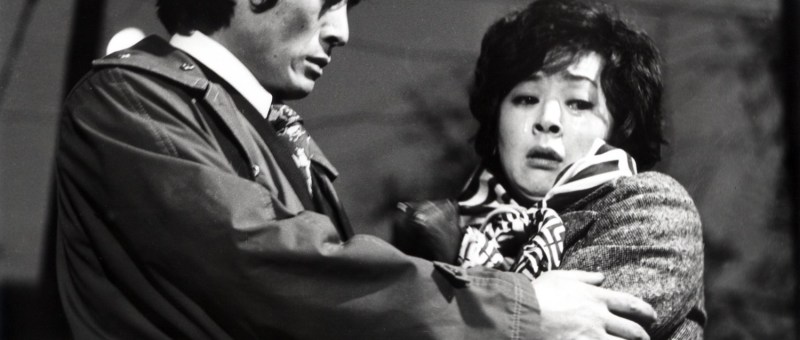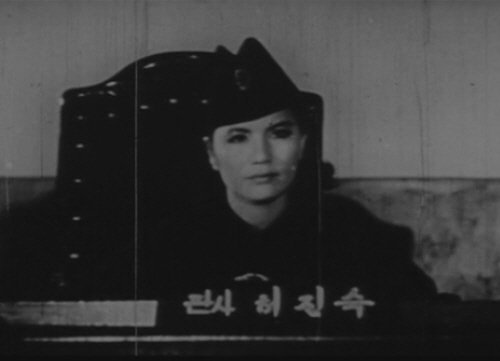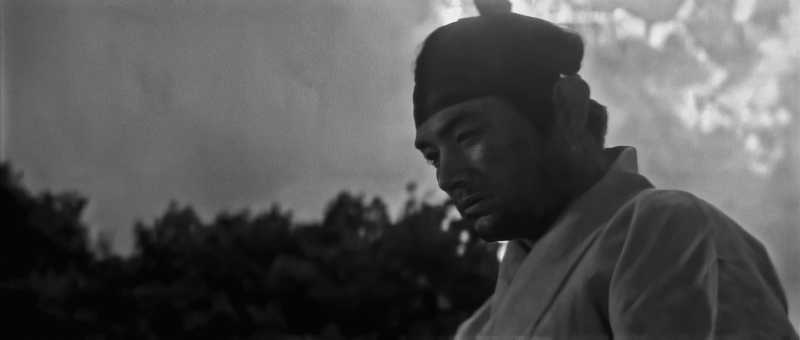
A Swordsman in the Twilight (황혼의 검객, Jeong Chang-hwa, 1967)

Jeong Chang-hwa is better known for the films he made with Shaw Brothers in Hong Kong, including the iconic King Boxer which helped to kick start the Kung Fu craze of the 1970s, than for earlier films he made in his native Korea. Nevertheless, while he was there he also instrumental in creating a new genre of Korean swordplay films with A Wandering Swordsman And 108 Bars of Gold and 1967’s A Swordsman In The Twilight (황혼의 검객, Hwanghonui Geomgaek).

Drawing inspiration from both Japanese samurai movies and King Hu’s wuxia dramas, the film is set in 1691 and like many Korean historical dramas revolves around intrigue in the court. Our hero is however not a high ranking courtier but as he describes himself a struggling vassal who was lucky to get his job as a lowly palace guard because he has no real connections nor does he come from a prominent family and his skills and long years of study mean almost nothing in this society ruled by status. The more things change, the more they stay the same. In any case, he was not unhappy with his life, got on well with his father-in-law, a poor scholar, and had a loving wife and daughter, who like him, valued human decency over ambition. 

But it’s that gets them into trouble when the venomous Lady Jang stages a palace coup to usurp the position of rightful queen, Min. Queen Min is depicted as a shining example of traditional femininity and idealised womanhood. Though the situation she finds herself in is unfair, she bears it with good grace and refuses the small comforts others offer her saying only that she is a sinner and it’s only right she suffers this way for displeasing the king. Hyang-nyeo (Yoon Jeong-hee), wife of swordsman Tae-won (Namkoong Won), was once her servant and shares her birthday so feels an especial connection to her. Pitying Queen Min seeing her forced to walk barefoot through the mud she offers her shoes and for this crime is hounded by the Jang faction on account of her supposed treason.

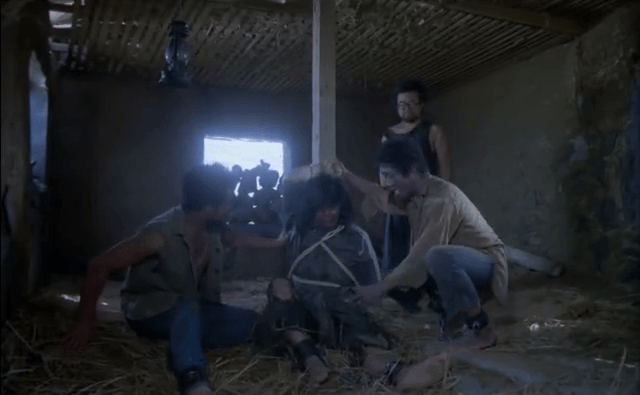
Having taken the local governor and his clerk, who are also against the Jang faction but don’t know how to oppose it, hostage, Tae-won narrates his long sad story and reasons for his desire for revenge against corrupt courtier Oh Gi-ryong (Heo Jang-kang) who, it seems, is also motivated by resentment and sexual jealousy after having once proposed to Hyang-nyeo but been instantly rejected by her father who did not wish to marry his daughter off to a thug. As such, he comes to embody the evils of the feudal order in his casual cruelty and pettiness. When we’re first introduced to Tae-won he saves a young woman who was about to be dragged off by Gi-ryong’s henchmen presumably as a consort for their immediate boss, Gi-ryong’s right-hand man, but is warned by the other villagers that he should leave town quickly else the Jang gang will be after him. That is however, exactly what Tae-won wants. He fights a series of duels with Gi-ryong, the first of which ends with Gi-ryong simply running away when Tae-won breaks his sword and in their final confrontation he resorts to the cowardly use of firearms not to mention an entire squad of minions pitched solely against a wounded Tae-won and the unarmed governor.

What it comes down to is a last stand by men who know the right path and are now willing to defend it rather than turn a blind eye to injustice. Tae-won’s own brother (Park Am) had thrown his lot in with Gi-ryong in the hope of personal advancement, willingly aligning himself with the winning side and complicit in its dubious morality. This of course puts him in a difficult position, though he implies he will be prepared to sacrifice Tae-won and his family if necessary even if he also tries to find a better solution such as suggesting Tae-won kill Queen Min to prove his loyalty to the Jang faction. In an odd way, it speaks to the contemporary era as a treatise on how to live under an authoritarian regime not to mention the creeping heartlessness of an increasingly capitalistic society. 

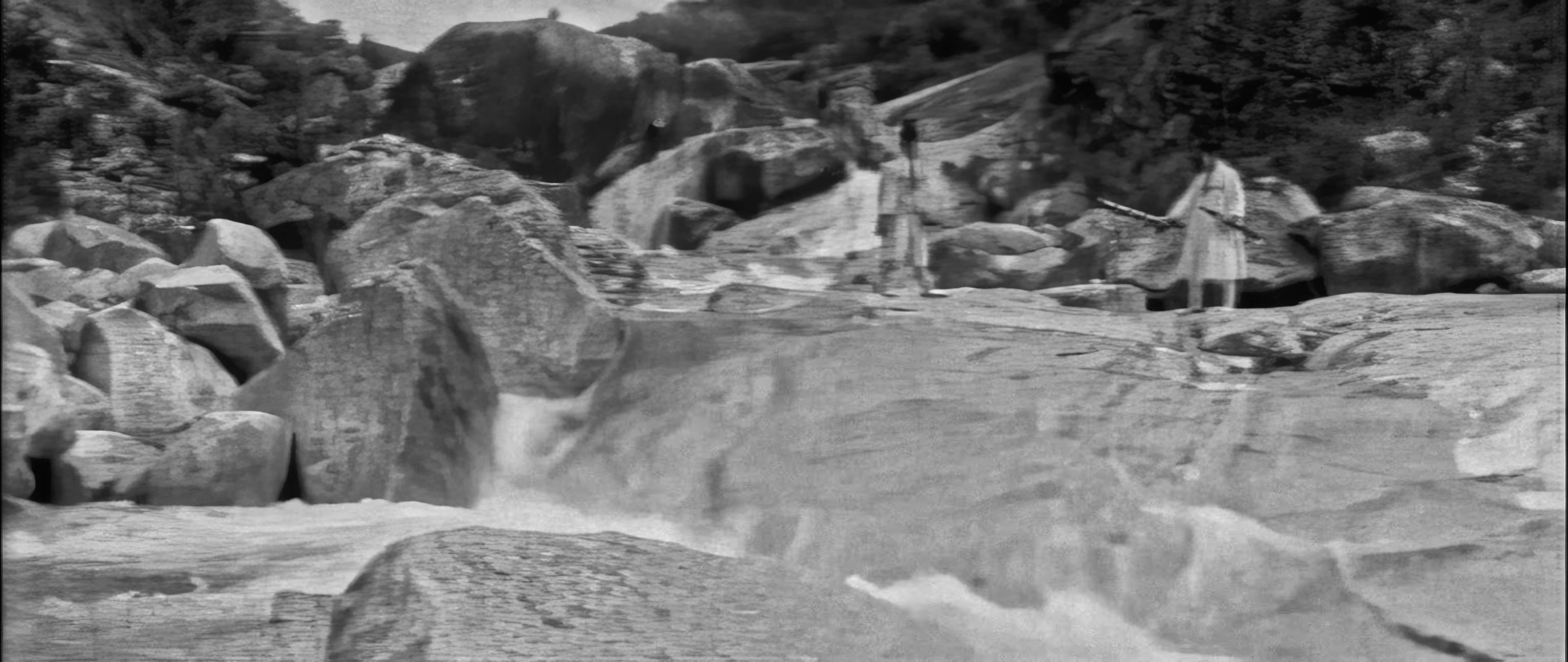
This sense personal rebellion may owe more to the jianghu sensibility found in the wuxia movies of King Hu than to the righteous nobility of the samurai film even if the ending strongly echoes chanbara epics in which the hero is displaced from his community and condemned to wander as a perpetual outlaw in a society which does not live up to his ideals. While staging beautifully framed action sequences such as fight at a rocky brook, Jeong undoubtedly draws inspiration from Hu in the use of trampolines and majestic jumps that have an almost supernatural quality. The sword fights are largely bloodless until the final confrontation but also violent and visceral. Gi-ryong’s henchman plays with a minion he feels has betrayed him by lightly scratching his throat before going in for the kill and such cruelty seems to be a hallmark of the Jang faction. But despite the seeming positivity of the ending in which a kind of solidarity has been discovered between Tae-won and the governor, the film ends on an ambivalent note with the fate of the nation still unknown as Lady Jang stoops to shamanic black magic to hold sway and darkness, the lingering shadows of authoritarianism, still hang over the swordsman even if he is in a way free as s rootless wanderer no longer quite bound by feudal constraint. 


A Swordsman in the Twilight screened as part of Echoes in Time: Korean Films of the Golden Age and New Cinema.
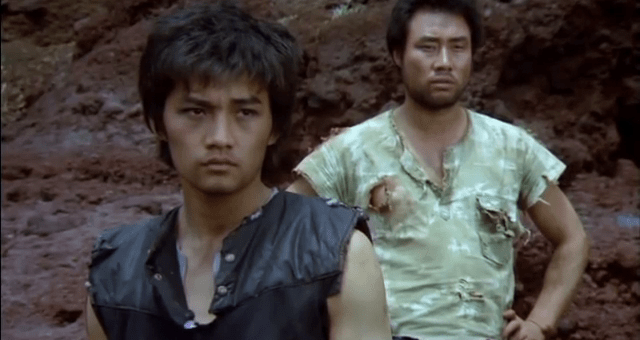
Lee Jang-ho’s Baseball Team (이장호의 외인구단, Lee Jang-ho, 1986)

After finding huge success with his debut film, Lee Jang-ho soon became disillusioned with the film industry and was in fact temporarily banned after being found in possession of marijuana. After the assassination of Park Chung-hee in 1979, Lee returned with a new focus on socially conscious filmmaking only to be blindsided by the advent of an entirely new age of oppression following the coup of general Chun Doo-hwan in 1980. In contrast to Park’s regime, Chun’s embarked on a deliberate bread and circuses policy pushing sports, sex, and screen in which social commentary was out and softcore very much in. 

Lee had opened his nonsense film Declaration of an Idiot with a scene of himself committing suicide because no one cares about movies anymore, they only like sports which lends a note of irony to his incredibly strange and very of its time baseball film, Lee Jang-ho’s Baseball Team (이장호의 외인구단, Lee Chang-houi wingudan). Adapted from a popular sports manhwa, the film is ostensibly a much more commercial affair yet in its way is attempting to subtly attack the growing inequalities of the Chun era as its poor mountain boy hero, Hye-seong (Choi Jae-sung), squares off against posh boy rival Dong-tak (Maeng Sang-hoon) not only for sporting glory but the hand of his innocent first love Um-ji (Lee Bo-hee). 

As Dong-tak joins a top-rated team and is interviewed on television, Hye-seong returns to the mountains to train and is trying to dodge the train fare while travelling with his father to discuss joining a team. He eventually strikes a blow against Dong-tak by striking him out during a perfect game, but ruins his shoulder in the process with his baseball dreams then behind him, which is a problem because he’s devoted his entire life to fulfilling the promise he made to Um-ji when they were children to become a great baseball player. Hye-song repeatedly promises to do anything he can to make Um-ji happy even if it means accepting her relationship with Dong-tak, but Dong-tak openly laughs at him for being a nobody though there is something worryingly intense in his suddenly throwing all his letters from Um-ji, which he had in his bag, on the table describing them as written by a “goddess” and his “sacred place.”

As for Um-ji herself, she seemingly has little control over her life as the daughter of an upperclass family. She began dating Dong-tak before reconnecting with Hye-seong in Seoul and originally sticks to her class-appropriate match before being tempted by her innocent childhood connection and realising Dong-tak is an arrogant arsehole who didn’t show up to her birthday dinner because he forgot and went on a date with another girl. Even so, her family continue to pressure her into marrying Dong-tak despite his manly decision to ignore her until he’s accomplished his mission of achieving 100 consecutive hits at which point he’ll propose. Hye-song ironically makes a similar decision, taking off for a training session on a remote island which ends up lasting a whole year during which his completely insane mentor Coach Byeon-ho (Ahn Sung-ki) denies him permission to write to her. When he returns, Um-ji has ended up married to Dong-tak and is in a depressive state wandering through life in a daze of guilt and disappointment that she betrayed both herself and Hye-seong because of social pressure to conform and is now stuck in this emotionally unsatisfying relationship. Hye-seong rejects her on the grounds that the spark has gone from her eyes and she’s no longer the Um-ji of his youth though also accepting some responsibility for that. At the end of the film, Hye-song loses his sight which allows him to reunite with a changed Um-ji who has separated from the now loser Dong-tak, no longer able to see the change in her remembering only the Um-ji he fell in love with. 

The men who were with him on the island where they underwent bizarre martial-arts style training regimes, were whipped and shackled, and almost killed their one-armed teammate have similar problems returning to situations that are less satisfying than they hoped. A wimpy pitcher despised by his son returns to find him unimpressed, while another discovers his wife had temporarily left him, and an incredibly short man, Kyeong-do, who’d been bothering a bank employee so much she switched branches to avoid him discovers she’s engaged to another man. Kyeong-do refuses to give up, arrogantly telling her that he’ll be replacing her groom on the big day while continuing to behave like a massive creep but actually successful in the end because of his sporting and financial success though it looks more like a case of her giving in than actually falling for him and sends some very mixed messages about a woman’s agency in this still conservative age. 

The players brand themselves losers and outsiders, each of them in some way compromised and locked out of pro-baseball from Kyeong-do’s short stature to Hye-seong’s poverty though the decision to include a mixed race man which may have been intended as a progressive gesture seriously backfires by having a Korean actor perform in blackface while insensitively mimicking racial stereotypes. The coach, Byeong-ho is also an outsider by virtue of walking with a cane and purposefully creates a team of others like himself he can train with his cruel and bizarre methods to take on the Dong-taks of the world. Even so, others brand them “inhuman”, “beasts trained with whips”, and continue to resent their attempt to subvert the contemporary class order. 

On the surface, however, Lee has simply made a baseball film about a group of outsiders who triumph over adversity. He fills it with the spirit of the times, throwing in several sequences accompanied by contemporary pop songs along with an atmosphere of ridiculous excess not to mention inconsequentiality as if he were actively mocking the current direction of Korean cinema despite the occasional moment of artistry such as the gothic scene in which Um-ji realises Hye-seong has returned but the pair are separated by a billowing white curtain. An oddity, but perhaps one that speaks of the oddity of its times. 


Sa Bangji (사방지, Song Kyung-shik, 1988)

The presence of an intersex person presents an existential threat to a fiercely patriarchal social order in Song Kyung-shik’s intense feudal-era drama, Sa Bangji (사방지). Inspired by the life of a historical figure who was exiled from mainstream society because of their gender identity, the film finds its protagonist continually exploited as a fetishised object of desire challenging the sexual repression of a society in which women were required to display no sexuality. 

The monks at the temple where Sa Bangji (Lee Hye-young) was raised advise them that they cannot live in the secular world and with good reason, as the hostility with which they are later greeted makes clear. On looking at them, a shamaness immediately has a vision of a snail, which is as she later explains a “hermaphrodite” creature, and immediately seems to have grasped their secret. The shamaness explodes with rage and insists the noble house by whom Sa Bangji has reluctantly been taken in as a maid should expel them at once for they will only bring misfortune and potentially death. They are later told that they are abomination born from their parents’ bad karma and made to pay the price for it with only the kind Buddhist monk reminding Sa Bangji that there will always be a place at the temple for them and that bad karma can always be overcome with goodness and light. 

Sa Bangji hadn’t wanted to leave the temple because they longed to see the world beyond it, only that even in this comparatively safe space they felt a burden while again ironically caught between two worlds neither nun nor layman. Though they present as a woman, Sa Bangji has male genitalia and is at pains to keep their true nature hidden. When the widow Lee So-sa (Bang Hee) encounters Sa Bangji at the temple, she too is drawn to their uncanniness and determines to “rescue” them from a monastic existence by taking them back to her home as a maid. Once there, she begins on what can only be described as a campaign of sexual harassment in which she continually makes advances to Sa Bangji who repeatedly turns them down because they are afraid of what will happen once their gender atypicality is exposed. So-sa in fact forces it out of them by accusing Sa Bangji of stealing a precious ring as a pretext for strip searching them. 

This ring is later exchanged as a token of their love once they have indeed become intimate and discovered in each other romantic fulfilment. Yet the ring also echoes the constraint which surrounds each of them by virtue of not being male in feudal society. “How dare you make decisions all by yourself” So-sa is told when she arrives home to the estate of her husband’s family with Sa Bangji in tow, even as a noblewoman unable to exercise much agency and dependent on relatives who blame her for her late husband’s death. Her chief oppressor is of course her mother-in-law who, as an older woman, has more power, though no more freedom, and uses it to control other women. So-sa keeps Sa Bangji captive as a kind of plaything and accidental sex slave, in part to ensure their identity is not revealed, but they do seem to have found a transgressive freedom in the genuine connection between them which is brokered by Sa Bangji’s otherness.

It is Sa Bangji’s hidden “masculinity” that both gives them power and makes them vulnerable. So-sa eventually betrays them, unable to defy the feudal order to protect the person she loves, and Sa Bangji finds themselves once again imprisoned this time by the shamaness who pimps them out to other sexually frustrated women who are not permitted to express sexual desire such as widows and concubines as part of what she originally claims is a plot of revenge against oppressive nobility who forced her shaman husband to father a noble woman’s child and then killed him to keep the secret. 

Sa Bangji too wants revenge and eventually insists that they are going to show the word the beauty of their body, only for that body to be repeatedly commodified and seen as little more alive than the dildo So-sa shockingly removes from a locked chest in order to ease her frustrated desires as a youthful widow. They are called a “freak”, and eventually come to see themselves as a “monster”, “neither male nor female” and therefore existing outside of the tightly ordered patriarchal feudal society which is what makes them such a threat. In the end, not even the sacred land of the temple is safe from secular intrigue. Sa Bangji makes a drastic decision in an attempt to free themselves from gender-based oppression but it isn’t enough to overcome the world’s cruelty and leaves them once again caught between two worlds, unable to overcome the fragile masculinity of the patriarchal feudal order. 


Sa Bangji screens at Genesis 29th April as part of this year’s Queer East 

Space Monster Wangmagwi (우주괴인 왕마귀, Gwon Hyeok-jin, 1967) [Fantasia 2022]

In Japan’s classic kaiju movies, the fault usually lies not with the monster but with humanity. The kaiju itself is neither good nor bad but simply what it is and its rampage is often a response to humanity’s mistreatment of the natural world or irresponsible scientific endeavour. In Korean monster movie Space Monster Wangmagwi (우주괴인 왕마귀, Ujugoein Wangmagwi), however, the threat is more concretely extra-terrestrial though the monster may be equally blameless apparently tortured and manipulated by an evil imperialist power hellbent on the colonisation of the Earth.

Shiny-suited aliens in impractical helmets are already on their way where they plan to disguise their invasion with the help of a passing typhoon. Their grand plan is to drop their space monster, Wangmagwi, onto the planet’s surface and let him run rampage until humanity has been subdued and they can claim the Earth. What they didn’t count on, however, is humanity’s spirited resistance led by brave Korean armed forces members and for some reason a plucky little boy with a pocket knife who manages to climb inside Wangmagwi and weaken him by taking out his vital organs. 

Wangmagwi’s extraterrestrial origins may hint at a fear of invasion most obviously from the North along with Cold War paranoia rather than an attempt to reckon with past transgressions or fear of new technology. The alien invaders are eventually forced to abandon their mission and turn back having experienced unanticipated human resistance vindicating the nation’s ability to defend itself even as the armed forces consider quite radical action such as the possibility of using nuclear weapons which the aliens from the planet Gamma admit would be disadvantageous seeing as they then wouldn’t be able to live on the planet either. 

Even so, the tone of the film is at least close to parody with the local population flailing about in panic trying to figure out what the best course of action might be. There is a particular irony in the captain of the spaceship’s explanation that the invasion has been 10 years in the planning so they can’t let it go wrong, while bride-to-be Ahn Hee feels something similar because she’s been planning her wedding all her life so this whole alien invasion thing is very inconvenient for her. Despite the warnings, Hee and her mother head to the wedding hall anyway with her in her full wedding dress waiting for airman fiancée Oh (Namkoong Won) to arrive though all military personnel have already been ordered back to base. Obviously, having her wedding cancelled at such short notice is distressing, but given there’s a rampaging kaiju on the loose Hee’s hysterics seem both childish and irresponsible though she later pays for them in being kidnapped by Wangmagwi and carried around just like Fay Wray in King Kong.

Meanwhile, the film throws in a lengthy comic relief sequence revolving around two middle-aged men who set up a bet to see who is the most cowardly leveraging their life savings, homes, and even a wife who later throws herself on the other man’s mercy hoping he’ll help her escape the kaiju because her own husband is too useless to be relied upon. Conversely, the military aren’t finding this funny at all instantly springing into action risking their lives to stop Wagmagwi’s rampage through the capital city which after all has only recently been rebuilt. The little boy meanwhile, seemingly an orphaned street kid, complains that grownups are all cowards incapable of facing Wangmagwi and so he’ll have to do it himself. 

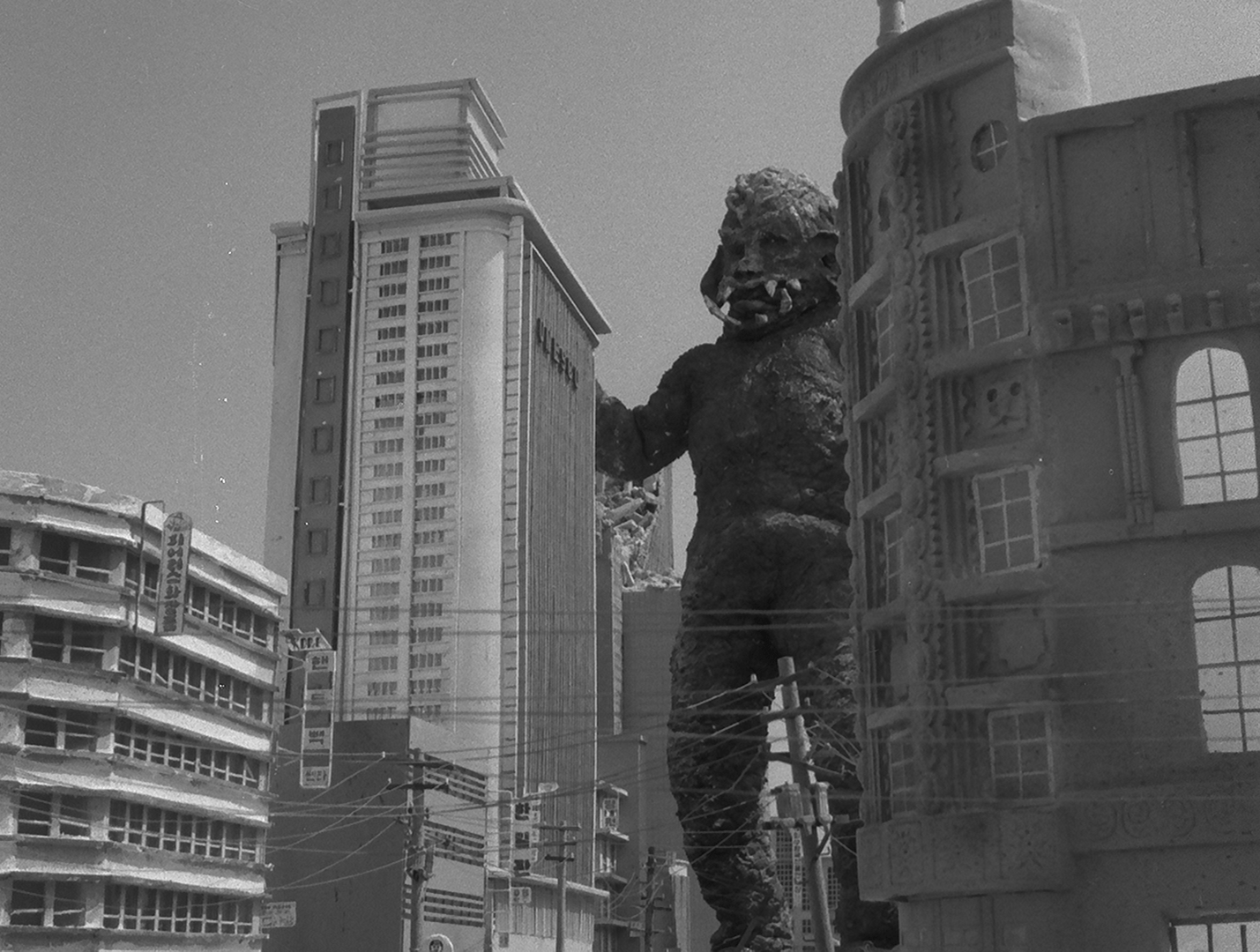
The film ends on a note of familial reconciliation in which Hee and Oh pledge to adopt the boy suggesting that the threat has been overcome and normality has now returned while the Gamma simply sacrifice Wangmagwi in deciding to cut their losses and return home. Despite the comic overtones, the praise of the armed forces is sincere leaning into an authoritarian message that the military is necessary for protection of the nation while subtly undercutting it by suggesting that it’s a fearless boy who is responsible for Wangmagwi’s downfall though in reality it’s the Gamma who eventually turn on him, ordering his “termination” through a “self-destruct” mechanism. Featuring some impressive model work, Space Monster Wangmagwi never takes itself too seriously, packing in portentous storm noises alongside its tokusatsu-inspired effects, but does perhaps have something to say about the anxieties of the Korean society in the late 1960s. 


Space Monster Wangmagwi screened as part of this year’s Fantasia International Film Festival.

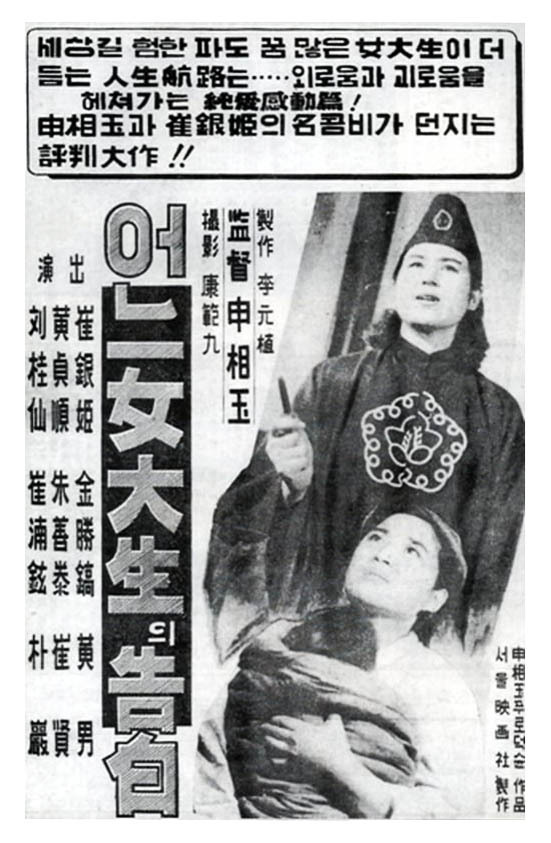
A College Woman’s Confession (어느 女大生의 告白 / 어느 여대생의 고백, Shin Sang-ok, 1958)

Five years after the end of the Korean War, South Korean society was both economically unstable and battling the increasingly authoritarian government of Rhee Syngman. Nevertheless, there was perhaps an aspiration for a brighter democratic future which many hoped would materialise after the protests which eventually brought down Rhee’s regime in 1960 but unfortunately led only to the even more repressive Park Chung-hee era. Released in the same year as Flower in Hell, Shin Sang-ok’s A College Woman’s Confession (어느 女大生의 告白 / 어느 여대생의 고백, Eoneu Yeodaesaengui Gobaek) is perhaps a reflection of that aspiration in its broadly humanist condemnation of an inherently unfair, rigidly patriarchal society which forces good people to act in ways which offend their sense of justice solely in order to survive. 

From a poor family, law student So-young (Choi Eun-hee) finds herself in dire straits after her grandmother who’d been supporting her and paying her tuition fees suddenly dies. She tries to find a part-time job that will let her carry on with her studies, but is either turned away or placed in difficult situations with men who abuse her trust. A sleazy boss interviewing her for a secretarial position pauses after hearing she’s a student after part-time work to suggest a “night job”, crudely leaning over as he offers her money to become his mistress. So-young slaps him across the face and leaves, but faces something much the same from the husband of her landlady who promises to stop pressuring her for the back rent in return for sexual favours. She turns him down too, but even though he backs off in fear she’ll tell his wife that he tried it on, his suddenly relaxed attitude only makes her landlady suspicious. 

At her wits end and about to quit school, So-young turns to her comparatively better off friend Hee-sook (Kim Sook-il) who dreams of becoming a novelist. Hee-sook brings up a diary she’s been reading that was found in some old furniture sold to her family’s store which recounts the sad life story of a girl who was seduced and betrayed by a man who left her to marry a wealthy woman. With too much time on her hands, Hee-sook has identified the man in the diary as prominent politician Choi Rim (Kim Seung-ho) and taken it upon herself to send him a letter telling him that he has a daughter named So-young from the love of his youth. Despite the fact that the diary says the woman’s baby died, Hee-sook suggests So-young pose as Choi’s long lost daughter so he’ll support her through the rest of uni. So-young is not convinced, but finds herself heading over to visit Choi after exhausting all her other options and being reluctant to go back to the boarding house without money. Choi absentmindedly turns her away, only to think better of it and send his secretary after her, but she ends up getting hit by a car trying to avoid yet another creepy old man who sees her in distress in the street and offers her money for sex. 

Creepy men are indeed everywhere. Even the wily Hee-sook finds herself bothered by an unpleasant man in a cafe who repeatedly pesters her even after she makes a point of ignoring him and pointedly switches seats. He doesn’t give up even after So-young arrives, abruptly offering to buy both women dinner, after which Hee-sook ushers So-young out declaring that this cafe is too “weird” to stay in any longer. Men are, it seems, content to exploit the desperation of vulnerable women for their own satisfaction. As So-young puts it in trying to defend another woman after she’s successfully become a lawyer, “vulgar men see women only as objects to satisfy their sexual desires”. 

This feeds back in to the sin the otherwise kindhearted Choi is trying to expiate. He made a choice in his youth, sometime in the colonial era, to abandon a woman he claimed to love to make a dynastic match. Though it’s not clear whether or not he knew there was a child, he seems to harbour a deep sense of guilt over his decision to essentially use two women in different ways. Faced with the “resurfacing” of So-young, he immediately explains everything to his wife (Yoo Gye-seon) but tries to pass it off as “all in the past” while earnestly asking her to help him make amends by accepting So-young into their home in place of the daughter they apparently lost. She fires back at him that it must be very convenient for men who can forget about things that are “all in the past” while women have to live the rest of their lives with the harm that they cause. Choi doesn’t argue with her, but nor does he ask for forgiveness, only understanding. Mrs. Choi answers that she ought to tell him no in revenge for the all the wrongs he’s done her (this appears not to be a terribly happy marriage), but agrees that it’s not So-young’s fault and so of course she can come because “it’s the right thing to do as a human being”. 

Mrs. Choi, however, remains suspicious, unconvinced by So-young’s story but also by her distance from her. That could of course be explained by embarrassment in being the child of the “other woman”, but Mrs. Choi is right to sense guilt in her reserve as she becomes ever more conflicted about the necessity of deceiving people who have been nothing but kind to her. It’s this sense of guilt which is intensified after she becomes a lawyer and achieves her dream of helping other disadvantaged women by defending a single-mother, much like the woman from the diary, who was seduced and betrayed by a man whom she later killed in a crime of passion. In her passionate defence of the extremely repentant Soon-hee (Hwang Jung-seun) is who is around the same age as she is, So-young reflects on the relative similarities between them and that the only reason they are standing in their respective positions is circumstance. 

“The purpose of the law is not only punishment but to awaken goodness in all our hearts” So-young reminds the judges, determined to offer “an earnest plea on behalf of desperate women”. Soon-hee admits her guilt and asks for no leniency, but is brought to tears as So-young outlines the social factors which explain why she found herself stabbing the man who had caused her so much suffering and then got on with his life without giving her a second thought. Her only transgression being sex before marriage, Soon-hee did everything else right but was condemned to a life of poverty and forced to consider sex work in order to buy medicine for her sickly baby. As a pure hearted woman, she can’t go through with it and considers robbery instead (apparently a “lesser” crime) only to bump into an old friend but be too ashamed to ask her for help. 

Earlier on, after her graduation ceremony, So-young had explained her ambitions to help women and children in poverty to Choi’s kindly secretary Sang-ho (Choi Hyeon) who has obviously taken a liking to her. He’s broadly supportive, but reminds her that if she wants to improve society perhaps she should think about fostering greater social change through political action (as he is perhaps doing), but she shakes her head and points out that he’s never known what it is to be hungry or desperate and that there are people who need the kind of help that only she can give them, such as women like Soon-hee. Yet in defending another woman she’s reminded only of her own “sin” in having wilfully deceived Choi and his wife, burdened by the need to keep her secret and convinced the only thing she can do is to confess all. 

Yet Mrs. Choi proves unexpectedly supportive, explaining that she’s known all along that So-young lied and has come to love her as a daughter anyway. She can see how happy she makes Choi who is proud and excited to have such an amazing young woman in his life, and finding out the truth would only break his heart. So-young’s confession would be for herself alone, to ease her own conscience, while the burden of carrying this secret is perhaps the price of her happiness. In an odd way, So-young has repaired their marriage, and with her success in the courts has perhaps completed the integration of their family with the implication that Sang-ho may later join it too. Fiercely condemning the evils of a patriarchal society, A College Woman’s Confession suggests that the literal truth might not be as important as the emotional, and that a rigid morality serves no one, while offering the vision of a brighter, more equal society founded on compassion and understanding rather than cold authoritarian paternalism. 


A College Woman’s Confession is the first of three films included in the Korean Film Archive’s Shin Sang-ok’s Melodramas from the 1950s box set. It is also available to stream via the Korean Film Archive’s YouTube Channel.

Ieodo (異魚島 / 이어도, Kim Ki-young, 1977)

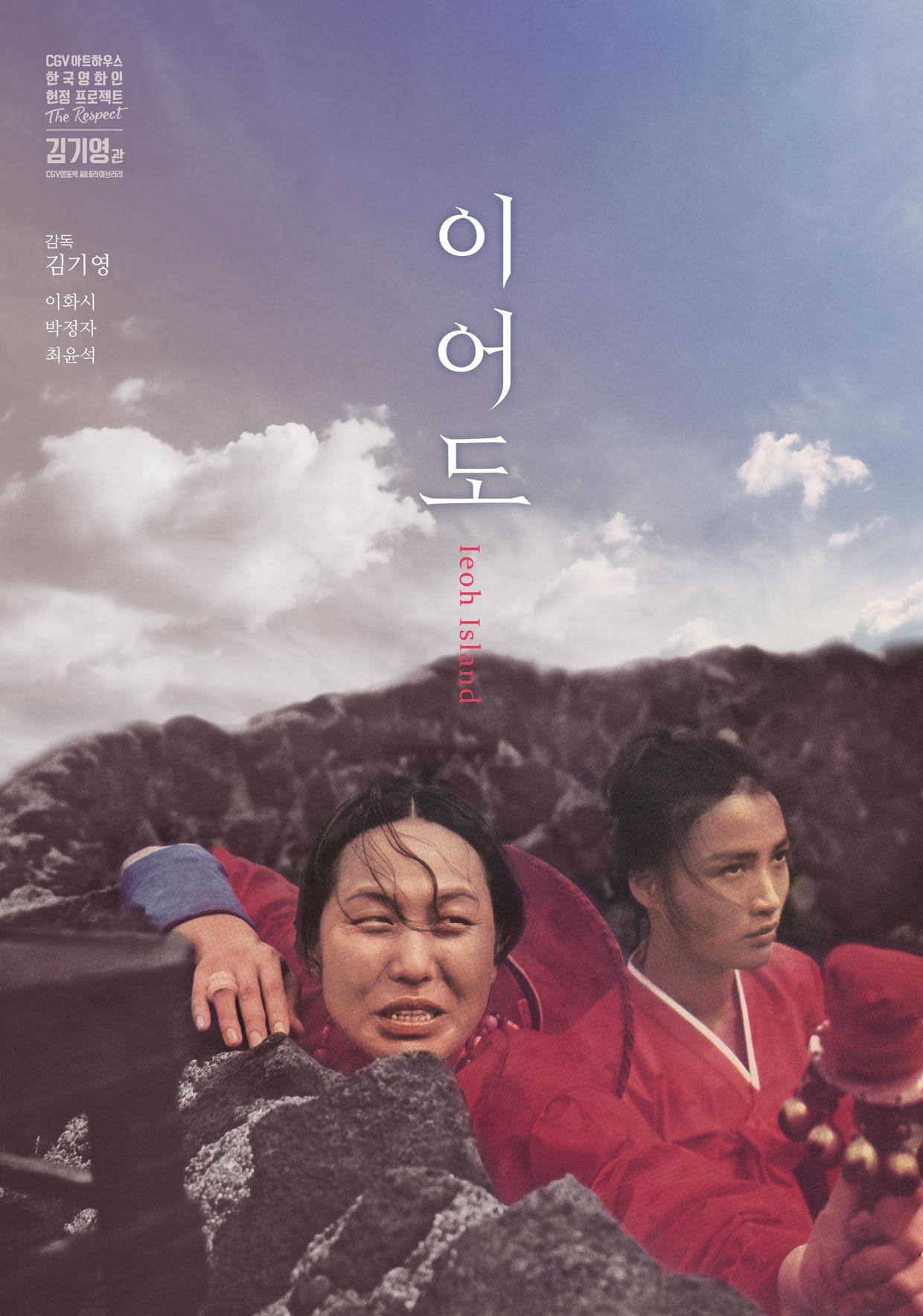
Ieoh Island restoration posterIn the hyper-masculine and intensely patriarchal atmosphere of Korea under Park Chung-hee, Kim Ki-young spins a tale of male obsolescence in the mysterious Ieodo (異魚島 / 이어도, AKA Ieoh Island). The eponymous island, apparently a kind of paradise home to the lonely ghosts of fishermen lost at sea, becomes a symbol of the impossible life drive of its impotent protagonists who find themselves taken by the island before their time while the community of women asserts its primacy in rendering men “redundant” through finding new ways to procreate.

The hero, Hyun Seon-woo (Kim Jeong-cheol), is an executive at a tourism company who is struggling to conceive a child with his wife and undergoing the early stages of IVF treatment. Alarmed to realise that his wife could have a child without him thanks to his frozen sperm, he throws himself into his work, planning for a new hotel development to be called “Ieodo” after the mythical fisherman’s paradise. Organising a publicity stunt in which journalists and industry guests are asked to board a boat to an unknown destination backfires spectacularly when a reporter, Chun Nam-seok (Choi Yoon-seok), becomes extremely upset and insists on turning the boat around on learning they will be heading towards the mythical island. Nam-seok accuses of the hoteliers of appropriating local culture, while even the boat’s captain expresses dismay at the thought of breaking such a strong taboo. Seon-woo offers to settle the matter with a drinking contest, eventually passing out during which time Nam-seok “falls” off the boat, leaving him the prime suspect in the man’s death. Convinced that Nam-seok must have taken his own life, he determines to investigate the case himself with the help of Nam-seok’s editor (Park Am).

Seon-woo’s quest takes him to the nearby island where Nam-seok was born, Parang – a place inhabited solely by women which all men must leave on having a child. Parang is a place where tradition reigns and superstition is prevalent. Guided to the local shamaness (Park Jeong-ja) by a timid widow, Seon-woo and the editor are told that Nam-seok’s family were under an ancestral curse in which all the men of previous generations were eventually taken by the “Water Ghost” of Ieodo, including Nam-seok’s own father. After his mother died of grief, Nam-seok tried to escape, but now, the villagers seem to believe, he too has returned to embrace his fate proving that the Water Ghost will always take what is hers by right.

In order to get around the lack of menfolk, the women practice what a friend of Nam-seok’s calls “both the most primitive and the most modern” form of marriage in which they copulate with men of their choosing during a candlelight ritual. Having sworn off having children himself, at least on the island owing to the curse, Nam-seok takes up with the wealthy widow Mrs. Park (Kwon Mi-hye) who finances his unusual business venture – an abalone farm designed to bring prosperity back to the island where the traditional diving business has begun to flounder thanks to the corruption of the modern world.

The fish in the ocean are dying because of industrial pollution – itself a problem produced by the thoughtless capitalism of the Park Chung-hee’s authoritarian regime and its relentless drive forward into economic dynamism at all costs. Watching his seed fall on stony ground (literally and figuratively), Nam-seok becomes enlightened to environmentalism, bemoaning that the ancestors of humanity cared for the planet for thousands of years only for recent generations to destroy it. It’s the end of the world, he says, everything is rotting. Which might, after a fashion, explain why everyone seems to be finding it so difficult so have children.

Nam-seok’s attempts to artificially breed abalone link straight back to Seon-woo’s inability to father a child with his wife whom, we are told in the very beginning, eventually died without ever giving birth. We’re told that sperm survives its host, that the sperm of a man who froze to death on the mountains was found to be perfectly viable once defrosted and that, therefore, Seon-woo himself is a largely irrelevant presence in his his wife’s ongoing quest to have a child. The island women too who do things the “traditional” way, had also stumbled on a way to conceive children in the absence of men, or at least in the absence of “living” men in realising that sperm could often be harvested from the dead and applied by means of ritual.

Kim returns to his favourite themes of sex and death as two literally become one. “All fears disappear when men and women unite”, the mysterious barmaid (Lee Hwa-si) tells an increasingly confused Seon-woo who has come to embody for her the soul of the lost Nam-seok whom she believes to be her spiritual husband. “Everything is only momentary”, he answers her, “eternity is a word which deceives us”. Seon-woo admires “the incredible energy of women who risk their lives to have children”, but if the island is to survive it can only be in the absence of his destructive male energy. Like countless men before him, he must leave, not for the paradise of Ieodo, but for the rapidly declining modern society, while a woman remains behind alone – the sole guardian of a child who is also, of course, the future.


Ieodo was screened as part of the 2019 London Korean Film Festival. It is also available on English subtitled blu-ray courtesy of the Korean Film Archive in a set which also includes a complete script (Korean only) bilingual booklet, commentary by critic & director Chung Sung-ill, commentary featuring critic Kim Young-jin and director Oh Seung-uk (not subtitled), an interview with actress Lee Hwa-si, and clips of Lee Hwa-si with Jeong Beom-sik, and Park Jeong-ja with Lee Yoon-ho (no subtitles).

Goryeojang (고려장, Kim Ki-young, 1963)

Goryeojang hanging bannerWhat happens to the marginalised in times of trouble? Nothing good, might be the answer. To exist outside of the group, to be in some way other, is to be rendered vulnerable but there can also be a kind of strength in involuntary independence. Like the Japanese Ballad of Narayama, Kim Ki-young’s Goryeojang (고려장) envisages a world in which the old are expected to sacrifice themselves for the young, but unlike either Keisuke Kinoshita or the later Shohei Imamura, Kim struggles to find nobility in adherence to such a cruel and inhuman tradition.

Kim opens with a contemporary TV panel discussion on overpopulation (a key concern of the day) which strays uncomfortably into comparison with vermin, leading one expert to contribute that when short of food rats eat each other in order to survive so perhaps people should too. Moving swiftly on, the host turns to a historian who explains that in the distant past during times of war or famine, there was a tradition of abandoning the over-70s on mountains to reduce the burden on the rest of society.

Kim then shifts to the main narrative which takes place in the feudal “Goryeo” era. During a time of scarcity, a lord married four times already scorns the local shamaness to marry a young and beautiful widow with a young son. The shamaness claims that the lord’s 10 sons from his previous marriages are to blame for the failure of the relationship and vows revenge on the entire family. Meanwhile, new wife Keum (Ju Jeung-ryu) struggles to adjust herself to the household and is warned that none of the previous wives managed to endure it very long. Though the lord accepts her son Guryong as his own and tries to integrate him with his 10 new brothers, the boys fiercely reject him, especially when they hear about the shamaness’ curse which states that he is destined to kill them at some unspecified point in the future. The abuse culminates in an attempt to assassinate Guryong with a snake bite. He survives but is left with a lame leg. Keum realises she cannot stay in the lord’s house, and so he gives her a small plot of land and some money to support herself and her son.

20 years pass, during which time Guryong (Kim Jin-kyu) has managed to make a life for himself but the brothers are still obsessed with getting back the land that was given to him. When they find out that Guryong has amassed enough resources to consider marrying despite the fact that he is disabled and therefore considered undesirable, their rage intensifies. Guryong meanwhile has been trying to keep to himself, but is brokenhearted in unrequited love for a woman, Gannan (Kim Bo-ae), who rejects him because of his disability. He is eventually married off to a woman who is mute, considered a socially acceptable match for both, but the brothers kidnap and rape her in an attempt to extort Guryong for the deeds to the land. Unable to tell anyone what’s happened, she murders her attacker. Faced again with cruel tradition, Guryong does not resist. 

After that, he goes back to minding his own business, but there are customs he will not follow including that of abandoning his mother on the mountain. 15 years later, drought and famine strike again. Keum worries that she is the cause and Guryong’s refusal to take her to the mountain has angered the gods. As supplies dwindle, the brothers make the most of their feudal powers, restricting access to the local well which is technically on their land, exchanging water for potatoes which are the only available source of food. Guryong, meanwhile, has spent the last few years quietly working away and has quite a sizeable crop of his own which makes him a rather wealthy and powerful figure, once again irritating the brothers. It’s at this point that a starving Gannan, now the mother of nine children, reappears and is forced to throw herself on Guryong’s mercy.

Marginalised because of his disability and fatherless status, Guryong has had to learn to survive alone and has prospered because of it, yet others regard him as a potential drain on their resources, an ill omen or harbinger of doom forever associated with the shamaness’ curse. With little to eat, people are forced to put their prejudices to one side but do so superficially. Gannan’s husband, dying of hunger, urges her to seduce Guryong and if possible marry him before he dies so that she won’t have to obey the custom of waiting three years in mourning before marrying again. Gannan is minded to sell her body, if that’s what it takes, but still reluctant to sell it to Guryong. In another case of socially acceptable partnering, she eventually sells one of her children to Keum to raise as a ward – Yeon, who is “imperfect” because of her pockmarked face.

Like Guryong, Yeon is brave and defiant, in some senses emboldened by her difference. She volunteers to go to Guryong because her siblings bully her over her face, but thinks nothing of cheerfully mocking Guryong’s limp or of talking back while playing the part of a servile daughter-in-law. She does, however, remain loyal to Gannan, stealing potatoes to sneak back to her family. The arrangement fails only when Keum decides it’s time to absent herself, that her presence is preventing Guryong uniting with Gannan and her children, but Guryong refuses to swap a mother for a wife and angrily rejects Gannan, beating her and the child believing them to have orchestrated a plot to get rid of Keum.

With the brothers hoarding food and Guryong keeping well out of it, the only solution proposed by the villagers involves the human sacrifice of a child. Guryong struggles to believe that they would really go that far, but finds himself again in the firing line when the brothers frame him for a murder and leave him at the mercy of the shamaness and her sacred tree. Spared only on the condition that he give in and take Keum to the mountain where she will pray for rain, he is forced into complicity with the cruelty of his times but his rage on his return knows no bounds. Realising he has been betrayed once again, he fulfils the shamaness’ prophecy, but is shaken by the words of one of the 10 as he attempts to stay his violence, insisting that they are not bad people and must embrace each other as brothers. He blames everything on the shamaness and her curse, which is of course a matter of a woman scorned. Guryong doesn’t quite buy that, the brothers were cruel to him because they could be even if the root cause was their father’s moral transgressions in his many marriages. He does, however, awaken to the inherent corruption of the world in which he lives embodied by the tyrannical authority of the shamaness and “Divine Spirit” manifested as the tree from which transgressors are hanged.

Kim never closes his framing sequence, the dark humour of the contemporary opening merely an introduction, but obliquely references the April Revolution of 1960 as Guryong takes an axe to the tree and frees himself from the shamaness’ control. According to Guryong, the tree kept the small evil out, but let the big one in. Taking the children by the hand, he leaves. “If there is someone to teach us, we can grow anything”, he tells them, it’s time to plant some seeds. Claiming his own freedom and rejecting his marginalisation, he steps forward into a better world out of the mountain’s shadow and free from the terrible tyranny of “tradition”. 


Goryeojang was screened as part of the 2019 London Korean Film Festival. The new 4K restoration will also be released on blu-ray by the Korean Film Archive on 14th November.

Promise of the Flesh (肉体의 約束 / 육체의 약속, Kim Ki-young, 1975)

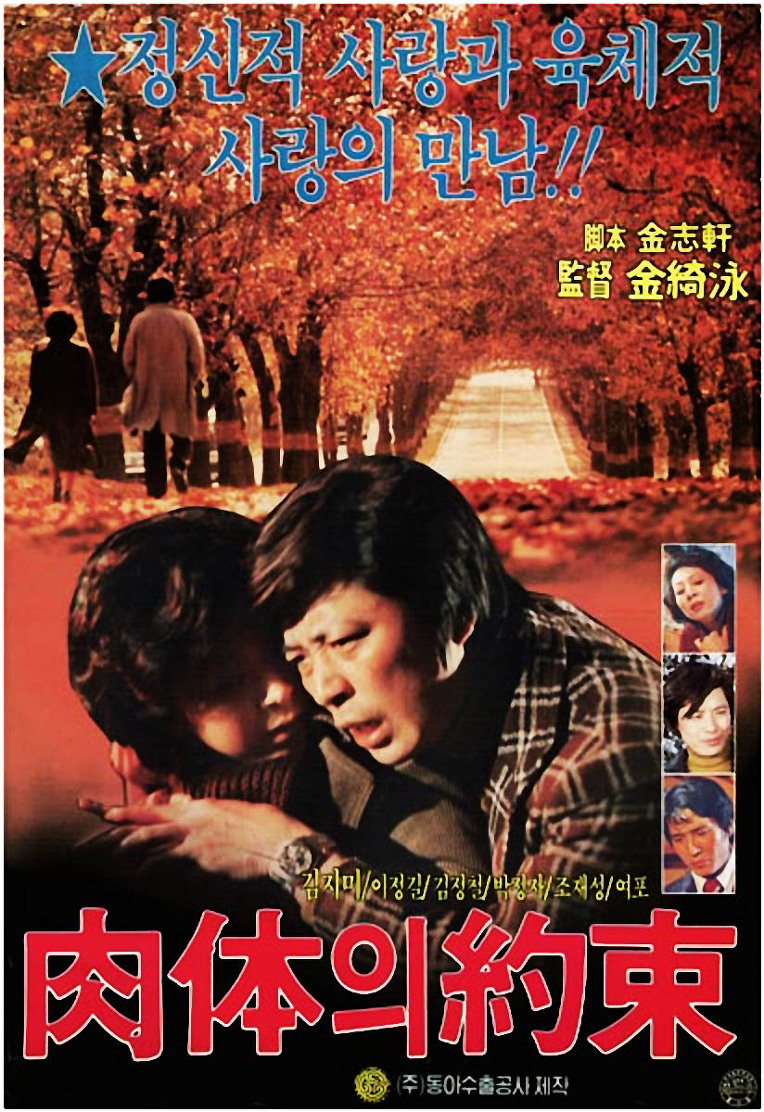
Promise of the flesh poster 1Lee Man-hee’s Late Autumn is one of the great lost gems of ‘60s Korean cinema and despite its unavailability has been remade three times in Korea and once in Japan. Kim Ki-young’s version, Promise of the Flesh (肉体의 約束 / 육체의 약속, Yukche-ui Yaksok), arrives two years after the acclaimed Japanese remake directed by Koichi Saito and takes a decidedly different, frustratingly ambivalent approach in which its heroine’s imprisonment is directly linked to emotional frigidity and a refusal to submit herself to the social conventions of womanhood which include home, family, and being sexually available to men.

We first meet Sook-young (Kim Ji-mee) taking a train to meet someone she is fairly certain will not be coming. While travelling she recalls a previous journey during which she met a man who changed her life – the very man she is now travelling to (not) see. Before that fateful day, however, Sook-young had endured an extremely troubling history of long term sexual abuse at the hands of various men all of whom expected her to surrender her body to them to do with it what they wanted. Eventually Sook-young snapped and killed a man who was trying to make love to her, getting herself sent to prison where she gradually fell into suicidal despair. In an effort to reawaken her sense of being alive, a kindly prison guard (Park Jung-ja) agreed to escort her to visit her mother’s grave which is how she met Hoon (Lee Jung-gil) – the first man we see being “nice” to her, which in this case extends to buying her a box lunch on the train.

Kim has a noticeably ambivalent attitude to female sexuality which eventually embraces the socially conservative, casting Sook-young’s plight as a great moral wrong but also insisting that her salvation lies in unwanted sex with a “nice” man as if that would somehow show her that “not all men” are violent sex pests and thereby make it possible for her to fulfil her “natural duties” as a woman by marrying and raising children. “A woman’s role is raising a child – everything else is pointless” Sook-young is instructed by a man who turns out to be, once again, deceiving her. Gradually we get the feeling that Sook-young has wound up in prison not because, as she later claims, the weight of all her degradations suddenly crushed her but because she attempted to live a life without men and is being punished for it.

At her first job interview, undertaken because her parents passed away and she had to leave university, Sook-young is advised to guard her body until she can “cope with men” otherwise she’ll “become a whore like all the others”. Shy and nervous, she is bullied into sex by a belligerent customer who turns out to have done it as some kind of rape revenge on behalf of a slighted friend to whom he later passes her on. Just about every man she meets, until Hoon, is after her body and nobody seems to think Sook-young has any right to refuse them access to it. Kim may lament the subjugated position of women in Korean society in condemning the actions of these “bad men”, but still insists that Sook-young needs “fixing” through finding a good man as a means to curing her despair.

This is why the prison guard enlists Hoon to teach Sook-young that “a woman needs a man” and that there is joy still in the world. Originally reluctant, Hoon decides to do just that by convincing her that she is wrong to be so mistrustful because human beings are basically good. Unfortunately he chooses to this in exactly the same way as all the other men she’s ever known – by pushing her into a dark corner and attempting to seduce her. In this case however it seems to work. Claiming she is too lonesome to ignore him, Sook-young is swept into Hoon’s rather romantic view of the world, little realising that he too is a fugitive from justice and will also have to pay for having become involved with the wrong people. Nevertheless, through meeting him, Sook-young affirms that she has been able to find a new capacity for living and convinced herself that “the meaning of life is to marry a good guy and live well”.

Socially conservative as it is, the message is undercut by the persistent melancholy that defines Sook-young’s existence even as she declares herself cured of her past traumas and vows to live on free of her “delusion of persecution”. Nevertheless, the picture Kim paints of Korean society is one of socially acceptable misogyny in which even women insist that women are nothing without men and the primacy of the male sex must be respected. At once resigned and angry, Kim paints Sook-young’s capitulation as a positive motion towards conformity but refuses to fully condemn the conservative society which has caused her so much misery.


Promise of the Flesh was screened as part of the 2019 Udine Far East Film Festival. It is also available to stream online via the Korean Film Archive’s YouTube Channel.

The Love Marriage (自由結婚 / 자유결혼, Lee Byung-il, 1958)

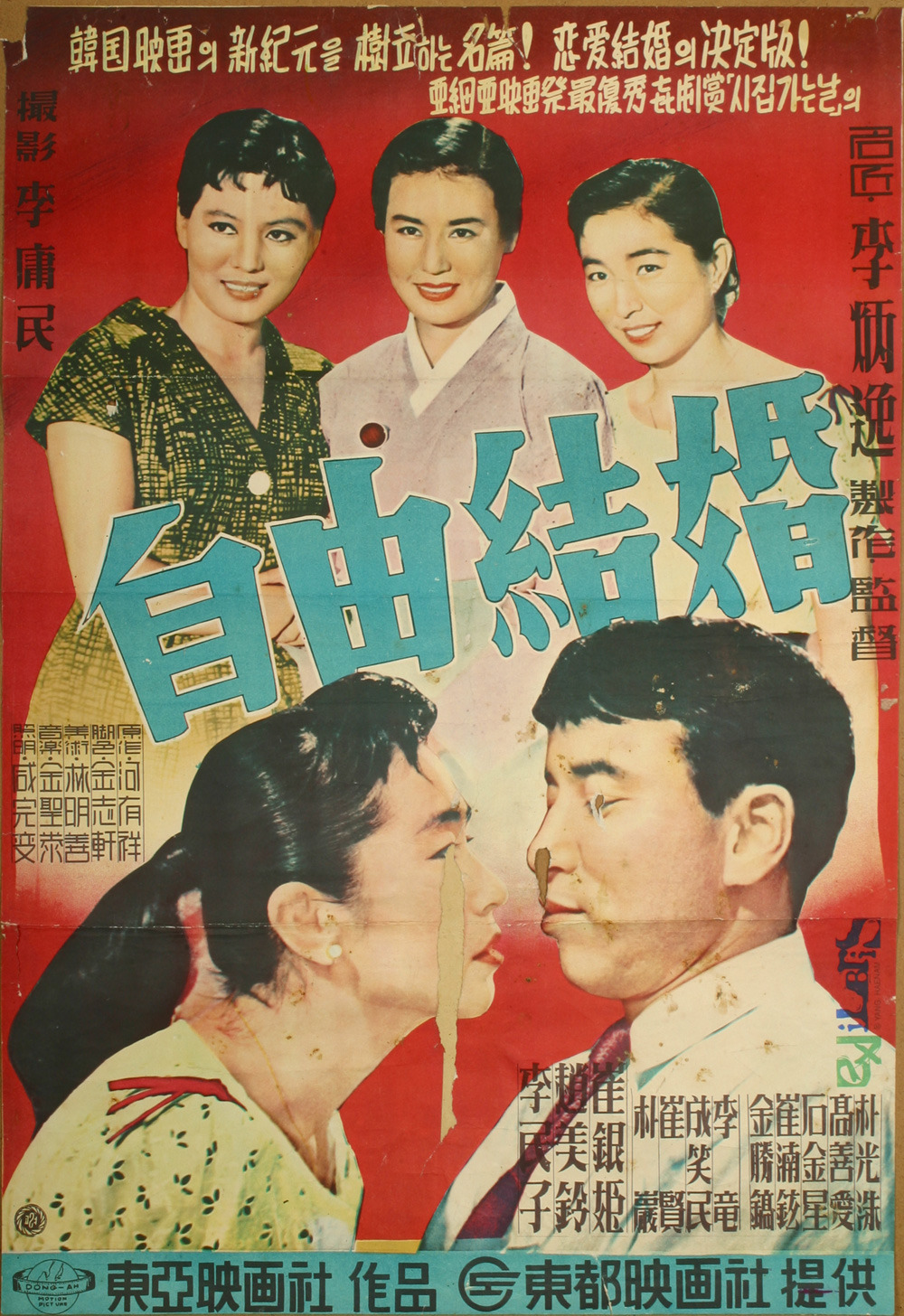
The love marriage posteA hot button issue at the centre of the tradition vs modernity debate – who knows best when it comes to love, a bevvy of relatives with lifetimes of experience behind them or the youngsters themselves still filled with youthful idealism? Then again, as the wise father of Lee Byung-il’s The Love Marriage (自由結婚 / 자유결혼, Ja-yugyeolhon) points out, perhaps both options are bad. An arranged marriage may not work out for a variety of reasons, and a love match may only result in heartbreak, but perhaps there is a third way after all – something which he intends to figure out through gentle manipulations of his lovelorn daughters and feisty conservative wife.

Inverting the normal pattern, Lee opens with the wedding. Dr. Ko’s (Choi Nam-Hyun) eldest daughter, Suk-hee (Choi Eun-hee), has scandalised her family by marrying for love, making a modern future in a modernising world. However, her new husband, Seung-il (Seong So-min), is pensive. He has something he feels he needs to get off his chest to start married life on the right foot. Seung-il confesses that he was once in love before, somehow believing this is a terrible secret which his new wife needs to know. Suk-hee is of course sympathetic and understanding, she never assumed herself to be marrying someone without a past. In an effort to console him she makes a confession of her own. She too was once in love with someone else – the older brother of a school friend who died tragically years ago never knowing of her deeply held affection. Despite his earlier plea, Seung-il is horrified, abruptly walks out on his new wife on their wedding night, and sails to America to make a new life for himself alone.

Flashforward four years and Suk-hee, humiliated, has retreated to her bedroom, seldom leaving the house and only then to walk along the paths she used to take with Seung-il when she does. Dr. Ko has two more daughters – Moon-hee (Lee Min-ja) and college student Myeong-hee (Jo Mi-ryeong), as well as a young son, Gwang-sik (Park Gwang-su), still in school. Ko’s wife, Mrs. Ahn (Seok Geum-seong), is convinced all Suk-hee’s problems are down to getting married for love – after all, Mrs. Ahn was always against it. To prevent the same thing happening again she plans to find good matches for her other two daughters, hoping to set Moon-hee up with the son of one of her best friends, Wan-seop (Lee Ryong), who has recently returned from studying abroad. Moon-hee, however, has taken a liking to the timid college student who has been tutoring Gwang-sik, Jun-cheol (Choe Hyeon). Meanwhile, Myeong-hee has also developed a fondness for Ko’s assistant, Yeong-su (Park Am).

The times are changing, but only to an extent. Mrs. Ahn doesn’t like it that they’re changing at all. The romantic destiny of her daughters was, perhaps, one of the few things over which she exercised complete control and control seems to be something she is reluctant to give up. Suk-hee’s decision to get married for love is a new one – a rejection of the oppressive pre-war system of total deference to one’s elders in favour of exercising her individual right to choice. Her choice, however, did not work out, in part at least because of some very old fashioned ideas embedded in the head of Seung-il who is unable to cope with the idea of his wife as a real flesh and blood woman rather than the idealised picture of passive femininity he had conjured for himself.

Love and marriage enter a conflict with each other. Ko and Mrs. Ahn have extremely different temperaments but seem to have built a happy and harmonious home for their four children, raising love between them as they go. Yet not all arranged marriages work out, especially when relatives might not have their children’s future happiness as a priority. Meanwhile, young people in love might not be best placed to make serious decisions about a long term future whilst caught in the throws of passion. Ko, otherwise sympathetic, has his doubts about Moon-hee and Jun-cheol, not because of Jun-cheol’s “weak” character which is his wife’s chief complaint, but because he worries that though they are in “love” they have not yet reached an understanding of each other. Rejecting both ideas – the hyperrationality of the “arranged” marriage, and the emotional volatility of the “love” match, Ko wonders if there isn’t a way to meet in the middle, that if the older generation could perhaps guide the youngsters towards a series of likely candidates they believe to be well suited, love might blossom in a place it can take root.

Ko, quiet yet wise and permanently amused, tries out his idea on his youngest daughter, Myeong-hee, who might be the most like him and also the most modern among her sisters. Spotting the obvious attraction between Myeong-hee and his assitant Yeong-su, Ko tries to set them up and then puts a wedge between them through using Wan-Seop who is at a loose end while Moon-hee pines after Jun-cheol and refuses to meet any other suitor. Wan-seop, despite Mrs. Ahn’s obvious esteem for him, is the very example of the new Korean man who tries to make a virtue of his modernity but only exposes his old fashioned conservatism. Caught in a small debate with Yeong-su and Myeong-hee, Wan-seop who has recently returned from study in America sings the praises of life overseas and declares himself a feminist – he hates the way women are treated in Korea which is why, when he’s married, he plans to 100% obey the housekeeper and not make waves in the domestic domain. Yeong-su, quite fairly, finds this ridiculous and even if his ideas are perhaps no more “progressive” he is at least transparent in his constant verbal sparring with the confident Myeong-hee.

For all its inherent comedy, love is still a painful business and parental rigidity has a potential dark side as we see in an attempted suicide brought about by heartbreak and frustration at not being listened to by parents who insist they know best. Yet in the end love conquers all. Ko’s gentle manipulations eventually work their magic, guiding each of his daughters towards their most hopeful path but leaving the decision to take it entirely up to them. Even Mrs. Ahn begins to see the beauty of young love rather than its destabilising qualities and cannot help being touched by the happiness each of the sisters seems to have found in their chosen men even if they’ve suffered quite a lot along the way. Love is never easy, but it doesn’t need to be so hard and it only takes a little bit of understanding to set it on its way.


The Love Marriage is the second of three films included in the Korean Film Archive’s Romantic Comedy Collection of the 1950s box set. It is also available to stream online from the Korean Film Archive‘s YouTube Channel.

A Woman Judge (女判亊 / 여판사, Hong Eun-won, 1962)

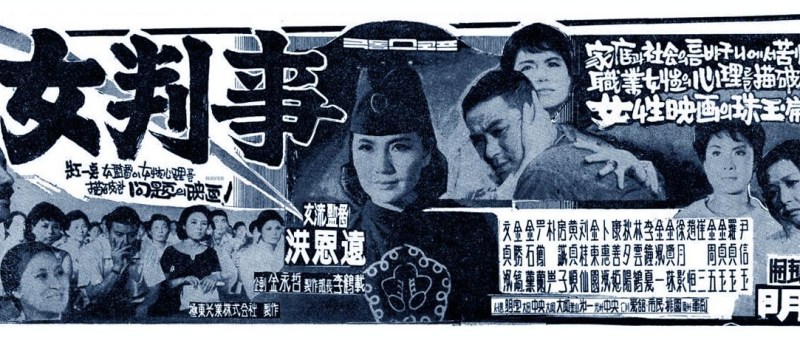
The 1960s were a time of great social change the world over, but while Doris Day was showing the world how to have it all (to a point, at least), not everywhere found the idea of women’s liberation quite so aspirational. In the comparatively more liberal period before the Motion Picture Law brought in by Park Chung-hee there had indeed been a fair few films challenging persistent misogyny and advancing the cause of equality, but there had also been those which ran the other way and pushed an intensely conservative message. Han Hyung-mo’s A Female Boss from 1959, for example, centres around a seemingly successful female editor of a woman’s magazine whose business is in trouble. Eventually she ends up marrying an employee and becomes a housewife, neatly reinforcing the idea that women do not belong in the work force. Three years later and just just before the advent of a more stringent censorship environment, Hong Eun-won’s A Woman Judge (女判亊 / 여판사, Yeopansa) takes a much more positive attitude to the idea of women having the right to personal fulfilment outside of the home but again only to a point and only partially.

Jin-suk (Moon Jeong-suk), a youngish woman from a humble home, is studying for the judges’ exams. Though her father is supportive and encourages her to study, Jin-suk’s mother (Hwang Jung-seun) worries – she cannot envisage a life for a woman who does not marry and doesn’t want her daughter to end up alone, unhappy, and isolated. Jin-suk also finds unexpected resistance from her childhood sweetheart, Dong-hoon (Park Am), who makes a motion to solidify a long held but never spoken promise that the pair would marry but only on the condition that Jin-suk give up her intentions of becoming a judge and agree to be solely his wife. Jin-suk, of course, refuses. Meanwhile, a construction magnate who caught sight of her on the road has taken a liking to her which is only deepened when he reads of her success in the papers. He becomes determined to get Jin-suk to marry his son, Gyu-sik (Kim Seok-hun), and add some sophisticated modernity to his otherwise soulless home.

The great surprise (or perhaps it is in its own way unsurprising) is that Jin-suk’s greatest supporters are two middle-aged men – literally her patriarchal elders in the form of her own father and her father-in-law. Each of the two men is impressed by Jin-suk’s fortitude and intelligence, they believe in her and want her to succeed. The women, however, feel quite differently. Jin-suk’s mother is caring and supportive but locked into the social codes of her youth, unable to envisage a successful life for a woman which does not involve marriage or children. Jin-suk’s mother-in-law by contrast is harsher, actively resenting Jin-suk’s insistence on maintaining her career and seeing it as a rejection of the idea of the good wife. The most surprising enemy, however, is Jin-suk’s new sister-law, Geum-won, who, despite being a modern woman exhibits extremely conservative values even at one point berating Jin-suk for not showing the proper respect to her husband and failing in her wifely duties. Women oppress other women, making it almost impossible to break free of the conspiratorial forces of a conservative social order even when there are women as brave and determined as Jin-suk willing to pave the way.

That said, Jin-suk is only prepared to go half the distance. She marries and then resigns herself to double duties, insisting that she can manage both a career and a home with no support. There is no suggestion of a rebalancing of the domestic world, no one asks anything of Jin-suk’s petulant husband Gyu-sik other than he do what he’s told. Gyu-sik married Jin-suk knowing she would prioritise her career, but it’s less the fact that she works that begins to irritate him than her growing “celebrity” as “the woman judge” coupled with the paternal oppression he too feels as his father’s son. Even though he is head of accounts, his secretary won’t cash his checks without his dad’s signature – he’s not “in charge” at home or at work and feels himself increasingly emasculated. Which is perhaps why he lets his sister manipulate him into an affair with his mousy secretary who conforms much more strongly to the feminine ideal and therefore allows him to feel like “a man”.

The affair between Gyu-sik, and his lonely secretary, Miss Oh, eventually turns dark and leads the pair to consider double suicide. Gyu-sik, a coward, is unwilling to leave his “unhappy” marriage but Miss Oh does not want to end up a perpetual mistress. The first case Jin-suk presides over is a divorce in which a man has cited his own adultery to divorce his wife because she works too much. Obviously, Jin-suk does not approve of his reasoning but it’s the accomplice who becomes unexpectedly sympathetic. Jin-suk asks her if she knew her lover was married to which she says she did not and that had she known she would never have become involved with him. When the woman affirms that she only slept with the man because she believed they would be married, Jin-suk asks her a perhaps cruel question with a wry smile – if she thought the same thing with each and every man she had ever slept with (implying there must have been many in an unintentional act of slut shaming). Rather sadly, the woman replies that yes she did – she may be naive, but she loved them all and firmly believed they would marry her only to be let down just as she’s being let down now.

Such is the difficult position in which women find themselves in a liberalising but not liberal society. One of Gyu-sik’s friends even petitions him to get Jin-suk to help him get rid of a paternity suit filed by a girl he’s got into trouble while engaged to marry someone else and has now disowned. In fact one of the frustrations fuelling Gyu-sik’s resentment is that he has become a mini conduit to Jin-suk as just about everyone attempts to make use of the familial connection to ease their legal woes, little knowing that Jin-suk is not that kind of judge. She entered the law to heal society like a doctor heals the sick, but begins to doubt herself when the disorder in her own home threatens to boil over.

Disorder shifts into murder. A surprising second act twist puts us back in the realms of the courtroom drama as Jin-suk finds herself first a suspect and then presumed an intended victim before being forced to interrogate, literally, her own family and prove her devotion to it in the process. Though it’s Jin-suk determination, perseverance and legal skill coupled with compassion and emotional intelligence that eventually save “the family”, the jury is still out on whether she will be allowed to continue her legal career or be forced to give it up to fully repair the fracturing family home. While Jin-suk is committed to the idea that all women have the right to fulfil their potential, she too is wedded to the patriarchal ideas of the home and family and never truly considers living outside of them, only insisting on being allowed to continue working as a wife if not, ultimately, as a mother (though it is also interesting that she never suggests her career necessitates a rejection of those things or that there is an active choice available to her). A Woman Judge provides a fascinating insight into the prevailing social codes of Korean society in the early 1960s, even if taking only small steps towards a larger goal.


A Woman Judge was screened as part of the Rebels With a Cause season of free film screenings at the Korean Cultural Centre London. You can also stream the film for free via the Korean Film Archive’s YouTube Channel.