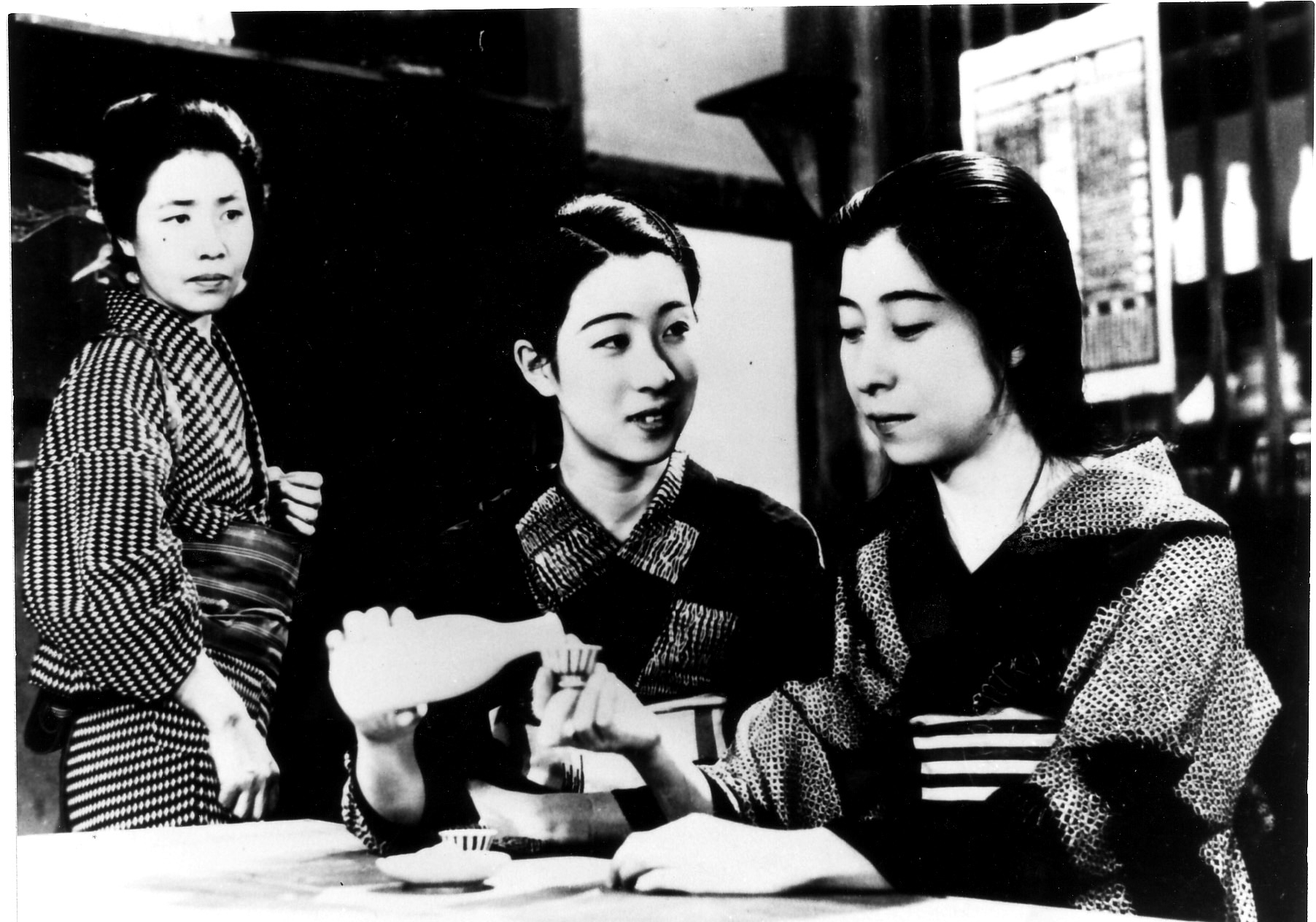
A Story of Floating Weeds (浮草物語, Yasujiro Ozu, 1934)

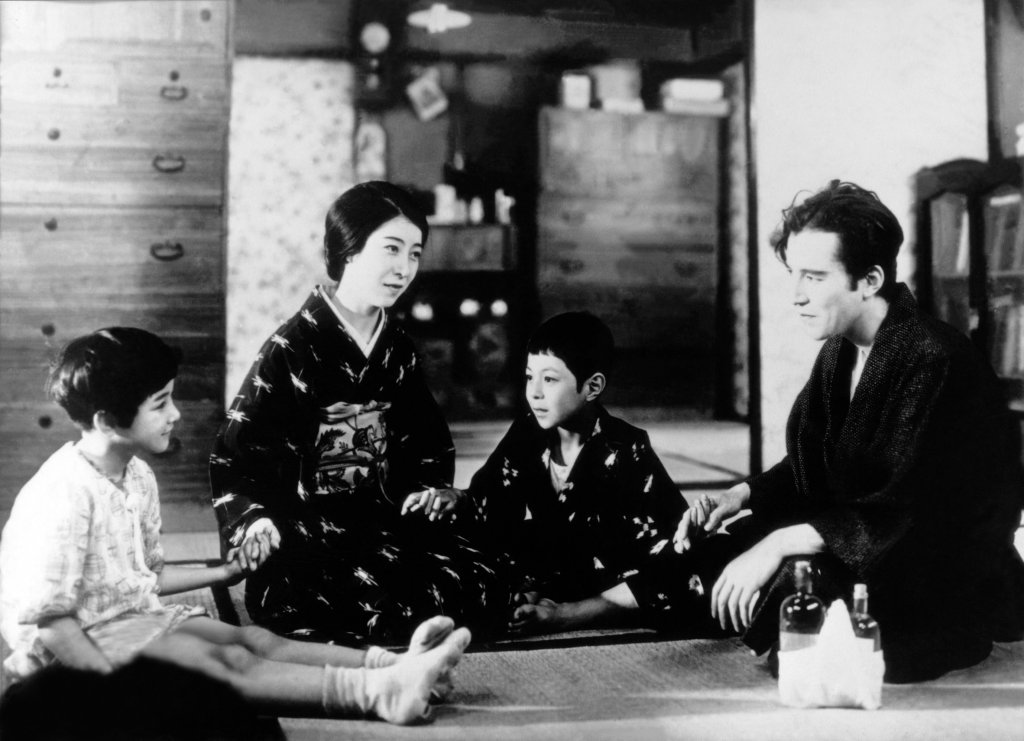
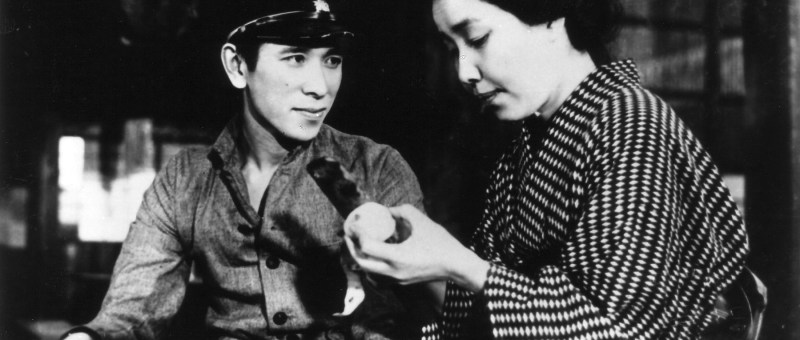
Japanese cinema is filled with tales of maternal self-sacrifice which is more often than not rejected by ungrateful children unable to understand the depths of a mother’s love. More contrarian than most would have it, Yasujiro Ozu’s abiding interest is with fathers and particularly with those who are flawed but loving. 1934’s A Story of Floating Weeds (浮草物語, Ukigusa Monogatari) which he later remade in colour 25 years later, is a tale of one such father and another of his “Kihachi” movies, but situates itself in a liminal space defined by Kihachi’s precarious position as a member of a virtual underclass of travelling players. 

Kichachi’s (Takeshi Sakamoto) troupe is returning to a small town after four years where they hope to stay a year. Unbeknownst to the other members, Kihachi has an ulterior motive in that the town is home to his former lover Otsune (Choko Iida) and his illegitimate son, Shinkichi (Koji Mitsui) who thinks that Kichachi is just a family friend and that his father was a civil servant who has now passed away. As is usual in travelling player stories, the troupe is in crisis and on the verge of disbanding, so Kihachi’s frequent absences do not go unnoticed, particularly by his current mistress Otaka (Rieko Yagumo) who has a petty and vindictive streak. When one of the veteran actors spills the beans, she marches straight over to Otsune’s to make trouble but Kihachi, sick of her possessive behaviour, breaks up with her. To take revenge, she bribes another actress, Otoki (Yoshiko Tsubouchi), to seduce Shinkichi. 

The central issue is one of Kihachi’s frustrated paternity. It’s clear that he couldn’t be physically present for his family but has always done his best to support them financially while Otsune runs a small restaurant. They are not married and their present relationship seems to be more one of companionship than romance but whatever label they might put on it they get along well and both deeply care for their son. While in town, Kihachi busies himself with fatherly activities, playing board games with Shinkichi or fishing in the local stream. It pains him that his visit may be short and that Shinkichi, who seems to like him a great deal, has no idea he is his son. 

That is largely because Kihachi’s only hope in life is that he spare Shinkichi from the depressing life of a travelling player. He has been paying for his education and Shinkichi is now almost a man, apparently a post-graduate student at an agricultural school. When he expresses an interest in coming to see the show, Kihachi seems panicked and tells him the kinds of shows he does are not for people like him and that he should stay home and study. Shinkichi laughs at the fatherly advice but little knows that it comes from a place of shame. Travelling players are regarded as an underclass. They are often barred from inns and not considered polite company.

“My son belongs to a world better than yours,” he shouts to Otaka during a heated, rain-drenched argument during which she threatens to expose him. Otoki, the other actress, was originally reluctant to enact Otaka’s plan, but later found herself falling for Shinkichi. Perhaps a young man bedding a travelling actress isn’t a grand shame or much of a problem for him, at least not so much as to provoke Kichahi’s despair in exclaiming he has caused his son’s ruin, but destroys his father’s hopes of keeping him out of that untouchable world for which he had sacrificed so much including his paternal love. 

Yet like the ungrateful child of a hahamono, on learning the truth Shinkichi rejects his sacrifice and feels only his abandonment, refusing to believe that any father could be so “selfish”. The rejection comes at a low point, immediately after Kihachi loses the acting troupe and considers returning to Otsune for a settled, ordinary life as a husband and father. Otsune scolds her son, reminding him that all he wanted was to give Shinkichi the settled, ordinary life that he could never live as a travelling player. It seems this life will always elude him, he is barred from his own home and must forever wander. Being a good father means he must keep far away from his son, a floating weed with no place to call home.
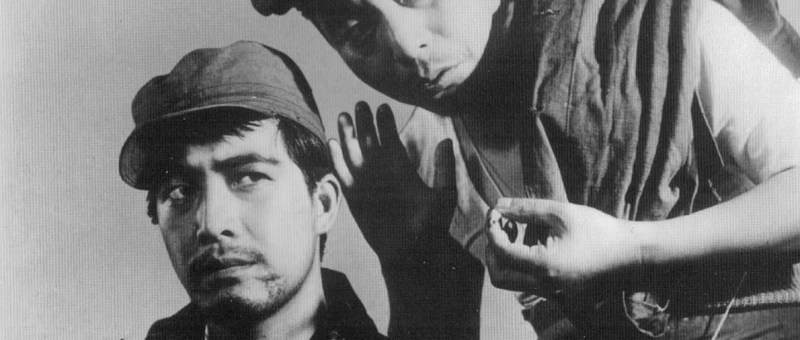

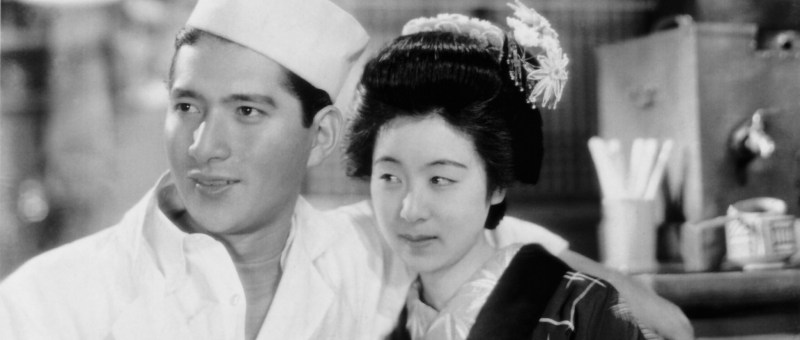
Passing Fancy (出来ごころ, Yasujiro Ozu, 1933)

“We have to help one another” a sympathetic soul insists towards the conclusion of Yasujiro Ozu’s Passing Fancy (出来ごころ, Dekigoroko). Ozu’s depression-era silents are not as devoid of hope as it might at first seem, but it is a much more positive statement and perhaps surprisingly the central messages lie more in the necessity or otherwise of repaying kindness and the kinds of forms that action may finally take. It is also, however, the first in a loose trilogy of films revolving around a single father named “Kihachi” and the only one in which he is not (at least potentially) exiled from the family he has been trying to protect. 

This Kihachi (Takeshi Sakamoto) has one young son, Tomio (Tokkan Kozo, AKA Tomio Aoki), and casual job working in a brewery though he is hardly a model employee and is often late due to oversleeping after a night of heavy drinking. A roguish womaniser, he is also a kinder soul than he seems which is why he stops to talk to a pretty young woman, Harue (Nobuko Fushimi), wandering around in distress late in the evening. His first approach is slightly crass, responding to her question about lodging for the night by explaining that he has a kid and no wife but then he takes her to a local cafe he frequents and persuades the owner, Otome (Choko Iida), to take her in. Otome takes a liking to her, and decides to offer her a job as a waitress. 

Kihachi develops a hopeless crush, comically dolling himself up in his fanciest kimono and getting an advance from work to buy a pretty comb, an unmistakably romantic gift, to present himself to Harue. Of course, she’s grateful but sees him as a nice older gentleman rather than a potential husband. In fact and somewhat surprisingly she develops a crush of her own on the brooding Jiro (Den Obinata) despite the fact he is constantly rude to her and more or less implies she’s an untrustworthy woman out to take advantage of “vulnerable” men like himself. There is something quite touching and unusual in the brotherly friendship between the two men that occasionally comes off as something more in Jiro’s deep antipathy to Harue, which is to say she isn’t going to come between them but the situation is indeed complicated. 

Harue is, in that sense, a distraction that takes Kihachi’s eyes off his proper role as responsible father. He and Tomio have a close, interdependent relationship and it’s clear that it’s often little Tomio, older than his years, who finds himself managing Dad. Kihachi is immensely proud of his son, fond of saying he’d be top of his class if only he had better manners. Like any father what he most wants for him is that he escape their life of poverty which is why he’s so glad that the boy does well at school. But little Tomio finds himself bullied precisely because of Kihachi’s lack of standing. The other boys mock his illiteracy, unable to believe a man could reach adulthood without being able to read. When his son is taken ill, Kihachi laments circumstances even more. “It’s horrible not having an education”, he tells Jiro, “I got my son sick and I can’t even pay the doctor’s bill”.

The depression may be less visible than in Ozu’s other ‘30s films, but its evidence is everywhere. Harue ends up on the streets after losing her job at a silk mill and having no family to fall back on. At the naniwabushi performance which opens the show, a series of spectators hopefully open a lost wallet but find it empty. Kihachi notices the discarded purse is slightly bigger than his own and makes a swap as a hopeful investment for the future. Just before the performance ends, several of the guests seem to be plagued by fleas. Kihachi is forever asking for advances for frivolous reasons but assumes he’ll be able to manage hand to mouth only to enter a moment of crisis when hit by the unexpected expenses of his son’s illness for which he feels responsible in attributing it to an excess of luxury after giving a him a pocket money bonus which he unwisely blew in one go on sweets (like father, like son after all). 

Yet what shines through is compassion and camaraderie. A friendly barber loans Jiro the money for a doctor, which is one reason he intends to leave for Hokkaido even after realising his feelings for Harue. As with the other Kihachis, this Kihachi rediscovers a sense of fatherly duty in feeling as if this debt must be his, that he should be the one to go to Hokkaido to repay it even if that means leaving his son behind. The barber tells him not to bother, the sentiment is enough for him and he doesn’t mind missing the money knowing it saved a boy’s life. “We have to help one another”, kindness doesn’t necessarily have to be repaid directly but can be paid forward in becoming a way of life. The Kihachis of A Story of Floating Weeds and An Inn in Tokyo are exiled from their families and serve their sons only by abandoning them, but this Kihachi turns back, his sense of “responsibility” perhaps a “passing fancy” but one that’s taught him the true meaning of fatherhood and what it is to live in a society.


Song of the Flower Basket (花籠の歌, Heinosuke Gosho, 1937)

The daughter of a tonkatsu shop finds herself with an overabundance of suitors in Heinosuke Gosho’s generally cheerful yet occasionally dark melodrama Song of the Flower Basket (花籠の歌, Hanakago no Uta). Adapted from a novel by Fumitaka Iwasaki and scripted by Kogo Noda, the film finds its heroine caught at a moment of social change as she battles her snooty aunt for the right to decide her romantic future while her impoverished student boyfriend does something much the same in defying his family’s attempts to micromanage his life dreaming of the bright lights of Ginza. 

Yoko (Kinuyo Tanaka) is the “kanban musume” of her father Keizo’s (Reikichi Kawamura) pork cutlet restaurant, attracting customers with her charm and beauty while the Chinese chef her father brought back with him from Shanghai, Lee (Shin Tokudaiji), is the culinary star. Lee is secretly in love with Yoko whom he continues to refer to largely as “the young lady” and has long been writing an ode in her honour. Yoko meanwhile is in love with a penniless student, Ono (Shuji Sano), who at the beginning of the film has just returned home after visiting his family whom he has alienated by declaring that he doesn’t want to work in an office in the country while refusing an offer to marry into another family as an adopted son-in-law. The reason for this is less his pride than his desire to stay in Tokyo amid the bright lights of Ginza, sighing as he looks out into the neon-lit night gazing at adverts for Club Hamigaki toothpaste and Meiji Chocolate. The second reason may also be that he’s fallen for Yoko but given his precarious financial situation and lack of prospects does not quite dare to imagine a future with her. 

He must however be serious as we later learn he’s given up going to hostess bars with his friends, a bar girl greeting him in the restaurant evidently not having seen him in ages asking where he’s been much to Yoko’s embarrassment. The encounter places a seed of doubt in her mind in a minor role reversal as she begins to resent Ono’s past irrationally annoyed by the idea he has dated other women. Meanwhile, at the memorial event marking 11 years since her mother passed away while working as a steward on a boat in Singapore, Yoko’s snooty aunt tries to set her up with an arranged marriage to an Osakan doctor who may or may not marry depending on the “negotiations” but has also been promised his own clinic by his wealthy parents if the marriage is confirmed. Okamoto (Toshiaki Konoe) has visited the restaurant to get a better look at Yoko making him the third suitor to encircle her even though the chief concern of the family is that Yoko is almost 24 and therefore ageing out of top tier matches.  

To his credit, Yoko’s father is fully in her corner trying to stand up to the domineering aunt who is definitely overreaching in trying to micromanage the romantic lives of her nieces in the absence of her sister. He determines to find out if Yoko has her eye on someone already to get the aunt off their backs, but the situation develops in an unexpected direction when Lee mistakenly assumes that she likes him back. Too shy to say himself, he advises Keizo to ask frequent customer and best friend of Ono, Hotta (Chishu Ryu), who is on track to become a Buddhist priest and take over the family temple, only Hotta obviously tells him, correctly, that Yoko is in love with Ono having completely forgotten that Lee had once confessed his feelings to him. 

The film does its best to present a more positive vision an internationalist Japan even in 1937 despite the Aunt’s obvious disapproval of the family’s wandering past and is largely sympathetic of the lovelorn Lee yet implies that a romance between he and Yoko is so unthinkable that no one really considered the possibility that he may be in love with her himself even though it is incredibly obvious given his ongoing attempts to write a love song while he’s even torn out a picture of Yoko which appeared in a magazine and hung it on his wall. Yoko is oblivious to his feelings, believing that he is in love with their waitress, Oteru (Yaeko Izumo), who is indeed in love with him, and perhaps doesn’t appreciate the effect moving Ono in as a trainee chef will have on him both professionally and emotionally. The message that is emerges accidentally or otherwise is that Lee’s place at the cafe is insecure despite his skill being a large part of its success as he falls into a deep depression and eventually decides it’s too painful for him to stay. 

The revelations surrounding Lee further destabilise Yoko’s confidence in her choice of Ono whom she constantly doubts even suspecting he may have committed a violent crime when carted off by the police after newspaper reports stating the bar hostess he introduced her to earlier has been murdered in her apartment. Perhaps it’s normal enough to be uncertain if you’ve made the right choice in the early days of a marriage, but believing your spouse capable of murder is a significant stumbling block as is her final admission that she doesn’t really trust him and isn’t ready to accept his past with other women in a further reversal of their roles given he has now married into her family and taken her name. Nevertheless, the crisis seems to be repaired by her father’s simple act of ordering a round of beers making clear that he plans to celebrate and obviously still has confidence in Ono while preparing to adapt their restaurant to their new circumstances by branching out into sukiyaki. Expressing some of the anxieties of the 1930s from the precarious economy and uncertainty of the future to changing social mores as young people reject the traditional to craft their own romantic futures, Song of the Flower Basket nevertheless ends on a note of melancholy in the wandering Lee’s ode to loneliness and heartbreak under the neon lights of Ginza.


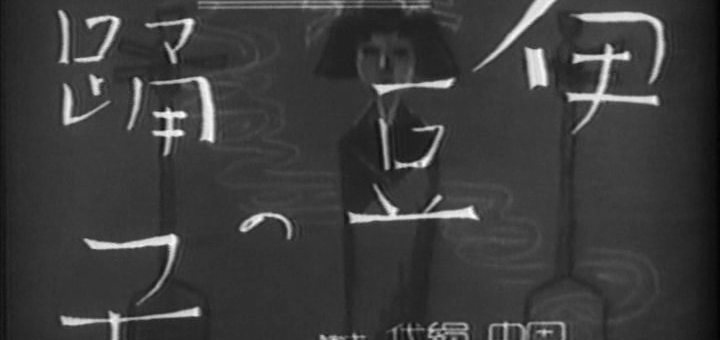
The Dancing Girl of Izu (恋の花咲く 伊豆の踊子, Heinosuke Gosho, 1933)

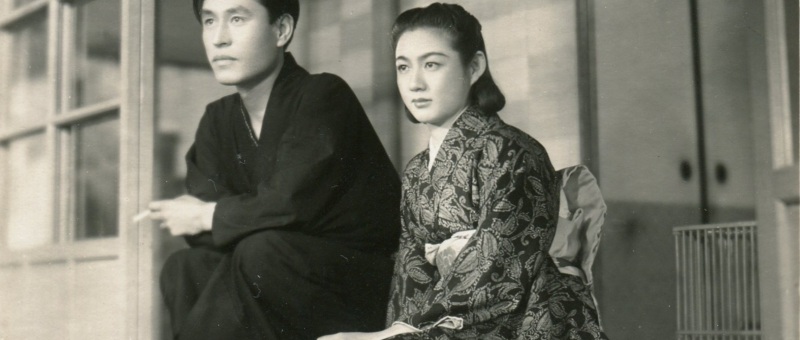
“Happiness is waiting for you” the melancholy heroine of The Dancing Girl of Izu (恋の花咲く 伊豆の踊子, Koi no Hana Saku Izu no Odoriko) is told by a man who truly loves her, though with his words all her hopes are dashed. Shot on location, Heinosuke Gosho’s 1933 silent is the first of several adaptations of the well-known Yasunari Kawabata story from 1926 and takes a number of liberties with the source material which are partly in keeping with the demands of contemporary cinema and partly an attempt to anchor it more firmly to the increasingly chaotic world of 1933 beset with both economic and political instability thanks to the global depression and Japan’s imperialist ambitions. The price of “happiness” it seems may be love, but perhaps stability as is much as you can ask for in an infinitely unstable world. 

Nominally speaking, the hero of this tale is a young student, Mizuhara (Den Ohinata), through whose eyes we view the transitory nature of young love and the rigidity of a society which will in the end not permit its fulfilment. The “dancing girl” however is our primary focus. Kaoru (Kinuyo Tanaka) is the orphaned younger sister of Eikichi (Tokuji Kobayashi) who inherited a literal goldmine but squandered his inheritance and forced the whole family on the road to earn their keep as travelling players. Such people occupy a kind of underclass, victims of a prejudice against those who have no fixed abode and cannot easily be identified through association with a place or people. Kaoru admits that though she has learned to bear her way of life because at least she’s with her family, signs such as the one they find in a ditch to the effect that beggars and itinerant actors are not welcome in the town fill her with despair. 

Mizuhara meets the actors when they have been unfairly accused of dumping the sign out of frustration (a child later vindicates them after confirming that it was a wandering priest who passed through shortly before). He wades into the fray to urge the angry farmers to exercise a little more patience and ends up agreeing to travel with the family to their next destination as he is himself engaged in a kind of holiday wandering around the picturesque countryside of the Izu peninsula (a popular activity for well to do students of the time). Unbeknownst to him they are already connected by mutual acquaintances in that a friend of Mizuhara’s, Ryuichi (Ryoichi Takeuchi), from the same university also lives in this town and is the son of the man, Zenbei (Arai Atsushi), who bought the goldmine from Eikichi after he went bankrupt. 

The economic subplot concerns an amoral mining engineer, Kubota (Reikichi Kawamura), who apparently has a reputation as a “slave driver” and was responsible for starting the mine which Eikichi’s father owned, the implication being that it failed because of his exploitative business practices and has flourished under Zenbei’s more compassionate ownership in contrast to the picture Kubota is about to paint of him. Having apparently failed at several other endeavours, Kubota has sworn off mines but has convinced himself that he is “owed” something seeing as Zenbei’s mine is now a success and he was the one who found it. He tries to get something out of Ryuichi, but he is unconvinced and eventually offended, accusing of Kubota of blackmail when he insinuates that there was something improper about his buying the mine from Eikichi for much less than it was worth. 

The film’s opening sequence which set up a subplot never resolved about a runaway geisha, however, showed us that Zenbei is as his name suggests a kindhearted man. He reported the geisha’s disappearance to the police not because she took off without clearing her debts but because he was worried for her safety, believing she may have been tricked into running off with an unscrupulous client. Kubota plants the seeds of resentment by convincing Eikichi that he was cheated out of the mine and is owed compensation. Eikichi, feeling humiliated, is determined to “negotiate”, but Zenbei tells him to give them his sister. 

As will be revealed later, Zenbei’s intentions are honourable and he has no thought of replacing the geisha who ran away with Kaoru but wants to take her into his household as an adopted daughter. Eikichi, however, misunderstands but is prepared to sell his sister in order to pursue a pointless revenge against Zenbei by getting money to buy another mine and thereby become even richer. Mizuhara berated him for even considering the idea of trading his sister for money, but in the end even Eikichi only sees her as capital in his rage-fuelled desire to avenge his wounded male pride and sense of impotence. He failed as head of household in losing the family fortune and now has no intention of protecting his sister from the vagaries of the world. 

Mizuhara once again intervenes and learns the truth from Zenbei, that he had been a friend of Eikichi’s father’s and has always been trying to look out for them but has recently lost patience with Eikichi who has already borrowed a lot of money from him. Zenbei is minded towards tough love, convinced his well-meaning attempts to help have only enabled Eikichi’s financial fecklessness. He doesn’t see why Kaoru should pay for his mistakes and has been putting some of the proceeds from the mine into a savings account in her name, hoping also that she may one day marry his son Ryuichi. Mizuhara is at once crushed by the painful goodness he sees in front of him, knowing that his love for Kaoru is now not only impossible but perhaps selfish. All he can do for her now is get out of the way so that she can be saved from the harsh life of an itinerant player, restored to her previous class status, and given the most elusive of all prizes in this chaotic age, stability. 

Zenbei’s plan for Kaoru is in itself a kind of miracle, the best she could ever hope for, but it’s also a minor tragedy in that it both robs her of any kind of agency to make her own choices and destroys the possibility of a romantic future with Mizuhara. To accept everyday comfort and safety, she must resign herself to giving up her love. Mizuhara asks her to do just that in an altruistic act of selflessness which recognises that without money he is powerless to help her. He’s not the one she loves (and we have no idea how he might feel about it), but Ryuichi seems to be a good and kind man, like his father Zenbei who is perhaps the face of compassionate, paternalist capitalism. The world is too chaotic for romance, but there is kindness enough if you’re lucky enough to find it, and if stability is all there is perhaps sorrow is easier to bear than hunger. 


Tokyo Chorus (東京の合唱, Yasujiro Ozu, 1931)

“Tokyo – city of the unemployed” runs a rather unexpected caption part way through Yasujiro Ozu’s depression-era silent comedy, Tokyo Chorus (東京の合唱, Tokyo no Chorus). Putting an unconventional spin on the reality of the contemporary capital, Ozu nevertheless retreats into his favourite themes as good people attempt to remain cheerful in the face of increasing adversity while embracing an often latent interest in class politics as the hero finds himself losing out at the hands of heartless capitalists when he alone is brave enough to stand up for a friend treated unfairly. 

Ozu opens however with an amusing prologue set some years before the main action in which the hero, Okajima (Tokihiko Okada), is a poor student goofing off during a military-style drill. While another boy arrives late to practice and is mocked for having arrived in geta, Okajima’s problem is that he didn’t want to take his jacket off because he isn’t wearing a shirt. A little less well off than some of the others, he brazens things out by ribbing the teacher, Mr. Omura (Tatsuo Saito). Flashforward some years and Okajima has become an insurance clerk, married with three children. His oldest child, a son, is desperate for a bicycle because the other kids have one and as Okajima is supposed to be getting his bonus today, the parents have decided to give in. 

Things do not, however,  go quite to plan. After picking up his pay packet, Okajima gets talking with an old timer who laments he’s just been fired. He thinks it’s because he sold some unlucky policies in which the beneficiary died shortly after signing the paperwork, but it seems obvious to Okajima that they’re firing him because they don’t want to pay his pension. He talks things over with the other employees who all agree it’s unfair, but is the only one brave enough to march into the boss’ office and say so. Unfortunately, Okajima gets nowhere and loses his own job in the proccess. Dejected, he buys his son a much cheaper scooter on the way home but the boy is unimpressed, as is his wife (Emiko Yagumo) when he hands her his notice of termination. 

It is of course a good and proper thing that Okajima stood up for colleague, but he’s lost out because of his pride, smugly explaining to his wife that he was in the right while arguing with his boss and resentfully refusing to admit the irresponsibility of his actions as a husband and a father. Pride becomes a persistent secondary concern as he tries to find another steady job in the economically straitened world of 1931. Despite telling his colleague he envied him for his job as a sandwichboard man and claiming that having a college degree makes him overqualified for casual work, Okajima struggles with himself intellectually knowing that any job will do to feed his family but embarrassed in having to resort to work he feels is beneath him. When he runs into Mr. Omura and he offers to help him with a job in the curry rice restaurant he now owns after retiring from teaching, Okajima is conflicted, telling him he won’t accept help if it’s offered out of pity but only if extended in friendship. When his wife spots him out delivering leaflets, however, she is scandalised and humiliated rather than proud or grateful, only later coming round and agreeing to help out in the Omuras’ restaurant herself. 

Meanwhile, family life is obviously strained by their ongoing financial predicament. When their daughter is taken ill and needs hospital treatment, Mrs. Okajima is upset to discover that her husband sold all her kimonos to pay the fees, their eyes aflash with anger and despair as they put on a brave face for the children but eventually brightening as they continue on with a family game of pat-a-cake. Despite her distress, Mrs. Okaijma maintains faith in her husband and the family is as happy as it can be under the circumstances. At a reunion organised for some of his former students now no longer the rambunctious young men they were at the film’s opening but wistful for the spent freedoms of their youth, Omura makes a toast hoping that everyone continues to prosper through “hard-work and self-reliance”, but it is the mutual solidarity which Okajima showed when he stood up for his mistreated colleague which eventually proves his salvation. Humbled by his experiences, no longer looking down on honest work, he gets the offer of another job which is not quite of the kind he was hoping for, but is perhaps a new start even if it means leaving Tokyo, city of the unemployed, behind for the greener pastures of provincial Tochigi and a simpler, but perhaps kinder, existence. 


Brothers and Sisters of the Toda Family (戸田家の兄妹, Yasujiro Ozu, 1941)

Yasujiro Ozu made only two films during the height of the war. After being drafted for the second time in 1943, he famously sat out the main action from the relative safety of Singapore where he was able to indulge his love of Hollywood cinema to an extent impossible in Japan. Somewhat surprisingly, 1941’s Brothers and Sisters of the Toda Family (戸田家の兄妹, Toda-ke no Kyodai) does not seem to fit the censor’s ideal in that it contains little to no patriotic content and never mentions the war save for presenting the idea of “Manchuria” as a place to start again free of burdensome codes of social oppression but, crucially, embraces classic ideas of filial piety which is presumably how it came to be approved by the powers that be. 

Shortly after the Toda family gathers for the first time in quite a while to celebrate Mrs. Toda’s (Ayako Katsuragi) 61st birthday, Mr. Toda (Hideo Fujino) drops dead of a heart attack and it is discovered that the family firm is near bankruptcy. The large, Western-style mansion where the family photo so recently took place will have to be sold and Mrs. Toda and her unmarried daughter Setsuko (Mieko Takamine) will have to move in with one of the married children. 

Like the later Tokyo Story, Brothers and Sisters of the Toda Family concerns itself with the failure of filial piety in an increasingly corrupt society. Multigenerational homes might once have been a cultural norm, but perhaps it’s understandable that few people might be excited about the prospect of their mother suddenly moving in with them especially as the traditional Japanese house is not designed with personal space in mind. Power dynamics seem to be the problem at the first home where daughter-in-law Kazuko (Kuniko Miyake) makes no secret of the fact that the two women are in the way. She resents having to shift everything around and reorder her home to give them space upstairs, complains about their noisy pet bird, and is then put out when Setsuko and her mother fail to greet her guests even though she specifically asked them to absent themselves in order to avoid meeting them. 

At the next home, however, it’s more a question of maternal heirarchy. Daughter Chizuru (Mitsuko Yoshikawa) has two children and the oldest, her son Ryokichi (Masao Hayama), is very attached to his grandma, so much so that he confides in her about skipping school because he got into a fight and is worried about reprisals. Chizuru’s main objection to them moving in had been that it might distract Ryokichi from his studies, and it’s clear that she finds it difficult to assert her own maternity with her mother hovering in the background. She accuses Mrs. Toda of interfering by keeping her promise to Ryokichi and not telling her about skipping school, making it impossible for them to keep living in the same house. 

Rather than descend on the home of the last daughter, Ayako (Yoshiko Tsubouchi), who is hurt but perhaps relieved to hear they won’t be living with her, Mrs. Toda and Setsuko decide to move into a dilapidated summer house the family thought too worthless to sell. They are now thoroughly marginalised, living in a literal half-way home having lost their position in society. Setsuko, naive but earnest, is the keenest to adapt to her circumstances. Her best friend Tokiko (Michiko Kuwano) is from an “ordinary” family and tries to point out, as nicely as possible, that Setsuko is going to find it much more difficult than she thinks to move beyond her privilege. Aware of her precarious circumstances, she expresses the intention to work but is quickly shut down by Chizuru who finds the idea highly offensive and in fact embarrassing. She urges her to think about a socially advantageous marriage instead.  

Shojiro (Shin Saburi), the youngest and as yet unmarried son, urges her to do something much the same at the film’s conclusion but also offers his sister the freedom to fulfil herself outside the home by accompanying him to the land of the possible, Manchuria. Previously regarded as a feckless failure, Shojiro decided to take up the opportunity to make something of himself in Japan’s new colonial endevour. On his brief return to mark the first anniversary of his father’s passing, he appears in a China-style suit and fiercely takes his siblings to task for their disrespect of his mother. It has to be said, however, that he does not particularly take Mrs. Toda’s feelings into account and foregrounds his own duty of filial piety in insisting that she live with family rather than alone excluding the possibility that she too may prefer her freedom. In any case, it’s freedom he dangles before Setsuko in suggesting that in Manchuria you can do as you please without needing to worry about what others think. He offers her the possibility of marriage, but also of working and a kind of independence which is bound within the family. For herself, Setsuko wants to bring Tokiko too, positing a possible arranged match between her friend and her brother which other members of the family may find inappropriate in its transgressive breach of the class divide. 

The family is both dissolved and restored as the three Todas prepare to remove themselves from a corrupted Japan for, ironically, a new start in the home of old ideas, China, where there is both the promise of modernity and all the “good” aspects of the traditional, to whit filiality. Fulfilling the censors demands in subtly criticising the decadent, selfish, and hypocritical lifestyles of an impoverished nobility while presenting Manchuria as an opportunity remake a better, purer (and subversively progressive) Japan through imperialist pursuits, Brothers and Sisters of the Toda Family offers an ambivalent portrait of contemporary Japanese society in which the young save themselves but only by saving their parents first. 


Brothers and Sisters of the Toda Family is available on blu-ray in the UK as part of the BFI’s re-release of Tokyo Story in its recent 4K restoration which also includes an introduction to Tokyo Story from Tony Rayns, and Talking with Ozu: a tribute to the legendary director featuring filmmakers Lindsay Anderson, Claire Denis, Hou Hsiao-hsien, Aki Kaurismäki, Stanley Kwan, Paul Schrader and Wim Wenders. The first pressing also comes with a booklet featuring an essay by Professor Joan Mellen, archival writing by John Gillett and Lindsay Anderson, and a biography of Yasujiro Ozu by Tony Rayns.

It is also available to stream online via BFI Player as part of the BFI Japan Yasujiro Ozu collection.

Titles and opening (no subtitles)

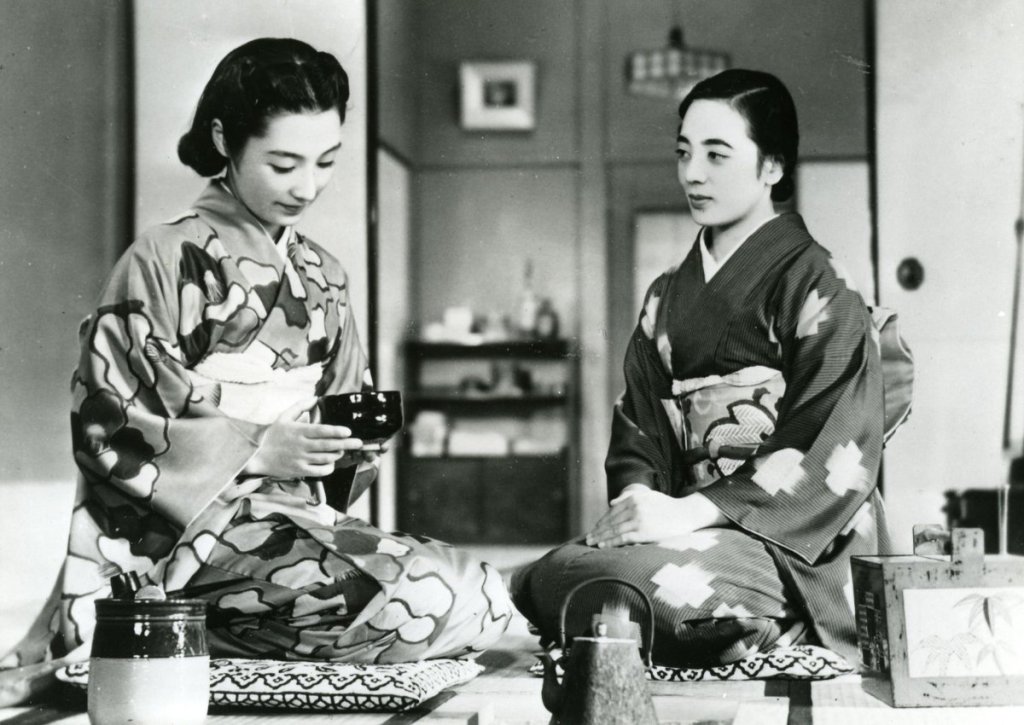
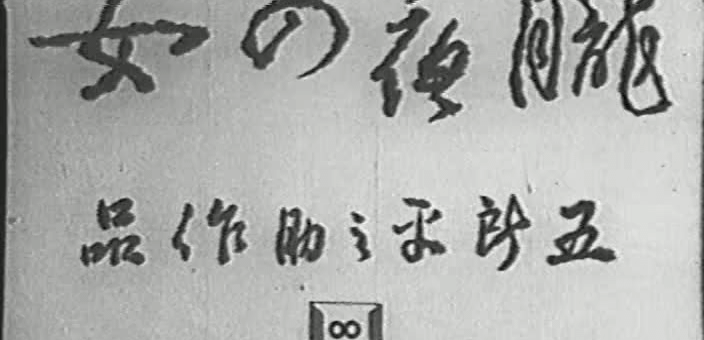
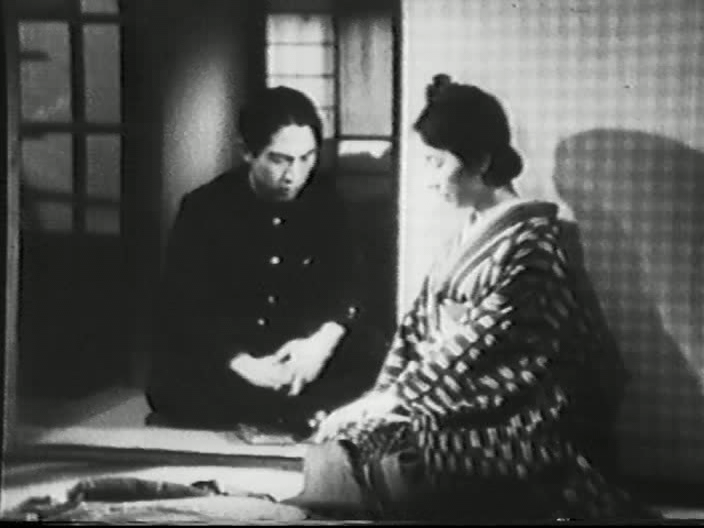
Woman of the Mist (朧夜の女, Heinosuke Gosho, 1936)

vlcsnap-2019-01-21-00h29m30s692The 1930s are often thought of as an era of social rigidity and implacable conservatism, yet even before the war things were changing. The young wanted something different than their parents often had and dared to dream of getting it even if their hopes were often dashed by the times in which they lived. Heinosuke Gosho’s Woman of the Mist (朧夜の女, Oboroyo no Onna) is the story of two youngsters who find themselves in a difficult situation and are offered a solution by elders acting kindness which they are persuaded to take only to find themselves progressively more miserable, burdened by the weight of the sacrifice their society has asked them to make.

Set in the jovial working class world of Shitamachi, Woman of the Mist opens with the hero of the tale, Fumikichi (Takeshi Sakamoto), enjoying a historical lecture regarding Edo era sacrifice for the common good during which his wife, Okiyo (Mitsuko Yoshikawa), comes to fetch him. Members of a local association he belongs to have come looking for him, it turns out for a favour. They want him to assist with some fundraising for a stone lantern to mark the association’s anniversary. Much to his wife’s exasperation, Fumikichi is only too happy to comply. It might seem that Fumikichi is a much respected pillar of the community only it is also true enough that he basks in the flattery of being regarded as someone to be depended upon and is therefore a soft touch (something undoubtedly well known to all around him).

Nevertheless, despite his slight tendency towards narcissistic attention seeking, Fumikichi is a salt of the earth type and willing to help those who need it for largely altruistic reasons. He therefore finds himself a surrogate father (though childless himself) to the son of his widowed sister Otoku (Choko Iida) who enlists him to talk some sense into his law student nephew, Seiichi (Shin Tokudaiji), who has apparently been “disrespecting” his mother and neglecting his studies by reading too many novels. Fumikichi has a word but counsels Seiichi that there’s nothing wrong with reading novels save that it obviously upsets his mum who has worked herself to the bone for the last 20 years dreaming of the day Seiichi becomes a fully fledged lawyer, which is to say a member of the middle classes.

Fumikichi, as he often will, becomes the conciliatory voice at the centre of generational conflict. Seiichi is a young man at the crossroads of life and finds himself torn between youthful idealism and a duty towards his family. He has become disillusioned with the law and would rather transfer to literature, secure in the knowledge that only in novels can you find the truly humane. Fumikichi is careful not to patronise but gives him a knowing look, realising that his confusion is partly born of resentment towards his well meaning yet accidentally possessive mother who has railroaded him into a career he doesn’t want to buy him a future which is her only dream. What he wants is control over his life, but when it comes to it he is still a boy and woefully unprepared for the demands of adulthood.

This becomes obvious when he falls in love and gets his girlfriend into trouble. Teruko (Toshiko Iizuka), a former geisha apparently known to Fumikichi in his younger days now working as a bar hostess, is not exactly the kind of wife his mother might have had in mind. The pair are careful to keep their relationship a secret for just this reason as Seiichi remains conflicted – one moment declaring that he no longer cares if everyone finds out and lying to his mother about her the next. Pregnancy forces the issue. Teruko, mindful of Seiichi’s bright future, declares that she can raise the child alone, glancing sadly at a picture of herself in her former life as a sex worker as if accepting what future sacrifices might be expected of her while half hoping Seiichi will rush forward to save her from such a fate. Seiichi doesn’t exactly rush but does tentatively accept his responsibility in reassuring her that he will soon come of age and is ready to become a father with all of the joys and obligations that entails.

Lost he turns to Fumikichi who hatches a plan which might be accounted a neat solution but is also another instance of the older generation making decisions on behalf of the young without really asking them. Despite being a rather feckless old man, Fumikichi tells his wife the child is his and asks for her forgiveness while also suggesting that they adopt the baby as their own. As expected, Okiyo is not exactly enthused but as Fumikichi calculated she would eventually comes around, ironically enough after a conversation with Otoku who has no idea the baby is really her grandchild. Once the decision is made, everyone rallies round to look after Teruko who finally becomes a (temporary) member of Seiichi’s family even whilst barred from ever becoming his wife and in fact of ever seeing him again as a result of the bargain which has been struck by Fumikichi. Nevertheless, Seiichi vacillates and attempts to change his mind by asking Teruko to marry him only for her to urge him to study hard and live well, sacrificing her happiness for his future.

Uncomfortably enough, it is Teruko who must pay for a series of transgressions against the norms of her society – for being a young woman with a past who seduced a nervous young man and dared to dream of a happier future with a person of her own choosing, though the very fact of her suffering is in itself an attack on these rigid and unfair social codes which do their best to destroy the happiness of ordinary, basically good people who have done nothing wrong other than attempt to live their lives. Fumikichi and his wife are doing their best and they too are good, compassionate people who have made good compassionate choices hoping for the best in a difficult situation even if their choices are defined by the prevailing conservative morality which places Seiichi’s future above a young woman’s life and love.

Then again, Fumikichi’s objections are largely practical – it’s hard to keep a family with no money coming in and Seiichi is still a student with no prospect of immediate employment that would pay enough for a wife and child. Could they be happy after a shotgun wedding and years of penury? Seiichi’s diffidence hints at no, but Teruko’s “purity” hints at yes as she vows to make the kind of sacrifice that proves her “goodness”. The youngsters find themselves beholden to the demands of their elders, torn between their personal desires and duties to those they love. Whatever they do, they lose and are destined to remain unhappy, unable to seize their individual chance of happiness in an oppressive, conformist society. Gosho may leave them at the mercy of such a system, but he does so with immense sympathy and not a little anger as we watch these good people making the best of things while asking ourselves if all of this is really for the best.


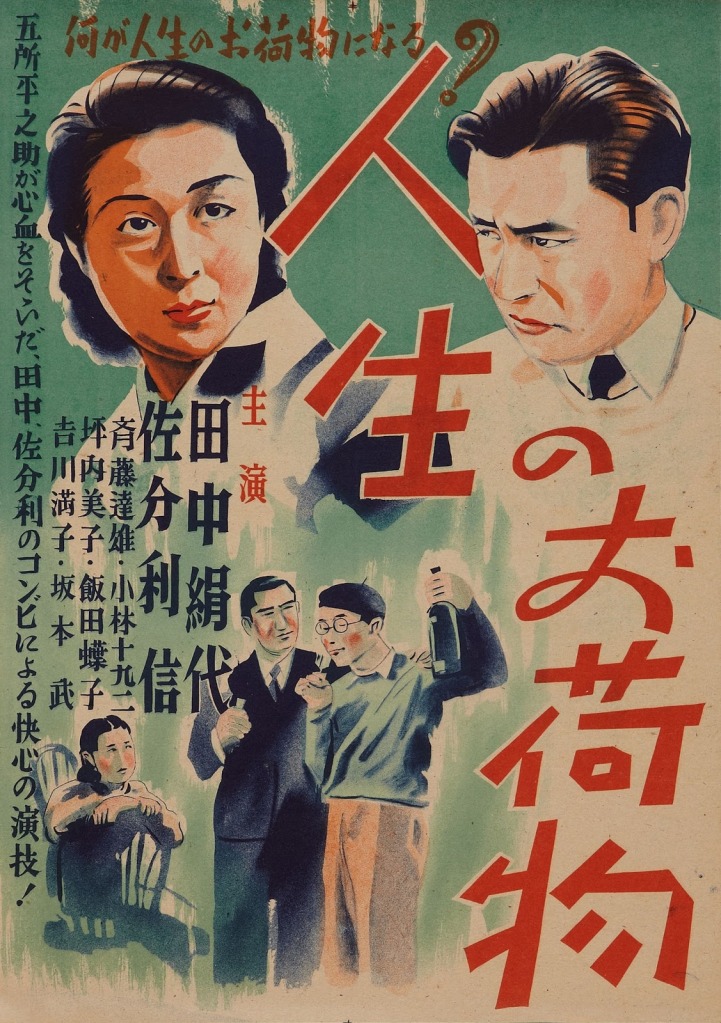
Burden of Life (人生のお荷物, Heinosuke Gosho, 1935)

Despite being at the forefront of early Japanese cinema, directing Japan’s very first talkie, Heinosuke Gosho remains largely unknown overseas. Like many films of the era, much of Gosho’s silent work is lost but the director was among the pioneers of the “shomin-geki” genre which dealt with ordinary, lower middle class society in contemporary Japan. Burden of Life (人生のお荷物, Jinsei no Onimotsu) is another in the long line of girls getting married movies, but Gosho allows his particular brand of irrevent, ironic humour to colour the scene as an ageing patriarch muses on retiring from the fathering business before resentfully remembering his only son, born to him when he was already 50 years old.
Rather than focussing on the main narrative right away, Gosho gives us a crash course in marital relations as we meet middle sister, Itsuko (Kinuyo Tanaka), who is currently posing for a raunchy portrait her starving artist husband is painting. Itsuko dresses in Western style, smokes openly and often, and her home is a bohemian one of the kind you’d imagine a (well to do) artist from the ‘30s would live in. The couple are interrupted by their brother-in-law who has come in search of his wife, Takako (Yoshiko Tsubouchi), with whom he’s had yet another argument causing her to storm off somewhere or other in a huff.

Takako has indeed stormed off, but has gone to her mother’s where her younger sister, Machiko (Mitsuyo Mizushima) is preparing for her own wedding and now feeling quite nervous hoping that it won’t be as tempestuous as Takako’s. The three sisters also have a little brother, Kanichi, who is doted on by the women of the family but has a strained relationship with his father, Shozo (Tatsuo Saito). The main conflict occurs once Shozo has successfully married off Machiko and begins happily contemplating a burden free life only to remember that little Kanichi is only eight and so there are twelve more years of fatherhood ahead of him and he’ll be 70 before he gets any peace. In order to speed up the process, he tells his wife Tamako (Mitsuko Yoshikawa) that maybe Kanichi doesn’t need to go school and should go out and get a job instead. Tamako, rightly outraged at her husband’s persistent coldness towards their son brings things to a head by leaving the family home.

The themes are common ones as a family faces the successful marriage of its youngest daughter but the pattern is complicated by the loose end that is Kanichi. Much younger than his sisters, it’s easy to believe Shozo’s assertions that his arrival was somewhat unexpected but far from a joyous surprise Shozo still seems to regard him with a degree of mild horror. Fearing becoming an elderly father Shozo’s concerns are fair given the additional burdens placed on him in having to find good husbands for three women and then pay for their weddings and dowries never mind a college education for a son he never wanted. Kanichi seems to be aware on some level of the way his father feels about him as a poignant scene implies when he begs some of the other neighbourhood children to keep playing with him even though it’s past tea time because he doesn’t want to go home if his dad is there.

Shozo fails to reform his opinion even after his wife leaves him. Almost delighting in a late life slice of batchelorhood, Shozo heads into the bar district for a night out where he ends up drinking with some younger guys, surrounded by students singing the Keio University song. His attention is momentarily taken by a small boy of around Kanichi’s age who is selling flowers to amorous patrons but it’s only once a hostess calls him “papa” that he seems to feel aged fatherhood reassert itself. Enquiring about her age he discovers she is only 19 – much younger than any of his daughters, and consequently Shozo begins to feel more like a ridiculous old man than a young buck on the prowl.

Gosho draws a number of contrasts within his “ordinary” family from the three sisters who seem to represent the changing times in their differing attitudes to the husband and wife and the division of their home. Itsuko, Westernised and brassy, is living well beyond her means and touching her parents for money in order to do it. Talking things over with the kimono’d Takako who offers to recommend a traditional hairstylist for Machiko’s wedding, Itsuko has some advice for dealing with men which she calls “reverse psychology”. Takako and her husband may not have children and fight all the time, but she is in other ways a model wife even if she thinks married life ought to be simpler than it is. Machiko is caught on the brink, though we never see her husband, wondering what her own married life will entail. Her father, Shozo, lamenting on his responsibilities remarks that women are like products for sale, requiring investments which will eventually pay off in terms of successful marriages but any investment in a son is, in a sense, a waste. Family, for him, is less a social unit and more a mini business enterprise from which he was looking forward to retiring.

In the end of course he changes his mind though more out of loneliness or a sense of mortality than any less selfish emotion. Slight at 66 minutes, Gosho packs in as much detail as possible whilst maintaining a broadly comic, almost screwball tone filled with selfish husbands and calculating wives all making the most of the relatively stable times. Life has many burdens but sometimes it’s better to rebrand those burdens joys and make the most of them before someone else decides to carry them for you and all you’re left with is an empty sort of lightness. You’re only old once, after all.


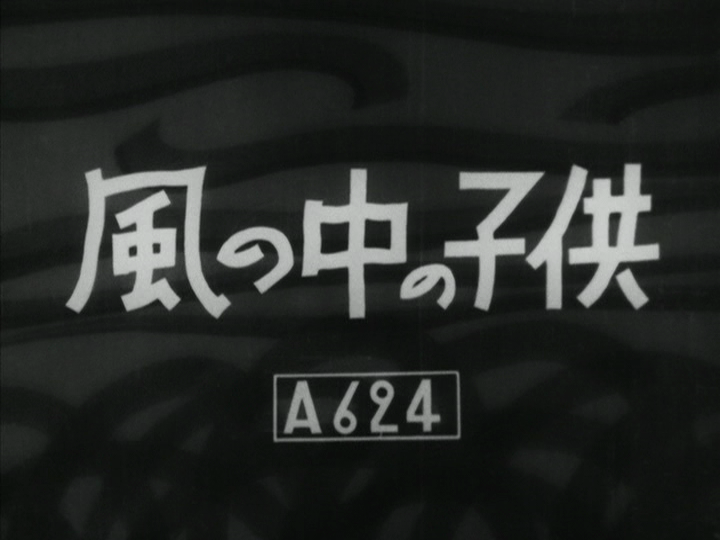
Children in the Wind (風の中の子供, Hiroshi Shimizu, 1937)

vlcsnap-2016-12-06-23h27m52s218It would be a mistake to say that Hiroshi Shimizu made “children’s films” in that his work is not particularly intended for younger audiences though it often takes their point of view. This is certainly true of one of his most well known pieces, Children in the Wind (風の中の子供, Kaze no Naka no Kodomo), which is told entirely from the perspective of the two young boys who suddenly find themselves thrown into an entirely different world when their father is framed for embezzlement and arrested.  Encompassing Shimizu’s constant themes of injustice, compassion and resilience, Children in the Wind is one of his kindest films, if perhaps one of his lightest.

Brothers Zenta (Masao Hayama) and Sampei (Bakudan Kozo) live a fairly comfortable life in a small town with their accountancy clerk father (Reikichi Kawamura) and doting mother (Mitsuko Yoshikawa). Older brother Zenta is the stereotypically good boy who studies hard, gets good grades, and causes no trouble. Sampei, by contrast, is a handful. Running out of the house to play Tarzan with the other neighbourhood kids even though he’d promised his mother he’d stay home to study to improve his awful performance at school, Sampei is the loveable rascal that no one quite knows what to do with. Despite their mother’s protestations, the boys’ father is content to let Sampei run riot for now, he’s only young after all.

When their father is accused of embezzling company funds, sacked, and later arrested, the boys’ world begins to crumble. The other kids won’t play with them anymore, their dad isn’t home, and their mother is worrying about money now that her husband has lost his job. Sampei is packed off to an uncle’s while Zenta stays behind to try and get a job to help out. Unfortunately, Sampei does not take well to his new environment and starts misbehaving even more than usual by disappearing up trees, riding a bucket down a river, running off to meet kappa, and even trying to run away with the circus!

All of this is told more or less from Sampei’s point view meaning that the facts of his father’s case recede into the background while Sampei’s worry and confusion comes to the fore. Having been in the office to deliver his father’s lunch when the coup occurred, Sampei can tell something awful has happened and tries to comfort his dad by closing all the blinds to block out the nosy kids’ faces peeking in from outside, and grabbing his father’s hat to get him to come home. Reassuring his dad that it’s all fine because he can just start a better company of his own, Sampei puts a childishly brave face on things while his ashen faced father walks home in silence. Of course, because Sampei is a child, no one explains to him exactly what’s happened, so no one explains it to us either, but we can perhaps infer a little more from the adults’ passing conversation than the still innocent Sampei.

The boys’ relationship with their father is one of the film’s warmest elements as, in contrast to the stereotypically austere salaryman dad, he delights in playing with his children, even breaking off from worrying about his impending doom by launching into a game of sumo. Sampei and Zenta know their father couldn’t have really done anything bad, so they aren’t really worried and though they miss him, they are sure he’ll be home soon. It’s not until fairly late on that they start to realise the gravity of the situation and how difficult things are for their mother, but once they do they become determined to support her too.

This being a (happy) Shimizu film, the injustice is finally undone and everything goes back to normal which what all children always want. Children, more than adults, are apt to forget quickly and so it’s not long before the other neighbourhood kids start responding to Sampei’s Tarzan call once again. In a typically nice touch, Sampei even invites his arch rival, Kinta – the son of the man who framed his dad for embezzlement in the first place, to come and see the approaching circus with him. A final gesture of reconciliation signals the end to hostilities as a possibly life changing event becomes a humorous summer interlude in the boys’ early lives. Warm and lighthearted, Children in the Wind is perhaps not as cutting or incisive as some of Shimizu’s more socially conscious efforts, but is filled with his characteristic compassionate humanism in its childlike certainty in justice and the willingness to forgive and forget.