Kokkuri (こっくりさん, Takahisa Zeze, 1997)

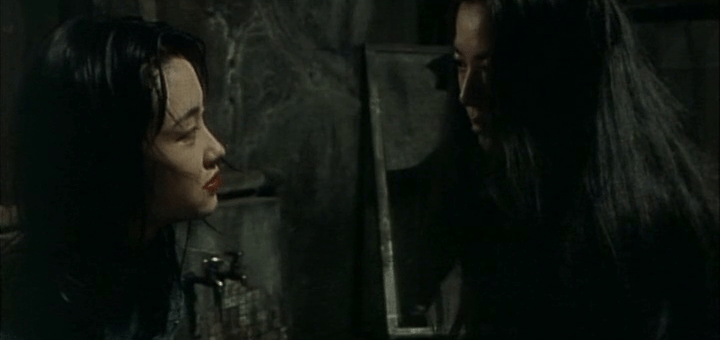
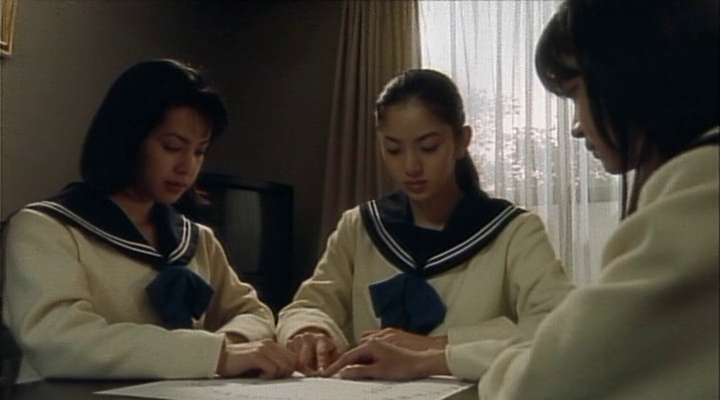
The tensions between a trio of young women are brought to the fore by an ill-advised consultation with Kokkuri-san in Takahisa Zeze’s atmospheric horror movie. Some more than others, these girls are all haunted if only by adolescent confusion and suppressed desire. Looking for answers with no one turn to in the absence of parental authority, they rely doubly on a late-night radio show, Midnight Blue Bird,  hosted by a girl their age calling herself “Michiru”.

“Michiru” is the heroine of the Japanese version of Blue Bird fairytale about a brother and sister who leave in search of the blue bird of happiness only to return and realise that it was waiting for them at home all along. While the moral of the fairytale might be that happiness is all around us if only you know how to look, there is precious little surrounding the girls outside of their friendship which is already beginning to fracture under the weight of adolescence, not to mention a series of overlapping love triangles.

What neither of the other girls know, is that Michiru is actually a persona constructed by Mio (Ayumi Yamatsu) who is actually the host of the radio show. As Michiru she claims to be sexually experienced and rebellious, answering the questions that come from other young women though, in reality, a regular high schooler and romantically naive. As we gradually become aware, she is in love with her friend Hiroko (Hiroko Shimada), but Hiroko has a crush on Masami’s fickle boyfriend Akira. It was Mio who suggested the Kokkuri-san game on her radio show, a Ouija board style means of divination, but it quickly turns dark with Masami (Moe Ishikawa) manipulating the board to needle Hiroko after realising she’s after her boyfriend.

The resulting fallout pushes Hiroko and Mio towards a confrontation with their shared traumas as survivors of a drowning. Hiroko is haunted by a little girl in red, ironically named “Midori” which means “green”, and struggles to get over the guilt she feels over a childhood friend who drowned in a public bath. Mio, meanwhile, gives contradictory biographical information on her show, but it seems that Mio’s mother intended to take her own life with Mio in tow after she caught her with her new husband to be following the death of Mio’s father. Echoing the central motivation of the film, Mio’s mother suggests the “go together” to where her father is, but later saves Mio alone.

But while Hiroko becomes preoccupied with the notion of sex, vowing to become more like Michiru, she tells Michiro that thanks losing her virginity will change her though she later laments that it’s changed nothing at all. Mio, meanwhile seems to have a hangup having caught her mother with another man. In disgust, she rubs at her libs in the same way that the older Mio later does after finally finding the courage to kiss Hiroko who lips have, by then, been coated in striking red lipstick. The colour red seems to represent the curse of Kokkuri-san and with it repressed guilt, regret, and forbidden desire. Though it seems that by learning to accept herself, publicly unmasking herself on her radio show and confessing her love for Hiroko live on air, Mio alone is able to overcome the curse. The kiss she gives Hiroko is one of life that seems to break the spell and free them both from Kokkuri-san’s trap, though all may not be as it first seems. 

Nevertheless, the fact that Hiroko does not remember makes this something of a private evolution for Mio even as voices from the past resurface and encourage them “go together” toward whatever fate awaits them in the film’s ambiguous conclusion that echoes that of Zeze’s earlier pink tale of frustrated same-sex desire, Angel of September, which shares many of the same themes. Even so, in finally accepting her sister, who is impressed and supportive of her coming out live on air even if she cynically adds it can be her new gimmick, Mio has undergone a transformation into adulthood and symbolically been reborn, emerging from the cleansing waters with greater clarity and self-assurance if perhaps no more certain of what the future may hold.


Trailer (no subtitles)
The Pinkie (さまよう小指, Lisa Takeba, 2014)

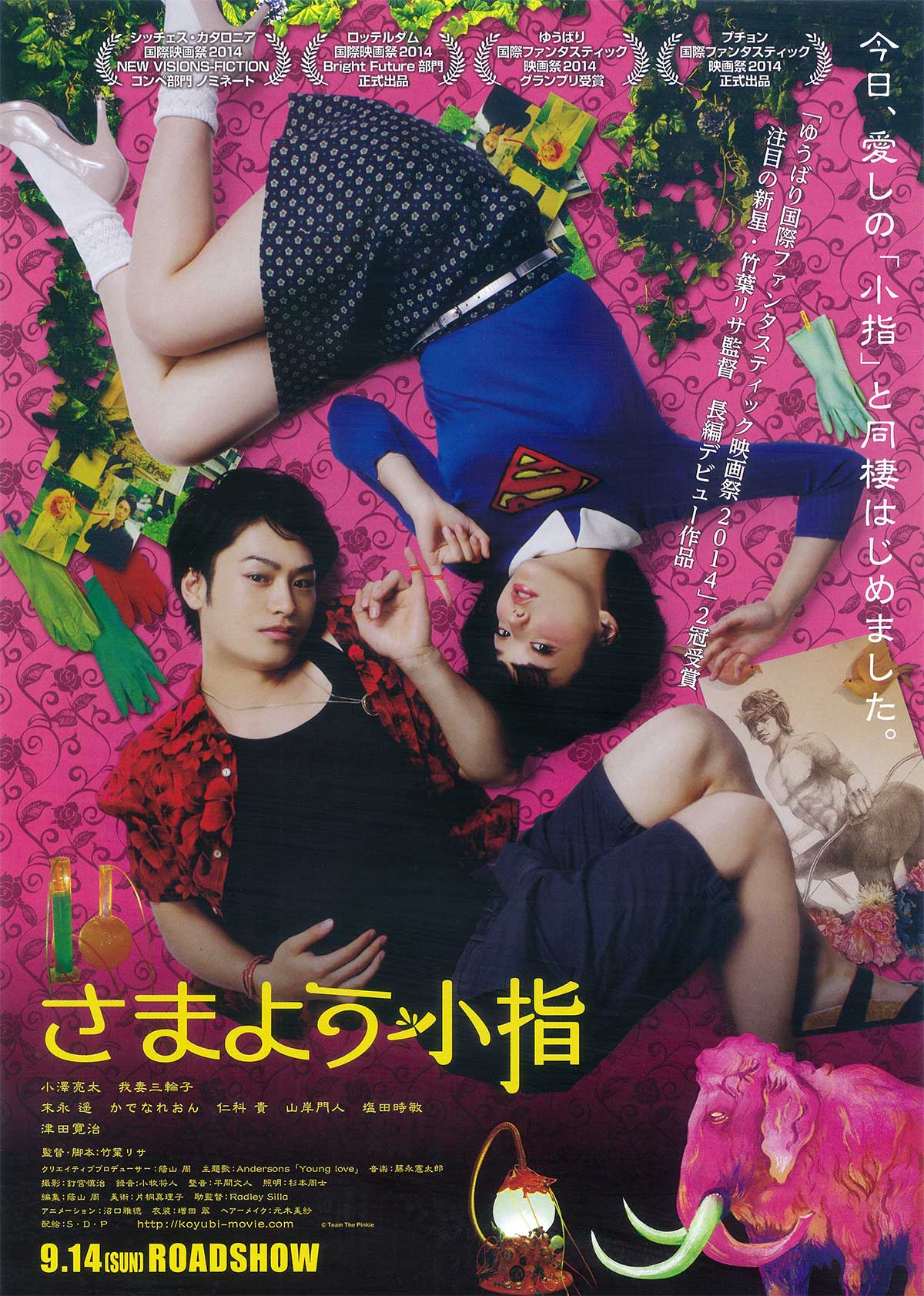
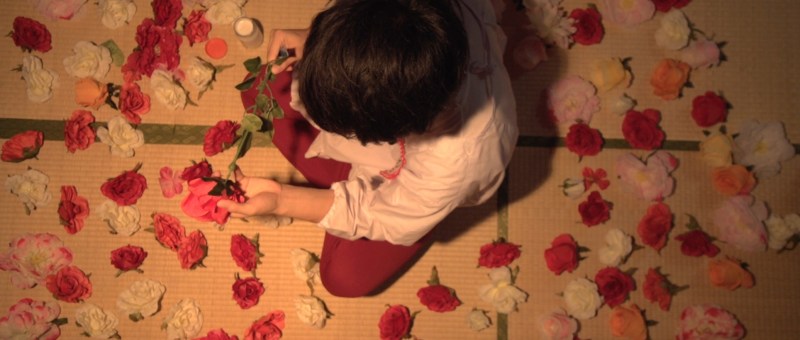
the pinkie posterWhat if someone cloned you and then they liked the other you better? The “hero” of Lisa Takeba’s debut feature The Pinkie (さまよう小指, Samayou Koyubi) is about to find out when his rather depressing life takes a turn for the surreal. Winner of the Grand Prize at the Yubari International Fantastic Film Festival, The Pinkie is an exercise in madcap fun which packs a considerable amount into its barely feature length runtime of 65 minutes. Ever cineliterate, Takeba leaps from sci-fi to romance to yakuza movie and revenge flick but then her ambitions are more grounded in the real as she explores the fallacy of infatuation, the nature of true, selfless love and the necessity of waking up from a romantic dream.

Ryosuke (Ryota Ozawa) has a lifelong problem. Ever since they were five, a girl has been stalking him. Momoko (Miwako Wagatsuma), in Ryosuke’s words, is the ugliest woman in the village. So infatuated is she, that Momoko has even undergone cosmetic surgery to adjust her face to Ryosuke’s tastes but that’s only made him dislike her more. Truth be told, Ryosuke is no great catch. He has no job and exists on the fringes of the underworld. He has, however, found love, of a kind, but unfortunately the lady in question is the paramour of a local gangster kingpin. Discovered in his illicit romance, Ryosuke is tormented by the gangsters until they eventually exact some of their trademark justice by cutting off his pinkie finger which then flies halfway across town and into the path of Momoko who uses it to create her very own Ryosuke clone.

Shifting focus somewhat, Takeba then tells the story of Momoko and the clone whom she christens “Pinkie Red String” in reference both to his origins and to the red strings which bind true lovers together. Momoko begins taking care of Pinkie, buying him clothes and teaching him to survive in the modern world, and before long the two have become a couple.

Ryosuke doesn’t quite like having a doppleganger – especially one who’s almost his polar opposite in terms of outlook and general personality. Under the gentle guidance of Momoko, Pinkie is good person who works hard, is kind to those around him, and is almost entirely selfless. Stolen away by Ryosuke, Pinkie becomes something between maid and prisoner as he takes on a purely domestic role, cooking and cleaning for his new master who later sends him out to work dressed as a woman wearing a long black wig and red dress, just to ram the point home.

Takeba’s aim is madcap fun but she also offers up a commentary on emotional repression as both Momoko and Ryosuke pursue their respective romances. Momoko has only ever wanted to express her love but her methods backfire, eventually getting her sent to a reform school which leads to the breakup of her family. Ryosuke, by contrast seems to be a fairly romantic, if sometimes cynical soul, originally asking if anyone would really sacrifice themselves for love only to attempt to do exactly that later on (though far too late). Neither Ryosuke nor Momoko is able to show their love in a straightforward way, opting for grand gestures over simple words. “Love needs a victim”, as someone later puts it, but there’s no need to run so eagerly to the gallows.

The world of The Pinkie is one of intense genre fusion as Takeba mixes references from classic cinema with the anarchic pace of anime and manga. Mad scientist sci-fi shifts to classic kung fu before cycling back to jitsuroku yakuza movie complete with on screen captions and brief sting of the iconic Battles Without Honour theme, but even if Takeba can’t always control her rate of progression her leaps are always inventive and unexpected, humorous and melancholy in equal measure. Pinkie, fulfilling his stranger in town role, begins to change his progenitor’s cynical psyche. Ryosuke is no longer the selfish loser but has learned to befriend the wounded Momoko who has also realised she can do better, abandoning her youthful fantasies for something more “real”. Then again, perhaps there is a second chance for lost love even if it is, in a sense, a synthetic solution for a very human problem.


Currently available to stream via FilmDoo in most of the world!

Original trailer (English subtitles)