Ninja’s Mark (忍びの卍, Norifumi Suzuki, 1968)

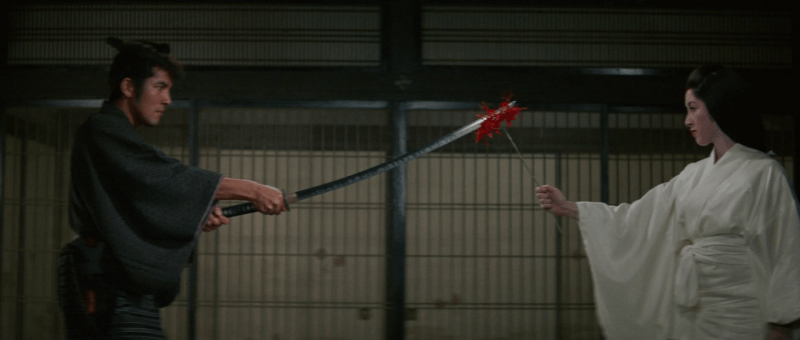
Many have tried to end the Tokugawa line. Few have done so by covering a courtesan’s legs in fish scales to put the Shogun off his stride. Based on a book by Futaro Yamada, Norifumi Suzuki’s Ninja’s Mark (忍びの卍, Shinobi no Manji) is at heart a romantic tale in which love is “part of the game” but also apparently the one trick a ninja can’t escape. Perhaps that’s why Shogun Iemitsu at the comparatively late age of 30 has failed to produce an heir with any of the beautiful yet emotionally distant courtesans of the inner palace many of whom also seem to be ninjas, therefore provoking a constitutional crisis.

Aside from that, it seems the ninja plot is a kind of revenge against the Tokugawa carried out by the last remnants of a house that was dissolved by the Toyotomi. There are in fact three ninja clans all clustering around the palace, Iga, Koga, and Negoro, each of whom have different kinds of skills. Technically, some of them are in the employ of the Shogun’s disinherited younger brother Tadanaga (Shingo Yamashiro), but others of them are working strictly for themselves and their revenge. In any case, their plan is to prevent Iemitsu from fathering an heir by putting him off sex essentially by making it freaky (in a bad way). Thus one of the ninjas uses his ability to transform objects so that the courtesan’s legs are covered in fish scales. Another plan sees a ninja body swap with one of the women so that Iemitsu’s sperm ends up inside him where it obviously has nowhere to go. Meanwhile others hatch a plan to steal some of Tadanaga’s seed to use on the women in the inner palace to cover up Iemitsu’s potential infertility seeing as it is after just as good being of the Tokugawa line. 

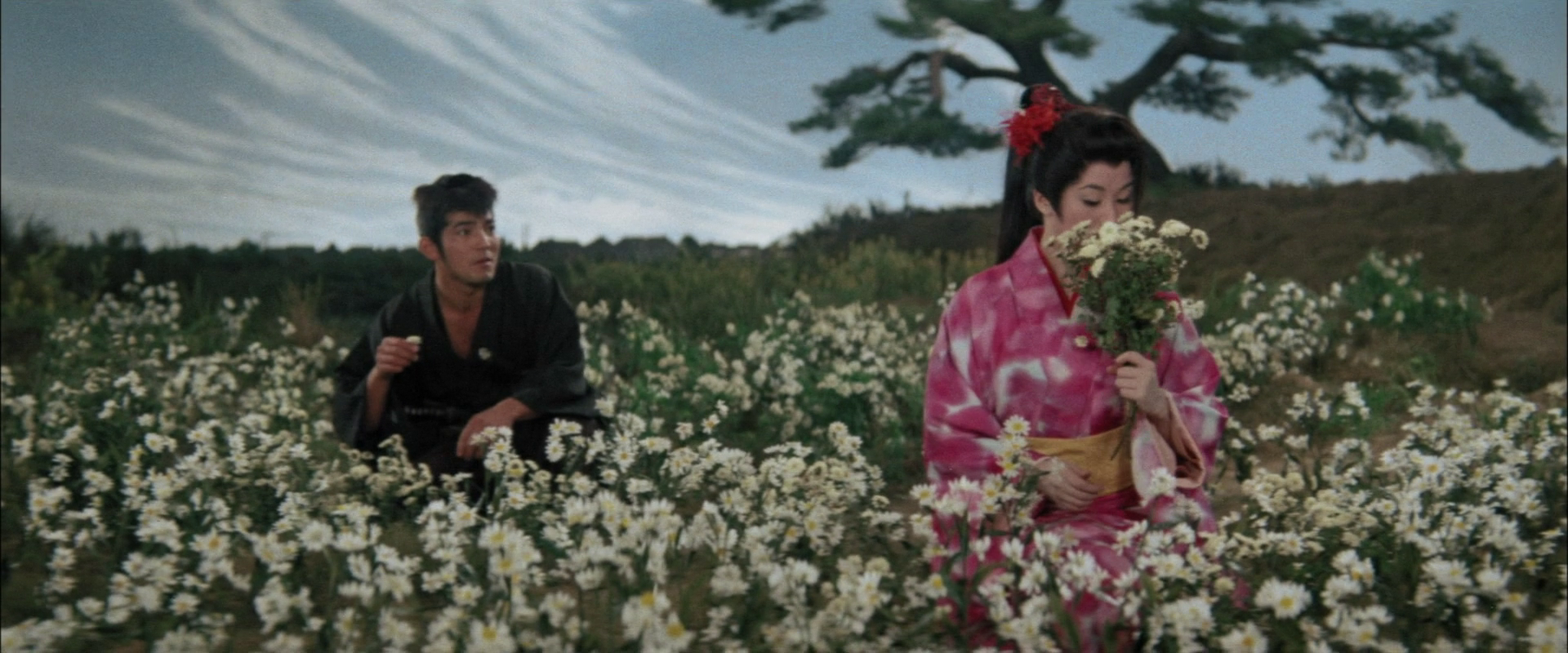
This particular ruse is suggested by Toma (Isao Natsuyagi), the disenfranchised former member of the Yagyu school turned ninja ronin they bring in to solve the problem. He quickly homes in on Kageroi (Hiroko Sakuramachi), a female ninja, as the villainess whose special power is poisoning men with love and desire by means of the spider lily plant. But as Toma points out to her, she is also a prisoner of her skill in that if she were to fall in love she would inevitably kill her lover. Of course, he survives her first attempt to kill him, leading her to fall in love with Toma and become conflicted in her mission while he plays on her emotions to escape but eventually realises they may be more genuine than he first realised. 

In this, Suzuki brings some of his trademark romanticism particularly in the colourful art nouveau aesthetics and frequent use of rose imagery. Though the film is clearly designed to lean into the erotic with frequent use of nudity and salacious scenes including a brief moment of lesbian seduction, it eventually heads towards romantic tragedy in which the debauched and nihilistic Toma and the wronged Kageroi discover a love made impossible by their ninja code and the times in which they live. Having been ordered to kill her, Toma declares that he will marry Kageroi in the next life and returns to her the Buddhist Manji that is the “ninja mark” of the title. 

Nevertheless, the dialogue is often suggestive as in Kageroi’s curse that Toma’s “sword” will rot, while it’s also Toma’s “sword” that alerts him to the danger she presents. Toma too claims to derive his ninja powers from his “sword” having apparently concentrated them by repressing his sexual desire and swearing off women. He says that he seals all his “distracting” thoughts into a virgin, closing off all her senses and placing her into a coma until he breaks the spell. Even so, he admits that without his “sword” he is just a man, and as a man claims to love Kageroi, but as long as he has his “sword”, and she her “lily”, their love is impossible. 

But this repressed love seems to pose less threat to the social order than the lack of it in Iemitsu who is bored with his courtesans and cannot conceive an heir. Constitutional crisis is averted only through a little ninja trickery and a convenient ruse to overcome Iemitsu’s infertility so that in time he produces five sons and a daughter, which honestly seems like it might just present another set of problems in about 30 years’ time. Like similarly themed ninja pictures, Suzuki makes good use of surrealist imagery and colour play alongside the kind of onscreen text later used in jitsuroku yakuza films to name each of the ninja’s key skills and which clan they belong to. What he always returns to, however, is the sense of romantic tragedy in a world seemingly poisoned by ambition in which love itself is rendered an impossibility. 


*Norifumi Suzuki’s name is actually “Noribumi” but he has become known as “Norifumi” to English-speaking audiences.
Kekkon Annai Mystery (結婚案内ミステリー, Yoshikuni Matsunaga, 1985)

Selected via a talent competition held in conjunction with the search for a new actress to play the leading role in Kosei Saito’s Ninja Wars, Noriko Watanabe became the second of the new “Sannin Musume” alongside the future star of The Little Girl Who Conquered Time, Tomoyo Harada, and Kadokawa’s top idol Hiroko Yakushimaru. Her career with the studio was however comparatively short-lived affording her only three leading roles before she eventually left the agency and went independent after turning down a lead in Koibitotachi no Jikoku because of its explicit nude scenes. Again adapted from a novel by Jiro Akagawa, Kekkon Annai Mystery (結婚案内ミステリー) was her final leading performance as a Kadokawa idol (though she would also play a supporting role in Obayashi’s His Motorbike, Her Island) and saw her playing a slightly more mature role as a young woman working for a matchmaking agency who finds herself mixed up in a country house mystery after accepting an unusual proposal from a client. 

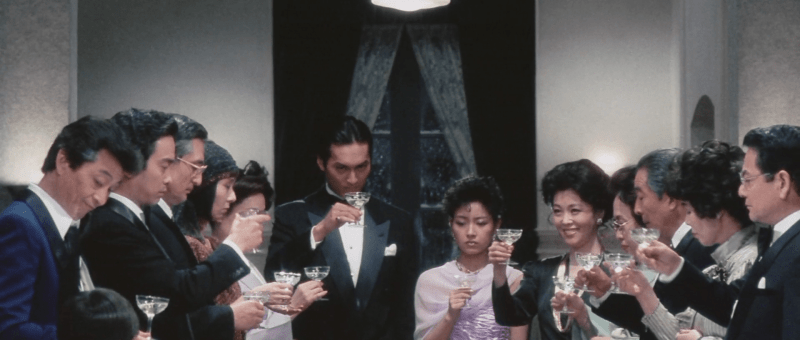
At 19, Hiroko (Noriko Watanabe) is the sole employee at the Fukada Marriage Consultation Agency owned and operated by her boss Mr. Fukada (Bengal). As we first meet her she’s deep undercover at a rival firm which has already shifted into a new era of computer-assisted matchmaking whereas Mr Fukada prefers to do things the old-fashioned way which is presumably why he has no business. It comes as something of a shock therefore when he receives a call from Mrs. Sekine (Aiko Nagayama), the temporary CEO of a major company who apparently wants to find a match for her son Masakazu (Ken Watanabe) who is shortly to return after graduating from Harvard in order to take over the family business following the death of his father six months previously. At the initial consultation, however, Mrs Sekine scandalises Mr Fukada by immediately selecting Hiroko as a potential bride. Seeing as it’s only an initial meeting, which would earn them a bonus payment, Hiroko agrees but when they drive out to the Sekines’ creepy gothic mansion in the middle of nowhere they discover all is not quite as it seems. Masakazu has a fiancée already, but unfortunately she was involved in a traffic accident and is currently in hospital which is a problem because for undisclosed reasons they need to hold the wedding right away. Hiroko is to act as a proxy seeing as no-one who’ll be coming to the ceremony has met Masakazu’s girlfriend and so will be none the wiser. 

Perhaps somewhat naively, Hiroko agrees and ends up staying in the house posing as Masakazu’s intended which includes sharing a room. Briefly shifting genres, a training montage sees Hiroko undertaking a crash course in how to be posh, adopting the correct deportment, using cutlery elegantly, and learning to walk downstairs in massive heals or up while wearing an inconveniently long dress. Which is all to say, the fabulously wealthy inhabit a different world of which Hiroko was hitherto ignorant. This is further brought home by the apparent cracks in the foundations of the Sekine family which is also a corporate entity with the other board members largely favouring other candidates more closely connected to the themselves to take over as chairman while apparent liability uncle Masao (Tamio Kawaji), whose creepy crossbow-carrying young son Mamoru is for some reason being raised by Mrs Sekine, is in some kind of trouble with yakuza loansharks. The other main issue is that Mrs Sekine is a second wife and longtime mistress of the late CEO. Masakazu was born out of wedlock and Mrs Sekine will do anything and everything she can to ensure he assumes his birthright. 

Counter-intuitively succession intrigue has little to do with the central mystery which begins to unravel when Hiroko is attacked on the eve of her wedding by a strange woman who had previously tried to warn her off Masakazu and kills her in self-defence. The body, which we can identify as that seen buried in the snow in the solarised green-tinted opening sequence, is taken care of by Mrs Sekine’s right hand man Kinoshita (Hayato Tani), but Hiroko begins to have her doubts after catching sight of a woman who looks exactly like the one she killed at the local ski resort. 

“Rich people are like that. They’d lie about anything in order to keep their wealth” Hiroko is told, realising she may be at the centre of an infinitely complex plot and becoming aware of Mrs Sekine’s tendency to throw money at people to get them to play along with her plans. Like any good gothic mystery, however, the house holds a dark secret in a hidden room which perhaps hints at the corruptions of the Bubble era along with those of the super rich elite and the undue pressure it puts on its young while uncomfortably suggesting that Mrs Sekine herself is the source of the corruption in her attempt to integrate into a higher social class into which she was not born. Atmospheric in its chilling vistas of the freezing snow, Kekkon Annai Mystery’s twisting tale of greed and manipulation may end in tragedy but ironically lives up to its name as its heroine finds a potential match in her accidental co-conspirator. 


Sasuke and His Comedians (真田風雲録, Tai Kato, 1963)

Criminally unknown in the Anglophone world, where Tai Kato is remembered at all it’s for his contribution to Toei’s ninkyo eiga series though his best known piece is likely to be post-war take on High Noon made at Shochiku, By a Man’s Face Shall You Know Him in which a jaded doctor finds himself caught in the middle of rising tensions between local Japanese gangsters and Zainichi Koreans. Kato’s distinctive visual style shooting from extreme low angles with a preference for long takes, closeups and deep focus already make him an unusual presence in the Toei roster, but there can be few more unusual entries in the studio’s back catalogue than the wilfully anarchic Sasuke and his Comedians (真田風雲録, Sanada Fuunroku), a bizarre mix of musical comedy, historical chanbara, and ninja movie, loosely satirising the present day student movement and the limits revolutionary idealism. 

An opening crawl introduces us to the scene at Sekigahara, a legendary battle of 1600 that brought an end to Japan’s warring states period and ushered in centuries of peace under the Tokugawa. Onscreen text explains that this is the story of the boys of who came of age in such a warlike era, giving way to a small gang of war orphans looting the bodies of fallen soldiers and later teaming up with a 19-year-old former samurai realising that the world as he knew it has come to an end. Soon the gang is introduced to the titular Sasuke who, as he explains, has special powers having been irradiated during a meteor strike as a baby. Recognising him as one of them, the war orphans offer to let Sasuke join their gang, but he declines because he’s convinced they’ll eventually reject him in fear of his awesome capabilities. Flashing forward 15 years, the kids are all grown up and the only girl, Okiri (Misako Watanabe), is still carrying a torch for Sasuke (Kinnosuke Nakamura) who dutifully reappears as the gang find themselves drawn into a revolutionary movement led by Sanada Yukimura (Minoru Chiaki) culminating in the Siege of Osaka in 1614. 

Don’t worry, this is not a history lesson though these are obviously extremely well known historical events the target audience will be well familiar with. A parallel is being drawn with the young people of early ‘60s Japan who too came of age in a warlike era and who are now also engaging in minor revolutionary thought most clearly expressed in the mass protests against the ANPO treaty in 1960 which in a sense failed because the treaty was indeed signed in spite of public opinion. Kato’s Sanada Yukimura is a slightly bumbling figure, first introduced banging his head on a low-hanging beam, wandering the land in search of talented ronin to join up with the Toyotomi rebellion against the already repressive Tokugawa regime. His underling sells this to the gang as they overlook a mile long parade of peasants headed to Osaka Castle as a means of bringing about a different future that they can’t quite define but imply will be less feudal and more egalitarian which is how they’ve caught the attention of so many exploited farmers. 

Of course, we all already know how the Siege of Osaka worked out (not particularly well for anyone other than the Tokugawa) so we know that this version of the 16th century better world did not come to pass the implication being that the 1960s one won’t either. The nobles are playing their own game, the Toyotomi trying to cut deals but ultimately being betrayed, while the gang fight bravely for their ideals naively believing in the possibility of victory. Sasuke, for his part, is a well known ahistorical figure popular in children’s literature and this post-modern adventure is in essence a kids’ serial aimed at a student audience, filled with humorous anachronisms and silliness while Kato actively mimics manga-style storytelling mixed with kabuki-esque effects. Boasting slightly higher production values than your average Toei programmer, location shooting gives way to obvious stage sets and fantastical set pieces of colour and light which are a far cry from the studio’s grittier fare with which Kato was most closely associated. That might be one reason that the studio was reportedly so unhappy with the film that it almost got Kato fired, but nevertheless its strange mix of musical satire and general craziness remain an enduring cult classic even in its ironic defeatism. 


Original trailer (no subtitles)