Tokarev (トカレフ, Junji Sakamoto, 1994)

The discovery of a pistol concealed under a vending machine provokes a prolonged crisis of power and masculinity in Junji Sakamoto’s tense psychological drama, Tokarev (トカレフ). So named for the guns at its centre, the film roots itself in post-Bubble anxiety in the push and pull between two very different men mediated through the kidnapping of an innocent child who in the end pays a very heavy price for the anxieties and resentments that drive his parents’ generation.

That said, the kidnappers are actually very nice to little Takashi who looks strangely happy in the videotaped ransom note as the friendly voice of a youngish man encourages him to look towards the camera. They take him to an amusement park, buy him new shoes and ice cream, and even let him wave the gun around during the money drop but are it seems otherwise callously indifferent to his fate.

The boy’s father, Nishiumi (Takeshi Yamato), has just moved onto a danchi housing estate with his wife Ayako (Yumi Nishiyama). They seem very excited to start their new life, yet the danchi itself speaks of a post-war aspiration which now seems dated and largely absent in the contemporary society. Nishiumi drives the bus to the local kindergarten picking up the surprisingly large number of children from their block each morning. Meanwhile, their neighbour, Matsumura (Koichi Sato) seems irritated by their presence perhaps jealous of their happy family life as he returns home alone and angrily flips the cover over his motorbike before opening the door. 

On the morning in question, Matsumura has trouble kickstarting his bike yet Ayako seems strangely drawn to him perhaps attracted by a different and older kind of masculinity. Unlike her husband, Matsumura wears a suit to work everyday and carries a little salaryman-style purse yet he works a job that could be considered manual in a printing press where they produce newspapers. He later excitedly tells Ayako that he gets to read the news before anyone else, though his hands glide over notices of violent crimes including a shooting which may seem additionally exciting to him given that he is the man who discovered a gun under a vending machine in Christmas-set opening sequence. His cluttered home otherwise at odds with the sense of order he projects is full of old newspapers while he seems to listen to the same weather broadcast every day. 

The gun is later used by another man who fires it at Nishiumi before abducting Takashi from the kindergarten bus. It takes Nishiumi a few seconds to realise it’s Takashi who’s been taken, suddenly taking off at speed after him endangering the lives of the other kids. The sense of guilt and inadequacy slowly consumes him. “Takashi must be so disappointed,” he later laments to Ayako over the phone in his failure to live up to the socially defined codes of masculinity. His son was taken from him in front of his eyes yet he couldn’t do anything to save him. Matsumura meanwhile turns up near the crime scene having been shot in the shoulder claiming the kidnapper stole his bike. 

Perhaps it’s this uncanny proximity along with his odd expression and obvious effect on Ayako that leads Nishiumi to believe that Matsumura was somehow involved in the crime. In another instance of mid-90s technophobia, the clue is once again discovered via videotape as a guiltridden Nishiumi spots Matsumura in the crowd at his son’s sports day which is odd considering he has no children of his own and no reason to be there. The kidnapper also films the random drop on camcorder, black and white images capturing a crowded Shibuya presumably as some kind of insurance plan.

After being attacked and seriously injured, Nishiumi ends up in hospital where he ironically discovers a gun of his own stashed in the restroom by a visiting yakuza. As it had Matsumura, the gun gives him a new sense of power but also drives him into a frenzied obsession, dressing like a yakuza himself in a suit and dark glasses having alienated Ayako who eventually leaves him for Matsumura who has by this point usurped him as a man and patriarch, taking everything he ever had. No longer wishing to live, he embarks on a suicide mission to get his revenge on Matsumura. The pair of them essentially trade places, Matsumura now in check shirt and jeans while Nishiumi approaches in a suit each of them corrupted by the illusionary power of the gun. 

It later transpires that the kidnapper was also facing a crisis of masculinity in that his business was about to go bust, though Nishiumi was not a wealthy man or particularly good candidate for a ransom. The police, who are in fact completely useless, bungling their only opportunity to retrieve Takashi because they were caught off guard by the kidnapper giving him the gun, keep asking him if there’s anyone who might have held a grudge but as he points out there must have been thousands of incidents of petty annoyance that may have pushed someone over the edge dating all the way back to his childhood. The battle he finds himself in is one of vengeance to reclaim his wounded sense of masculinity while Matsumura in turn is determined to defend the new life he’s bought for himself or perhaps stolen from Nishiumi as a happy family man. Sakamoto keeps the tension high through the near wordless closing sequence in which the two men square off against each other with the intention of meeting their endgame each victims of the pervading sense of futility of the post-Bubble era.
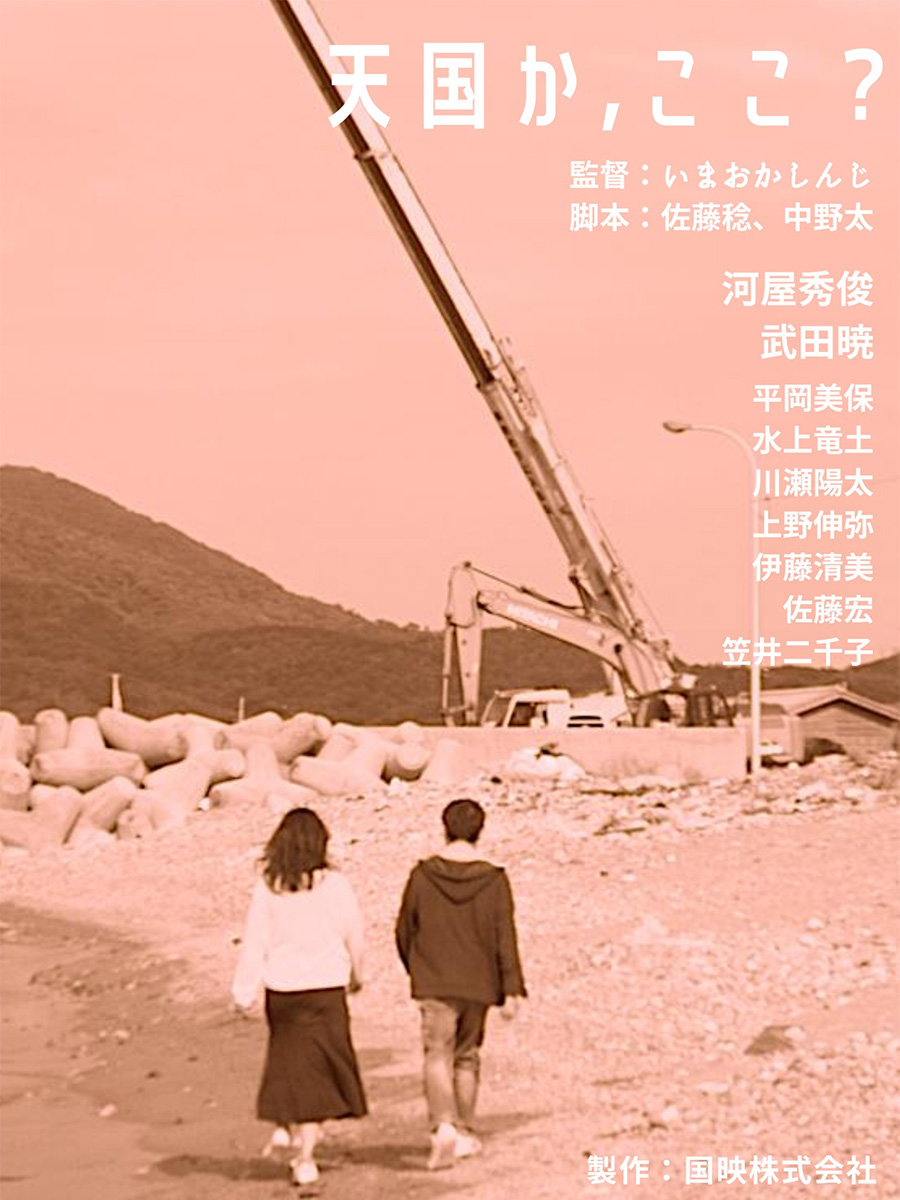
Is This Heaven? (天国か、ここ?, Shinji Imaoka, 2023)

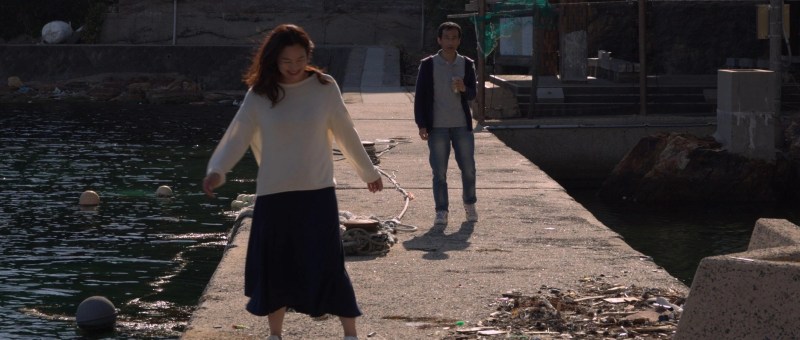
A middle-aged couple ponder loss and regret on a surreal odyssey into the afterlife , or something like it at least, in Shinji Imaoka’s cheerfully absurdist dramedy Is This Heaven? (天国か、ここ?, Tenkokuka, Koko?). Reuniting with several actors who starred in Imaoka’s previous film Reiko and the Dolphin, the film addresses several of the same themes in its exploration of grief and the inability of moving on but perhaps paradoxically sees its central couple arrive at a happier destination having begun to repair a marital rift. 

How they end up in “Heaven” isn’t exactly clear. Nobuo (Hidetoshi Kawaya), a middle-aged man who likes a drink, dances along a highway with half a can of chuhai in his hand and suddenly finds a flier with the word “Heaven” written on it. Everyone he meets seems to be doing an odd dance, even his wife Mayuko (Aki Takeda) who soon snaps out of her trance to tell him off for drinking in public again. While wandering around wondering where they are and how to get back because stationery stores don’t run themselves, the couple run into an old friend, Ueno, which is nice but also weird because Ueno died a week ago having hanged himself in shame over the failure of his business. 

Like everyone else in this strange place, Ueno is irrepressibly cheerful and seems to know nothing of his suicide. “When we die, we go to Earth, right?” he asks perplexed while Nobuo begins to wonder what it might mean if he’s really in Heaven, if he’s alive or dead or something in-between. Gradually we come to understand that there is tension in the marriage, much of it born of Nobuo’s insecurity. He fears that Mayuko only married him out of lonely desperation following the death of her first husband Takeshi (Yohta Kawase) whom she may never have got over, and that absolutely anyone would have done it just happened to be him. He resents Mayuko pointing out they’ll be in trouble if they close the stationery store because he’s never had a proper a job and his drinking problem won’t allow him to get one. 

It may be drinking that’s brought him on this strange odyssey. The film is divided into four chapters each bearing the title of a progressively harder drink as things get ever stranger while Nobuo wanders around meeting various other strange people including one who may have appeared in one of Imaoka’s previous films along a with a young woman obsessed with shogi and sex. Nobuo later describes them as people he’ll never meet again, standing this time on the other shore of life and death shouting back at the void in a defiant memorial of all he’s lost. Yet his weird journey to the other side has perhaps helped both he and Mayuko deal with the unresolved past and with it the cracks in their marriage.

In a strange way it may be that “Heaven” really is “here” as the couple rediscover an appreciation for all that they have now in the shadow of past and future loss. Indeed, one of the things that convinces Nobuo that he’s not really “dead” is the fact that he can still get drunk and is at least able to feel something while experiencing the sensations of life in taste and touch that the dead can no longer enjoy. “It’s such a miraculous thing” Mayuko sadly tells the younger woman of meeting and falling in love, reminding her not to waste the gift she’s been given. 

Then again, Nobuo’s conception of Heaven is very much that of a middle-aged man with its drinking and hostess clubs even if Mayuko opts for the more wholesome option of a trip to the onsen while the young woman rebels against her unwholesome life by embracing the comparatively respectable game of shogi. The strangely dreamlike, elliptical quality of the other world Nobuo and Mayuko find themselves in has its qualities of whimsy in the weird dancing, the death god wine, random cake, and underwater voice effects but also a deep melancholy and a kind yearning for something, well, more Earthy that the pair may eventually rediscover at the end of their journey.


Is This Heaven? had its World Premiere as part of this year’s Osaka Asian Film Festival.

Original trailer (no subtitles)

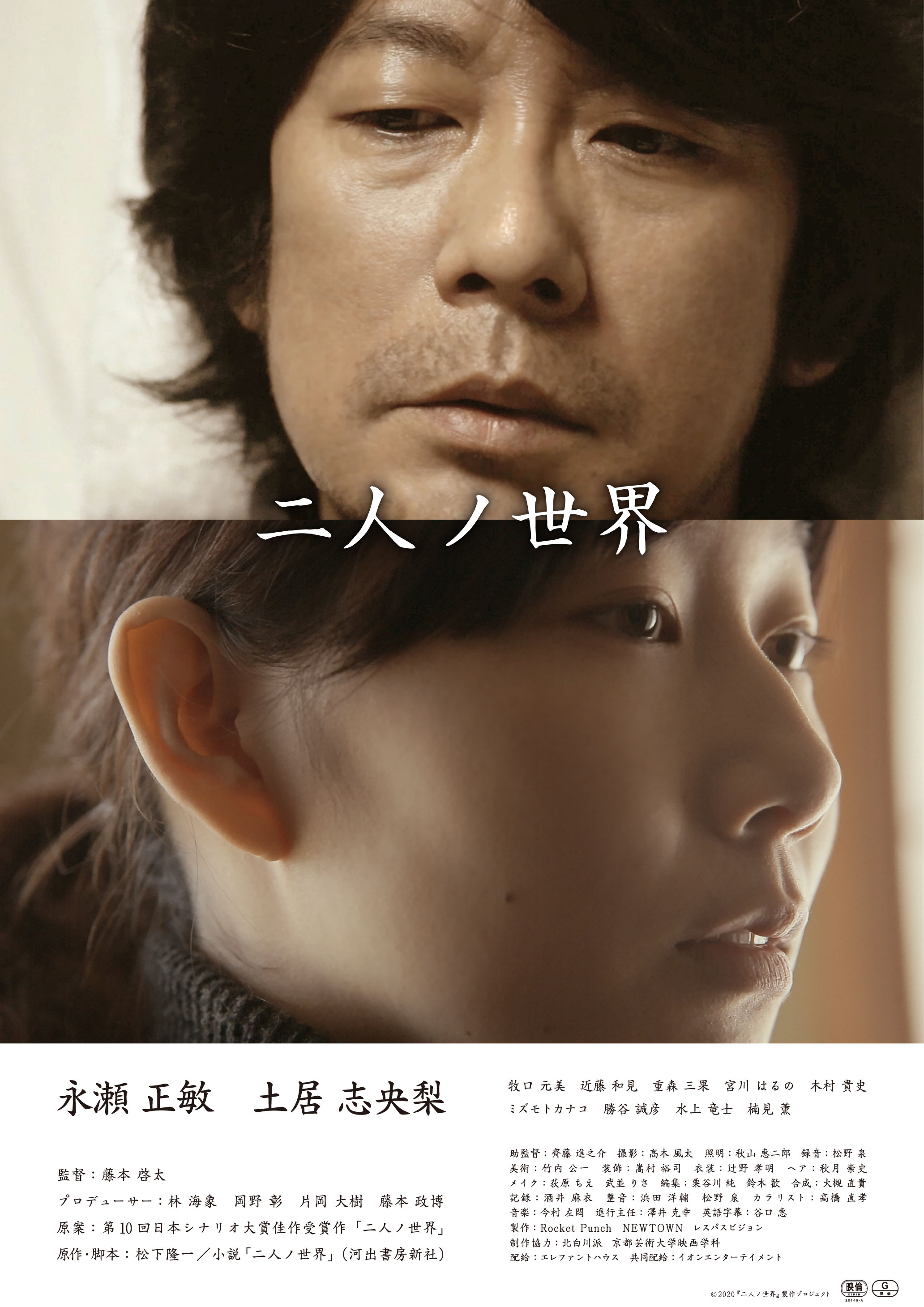
Just the Two of Us (二人ノ世界, Keita Fujimoto, 2020)

“We’re just ordinary people” the heroine of Just the Two of Us (二人ノ世界, Futari no Sekai) eventually exclaims in exasperation with the often hostile world around her. Produced by Kaizo Hayashi as a project for students at the Kyoto University of the arts, Keita Fujimoto’s sometimes bleak social drama offers a less rosy view on disability in the contemporary society than has perhaps been seen in recent Japanese cinema as the twin protagonists each struggle against prejudice and preconceived notions of how disabled people should live while internalising a sense of shame and impossibility that leaves them with little hope for the future. 

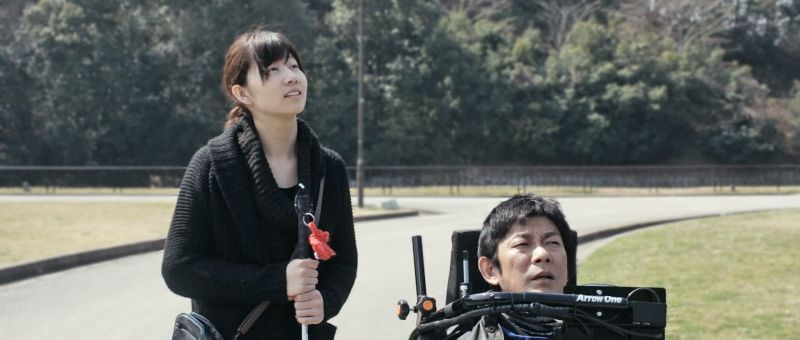
Opening in darkness, the scene then shifts to bright sun light as a young woman, Hanae (Shiori Doi), is woken by a phone call informing her she has been unsuccessful in a recent job application. Meanwhile, Gohei (Motomi Makiguchi), an old man caring for his son Shunsaku (Masatoshi Nagase) who has been paralysed from the neck down since a motorbike accident some years previously, finds his latest attempt to hire a carer ending in failure, Shunsaku deliberately making obscene comments towards the earnest young woman leaving her so upset that she leaves in tears and does not return. After hearing Gohei discussing his problem on a local radio show, Hanae decides to apply for the job the only thing being that she herself is blind which is why she’s been having so much trouble trying to find employment. 

Gohei has his doubts, but after talking to the young woman and witnessing her take no notice of Shunsaku’s attempts to make her uncomfortable, he decides to take her on in part because she reminds him of his late wife and he instinctively feels that he can trust her. As we discover, that’s something all the more pressing to Gohei because not only is he finding it increasingly difficult to care for his son as he himself ages but is also suffering with a serious medical condition and worrying who will look after him once he’s gone. For all these reasons he places a heavier responsibility on Hanae than she had expected, showing her where the spare key is in case she needs to get in when he’s out and even handing over their passbooks and bank cards. A little shocked, Hanae asks him if that’s really necessary, how does he know she won’t just run off with them but he simply tells her that he knows she’s not the sort of person who would do something like that and indeed she isn’t. 

As she later reveals, Hanae has no family of her own repeatedly reminding Shunsaku that he was lucky to have parents that loved and cared for him as much as they did. She becomes in a sense a member of the family, Gohei telling hospital staff she is his daughter while later even Shunsaku claims to be her husband in order to make a point. Yet the arrangement is not one that all find suitable, Shunsaku’s snooty aunts instantly taking against Hanae on the grounds that they cannot believe a blind woman could care for a paralysed man while simultaneously attempting to chase Shunsaku out of his home he fears disguising their desire to get their hands on the inheritance as concern for his wellbeing. They continue to infantilise him, refusing his right to make his own decisions over his life even though he is a man in his 40s of entirely sound mind insisting he should be put away in a nursing home rather than allowed to live as independently as possible in a house which he owns. 

Tellingly Shunsaku had been reluctant to leave the house afraid of the stigma and judgement he may receive from others in an ableist society, a fear later borne out by their encounter with an extremely rude man while trying to enjoy a summer a festival. Hanae who had been partially sighted since birth and lost her sight entirely five years previously reassures him that she feels people staring at her all the time but has had to become used to it in order to carry on with her life, her courage and support beginning to give him the desire to begin living again yet the world continues to place various barriers in their way eventually removing all sense of hope and possibility that the decisions they’ve made for themselves will be accepted or that they could become a conventional family supporting each other. 

“How can we live without bothering others?” Hanae eventually snaps back at the snooty aunts, signalling perhaps a slightly problematic framing that leans into the idea that Hanae and Shunsaku are burdens and that their presence is never anything other than a nuisance to those around them rather than taking others to task for their refusal to accept disabled people as equals or to treat them with basic human empathy. The conclusion is further reinforced by the bittersweet ending which echoes the film’s title implying that the pair can stay together but only by accepting exile from mainstream society and retreating into a world of two. Nevertheless, Fujimoto’s often sensitive, elegantly shot drama has genuine poignancy even in its melancholy conclusion as the marginalised heroes find solace in each other in defiance of a hostile society.


Original trailer (no subtitles)

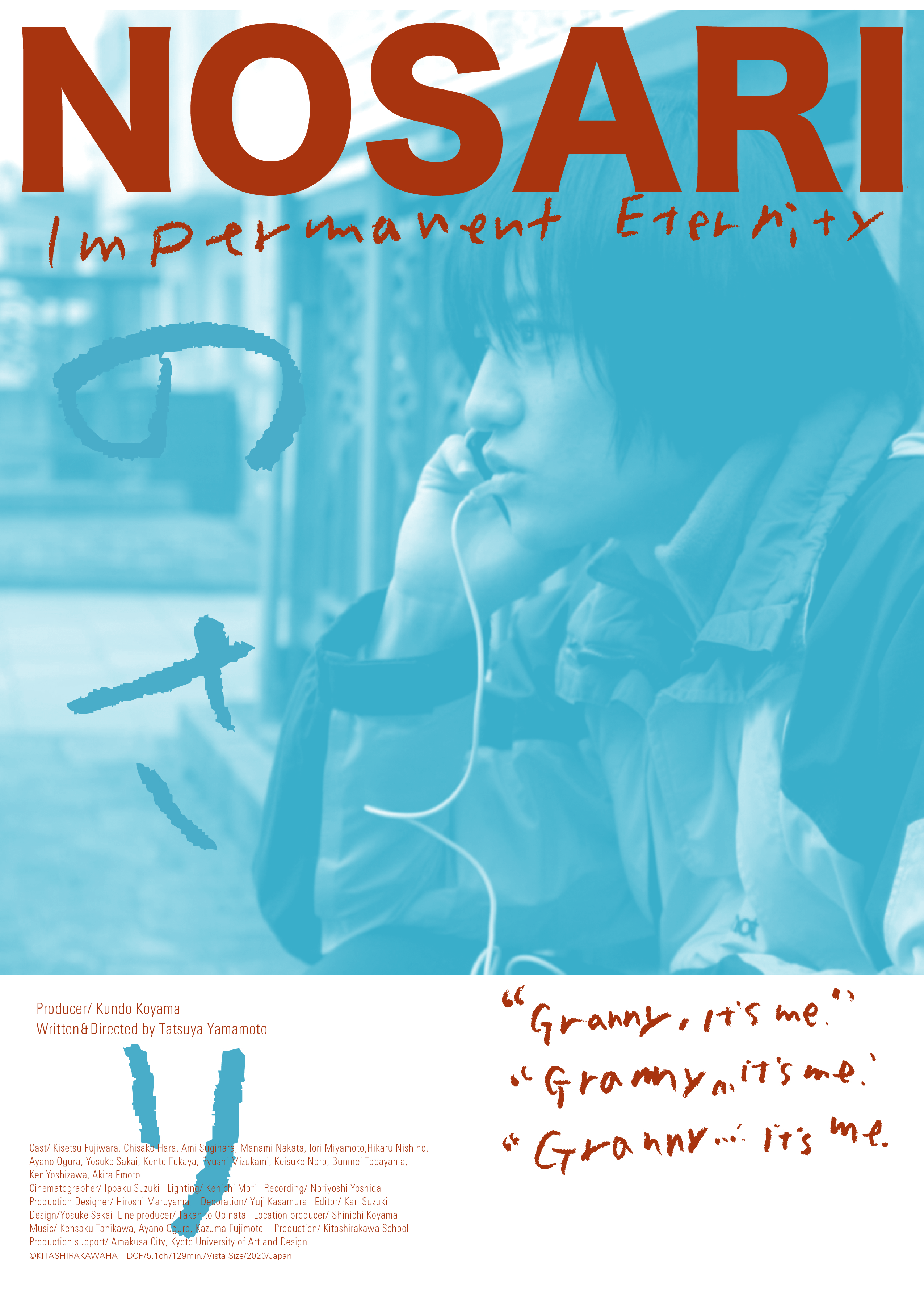
Nosari: Impermanent Eternity (のさりの島, Tatsuya Yamamoto, 2020)

“This is an illusion” a boatman explains to a lost young man “but sometimes people need it”. Produced by the Kyoto University of the Arts Department of Film Production, Tatsuya Yamamoto’s Nosari: Impermanent Eternity (のさりの島, Nosari no Shima) is the latest in a minor trend of indie dramas which see meandering young men find their feet while hiding out in moribund communities where the people are kind, honest, and willing to lend them space in which to figure themselves out enough to get back on the right path. 

This particular young man (Kisetsu Fujiwara) is an “ore ore” scammer, a popular form of telephone fraud in which the caller rings an elderly person and claims to be their grandson explaining in a panic that they’re in trouble and need money right away. The elderly person on the other end of the phone usually complies, either too estranged to realise that it isn’t their grandson’s voice or too anxious to give it much thought. On this particular occasion, however, the woman that the man rings after arriving on the small island of Amakusa appears not to understand, believing that he really is her grandson, Shota, suddenly arrived for a visit. The young man ends up going along with it, warming to the old woman, Tsuyako (Chisako Hara), and more or less forced to stay after she hides his phone and wallet (which contains money he’d already stolen from the honesty box in her music store). 

In some senses, “Shota’s” previous life as a cruel exploiter of the elderly is painted as a symptom of urban disconnection, that his alienated city life has robbed him both of empathy and basic morality though we know nothing of his wider circumstances save that he seems to be on the run from a series of similar crimes along the rail line out from Tokyo. It’s never exactly clear how much Tsuyako knows at any one time, though the movement of a photograph in the closing moments makes plain that she does indeed on some level realise that the man isn’t Shota no matter how much she’d like him to be. As the opening title card explained, the local people have a habit of simply accepting whatever it is that comes their way which is perhaps what Tsuyako decides to do with Shota, realising that he’s in trouble and wanting to help him by taking him into her home which does at least restore his sense of empathy for the elderly. 

The truth is however that Tsuyako is one of many elderly people left behind in a rapidly depopulating rural Japan, her son having moved away to the city and her husband presumably already passed away. Hers is the only shop still open in an eerily empty shopping arcade where she sits on a small stool waiting for customers that presumably rarely come, leaving an honesty box on the counter should she need to nip away. A parallel plot strand finds the host of a local radio programme, Kiyora (Ami Sugihara), desperately trying to find footage from back when the area was filled with life and industry but more or less coming up short. On her travels, she interviews an old man (Akira Emoto) who was once a master craftsman of noh masks but has recently turned to making lifelike scarecrows whose eerie presence attempts to make up for the sense of absence in the moribund town where, he points out, the elderly residents once played together as children. 

Kiyora also meets with a series of businessmen who have their own ideas about how to reinvigorate the town but comes up with few solutions to Japan’s ongoing rural depopulation crisis and is perhaps herself also lonely as one of the few youngsters remaining behind. She loves Amakusa for its serenity, often playing the calming soundscape on air for harried Tokyoites trapped on their cramped commuter trains but for her friend Yukari (Manami Nakata) country life seems stifling. She realises that those from the city long for the connection and kindness of the countryside, but she can’t stand the seasonal rhythm of rural life or the feeling of being under constant watch, peer pressured into dull activities she might not have much interest in solely to keep up appearances. 

For Shota, however, country connection seems to be exactly what he needed. “I don’t know what’s real and what’s false” he later complains, perhaps too invested in his temporary existence as Shota to fully appreciate the contradictions of his life. Gently cared for by Tsuyako he begins to realise that the world can also be kind, touched by her generosity as she tells him that on occasion there is more money in her honesty box than there should be but even if there were less it would be alright it just means that someone was in need. Arguing that something has been lost in the fracturing of communities, Nosari longs for a return to a more innocent, connected time in which people knew and supported each other, something of which seems to return in the busier Amakusa streets even if Kiyora finds herself suddenly surrounded by scarecrows in the loneliness of the empty arcade, striking up a friendship with a bashful harmonica player who later finds her way to Tsuyako’s store. For Shota, however, Amakusa has perhaps given him a better sense of himself, ready to head back out into the world with kindness and empathy in place of hardened cynicism. 


Nosari: Impermanent Eternity streamed as part of this year’s Nippon Connection.

Original trailer (no subtitles)

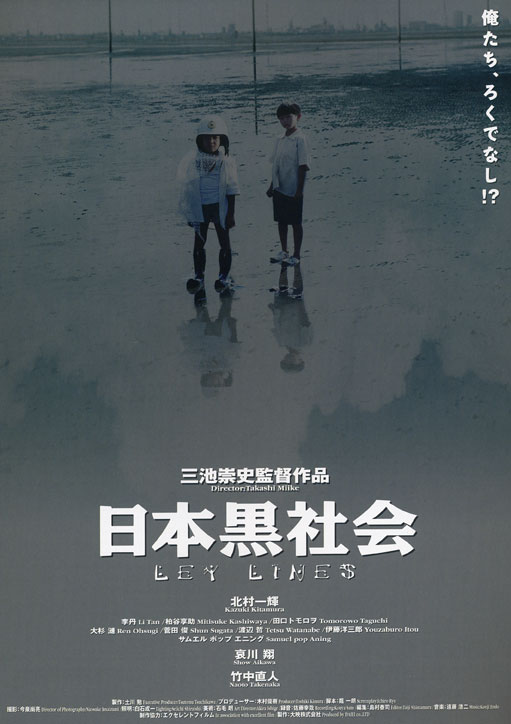
Ley Lines (日本黒社会 LEY LINES, Takashi Miike, 1999)

ley-linesThe three films loosely banded together under the retrospectively applied title of the Black Society Trilogy are not connected in terms of narrative, characters, tone, or location but they do all reflect on attitudes to foreignness, both of a national and of a spiritual kind. Like Tatsuhito in the first film, Shinjuku Triad Society, the three young men at the centre of the final instalment, Ley Lines (日本黒社会 LEY LINES, Nihon Kuroshakai LEY LINES), have each faced prejudice and discrimination due to their Chinese heritage. Fleeing their small town blues and heading for the big city, they want out of the homeland which can find no place for them to try their luck in pastures new, but desperation breeds poor choices and if they find their freedom it may not be in the way they might have hoped.

Angry young man Ryuichi (Kazuki Kitamura) seems to have been in some trouble with the law recently, at least that’s the reason the pedantic government official gives for rudely rejecting Ryuichi’s attempts to get a passport whilst subtly underlining the fact that a “real” Japanese person would know you can’t have one whilst on probation. Offended, Ryuichi picks up a small potted tree and hits the uncooperative desk jockey on the head with it. With Brazil off the cards and no work or prospects on the horizon, Ryuichi decides to blow town with some friends. All but three of them change their minds at the train station but Ryuichi, his sensitive younger brother Shunrei (Michisuke Kashiwaya), and their friend the impulsive Chan (Tomorowo Taguchi) head for the sleazy streets of Shinjuku hoping to find someone to forge their papers for passage overseas.

Once there, hotheaded Ryuichi immediately begins to cause trouble and the trio get mixed up in an ongoing series of gang problems with the traditionally minded Chinese gangsters and a petty thug (Show Aikawa) selling what he claims is a new wonder drug, Toluelene. Teaming up with a brutalised local prostitute, Anita (who previously ripped them off leading to their ill advised Tolulene adventures), also desperate to get the hell out of Shinjuku, the four form an unconventional mini family but a last ditch solution to their dilemma will turn out to be a gamble too far.

Neatly uniting the themes of the previous two movies in the Black Society Trilogy, Ley Lines casts its heroes as multilayered outsiders. Miike begins the film with deliberately retro, aged footage of the brothers as young boys playing happily on a beach until some Japanese kids turn up and remind them that they’re different. Never allowed to just fit in, Ryuichi has become angry and frustrated whereas Shunrei studies harder than anyone trying to earn his place in a competitive society. If their Chinese heritage had set them at odds with their small town peers, the boys are just as much adrift in the big city, a trio of bumpkins wandering into all the wrong places naively thinking they can scrap their way out of Japan. Anita, also Chinese, shares in their desperation as her situation has become unsustainable. Shackled to a useless pimp and forced to endure frightening and barbaric treatment, Anita needs out of the flesh trade and the guys might just be her ticket to ride.

As he would later do so splendidly in Audition, Miike deliberately wrong foots us in the beginning as if he’s about to embark on a standard tale of a young man making his first big set of mistakes which will set him on a path to becoming a better person, but of course this isn’t where we’re going. The original Japanese title, “Japan Black Society” hints at the all pervading darkness which exists below the everyday world into which our trio of hapless dreamers have fallen. The guys are ordinary young men making ordinary mistakes which have a familiar, often comedic quality which only serves to deepen the agony they’re about to face.This underworld belongs to people like the mad gangster Wang (Naoto Takenaka) dreaming of his Chinese homeland and forcing young women to tell him folktales to remind him of it, the pimp the who mishandles the desperate Anita, and the deluded drug dealer Ikeda convinced he’s onto the next big thing. The boys don’t stand a chance. Ending with a typically poetic, bittersweet set of images as some of our heroes find a kind of freedom in an endless sea, Miike does not stint on the irony but his sympathy is very much with these disenfranchised youngsters, denied their futures at every turn and finally backed into a corner by the cruel and unforgiving nature of the Black Society which they inhabit.


Original trailer (English subtitles)

https://www.youtube.com/watch?v=9hB0d_u-6Zk&t=3s