A Wanderer’s Notebook (放浪記, Mikio Naruse, 1962)

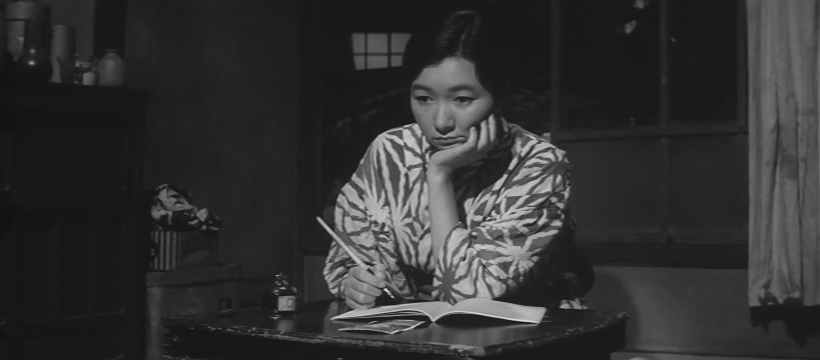
Many of Mikio Naruse’s most famous films are adapted from the work of Fumiko Hayashi, a pioneering female author who chronicled the life of a working class woman with startling frankness. Yet his dramatisation of her life, A Wanderer’s Notebook (放浪記, Horo-ki), is both a little more reactionary than one might have expected and surprisingly unflattering even in the heroine’s eventual triumph in escaping her poverty through artistry. Even so if perhaps sentimentalising the economically difficult society of the 1920s in emphasising the suffering which gave rise to Hayashi’s art, the film does lay bare the divisions of class and gender that she did to some extent transgress in pursuit of her literary destiny. 

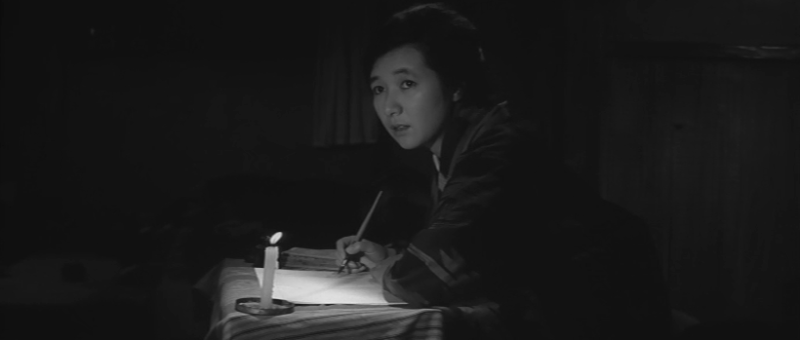
Naruse and his screenwriters Toshiro Ide and Sumie Tanaka bookend the the film with a literal “lonely lane” which the young Fumiko walks with her itinerant salespeople parents. As a small child, she sees her father arrested for a snake oil scam peddling some kind of wondrous lotion, setting up both her disdain for men in general and her determination not to be deceived by them at least unwittingly. She has no formal education but is a voracious reader well versed in the literary culture of the time and intensely resentful of if resigned to her poverty. In the frequent sections of text which litter the screen taken directly from her novels, she details her purchases, wages, and longing for the small luxuries she can in no way afford. 

As an uneducated woman in the 1920s her working opportunities are few. She exasperatedly relates standing in a queue with hundreds of other women waiting for an interview for a company job only to be told they’ll let her know, while her other opportunity involves meeting a theatre director at a station who later takes her to his hotel/office and makes it plain he’s not really interested in her CV. She gets a job at the office of a stockbroker, but lies about being able to do accounts and is flummoxed by double entry bookkeeping getting herself fired on day one. After a brief stint in factory painting toys, she leaves with a friend to become a hostess but is also fired on her first day for getting drunk and being unwilling to ingratiate herself with the boorish men who frequent such establishments. 

Despite her animosity, she is drawn towards men who are callous and self-involved, firstly taking up with a poet and actor who praises her work but turns out to have several “wives” on the go, and then begins living with a broody writer, Fukuchi, who is insecure and violent, resentful at her success in wake of his failure. Perhaps because of her experiences, she seems to resent any hint of kindness though sometimes kind herself, lending money to her friend whose mother is in need and often ready to stand up for others whom she feels are being mistreated. A kindly widower in the boarding house where she lives with her mother, Yasuoka, falls in love with her but she repeatedly rejects him partly as someone suggests because he is not handsome, but mainly because of his goodness and kindness towards her. Nevertheless, he continues to support always ready in her time of need though having accepted that she will never return his feelings or accept his proposal. 

Perhaps her might have liked to have been kinder, but was too wounded by her experiences to permit herself. In any case at the film’s conclusion in which she has achieved success and in fact become wealthy it appears to have made her cold and judgemental. She instructs her maid to send a man away believing he is from a charity set up to help the poor, insisting that the poor must work for industry is the only path out of poverty implying that as she managed it herself those who cannot are simply not applying themselves when she of all people should know how fallacious the sentiment is. As if to bear out the chip on her shoulder, she forces her mother to wear a ridiculous kimono from a bygone era that is heavy for an old woman and makes her feel foolish because of her own mental image of the finery she dreamed of providing her on escaping the persistent hardship of their lives. 

As she says, she’s no interest in the socialist politics espoused by the literary circles in which she later comes to move, pointing out that the poor have no time for waving flags. One of her greatest supporters is himself from a noble family despite his progressive politics and in truth can never really understand the lives of women like Fumiko. He describes her work as like upending a rubbish bin and poking through it with a stick, at once fascinated and repulsed by a frankness he may see as vulgar. At one point he accuses her of writing poverty porn, playing on her humble origins for copy and becoming something of a one note writer. 

In truth, the film is not really based on the novel from which it takes its title but on the play that was adapted from it, while the novel itself was apparently reworked and republished several times in response to reader taste giving rise to a series of questions both about its essential authenticity and what it was that it was attempting to convey. In the film at least, moments after her literary success, Fumiko is challenged by a fellow female writer, Kyoko, who was once her love rival, that she cheated in a contest by failing to submit Kyoko’s entry until after the deadline had passed, though as it seems she would have won anyway. She is occasionally underhanded, perhaps because she feels she has no other choice, but then as we can see there is no particular solidarity between women save the kindly landladies who often let her delay her rent payments. Fumiko feels herself to be alone and her quest is not really for literary success but simply for her next meal, though she feels the slights of the bitchy women and arrogant men who mock her commonness while simultaneously exploiting it as entertainment. 

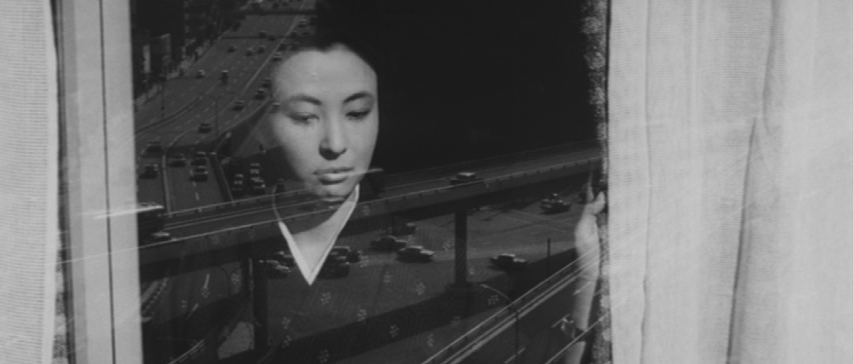
On the one hand, her success seems to signal a triumph of independence having freed herself from the need to depend on terrible men though she also she seems to have met and married a warmhearted painter who cares for her and supports her work while she has also been able to give her mother the level of comfort they both once dreamed of. Even so, the unavoidable fact that she dies at such a young age implies she’s worked herself into an early grave in a sense punishing her for her rejection of contemporary social norms undercutting her achievements with some regressive moralising while the one thing she still desires, rest, is given to her only in death. In Takamine’s highly stylised performance, as some have implied perhaps intended to mimic the silent screen, Fumiko is at once a carefree young woman who dances and sings and a melancholy fatalist with a self-destructive talent for choosing insecure and self-involved men, but above all else a woman walking a lonely road towards her own fulfilment while searching for a way out of poverty that need not transgress her particular sense of righteousness. 


Original trailer (no subtitles)
Beast Alley (けものみち, Eizo Sugawa, 1965)

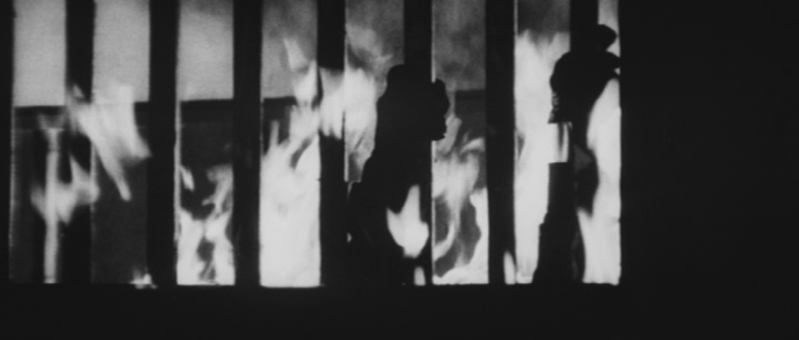
In the opening title sequence of Eizo Sugawa’s Beast Alley (けものみち, Kemonomichi), a thick blob of inky blackness gradually expands over an aerial view of the city until it obscures it entirely. The title card which then appears is written in plain white, but will reappear at the film’s conclusion this time ashen as if it too had been singed by the deeply ironic flames with which the film ends. Based on a novel Seicho Matsumoto and scripted by The Beast Shall Die’s Yoshio Shirasaka, the film similarly takes an incredibly cynical view of the modern post-war society in which it is revealed the militarists are still basically in charge and presiding over a deeply corrupt social order. 

The big bad, Kito (Eitaro Ozawa), says as much when he states the need for reforming the nation’s “rotten political system” by which he means post-war democracy. Kito made his made his money doing deeply dodgy things in Manchuria in addition to running an exploitative coal mine in Japan. Now mainly bedridden, he basically runs the country as a far-right political fixer working in tandem with big business and the yakuza who have traditionally been big supporters of conservative and nationalist forces. Early on we see one of his underlings negotiating with politicians to ensure that Taiyo Roads will be hired be hired for a large scale construction project planning to put highways all the way through Tokyo. As we later discover, he’s prepared to go to great lengths in order to achieve his goal, going so far as to have a sex worker murdered to implicate the uncooperative CEO of a rival construction film into resigning by threatening to frame him for the crime so they can install their stooge in his position. 

It’s into this world that everywoman Tamiko (Junko Ikeuchi) is drawn while working as a hotel maid at a traditional Japanese inn. Trapped in a bad marriage to a man who is also bedridden yet still attempts to rape her when she returns home to find him in bed with the housekeeper, Tamiko longs for escape and is therefore ripe for the picking when approached by Kotaki (Ryo Ikebe), the manager of an upscale Western hotel, to join him in an unspecified enterprise which will apparently make her very rich. The only catch is that she will have to “get rid” of her “dependent”, which she probably wanted to do anyway, by burning down her house with him inside it. Once she’s done this, there is no turning back for her even if she had not developed complicated feelings for Kotaki who is both her salvation and damnation. 

Tamiko’s husband had failed to give her the comfortable life that he had promised, something which she thinks Kotaki can deliver even if it requires her to become the plaything of Kito whom does she actually seem to like even if aware of the precarity of her position and still in thrall to Kotaki. Leaving the hotel so abruptly was however a strategic error as it arouses the suspicious of (originally) earnest cop Hisatsune (Keiju Kobayashi) who quickly realises that Tamiko set the fire to kill her husband. Though he seemed to be motivated by justice, Hisatsune too is soon corrupted explaining to Tamiko that he has become cynical and jaded. Years of police work have shown him that true criminals know how to break the law and get away with it so he can’t do anything about them, but “good” people, like he implies Tamiko, are pushed into crime by desperation and are easily caught. Tamiko wields her sexuality against him by agreeing to a tryst, though when it doesn’t go to plan he tries blackmail and then rape before she, ironically, manages to escape from his bungled crime. 

Hisatsune’s corruption is gradual and self serving. He starts with suspicion, tailing Tamiko in the interests of justice but also because he desires her, before stumbling on the conspiracy, putting the pieces together, attempting to use them for his own gain and trying to blow a whistle mostly out of resentment. Kito’s reach is all encompassing. Hisatsune is warned off investigating certain aspects of the crime by his senior officers and is then fired on Kito’s instructions for fiddling his expenses after harassing Tamiko. He tries to give his findings to his boss but it goes nowhere and then tries the press but is given the brush off, the editor his reporter friend refers him to gently implying he’s just a crank with an axe to grind. Of course, it turns out that the reporter is already in league with dodgy lawyer Hatano (Yunosuke Ito) who is Kito’s right-hand man. 

The connections between the three men, Kotaki who was once a communist, Hatano, and Kito go back to Manchuria and the corruptions of militarist era which it becomes clear has never really ended. Kito has only one rival and it’s another faction of the conservative ruling party who are probably just waiting for him die. Attempts are made on his life and they don’t go well for those who make them. Even if Hatano hoped to simply inherit an empire he, as he points out, put in much of the work to build he is sorely mistaken while Tamiko may intellectually understand that Kito’s death would place her in a precarious position but carries on regardless. “You never know who will betray you in this world” Kotaki laments, echoing Kito’s later claim that his Buddhist statues are the only ones will never betray him even as sleeps next to a statue of Aizen Myo whom he ironically claims protects mankind from their lust and desire. 

It could be said that desire is Tamiko’s undoing, but as Hisatsune had suggested perhaps you couldn’t blame her for longing to be free of the bedridden husband who had not delivered what he promised her. As she said, she was doing what could to survive even if you’d think she’d know putting on a ring taken from the finger of a murdered woman is akin sealing your own fate. Sugawa shoots with a noirish sense of dread, tracking Tamiko with her coat drawn up around her face as she tries to leave the scene of her crime, and makes the most of his fiery imagery before ending on a note of cynical laughter amid the inescapable hell the of post-war society. 


Original trailer (English subtitles)

Woman of Design (その場所に女ありて, Hideo Suzuki, 1962)

“This job poisons you and deprives you of your youth” according to conflicted ad-exec Ritsuko (Yoko Tsukasa) trying her best to make it in the still very male world of adverting. A snapshot of the city in the early ‘60s, Hideo Suzuki’s workplace melodrama Woman of Design (その場所に女ありて, Sono Basho ni Onna Arite) considers the changing position of women through the eyes of four friends working at the same company, each facing challenges mainly at the hands of useless men while trying to claim a space for themselves as individuals but discovering that they are still subject to a binary choice when it comes to deciding their romantic futures. 

A woman of around 30, Ritsuko has worked her way up to a fairly senior position at Nishigin Advertising which at least appears to be a fairly progressive company run by a compassionate boss who treats his employees equally with respect for all. Nevertheless, Nishigin is very interested in its bottom line especially as the company is apparently not doing so well to the extent that they’ve unfortunately had to cut back on their “entertainment” budget which is apparently how they win and keep clients. A new opportunity has presented itself in the chance to win a contract with a pharmaceuticals company to market their brand new drug aimed at “revitalising” the lives of the over 40s. Unfortunately, they have a rival in the form of Daitsu and suave adman Sakai (Akira Takarada) who appears to have pipped Ritsuko to the post in “seducing” their sleazy PR guy.

Though focussed on her career and somewhat resistant to romance, Ritsuko finds herself attracted to Sakai if eventually wondering if he’s only using her for inside info on Nishigin which she doesn’t directly give him but their relationship does perhaps soften her attitude. Sakai’s minor betrayal in poaching the head of their art department will eventually destroy any genuine feelings they may have had for each other while leaving Ritusko painfully aware of her vulnerabilities as a female employee and of the costs of her momentary decision to break with her long-held determination to keep her professional and private lives entirely separate, admitting that her relationship with Sakai may have been a mistake but refusing to resign because of it. Meanwhile, the boss of the pharmaceuticals company with whom she seems to be on good terms tries to blackmail her into attending an omiai meeting implying he’ll be much more likely to give them the contract if she goes. Not that they necessarily mean she should give up her career, but even Ritsuko’s colleagues seem to be keen that she get married, shocked that she might determine to remain single for the rest of her life. 

That’s exactly the decision her friend Yuko (Akemi Kita) has made, dedicating herself to her career but also moody and embittered. In fact though it is no way explicit, Yuko is strongly coded as a lesbian with a possible crush on friend and colleague Mitsuko (Kumi Mizuno), herself in a difficult position apparently pushed into debt because of an attachment to a no good man whose hospitals bill she has been paying. Ritsuko’s deskmate Hisae (Chisako Hara), meanwhile, is a divorcee wondering what she’s going to do when her ex, whom she’s still hung up on, stops paying alimony, and her sister is forever badgering her for money because her brother-in-law is an irresponsible layabout who can’t hold down a steady job and has no real intention of doing so. “Men who live off women are the worst” Yuko exasperatedly exclaims thoroughly fed up with the bunch of two bit louses who seem to have ruined the lives of all her friends. 

It’s not difficult to understand why Ritsuko may be ambivalent about marriage, but even at work she’s not free of selfish, entitled men who routinely take credit for her work. Sleazy college Kura (Tsutomu Yamazaki) from the art department is forever sucking up to her only to attempt rape while discussing work at her apartment, later brushing the affair off while talking to a female colleague by affirming that older women aren’t his thing anyway. He also undercuts her by visiting the client himself to discuss ideas and changes. Kura later wins a big design prize in part thanks to the slogan Ritsuko came up with only to annoy his colleagues by implying he handled the whole campaign single-handedly. Meanwhile, though in some ways progressive her bosses are conservative when it comes to the business, shutting down the art director’s suggestion of running with an out of the box campaign (the sexier ad featuring a muscular man in his briefs which he later sells to Sakai is the one which ends up winning). Tsuboichi (Jun Hamamura) and Kura perhaps too feel constrained by a top down hierarchal structure which frustrates innovation and in their own ways rebel, but as Ritsuko later makes plain in her speech to the boss if she wants to keep her position she has to play by the rules. “Life’s short. Especially for a woman. We have no room for mistakes” as Yuko cheerfully agrees.

Yet even within that, Ritsuko manages to redefine her boundaries, making it clear that she won’t be doing the omiai. She does not, however, reject marriage entirely only state that “I will get married only when I feel the time is right”, for the moment at least entirely focused on her career. Though the future may have looked gloomy, the crisis passes and the mood brightens significantly with the news that another company is about to officially announce the launch of a long-rumoured anti-ageing cream which provides another potentially lucrative campaign opportunity for Nishigin and of course for Ritsuko should she win it. Having opened with a series of still frames followed by hazy footage of a sea of workers wandering towards their offices on an overcast morning, Suzuki closes in the twilight with the three ladies leaving the office, their friendship solidified as they head off to celebrate renewed hope for the future bolstered by a sense of female solidarity.


Too Young to Die (死ぬにはまだ早い, Kiyoshi Nishimura, 1969)

Perhaps more or less forgotten for reasons we’ll come to later, Kiyoshi Nishimura was for a time a successful director associated with Toho’s line of noirish B-movie action dramas. When the Japanese cinema industry entered its decline in the 1970s, Nishimura shifted into similarly themed TV drama and was well respected for his ability to turn in on time and on budget. None of that mattered however when he was engulfed in scandal in 1987 after being caught operating spy cams in the female only area of a public bathhouse bringing his career to an abrupt end. Directing a few more projects under the name Yusai Ito, he sadly took his own life a few years later in 1993 at the age of 61. 

Nishimura’s 1969 debut Too Young to Die (死ぬにはまだ早い, Shinu ni wa Mada Hayai), however, is a masterclass in high tension filmed with shaky handheld set largely in a single location and imbued with a singular irony replete as it is with cosmic coincidences as a collection of customers at a roadside bar are taken hostage by a crazed criminal with a gun intent on finding the lover of the girlfriend he claims to have murdered for her infidelity. The heroes, however, are ennui-filled couple Matsuoka (Koji Takahashi) and Yumiko (Mako Midori) who are in fact not married, or at least not to each other, but carrying on an extra-marital affair which may be on the cusp of fizzling out. A former racing champ who claims he just got bored with the sport one day and now works for a company selling accessories for toy cars, Matsuoka is supposed to drive Yumiko home where she’s expecting a call from her controlling husband, away on a business trip, at 1am. These are all reasons they are unusually nervous about a police checkpoint searching for an armed fugitive, deciding to stop off at a roadside bar for a stiff drink and something to eat. Only, shortly after their arrival a young man (Toshio Kurosawa) in denim enters giving each of the other men intense side eye before shooting a policeman who comes in to make enquiries about the fugitive. 

The unnamed young tough takes the entire bar hostage intent on finding his lover’s lover, overcome with a sense of cosmic irony when Matsuoka calmly points out he may have arrived too early and the man he’s looking for had not yet arrived when he put the place in lockdown. Before the gunman’s arrival, Nishimura introduces us to each of the other customers via the handy device of two teenage girls apparently stranded and asking around for a lift back to the city. A middle-aged doctor (Chuzaburo Wakamiya), apparently a regular, eventually offers to take them but is dissuaded by the barman (Kazuya Oguri) who reminds him he’s been drinking too heavily to take passengers, while a taxi driver (Shigeki Ishida) who seems to be feeling unwell flat out refuses. The other customers are a suspicious looking man in a trenchcoat (Daigo Kusano) sitting in the corner piling matchsticks, and a newlywed couple who we later learn saved up for their wedding for three years, the wife (Nami Tamura) already going through her accounts book irritated by her friends’ decision to graffiti their car and wondering how much it’ll cost to get it cleaned up while the husband (Tatsuyoshi Ehara) disappoints her by wanting to rush home because he’s planning to return to work the next morning ahead of schedule. 

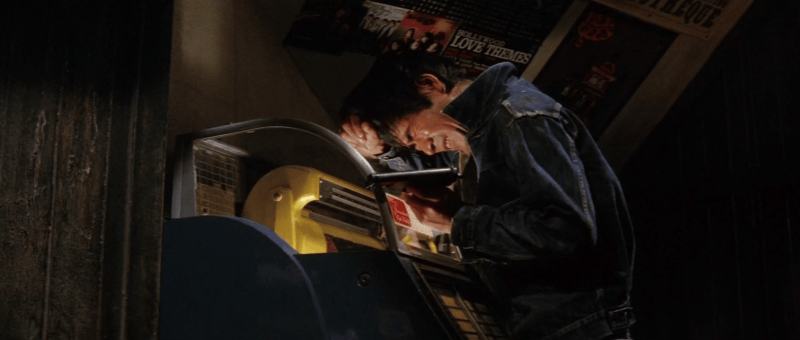
The relationships of the two couples are often directly contrasted, Matsuoka and Yumiko unsure of their connection as adulterous lovers while the newly married couple also seem be under strain even before the traumatic events about to take place. Apparently brokenhearted, the gunman collapses over the jukebox playing a series of melancholy songs about lost love, Matsuoka later darkly musing that perhaps he was only able to kill his lover because he loved her so much. Unlike the other customers, Matsuoka appears entirely unperturbed by their predicament calmly talking to the gunman and even ringing the police to ask them to temporarily stand back so they can evacuate a hostage in need of medical treatment. The gunman sends Matsuoka and the newlywed husband to take the injured party out, taking Yumiko hostage as security while she fears Matsuoka does not value her enough to return though both men do in fact come back rather than abandon their respective women. The newlywed husband, however, later fails a test of manhood when the enraged gunman goes off on a misogynistic rant and tries to force the doctor to rape the newlywed wife to prove that all women are faithless “whores”, the husband reduced to a gibbering wreck cowering in the corner unable to protect his new wife or challenge the gunman’s authority as Matsuoka later does when he orders Yumiko to remove her clothes in front of the other hostages. 

Though Yumiko had feared the affair was on its way out, ironically describing Matsuoka as not so different from her husband while lamenting that their connection seemed to have dwindled, the traumatic experience seems to reinforce the reality of their love as something more than a casual extra-marital fling even as Matsuoka forgives her for not trusting him because their relationship is not founded on the same idea of “commitment” as the married couple. The question for the other customers is how much the lives of others they’ve only just met really mean to them, the two teenage girls deciding to attempt escape while the gunman takes Yumiko hostage to use the bathroom, the doctor edging round the sides as Matsuoka tries to stop them to protect her while the newlyweds similarly waltz towards the door. All the while the TV crackles with an inane variety show complete with its cheerful advertisements while the police apparently have the place surrounded ironically convincing the gunman he has no way out and therefore nothing to lose. A tense meditation on interpersonal relationships, Too Young to Die is not without its share of ironies in strange number of coincidences and misapprehensions as the siege eventually draws to an unexpected close sending our conflicted lovers back into the night if perhaps a little more alive for their brush with death. 


The Last War (世界大戦争, Shue Matsubayashi, 1961)

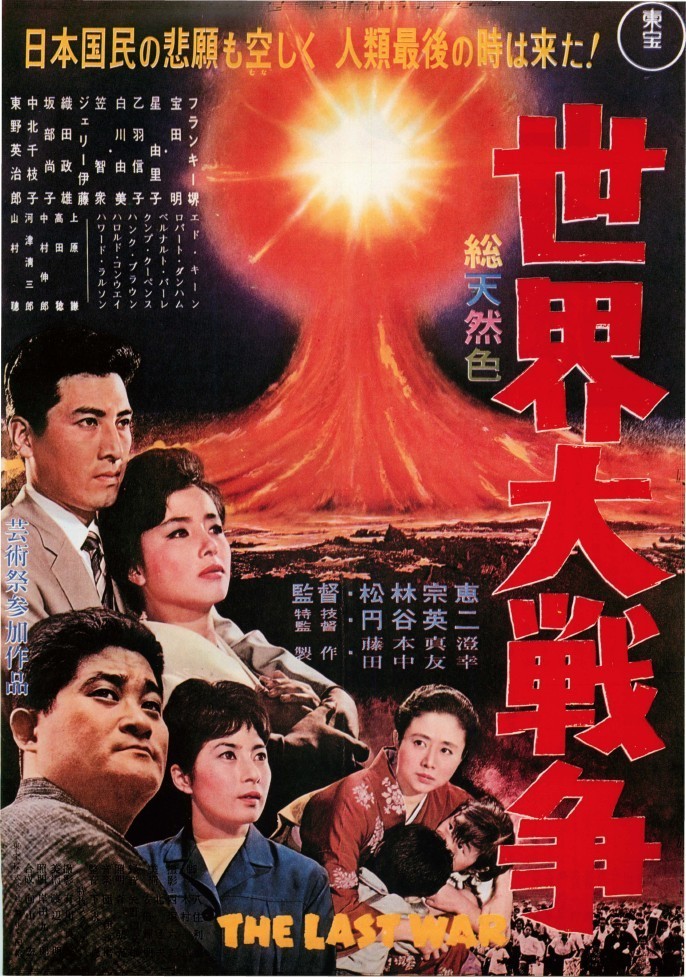
As The Last War (世界大戦争, Sekai Daisenso) points out, by 1961 16 years had passed since the end of World War Two during which Japan had begun to rebuild itself, heading into a period of unprecedented economic prosperity with the Olympics already on the horizon. But the early 1960s were also a time of increased international tension as the Cold War mounted and many in Japan feared being pulled into another conflict especially with the Korean War not quite so much in the distant past. Toho had become the home of special effects cinema and such films were often coloured with strong messages of peace and social responsibility as humanity banded together to combat an existential threat be it a giant monster or mad scientist. The Last War is no different in that regard, but sadder in showing us that the end of the world may come suddenly and without warning and that if we for a second become complacent it could already be too late to stop it. 

Patriarch Mokichi (Frankie Sakai) has made a decent life for himself after the war working as a driver. His wife, Oyoshi (Nobuko Otowa), is in poor health and he dreams of buying a house by the sea where she can live in comfort. Meanwhile, they have a grownup daughter, Saeko (Yuriko Hoshi), born before the war, and two much younger children, a girl, Haru, and boy, Ichiro. They are a very happy, very ordinary family who are beginning to think that their days of hardship are finally behind them and they have escaped the war’s shadow. The only note of potential conflict lies in the fact that Saeko wants to marry a family friend, Takano (Akira Takarada), a sailor, and is afraid of Mokichi’s reaction, especially as he keeps trying to set up matches for her. 

In fact, having lived through the war Oyoshi and Mokichi are certain that nothing like that is going to happen again, even if the younger generation is filled with anxiety. “Who could ever profit from the destruction of the Earth?” Mokichi not unreasonably asks, signalling his newly consumerist world view. Mind you, he adds, everyone knows the alternative to calamity is hard work, “you have to work hard for peace”. 

Mokichi has indeed been working hard, but has perhaps begun to neglect other areas of his life in his desire to become rich even if that desire is only to make his family more comfortable and give his children better opportunities than he had. Brought over to see a new TV set now on sale, he scoffs that he already has one, “Who needs a second TV?” he asks, but on hearing the news that tensions are rising because a military plane has gone down off the coast of Africa, his first thought is to get on the phone to his broker and junk his real estate stocks for shares in aeronautics. Mokichi is unconvinced by an old man selling potatoes on their street who apparently lost everything in Hiroshima and has since become a devoted Christian donating most of his profits to anti-nuclear charities, describing him as just “showing off”, firmly believing that nothing like that is ever going to happen again. “I cannot accept it” he says, “what would be the point of the aspirations of humble folk like us if we’re all destined to go poof into extinction?”.  

As the only nation to have directly experienced nuclear war, the intense fear of its recurrence is indeed understandable. If a nuclear war escalates, it will be the end of everything. All human endeavours over thousands of years will be mere dust. There will be no weddings, no births, no graduations, no grand discoveries, just nothing. When the bomb does indeed hit, the scenes of devastation must have proved extremely traumatic for many in the audience as buildings crumble ominously, the sky turns a fiery red, the streets run with lava, and we can see the outlines of charred bodies lying among the wreckage. The tip of the Diet building sits neatly atop the rubble as if in rebuke of the political failures which, despite the best efforts of the Japanese politicians who make an effort to govern responsibly and are honest with the electorate while advocating strongly for peace through diplomatic channels, have led to the literal end of the world. “You have to work hard for peace” the closing title card reminds us. “We can stop this before it happens, but we have to work together”. “I won’t let you destroy our happiness” Mokichi had screamed at the void, but in the end he was powerless. All it takes is a minor slip, and the world as we know it will cease to be.