Endless Desire (果しなき欲望, Shohei Imamura, 1958)

In the noir films of the immediate post-war era, the protagonists are often haunted by an inescapable past that prevents them from moving on into the new democratic Japan. But in Shohei Imamura’s Endless Desire (果しなき欲望, Hateshinaki Yokubo) the situation is ironically reversed as a group of former soldiers who on the surface of things at least seem to have made moderately successful lives for themselves reunite to dig up buried treasure from the dying days of the war greedy for a little more glamour than the world has seen fit to show them.

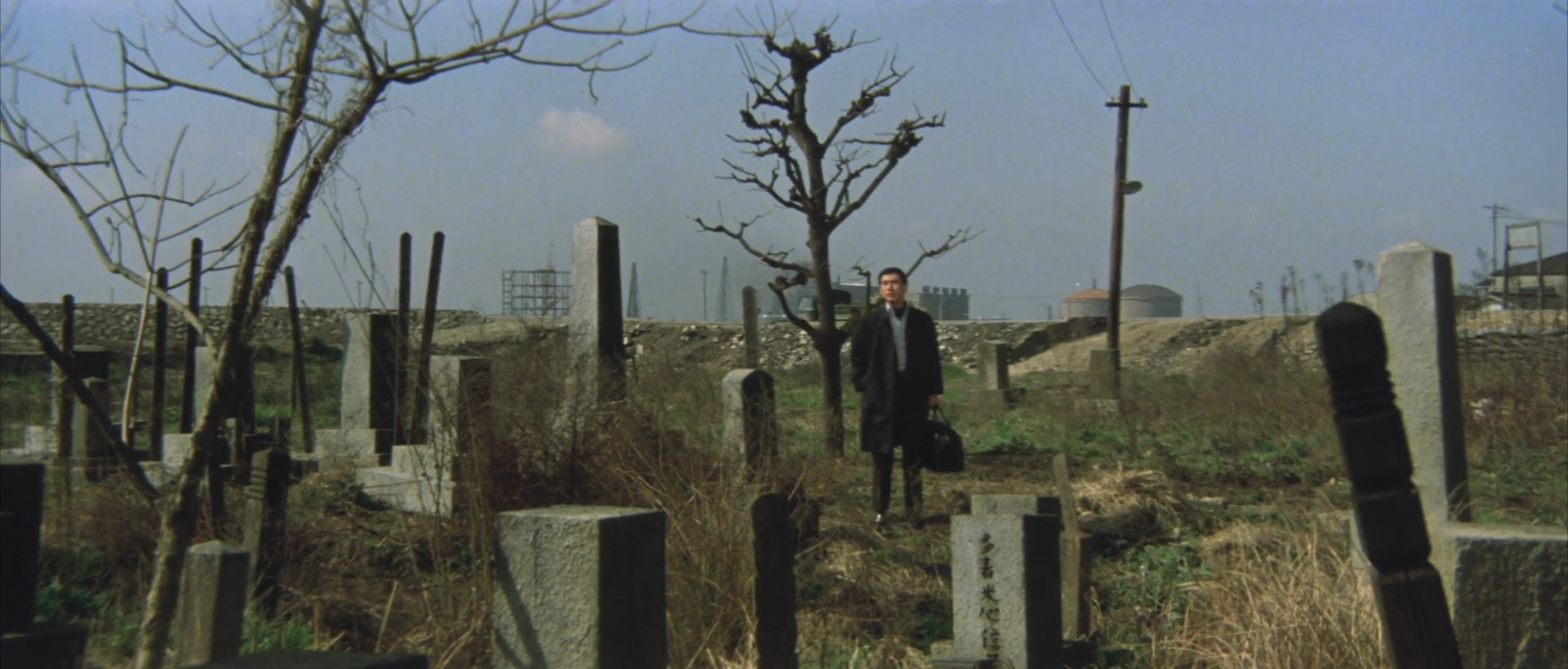
Their venal amorality is directly contrasted with the bumbling earnestness of Satoru (Hiroyuki Nagato), a young man who fears his childhood sweetheart, butcher’s daughter Ryuko (Sanae Nakahara), is going to marry another man because he is unemployed and cannot find a job in the still difficult if steadily improving post-war economy. As such, he’s incredibly excited by the opportunity to get into the real estate business, wandering around town dressed in a suit and carrying a briefcase to scout properties or otherwise doing odd jobs for the gang, which is a shame because unbeknownst to him the business is a sham set up as a front by the crooks who’ve rented a vacant shop from Satoru’s land shark dad so they can tunnel their way to the treasure which they think is buried under Ryuko’s butcher’s shop. 

The changing nature of the times is rammed home by the fact that the shopping district, which stands atop the site of the former military hospital where the gang buried a barrel full of stolen morphine at the end of the war ten years previously, is itself about to be torn down. Effectively a post-war shantytown, the area is now ripe for redevelopment with the economy beginning to bounce back thanks to the stimulus of the Korea War. The post-war era is not quite “over”, but it’s definitely on its way out which makes the gang’s determination to recover the stolen morphine all the more ironic especially as the market for hard drugs may not be as a lucrative as it once was not to mention to the logistical difficulties of turning it into cash. 

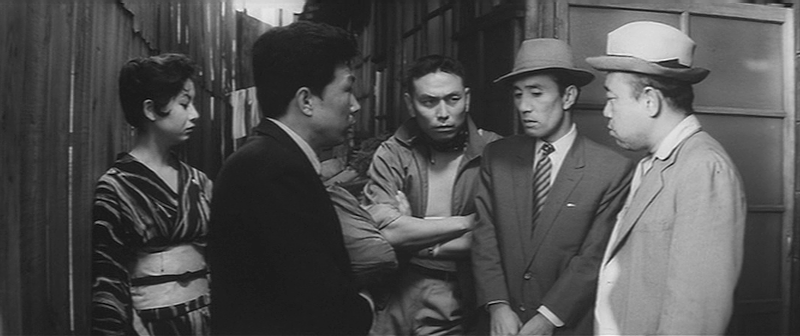
Nevertheless, the desire for it immediately sets the gang against each other. The problem is that the lieutenant, Hashimoto, who set the whole thing up has apparently died and extra person has turned up to claim some of the loot despite the gang members having been told there should only be three of them. They were not particularly close in the war and cannot exactly remember each other while Hashimoto had them all work separately without knowing who else was on board so they don’t even know which one of them is the potentially uninvited guest. Meanwhile, the presence of a woman, Shima (Misako Watanabe), who claims to be Hashimoto’s sister sets them all on edge with masculine jealously as she sometimes gleefully plays the femme fatale later even trying to seduce the innocent Satoru, convincing him she’s a victim of domestic violence in need of rescue in an attempt to quiet his concerns over what might be going on at the shop. 

The fact is that none of the gang members can really claim to be desperate, all are simply greedy and selfish silently plotting to keep all the money for themselves rather than share it. One of them is eventually crushed under the barrel, an embodiment of their insatiable desire, but with their dying breath insists it’s theirs and no one else can have any. As old man later says, this kind of greed only leads to a bad end unlike the greed he’s patiently practiced over decades which seems to be taking a little here and there where you find it such as asking Shima for some extra money for “helping” her before asking the police about a reward and turning her in anyway.

Even Satoru’s dad is “greedy”, renting the crooks a shop he new would soon be knocked down and then complaining when his tenants try to take the tatami mats and shoji doors they’d paid for themselves out of his property. Greed maybe the way of the world, at least for those who unlike the diffident Satoru do not lack for self-confidence, but endless desire has only one reward. Darkly comic and often deeply ironic, Imamura plays with a noirish sense of fatalistic retribution but finally returns to a sense of childish innocence in the bumbling courtship of Satoru and Ryuko who may be her own kind of femme fatale playing two suitors against each other while refusing to be dominated by any man but nevertheless riding off into the sunset on her bicycle with a diffident Satoru chasing along behind her.

A Killer’s Key (ある殺し屋の鍵, Kazuo Mori, 1967)

Raizo Ichikawa returns as the jaded ace assassin only this time a little less serious. Set some time after the events of A Certain Killer, A Killer’s Key (ある殺し屋の鍵, Aru Koroshiya no Kagi) finds Shiozawa (Raizo Ichikawa) having left the restaurant business to teach traditional dance under the name Fujigawa while known as killer for hire Nitta in the underworld. Like the previous film, however, he thinks of himself as a justifiable good, standing up against contemporary corruption while still burdened by his traumatic past as a former tokkotai pilot. 

Nitta’s troubles begin when a corruption scandal kicks off with a prominent businessman, or less generously loan shark, arrested for tax evasion. Asakura (Asao Uchida) knows too much and political kingpin Hojo (Isao Yamagata) is worried because he knows Asakura has hard evidence about a land scandal and might be persuaded to spill the beans, exposing a circle of corrupt elitists for their shady goings on. He wants Asakura knocked off on the quiet, as he heavily implies but does not explicitly state to his underling Endo (Ko Nishimura) who gets in touch with their yakuza support who in turn decide that Nitta is the only man for the job.

Petty yakuza Araki (Yoshio Kanauchi) sells the job to Nitta as a public service, pointing out how unfair it is that Asakura has been cheating on his taxes when other people have taken their own lives in shame because they weren’t able to pay. Conveniently, he doesn’t mention anything about petty vendettas or that he’s essentially being hired to silence a potential witness before he can talk so Nitta is minded to agree, for a fee of course (which, we can assume, he won’t be entering on his tax form). Unfortunately things get more complicated for everyone when the gangsters try to tie up loose ends by engineering an “accident” for Nitta which sends him on a path of revenge not only taking out the gangsters but the ones who hired them too. 

Nitta’s revenge is personal in focus, but also a reflection of his antipathy to modern society as a man himself corrupted by wartime folly who should have died but has survived only to become a nihilistic contract killer. He perhaps thinks that the world is better off without men like Asakura, the dim yakuza, spineless underling Endo, and corrupt elitist Hojo but only halfheartedly. His potential love interest, Hideko (Tomomi Sato), a geisha learning traditional dance, has fallen for him, she says because she can see he’s not a cold man though continually preoccupied and there is indeed something in his aloofness which suggests that he believes in a kind of justice or at least the idea of moral good in respect of the men that died fighting for a mistaken ideal. 

As Hideko puts it, Asakura made his money off the suffering of others, so perhaps it’s not surprising that he met a nasty end. She herself is a fairly cynical figure, aware as a geisha that she is in need of a sponsor and that it’s better to get the one with the most money though she too has her code and will be loyal to whoever’s paying the bills. Or so she claims, eventually willing to sell out Endo to protect Nitta but disappointed in his continued lack of reciprocation for her feelings. Echoing his parting words at the close of the first film but perhaps signalling a new conservatism he coldly tells Hideko that he doesn’t need a woman who stays with anyone who pays refusing to include her in the remainder of his mission.

Nitta is perhaps a man out of his times as a strange scene of him looking completely lost in a hip nightclub makes clear. He tries to play a circular game, stockpiling his winnings in different suitcases stored in a coin locker, but eventually finds that all his efforts have been pointless save perhaps taking out one particular strain of corruption in putting an end to Hojo’s nefarious schemes. More straightforwardly linear in execution than A Certain Killer, Killer’s Key is a less serious affair, resting squarely on an anticorruption message and easing back on the hero’s wartime trauma while allowing his needle-based hits to veer towards the ridiculous rather than the expertly planned assassination of the earlier film, but does perhaps spin an unusual crime doesn’t pay message in Nitta’s unexpected and ironic failure to secure the loot proving that sometimes not even top hit men can dodge cosmic bad luck. 


Update, 13th February 2025: now available to stream via Arrow Player.

Original trailer (no subtitles)

A Certain Killer (ある殺し屋, Kazuo Mori, 1967)

A nihilistic hitman safeguards the post-war future in Kazuo Mori’s chivalrous B-movie noir, A Certain Killer (ある殺し屋, Aru Koroshiya). Set against the backdrop of the Vietnam War with US airplanes flying constantly overhead, Mori’s crime thriller situates itself in the barren wasteland of a rehabilitated city in which betrayal, exploitation and duplicity have become the norm while a former tokkotai pilot turned killer for hire takes his revenge on social hypocrisy as a product of his society, a man who did not die but knows only killing. 

Shiozawa (Raizo Ichikawa) runs a stylish restaurant by day and supplements his income by night as a killer for hire, apparently highly regarded by the local underworld. As such, he’s approached by a yakuza underling, Maeda (Mikio Narita), on behalf of the Kimura gang who want him to off another gangster, Oowada (Tatsuo Matsushita), who double crossed them in contravention of the yakuza codes of honour. Shiozawa is resolutely uninterested in yakuza drama and so turns the job down but changes his mind when he’s paid a visit by boss Kimura (Asao Koike) himself who sells him a different kind of mission. Kimura characterises Oowada as a “bad” yakuza, one has subverted the traditional gangster nobility by dealing in the “dirty” sides of organised crime, corrupting the modern society by trafficking in illegal prostitution, drugs, and extortion, where as he is a “good” yakuza mostly running construction scams and therefore building the post-war future. His crime is, literally, constructive, where Oowada’s is not. 

Shiozawa doesn’t quite buy his justifications, but men like Oowada represent everything he hates. “They’re not worthy of this world. They’re nothing but cockroaches” he laments, recalling the young men who served with him and gave their lives because they believed in a country which betrayed them. He agrees to take the job in rebellion against post-war venality, but only at a price, asking for four times the original fee. Kimura is willing to pay, because his true aim is profit more than revenge. He plans to take over Oowada’s remaining business concerns. 

Fully aware of this, Shiozawa seems almost uninterested in the money despite having asked for so much of it. He runs his shop as a front for his side business and otherwise lives a quiet, unostentatious life keeping mostly to himself. He is not, it would seem, a cold blooded killer, often making a point of leaving those who get in his way incapacitated but alive. Targeted by a street punk for supposedly messing with his girl he cooly disarms him and walks away, only for the girl to follow attracted partly by his icy manliness and partly by the thickness of his wallet as glimpsed when he made the fatal decision to offer to pay for her meal in order to save the chef from embarrassment over her attempts to pay with things other than money. Unable to get by on her own, Keiko (Yumiko Nogawa) attaches herself to various capable men beginning with the pimp, transferring her affections to Shiozawa whom she petitions to marry her, and then to Maeda, eventually vowing to find a new partner and make lots of money. 

Both Maeda and Keiko chase Shiozawa and are rebuffed. Impressed by his cool handling of the Oowada affair, not to mention the amount of money he now realises you can make in his line of business, Maeda asks to become his pupil in order to become a “real man”. Shiozawa doesn’t regard his work as something “real men” do, and in any case prefers to work to alone. Maeda repeatedly asks to be allowed to accompany him even after plotting betrayal, only to be rejected once again as Shiozawa tells him that he doesn’t like people who don’t know the difference between the job and romance, flagging up the homoerotic subtext for those not paying attention. Maeda parrots his words back to Keiko with whom he had begun a halfhearted affair as joint revenge against Shiozawa’s indifference. 

Following the successful offing of the mob boss, Shiozawa finds himself coopted into another job robbing a drug handoff between Oowada’s former associates, the illicit narcotics ironically packaged inside cartons intended for baby powder. Shiozawa apparently doesn’t object to profiting off the drug trade himself, but later abandons the loot in protest while the remainder is lost or squandered during the final battle with the remaining gang members, Shiozawa’s cartons left sitting ironically on top of a gravestone taken by no one. Cool as ice, Shiozawa places himself above petty criminality, always one step ahead, trusting no one and looking out for himself but reacting as a man created by his times, forged by a war he was a not intended to survive while looking on at another cruel and senseless conflict across the sea. Adapting the hardboiled novel by Shunji Fujiwara, Yasuzo Masumura’s jagged, non-linear script (co-written with Yoshihiro Ishimatsu) is imbued with his characteristic irony but also coloured with nihilistic despair for the post-Olympics society and its wholesale descent into soulless capitalistic consumerism.


Update, 13th February 2025: now available to stream via Arrow Player.

Original trailer (no subtitles)

Love in the Mud (泥だらけの純情, Sokichi Tomimoto, 1977)

Love in the Mud posterJapanese youth cinema was in a strange place by the late 1970s. Angsty seishun eiga had gone out with Nikkatsu’s move into Roman Porno and the artier, angry youth films coming out through ATG were probably not much for a teen audience. The Kadokawa idol movie was only a few years away but until then, films like Love in the Mud (泥だらけの純情, Dorodarake no Junjo) arrived to plug the gap. Based on a novella by Shinji Fujiwara which had been previously adapted by Ko Nakahira in 1963 in a version starring Sayuri Yoshinaga and Mitsuo Hamada, Love in the Mud is a classic tale of poor boy meets rich girl and ends in a predictably hopeless way but in deep contrast to the prevailing culture of the time, the film takes the “junjo” or “purity” in its title literally in its innocent chasteness.

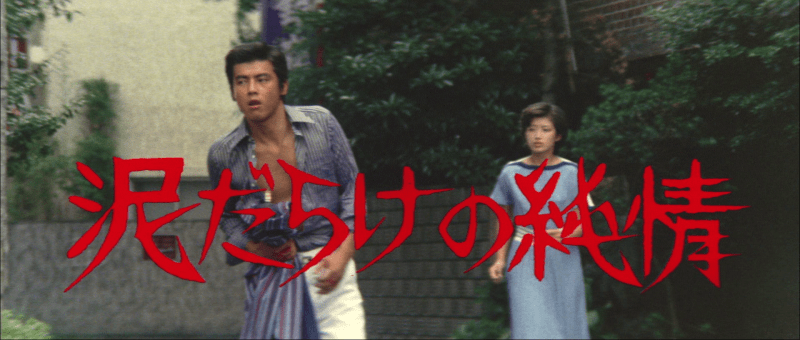
As the camera pans over a rapidly developing city, it settles on a bright red, flashy sports car being driven by Mami (Momoe Yamaguchi), the daughter of the Japanese Ambassador to Spain, with her friend sitting cheerfully in the passenger seat. Disaster strikes when the pair are run off the road by a biker gang who taunt them from outside the car, threatening rape and robbery. Luckily for them another gangster turns up, beats up the bad guys and saves the girls but alarm bells should have been ringing when he asks Mami to step out of the car and “thank him properly”. Mami, stupidly, does what she’s told and the girls are hijacked by gangsters round two. When they reach the shady place the gangsters are planning to have their wicked way with them, a third wave of gangster appears, disapproves of the goon’s intentions and heroically fights them off. However, the girls’ saviour is stabbed in the stomach and then later stabs and kills the leader of the aggressors.

The noble gangster, Jiro (Tomokazu Miura), tells the girls to run – which they do, but somehow Mami can’t quite bring herself leave him. A thoroughly middle-class girl, Mami is at university studying English literature but her dream is to open a hat shop in Paris and she spends most of her spare time working with a hat designer. In the absence of her father, Mami’s uncle (Ko Nishimura) has been looking after her but is the classic upperclass male who thinks the hat stuff is just a hobby and what Mami needs is a good husband as soon as possible. Accordingly he’s set her up with a pleasant enough business contact he hopes will both support Mami in the manner to which she’s been accustomed and his business dealings too.

Your average teenage girl might not be in such an extreme situation as young Mami, but most can certainly sympathise with her lack of agency. The life her uncle has planned for her is not what she wants but more than that, she’s acutely aware of being denied a choice in her future. She may be rich, but she’s never been free. Jiro, by contrast, grew up poor in tragic family circumstances and enjoys his own kind of freedom even if he feels himself constrained by his social class and lack of opportunities following a life in care with no real education. Not actually a yakuza but a gambler and petty punk living on the fringes of the underworld, Jiro has been content to live a meaningless life of empty gains but as his rescuing of Mami and her friend shows, he has a kind heart which extends to delivering presents to the daughter of a melancholy bar hostess currently living in an orphanage.

Jiro’s nobility is of a true and pure kind. After Mami comes forward to testify in Jiro’s defence, she tries to strike up a friendship but Jiro rebuffs her. He’s too smart not to know posh girl and poor boy never ends well, but then they do have a real connection which proves hard to kill. Their social differences are made apparent when Mami makes the naive decision to invite Jiro to a party at her fancy mansion. He buys a nice suit and an expensive necklace as a present, but Mami’s nanny doesn’t want to let him in and when Mami introduces Jiro to her uncle he whips out a checkbook causing Jiro to leave enraged. Nevertheless Mami chases Jiro through the shadier parts of Shinjuku, taking her first taste of gyoza, frequenting underground nightclubs and mahjong parlours, and swapping her elegant outfits for the casual jeans and T-shirts of Jiro’s world.

While all of this is going on, Jiro is also embroiled in the gang trouble which started with the stabbing in the beginning. A “friend”, almost, of the local policeman, it’s not surprising suspicion falls on Jiro and he faces a bleak future if he chooses to remain in Shinjuku. The courtship of the pair is a stuttering, nervous affair in which the emboldened Mami chases Jiro whose sense of honour teaches him to try and avoid her all the while he too is smitten. This is, however, a chaste and innocent love. Jiro and Mami spend a night together gazing at the moon but all they do is talk and the climax of the romance is met firstly with an innocent hug, and then a troubling slap from Jiro which is designed to show the depth his love in his desire to push Mami away, rather than anything more explicit.

A tragic tale of love across the class divide, Love in the Mud indulges the worst aspects of its genre in the fetishisation of doomed romance and extreme dedication the idea of “pure” emotion. The force that keeps Jiro and Mami apart, rather than entrenched social mores and differing forms of oppression is a kind of fatalistic pessimism which says the only true love is death. Perhaps too innocent and too chaste, Love in the Mud never earns its melodramatic ending but does what it needs to in appealing to its teenage target audience, neatly anticipating the genial edginess of the idol movie but failing to move much beyond capturing its moment as a snapshot of late ’70s youth culture.


Original trailer (no subtitles)