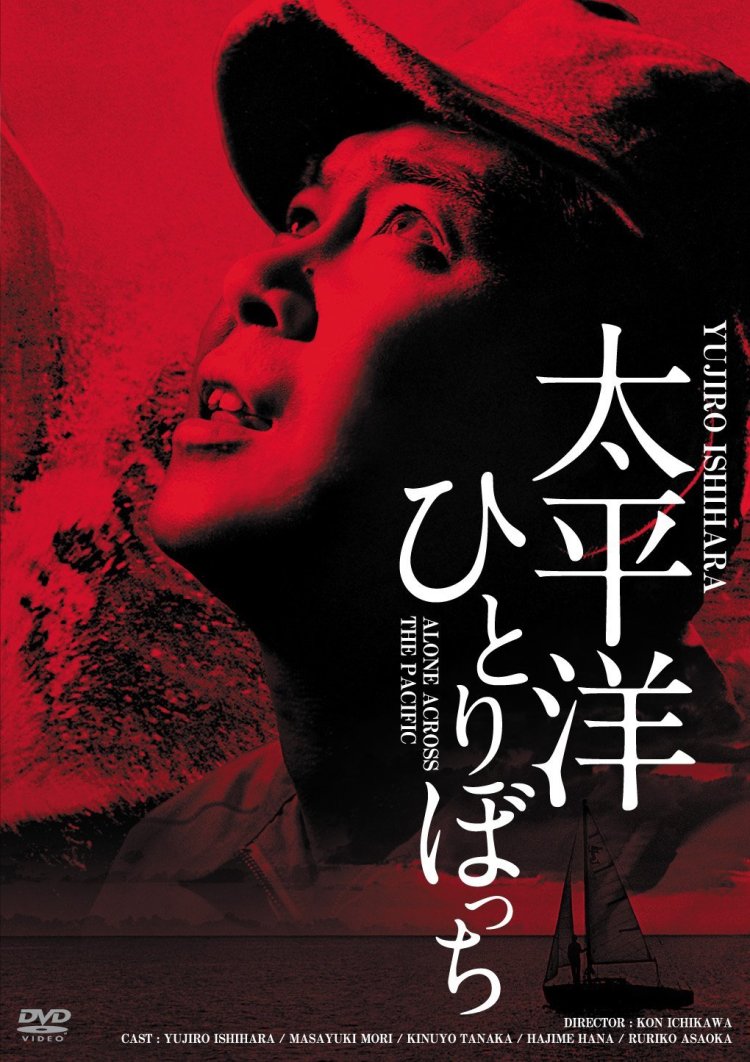
Alone Across the Pacific (太平洋ひとりぼっち, Kon Ichikawa, 1963)

Alone Across the PacficKon Ichikawa made two sorts of movies – the funny ones and the not so funny ones. Despite the seriousness of the title, Alone Across the Pacific (太平洋ひとりぼっち, Taiheiyo hitori-botchi) is one of the funny ones. Like many of Ichikawa’s heroes, Horie is a man who defies convention and longs for escape from the constraining forces of his society yet is unable to fully detach himself from its cultural norms. Based on the real life travelogue of solo sailor Kenichi Horie, Alone Across the Pacific is less the story of a man battling the elements, than a cheerful tale of a man battling himself in a floating isolation tank bound for the “land of the free”.

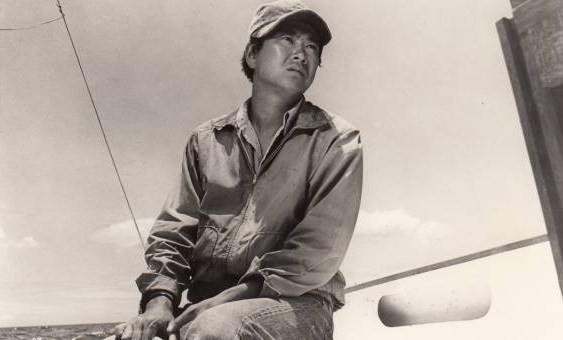
Kenichi (Yujiro Ishihara) is a strange man. He has few friends (aside from the family dog, Pearl) and is obsessed with the idea of running away to sea. Inspired by the tales of other intrepid sailors, his dream is to sail all alone across the Pacific Ocean from Osaka to San Fransisco. Despite the fact that it is illegal for small boats to leave Japanese waters (and that he is too impatient to wait for his passport to come through), Kenichi has custom made his own yacht, one without an engine, and has set off on his longed for voyage under the cover of darkness.

Rather than filming Kenichi’s journey naturalistically, Ichikawa opts for an adventurer’s tale as Kenichi provides an ironic voice over detailing some of his naive failings as a rookie sailor undertaking such a daunting mission. Each of Kenichi’s crises links back to a memory from his shore life, reminding us why he’s on this journey in the first place. Kenichi’s struggles are the same as many a young man in post-war Japan and, in fact, many of those previously played by the poster boy for youthful rebellion, Yujiro Ishihara.  Unwilling to live a life hemmed in by the predetermined path of a job for life, wife, children and total social conformity, Kenichi longs to be free of his cultural baggage by abandoning his civility during a long process of isolation therapy free of overbearing fathers, fretting mothers, indifferent sisters and a generally noisy world.

Kenichi’s father (Masayuki Mori) is the very personification of authority, berating his son for his fecklessness and pointless obsession with sailing – a sport a working class boy like Kenichi can barely afford. Kenichi’s determination to achieve his goal sees him leave school early, take a job in his father’s workshop only to quit suddenly for a more lucrative one delivering luggage for a travel agents, and quitting that too to work full time on his boat. While his father huffs and puffs his mother (Kinuyo Tanaka) worries, hoping her mad son won’t really go through with it but knowing that he will.

When Kenichi finally reaches San Fransisco, he’s assaulted by congratulatory voices from all directions. Towed into harbour by a motor boat, Kenichi first has to deal with mundane problems like the customs patrol wanting to know if he’s got any fruit left on the boat before a crowd gathers to shake his hand asking where he’s come from and why, what he wants to do now, and praising him for his daring feat of solo sailing glory. In Japan however, things are different. Dragged out for an interview by the press, Kenichi’s worried mother avows that she’s just happy to know her son is safe while his father bows deeply and reassures everyone that he will absolutely put a stop to any such random acts of individualism his wayward son may attempt in the future. 

Kenichi evades the twin pulls of his mother’s apron strings and his father’s handcuffs by taking off alone but even at sea he’s never free of his cultural programming, checking the wide empty ocean before removing his clothes and then stepping back down into the cabin to finish the job. Kenichi’s failure to acquire a passport is an ironic one seeing as part of what he’s running from is being Japanese but even as his quest is one for self determination it is also intensely selfish and self involved. In this Kenichi commits the ultimate act of individualism, caring nothing for the thoughts and feelings of others in the all encompassing need to achieve his goal. Kenichi may have found a home at sea, but on land he’s caged once again, a prisoner both of social conformity and his own need to defy it.


Available on R2 DVD from Eureka Masters of Cinema.

Original trailer (no subtitles)
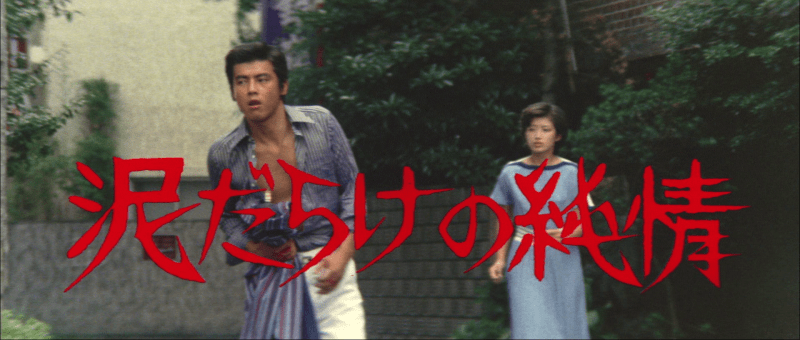
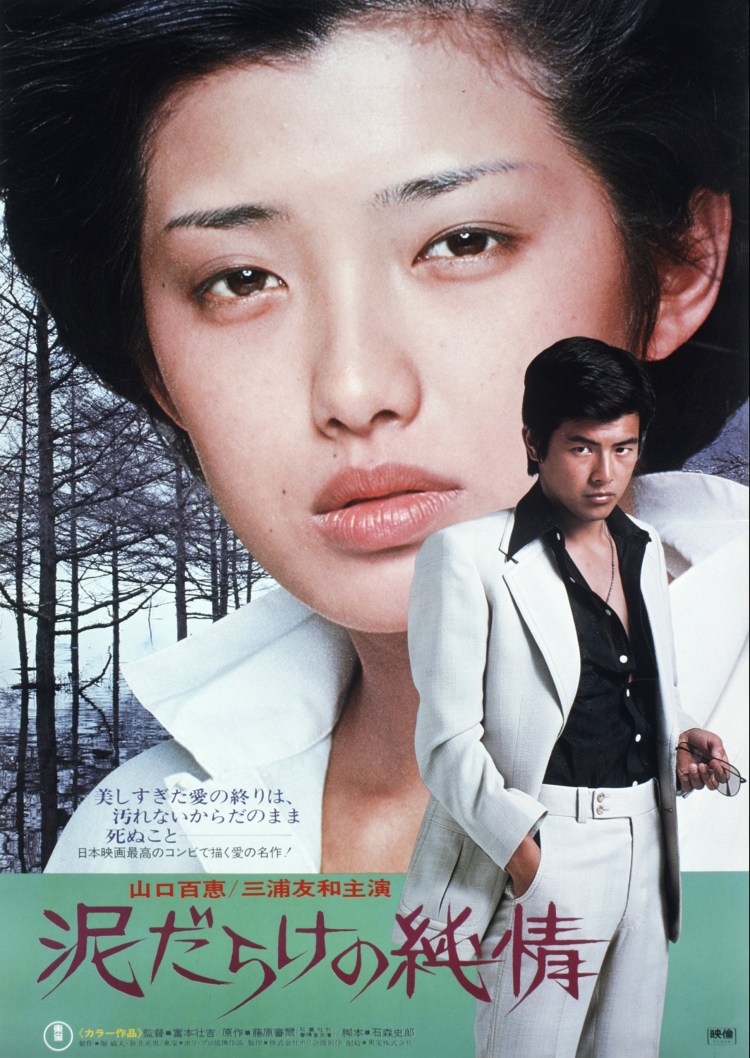
Love in the Mud (泥だらけの純情, Sokichi Tomimoto, 1977)

Love in the Mud posterJapanese youth cinema was in a strange place by the late 1970s. Angsty seishun eiga had gone out with Nikkatsu’s move into Roman Porno and the artier, angry youth films coming out through ATG were probably not much for a teen audience. The Kadokawa idol movie was only a few years away but until then, films like Love in the Mud (泥だらけの純情, Dorodarake no Junjo) arrived to plug the gap. Based on a novella by Shinji Fujiwara which had been previously adapted by Ko Nakahira in 1963 in a version starring Sayuri Yoshinaga and Mitsuo Hamada, Love in the Mud is a classic tale of poor boy meets rich girl and ends in a predictably hopeless way but in deep contrast to the prevailing culture of the time, the film takes the “junjo” or “purity” in its title literally in its innocent chasteness.

As the camera pans over a rapidly developing city, it settles on a bright red, flashy sports car being driven by Mami (Momoe Yamaguchi), the daughter of the Japanese Ambassador to Spain, with her friend sitting cheerfully in the passenger seat. Disaster strikes when the pair are run off the road by a biker gang who taunt them from outside the car, threatening rape and robbery. Luckily for them another gangster turns up, beats up the bad guys and saves the girls but alarm bells should have been ringing when he asks Mami to step out of the car and “thank him properly”. Mami, stupidly, does what she’s told and the girls are hijacked by gangsters round two. When they reach the shady place the gangsters are planning to have their wicked way with them, a third wave of gangster appears, disapproves of the goon’s intentions and heroically fights them off. However, the girls’ saviour is stabbed in the stomach and then later stabs and kills the leader of the aggressors.

The noble gangster, Jiro (Tomokazu Miura), tells the girls to run – which they do, but somehow Mami can’t quite bring herself leave him. A thoroughly middle-class girl, Mami is at university studying English literature but her dream is to open a hat shop in Paris and she spends most of her spare time working with a hat designer. In the absence of her father, Mami’s uncle (Ko Nishimura) has been looking after her but is the classic upperclass male who thinks the hat stuff is just a hobby and what Mami needs is a good husband as soon as possible. Accordingly he’s set her up with a pleasant enough business contact he hopes will both support Mami in the manner to which she’s been accustomed and his business dealings too.

Your average teenage girl might not be in such an extreme situation as young Mami, but most can certainly sympathise with her lack of agency. The life her uncle has planned for her is not what she wants but more than that, she’s acutely aware of being denied a choice in her future. She may be rich, but she’s never been free. Jiro, by contrast, grew up poor in tragic family circumstances and enjoys his own kind of freedom even if he feels himself constrained by his social class and lack of opportunities following a life in care with no real education. Not actually a yakuza but a gambler and petty punk living on the fringes of the underworld, Jiro has been content to live a meaningless life of empty gains but as his rescuing of Mami and her friend shows, he has a kind heart which extends to delivering presents to the daughter of a melancholy bar hostess currently living in an orphanage.

Jiro’s nobility is of a true and pure kind. After Mami comes forward to testify in Jiro’s defence, she tries to strike up a friendship but Jiro rebuffs her. He’s too smart not to know posh girl and poor boy never ends well, but then they do have a real connection which proves hard to kill. Their social differences are made apparent when Mami makes the naive decision to invite Jiro to a party at her fancy mansion. He buys a nice suit and an expensive necklace as a present, but Mami’s nanny doesn’t want to let him in and when Mami introduces Jiro to her uncle he whips out a checkbook causing Jiro to leave enraged. Nevertheless Mami chases Jiro through the shadier parts of Shinjuku, taking her first taste of gyoza, frequenting underground nightclubs and mahjong parlours, and swapping her elegant outfits for the casual jeans and T-shirts of Jiro’s world.

While all of this is going on, Jiro is also embroiled in the gang trouble which started with the stabbing in the beginning. A “friend”, almost, of the local policeman, it’s not surprising suspicion falls on Jiro and he faces a bleak future if he chooses to remain in Shinjuku. The courtship of the pair is a stuttering, nervous affair in which the emboldened Mami chases Jiro whose sense of honour teaches him to try and avoid her all the while he too is smitten. This is, however, a chaste and innocent love. Jiro and Mami spend a night together gazing at the moon but all they do is talk and the climax of the romance is met firstly with an innocent hug, and then a troubling slap from Jiro which is designed to show the depth his love in his desire to push Mami away, rather than anything more explicit.

A tragic tale of love across the class divide, Love in the Mud indulges the worst aspects of its genre in the fetishisation of doomed romance and extreme dedication the idea of “pure” emotion. The force that keeps Jiro and Mami apart, rather than entrenched social mores and differing forms of oppression is a kind of fatalistic pessimism which says the only true love is death. Perhaps too innocent and too chaste, Love in the Mud never earns its melodramatic ending but does what it needs to in appealing to its teenage target audience, neatly anticipating the genial edginess of the idol movie but failing to move much beyond capturing its moment as a snapshot of late ’70s youth culture.


Original trailer (no subtitles)


Red Pier (赤い波止場, Toshio Masuda, 1958)

Snapshot-2016-01-24 at 11_01_43 PM-1747507265Loosely inspired by Julian Duvivier’s 1937 gangster movie Pépé le Moko, Toshio Masuda’s Red Pier (赤い波止場, Akai Hatoba) was designed as a vehicle for Nikkatsu’s rising star of the time, Yujiro Ishihara – later to become the icon of the Sun Tribe generation. On paper it sounds like a fairly conventional plot – young turk of a gangster comes to town to off a guy, sees said guy killed in an “accident”, and shrugs it off as one of life’s little ironies only to accidentally become acquainted with and fall head over heals for the dead guy’s sister. So far, so film noir yet Masuda adds enough of his own characteristic touches to keep things interesting.
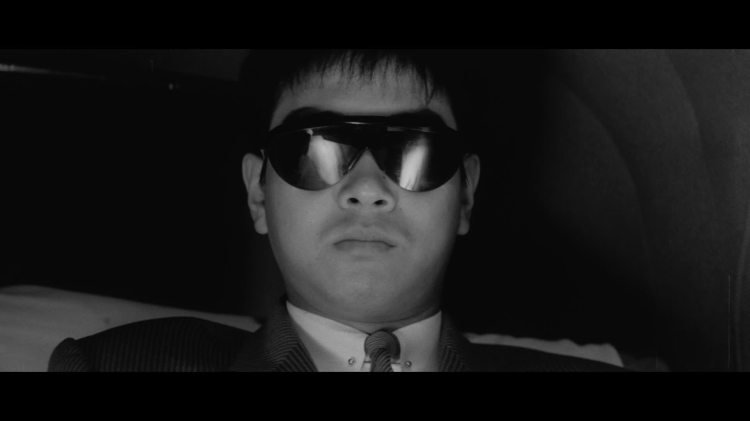
“Jiro the Lefty” (Yujiro Ishihara) is a sharp looking petty yakuza type in a bright white suit and sunglasses. Another of Japan’s post-war abandoned street kids, he found a home in a gang and has never known anything one could call a “normal” way of life. Other than his obvious talent with a gun, he has a cheerful and ironic personality that has him even almost respected by the police and is generally well liked in the area.

Early on Jiro rescues a little boy from almost being hit by a car and later when playing the harmonica for him gets hit by a thunderbolt of love when catching sight of the boy’s aunt, Keiko (Mie Kitahara). This causes him several problems at once: to begin with, she’s the sister of the guy he saw get hit by a crane and she doesn’t seem to know her brother was a gangster, two – Keiko is obviously of a much higher social class and a little out of his reach even if he managed to go straight, three – he can’t go straight, he doesn’t know how to do anything else, four – Mami, his current nightclub dancer “girlfriend” who’s invested a little more in the relationship than he has. Actually this is only the start of a long list of problems Jiro has to deal with, he just doesn’t know about them yet.

The story is set around the docks of Kobe where the living is hard and life is cheap. The local policeman is a fairly laid-back, ironic chap who’s made an odd sort of friendship with Jiro wherein he doesn’t really want to see anything too bad happen to him. He can see this thing with Keiko is not a very good idea and is constantly lurking in the shadows trying to control the situation as much as he can. Jiro, doesn’t know it yet but his own guys are out to get him too and after one of his sworn brothers ends up paying the price for Jiro’s rising profile in the yakuza world, he finds himself on the run from pretty much everyone.

This sounds like quite a complicated set up but Masuda manages to martial everything into a coherent order and even adds a hearty dose of realistic emotion too. As far as the aesthetic goes, Masuda takes his cues from American film noir with harsh lighting and canted angles all employed to show us the crookedness of this underground world but he also makes sure to add occasional touches of artistic flair such as the light bouncing off Jiro’s sunglasses during a night time cab ride or the sheer shock on Ishihara’s face as he first sees Keiko framed against the bright sunshine of Kobe’s harbour.

The too noble for his own good gangster who wants to go straight but knows he has a crooked heart – it’s an old story, but a good one. Red Pier pushes a lot of these ideas to the max but handles them well and adds a traditional “crime doesn’t pay” ending which is both endlessly sad and completely appropriate at the same time. You can’t help feel for Jiro and his small scale existential crisis in which the reluctant gangster wants to jump ship for more peaceful climes but can’t for both personal and societal reasons. Red Pier may not be the best Masuda/Ishihara collaboration but it is certainly an excellent example of everything its genre has to offer.


Red Pier is the Second film included in Arrow’s Nikkatsu Diamond Guys Vol. 1 collection.

http://www.youtube.com/watch?v=JppZs7c9AIY

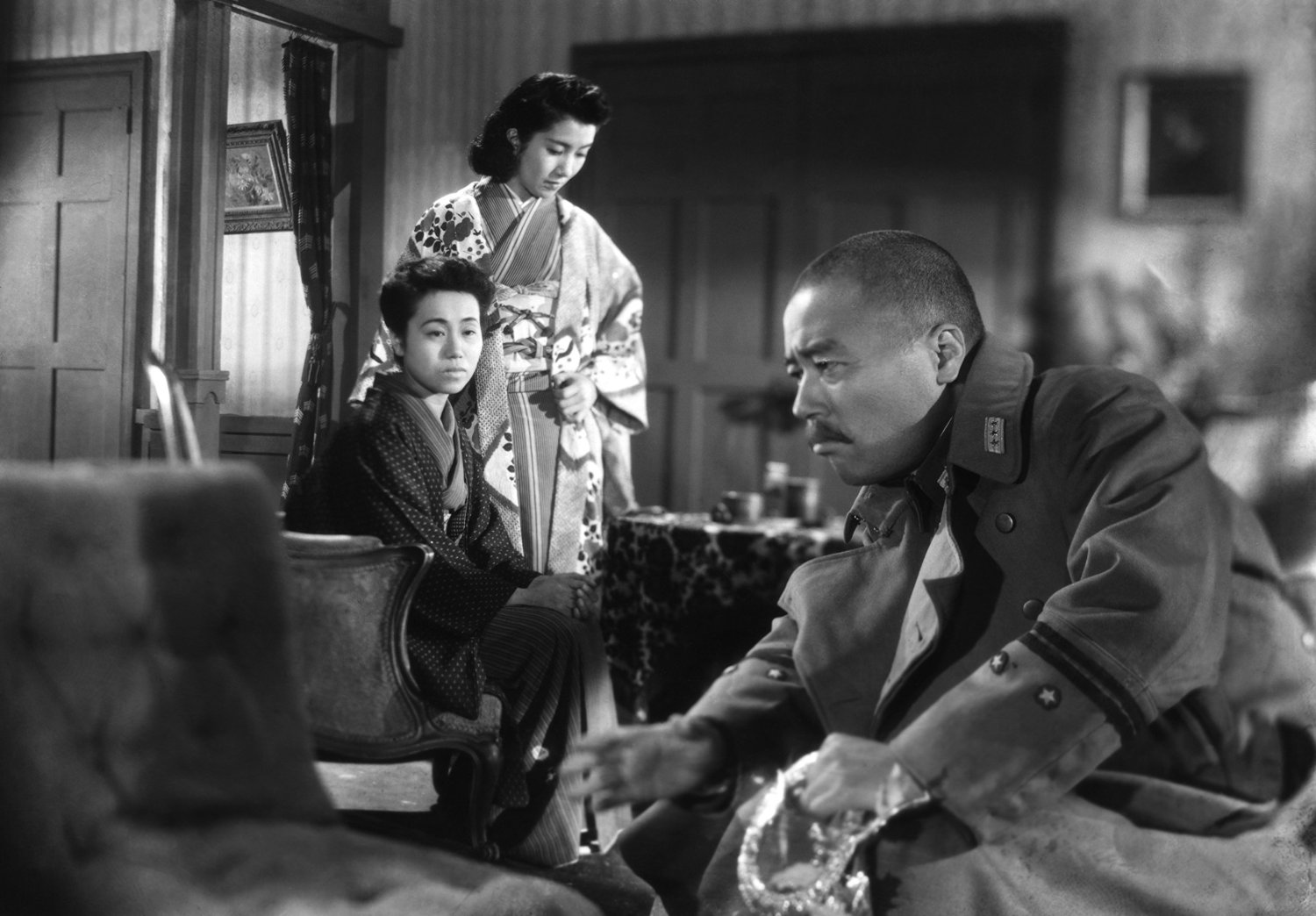
Morning for the Osone Family 大曾根家の朝 (Keisuke Kinoshita, 1946)

81avzyD41gL._SL1500_So, after making the subtly subversive Army, Kinoshita found himself persona non grata but all that changed with Japan’s final surrender and the coming of the Americans. You might think that means an end to the system of censorship and a greater freedom of expression but the truth is one master had simply been swapped for another. The Americans now imposed their own censor’s office and banned the depiction of various dangerous or inconvenient ideas including anything xenophobic, militaristic or anti-democratic. In short, the complete reverse of before but perhaps no less restrictive. However, the new requirements were undeniably closer to Kinoshita’s true feelings so there were fewer problems when it came to getting a film made. Accordingly Kinoshita began working on Morning for the Osone Family soon after the surrender and the film was released in 1946. Extremely raw and probing, the film deals with the effects of the war on a well to do, liberal intellectual family but turns their plight into a metaphor for the country as a whole.

The film begins in the Christmas of 1943 as the Osones gather together around the piano for a rendition of Silent Night as they prepare to say goodbye to the daughter’s fiancé who’s been drafted and will shortly be leaving for the war. The celebration is short lived as their peace is shattered by an ominous knock at the door. Oldest son Ichiro is carted off by military police for having written a mildly subversive essay in a newspaper. Whilst all this is going on Yuko’s fiancé, Akira, takes his leave handing her a letter to say she needn’t wait for him with the future so uncertain. It’s at this point that meddling fascist uncle first appears to reveal he has written to Akira’s family to break off the engagement because they are of a high status and with Yuko’s brother’s arrest he feels it’s inappropriate to bring them shame. As the war drags on, Uncle Issei comes to have more and more control over their lives but will the progressive atmosphere of the Osone household ever be able to withstand the bluster of Uncle Issei’s militaristic fervour?

Made immediately after the war, Morning for the Osone Family is filled with the bitterness and anger of disillusionment. Coloured by the knowledge of Japan’s impending defeat, the events can’t help but take on a portentous air and it’s pretty obvious the Osone family will never be able to return to that final Christmas in 1943 before everything was taken away from them. The obnoxious Uncle Issei becomes a metaphor for Japanese fascism as a whole with his heartless militarism and personal corruption. During one telling episode, Yuko remarks that the more they simply obey him the worse he’ll get and that they should stand up to him every now and then. The mother, Fusako, agrees but thinks it’s impossible. Later, in a last impassioned speech, she laments that she should have done more, said no earlier, but she tried to do what was expected of her. Fusako voices the rage and disappointment of the masses of ordinary people who went along with things they didn’t agree with because they felt it was the proper thing to do. Now she sees no need for the pretence, in this brave new world it’s time for the younger generation to do as they see fit without feeling beholden to these corrupt ideas peddled by those who claim to speak for everyone but have only ever been speaking for themselves.

Oddly, Morning for the Osone Family may have the most overtly propagandistic feeling of any of the films in Criterion’s Kinoshita and World War II boxset. Though it ends on an undeniably powerful declaration of hope for renewal and rebirth, its epilogue feels like a step too far – both hollow and needlessly over the top. Apparently this final scene was added at the behest of the Americans who wanted more deliberately democratic sentiments which may explain its on the nose tone though it isn’t entirely out of keeping with the rest of the film and most likely represents Kinoshita’s real feelings. Morning has arrived after a long night filled with pain and sorrow, all that remains now is to banish the darkness and welcome in the light.