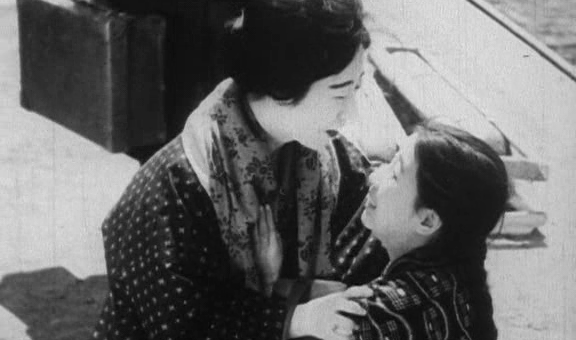

A family broken by economic shock and destructive male pride is eventually mended through Christian faith in Torajiro Saito’s 1929 silent melodrama The Dawning Sky (明け行く空, Akeyuku Sora). Though most of his work is currently presumed lost, Saito became known as the “god of comedy” while working at Shochiku’s Kamata studios yet Dawning Sky while affecting a cheerful tone is marked by a sense of sadness and anxiety that perhaps reflects the precarities of the world of 1929.
Recently widowed Kyoko (Yoshiko Kawada) has learned to bear her grief by doting on her newborn daughter Reiko, though her world is about to implode as the bank operated by her previously wealthy father-in-law Junzo (Reikichi Kawamura) has collapsed leaving the family in financial ruin. Kyoko’s parents approach Junzo offering to take her back, but the idea provokes only intense resentment in Junzo’s wounded pride as he takes it that they no longer feel his family is good enough for their daughter now that he is no longer rich. A traditionally minded woman Kyoko pleads with him to stay but he will have none of it, throwing her out but insisting on keeping Reiko with him. Out of old-fashioned ideas of loyalty, Kyoko decides that she will not return to her parents nor marry again but is at a loss for what to do sadly wandering about ominously near a bridge before catching sight of the cross on a Christian church and feeling herself saved. Some years later, Kyoko is sent to a small town as a female pastor where, by total coincidence, Junzo is also living with Reiko (Mitsuko Takao) and now working as a lowly coachman.
The cause of Kyoko’s forced dislocation is located directly in the economic shock of the late 1920s which causes Junzo to lose his family bank and with it the social status which gives his life meaning, but it’s also implicitly the demands growing consumerist capitalism which have already undermined traditional familial bonds and responsibilities. Junzo is so consumed by resentment towards Kyoko’s family, who may have made the offer for pure-hearted reasons rather than snobbish disdain for Junzo’s ruined state, that he coldly separates a mother from her child and thinks nothing of the consequences seeing only red in his internalised shame in having failed in business. Yet true happiness is evidently not possible until he finally learns to abandon his lust for material success. “I’m poor, I know, but life is nice and carefree because I have my granddaughter” he explains to one of his passengers having reconsidered his priorities and come to realise it’s familial bonds which are most important after all.
Nevertheless, he continues to hide the truth from Reiko having told her that both her parents are dead while she continues to pine for a mother she’s never known. Her little friend Koichi meanwhile is the only son of his widowed mother who is bedridden and unable to work. As the family is poor Koichi is responsible not only for her care, they’ve rigged up a kind of machine which automatically dispenses her medicine while he isn’t there to administer it, but for the cooking and cleaning too. The two children first bond when Reiko discovers a wounded pigeon shot by Koichi and scolds him that he has no right to kill living things though he only wanted to feed his sick mother, the pair of them deciding to bury the pigeon and give it a proper funeral. This brings her to the attention of the pastor, Kyoko, who is proving especially popular in the local community because of her innate kindness and compassion. But in suspecting that Reiko may be her daughter, Kyoko is at a loss as to how to move forward unwilling to disrupt her life with Junzo by telling her the truth while torn apart inside by her wounded maternity and new duties to her Christian faith.
The film’s overt religious overtones are perhaps surprising for the world of 1929 as is the near universal approval with which the church is viewed in the local community with only the strange and bookish Hide refusing to attend on the grounds that he hates Christians while all of the other children begin hanging out inside largely because of Kyoko’s warmth and kindness. It is finally Christian virtues which allow the family to be repaired, Junzo overcoming his sense of wounded male pride when faced with Reiko’s constant pining as the pair eventually make a mad dash towards the station on learning that Kyoko has decided to leave town rather than risk causing Reiko further pain by disrupting her new life. “God’s grace brought them together” as the benshi intones, yet as much as Kyoko’s maternity is restored she remains a liminal figure returning not to Junzo’s house but only to the church as its pastor recommitting herself to her religious duties while looking out sadly as Reiko plays with the other children in the beautiful countryside suggesting that the ruptured bonds of the traditional family cannot ever be fully repaired.
Saito’s elegant mise-en-scène has its moments of poignancy in the expressionist angles of Kyoko’s walk into darkness or frequent employment of superimposition, not to mention the intensity of its climactic storm scene intercut the with the spiritual ferocity of Kyoko’s desperate praying surrounded by candles in the dark and empty church, but the film is first and foremost a melancholy tale of familial reunion which, while in some senses incomplete, nevertheless suggests that true happiness exists only in simplicity, the family repairing itself through jettisoning contemporary ideas of capitalistic success and social hierarchy in order to embrace their natural affection for each other.

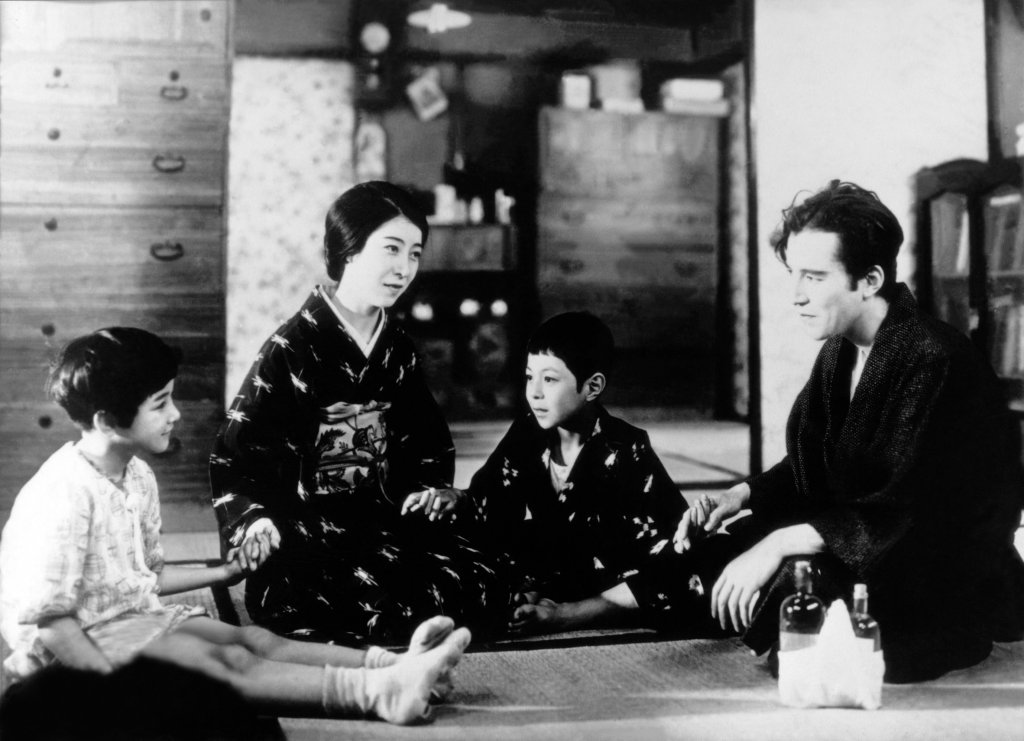

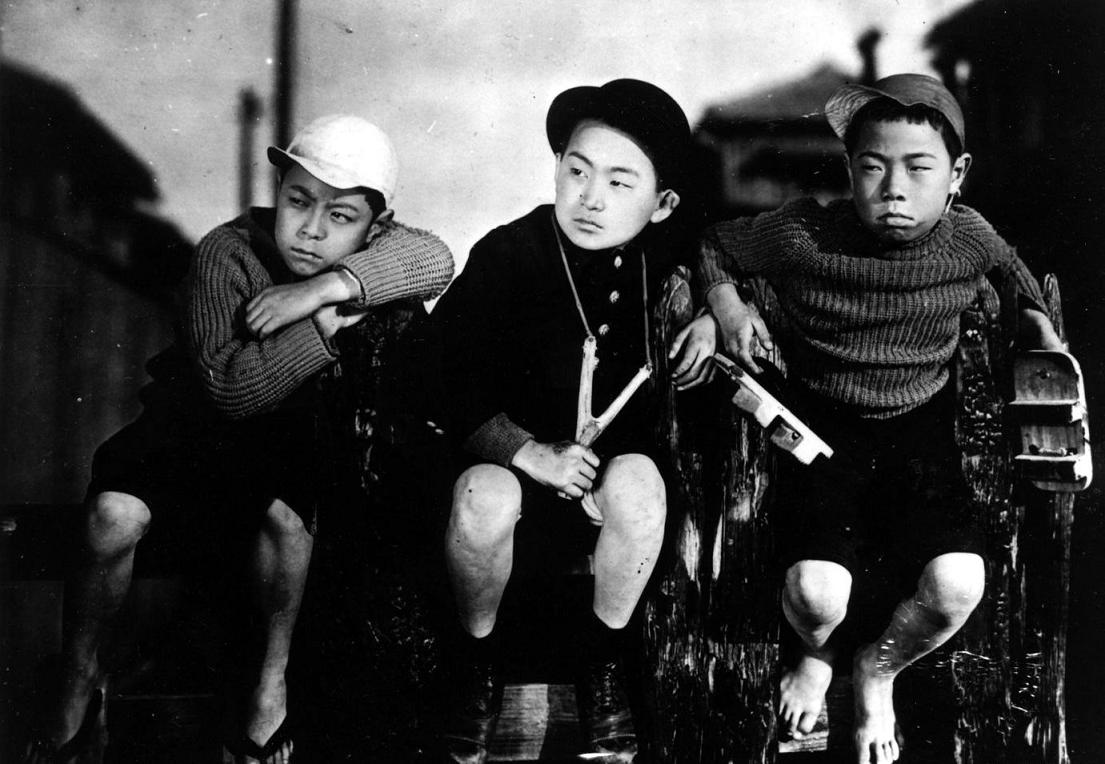 When one thinks of the classic examples of children in Japanese cinema, Hiroshi Shimizu is the name which comes to mind but family chronicler Yasujiro Ozu also made a few notable forays into the genre. I Was Born, But… (大人の見る絵本 生れてはみたけれど, Otona no miru ehon – Umarete wa mita keredo) stars one of the premier child actors of the silent era in Tokkan Kozo (later known as Tomio Aoki) who also worked repeatedly with Shimizu (
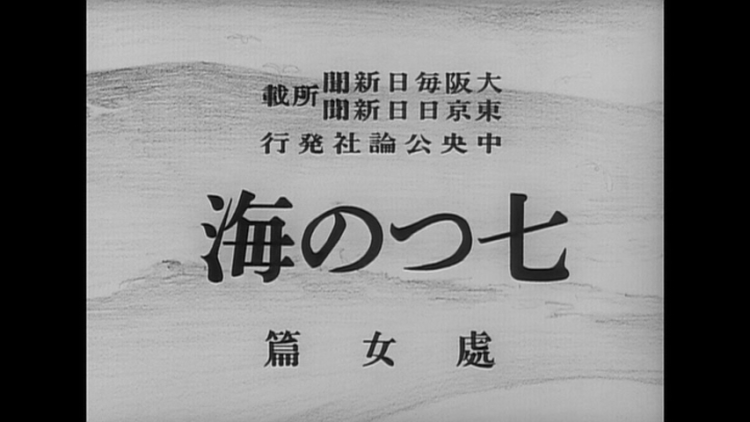 Hiroshi Shimizu is best remembered for his socially conscious, nuanced character pieces often featuring sympathetic portraits of childhood or the suffering of those who find themselves at the mercy of society’s various prejudices. Nevertheless, as a young director at Shochiku, he too had to cut his teeth on a number of program pictures and this two part novel adaptation is among his earliest. Set in a broadly upper middle class milieu, Seven Seas (七つの海, Nanatsu no Umi) is, perhaps, closer to his real life than many of his subsequent efforts but notably makes class itself a matter for discussion as its wealthy elites wield their privilege like a weapon.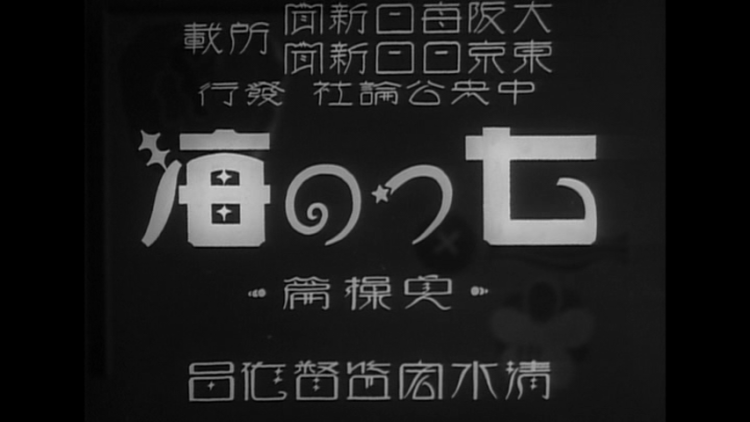
 Like many other areas of the world in the first half of the 20th century, Japan also found itself at a dividing line of political thought with militarism on the rise from the late 1920s. Despite the onward march of right-wing ideology, the left was not necessarily silent. Ironically, the then voiceless cinema was able to speak for those who were its greatest consumers as an accidental genre was born detailing the everyday hardships faced by those at the bottom end of the ladder. These “proletarian films” or “tendency films” (keiko eiga) were increasingly suppressed as time went on yet, in contrast to the more politically overt cinema of the independent Proletarian Film League of Japan, continued to be produced by mainstream studios. Long thought lost, Shigeyoshi Suzuki’s What Made Her Do It? (何が彼女をそうさせたか, Nani ga Kanojo wo Sousaseta ka) was a major hit on its original release with some press reports even claiming the film provoked riots when audiences were passionately moved by the heroine’s tragic descent into madness and arson after suffering countless cruelties in an unfeeling world.
 Naruse’s final silent movie coincided with his last film made at Shochiku where his down to earth artistry failed to earn him the kind of acclaim that the big hitters like Ozu found with studio head Shiro Kido. Street Without End (限りなき舗道, Kagirinaki Hodo) was a project no one wanted. Adapted from a popular newspaper serial about the life of a modern tea girl in contemporary Tokyo, it smacked a little of low rent melodrama but after being given the firm promise that after churning out this populist piece he could have free reign on his next project, Naruse accepted the compromise. Unfortunately, the agreement was not honoured and Naruse hightailed it to Photo Chemical Laboratories (later Toho) where he spent the next thirty years.
 Following on from
  Windows on Worlds