Escape (逃走, Masao Adachi, 2025)

Satoshi Kirishima’s incongruously smiling face was a familiar presence across on the nation for over 40 years until he finally made a deathbed confession revealing his true identity as a man wanted in connection with a series of bombings in the 1970s and that he’d successfully evaded the authorities until the very end of his life. What apparently appealed to director Masao Adachi, a former Japanese Red Army member, was the question of why he chose to come clean rather than enjoy his secret victory by taking the truth to his grave.

That might be a minor irony at the centre of the Escape (逃走, Toso) in that Satoshi (Kanji Furutachi) is essentially in flight from himself only to finally escape from his torment by accepting his original identity. As a young man, Satoshi had been a member of a left-wing cell that wanted to awaken the population at large to the ways Japanese society had not changed in continuing to discriminate against the Ainu, those from the Ryukyu Islands, Koreans and other minorities while modern corporations enact another kind of capitalistic imperialism built on exploitation. It was for this reason that they embarked on a bombing campaign targeting large companies, but due to a miscalculation with the explosives, the bombing of the Mitsubishi Heavy Industries Building in 1974 proved more destructive than intended resulting in loss of life. 

Satoshi was not directly involved in that bombing which was carried out by another cell but was wanted for allegedly setting up a bomb in the Economic Research Institute of Korea which did not result in any casualties. Details of the real Satoshi’s life during his 40 years on the run are thin on the ground, but Adachi paints him as a man torn apart by internalised conflict and unable to make peace with the sense of guilt he feels for those who killed even if he was not directly responsible. The film’s Japanese title is a kind pun in that it’s a homonym which can mean both “escape” and “struggle” which for Satoshi become one and the same. He’s in flight from his younger self while simultaneously preoccupied with how he can continue the revolution in the name of his friends who were not so lucky. Adachi structures the later part of the film as a kind of self-criticism session as Satoshi engages in various dialogues with himself notably as a Buddhist priest interrogating him about his worldly attachments. 

These worldly attachments also obviously separate him from his true calling to revolution including a non-relationship with a woman he meets at a concert venue and is later told has two previous convictions for marriage fraud. Most of the people around him are also leading double lives or harbouring secrets of their own including a man that Satoshi once worked with whom he finds out years later was also another former member of the far left movement living life on the run. The implication is that this sense of isolation and aloneness in wilfully having to suppress his identity became a kind of prison, but that it also liberates Satoshi to a more intensive examination of the self. 

To that extent, his escape is also from contemporary Japan and an act of resistance towards an increasingly capitalistic and indifferent society. Hoping to stay below the radar, Satoshi works a series of casual construction jobs chiefly because of their anonymity. There was plenty to be built in this era and jobs like these were plentiful, usually offering basic accommodation in a company dorm. He experiences the hardships of the working man first-hand and lives a life of asceticism in which live music and drinking are his only outlets. “We’re all dying to survive,” he reflects, “trying to go home,” though he no longer has a home to go to and has become estranged from his previous identity. He meditates on fallen comrades who either took their own lives or spent them in prison while convincing himself that he’s continuing the struggle on their behalf even in the act of running away in perfecting his “escape”. Though Adachi’s approach is less sentimental than Banmei Takahashi’s in I am Kirishima, he is not immune to sentiment as in his depiction of Satoshi’s final escape from life as the ultimate form of liberation even as his ghost proclaims he will continue to fight, but nevertheless introduces a meta commentary of self-examination in Satoshi’s constant questioning if his long years of struggle have really been worth it.


Escape screened as part of this year’s Nippon Connection.

Hijacked Youth – Dare to Stop Us 2 (青春ジャック 止められるか、俺たちを2,  Junichi Inoue, 2024)

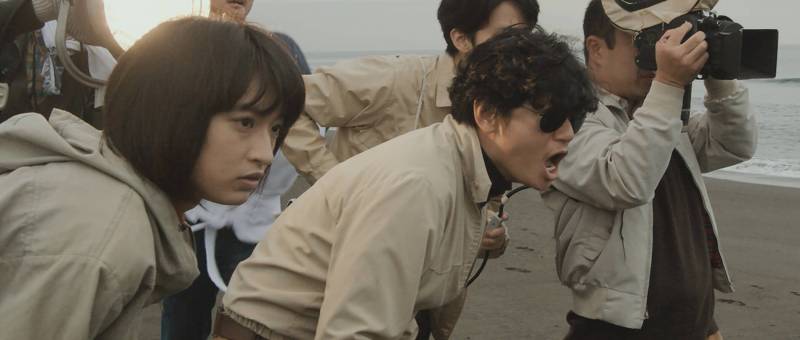
A loose sequel to 2018’s Dare to Stop Us, Hijacked Youth (青春ジャック 止められるか、俺たちを2, Seishun Hijack Tomerareruka, Oretachi wo 2) picks up a decade later with an autobiographically inspired tale from writer director Junichi Inouchi but in its way also becomes the latest in a series of indie films to offer a celebration of Japan’s mini theatres still struggling with the fallout from the COVID-19 pandemic while exploring the origins of the contemporary independent film scene. 

The allusion seems clear even from the film’s opening in which cinephile and former programmer Kimita (Masahiro Higashide) fears for the future of cinema amid the arrival of the VCR. Having quit his job to support a young family, he is puzzled but eventually won over when unexpectedly contacted by notorious film director Koji Wakamastu (Arata Iura) who has apparently decided to open a cinema in provinciail Nagoya after the screening of Ecstasy of the Angels was restricted because someone bombed a police box for real. Kimita wants to run it as a rep cinema, but Wakamatsu sees it partly as a vanity project and a side business so has his eye on the bottom line. Making the mistake of programming films he thinks are good rather than ones people want to see quickly puts them in the red with Wakamatsu pressuring Kimita to give in and agree to screen pink films even though he himself had admitted that pink cinema had had its day. 

Wakamatsu is forever taking Kimita to task for having a prejudice against these kinds of films which are after all the kind that Wakamatsu makes though he does concede that there are talented directors working in pink film who may someday become the leading lights of the Japanese cinema industry. Some of that is hindsight, but what the film is working towards is a link between pink film, which was independently produced in contrast to something like Roman Porno which was made by a studio with much higher budgets and production values, and the rise of independent cinema which is largely dependent on the mini cinema ecosystem to it keep going. 

But then the film is also a nostalgic memoir revolving around the director’s teenage dreams and his eventual meeting of Wakamatsu thanks to the cinema in Nagoya. The irony is that the first film had been titled “Dare to Stop Us,” focussing on Wakamatsu Pro during the turbulent days before Asama-sanso as an anarchic force in a sometimes staid film industry. But the through line here is that everyone gives up far too easily. Kimita abandoned his dreams to sell video recorders, while the young woman who works for him believes she has three strikes against her, the first being her gender, the second a lack of talent, and the third which she does not disclose that she’s a member of the Zainichi community of ethnic Koreans often discriminated against even the Japan of the 1980s and in fact today. 

Junichi gives up a bit easily too after making a twit of himself on Wakamatsu’s film set, though the picture he paints of him is larger than life. Fatherly and compassionate, he gives him solid advice to go to a proper uni and learn filmmaking with him while otherwise taking him under his wing, but also pretty much takes over after giving him his first opportunity to make a film and has a tendency to take no prisoners when it comes to his crew members. At least as far as the film would have it, he’s become a rather lonely figure now that his more politically minded friends have scattered following he decline of the student movement in Japan. As much as anything else, the film is a sort of hagiography as evidenced by the surreal coda which seems to reference the director’s early death in traffic accident in 2012, jumping forward 30 years to find the cinema still open and celebrating his legacy more literally yet also in its existence in supporting the indie scene Wakamatsu helped to birth. According to Wakamatsu, the most important thing is finding your own angle and sticking to it, something his rebellious spirit at least may have fostered in the many directors who started their careers at Wakamatsu Pro and not least Inoue himself.

Hijacked Youth – Dare to Stop Us 2  screened as part of this year’s Nippon Connection

Original trailer (English subtitles)

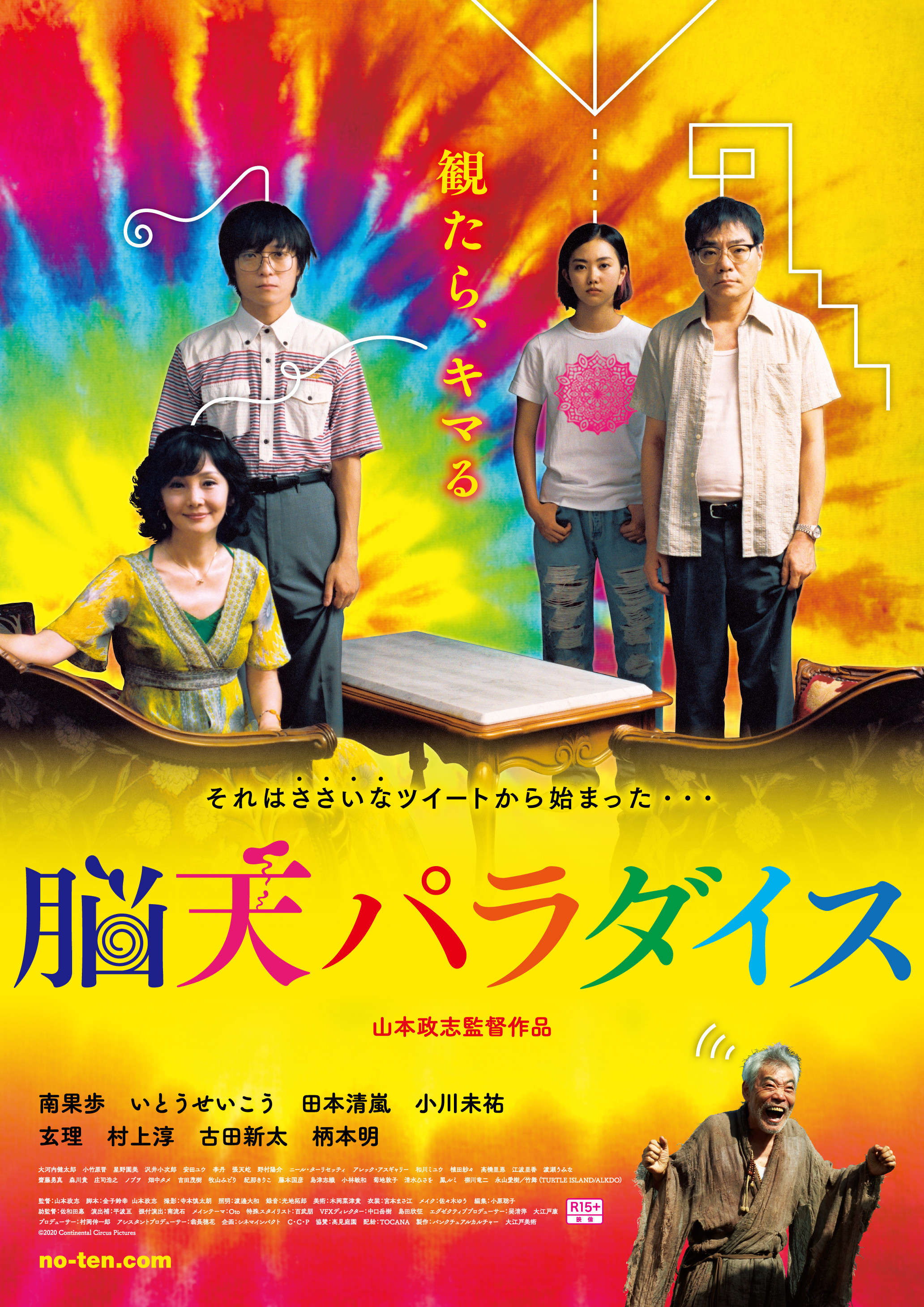
Wonderful Paradise (脳天パラダイス, Masashi Yamamoto, 2020)

A moribund Tokyo mansion becomes the scene for an orgy of life, death, love, and rebirth in Masashi Yamamoto’s surrealist party movie Wonderful Paradise (脳天パラダイス, Noten Paradise). Sometimes you have to learn to say goodbye and move on, other times you have to learn to forgive and let go of past resentment. Of course, sometimes you have to do both of those things at the same time, which is perhaps appropriate for the former home of the Sasayas which seems to exist between the realms of life and death, a perpetual Bon festival where departed spirits and lost souls congregate for one almighty party. 

Dad Shuji (Seiko Ito) has had a run of bad luck and unfortunately lost the family home he inherited from his parents meaning he and his two adult children, son Yuta (Soran Tamoto) and daughter Akane (Mayu Ozawa), are having to move on though who knows where to. Resentful that she’s having her life uprooted by her father’s fecklessness, Akane takes to social media and Tweets that there’s a party at hers and everyone’s invited as kind of goodbye to the house. Meanwhile, a series of strange events occur from a weird old monk (Akira Emoto) who keeps trying to pray to the various neoclassical statues on the property going nuts at a belligerent removal man and then apparently dropping dead, to the resurfacing of mother Akiko (Kaho Minami) who apparently left the family some years previously for a man who ran a coffee shop but has since passed away. 

The first people to arrive for the party are a gay couple looking for somewhere to celebrate their marriage, a minor irony in that the event will later descend into an elaborate funeral for two people who may or may not be dead. As more and more guests arrive, along with a series of opportunistic commercial food stands and other businesses, the party begins to get out of hand becoming ever stranger as the night wears on. 

At the heart of it all are the tensions in the family, an unresolved resentment directed at son Yuta who is, according to his brash aunt Yuka (Sonomi Hoshino), overly preoccupied with his family circumstances to the extent that it prevents him from getting a regular job and moving on with his life. Shuji has quite clearly failed both as a son and as a father, eventually betting one of his dad’s precious antiques in a card game run by yakuza loansharks setting up shop in the house. Akane appears exasperated, but is also harbouring an intense resentment towards Akiko for her abandonment that prevents her being able to “move on” from her former family home. 

Moving on is also a problem for a few of the ghosts, the line between the living and the dead becoming increasingly blurred. One random surreal moment to the next, Yamamoto careers between absurdist episodes culminating in a fight between a murderous sentient coffee bean and a statue come to life. What began as a lowkey wedding eventually becomes a bizarre funeral enacted through the medium of Bollywood song and dance transitioning into a traditional enka festival number all of which happens before a couple of hapless crooks who’ve been operating a drug factory on the family’s property for the last two years without them ever knowing turn up with their “super mandala drug of paradise” to send the evening in a psychedelic direction. 

Yet for all the surreality of death, violence, sex, and rebirth when dawn arrives it brings with it a kind of calm brokering a new peace between friends and family members as they learn to accept each other and the past in an unburdened sense of openness. Possibly deceased monks, talking cats, kids who can’t figure out how to stop swinging and mysteriously turn themselves into sticks or dissolve in bath water, scorned lovers, unrepentant thieves, ghosts and family secrets descend on this weird gothic mansion in the middle of a city, creating a “wonderful paradise” for one night only filled with surrealist magic and unforgettable strangeness that nevertheless pushes the family back together through dream logic and a taste of the absurd. A weird, sometimes incomprehensible, journey into an etherial, psychedelic twilight psychodrama rave, Yamamoto’s charmingly bizarre nighttime odyssey is a law unto itself but one filled with wonder for the uncanniness of the everyday. 


Wonderful Paradise streamed as part of this year’s Nippon Connection.

Original trailer (English subtitles)

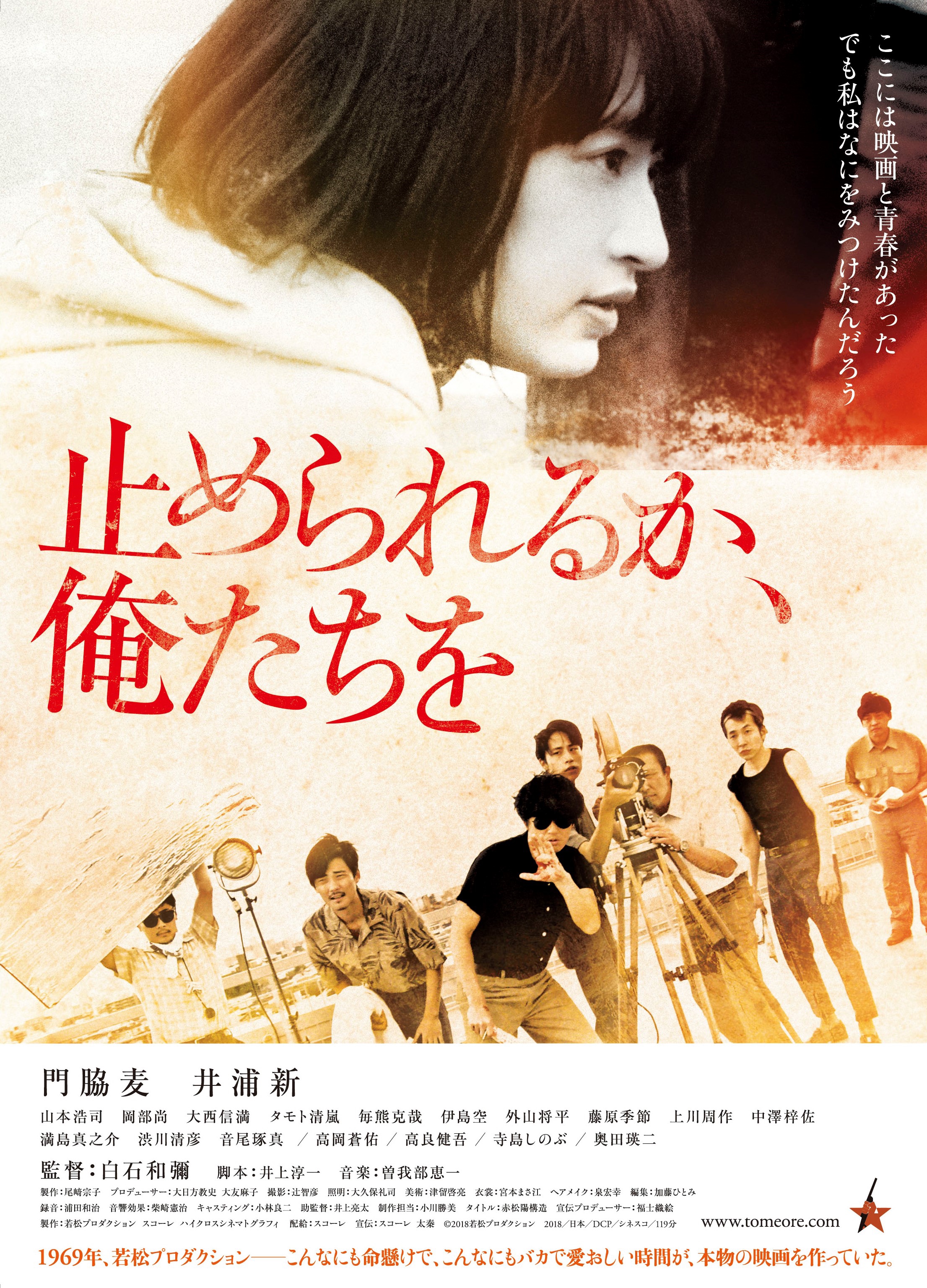
Dare to Stop Us (止められるか、俺たちを, Kazuya Shiraishi, 2018)

Dare to stop us posterUntil his untimely death in a road traffic accident in 2012, Koji Wakamatsu had been the enfant terrible of Japanese cinema. An irascible but somehow much loved figure, Wakamatsu is most closely associated with a series of provocative sex films which mixed politically radical avant-garde aesthetics with pink film exploitation. Kazuya Shiraishi, himself a former Wakamatsu apprentice, takes a look back at the heady years of Japanese indie cinema in the aptly titled Dare to Stop Us (止められるか、俺たちを, Tomerareruka, Oretachi wo) which explores the backstage environment at Wakamatsu Production from 1969 to 1972 (or, right before everything changed with the death of the student movement in Japan following the Asama-sanso incident).

Rather than follow Wakamatsu (Arata Iura) directly, Shiraishi frames his tale around aspiring director Megumi Yoshizumi (Mugi Kadowaki) – the only female presence (besides the actresses) at the otherwise extremely masculine studio which focusses mainly on artistic soft-core pornography. A Shinjuku hippie and self-confessed fan of Wakamatsu, Megumi finds herself joining the team after being recruited to scout potential starlets who could pass for high schoolers. On arrival at the studio, Megumi is quickly mistaken for an actress or mistress but finally manages to win the guys round and is taken on as an assistant director with the possibility of stepping up to the director’s chair if she lasts three years working under Wakamatsu.

As the gruff director warns her, most don’t even last the month. Megumi is however determined, despite Wakamatsu’s continued show of forgetting her name and harsh on-set demeanour. Commiserating with her, another veteran affirms that the big studios wilfully exploit their ADs, at least with Wakamatsu his heart is in the right place even if he’s only a different sort of difficult. He also, however, hands her a bottle of hooch which serves an unfortunate harbinger of things to come as Megumi finds herself playing along with the hard drinking boys club but becoming ever more confused about her role in the organisation and the further direction of her life.

Wakamatsu and his partner Masao Adachi (Hiroshi Yamamoto) vow to make films to shake the world, but are not above commercial concerns which is why they find themselves making pure sex films under pseudonyms to balance the books, much to the chagrin of some of the studio’s more politically engaged members. These are particularly politically engaged times in which the student movement is at its zenith, protesting not only the renewal of the ANPO treaty, but the Vietnam War, and the fiercely contested building of Narita airport. Mostly thanks to Adachi, Wakamatsu Production gradually shifts from indie film company to activist organisation in which political concerns are beginning to take precedence over the business of filmmaking.

The shift leaves those like Megumi who were not so interested in the political dimension floundering along behind and increasingly disillusioned with the world of Wakamatsu Pro. Megumi may admit that she had other problems that probably should have been better addressed, but remains conflicted as to her involvement with the studio. Feeling as if she has nothing in particular to say, she questions her desire to make films at all while clinging fiercely to the surrogate family that has grown up around the strangely fatherly director and continuing to feel insecure in her atypical femininity in a world which more or less requires her to act like a man but doesn’t quite accept her for doing so.

Wakamatsu said he wanted to hold the masses at knifepoint and create a film to blow up the world, but Megumi increasingly feels as if it’s she who will eventually face Wakamatsu with only one of them surviving. Megumi is, in a sense, a victim and encapsulation of her age in which she wanted a little more than it had to give her and found herself increasingly disillusioned with its various betrayals and disappointments. Given the chance to direct a 30-minute short for love hotels, Megumi spins a tale of Urashima Taro which is, as Adachi puts it, all about how she can’t go back to being a hippie after getting mixed up with Wakamatsu and has lost sight of her true self in her quest for acceptance. Both nostalgic look back to a heady era and a tragic tale of that era’s costs, Dare to Stop Us is a fitting tribute to the Wakamatsu legacy which portrays the irascible director as neither saint nor demon but painfully human and infinitely flawed.


Dare to Stop Us was screened as part of the 2019 Udine Far East Film Festival.

Original trailer (no subtitles)

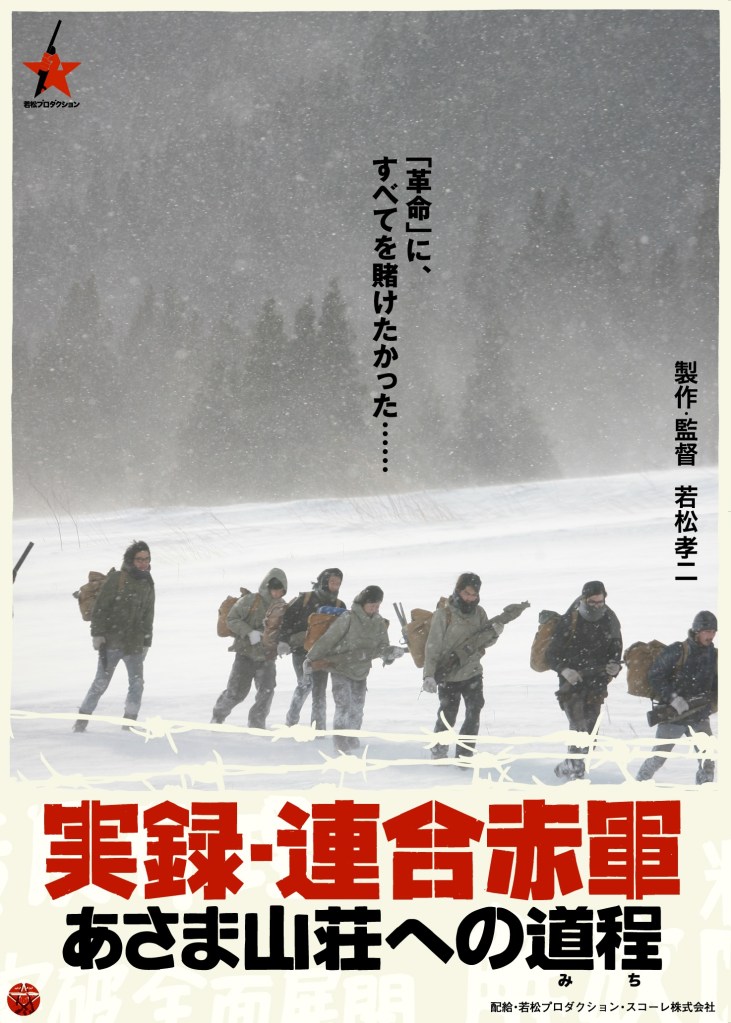
United Red Army (実録・連合赤軍 あさま山荘への道程, Koji Wakamatsu, 2007)

Koji Wakamtasu had a long and somewhat strange career, untimely ended by his death in a road traffic accident at the age of 76 with projects still in the pipeline destined never to be finished. 2008’s United Red Army (実録・連合赤軍 あさま山荘への道程, Jitsuroku Rengosekigun Asama-Sanso e no Michi) was far from his final film either in conception or actuality, but it does serve as a fitting epitaph for his oeuvre in its unflinching determination to tell the sad story of Japan’s leftist protest movement. Having been a member of the movement himself (though the extent to which he participated directly is unclear), Wakamatsu was perfectly placed to offer a subjective view of the scene, why and how it developed as it did and took the route it went on to take. This is not a story of revolution frustrated by the inevitability of defeat, there is no romance here – only the tragedy of young lives cut short by a war every bit as pointless as the one which they claimed to be in protest of. Young men and women who only wanted to create a better, fairer world found themselves indoctrinated into a fundamentalist political cult, misused by power hungry ideologues whose sole aims amounted to a war on their own souls, and finally martyred in an ongoing campaign of senseless death and violence.

Dividing the narrative into three distinct acts, Wakamatsu begins with a lengthy history lesson starting right back in 1960 with the birth of the student movement and the first casualty of the unborn revolution as a young woman loses her life protesting the rise of tuition fees. Despite the lack of success, the student movement intensifies during the turbulent 1960s with the renewal of the ANPO treaties and the perceived complicity of the Japanese government with America’s anti-communist warfare in Asia. Mixing archive footage with reconstructions and on screen text detailing timelines, names and affiliations these early segments are hard to follow but bear out the complexity and chaos which contributed to the inefficacy of the student movement. Soon, each of the leaders we have been introduced to has been removed from the scene leaving the older but inexperienced Tsuneo Mori (Go Jibiki) in charge of what was then the Red Army Faction.

Mori had only recently rejoined the movement after leaving in disgrace at fleeing a protest and thereby evading arrest. The Red Army Faction then merges with another sect, the Revolutionary Left Wing (RLF), to form the United Red Army. Led by Mori and a female commander, Nagata (Akie Namiki), the United Red Army holes up in a cabin in the woods in order to undergo military training for the upcoming armed insurrection. Prior to this, there had been a series of purges and executions in the city producing an atmosphere of terror and paranoia which only intensifies in the incestuous and claustrophobic environment of the ascetic mountain retreat.

Out of his depth and eager to prove himself, Mori’s revolutionary consciousness developes into a dangerous cult of personality in which his iron rule is more akin to fundamentalist religion than a serious political movement intended to change the world for the better. Wakamatsu’s depiction of these events is as terrifying as it is absurd. Maoist doctrine becomes a holy scripture as each of these would be revolutionaries is forced to undergo self criticism in order to devote themselves fully to the revolution and become a “true communist”. Brainwashed and naive, the cadre comply seeming not to realise that no self criticism they can offer will ever be good enough for Mori’s constant need for identity erasure and that each fault they offer will only be used to form the basis of the next charge levelled against them. What begins as questioning develops into screaming before descending into bloody violence and eventually murder.

If Mori’s fault is a kind of madness born of fear and insecurity, it is Nagata whose mania takes on an almost gleeful quality. A plain woman with unremarkable features and a sharp personality, Nagata, as she’s portrayed in the film, displays extreme issues relating to femininity. When an idealistic young woman arrives dressed in typical city fashions necessary to blend in with the capitalist bourgeoisie, Nagata wastes no time in berating her for her stylish clothes and makeup. Threatened both by the woman’s conventional beauty and high ranking position in another faction, Nagata takes especial care to make sure she herself remains on top. Despite being in a relationship with one cadre member and later leaving him for Mori (because it’s “right from the communist perspective”), Nagata cannot bear any hint of sexual activity and it is an ill judged kiss which ends up leading to the first set of mercilessly violent self criticism sessions eventually resulting in death as both parties are beaten and then tied up in the freezing mountain air where death by exposure is all but inevitable.

Mori declares that “leadership means beating” but when this is no longer enough the death sentences come thick and fast. Eventually, some members manage to escape and the mountain hideout is discovered. Splitting up and heading on the run, Mori and Nagata are captured while a group of five break into a mountain lodge where they take the caretaker’s wife hostage and remain under siege for nine days until the police eventually break in, arrest the terrorists and rescue the woman all of which became the first such event to be live broadcast on Japanese TV. The Asama-Sanso incident, as it came to be known, sealed the fate of the left wing protest movement in Japan as the terrorist violence of the renegade protestors forever coloured public perception.

Wakamatsu does not end his story here – returning to the captions which opened the film, he reveals to us the legacy of the failed student protest movement in the overseas activities of the Japanese Red Army, most notably in North Korea and the Middle East. The protest movement in Japan resulted in abject failure – the ANPO treaty survives, the Sanrizuka villages were destroyed and an airport built, the capitalist future arrived at speed heading into the bubble economy where the only revolution was consumerism. The glorious future of which these young people dreamed, free of class, gender, and social inequality, would not materialise as their idealism devolved into introspective dogmatic rhetoric, violence and murder. Trapped inside a fundamentalist cult, the true tragedy is that this was a children’s revolution – the vast majority of its victims under 25 years old, one just 16 and forced to participate in the death of his own brother. How much good could each of these socially conscious young people have gone on to do if only they’d found a less destructive cause? Would anyone want to live in the world born of this revolution? Contrasting the joyous camaraderie of the peaceful protests with the escalating, internecine violence of the URA, Wakamatsu’s vision of the movement he was once a part of is a necessarily bleak one but resolute in its gaze. Ugly, cold and unforgiving United Red Army is a warning from history which has only sympathy for those caught up in its terrible machinations.


Original trailer (English subtitles)