Unchained (四月の余白,  Keisuke Yoshida, 2026)

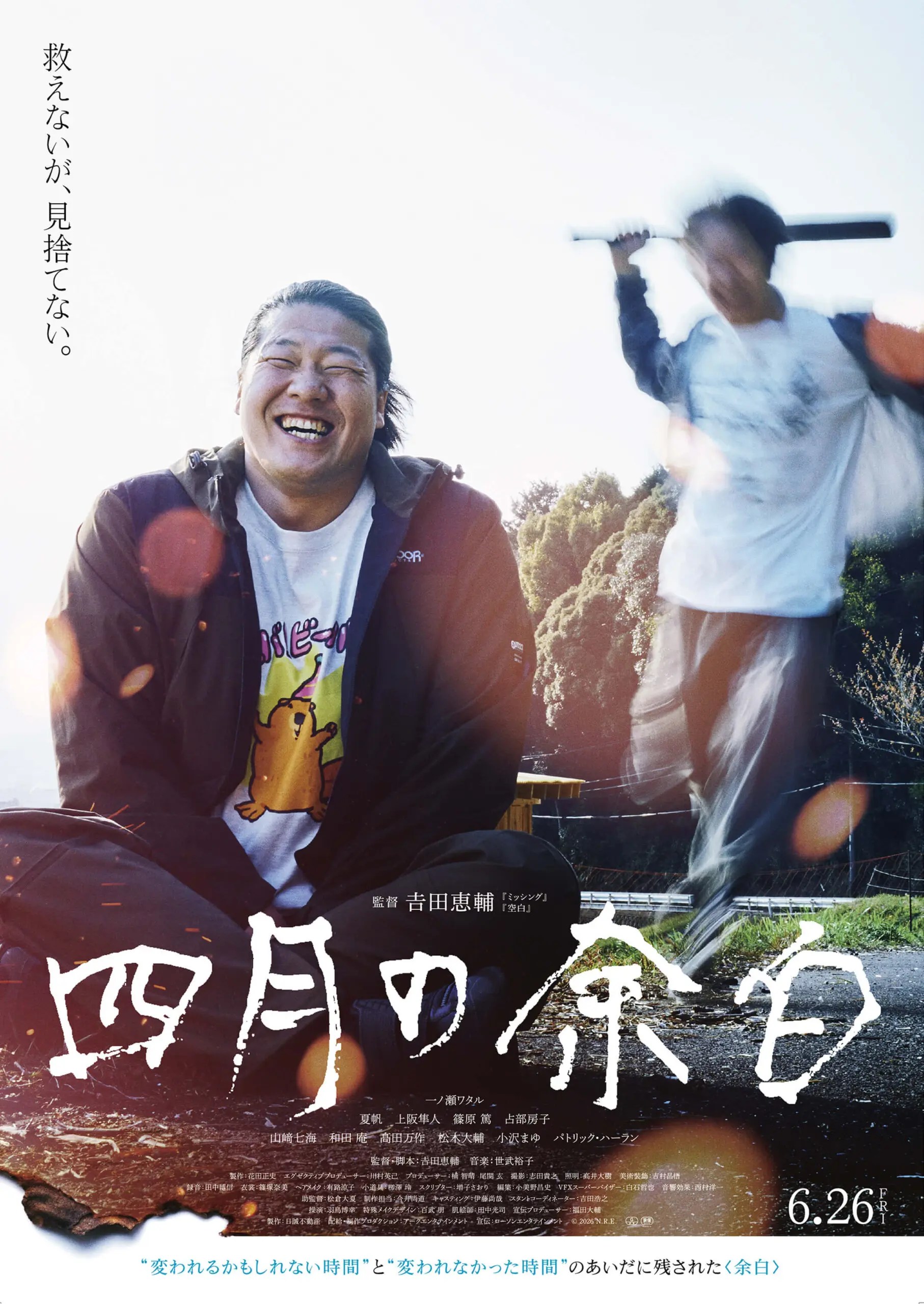
Can a person really change, or should we just accept that some people are born bad and can’t be accepted in mainstream society? This seems to be the question at the centre of Keisuke Yoshida’s empathetic drama Unchained (四月の余白, Shigatsu no Yohaku) which suggests, in a way, that violence is a vicious circle as society tends to write off those with behavioural issues pushing them deeper into their isolation and giving them little opportunity for reform or rehabilitation.

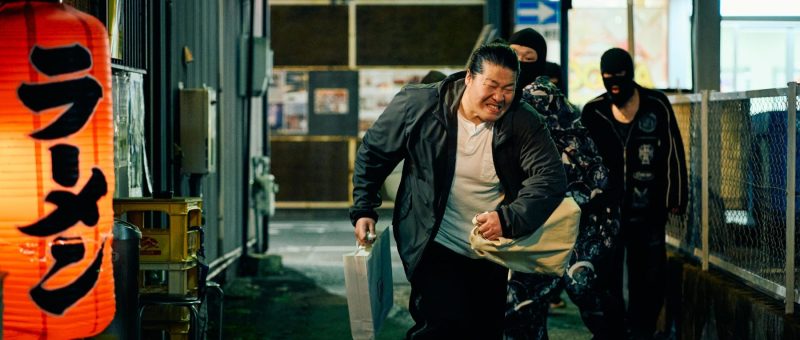
“Mister Nishi” (Wataru Ichinose), as he seems to be known, is a former delinquent who committed acts of heinous violence in his youth, spent time in prison, and experienced a personal tragedy that acted as a wake up call and gave him the opportunity to turn his life around. He now works at a kind of tough love bootcamp that attempts to guide wayward teens back towards the mainstream. His methods, however, are not universally approved and especially not by contemporary teachers. Though corporal punishment has long been outlawed in educational facilities, Nishi believes that sometimes there is no other way to reach these children and violence may be the only way to teach them that their actions have consequences. 

A teacher takes him to task and asks him if he isn’t just teaching them to be violent and in fact pushing them towards and anti-social behaviour. Nishi disagrees, but the film doesn’t really explore the alternative any further and more or less sides with Nishi. The children at the facility do seem to be doing better than they presumably were beforehand and do not appear to be unhappy there. It also seems that they are expected to do farm work, and it’s unclear if they’re being compensated for that, though this may be a slight cultural difference that is not raised in the film either by the documentary crew that comes to film the facility nor by a journalist who tries to take Nishi down by accusing him of fabricating details of his backstory which eventually leads to the facility closing down. 

Nishi may, however, have met his match in Kaito (Hayato Kohsaka), a violent young man exhibiting an extreme lack of empathy. Kaito’s teacher first seeks out Nishi because she’s at a loss of what else to do, while the boy’s mother appears to be a good woman who has tried everything she can and is now at the end of her tether. Kaito has become violent towards her too and apparently beat the family dog to death in a fit of rage for which he feels no remorse. The mother is beginning to feel suicidal and willing to try Nishi’s methods as a last-ditch effort to save her family. There is no clear reason why Kaito became this way. We get a hint of generational violence in that Kaito seems to resent his father who is disabled and in his view defeated by life. His father does seem to have become depressed because of his disability and it’s because of the depression and sense of worthlessness that he’s been unable to hold down a job and has taken to drink.

In a twist of fate, it turns out that it was Nishi who crushed his knee and left him permanently disabled. Kaito’s father therefore piles all of his resentment onto him without taking any responsibility for the choices he made himself after that. When Kaito ironically injures another boy in the same way, his father begins to realise his mistakes and cautions the other boy against becoming consumed by resentment or a sense of defeat. It’s this notion of “defeat” that becomes central to the interrogation of a cultural notion of toxic masculinity in which the reason some of these young men are thought to act out is that they don’t want to be seen as losers and harm others to prove their superiority. This is in part true of Kaito who declares himself happy to hurt other people as long as he himself does not get hurt. It’s not that he is incapable of understanding that others experience pain in the same way that he does, but that he simply does not really care. 

Some argue that Nishi doesn’t either and that, as he was a delinquent himself, he is incapable of fully sympathising with victims and only has empathy for those commit acts of violence. Nevertheless, that does give him a unique perspective that allows him to help some of these teens both by supporting them and being a positive role model as someone who has been able to reform and live a more mainstream, settled life. Then again, some seem dubious of the way he seems to change after the media takes interest which leaves him with less time for the children while chasing the spotlight. Ms. Kusano (Kaho), meanwhile, wonders if she did the right thing or perhaps just did what was easiest for her in abandoning Kaito into Nishi’s care. She chastises herself for having forgotten a model student who spoke to her at a reunion while uncertain if it’s right to devote so much of her time to kids like Kaito rather than supporting those he victimised such as student who withdrew from the school due to his bullying.

While a fellow teacher’s characterisation of Kaito as a”bad apple” who should be “discarded” before he causes any more trouble may seem callous, it’s also true that without his influence the other kids who’d been in his gang begin to straighten out and give more thought to their futures. Though he struggles at the facility, Kaito does seem to benefit in a way from a less stimulating environment and shows signs of change, if also of self-sabotage and an inability to walk away from his delinquent life for fear of being seen as a loser. It’s only after he’s cajoled into another act of violence and receiving kindness in return that he begins to see the error of his ways. The film seems to suggest, then, that person can change but that equally society has to let them, rather than try to tear them down as they did to Nishi in denying him his fresh start by reminding him that no apology is enough to change what he did in the past. While perhaps controversial in some of its implications, the film is at least empathetic and even handed, filmed in an unostentatious style that tries to sympathise both with the dealers and the receivers of violence in the conviction that there is no one who cannot change.


Unchainedscreened as part of this year’s Camera Japan.

Trailer (no subtitles)

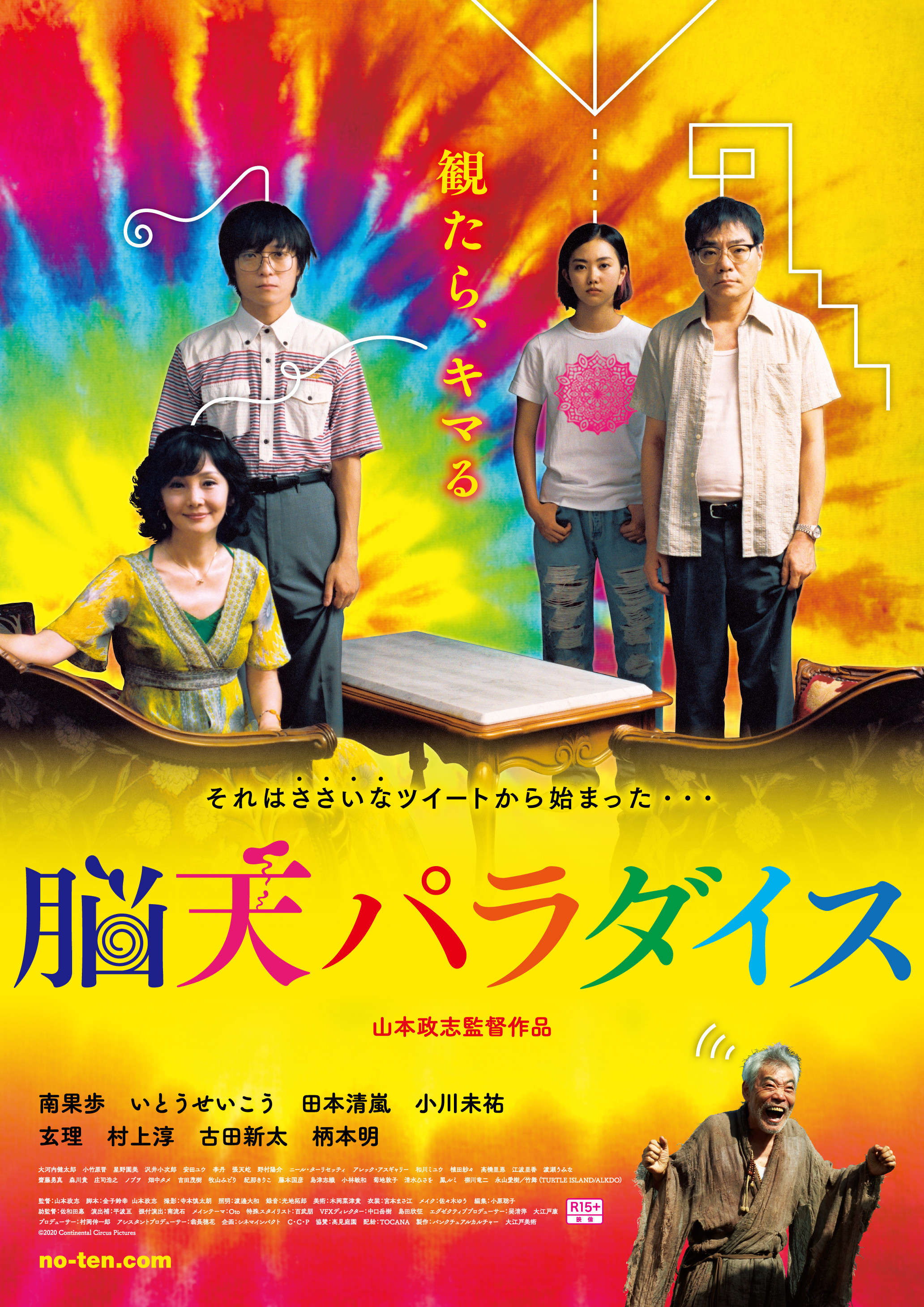
Wonderful Paradise (脳天パラダイス, Masashi Yamamoto, 2020)

A moribund Tokyo mansion becomes the scene for an orgy of life, death, love, and rebirth in Masashi Yamamoto’s surrealist party movie Wonderful Paradise (脳天パラダイス, Noten Paradise). Sometimes you have to learn to say goodbye and move on, other times you have to learn to forgive and let go of past resentment. Of course, sometimes you have to do both of those things at the same time, which is perhaps appropriate for the former home of the Sasayas which seems to exist between the realms of life and death, a perpetual Bon festival where departed spirits and lost souls congregate for one almighty party. 

Dad Shuji (Seiko Ito) has had a run of bad luck and unfortunately lost the family home he inherited from his parents meaning he and his two adult children, son Yuta (Soran Tamoto) and daughter Akane (Mayu Ozawa), are having to move on though who knows where to. Resentful that she’s having her life uprooted by her father’s fecklessness, Akane takes to social media and Tweets that there’s a party at hers and everyone’s invited as kind of goodbye to the house. Meanwhile, a series of strange events occur from a weird old monk (Akira Emoto) who keeps trying to pray to the various neoclassical statues on the property going nuts at a belligerent removal man and then apparently dropping dead, to the resurfacing of mother Akiko (Kaho Minami) who apparently left the family some years previously for a man who ran a coffee shop but has since passed away. 

The first people to arrive for the party are a gay couple looking for somewhere to celebrate their marriage, a minor irony in that the event will later descend into an elaborate funeral for two people who may or may not be dead. As more and more guests arrive, along with a series of opportunistic commercial food stands and other businesses, the party begins to get out of hand becoming ever stranger as the night wears on. 

At the heart of it all are the tensions in the family, an unresolved resentment directed at son Yuta who is, according to his brash aunt Yuka (Sonomi Hoshino), overly preoccupied with his family circumstances to the extent that it prevents him from getting a regular job and moving on with his life. Shuji has quite clearly failed both as a son and as a father, eventually betting one of his dad’s precious antiques in a card game run by yakuza loansharks setting up shop in the house. Akane appears exasperated, but is also harbouring an intense resentment towards Akiko for her abandonment that prevents her being able to “move on” from her former family home. 

Moving on is also a problem for a few of the ghosts, the line between the living and the dead becoming increasingly blurred. One random surreal moment to the next, Yamamoto careers between absurdist episodes culminating in a fight between a murderous sentient coffee bean and a statue come to life. What began as a lowkey wedding eventually becomes a bizarre funeral enacted through the medium of Bollywood song and dance transitioning into a traditional enka festival number all of which happens before a couple of hapless crooks who’ve been operating a drug factory on the family’s property for the last two years without them ever knowing turn up with their “super mandala drug of paradise” to send the evening in a psychedelic direction. 

Yet for all the surreality of death, violence, sex, and rebirth when dawn arrives it brings with it a kind of calm brokering a new peace between friends and family members as they learn to accept each other and the past in an unburdened sense of openness. Possibly deceased monks, talking cats, kids who can’t figure out how to stop swinging and mysteriously turn themselves into sticks or dissolve in bath water, scorned lovers, unrepentant thieves, ghosts and family secrets descend on this weird gothic mansion in the middle of a city, creating a “wonderful paradise” for one night only filled with surrealist magic and unforgettable strangeness that nevertheless pushes the family back together through dream logic and a taste of the absurd. A weird, sometimes incomprehensible, journey into an etherial, psychedelic twilight psychodrama rave, Yamamoto’s charmingly bizarre nighttime odyssey is a law unto itself but one filled with wonder for the uncanniness of the everyday. 


Wonderful Paradise streamed as part of this year’s Nippon Connection.

Original trailer (English subtitles)

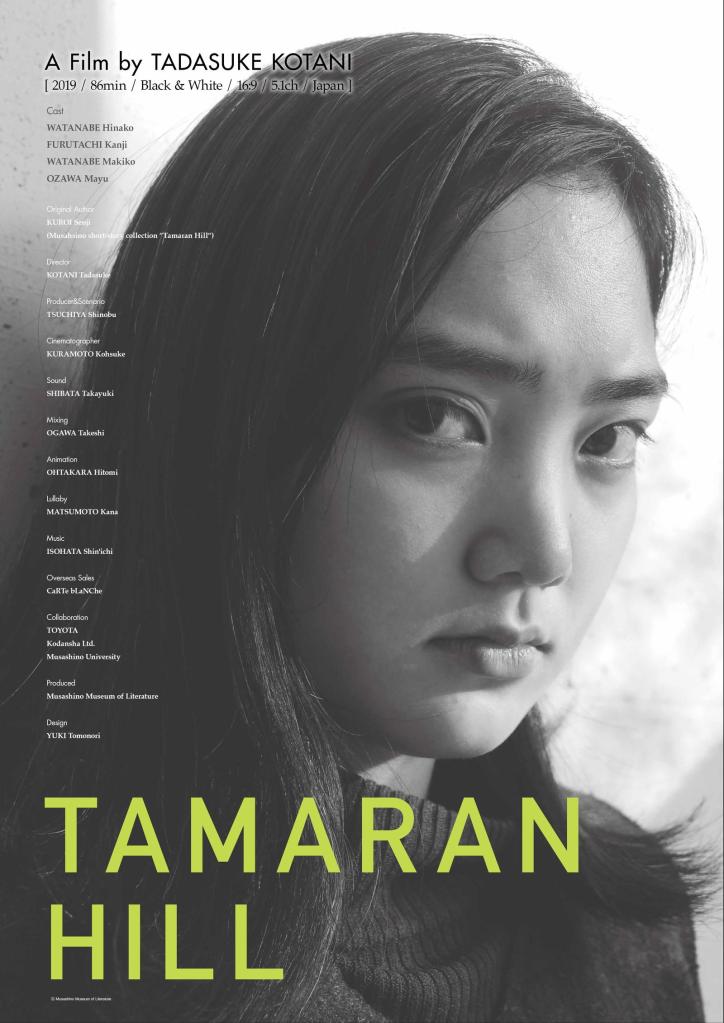
Tamaran Hill (たまらん坂, Tadasuke Kotani, 2019)

Does Japan have more uphills or downhills? You have to think about that one for a second, like one of those trick questions they put in books for children. Nevertheless, you can’t argue with the idea that so much of life is really about perspective and perhaps perspective itself can also be a subjective choice. Shot in crisp black and white with occasional animation and adapting the novel by Seiji Kuroi who actually appears at one particularly meta moment, Tadasuke Kotani’s Tamaran Hill (たまらん坂, Tamaranzaka) follows a young woman’s path towards forging, or perhaps rediscovering, her identity through a meditation on the word “unbearable”, its association with her father, and the long buried memories of a potential hometown. 

Hinako (Hinako Watanabe), a college student, lost her mother at four years old and is at something of a crossroads as she contemplates her future. Her teacher (Makiko Watanabe), who for some reason has an ever present robot assistant at her side, advises Hinako and her fellow students that if they want to get a good job what they need to get good at is the art of narrative lying. They need to assert their individuality in inoffensive ways, quantify their experiences in concrete numbers, but avoid embellishing facts in which hard evidence is available. Her advice to Hinako is that she needs to create a convincing “character” to pep up the self intro on her CV, perhaps paint herself as a survivor who lost her mother not to cancer of the vocal chords but in a natural disaster. 

Hoping to start at the beginning in rebuilding herself, Hinako begins researching the idea of “hometowns” only to be sidetracked by a book titled “Tamaran Hill”. The title catches her eye because “tamaran” which means “unbearable” is one of her father’s catchphrases, indeed we heard him say it numerous times after getting stuck at the airport by a typhoon meaning that he couldn’t get back for his late wife’s memorial service. In the book, the narrator details his friend’s increasing obsession with a slope near his home by the name of Tamaran Hill, something with which Hinako also becomes intrigued as she finds herself sliding into the narrative, the narrator detailing her own experiences as if she were reading them. 

It seems that for most, “tamaran” does indeed mean “unbearable”. The explanations for the name run from a deserting samurai decrying the folly of war as he ran from a nearby battlefield to Showa-era students resentful at having to climb uphill to gain their education but Hinako is disappointed to learn that the answer may be far more prosaic than she’d hoped. Reality and fiction begin to blur. She finds herself asking if an old man is merely a character from her imagination only to receive a philosophical answer that characters are composed of words but that words have vitality, warmth, and power. Meanwhile she begins to have visions of a mysterious past which mingle with those of the narrator’s friend leading her towards the “hometown” she has long been looking for. 

Hinako’s “unbearable” Buddhist priest father (Kanji Furutachi) apparently doesn’t like to talk about the past, which might be why she feels so lost, while he also berates her for not properly looking after her seemingly adopted younger brother. He actively hides from her the keys to her history, offhandedly remarking on the reappearance of a long absent relative in Hinako’s questions about a mysterious cosmos flower placed on her mother’s grave. Hinako wonders if it’s her mother’s fault that she can’t love anyone, retracing her steps inspired both by the novel and a letter hidden by her father in order to make sense of the brief and fragmentary memories which comprise her visions and thereby reconstruct an image of herself which is, essentially, narrative. 

Hinako’s process towards self identification hints at personal fictions and the strange alchemy of fantasy and reality that is memory, but she does at least seem to have straightened her story as per her teacher’s instruction, confidently stating that she has “decided” on her hometown. Perhaps the fiction is more reliable than truth in its manufactured certainties, and after all no one takes “just be yourself’ at face value. Does the slope go up or down, or is it actually on the level and it’s just that everything else is tilted? It’s all a matter of perspective, “unbearable” only in its inscrutability. 


Tamaran Hill streamed as part of this year’s online Nippon Connection Film Festival.

Original trailer (English subtitles)