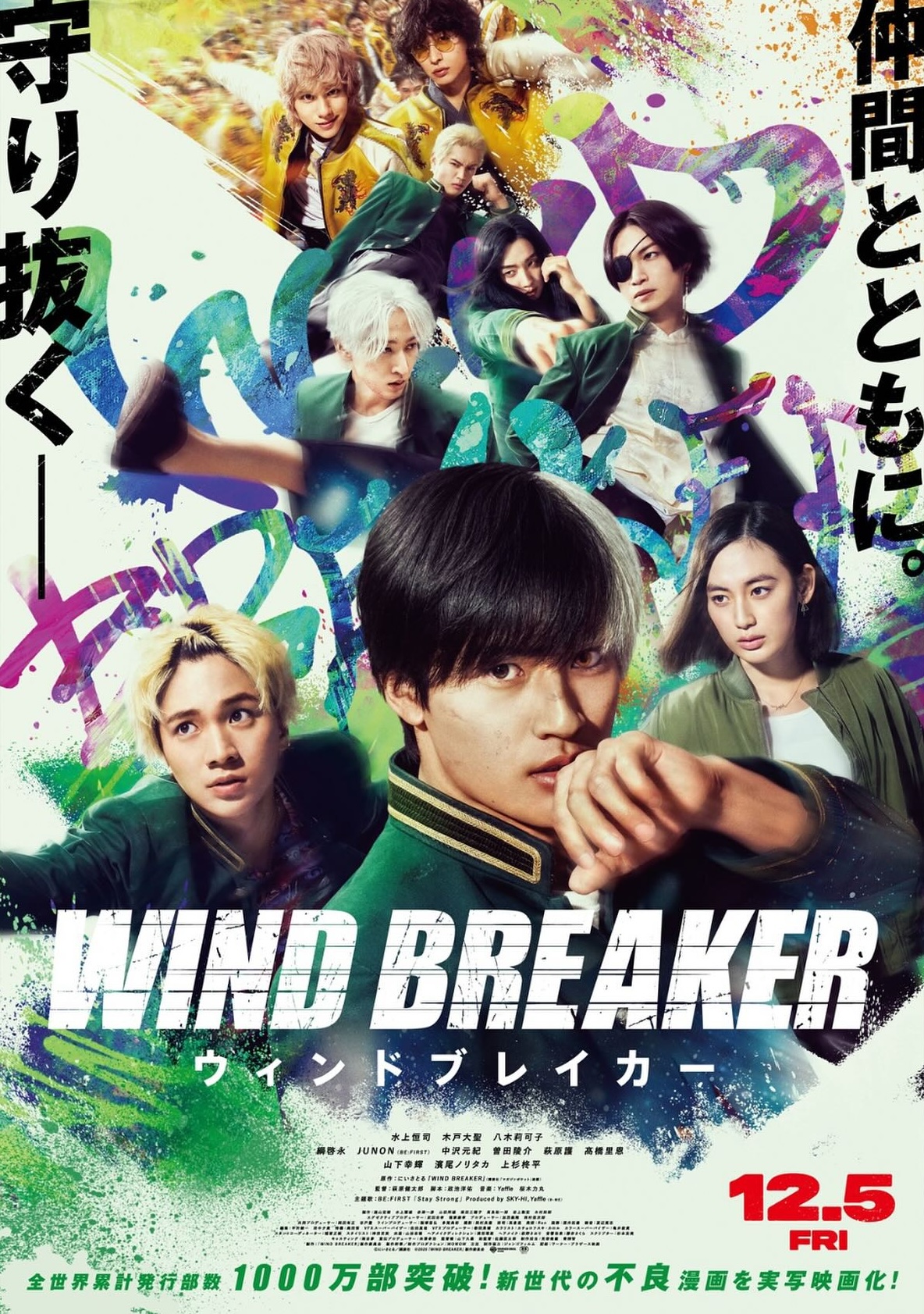
Throughout the fairly long history of delinquent fighting movies, they were mainly taken at face value as contests of masculinity conducted between adolescent men that may not always have had much to them beyond the battle to reach the top. More recent entries in the genre have, however, begun to reinterrogate its themes along with the kind of masculinity to which these young men subscribe. This is undoubtedly the case in Kentaro Hagiwara’s Wind Breaker (WIND BREAKER/ウィンドブレイカー), adapted from the manga by Satoru Nii, which pits the individualistic desire for domination against that for a healthier and more accepting vision of group unity that exists for the purpose of protecting the community.
This kind of duality is embodied in the hero, Sakura (Koshi Mizukami), who has just arrived in town with the intention of becoming top dog at Furin High School. Sakura has two-tone hair neatly divided down the middle while sporting a golden eye on his white side. His unusual appearance has made him a social outcast rejected by those around him, and so he has decided that violence is one way he can be successful as no one cares what you look like while you’re fighting. Similarly, his dilemma is manifested visually through repeated dream sequences in which he’s walking a narrow tightrope while facing rejection on all sides.
He will, however, be disappointed to have arrived in this town as the delinquents of Furin High have already rebranded and are no longer interested in fighting for fighting’s sake. Rather they act as a kind of local community militia patrolling the streets to stop rival yellow-jacketed gang Shishitoren from hassling the mostly elderly shopkeepers. Most of the action takes place in a narrow high street-style shopping area which both gives it the feel of a Wild West town and harks back to an older Japan which is in reality already disappearing. Seen from above in the opening crane shot, it appears to be a slightly run-down former slum area, but we can see that it has already been repurposed into a kind of hipster paradise given a friendly feel by the orange and teal colour scheme and modern painted signage. Rather than markets or shops offering basic services like dry cleaning and key cutting, these mainly seem to be artisanal cafes. Nevertheless, most of the proprietors appear to be elderly people whom the young men are dedicated to both protecting and assisting. In return, they have been somewhat adopted by them with the shopkeepers freely giving out food and produce as a thank you rather an as protection.
This does not sit that well with Sakura who resists making friends and only agrees to join the group in the hope of finally fighting its leader Ume (Shuhei Uesugi), a young guy with grey hair who fulfils the role of the wise old man. He’s set up a garden on the school roof and somehow installed a giant tree up there. His wholesome desire for a kind of pastoralisation or a managed ecological take over the urban space stands in stark contrast to the of Shishitoren whose territory is a mess of discarded paper strewn with makeshift fabric banners that echo post-industrial apocalyptic decline. Similarly, Shishitoren subscribe to a quasi-fascist philosophy which values only strength with gang leader Choji (Koki Yamashita) actively beating up and kicking out guys who lose fights.
Yet as Ume says, fighting is dialogue and these physical clashes are also ways for young men to work out emotional problems they may not even have identified. Choji may be fighting a kind of ennui in having reached the top and realised there’s no where else to go, while his conflicted subordinate realises his desire to support his friend was misplaced and rather than going along with him the right thing to do would have been to discourage his obsession with physical strength and loathing of “weakness”. Sakura too comes to realise that true weakness lies in the inability to trust and rely on others. Fighting only has merit when it’s in service of something other than oneself. Thus masculinity is defined as something rooted in family, community, and brotherhood rather than in aggression and violence, though the only real way to win is not to fight at all. Anchored by strong production design and well-crafted action sequences, the film has an air of sincerity in its earnest messaging that perhaps cuts across the grain of contemporary debate and offers a more positive view of the future marked by progress and positivity rather than darkness and violence.
Trailer (English subtitles)