The Military Policeman and the Dismembered Beauty (憲兵とバラバラ死美人, Kyotaro Namiki, 1957)

The Military Policeman and the Dismembered Beauty (憲兵とバラバラ死美人, Kenpei to Barabara Shibijin) was apparently a substantial hit on its release, though to modern eyes at least it doesn’t quite live up to the salaciousness of its title. In fact, it seems a little more interested in reassessing the militarist past while attempting to rehabilitate an authoritarian power and reframing it as good and compassionate unlike the corrupted killer who is selfish and ambitious to the extent that he’s literally poisoning the militarist wells. 

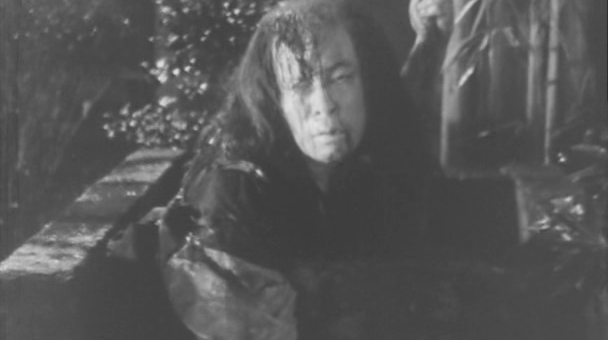
What we’re first introduced to, however, is a rather familiar tale of a soldier who’s gotten a girl pregnant but now won’t marry her mainly because he’s onto a good thing with a pretty girl from a prominent family so his girlfriend’s in the way. Though we see a prelude to the murder, we don’t get good a look at the soldier’s face (though we do hear his voice) which on one level hints at the generalised violent threat of the militarist machine but is also a neat plot device that allows us to into the crime but still maintains the mystery. When we do see the actual killing, it’s surprisingly frank for the time period and disturbing in its sexual charge though there is no gore involved save a grisly discovery in yet another well. 

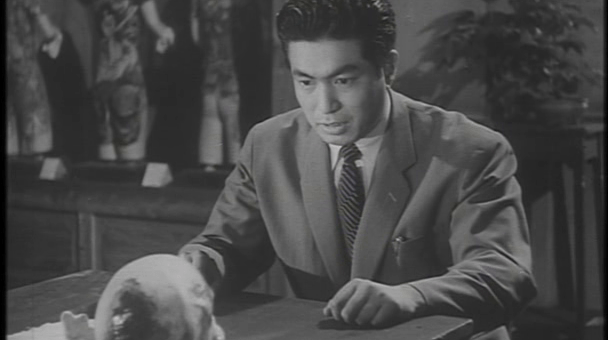
The killing occurred shortly before the regiment left for Manchuria, which seems to be one way the killer sought to move on and leave his crime behind. The first hint of the corruption is discovered by a gang of new recruits as yet unused to the militarist machine. They notice that the water in the well in the barracks is bad, but are at first bullied and insulted by another soldier who’s been there longer and gives them a rather priggish speech about the sanctity of the regimental water. What they discover is that the water tastes bad because there’s a dismembered torso in there and has been for the last six months. One has to wonder why the culprit would think this a good place to hide a body given the risk of discovery and increasing suspicion but as it turns out no one is all that interested. The Military Police aren’t that keen on investigating themselves, and then we get the familiar conflict between the local cops and the specialists as a top investigator, Kosaka (Shoji Nakayama), is assigned to investigate the crime and insists on doing so thoroughly rather than just beating their favourite subject into a false confession. 

Kosaka is then posited as a nice Military Policeman, an emissary of legitimate authority rather than bumbling provincials who are ridiculous and self-serving not to mention incompetent and resentful. We’re told repeatedly that Kosaka is prepared to work with the civilian police unlike the other military policemen who insist on militarist primacy and refuse to allow the detectives onto the base to investigate. He’s a representative of a less authoritarian age that looks forward to the democratic future, but he is also a part of that organisation himself no matter how different he may seem to be and cannot escape the overarching structures of militarism. Nevertheless, his edges are further softened by a nascent romance with the middle-aged innkeeper at his lodging house while his assistant is after her sister, a childhood friend who can’t stop calling him by his old nickname. 

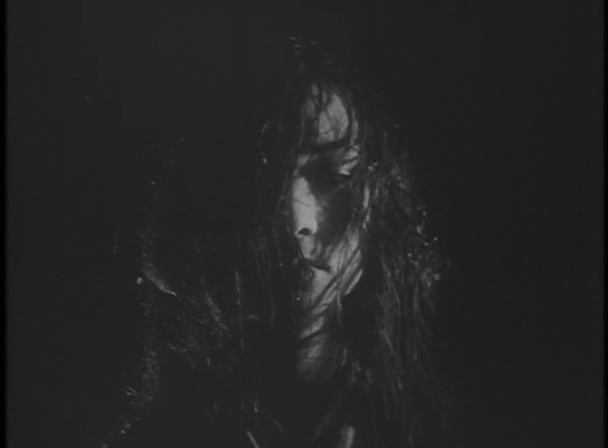
The two of them investigate scientifically, making frequent trips to the pathologist to discuss theories and evidence though Kosaka is eventually guided towards the solution after seeing the young woman’s ghost. The local military police meanwhile fixate on another soldier who has a reputation for using sex workers, one of whom has recently disappeared, though Kosaka thinks the man is a just a crook with what modern viewers make think of as a sex addition that sees him steal supplies from the kitchen to sell in order to finance his visits to the red light district. The military police whip him in an oddly sexually charged manner to try to get him to confess, but he maintains his innocence. One of the motives for the murder was seemingly that the victim planned to expose the affair, taking her concerns to the killer’s superior officer in an effort to force him to marry her which would have ruined his career prospects in what is supposed to be an organisation of honourable men. Unlike Kosaka who shares his name with the writer of the novel the film is based on which may have been inspired by true events, the other military police are largely like the killer, arrogant, selfish and unfeeling though all Kosaka himself represents is a supposedly more benevolent authority that for his niceness may not actually be all that much nicer.
Female Slave Ship (女奴隷船, Yoshiki Onoda, 1960)

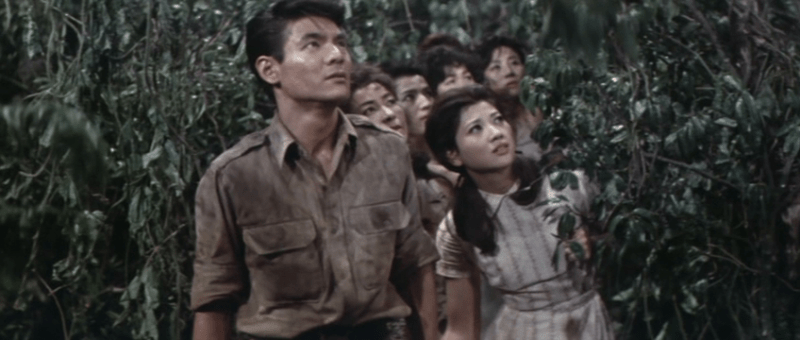
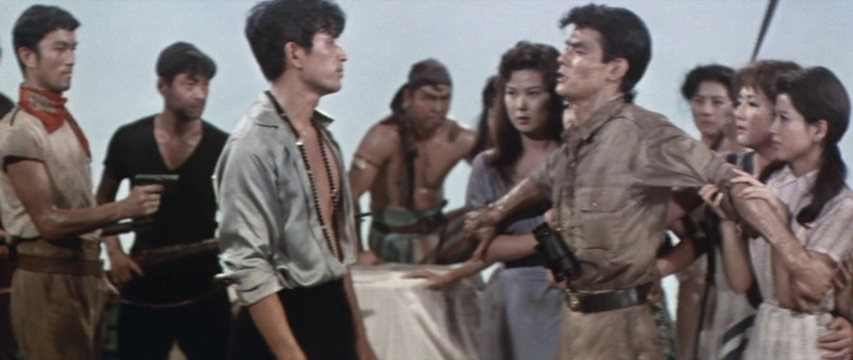
Playing out much more like a classic serial than war movie, Yoshiki Onoda’s Female Slave Ship (女奴隷船Onna dorei-sen) takes a curiously flippant approach to the conflict along with a moral perhaps a little at odds with similar films of the time. Adapted from a novel by Jun Funazaki, the film begins as spy thriller but ends up drifting into pirate territory as a Japanese solider with an incredibly important mission is shot down on his way to Tokyo, rescued by a freighter carrying women en route to being sex trafficked in Shanghai, and then captured by pirates who want to sell him to a Chinese spy working for the Americans. 

It’s right at the end of the war and Japan is losing quite badly they think because of advancements made in radar by the Allied forces. They’ve been passed blueprints for a better radar system by a German contact and so Lt. Sugawa (Bunta Sugawara), stationed in Malaya, has been charged with bringing them back to Tokyo disguised as a photo of a pretty young woman they’re going to say is his sister. Perhaps the most surprising thing about the film is that Sugawa abandons his mission quite quickly and instead devotes himself to rescuing the women, vowing not to return to Tokyo without them despite the fact that this vital information he’s carrying could supposedly turn the tide of the war.

Even so, this manly chivalry defines his code of heroism. He is constantly trying to escape and defiantly stands up both to the captain of the tugboat, who is not actually in charge, but also to the pirate captain (Tetsuro Tanba) who doesn’t really seem to be doing much of anything. Among the crew of pirates is a Japanese man who later confirms that he’s a deserter but alternately switches sides, first offering to team up with Sugawa because he’s fed up with the discrimination he faces from the other pirates, and then betraying him before doing the same thing again but claiming that he feels bad about deserting and wants to do something for Japan now that his Japaneseness has been truly awoken.

It was indeed other Japanese people who were operating the slave ship, chief of them being the Queen (Yoko Mihara) who rules the boat with an iron hand but then uses her sex appeal to curry favour with the pirate captain while simultaneously developing feelings for Sugawa who is equally drawn to a meek young woman, Rumi (Utako Mitsuya), who was tricked onto the boat on the promise of a nursing job in Manchuria. Most of the other women, few of whom are actually given any characterisation, are established sex workers and resolved to their fates but all feel bad for and protective of Rumi. Though she’s the one Sugawa is closest to, it’s quite refreshing that the women are otherwise treated as equals rather than looked down on because of their occupation with Sugawa insistent on rescuing them all before they can be sold in Shanghai. 

As is usual for these kinds of films, the chief villain is Chin (Shuji Kawabe), a Chinese man apparently with ties to the Americans who has somehow found out about the radar plans, even knowing that they’re presented on a photo of a woman, and wants to capture Sugawa to get his hands on them. The bounty causes a rift between the pirate captain and Chin with the pirate captain wanting in on the deal and Chin not really willing to share, though there is a clear implication that these mercenary pirates are on the wrong the side in working with the Chinese and Americans while the slave ship was more on the level of not being okay but definitely not as bad. 

In any case, it comes down to a battle of masculinity between the monkey-loving pirate captain and his trusty whip, and Sugawa’s good old-fashioned chivalry. Surprisingly chaste given its racy title, even the pirates are more of the drunken and lascivious type than violent and rapacious, the film has a rather odd sensibility landing somewhere between jungle adventure and wartime escapade in which an earnest young man bravely carries the weight of the nation on his shoulders while doing his best to address a more immediate threat and rescue 12 captive women from the evils of Japan’s imperialist expansion. 


Original trailer (no subtitiles)

The Ceiling at Utsunomiya (怪異宇都宮釣天井, Nobuo Nakagawa, 1956)

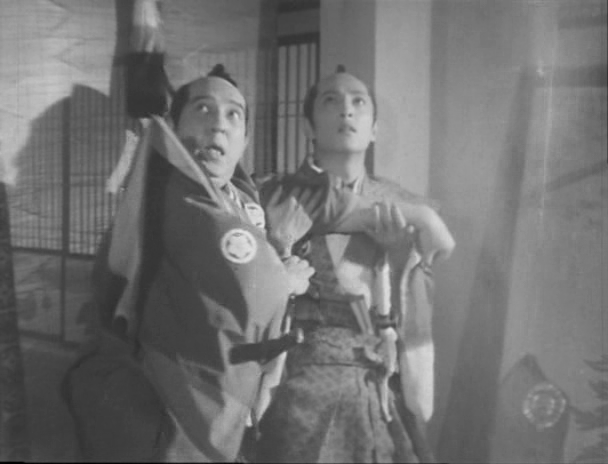
Crime does not pay for a series of conspirators at the centre of Nobuo Nakagawa’s supernaturally-inflected historical tale, The Ceiling at Utsunomiya (怪異宇都宮釣天井, Kaii Utsunomiya Tsuritenjo). As the title implies, Nakagawa’s ominous jidaigeki is inspired by a historical legend in which a retainer supposedly attempted to assassinate the shogun through the rather elaborate device of a mechanical ceiling designed to crush him as he slept. In actuality no such thing took place, the shogun changed his route and subsequent investigations of Utsunomiya Castle found no sign of a false ceiling, yet the story took on a life of its own as local folklore. 

In this version of the tale, conspirators Councillor Kawamura (Ureo Egawa) and local yakuza Kagiya (Masao Mishima) are conspiring to depose Tokugawa Iemitsu (Yoichi Numata) in favour of his brother, manipulating Lord Honda (Shuntaro Emi) of Utsunomiya Castle by convincing him that his clan will prosper when the other retainers fall in behind the new shogun. The pair have arranged for nine talented craftsmen to be shut up in the castle to install “the mechanism” in time for the arrival of the shogun who is due to stay at the castle on his way to Nikko. Meanwhile, Kawamura is also intent on sleeping with the daughter of head carpenter Toemon (Yoji Misaki), Ofuji (Konomi Fuji), whom chief minion Tenzen (Tetsuro Tamba) is supposed to kidnap once the workmen have gone into isolation in the castle. Righteous samurai Ryutaro (Hiroshi Ogasawara) however, an undercover shogunate bodyguard, begins to disrupt their plan saving Ofuji while bonding with a friendly bar hostess, Onobu (Sachiko Toyama), and secret princess forest woman Oshino (Akemi Tsukushi). 

The plot represents in itself a malfunctioning of the feudal order in the essential weakness of Lord Honda, the ambition of his underling Kawamura, and the cruel greed of Kagiya. As the two men conspire, Kagiya jokingly laments that he isn’t a samurai while Kawamura reminds him that if the plan comes off he’ll be fantastically rich. Kagiya, a yakuza who sends his thugs to extort protection money from the local market, is representation of the threat of the rising merchant class whose financial power presents a challenge to the authority of the samurai. Toemon, meanwhile, a master craftsman, is manipulated into participating in the plan because he is in debt to Kagiya, later promised that he too will be “promoted” in being given permission to carry a sword little knowing that Kawamura and Kagiya not only plan to kidnap and rape his daughter but never intend to allow any of the craftsmen to live because they simply know too much. 

The Ceiling at Utsunomiya is not a ghost story in the manner for which Nakagawa is best known but it certainly plays like one, Kagiya eventually haunted by the figure of a betrayed Toemon which in turn leads him to a self-destructive attack on Tenzen and his eventual demise collapsed over his ill-gotten gains, a koban falling from his hand. Greed and violence will only repay in the same, the weak-willed Lord getting his comeuppance from the ever confident shogun even if he himself coolly stands back while others risk their lives to protect him. Even so, the eventual operation of “the mechanism” is intensely startling, the ceiling abruptly collapsing with alarming ferocity though one wonders what the advantage is in such an expensive, elaborate contraption aside from its ironic symbolism when the point of a sword will do. 

Then again, the heroic Ryutaro is almost assassinated while crossing a river via zip wire later fished out of the river by sullen forest woman Oshino, first encountered hunting birds with darts but later revealed to be the illegitimate child of samurai parents who fell foul of political intrigue. In a sense this revelation emphasises the restoration of the political order, Ryutaro permitted to fall in love with Oshino because they are of the same social class, while the romance between Ofuji and craftsman Yoshichi (Kotaro Sugiyama) also comes to fruition eliding the minor class difference between them in allowing the boss’ protege to marry the now orphaned daughter. Onobu meanwhile pays heavy price for her misplaced love for Ryutaro, denied romantic fulfilment in her liminal existence as a bar hostess. In any case, the corruption is exorcised and the normal order resumes reinforcing the hierarchical shogunate society with each of the players back in their rightful positions and possessing new hope for the future as Ryutaro and the shogun continue their tour while their former comrades kneel at the roadside. 


Death Row Woman (女死刑囚の脱獄, Nobuo Nakagawa, 1960)

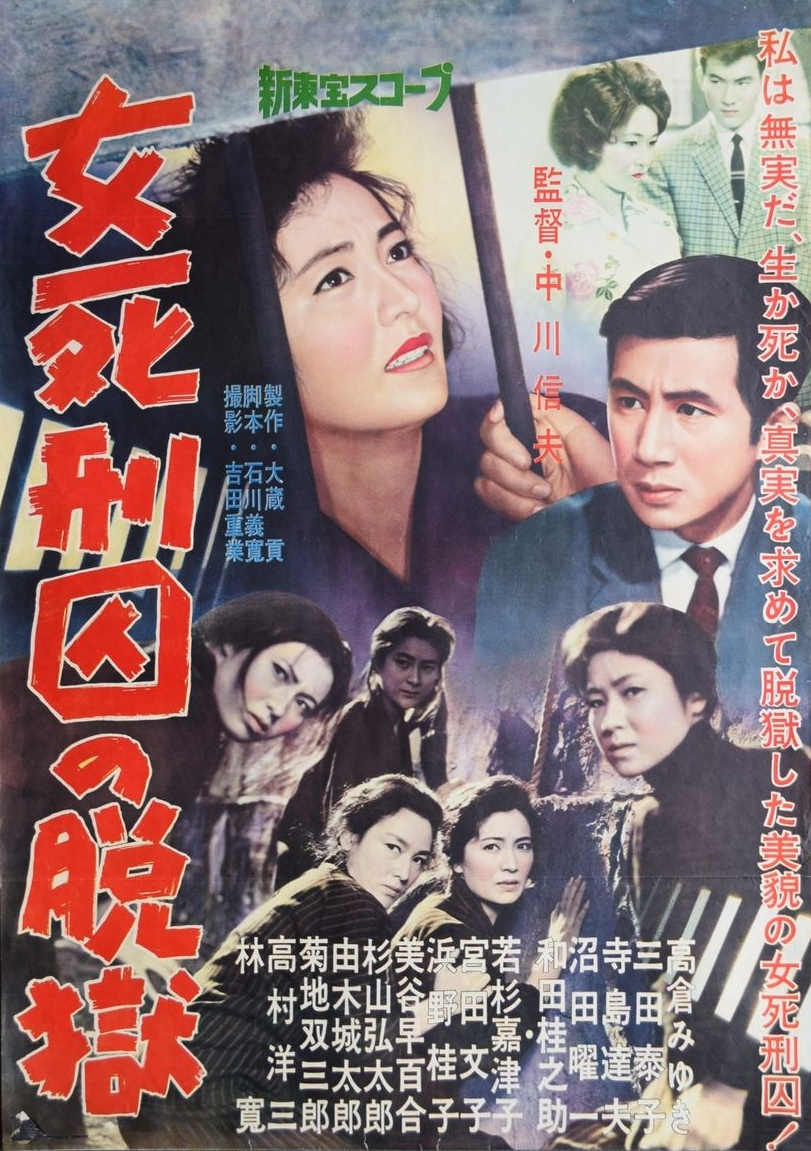
How far does freedom extend in the complicated post-war society? Best known for his eerie horror films, Nobuo Nakagawa takes a stab at B-movie crime in a tale of wronged femininity as a woman’s attempt to escape her father’s authority ends in a death sentence. Death Row Woman (女死刑囚の脱獄, Onna Shikeishu no Datsugoku) sends its wrongfully convicted heroine on the run, literally, from a cruelly patriarchal society, but there is something quite perverse in its ambivalent conclusion which at once frees and vindicates but also suggests that perhaps daddy knows best after all. 

As the film opens, patriarch Imai (Hiroshi Hayashi) is engaging in a bonding ritual with his prospective son-in-law, Aoki (Keinosuke Wada), teaching him how to hunt. Meanwhile, his daughter, Kyoko (Miyuki Takakura), has wandered off with another man, Soichi (Tatsuo Terashima), with whom she is in love. Soichi is obviously worried about Aoki, but she tells him that the marriage is her father’s idea and she’s no intention of going through with it, not least because she is pregnant with Soichi’s child. The pair embrace, engaging in a clinch in the woods, but are spotted by Kyoko’s step-sister, Minako (Yasuko Mita), who apparently doesn’t like someone else hunting what she’s got her eye on, pointing her shotgun right at the loved up couple before her mother (Fumiko Miyata) arrives and knocks it out of the way sending a shot into the air in the process. 

Soichi is a spineless sort of man, telling Kyoko that he “can’t talk to old people” and refusing to go with her to see her father. She’s confident Imai will have to give in seeing as her pregnancy makes this a fait accompli, but he tells her to get an abortion and if she doesn’t like it she can get out. Imai wanted her to marry Aoki because he picked him out as a son, an heir to leave his company to. As Kyoko points out, he never considered her feelings, only seeing her as a tool to be manipulated for his own ends in securing his business interests. Imai objects to Soichi not only because he resents having his authority undercut, but because Soichi is a “nobody” and he finds the idea of his daughter marrying someone from a different social class distasteful in the extreme. All of that is about to become moot, however, because seconds after Kyoko storms out vowing to marry Soichi even if it means severing ties with her family, Imai drops dead, not of an apparent heart attack as it first seems but of poison! As the last person to see him alive and with the entire household having heard their row, Kyoko is arrested for her father’s murder and sentenced to death. 

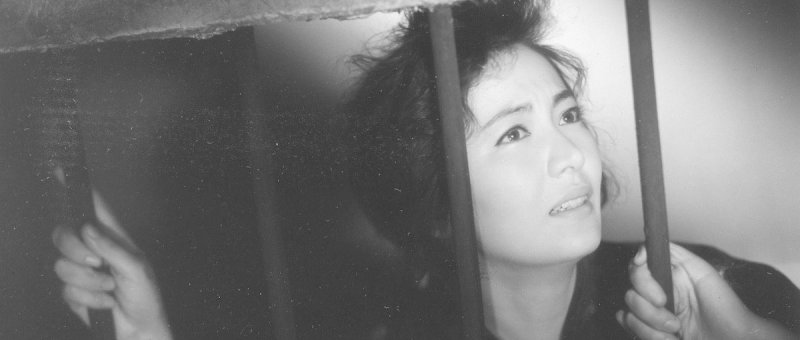
Jumping on over a year, Kyoko’s son is seven months old and apparently living in a children’s home rather than being cared for by any of her family while she languishes in prison still proclaiming her innocence. Nakagawa flirts with woman in prison tropes, putting Kyoko in a room of four women including a predatory lesbian, but eventually allows her to find female solidarity with a “habitual criminal” who helps her escape in order that she might prove her innocence and be reunited with her son. Kyoko’s decision to escape is prompted by an awkward visit from Soichi who has neglected to bring the picture of their baby he’d promised her while claiming to be working hard on her case. He tells her that he’s engaged a lawyer who has turned up evidence implicating Aoki who has made several attempts of his own to visit her all of which she has turned down. Unbeknownst to her, he’s even transferred to the town near the prison and is living in a company dorm not too far away. Coming to the conclusion that Aoki is the architect of all her misfortune, she determines to pay him a visit and either get a confession or take her own life. 

Aoki, however, turns out to be a good guy after all. He didn’t kill Imai and has been living near by because he’s sure Kyoko didn’t either and is determined to crack the case. Aoki helps her hide from the authorities and manages to get her on a train to Tokyo daringly defying the police dragnet, while the case’s original investigator begins to smell a rat in staking out the Imai home. Soichi seems to have become awful close with the two Imai ladies, so perhaps he really was the odious social climber old Imai feared him to be. So far, Kyoko’s attempts to take charge of her own future in rejecting her father’s authority have not gone well. She has ended up with a death sentence for daring to challenge the social order by advancing her own agency and has escaped from the literal prison, but is once again locked up for her own safety while Aoki does all the investigating on the outside. Her desire to reassume her role as a mother to a child technically born out of wedlock is what eventually gets her caught, leaving her at the mercy of the magnanimous police who, thankfully, decide that the duty of law enforcement is to act in the best interests of justice, admitting their mistakes rather than covering them up to save face. 

So, Aoki turns out to be good and Soichi bad. Kyoko is vindicated, proving herself innocent of the crime of patricide, but is punished fiercely for her attempt to escape her father’s control. It’s tempting to think that the message is that her father knew best after all and if she’d only done as she was told and married Aoki without making a fuss all of this could have been avoided. Amoral post-war ambition has been unmasked, everyone has been shuffled back into their original class boxes with order seemingly restored. Kyoko has “escaped” her imprisonment, but is she truly “free”? “That’s all in the past now”, Aoki reassures her, “but hang on tight anyway”.