
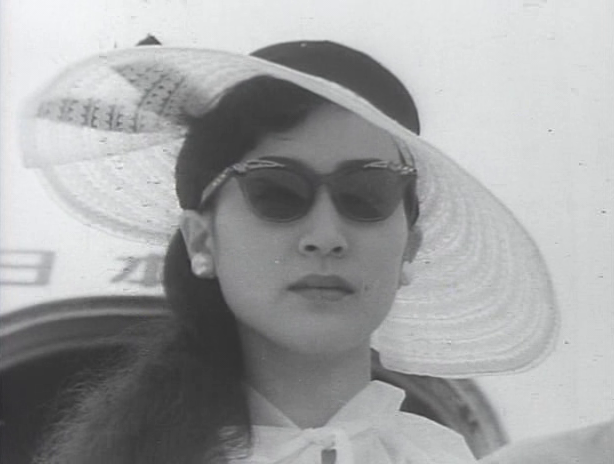
Revenge of the Pearl Queen (女真珠王の復讐, Toshio Shimura, 1956)

Born amid the labour disputes that engulfed Toho in the late 1940s, Shintoho began as a rather lofty endeavour mostly geared towards artistic films, but after a series of box office failures was soon in the red. Impresario Mitsugu Okura was brought in to turn the company around, but his ethos was decidedly populist. He shifted the studio away from the auteurist focus of its early days towards the racy dramas and ghost films with which it would become associated. 

Revenge of the Pearl Queen (女真珠王の復讐, Onna shinju-o no fukushu) was key to this transformation and made a star out of its leading lady Michiko Maeda who had been discovered working in the kimono department of the Mitsukoshi department store. Though sometimes billed as the first mainstream feature to depict full female nudity, what it really sells is the promise rather than the reality. The nudity in the film is generally abstract or artistic, shooting Maeda from behind and at a distance amid nature or capturing brief shots of her rear as her skirt flutters in the wind. Otherwise, she is seen in loose, torn clothing or with her hands covering her bare breasts as she, ironically, tries to escape from a series of men trying to assault her.

Adapted from a novel by Yoshihisa Aoki, the film is also inspired by a real life incident in which a group of men and one woman were marooned on Anatahan island at the end of the war. The men eventually ended up killing each other over the woman. The same incident inspired the 1953 film by Josef von Sternberg. Natsuki (Michiko Maeda), an office worker, is engaged to diligent employee Kizaki (Ken Utsui) and about to undertake a trip abroad with her boss, Asamura (Susumu Fujita). An early scene sees their passports arrive with some fanfare as it was still difficult at this time for ordinary people to acquire one or indeed to travel outside of Japan. But it soon turns out that her boss has an ulterior motive. Kizaki is framed for the murder of the company president, while Asamura first attempts to blackmail Natsuki into entering a sexual relationship with him, then tries to assault her when she refuses. She manages to get away from him, but he chases her and she ends up being thrown overboard.

She then washes up on an island and is “rescued” by five shipwrecked sailors. Three of them are desperate to rape her, while the oldest of the men Ishizuka (Saburo Sawai) is against it and tries to protect her along with his son-in-law to be Yuzo (Shigeru Amachi). Ishizuka takes the men to task and asks them how they could show their faces in Japan having done something so heinous, but they just laugh at him. In some ways, this seems to be an echo of wartime atrocities and the fishermen stand-ins for men who did terrible things overseas and then were able to forget about it and live normal lives in post-war Japan. The same is true of Asamura whose wartime service in intelligence is often referenced, though his subordinate Noguchi (Tetsuro Tanba) later suggests he’s embellished his record. Asamura isn’t even his real name, though he’s been able to build a business empire for himself largely based on fraud, tax evasion, forgery, and apparently also drug smuggling. He used Kizaki as a foil to kill his boss and take over the company, while hoping to also bed Natsuki at the same time.

Nevertheless, after the three aspiring rapists turn on each other and are killed, Natsuki discovers a wealth of riches under the sea while attempting to save one of them from a whirlpool. Spending her entire time diving for pearls, she becomes incredibly wealthy and is able to rebrand herself as “Helen Minami”, a Japanese-American “pearl queen”, on her return to Japan. Sharing her riches with Ishizuka and Yuzo, the trio plot revenge hoping to clear Kizaki’s name and expose Asamura’s corruption. They use the money to attack them through the stock market while also discouraging their clients from doing business with them until the company is finally on its knees. The crows are coming home to roost for Asamura with Natsuki returning to expose all his wrong doing, though such occurrences were perhaps rare for other men like him in reality. By reinventing herself, Natsuki is at least able to cure this corruption and restore her innocent connection with Kizaki in a dramatic nightclub showdown in which justice is finally served.
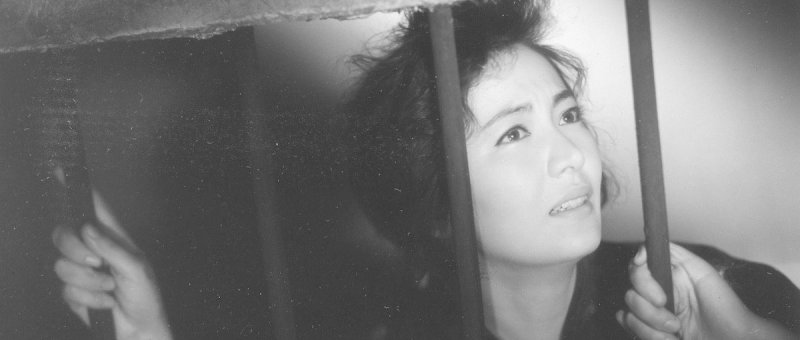
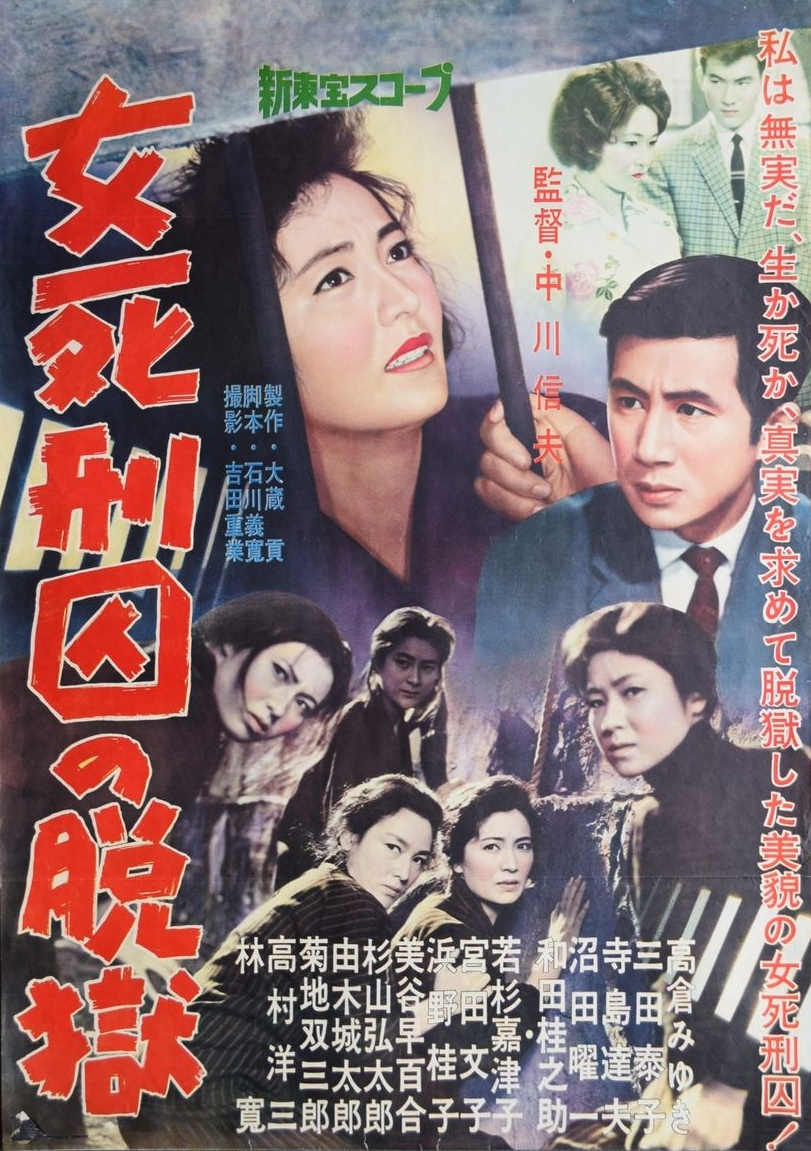
Death Row Woman (女死刑囚の脱獄, Nobuo Nakagawa, 1960)

How far does freedom extend in the complicated post-war society? Best known for his eerie horror films, Nobuo Nakagawa takes a stab at B-movie crime in a tale of wronged femininity as a woman’s attempt to escape her father’s authority ends in a death sentence. Death Row Woman (女死刑囚の脱獄, Onna Shikeishu no Datsugoku) sends its wrongfully convicted heroine on the run, literally, from a cruelly patriarchal society, but there is something quite perverse in its ambivalent conclusion which at once frees and vindicates but also suggests that perhaps daddy knows best after all. 

As the film opens, patriarch Imai (Hiroshi Hayashi) is engaging in a bonding ritual with his prospective son-in-law, Aoki (Keinosuke Wada), teaching him how to hunt. Meanwhile, his daughter, Kyoko (Miyuki Takakura), has wandered off with another man, Soichi (Tatsuo Terashima), with whom she is in love. Soichi is obviously worried about Aoki, but she tells him that the marriage is her father’s idea and she’s no intention of going through with it, not least because she is pregnant with Soichi’s child. The pair embrace, engaging in a clinch in the woods, but are spotted by Kyoko’s step-sister, Minako (Yasuko Mita), who apparently doesn’t like someone else hunting what she’s got her eye on, pointing her shotgun right at the loved up couple before her mother (Fumiko Miyata) arrives and knocks it out of the way sending a shot into the air in the process. 

Soichi is a spineless sort of man, telling Kyoko that he “can’t talk to old people” and refusing to go with her to see her father. She’s confident Imai will have to give in seeing as her pregnancy makes this a fait accompli, but he tells her to get an abortion and if she doesn’t like it she can get out. Imai wanted her to marry Aoki because he picked him out as a son, an heir to leave his company to. As Kyoko points out, he never considered her feelings, only seeing her as a tool to be manipulated for his own ends in securing his business interests. Imai objects to Soichi not only because he resents having his authority undercut, but because Soichi is a “nobody” and he finds the idea of his daughter marrying someone from a different social class distasteful in the extreme. All of that is about to become moot, however, because seconds after Kyoko storms out vowing to marry Soichi even if it means severing ties with her family, Imai drops dead, not of an apparent heart attack as it first seems but of poison! As the last person to see him alive and with the entire household having heard their row, Kyoko is arrested for her father’s murder and sentenced to death. 

Jumping on over a year, Kyoko’s son is seven months old and apparently living in a children’s home rather than being cared for by any of her family while she languishes in prison still proclaiming her innocence. Nakagawa flirts with woman in prison tropes, putting Kyoko in a room of four women including a predatory lesbian, but eventually allows her to find female solidarity with a “habitual criminal” who helps her escape in order that she might prove her innocence and be reunited with her son. Kyoko’s decision to escape is prompted by an awkward visit from Soichi who has neglected to bring the picture of their baby he’d promised her while claiming to be working hard on her case. He tells her that he’s engaged a lawyer who has turned up evidence implicating Aoki who has made several attempts of his own to visit her all of which she has turned down. Unbeknownst to her, he’s even transferred to the town near the prison and is living in a company dorm not too far away. Coming to the conclusion that Aoki is the architect of all her misfortune, she determines to pay him a visit and either get a confession or take her own life. 

Aoki, however, turns out to be a good guy after all. He didn’t kill Imai and has been living near by because he’s sure Kyoko didn’t either and is determined to crack the case. Aoki helps her hide from the authorities and manages to get her on a train to Tokyo daringly defying the police dragnet, while the case’s original investigator begins to smell a rat in staking out the Imai home. Soichi seems to have become awful close with the two Imai ladies, so perhaps he really was the odious social climber old Imai feared him to be. So far, Kyoko’s attempts to take charge of her own future in rejecting her father’s authority have not gone well. She has ended up with a death sentence for daring to challenge the social order by advancing her own agency and has escaped from the literal prison, but is once again locked up for her own safety while Aoki does all the investigating on the outside. Her desire to reassume her role as a mother to a child technically born out of wedlock is what eventually gets her caught, leaving her at the mercy of the magnanimous police who, thankfully, decide that the duty of law enforcement is to act in the best interests of justice, admitting their mistakes rather than covering them up to save face. 

So, Aoki turns out to be good and Soichi bad. Kyoko is vindicated, proving herself innocent of the crime of patricide, but is punished fiercely for her attempt to escape her father’s control. It’s tempting to think that the message is that her father knew best after all and if she’d only done as she was told and married Aoki without making a fuss all of this could have been avoided. Amoral post-war ambition has been unmasked, everyone has been shuffled back into their original class boxes with order seemingly restored. Kyoko has “escaped” her imprisonment, but is she truly “free”? “That’s all in the past now”, Aoki reassures her, “but hang on tight anyway”.