Warm Water Under a Red Bridge (赤い橋の下のぬるい水, Shohei Imamura, 2001)

According to the blue-tent philosopher, the real meaning of freedom lies in thinking for oneself and coming to your own conclusions. People today are too educated to admit their desires, he says. That’s certainly true of Sasano (Koji Yakusho), the embodiment of the contemporary salaryman and one who has now been cast adrift in the wake of economic stagnation. He later asks if an officer worker doesn’t have the right to love, and in his present state he might not because it’s made him a stranger to himself who can no longer make his own decisions or identify what he really wants out of life.

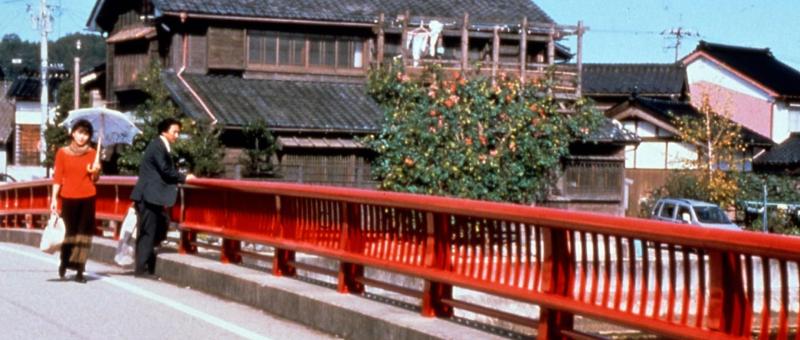
That might be the reason that the late Taro (Kazuo Kitamura) decided to send him on a wild goose chase to the Noto Peninsula where he once hid a Buddhist statue he stole from a Kyoto temple in a pot which shoved at the back of a cupboard in the house of a woman he once loved. As we later learn, Taro became a drifter after the war and ended up living with a woman now known only as “Granny” (Mitsuko Baisho) before he unfortunately killed someone and went to prison. After that, he was too ashamed to return, but it seems like Granny spent the rest of her life waiting, sitting by the little red bridge that leads to her home.

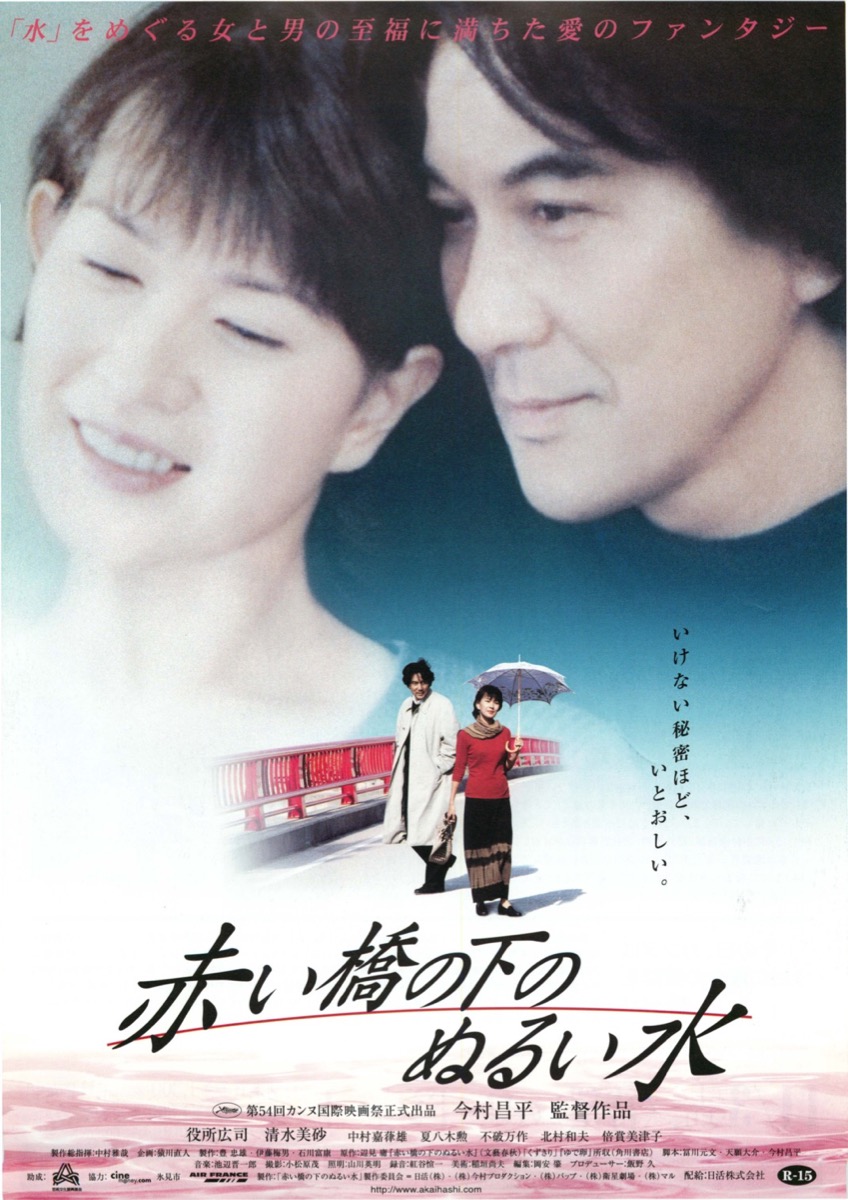
The bridge itself comes to represent a path to freedom as Sasano becomes involved with a younger woman who lives there, Saeko (Misa Shimizu) . After witnessing her seemingly wet herself while stealing cheese at the supermarket, Sasano uses an earring she lost as an excuse to enter the house and unexpectedly ends up having sex with her which causes Saeko to gush large amounts of water on orgasm. This is apparently Saeko’s affliction and to her a source of shame that’s ruined relationships and isolated her from society. Every time she has too much water inside her, or in other words, when her libido can no longer be denied, she feels the urge to exorcise it in other transgressive ways such as shoplifting. To that extent, female sexual desire is framed as something seen as taboo, but Saeko’s sexual fulfilment turns out to be good for the world around her. It’s why the trumpet flowers bloom so beautifully outside the house, and when the water flows into the river it beckons the fish in from further out to sea. Saeko doesn’t connect the two things, but it’s also, of course, why she has access to high-quality water that enables her to make delicious traditional-style sweets.

Sasano, meanwhile, begins to discover another side of himself while living in this small town. His wife often calls to nag him to transfer money, and to begin with we might assume that they’re already divorced but the truth is that they’ve been forced to live separately because of Sasano’s economic situation. Though she’s taken their son and moved back in with her parents, Sasano’s wife tells him to hurry up and get another job or else they’ll never get back to Tokyo. Nevertheless, just as he does, she may be discovering a new and happier life outside of the city. When she calls to say she wants a divorce, she tells him that their son has made a lot of new friends and he doesn’t want to move back. It seemed that what she wanted was the salaryman ideal and she resented Sasano for falling from the corporate ladder, but it turns out that there are other ways to be happy. As Taro had put it, corporate culture doesn’t want workers to think. It wants busy drones who complete tasks mindlessly to pay off their mortgages and be accepted as fully-fledged members of society.

By breaking out of the salaryman straightjacket, Sasano begins to find unexpected fulfilment in a simpler life as a fisherman. Through his reconciliation with Saeko and acceptance of the emotional dimension of their relationship rather than the purely sexual, he discovers a kind of serenity as evidenced by the rainbow that emerges above them as Saeko orgasms directly into the sea. Life is about small pleasures, the film seems to say, such as good food and sexual fulfilment, that can also improve the general environment quite literally watering the earth with human warmth.


Trailer (English subtitles)
Boiling Point (3-4X10月, Takeshi Kitano, 1990)

The heroes of Takeshi Kitano’s films are often gentle men, capable of great tenderness but also filled with quietly mounting rage permanently on the brink of explosion. Everyone perhaps has their Boiling Point, the straw that breaks the camel’s back and sends it careering towards a self-destructive attempt at restitution. “Boiling Point”, however, has absolutely nothing to do with the original Japanese title (3-4X10月) which references the score on the board at a baseball game and the originally scheduled month of the film’s release, October (it was later moved up to September making the whole thing even more meaningless). This perverse randomness was apparently another minor win for Kitano who had scored a critical hit with his debut feature Violent Cop but had struggled to convince the team around him to embrace his unconventional vision. Working with greater independence, Kitano minimises camera movement in favour long takes with static camera which perfectly compliment his deadpan sense of the absurd. 

He also relegates himself to a supporting role unseen on screen for over half of the running time. Our hero is small town loser Masaki (Yurei Yanagi) who we first meet hiding in a toilet during an amateur baseball game in which he is desperate to play but strikes out when given the opportunity in the first of many petty humiliations. He has been taken under the wing of the team’s coach, Iguchi (Taka Guadalcanal), a former yakuza attempting to go straight by running a dive bar, and has a part-time job at a petrol station. Masaki perhaps images himself as something greater, as evidenced by his extremely cool motorcycle jacket and bike, but is a dreamer at heart, nervous and tongue-tied, unable to unlock his hidden potential. Even he has a boiling point, however, which is later hit when he gets into an altercation with a teddy boy yakuza at the garage who starts a pointless argument about being kept waiting, pulling the old trick of goading Masaki into fighting back to get leverage over their shop and begin extorting it. Masaki has just got his boss into trouble through losing his cool, but is ironically offered a job by a visiting thug jokingly admiring his fighting prowess. 

Iguchi meanwhile is a man divided, permanently on the brink of boiling over. When some irritating sophisticates “ironically” visit his bar clutching their designer handbags and holding their noses, he’s obliged to be nice to them but he simply can’t. Unable to bear their snotty arrogance, he glasses one of the women on the way back from the bathroom and throws the whole gang out. The yakuza has it seems been reawakened, and though he was reluctant before, he to decides approach his old boss, Otomo (Hisashi Igawa), on Masaki’s behalf. The reception he receives is not as he expected. Iguchi is reminded that he chose the civilian life and being a yakuza isn’t a part-time job, you can’t just pick it back up again when it suits you. Not being able to help Masaki is another small humiliation, one he perhaps intends to overcome through turning violence on an old underling who disrespected him in refusing the customary deference. Predictably, it backfires, you can’t be half a yakuza after all. Iguchi is completely finished, boiling with rage but too humiliated to do much about it other than vow revenge by going to Okinawa to buy a gun in order to put an end to the lot of them. To protect his mentor, an oddly yakuza-esque gesture, Masaki volunteers to go in his stead, dragging his catcher friend Kazuo (Duncan) along for the ride. 

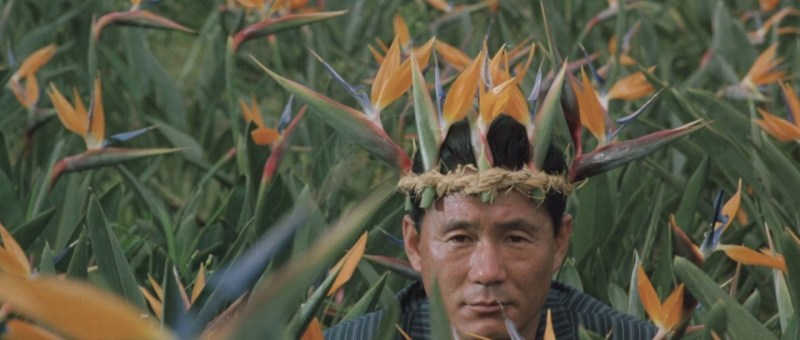
A complicated liminal space, Okinawa is both an enticing holiday destination and source of political contention thanks to the controversial presence of the US military bases. It’s indeed corrupt foreign influences who can provide our guys with guns, but Okinawa is also a place slightly out of time, trapped in the Showa-era past while the rest of Japan has already transitioned to an economically prosperous mid-Bubble Heisei. Consequently, these are Showa-era yakuza with fancy outfits and sunshades hanging out in neon-lit bars with butterflies on the walls. Uehara (Takeshi Kitano) is in the process of being humiliated in front of his gang for supposed embezzlement of collective funds. He too wants a gun to enact his revenge, something which he fantasises about in an eerie and fatalistic flash forward. Before that, however, he’s befriended our guys and taken quite a liking to Kazuo, hinting a latent homosexuality in another example of the unwelcome association of queerness and savagery often seen in yakuza movies. Uehara has a girlfriend but treats her with utter contempt, insisting that she sleep with his underling only to punish her for it afterwards and take over halfway through to rape him. In fact all of his subsequent sexual actions are rapes, his assaults on women cold and mechanical as if purely performative, implying that it is his repressed homosexuality which underpins the sense of humiliation that fuels his violence and his cruelty. 

Unlike Uehara and Iguchi, our guys have not even one foot in the yakuza world and despite their ingenious plan to get the guns on the plane have no idea what they’re going to do with them, marching all the way over to Otomo’s before realising they don’t know anything about the use of firearms with the consequence that they become useless lumps of metal in their hands. They are boys playing gangster out of a misguided ideal of heroic nobility in their desire to avenge Iguchi who by all accounts is still sulking alone at home. This is their greatest and final humiliation, failing as men in front of men. Yet, their friendship perhaps survives, patched up in silence over shared ice lollies. Even so, Masaki is about to boil over, travelling towards a split second moment of fiery self-destruction and misdirected rage. But then Kitano pulls the rug out from under us again. Was this all a dream after all, grim wish-fulfilment from a repressed young man longing to burn out bright, or perhaps a lengthy vision of the kind visited on Uehara which would at least explain Kitano’s many non-sequitur cuts and ellipses? Who can say, but the humiliating sense of impossibility is all too real for those unable to take a swing at life’s many opportunities.


Boiling Point is the second of three films included in the BFI’s Takeshi Kitano Collection blu-ray box set and is accompanied by a new audio commentary by Little White Lies’ David Jenkins, plus a featurette recorded in 2016. The first pressing includes a 44-page booklet featuring a piece on Boiling Point from Mark Schilling, an essay on Violent Cop by Tom Mes, an introduction to Kitano’s career & writing on Sonatine by Jasper Sharp, an archival review by Geoff Andrew, and an appreciation of Beat Takeshi by James-Masaki Ryan.

The Takeshi Kitano Collection is released 29th June while Violent Cop, Boiling Point, and Sonatine will also be available to stream via BFI Player from 27th July as part of BFI Japan.

Original trailer (English subtitles)