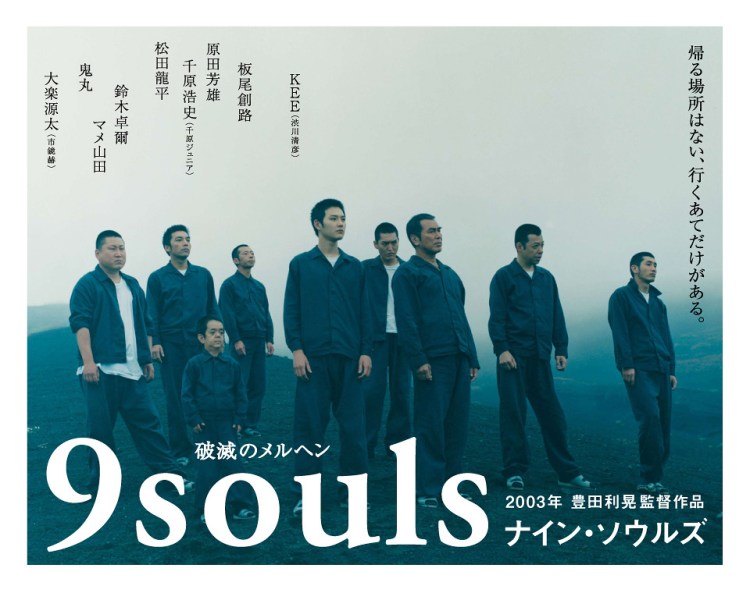
 Toshiaki Toyoda has never been one for doing things in a straightforward way and so his third narrative feature sees him turning to the prison escape genre but giving it a characteristically existential twist as each of the title’s 9 Souls (ナイン・ソウルズ) search for release even outside of the literal walls of their communal cell. What begins as a quirky buddy movie about nine mismatched misfits hunting buried treasure whilst avoiding the police, ends as a melancholy character study about the fate of society’s rejected outcasts. Continuing his journey into the surreal, Toyoda’s third film is an oneiric exercise in visual poetry committed to the liberation of the form itself but also of its unlucky collection of reluctant criminals in this world or another.
Former hikkikomori Michiru (Ryuhei Matsuda) is being thrown in at the deep end as the 10th prisoner in a crowded communal cell to which he has been consigned after the murder of his father. Not long after he arrives, one of the veteran inmates who had been assigned to him as a mentor and goes by the nickname of The King of Counterfeiters (Jun Kunimura), suddenly has some kind of psychotic episode where he goes off on a long monologue about a buried time capsule and the key to the universe before being dragged off somewhere by the guards. Right after that, a little mouse turns up signalling the probability of a mouse hole somewhere in the cell. Master escape artist Shiratori (Mame Yamada) somehow comes up with a plan to use this information in order for everyone to escape, which they do, emerging from a pipe into the blue tinted landscape and making a break for freedom.
Commandeering a camper van from a young man terrified of ghosts, the gang of nine hit the road heading for a primary school where their cellmate’s time capsule promises an untold fortune in counterfeit currency. What they find there is unimpressive except for a strange looking key which they decide to give to Michiru because they’re a bunch of guys who appreciate irony. At a loss again, each begins to think about the circumstances which brought them to this point, wondering if there’s a way back or if anyone is still waiting for them.
Less than a prison break movie, 9 Souls shares more in common with the return to Earth genre in which a recently deceased person is given a second chance to deal with some unfinished business until they are finally able to accept the inevitable. Though the prisoners have each committed heinous, often violent or unforgivable crimes, they each have dreams and aspirations which were previously denied to them but may just be possible now given their extremely unusual circumstances. Sometimes those dreams are heartbreakingly ordinary – falling in love, getting married and opening a small cafe in the countryside, for example, or attending your daughter’s wedding and being able to give her a wedding present in person. Try as they might, the prisoners are only able to gain a small taste of their hopes and dreams before they all come crashing down again, leaving them with only their fellow escapees to rely on.
Looking forward to Toyoda’s next film, The Hanging Garden, 9 Souls also takes a sideways view of that most Japanese of topics – the family. Michiru came from an extremely dysfunctional environment in which his mother abandoned him and he was forced to kill his own father only for his younger brother to then betray him. Veteran prisoner Torakichi (Yoshio Harada) unwillingly becomes the “father” of the group though he was imprisoned for the murder of his son. This perfect symmetry of a fatherless son and sonless father adds to the circularity of Toyoda’s tale as each is forced to reassume their familial roles within the equally forced genesis of the prison cell family. In the outside world, each of the prisoners is searching for only one thing – acceptance, but each finds only that which they feared most, rejection. Once again cast out from mainstream society as they had been all their lives, the prisoners are left with nowhere else to go but the mystical destination offered to them by the counterfeiter’s magic key.
The truck driver’s strange fear of ghosts comes back to haunt us at the end of the film as the van, now painted a peaceful sky blue complete with fluffy clouds as opposed to the hellish red of the ironically named “lucky hole”, begins to fill up with departing spirits each finding their exit in one way or another. A man who helped his son to die will now have to save another, while a boy who locked himself inside his room will have to turn the key and open a door on eternity. Swerving from absurd comedy to deeply melancholic meditations on guilt, redemption, and a failing society, 9 Souls is among the most poetic of Toyoda’s early works swapping the rage which imbued the young of Pornostar for the sorrowful resignation of experience.
Available now in the UK as part of Third Window Films’ Toshiaki Toyoda: The Early Years box set.
Original trailer (English subtitles)
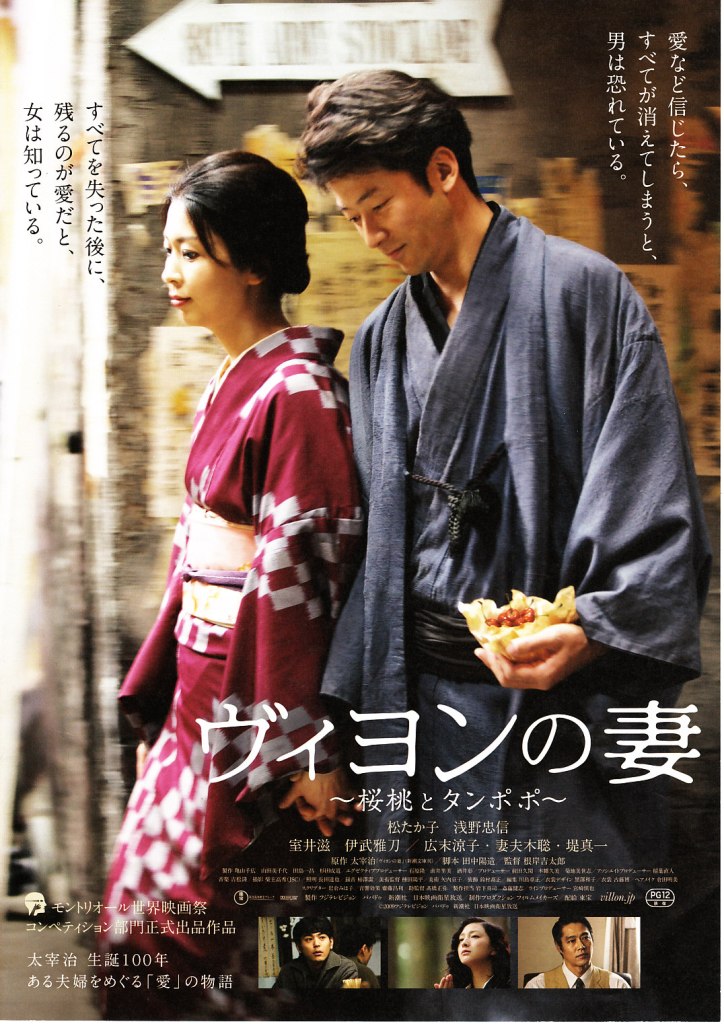 2009 marked the centenary year of Osamu Dazai, a hugely important figure in the history of Japanese literature who is known for his melancholic stories of depressed, suicidal and drunken young men in contemporary post-war Japan. Villon’s Wife (ヴィヨンの妻 〜桜桃とタンポポ, Villon no Tsuma: Oto to Tampopo) is a semi-autobiographical look at a wife’s devotion to her husband who causes her nothing but suffering thanks to his intense insecurity and seeming desire for death coupled with an inability to successfully commit suicide.
