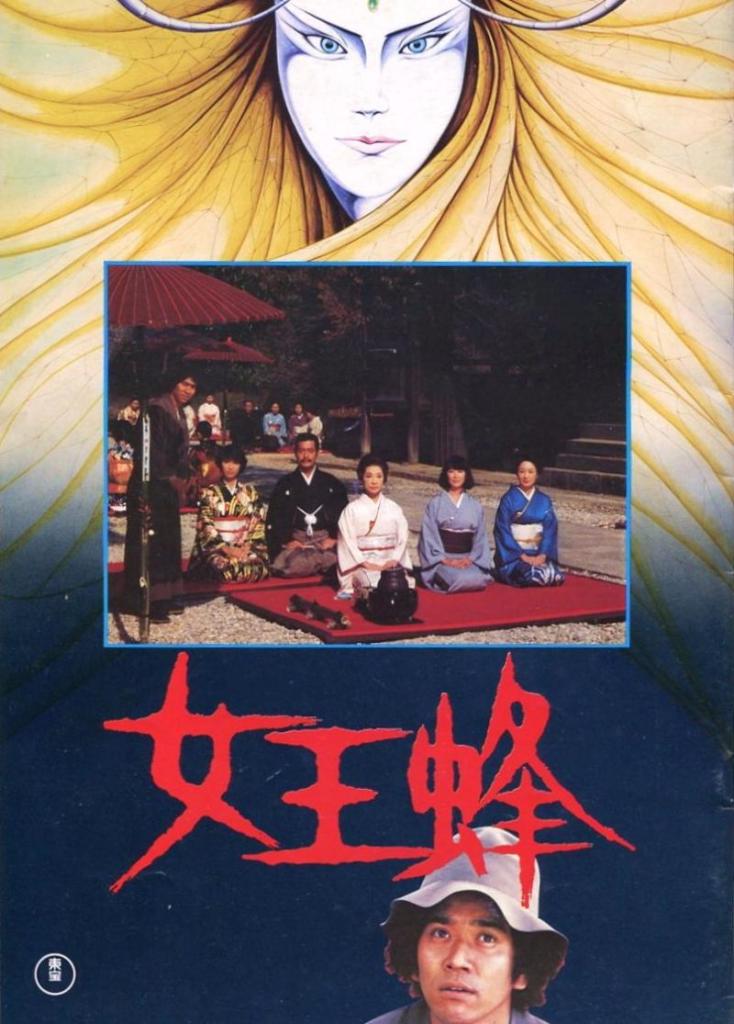
 Kon Ichikawa may be best remembered for his mid career work, particularly his war films The Burmese Harp and Fires on the Plain as well as his melodramas Ototo and Bonchi, but he was one of the few directors who was prepared to keep one foot in the commercial arena as well as making more personal, “artistic” efforts. For this reason he was able to go on working through the creatively dry ‘80s when other big name directors, in particular Akira Kurosawa, found themselves locked out of the cinematic arena in their native country. Ichikawa’s biggest box office success was in fact the literary adaptation of a popular mystery novel The Inugamis (which he actually remade in 1999 as his final feature film). 1978’s Queen Bee (女王蜂, Jooubachi) is one of five films that Ichikawa made based on the work of popular mystery writer Seishi Yokomizo which feature the eccentric detective Kousuke Kindaichi.
In many ways, Queen Bee is the perfect synthesis of European and Japanese mystery styles as it technically plays host to its strange detective but places him off centre, more as an onlooker to events than the protagonist. Though it follows something like a classical Agatha Christie approach, it also brings in the Japanese love of puzzles and the importance of long buried secrets bubbling to the surface and coming back to haunt everyone involved in the original incident. It’s also important to note that Ichikawa is deliberately playing up the camp comedy of the situation too as he makes his bumbling policeman a definite figure of fun as well as sending Kindaichi tumbling into a pond among other oddly comic elements for this multiple murder mystery.
The story itself begins in 1932 as two students, Hitoshi and Ginzo, leave a small town where they’ve been learning all about the local folklore. Hitoshi later returns under less than pleasant circumstances as he’s come to get his grandmother’s ring back after giving it to a local girl, Kotoe, whom he’d agreed to marry, only his mother objects so now he wants to hold off a bit. Unfortunately this is not a good idea as Kotoe is already pregnant with his child. Sometime later Hitoshi dies in mysterious circumstances and we flash forward to 1936 when the daughter, Tomoko, is three years old and Ginzo comes back to propose to Kotoe.
Now we fast forward to 1952 when Tomoko is about to turn 19. Kotoe has died, Tomoko has been adopted by Ginzo, and three folklore loving students have set their eyes on her as a bride. Unfortunately, one of these suitors also winds up getting killed with Tomoko the prime suspect and it looks like history may be about to repeat itself.
Queen Bee may be a more mainstream effort, but Ichikawa films in a noticeably anarchic fashion with extremely strange cuts and juxtapositions, not to mention the almost parodic tone of the film. He adopts a fairly perverse approach to the entire enterprise even allowing his veteran star Tatsuya Nakadai to play the 20 year old version of himself in the brief 1930s scenes which is, it has to be said, something of a mistake. As fine an actor as Nakadai is, playing a 20 year old at 50 is a stretch and one which serves as a point of alienation during the deepest historical layer of the film.
As is usual with Japanese mysteries, the plot relies on the solution of various puzzles, riddles and the mechanics of crime much more so than the human psychology and importance placed on motive that dominate Western detective tales. As well as the long buried secrets, Queen Bee brings in some commentary on the place of social class in the post-war world, the folly of misplaced love, and how the failure to act honestly and in the best interests of others by putting your own feelings aside can cause extreme repercussions not only in your own future but those of generations to come. Once again, only by exposing previously unexpressed emotions and lies both accidental and deliberate can the trauma be resolved and crises come to an end.
Queen Bee is a strange film which plays up its European detective novel atmosphere complete with the drawing room lecture that has become a hallmark of the genre but also adds in a layer of irony and an almost winking jokiness that make for an oddly amusing tone. The mystery element itself is satisfying enough to keep even the most seasoned crime fan guessing with plenty of red herrings and misinformation along the way. That said, Queen Bee is also very much of its time and perhaps fails to offer much more than an enjoyably old fashioned detective story, albeit one which is anchored by strong performances from its veteran cast.
Unsubtitled trailer:
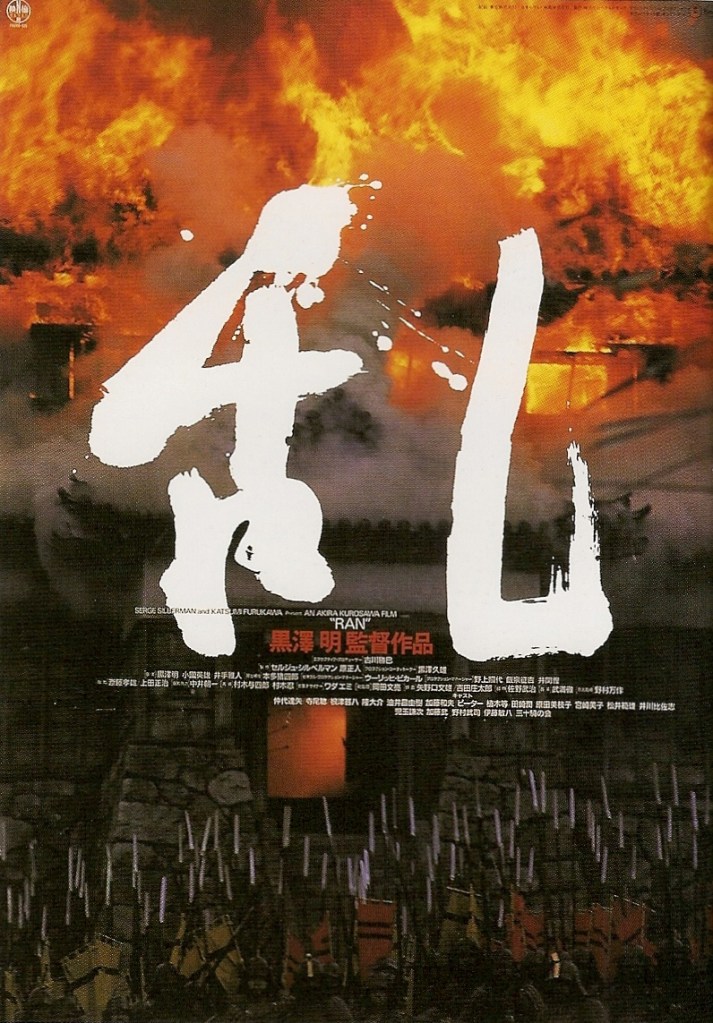 Akira Kurosawa is arguably the most internationally well known Japanese director – after all, Seven Samurai is the one “foreign film” everyone who “doesn’t do subtitles” has seen. Though he’s often thought of as being quintessentially Japanese, his fellow countryman often regarded him as too Western in terms of his filming style. They may have a point when you consider that he made three different movies inspired by the works of Shakespeare (The Bad Sleep Well – Hamlet, Throne of Blood – Macbeth, and Ran – King Lear) though in each case it’s clear that “inspired” is very much the right word for these very liberal treatments.
 It’s 1963 now and the chaos in the yakuza world is only increasing. However, with the Tokyo olympics only a year away and the economic conditions considerably improved the outlaw life is much less justifiable. The public are becoming increasingly intolerant of yakuza violence and the government is keen to clean up their image before the tourists arrive and so the police finally decide to do something about the organised crime problem. This is bad news for Hirono and his guys who are already still in the middle of their own yakuza style cold war.
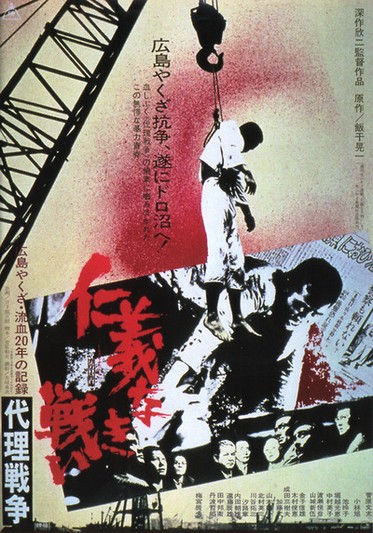 Three films into The Yakuza Papers or Battles Without Honour and Humanity series, Fukasaku slackens the place slightly and brings us a little more intrigue and behind the scenes machinations rather than the wholesale carnage of the first two films. In Proxy War we move on in terms of time period and region following Shozo Hirono into the ’60s where he’s still a petty yakuza, but his fortunes have improved slightly.
 Windows on Worlds