Eleven Samurai (十一人の侍, Eiichi Kudo, 1967)

“If no one denounces the absurdity of this world, then our descendants will keep suffering,” a soon-to-be ronin insists in Eiichi Kudo’s revengers tragedy, Eleven Samurai (十一人の侍, Juichinin no Samurai). It seems clear from the outset that their actions will have little effect no matter whether they succeed or fail because the enemy is feudalism which may be approaching the end of its life but is definitely not dead yet. They can at least attempt to avenge their clan even if they can’t save it while refusing to let an entitled, selfish lord get away doing whatever he likes just because he happens to be the son of the former shogun and brother of the current one.

The opening scenes see Nariatsu (Kantaro Suga) chasing a deer having declared himself a “real hunter”. He ignores the cries of his men to watch where he’s going and sails over the border into the territory of Oshi which amounts to an invasion seeing as he is armed and has no permission to be there. The deer gets away, but Nariatsu shoots an old woodcutter whom he felt to be in his way with his bow and arrow. The Lord of the Abe clan that rules Oshi immediately takes him to task and tells Noriatsu that his behaviour is unbecoming for the son of the former shogun. He’s committed a murder in their territory, but they’re prepared to let it go as long as he leaves as soon as possible. But Nariatsu doesn’t like being told what to do and simply shoots the lord in the eye, potentially sparking a diplomatic incident. 

The Abe clan try to lodge a complaint in Edo, but are shut down by courtier Mizuno (Kei Sato) who fears that to acknowledge an event such as this would damage the moral authority of the Tokugawa regime. He decides to cover the whole thing up by claiming it was the Abe clan who insulted Noriatsu. The Abe clan will then be dissolved, and Oshi essentially gets nationalised. All of which suits Nariatsu just fine because he wants to take control of Oshi and expand his territory anyway. Part of his petulance seems to stem from the fact that he feels hard done by with such a small inheritance when his brother became the Shogun and received multiple fiefdoms. The previous Shogun, Tokugawa Ieyoshi, had produced an unusual number of children which became quite a problem in that he had to find lands for them all and eventually hastened the demise of the shogunate because of the additional strain. 

But Nariatsu is also an overgrown child who has no idea how to do anything for himself and no concern for the feelings or fortunes of others. When instructed to do something he doesn’t want to, Nariatsu petulantly stamps his feet and complains, and when his actions are challenged he simply replies that he’ll be telling his father. In fact, he is so infuriating that it’s likely most of his men secretly want him dead too, including his chief adviser Gyobu (Ryutaro Otomo) who was once the General Inspector but is now expected to babysit this absolute buffoon. Even though Nariatsu knows the Abe clan will be trying to kill him, he still sneaks out to the red light district and gets blind drunk with geisha which in itself is conduct unbecoming for a high ranking samurai such as himself. 

As such, he represents almost everything that’s wrong with the feudal order while Mizuno represents the rest. It’s Mizuno that secretly plots against the plotters, manipulating them into giving up their assassination mission by claiming to have switched sides only to backtrack and reveal he’s actually still working for Nariatsu fearing a reputational loss for the Tokugawa. Chief revenger Hayato (Isao Natsuyagi) is also banking on this fear of reputational damage, certain that the Shogunate won’t be able to bear the humiliation of Nariastsu being killed by a ronin so will instead claim that he died from an illness. Vowing to avenge the clan, Hayato righteously gives up his position to become one so that the Abes won’t be linked to the crime and is joined by 10 more similarly annoyed samurai. Six of them are already “dead” having been asked to commit seppuku for recklessly attacking Nariatsu on their own and blowing the whole operation. 

Hayato at least believes this to be a suicide mission. He leaves his loving wife and home and allows people to think he’s run off with Nui (Eiko Okawa), the younger sister of one of their number who died before he could join them. They do this because they think it must be done, and also because if no one stands up to samurai oppression it will never end. Wandering peasant Daijuro (Ko Nishimura) agrees with them. He wants revenge on the samurai for raping his sister after which his father and brother took their own lives. Nariatsu is as good as anyone else and he does very much need to die. 

But despite Daijuro’s homemade cannons, nothing quite goes to plan. Kudo sets his final battle in an atmospheric, misty valley that is an obvious stand in for the underworld. Hayato may succeed in killing Nariatsu but it’s a pyrrhic victory. Though he vowed “to put an end to this ridiculous world,” a samurai cannot really win this battle. It’s Daijuro who eventually walks off with Nariatsu’s head, symbolically decapitating the shogunate which the closing titles confirm was mortally wounded by this incident. With his striking black and white cinematography, Kudo does indeed paint this samurai world as a hellish place ruled over by an infinitely corrupt and self-interested authority. The nihilistic futility of it all is emphasised by the figure of a grown man sitting like a small child and splashing his sword in a puddle while surrounded by dead bodies. There might be a way out of this, but not for the samurai, only for those who will come after and perhaps finally be free of this world’s absurdity.
Samurai Wolf (牙狼之介, Hideo Gosha, 1966)

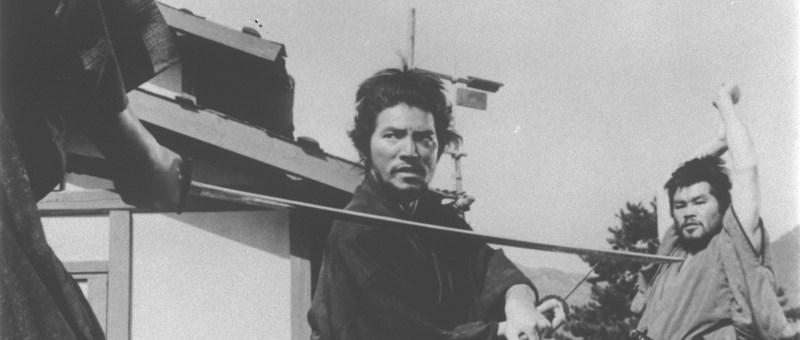
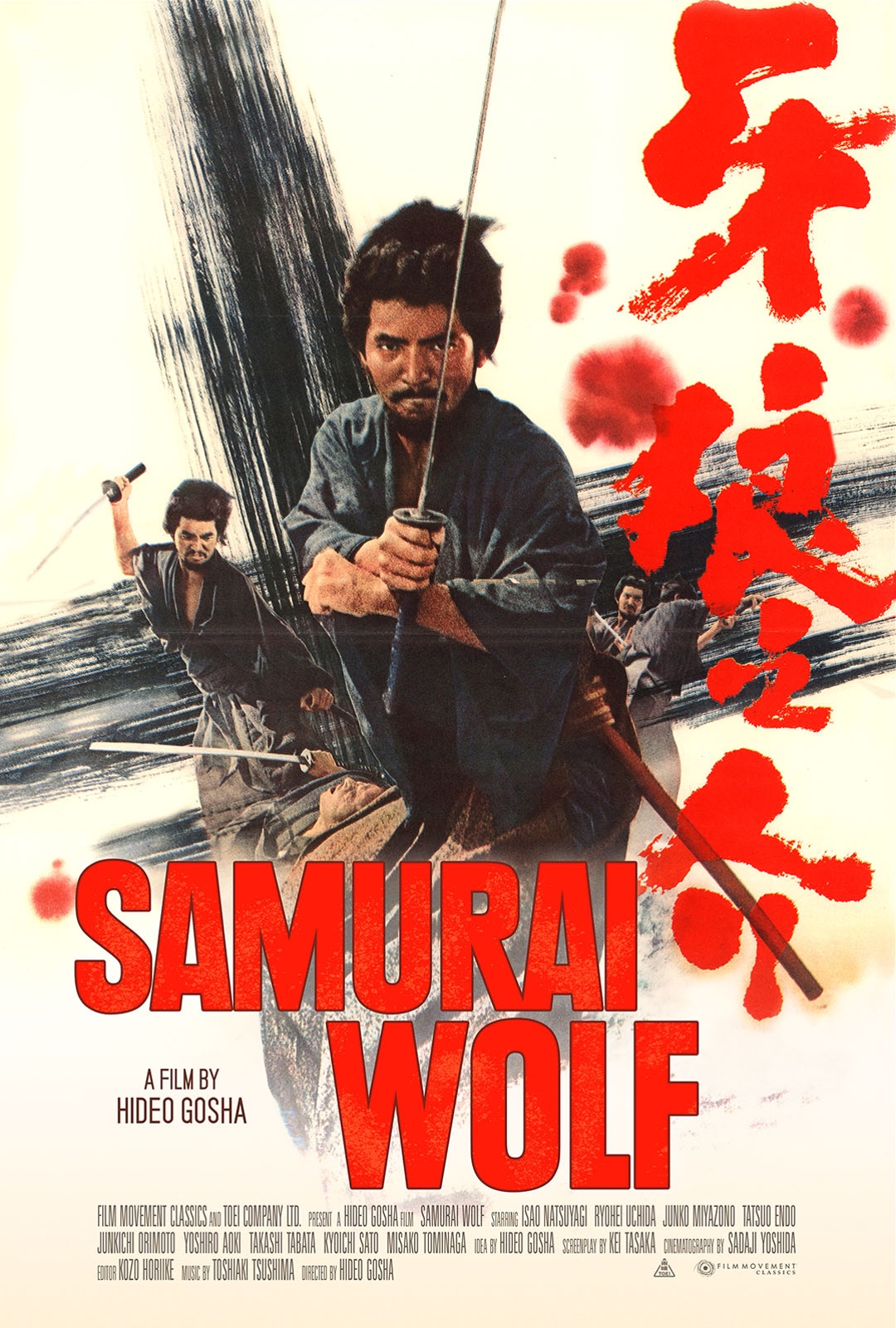
A cheerful ronin with strong moral fibre finds himself squaring off against a nihilistic assassin and a corrupt retainer/postmaster in Hideo Gosha’s new wave chambara Samurai Wolf (牙狼之介, Kiba Okaminosuke). Where many jidaigeki of the age would follow the antagonist Sanai (Ryohei Uchida), Gosha’s focusses on the figure of a man with wolfish appetites who is otherwise unaffected by the infinite corruption of the world around him and in that at least unwilling to submit himself to the dog-eat-dog mentality of late Edo-era society. 

Wandering samurai Kiba Okaminosuke (Isao Natsuyagi) explains that he got his name because often he bares his fangs and is known as the Furious Wolf, yet as much as the ferocity of the opening titles might bear that image out he is not cruel or avaricious but measured and honest. After wolfing down an exorbitant amount of food prepared by an old woman at a way station, he announces that he can’t pay. The old woman panics and we wonder if he might become violent or even kill her, but Kiba simply offers to pay in kind fixing the old lady’s leaky roof and chopping a supply of wood much to her surprise and gratitude. It seems, the wolf always pays his way. While there, he witnesses a trio of bandits attack a postal cart and kill the men who were pulling it. He retrieves the bodies along with a runaway horse and takes them back to the outpost they came from but the guard there is disinterested claiming that, as they died on the road and not in the town, it’s not his business. As Kiba soon discovers, the guard is in league with a corrupt lord, Nizaemon (Tatsuo Endo), who is an official messenger for the shogun but wants to take over the public postal service which is why he’s terrorising the postmistress, Chise (Hiroko Sakuramachi), with the intention of getting his hands on the relay outpost. 

There is something a little ironic in the fact that Ochise is blind while Nizaemon’s chief assassin is deaf and mute, both of them excluded from mainstream society and looking for support but finding it in opposing directions. Formerly a samurai woman, Ochise wants to hang on to the outpost because it has become her place to belong while resenting the incursion by corrupt lord Nizaemon who only wants it for the potential to control the cargo route along with raising the rates to use it to exorbitant heights. Shortly after Kiba tries to take out the assassins, a bunch of government inspectors turn up to complain about the missing merchandise while backing Chise into a corner by forcing her to accept the liability for transporting a large sum of gold coins. Kiba originally says he won’t help because he doesn’t want to risk his life for people he doesn’t even know, but of course later agrees in part on the promise of a significant return but also because he likes Chise and resents the kind of corruption men like Nizaemon represent.

On the other hand, his humanity is mirrored in his antagonist, hired gun Sanai who fetches up to help Nizaemon stop Kiba and take over the outpost. Sanai cynically tells him, that in five years’ time Kiba will be no better than he is, if he doesn’t kill him first. Kiba rejects the claim but it’s easy enough to see how someone could be corrupted by the realities of Edo-era society. Sanai later reveals that he fell in love with a samurai woman and eloped with her, a fierce taboo given the class difference between them, and later fell into his present state of nihilistic despair when she was taken from him quite literally betrayed by the social order. But Kiba seems different. He is not naive and has no expectations of human goodness yet remains cheerful and in his own way honest. When a young woman comes to him with her life savings and tells him that Sanai is the man whom she’s been waiting for to gain her revenge, he tells her to keep her money because he’s going to end up fighting him anyway. Likewise, when he realises someone he trusted has betrayed him, he tells them that he understands why they did it and bears them no ill will it’s simply the way things are only he suspects they will regret that others have died because of it. Even in his final confrontation with Sanai, he notices that his opponent is injured and ties one of his own hands to his belt to ensure it will be a fair fight. 

In any case, it seems that Sanai’s morally compromised existence is about to catch up to him with several other players intent on taking his life aside from the sex worker who longed to avenge the deaths of her family murdered during a massacre of peasants killed for standing up to a cruel landowner. A female gang leader also wants revenge for the death for her boss, while the cynical madam at the local brothel offers to team up with him to steal the gold from under Nizaemon’s nose. It seems that Sanai is a man already dead, having long abandoned the lovelorn boy he was for the nihilistic existence of a wandering assassin only to be confronted with the ghosts of the unattainable past. This world is indeed rotten, but Kiba has somehow managed to rise above it embracing his wolfish appetites in more positive ways while opposing injustice wherever he finds it. Much more avant-garde than much of his later work would be, Gosha makes great use of slow motion and silence broken only by the reverberating sound of clashing swords and hints at the meaninglessness of a life of violence in an agonisingly haunting death scene in which a bloodstained man turns and falls as if the air were suddenly leaving his body. In the end all Kiba can do is turn and walk away, on to the next crisis on the highways of a lawless society.


Samurai Wolf opens at New York’s Metrograph on Dec. 26 as part of Hideo Gosha x 3

Original trailer (English subtitles)

Horrors of Malformed Men (江戸川乱歩全集 恐怖奇形人間, Teruo Ishii, 1969)

Horrors of Malformed Men poster

The line between madness and sanity is often a thin one, entirely dependent on a series of social perceptions themselves dictated by a vague concept of time and morality. Horrors of Malformed Men (江戸川乱歩全集 恐怖奇形人間, Edogawa Rampo Zenshu: Kyofu Kikei Ningen), loosely inspired by an Edogawa Rampo short story The Strange Tale of Panorama Island as well as a series of similarly themed tales from East and West, is set in 1925 – the end of “Taisho” which is to say immediately before the problematic “Showa” era marked by its own kind of madness and defeat if also by a gradual rebirth. Nevertheless, madness reigns in here though it’s madness of a very particular kind as those excluded from a fiercely conformist society seek to remake the world in their own image and take a horrifyingly poetic revenge on the rest of humanity for their failure to embrace difference.

The tale begins with amnesiac medical student Hirosuke (Teruo Yoshida) who finds himself inside a cage at a mental institution surrounded by screaming, half naked women one of whom attacks him with a knife. Luckily, the knife turns out to be a stage prop with a retractible blade presumably given to the unfortunate woman wielding it as a kind of calming device. Eventually rescued by the warden who attacks the mad with whips as if they were mere cattle, Hirosuke retreats to his cell to ponder on his current circumstances, if he is really “mad” or the only sane man in an insane world. Meanwhile, he is plagued by the memories of a long forgotten lullaby and the vision of a woman’s face suddenly contorting, transformed into a horrifying monstrosity.

Managing to escape, Hirosuke gets a lead on the lullaby that takes him to a coastal village where he discovers that a man who looks eerily like himself has recently passed away. Hoping to solve a series of mysteries, he fakes his own death and manages to convince the other villagers that he is the recently deceased Genzaburo somehow resurrected and risen from the grave. Where all this takes him is to a mysterious island where Genzaburo’s father Jogoro (Tatsumi Hijikata) – a hideously deformed man with webbed fingers, has been trying to create his own bizarre society.

Horrors of Malformed Men was technically “banned”, or perhaps it’s better to say suppressed in an act of self censorship by a nervous studio, but not so much for its gleefully surreal grotesquery as for the “malformed” in the Japanese title which is in fact an extraordinarily offensive word. In any case it adopts a typically difficult position towards those it calls “malformed” as warped both in body and mind. Our mad scientist, Jogoro is a man driven insane by his society’s consistent rejection of him. When the beautiful wife he has somehow managed to win displays only disgust towards his twisted body and finally betrays him by sleeping with her handsome, sensitive cousin, Jogoro’s mental stability is forever fractured leading to his dark desire to take revenge on the “perfect” world by creating his own “malformed” creatures mirroring his own spiritual decline.

Jogoro’s island is a place of “madness” where spiritual corruption leads only to a kind of devolution in which animalistic desires exist only to be sated. Here there is no love or community, only a cold and individual progress towards oblivion. Hirosuke enters a nightmare of a waking sort in which he must confront himself, his family legacy, and a potential conflict between his own desires and the rules of society. Yet he is also haunted by the image of an as yet unseen future of where such ugliness may lead. Jogoro’s otherworldliness and deformities, his singleminded to desire to remake the world with himself on top and others all below, speak of a madness yet to come and the terrible retribution which would be exacted for it.

As if to reinforce his own message, Hirosuke declares himself not of this kind – he chooses to remove himself from a world with which his personal desires are incompatible, maintaining their purity in refusing to live on indulging in a practice most would regard as so taboo as to constitute a kind of “madness” all on its own rather than honouring civilisation by living on in denial. Something tells him, this is where he’s been heading all along. Deeply strange, surreal, and perhaps questionable in its final moment of capitulation which lays the blame for the entire sad and sorry escapade at the feet of a scornful woman rather than the society which both forced her to marry a man she didn’t like and encouraged her to reject him on the grounds of his “ugliness”, Horrors of Malformed Men is not a story about madmen and weird islands but of the evil that men do and the pain it leaves behind.


Horrors of Malformed Men is available on blu-ray from Arrow Films. The set includes two audio commentaries – one featuring film critic Mark Schilling ported from a previous release, and the other a new commentary by film scholar Tom Mes, as well as interviews with Shinya Tsukamoto and Minoru Kawasaki on Ishii’s career, and footage of Ishii visiting the Udine Far East Film Festival. The first pressing also comes with a booklet featuring a wide ranging essay by Jasper Sharp plus shorter essays by Tom Mes on Ishii’s career and Grady Hendrix on Edogawa Rampo.

Original trailer (English subtitles)