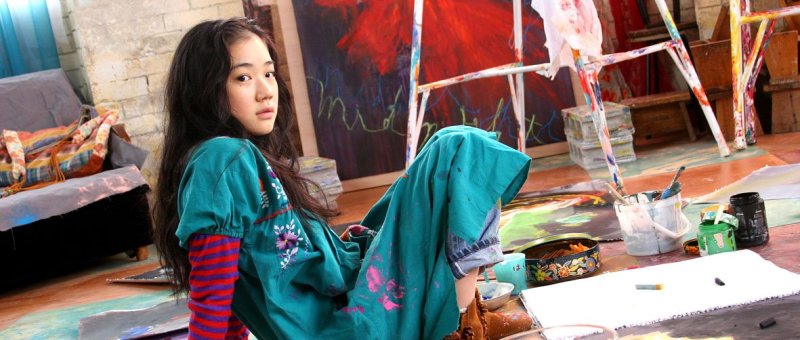
 Ah youth! Chica Umino’s phenomenally popular manga Honey and Clover (ハチミツとクローバー, Hachimitsu to Clover) is, essentially, a coming of age story in which love, requited and otherwise, plays a significant part. Masahiro Takada’s adaptation is no different in this respect as its central group of friends learn to come into themselves through various different kinds of heart break leading to soul searching and eventual self actualisation. The path to adulthood is rocky and strewn with anxieties, but has its own charms as our self branded Mr. Youth seems to have figured out, romanticising his own adolescence even while he lives it.
The action kicks off at an art college in Tokyo where a circle of friends is temporarily shaken by the arrival of a new student – a distant relative of a popular professor, Hanamoto (Masato Sakai). Our youth loving hero, Takemoto (Sho Sakurai), falls instantly in love with Hagu (Yu Aoi) – a genius self-taught painter with a dreamy, ethereal personality and negligible interpersonal skills. Hagu, however, seems to have developed a strange connection with conceited sculptor Morita (Yusuke Iseya) who continues to struggle with his conflicting interests in art and commerce. Meanwhile, geeky design student Mayama (Ryo Kase) has a problematic crush on his boss, Rika (Naomi Nishida), whose husband went missing some years ago, and has begun semi-stalking her. Unbeknownst to him, Mayama is also being semi-stalked by Yamada (Megumi Seki) – a spiky ceramicist who refuses to give up on her unrequited crush despite being fully aware of his one sided love for a brokenhearted middle-aged woman.
In actuality all of our protagonists are a little older than one might assume – all past the regular age for graduating college and either hanging around after being unable to complete their studies or pursuing additional training in the hope of furthering their art. They are all also hopelessly lost in terms of figuring out who they are – perhaps why they haven’t quite got a handle on their art, either. Hagu, younger than the others, seems to have an additional problem in existing outside of the mainstream, experiencing difficulties with communication and needing some additional help to get into the swing of college life. Perhaps for this reason, maverick professor Hanamoto palms her off on the “least arty” (read “most responsible”) of his students, Takemoto, who is tasked with accompanying her for meals – something for which he is quite grateful given his first brush with love on catching sight of her at her easel.
Hagu is also, however, the most sensitive and perceptive of the students even if she can only truly express herself through canvas. Her most instantaneous connection is with Morita, whose instinctive approach perhaps most closely mirrors her own though where Hagu is quiet and soulful, Morita is loud and impetuous. Watching him creating his centrepiece sculpture, Hagu is honest enough to tell Morita that he’s overdone it. Morita agrees but ends up exhibiting the piece anyway and not only that – he sells it for a serious amount of money despite knowing that it lacks artistic integrity. Hagu is unimpressed and her disapproval only adds to Morita’s sense of self loathing in his ambivalence towards to the fleeting rewards of superficial success versus the creation of artistic truth.
A similar sense of ambivalence imbues the romantic difficulties which neatly divide the group into a series of concentric love triangles. Takemoto, the selfless hero, realises the best thing he can do for Hagu is try to help Morita be less of a self-centred idiot while simultaneously dwelling on his fleeting youth and actively pursuing himself while debating whether or not to hit the road and leave his lovelorn friends to it. Mayama and Yamada, by contrast, are content to dance around each other, understanding the irony of their respective unreturned crushes while not quite bonding over them but both determined not to give up on their dreams (romantic and professional).
Despite the central positioning of our shy hero as he walks towards the end goal of being able to state his feelings plainly, the drama revolves around the enigmatic Hagu whose descent into an intense depression after an ill-advised moment on a beach is only eased by the careful attentions of her new friends finally realising that their artistic souls benefit from compassion for others rather than remaining solipsistically obsessed with their own romantic heartbreak. Despite its noble intentions, Honey and Clover misses the mark in charting the heady days of youth though our confused heroes do eventually manage to find themselves and each other along the road to adulthood as they chase down disappointments romantic and professional and discover what is they really want in the process.
Original trailer (no subtitles)


 In the brave new Netflix era, perhaps it’s not unusual to hear someone exclaim that their most significant relationship is with their television, but most people do not mean it as literally as Haruko, the heroine of the self titled Haruko’s Paranormal Laboratory (春子超常現象研究所, Haruko Chojogensho Kenkyujo). Lisa Takeba returns with her second film which proves to be just as strange and quirky as the first and all the better for it. Haruko’s world is a surreal one in which a TV coming to life is perfectly natural, as is the widespread plague of “artistic” behaviour which involves robbing the local 100 yen store for loose change and randomly setting fire to things. Yet Haruko’s problems are the normal ones at heart – namely, loneliness and disconnection. Takeba’s setting may be a strange fever dream filled with fiendishly clever, zany humour but the fear and anxiety are all too real.
 There are few things in life which cannot at least be improved by a full and frank apology. Sometimes that apology will need to go beyond a simple, if heart felt, “I’m Sorry” to truly make amends but as long as there’s a genuine desire to make things right, it can be done. Some people do, however, need help in navigating this complex series of culturally defined rituals which is where the enterprising hero of Nobuo Mizuta’s The Apology King (謝罪の王様, Shazai no Ousama), Ryoro Kurojima (Sadao Abe), comes in. As head of the Tokyo Apology Centre, Kurojima is on hand to save the needy who find themselves requiring extrication from all kinds of sticky situations such as accidentally getting sold into prostitution by the yakuza or causing small diplomatic incidents with a tiny yet very angry foreign country.
 Windows on Worlds