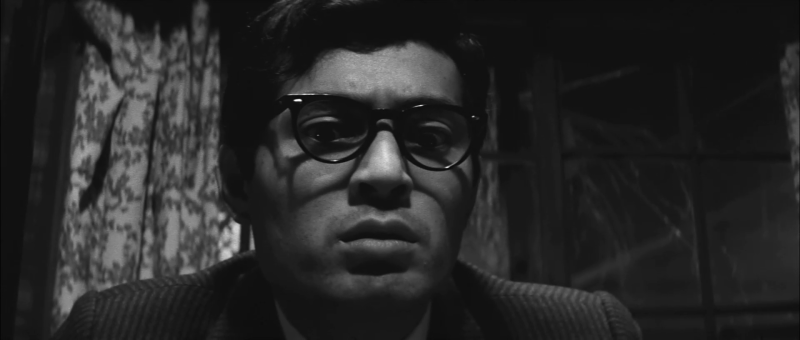
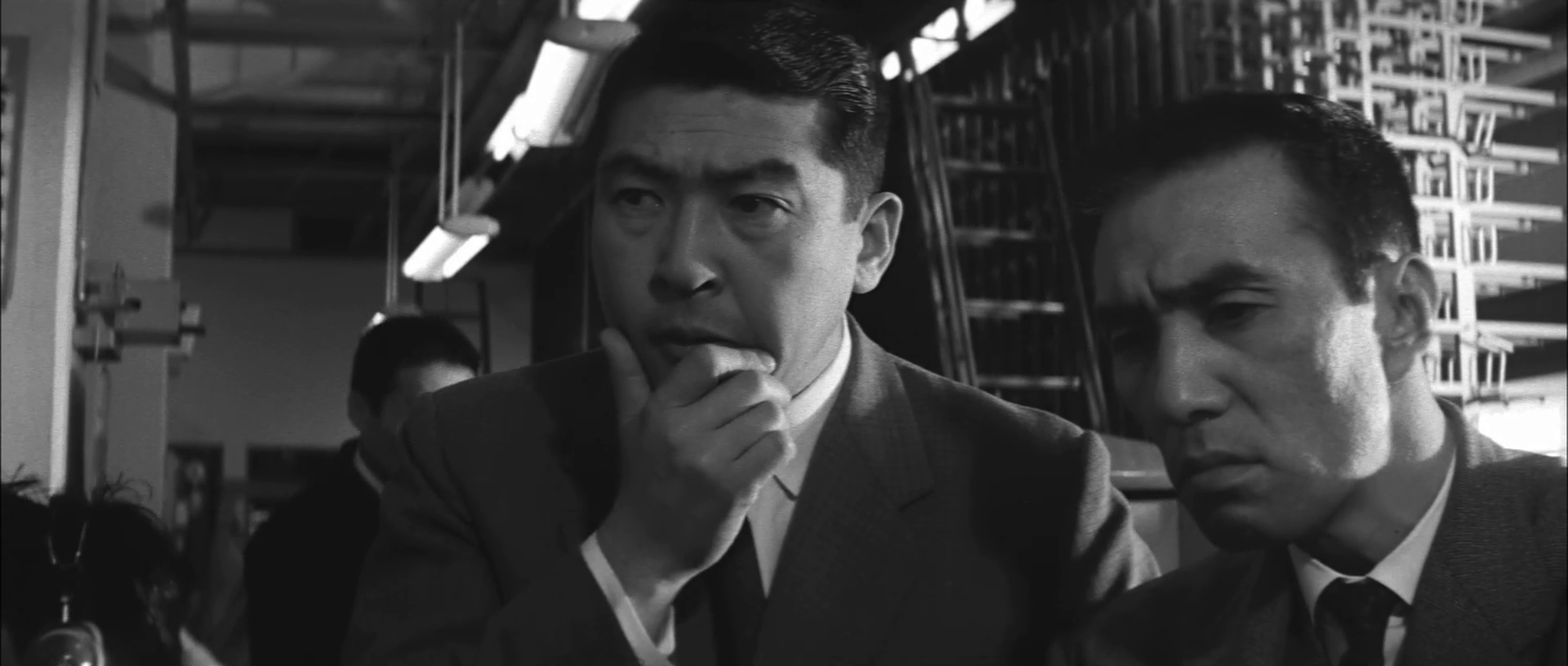
Pressure of Guilt (白と黒, Hiromichi Horikawa, 1963)

When a lawyer’s wife is found strangled at home, the police immediately arrest a “suspicious person” who is found to be carrying jewellery stolen from her room. Open and shut case, some might say, and prosecutor Ochiai (Keiju Kobayashi) agrees. But in reality nothing is really so black and white in the contemporary society of Hiromichi Horikawa’s crime drama, Pressure of Guilt (白と黒,, Shiro to Kuro). Perhaps ironically, the film opens in the same way as Tai Kato’s later I, the Executioner, with a man’s hands stretching around a piece of rope, and also features a law enforcement officer who is distracted from his duties by a bad case of piles he refuses to get treated.

Ochiai says his haemorrhoids are born of sitting down thinking too much, but the problem might be that he doesn’t think enough or that he suppresses thoughts which might prove inconvenient. There’s something that bothers him about the idea of Wakida (Hisashi Igawa) being the killer, but he shoves his doubts out of his mind and continues questioning him until he confesses. Some of this is born of prejudice. Wakida has a long criminal record mainly for burglary, and has been in and out of prison the whole of his adult life. Currently suffering from TB, he appears to be one of the young men who came to the city in search of work but found only exploitation and eventually had no option but to turn to crime. That he stole the jewellery is not in dispute, but Wakida continues to insist he didn’t kill Mrs Munakata (Koreya Senda). His lack of cooperation puzzles Ochiai, but it confuses him still more that Wakida keeps changing his story. He is, it seems, trying to tell him what he wants to hear, but finally becomes fed up with the whole thing after receiving a letter from his mother telling him to confess. She evidently thinks he did it too. Falling into hopelessness, Wakida declares that he no longer cares who did it and might as well be him because his life is essentially already over. In his condition he won’t last long in prison. There’s no prospect of turning his life around, either. So a death sentence won’t make any difference.

The funny thing is that it’s realising his fiancée must have figured out he did because she’s covering up for him that forces Hamano (Tatsuya Nakadai) into a confession. He’s plagued by guilt that Wakida might die for his crime, but not enough to exonerate him by coming forward. Nevertheless, he tries to talk Wakida round, asking why he confessed and if he was pressured by the prosecutors. The Japanese legal system places confessions above all else, but the issue is that Wakida’s confession is the only evidence that links him to the murder. Just because he stole the jewellery doesn’t mean he killed Mrs Munakata. Ironically enough, he’s defended by the victim’s husband (Koreya Senda), an anti-death penalty activist lawyer who agrees to represent him in part to vindicate his principles. Wakida only agrees to cooperate with Munakata and Hamano who is acting as his assistant when he confirms they’re not trying to help out of pity but only for their own self-interest. 

Yet Ochiai might have a point asking why Hamano is certain that Wakida didn’t do it, or why, on beginning to suspect him, he’s trying so hard to exonerate a man who was going to pay for his crime. It’s Hamano’s own suspiciousness that leads him to question his judgement about Wakida and ask himself if his thinking wasn’t too black and white and he should have investigated more thoroughly rather than pressuring Wakida into a confession and charging him. On realising he may have made a mistake, Ochiai puts the prosecution in a difficult position as his boss warns him of the potential reputational damage to the police and prosecutors if they’re shown to have made a mistake with the mild implication that, as he had assumed someone in Hamano’s position would want to, he should just keep quiet and let Wakida hang. 

Surprisingly, however, it only seems to improve the public’s view of the prosecution to be able to see them admit that they made a mistake and try to fix it rather than refuse to change their position. Mystery writer Seicho Matsumoto makes a cameo appearance as a TV pundit who says he admires Ochiai, while the film also uses a real TV show host to interview Ochiai boosting the sense of realism. As it turns out, there was more to the story than even Ochiai or Hamano thought, but still he declares that it’s better to be a fool than a hopeless idiot and that he was right to look for the truth even if it ended up biting him in the behind. The pressure of Hamano’s guilt, however, never really dissipates even as he struggles with himself, trying to find a way to save Wakida and avoid becoming a murderer twice over, without giving himself away. Nothing’s really that black and white after all, and this case wasn’t exactly open and shut, but the conviction that it had to be based on prejudice and circumstantial evidence might be the biggest crime at all no matter how it actually turned out.
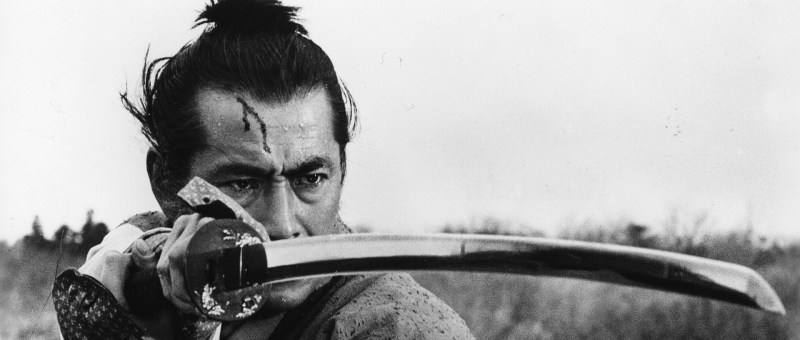

Samurai Rebellion (上意討ち 拝領妻始末, Masaki Kobayashi, 1967)

samurai rebellion posterIf Masaki Kobayashi had one overriding concern throughout his relatively short career, it was the place of the individual with an oppressive society. Samurai Rebellion (上意討ち 拝領妻始末, Joi-uchi: Hairyo Tsuma Shimatsu), not quite the crashing chanbara action the title promises, returns to many of the same themes presented in Kobayashi’s earlier Harakiri in its tale of corrupt lords and a vassal who can no longer submit himself to their hypocritical demands. On the film’s original release, distributor Toho added a subtitle to the otherwise stark “Rebellion”, “Hairyo Tsuma Shimatsu”, which means something like “sad story of a bestowed wife” and was intended to help boost attendance among female filmgoers who might be put off by the overly male samurai overtones. The central conflict is that of the ageing samurai Isaburo (Toshiro Mifune), but Kobayashi saves his sympathy for a powerless woman, twice betrayed, and given no means by which to defend herself in a world which values female life cheaply and a woman’s feelings not at all.

Having the misfortune to live in a time of peace, expert swordsman Isaburo has only the one duty of testing out the lord’s new sword (which he will never draw) on a straw dummy. He and his friend Tatewaki (Tatsuya Nakadai) are of a piece – two men whose skills are wasted daily and who find themselves at odds with the often cruel and arbitrary samurai world, refusing to fight each other because the outcome would only cause pain to one or both of their families. Isaburo has two grownup sons and dreams of becoming a grandpa but needs to find a wife for his eldest, Yogoro (Go Kato). He wants to find a woman who is loyal, loving, and kind. As a young man Isaburo was “forced” into marriage and adopted into his wife’s family but has been miserable ever since as his wife, Suga (Michiko Otsuka), is a sharp tongued, unpleasant woman whose only redeeming features are her stoicism and dedication to propriety.

It is then not particularly good news when the local steward turns up one day and informs Isaburo that the lord is getting rid of his mistress and has decided to marry her off to Yogoro. News travels fast and though others may appear jealous of such an “honour”, Isaburo is quietly angry – not only is he being expected to take on “damaged goods” in a woman who’s already born a son to another man, but they won’t even tell him why she’s being sent away, and the one thing he wanted for his son was not to end up in the same miserable position as he did. Nevertheless when Isaburo repeatedly tries to decline the “kind offer”, he is prevented. A suggestion quickly becomes an order, and Yogoro consents to prevent further conflict.

Against the odds, Ichi (Yoko Tsukasa) is everything Isaburo had wanted in a daughter-in-law and even puts up with Suga’s constant unkindness with patience and humility. Eventually she and Yogoro fall deeply in love and have a baby daughter, Tomi, but when the lord’s oldest heir dies and Ichi’s son becomes the next in line, it’s thought inappropriate for her to remain the wife of a mere vassal. Summoned to the castle, Ichi is once again robbed of her child but also of her happiness.

Ichi’s tale truly is a sad one and emblematic of the fates and positions of upperclass women in the feudal world. Having had the misfortune to catch the lord’s eye, Ichi tries to decline when the steward shows up to take her to the castle, reminding him that she is already betrothed. Sure that her fiancé will protect her, Ichi says she’ll go if he agrees never thinking that he would. Betrayed in love, Ichi is sold to the castle to be raped by the elderly Daimyo who views her as little more than a baby making machine and faceless body to do with as he wishes. When she returns from a post-natal trip to the spa and discovers the lord has already taken a new mistress, her anger is not born of jealously but resentment and disgust. This other woman is proud of her “position” at the lord’s side when she should be raging as Ichi is now, at her powerlessness, at the male society which reduces her to an object traded between men, and at the rapacious assault upon her body by a man older than her father.

Isaburo is also raging, but at the cruel and heartless obsession with order and protocol which has defined his short, unhappy life. Having been a model vassal, Isaburo has lived a life hemmed in by these rules but can bear them no longer in their disregard for human feeling or simple integrity. Isaburo says no, and then refuses to budge. Having retired and surrendered control of the household to Yogoro, Isaburo leaves the decision to his son who refuses to surrender his wife and swears to protect her from being subjected to the same cruel treatment as before. The samurai order is not set up for hearing the word “no”, and the actions of Isaburo, Yogoro, and Ichi threaten to bring the entire system crashing down. Love is the dangerous, destabilising, manifestation of personal desire which the system is in place to crush.

Isaburo’s rebellion, as he later says, is not for himself, or for his son and daughter-in-law whose deep love for each other has reawakened the young man in him, but for all whose personal freedom has been constrained by those who misuse their power to foster fear and oppression. Having picked up his sword, Isaburo will not stand down until his voice is heard, fairly, under these same rules that the authority is so keen on enforcing. He does not want revenge, or even to destroy the system, he just wants it to respect him and his right to refuse requests he feels are unjust or improper. Like many of Kobayashi’s heroes, Isaburo’s fate will be an unhappy one but even so he is alive again at last as the fire of rebellion rekindles his youthful heart. Those caught within the system from the venal stewards and greedy vassals to the selfish lords suddenly terrified the Shogun will discover their mass misconduct are dead men walking, sublimating their better natures in favour of creating the facade of obedience and conformity whilst manipulating those same rules for their own ends, yet the central trio, meeting their ends with defiance, are finally free.


Available with English subtitles on R1 DVD from Criterion Collection.

Original trailer (English subtitles – poor quality)