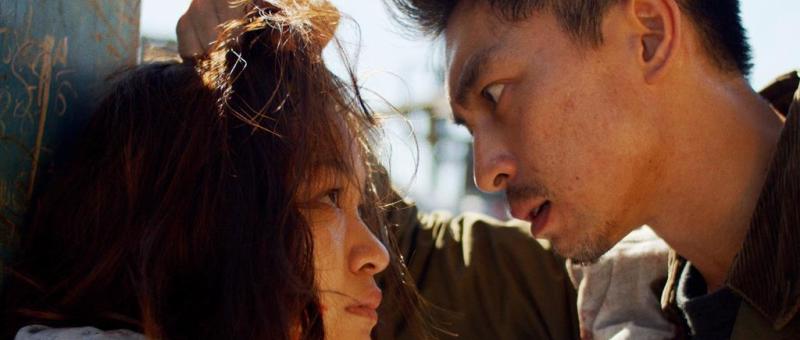
Escape (逃走, Masao Adachi, 2025)

Satoshi Kirishima’s incongruously smiling face was a familiar presence across on the nation for over 40 years until he finally made a deathbed confession revealing his true identity as a man wanted in connection with a series of bombings in the 1970s and that he’d successfully evaded the authorities until the very end of his life. What apparently appealed to director Masao Adachi, a former Japanese Red Army member, was the question of why he chose to come clean rather than enjoy his secret victory by taking the truth to his grave.

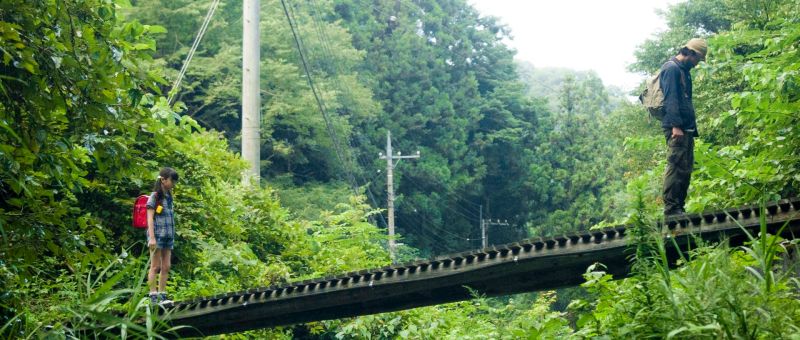
That might be a minor irony at the centre of the Escape (逃走, Toso) in that Satoshi (Kanji Furutachi) is essentially in flight from himself only to finally escape from his torment by accepting his original identity. As a young man, Satoshi had been a member of a left-wing cell that wanted to awaken the population at large to the ways Japanese society had not changed in continuing to discriminate against the Ainu, those from the Ryukyu Islands, Koreans and other minorities while modern corporations enact another kind of capitalistic imperialism built on exploitation. It was for this reason that they embarked on a bombing campaign targeting large companies, but due to a miscalculation with the explosives, the bombing of the Mitsubishi Heavy Industries Building in 1974 proved more destructive than intended resulting in loss of life. 

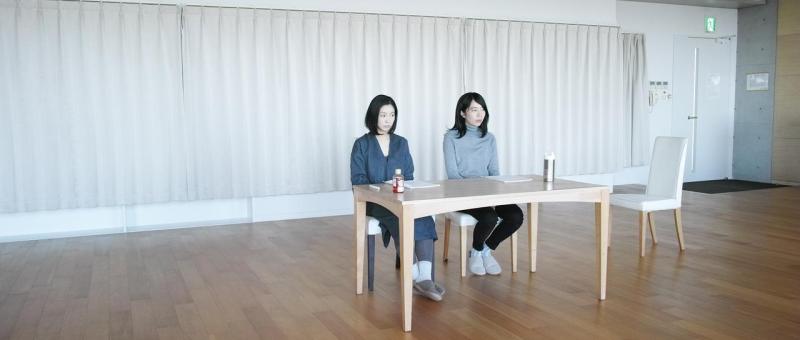
Satoshi was not directly involved in that bombing which was carried out by another cell but was wanted for allegedly setting up a bomb in the Economic Research Institute of Korea which did not result in any casualties. Details of the real Satoshi’s life during his 40 years on the run are thin on the ground, but Adachi paints him as a man torn apart by internalised conflict and unable to make peace with the sense of guilt he feels for those who killed even if he was not directly responsible. The film’s Japanese title is a kind pun in that it’s a homonym which can mean both “escape” and “struggle” which for Satoshi become one and the same. He’s in flight from his younger self while simultaneously preoccupied with how he can continue the revolution in the name of his friends who were not so lucky. Adachi structures the later part of the film as a kind of self-criticism session as Satoshi engages in various dialogues with himself notably as a Buddhist priest interrogating him about his worldly attachments. 

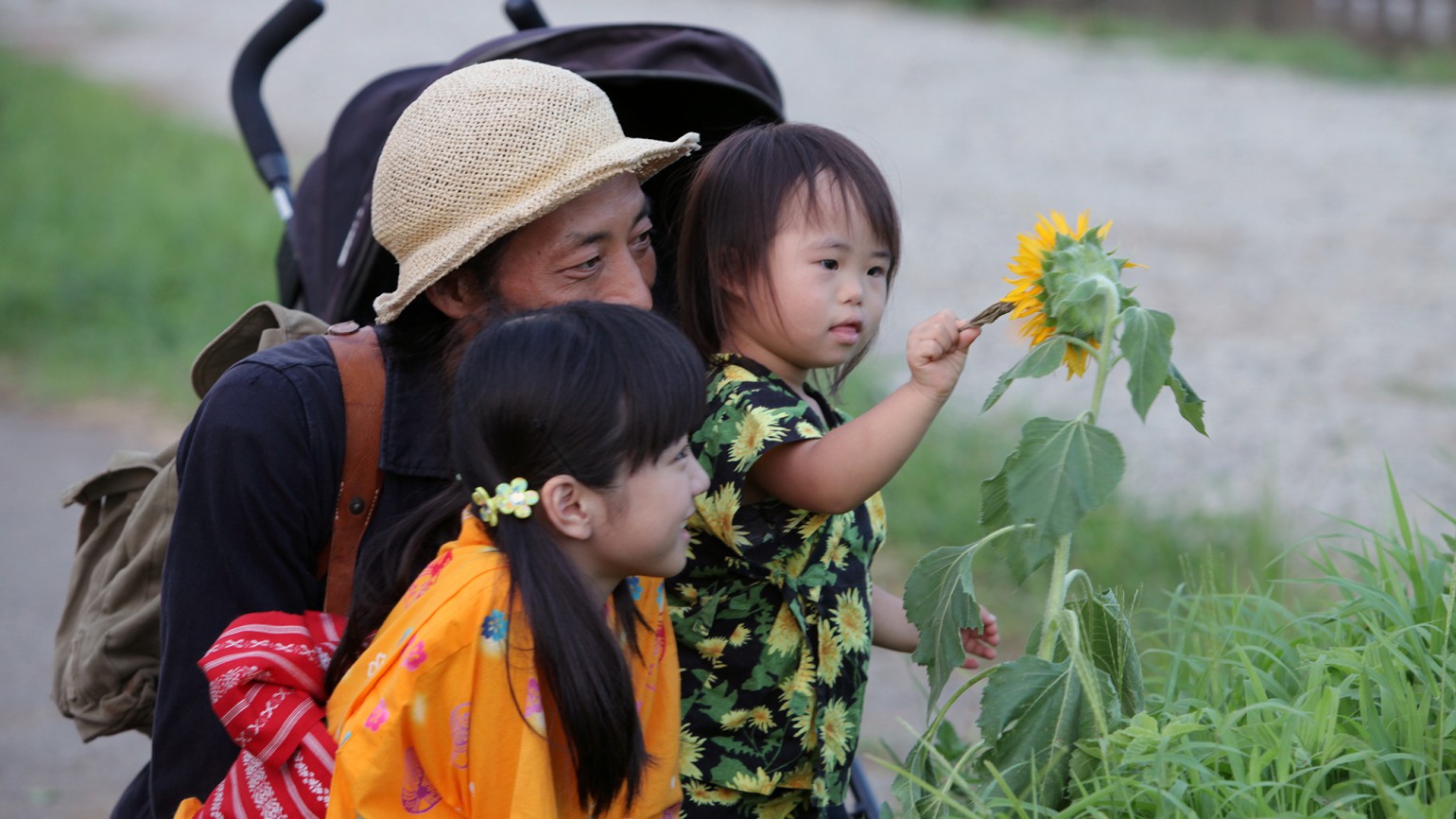
These worldly attachments also obviously separate him from his true calling to revolution including a non-relationship with a woman he meets at a concert venue and is later told has two previous convictions for marriage fraud. Most of the people around him are also leading double lives or harbouring secrets of their own including a man that Satoshi once worked with whom he finds out years later was also another former member of the far left movement living life on the run. The implication is that this sense of isolation and aloneness in wilfully having to suppress his identity became a kind of prison, but that it also liberates Satoshi to a more intensive examination of the self. 

To that extent, his escape is also from contemporary Japan and an act of resistance towards an increasingly capitalistic and indifferent society. Hoping to stay below the radar, Satoshi works a series of casual construction jobs chiefly because of their anonymity. There was plenty to be built in this era and jobs like these were plentiful, usually offering basic accommodation in a company dorm. He experiences the hardships of the working man first-hand and lives a life of asceticism in which live music and drinking are his only outlets. “We’re all dying to survive,” he reflects, “trying to go home,” though he no longer has a home to go to and has become estranged from his previous identity. He meditates on fallen comrades who either took their own lives or spent them in prison while convincing himself that he’s continuing the struggle on their behalf even in the act of running away in perfecting his “escape”. Though Adachi’s approach is less sentimental than Banmei Takahashi’s in I am Kirishima, he is not immune to sentiment as in his depiction of Satoshi’s final escape from life as the ultimate form of liberation even as his ghost proclaims he will continue to fight, but nevertheless introduces a meta commentary of self-examination in Satoshi’s constant questioning if his long years of struggle have really been worth it.


Escape screened as part of this year’s Nippon Connection.
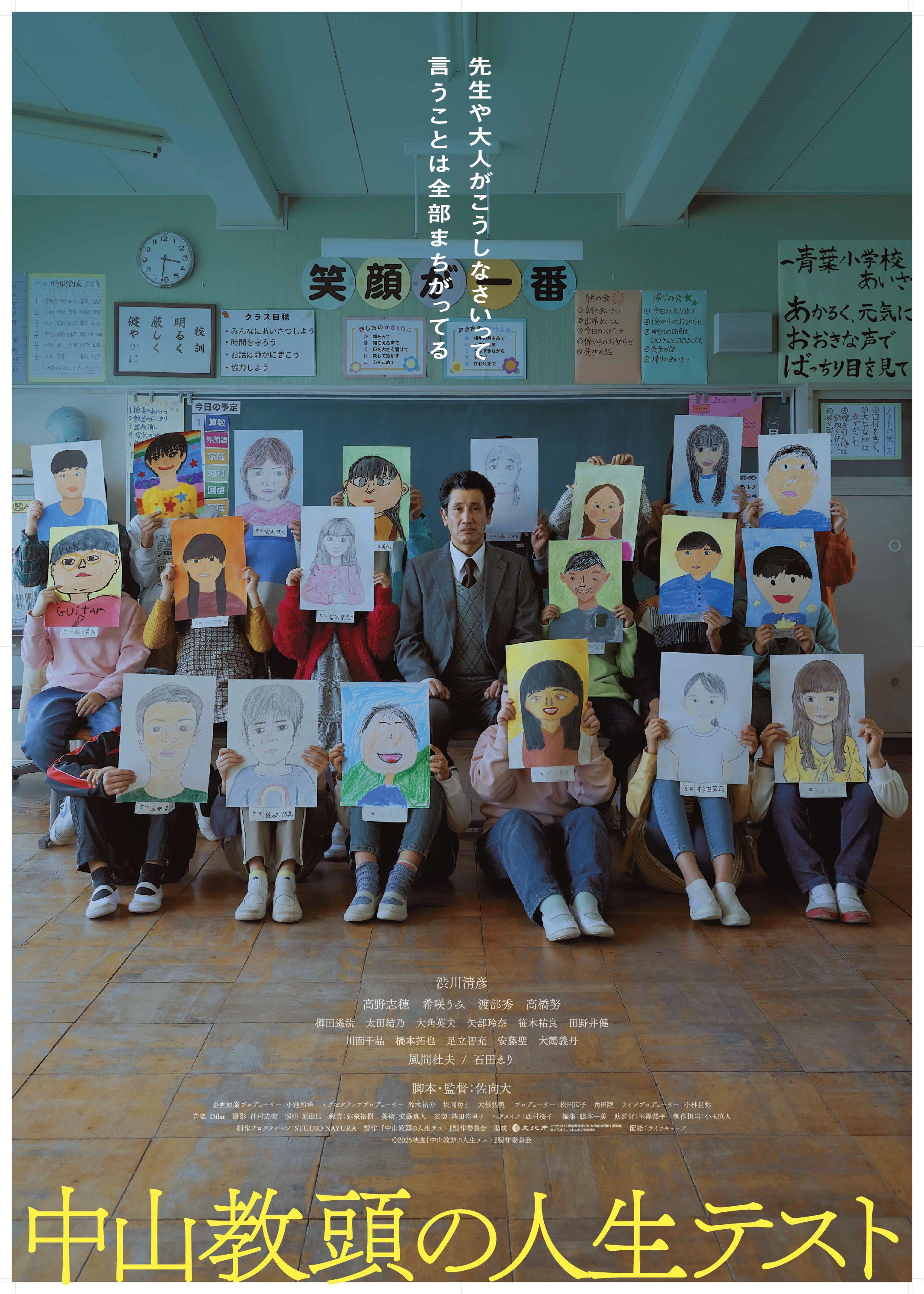
PRINCIPAL EXAMINATION (中山教頭の人生テスト, Dai Sako, 2025)

What is the place of the teacher in the contemporary society? Are they extensions of authority whose only role is to insist on order and produce children who will be obedient and know how to follow rules, or is it to educate and care for them so they can become the best versions of themselves free from the pressures of a conformist society? After taking some time away from active teaching, an absent-minded deputy headmaster finds himself confronted by just these contradictions as he’s suddenly tasked with taking over a class of primary school children while studying for the exams to qualify as a head teacher.

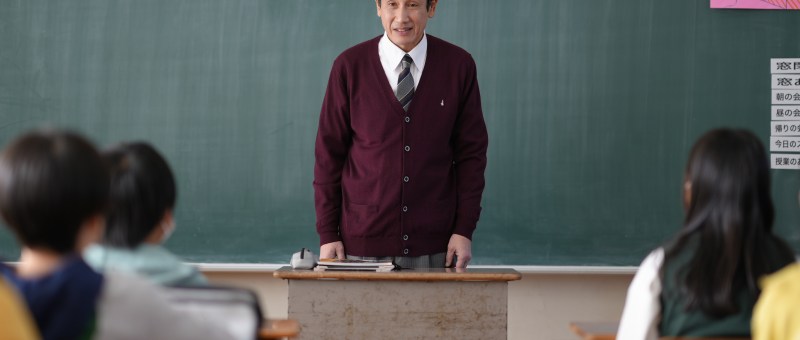
A mild-mannered man, it’s clear that Nakayama (Kiyohiko Shibukawa) is already overloaded and that the headmistress, Ms. Takamori (Eri Ishida), delegates most of her work to him. Though he was a frontline teacher for most of his career, he took an admin job after his wife’s death and seemingly lost his enthusiasm for the profession but quickly finds himself in the middle of a wider dispute about the scope of a teacher’s responsibilities to their students. He’s asked to take over after the current teacher, Kurokawa (Shu Watanabe), takes a leave of absence having come in for criticism from the children and their parents over his overly harsh teaching style. We see him force the children to repeat their morning greeting several times because they were not “in unison,” while he otherwise singles children out in front of the class for various rule infractions or poor performance. He appears to be more or less bullying some of the students, including Reona (Michiru Kushida), who comes from a single-parent family and is not able to get her mother to check her homework over for her because she just doesn’t have time.

There is a degree of push and pull between the teachers and parents over the shared responsibility for educating the child with some feeling that asking parents to do this kind of task is unreasonable while also reinforcing traditional gender roles in expecting there to be someone at home who is always available and dedicated only to raising children. This mistaken assumption disadvantages children like Reona while also stigmatising her in front of the rest of the class. Meanwhile, teachers are overly cautious of upsetting parents if they tell a child off in school. One irate father makes a point of coming in to see them when his son was merely questioned about something that happened after class and appears to be something of a bully himself. His son was one of the boys who criticised Kurokawa, and seems to have a lot of pent-up anger that could become a problem in the future but there isn’t much they can do about it at school. 

Kurokawa had only been appointed because Ms. Takamori insisted on temporarily suspending the original teacher, Ms. Shiina (Shiho Takano), because of complaints about something that happened outside of school. She had accepted an invitation to a barbecue with the children’s families where a child fell over and was injured. Ms. Shiina was then criticised for not properly supervising the children though she had only been at the barbecue as a guest and wasn’t responsible for watching them. Nevertheless, she was criticised because her role as a teacher leads people to think that she should be somehow responsible for any children present even when attending in a personal capacity as a private citizen, further emphasising a blurring of the lines when assessing the boundaries around the roles of teacher and parent. 

Ms. Shiina, who also appears to be queer coded, is presented as a more progressive teacher who doesn’t care about playing the game but only about the children’s welfare and wants them to grow up to be morally responsible people who can think for themselves. The irony is that Ms. Takamori may have been similar, later saying that Ms. Shiina reminded her of herself when she was younger, but because of the discrimination and prejudice she faced as a woman she decided her life would be best served by following all the rules so no one could complain. A former champion weightlifter, she had been criticised for a lack of femininity all her life and is also subject to the sexist and misogynistic judgements of the former headmaster, Kishimoto, who has made Nakayama his prodigy, but only if he plays the game which means becoming the kind of teacher who puts appearances first and enforces discipline rather than attempting to find out what’s going on in the children’s lives or fully understand the realities of class dynamics.

Indeed, it turns out to be the kids who are following the rules who are the worst and actively encouraging the semblance of order maintained through hierarchical bullying. Nakayama tries to investigate, but only arrives at half the truth and is torn between his desire to become a head teacher, which means submitting himself to the rigidity of the school system, and the idealism he once had for teaching. He finds himself effectively bullied, pressured into going along with things he doesn’t think are right which is the opposite of what he wanted for the children. As he eventually tells one of them, everything the teachers say is wrong, and what they really wanted to do was right, which is as close to admitting the irony of his position as it’s possible to get. 

The film’s English title has its ironies too as this is also an examination of Nakayama’s principles and how far he’s willing to compromise on them to be validated by the system in becoming a headmaster. He betrays his principles when he takes the test, but gets away with it and is in fact uncomfortably praised for his hardline stance after lying to protect Ms. Takamori by saying it was his decision to suspend a pupil who was caught shoplifting and drinking though some criticise it for its unfairness on the child. After all, suspending them will just result in them having nothing to do and getting into more trouble. But on the other hand, some parents now see this child as problematic and don’t want them back at the school where they worry they may prove disruptive to their own children’s education and development. 

The film offers no solutions though lands on the side of the children rather than the authority, sympathising with Ms. Shiina and encouraging Nakayama to regain his former idealism rather than become just another tool of an already oppressive social system. The fact that Nakayama loses his notebook implies a disregard for the kind of rules that are written in the headmaster’s manual and a return to his own judgement while leaving his final decision ambiguous as to which side of the line he will finally be on or whether he can really change this system from within. Though pretty bleak about the education system and its implications for the wider society, there is still a note of optimism in those like Ms. Shiina who don’t care about the rules so much as the children’s wellbeing that there is still a place for a more idealised form of teaching even within a fairly oppressive society.


PRINCIPAL EXAMINATION screens 31st May as part of this year’s Nippon Connection.
Trailer (no subtitles)

River Returns (光る川, Masakazu Kaneko, 2024)

At the beginning of Masakazu Kaneko’s River Returns (光る川, Hikaru Kawa), a little boy asks his father where water comes from. It’s one of those questions that children ask but adults find difficult to answer. In any case, his father tells him that it comes from the sky, travels down leaves and branches, and then makes its way to the river. But what if all the trees are felled, the boy asks. His father tells him not to worry, they only cut down “useless” trees in order to plant “money-making” ones in their place.

This is the conflict at the centre of the film and to some extent that at the centre of all of Kaneko’s films so far in the changing relationships between man and landscape. The boy, Yucha (Sanetoshi Ariyama), is too young to fully understand what’s going on but has an inkling that might not be good for his beloved mountain which is somehow linked with the fate of his sickly mother, Ayumi (Kinuo Yamada). His father, Haruo (Tomomitsu Adachi), is one of the younger men in the village in favour of a plan to sell off the mountain for industrial construction with the building of a modern roadway and a dam project which he says will make everyone in the village rich. It’s 1958, and the nation is fast recovering from post-war privation. The population is increasing. New homes will need to be built so there’s money in timber. He wants to use some of it to treat Ayumi’s illness, but his mother has her doubts even if her son dismisses them as backward superstition. 

Haruo worries that their old-fashioned, rundown home may not survive a severe typhoon nor the flooding that often accompanies them. If you fear floods, then cutting down trees is obviously not a good idea and there is something quite unsettling about the imposition of the dam that would interfere in this ancient and natural process that keeps the rivers flowing. Yet this particular river also has a quasi-mystical quality that Yucha learns of from his grandmother and a kamishibai storyteller who recounts a local folktale about a girl who drowned herself in the pool at the river’s source after falling in love with a nomadic mountain woodcutter. It is said the girl’s despair sometimes brings about terrible floods and that the one who receives a wooden bowl from the river must return it full or a loved one will be taken by the waters.

Yucha had been worried about this before, frightened that his mother would not be able to escape the rising waters because of her illness. What he learns is that time flows differently at the source and in temporal terms, this river also flows backwards. He becomes a kind of conduit and saviour of the mountain in going back to right a wrong, ensuring that man and landscape are joined once again and can live in a more natural harmony. By saving the mountain, he can also save his mother whose condition it is implied is partly caused by a corrupted modernity. Haruo could not save her with money gained by nature’s destruction, only by restoring nature itself and making a commitment to keep the pool as clear and blue as the cormorant’s eye. 

The nomadic woodcutters after all know that too much felling ruins the mountain which would take generations to recover. They kneel and pray after felling their trees and respectfully move on at the full moon. Kaneko structures his tale elliptically, like a river that constantly returns in which all is a harmonious cycle that man threatens to interrupt, arrogantly thinking that it can improve upon nature. The middle part of the film is a lengthy flashback transitioning out of the kamishibai folktale set sometime in the feudal past in which even then there was division between the “civilisation” represented by the village and the natural world of the mountains which would be healed in the union of Oyo and the woodcutter Saku and is opposed both by the mountain nomads and Oyo’s widowed father Tsunekichi (Ken Yasuda). Only the mute boy can in the end resolve this romantic tragedy and ensure the river continues to flow. Elegantly lensed to capture the majestic quality of the mountain landscape, River Returns is a timely reminder of the importance of protecting the natural environment which in return will also protect us. 


River Returns screens as part of this year’s Cinema at Sea.

Trailer (English subtitles)

Tatsumi (辰巳, Hiroshi Shoji, 2023)

The titular Tatsumi (辰巳) laments that there used to be a line. They used to be better than this. But his incredibly duplicitous boss just laughs at him and says they can’t live on honour and humanity anymore. In any case, there didn’t seem to be much honour or humanity in Tatsumi’s decidedly unglamorous life of petty gangsterdom even before everything went to hell but despite his cynicism and seeming indifference he is the last holdout for some kind of gangster nobility.

Though he has a cover job as a fisherman, Tatsumi’s (Yuya Endo) main hustle is as a cleanup agent getting rid of inconvenient bodies for various gangs. He finds himself mixed up in local drama when a pair of crazed, sadistic gangsters become aware someone’s been skimming their meth supply. They torture and kill a suspect who leads them to another, garage owner Yamaoka (Ryuhei Watabe) who is married to an old flame of Tatsumi’s, Kyoko (Nanami Kameda), while her younger sister, Aoi (Kokoro Morita), is also in trouble with another rival ganger, Goto (Takenori Goto), on the suspicion of having pinched some of his meth supply. Tatsumi ends up agreeing to mediate for Aoi, gets much more than he bargained for when the crazed Ryuji (Tomoyuki Kuramoto) murders Yamaoka and Kyoko and Aoi becomes a secondary target after catching him in the act.

Ryuji doesn’t seem to care about tying up loose ends, but just wants Aoi dead for reasons of total vengeance. It’s his uncontrolled violence that has disrupted the equilibrium of the local gangster society though the proposed solution is simply more violence in allowing him to kill the people he wanted to kill in the hope he’ll then calm down and stop which seems unlikely. Like many similarly themed yakuza dramas, Ryuji’s violence appears to have a sexually charged quality and there is also a hint of a potential relationship between Ryuji and Tatsumi’s boss whom he calls “Skipper.” 

Ryuji also has a slightly less crazy sibling in an echo of the relationship Tatsumi once had with his own brother who died of a drugs overdose having become involved in petty crime. The implication is that Tatsumi gave up on his brother and was relieved when he died but also that he harbours a degree of guilt for preventing him ending up the way he did and not trying harder to save him. That may partly be why he decides to help Aoi, seeing echoes of the brother he couldn’t save while she is also friendless alone having unwisely made enemies of almost everyone because of her outrageous behaviour and reckless disregard for authority. Aoi has an unpleasant habit of spitting at people who upset her while otherwise adopting a devil-may-care attitude with those minded to kill her. If she did skim from Goto’s stash, it cost the life of another falsely accused underling. 

Despite himself, Tatsumi becomes increasingly determined to help Aoi even though or perhaps because he assumes neither of them is likely to survive this crisis. Desperately trying to stay one step ahead he plays one side against the other and tries to find the best angle for escape while knowing there probably isn’t one. Shoji sets the tale across a series of moribund jetties and shacks laying bare the busy emptiness of this world with only the sea beyond. “Emotion will make you fail,” Tatsumi tells Aoi while describing dead bodies as just things and trying to keep his cool when needled by Ryuji or another dangerous and violent gangster. 

Death and life by extension appear to be meaningless and of little value. Tatsumi does perhaps close a circle, or maybe more than one, as the last principled gangster who thought there ought to be a line between what they do and greedy thuggery only to find there never was one and his determination not to cross it is the kind of sentimentality that can get a man killed. Making good use of slow dissolves, Shoji revels in a retro aesthetic in a tale of moral compromise and redemption as Tatsumi determines to safeguard Aoi not only from her own reckless impulses but the meaningless emptiness of the gangster life but the toxic legacy of violence and fallacy of vengeance as a salve for the wounds of the soul.


Tatsumi screened as part of this year’s Camera Japan.

International trailer (English subtitles)

Drive Into Night (夜を走る, Dai Sako, 2022)

Small-town futility leads to tragedy when two frustrated scrapyard workers attempt to cover up a crime in Dai Sako’s dark psychological drama Drive into Night (夜を走る, Yoru wo Hashiru). Oppressive in its atmosphere, the film situates itself in a world of constant humiliations where life is cheap and reputation everything. Its heroes seek escape from their disappointing existences through consumerism and extra-marital affairs, but no longer see much of a future for themselves while even the dissatisfying present seems to be ebbing away from them. 

Asked what makes his life fun, Akimoto (Tomomitsu Adachi) replies “not much”. A classic mild-mannered guy, he’s regarded as the office dogsbody and at the beck and call of his abusive manager, Hongo (Tsutomu Takahashi). When a new female sales representative, Risa (Ran Tamai), visits the yard, Hongo runs Akimoto down in front of her apologising for having such a useless employee who does nothing other than drive around all day. His sense of masculinity is also wounded by an older colleague who tries to sell he and his friend Taniguchi (Reo Tamaoki) some kind of aphrodisiac but reflects that Akimoto is too “tame” to ever make use of it, while even Taniguchi needles him about being a 40-year-old man who’s never had a girlfriend and still lives at home with his parents. In many ways he’s the classic “nice guy”, but there’s also something a little dark about him that makes it seem as if he may snap any moment. That may have been what happened when he and Taniguchi went to a bar with Risa shortly after she’d been coaxed into a works drink with Hongo. Something obviously went dreadfully wrong in the night, because Risa is soon reported missing and both Akimoto and Taniguchi begin behaving oddly. 

It is true enough that both men, and many of their colleagues, also consider themselves to be on the scrap heap. Akimoto is tempted to quit his job to put distance between himself and the scrapyard but reflects that he’s unlikely to find another job even if quitting so suddenly might arouse suspicion as Taniguchi warns him. Meanwhile, he knows the yard is in trouble. They have him running round doing cold calls but returning empty handed, while office workers are constantly fielding calls about unpaid invoices. His irritation is palpable when he spots the boss, Miyake, leaving one morning soon after he arrives, loading expensive golf clubs into his fancy car. Hongo bullies him, but later says he does it out of respect because Akimoto is the only one who bothers to do his job properly. But then again even Hongo concedes that hard work gets you nowhere. Most of his paycheques go on child support and he often sleeps in his car in the car park. The only reason he’s not been fired is that he has a personal connection to Miyake.

Even so, this fairly tenuous relationship does not really explain why Miyake goes to such great lengths to protect Hongo when he becomes the prime suspect in Risa’s disappearance and is framed by Taniguchi and a guilty Akimoto. It may be in a way that he really does think of the company as a kind of family, as perhaps do the loan sharks who keep calling them after Akimoto ends up in debt having joined a weird cult encourages him to think there is nothing wrong with him and the fault is all with an unaccepting world. The cult leader tells him that he is “full of anger”, which perhaps he is. This being in the immediate aftermath of the coronavirus pandemic, Akimoto is often questioned about still wearing a mask long after most people have abandoned them and part of the reason is as an attempt to hide his true self. After joining the cult he takes it off, but soon adopts another disguise in dressing in Risa’s clothes as his mental state continues to decline. 

Taniguchi meanwhile makes an effort to continue with his “normal” life which includes visiting his mistress. Unbeknownst to him, his wife Misaki (Nahana) is also having an affair with the consequence that neither of them is able to fully devote themselves to their young daughter Ayano who eventually ends up in a potentially dangerous situation because of her parents’ various transgressions. Nevertheless, despite discovering that her husband may have been involved in a murder it’s Misaki who decides that he has to “protect our family” above all else. Amid all of this, Risa becomes almost literally lost before later being unceremoniously dumped like so much scrap. After framing Hongo, Taniguchi tries to convince Akimoto that Risa isn’t their problem anymore as they each struggle to hang on to the previously disappointing realities they had been so desperate to escape. 

It has to be said that aside from the misogyny of its worldview, there is also an uncomfortable quality in the film’s characterisation of a shady Chinese businessman who of course knows how to get rid of bodies along with the fact his chief associate is Korean-Japanese gangster. Though the film’s strongest character may in fact be the Filipina bar hostess, Gina (Rosa Yamamoto), on whom Akimoto fixes most of his hopes who defiantly tells the cult leader that she’s happy with her life and has no reason to join his organisation, Akimoto exposes himself by telling her she’s wrong because he doesn’t see why a “foreigner”, “a woman”, who works in a “dirty” bar, could be happy or averse to being “saved” by him. Still he insists that he hasn’t “changed”, it’s the world that’s changed around him. Taniguchi later says something similar, and they each may have a point. In any case, this world is largely one of resentment and futility in which there is no release. Sako captures the drudgery of his protagonists lives with crushing naturalism but also perhaps little sympathy.


Original trailer (no subtitles)

Small, Slow But Steady (ケイコ 目を澄ませて, Sho Miyake, 2022)

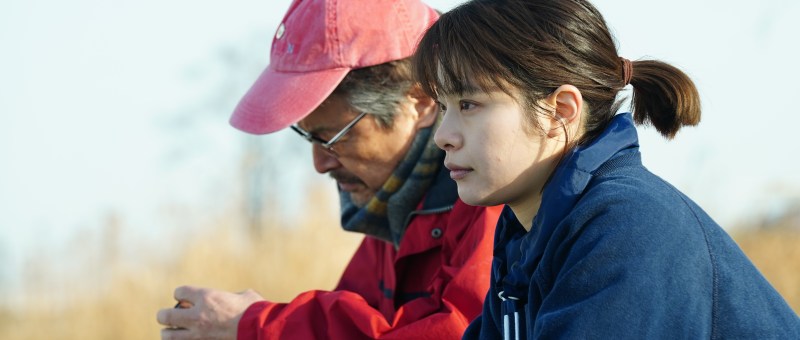
Part way through Sho Miyake’s empathetic character study Small, Slow But Steady (ケイコ 目を澄ませて, Keiko, Me wo Sumasete), an older man visits a doctor and is told that though he may think there is nothing really to worry about at the moment, a tiny drop of water falling steadily can soon make its mark in stone. It’s in one sense the small, slow, but steady stresses of everyday life that have eaten away at the soul of Keiko (Yukino Kishii), an aspiring boxer who is fast losing the will the fight. Yet it is also a small, slow, but steady process that allows her to begin moving again, climbing a new hill towards the next bout no longer so afraid of leaving the safety of the familiar. 

Deaf since birth, Keiko became a professional boxer two years previously and makes ends meet with a part-time job in housekeeping at an upscale hotel. Miyake often positions her as in a way free of the frenetic nature of the noisy city, unaffected by the shouts of rude passersby and unlike the men at her boxing gym never subjected to angry rants from her coaches. Yet it’s also at times as if she feels a kind of loneliness in the minor rejections of an indifferent society which often fails to cater to her difference. Few people are able to sign, even those at her gym haven’t learned, while others are sometimes impatient in her attempts to communicate. The restrictions of the coronavirus pandemic meanwhile only make things worse for her given that constant masking means she can no longer rely on lipreading nor can she hear the public health messages being blasted out in public spaces reminding citizens that there is a state of emergency in place and they should restrict their journeys to the barest of essentials. 

Then again, in the gym, she obviously cannot sign because the gloves her impede her ability to communicate. Nor can she hear the session bell or words of encouragement and advice from her coaches and the crowd. The chairman of the boxing club (Tomokazu Miura) admits in an interview that deafness is potentially fatal for a boxer, but that what Keiko may crave is a kind of internal peace in the surrender to the purely physical which allows her to empty her mind of everyday troubles. She may have taken up boxing as some say after being bullied as a child because of her disability, quite literally fighting back against a conformist society she refuses to beaten by, but has also found something reassuring in its slow and steady rhythms that allows her to reorient herself blow after blow. 

The chairman also says, however, that it’s not a matter of having a preternatural talent so much as a steady work ethic and above all a big a heart, describing her finally as simply “a really nice person”. “Why don’t you have your guard up properly?” another of her coaches asks her, while her brother having noticed there is obviously something bothering her tries to get her to talk, only for her to point out that “talking doesn’t doesn’t make a person any less alone”. With rumours the pandemic, along with the boss’ failing health, will finally take the boxing gym too, Keiko fears losing this final safe space but finds herself unable to stand up and fight for it. Though she had struggled to find a gym who would accommodate her disability, she is ambivalent when a new solution is found in an empathetic female coach (Makiko Watanabe) running a modern training facility who is learning sign language and keen to empower her in her own decision making rather than patronise or railroad her. Afraid of getting hurt, she takes a step back unwilling leave the security of the past for the possibility of the future. 

As Keiko reminds herself in her diary, self-control is the most important thing and the force she struggles with, suddenly losing her concentration in the middle of a match because the thoughtless referee keeps telling her to listen to him when he calls stop. In the end, it’s something quite trivial that sets her back on the path, a kind yet seemingly meaningless moment of acknowledgement from an unexpected source. Shot in a richly textured 16mm, Miyake captures Keiko’s isolated everyday with stunning clarity finding her alone amid the noisy city staring into space and looking for direction. Using intertitles to translate sign language his composition mimics that of a silent movie and lends an almost elegiac quality to the moribund boxing gym as it becomes an accidental victim of its times but ends on a note of quite resilience in the small, slow, but steady rhythms of gentle forward motion. 


Small, Slow But Steady screened as part of this year’s BFI London Film Festival.

Original trailer (no subtitles)

Onoda: 10,000 Nights in the Jungle (Onoda, 10 000 nuits dans la jungle, Arthur Harari, 2021)

For most people, the Pacific War ended in 1945. For Hiroo Onoda it may in a sense never have ended though he laid down his arms in 1974, 30 years after his initial dispatch, having spent the intervening three decades pursuing guerrilla warfare in the Philippine jungle the last two of them entirely alone. Arthur Harari’s three-hour existential epic, Onoda: 10,000 Nights in the Jungle (Onoda, 10 000 nuits dans la jungle), explores the psychological dimensions of his quasi-religious conviction in the righteousness of a mission which is in one sense no more than to survive along with his refusal to accept that the war is over and his personal struggle has been pointless. 

Immediately in opening the film in 1974 with a young man identified only as a “tourist” (Taiga Nakano) arriving on the island in search of Onoda (Kanji Tsuda), Harari draws a direct contrast between these two arrivals and subsequent departures. As he says, the Tourist is just that in town for a specific purpose after which he will leave and though you might be able to say the same of Onoda who came to the island of Lubang in late 1944 his reality was very different. On luring him out of the jungle by playing the patriotic war song he had sung with the other soldiers who unlike him accepted the surrender, the Tourist poignantly tells Onoda that he has travelled to over 50 countries whereas Onoda in a certain sense has never left Japan. “This island belongs to us” he’s fond of insisting seeing it as a piece of the Japanese empire which others are trying to take from him but he alone must defend. 

As we discover, the young Onoda (Yuya Endo) had wanted to become a pilot but washed out of the training program because of a fear of heights and was subsequently put forward for a kamikaze squadron. The irony of his life is that he is a man who refused to die for the emperor, his will to survive bringing him to the attention of Major Taniguchi (Issey Ogata) of the notorious Nakano spy school who sells his students a line that they are the good guys helping to liberate East Asia from Western imperialism. Trained in guerrilla warfare part of Onoda’s mission is to foster an uprising in the local population whom he assumes will also oppose American influence never realising that he is in fact a part of a destructive colonising force they will also seek to repel not least because of the way they have been treated by Japanese forces. 

Onoda’s first meeting with his captain on arriving on Lubang is interrupted by the arrival of the mayor of a nearby town who has come to complain that Japanese soldiers have been stealing food supplies from local farmers. This comes as a surprise to Onoda who is obviously not fully aware of the reality on the ground. His initial orders are largely ignored by the remaining NCOs who get up and leave during his briefing knowing that what he’s proposing is impossible. These men are already battle weary, many of them are sick, and they are running low on supplies. Onoda is 22 and fresh faced, arriving full of energy and patriotic zeal assuming these men are simply lazy or lack ideological commitment. He has no grounds to wield authority and no combat experience that would permit him to understand the circumstances in which he finds himself. In an especial irony, his first kill occurs after the war has (for everyone else) ended and he will himself go on to commit acts of atrocity against the local population which he justifies as acts of war. 

The military song which he is fond of singing celebrates there being no more bandits, yet banditry is essentially what he has been reduced to calling into question any idea of heroism which might be attributed to his refusal to accept the wartime defeat. In his Nakano spy school training, Onoda had been encouraged to ignore the accepted rules of war, that all is permissible in the pursuit of victory. He is also told that the prize for the “secret war” he is conducting will be a “secret glory” that goes unrecognised by others while he alone will possess true integrity in knowing that he never wavered in his mission. Yet there is something in him which weakens when he encounters the Tourist and is told that most of Japan believes him to be dead, rendering his struggle an irrelevance. 

He begins to admit the concept of surrender but only if given new orders from Taniguchi whose contradictory teachings have informed the course of his life, yet Taniguchi like many of his generation in the Japan of 1974 does not want to face his wartime past. The bookshop he now runs sells no military books and he claims not to remember Onoda or Lubang refusing his responsibility for his role in the conflict now filled with shame and regret. Yet it’s also possible that Onoda misunderstood the nature of the mission he’d been assigned, that in saving him from the kamikaze squadron because he did not want to die, Taniguchi gave him only one order – to survive. “You do not have the right to die” he reminds the recruits while giving them the ultra-individualist mantra that they must be their own officers which is in essence the paradoxical instruction to obey no orders but their own meaning that Onoda was always free to accept defeat. 

The psychological consequences of doing so, however, may have been too great. Coming of age in a militarised society, he already feels himself emasculated and embarrassed by his failure to become a pilot essentially because he is afraid to die. An awkward meeting with his father (played by film director Nobuhiro Suwa) resembles that of a Spartan woman sending her son to war with the instruction to return with his shield or on it. To return in defeat is psychologically impossible and suicide forbidden and so the only choice is inertia. In this Onoda may be hiding in the jungle unable to face a post-war future, descending into delusional conspiracy when presented with evidence that the war is over choosing to see the attempts of others to discourage him from his mission as proof of its importance, as if he and the remaining soldier sticking with him are key players in geopolitical manoeuvring worthy of such an elaborate plot. To believe the world is wrong is easier than to accept that he’s wasted his life in service of a mistaken ideal while failing to prove himself a man by the standards of a heavily militarised society. 

He’s tempted out of his delusion only by the Tourist who confronts him with the face of a new Japan entirely unknown to him, a Japan of economic prosperity, of the Shinkansen, of democracy. Being taken off the island means he must finally leave his dreams and delusions behind to enter a new post-war reality. Harari frames the island of Lubang as a psychological realm, the topography of Onoda’s delusion, but is also mindful of the islanders living outside it whom Onoda terrorises under the justification of war no better than a bandit in his quest for survival. In Harari’s oneiric landscapes, Onoda’s vistas are forever haunted by the spectres of his latent regret in the reflections of the boy he once was who came to Lubang to prove himself a man only to leave it a ghost. 


Onoda: 10,000 Nights in the Jungle opens in UK cinemas April 15 courtesy of Third Window Films. It will also be released on blu-ray May 16 in a set which also features an interview with actor Kanji Tsuda plus an interview with director Arthur Harari, DOP Tom Harari and assistant director Benjamin Papin.

Original trailer (English subtitles)

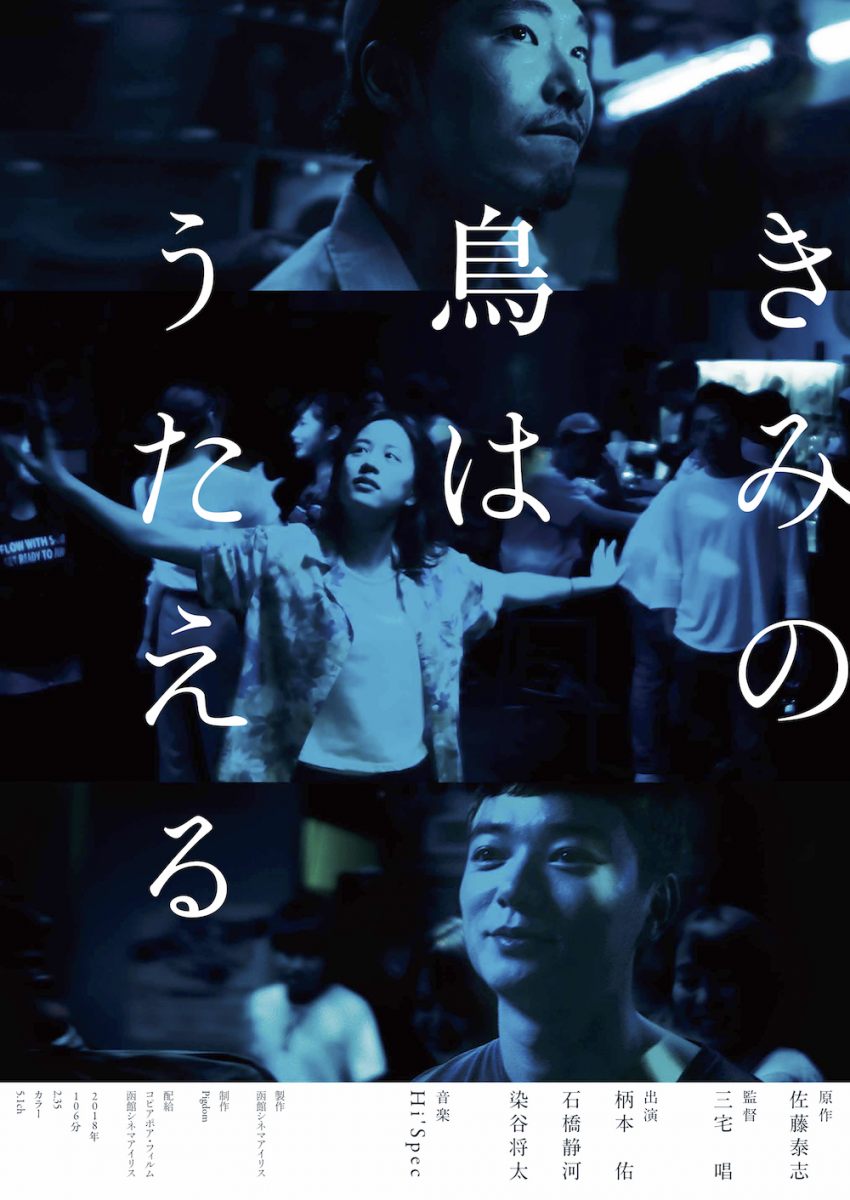
And Your Bird Can Sing (きみの鳥はうたえる, Sho Miyake, 2018)

And Your Bird Can Sing poster 1Yasushi Sato, an author closely associated with the port town of Hakodate who took his own life in 1990, has been enjoying something of a cinematic renaissance in the last few years with adaptations of some of his best known works in The Light Shines Only There, Over the Fence, and Sketches of Kaitan City. And Your Bird Can Sing (きみの鳥はうたえる, Kimi no Tori wa Utaeru), taking its title from the classic Beatles song, was his literary debut and won him a nomination for the prestigious Akutagawa Prize in 1981. Unlike the majority of his output, And Your Bird Can Sing was set in pre-bubble Tokyo but perhaps signals something of a recurring theme in its positioning of awkward romance as a potential way out of urban ennui and existential confusion.

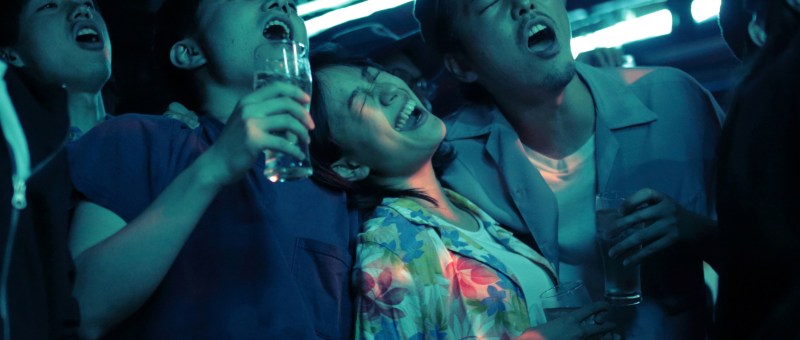
Sho Miyake’s adaptation shifts the action back to Hakodate and the into present day but maintains the awkward triangularity of Sato’s book. The unnamed narrator (Tasuku Emoto), the “Boku” of this “I Novel”, is an apathetic slacker with a part-time job in a book store he can’t really be bothered to go to. After not showing up all day, he wanders past the store at closing time which brings him into contact with co-worker Sachiko (Shizuka Ishibashi) who appears to be leaving with the boss (Masato Hagiwara) but blows him off to come back and flirt with Boku who makes a date with her at a cute bar but falls asleep after getting home and (accidentally) stands her up, drinking all night with his unemployed roommate Shizuo (Shota Sometani) instead. Luckily for Boku, Sachiko forgives him and an awkward romance develops but their relationship becomes still more complicated when Boku introduces Sachiko to Shizuo with whom she proves an instant hit.

This is not, however, the story of an awkward love triangle but the easy fluidity of youth in which unselfishness can prove accidentally destructive. Boku, for all his rejection of conventionality, is more smitten with Sachiko than he’s willing to admit. He counts to 120 waiting for her return, refusing to make a move himself but somehow believing she is choosing him with an odd kind of synchronised telepathy. She pushes forward, he holds back. Boku encourages Shizuo to pursue Sachiko, insisting that she is free to make her choices, and if jealous does his best to hide it. Shizuo, meanwhile, is uncertain. Attracted to Sachiko he sees she prefers Boku but weighs the positivities of being second choice to a man dressing up his fear of intimacy as egalitarianism.

Boku tells us that he wanted the summer to last forever, but in truth his youth is fading. Like Sachiko and Shizuo, he is drifting aimlessly without direction – much to the annoyance of an earnest employee at the store (Tomomitsu Adachi) who prizes rules and order above all else and finds the existence of a man like Boku extremely offensive. Sachiko, meanwhile, has drifted into an affair with her boss who, against the odds, actually seems like a decent guy if one who is perhaps just as lost as our trio and living with no more clarity despite his greater experience. Like Boku, Shizuo too is largely living on alienation as he strenuously resists the fierce love of his admittedly problematic mother (Makiko Watanabe).

“What is love?” one of Sachiko’s seemingly less complicated friends (Ai Yamamoto) asks, “why does everybody lie?”. Everybody is indeed lying, but more to themselves than to others. Fearing rejection they deny their true feelings and bury themselves in temporary, hedonistic pleasures. Boku reveals that he hoped Sachiko and Shizuo would fall in love so that he would get to know a different side to Sachiko through his friend, as if he could hover around them like transparent air. The problem is Boku doesn’t quite want to exist, and what is loving and being loved other than a proof of existence? Sachiko prompts, and she waits, and then she wonders if she should take Boku at his word and settle for Shizuo only for Boku to reach his sudden moment of clarity at summer’s end. A melancholy exploration of youthful ennui and existential anxiety, And Your Bird Can Sing is a beautifully pitched evocation of the eternal summer and the awkward, tentative bonds which finally give it meaning.


And Your Bird Can Sing was screened as part of the 2019 Nippon Connection Film Festival.

Original trailer (English subtitles)

Domains (王国(あるいはその家について), Natsuka Kusano, 2019)

domains posterMost of us like to feel as if we’re connected to something. Not merely floating islands, but anchored to the world by strong connections to others – only when we feel as if the world is not holding on as tightly as we’d like do we begin to feel as if perhaps there are as many worlds as people and many of them barred to those who have no right to enter. Natsuka Kusano’s second feature, Domains (王国(あるいはその家について), Okoku (Arui wa Sono Ie ni Tsuite)), tackles this conflict head on in a tragic tale of rage, madness, and jealousy driven by a series of mutual resentments as a collection of middle-aged men and women struggle to accept the “intrusion” of an unwanted third party into the kingdom of their intimate relationships.

Kusano opens boldly with the film’s most straightforward, though infinitely shocking, scene as a woman in her late 20s, Aki (Asami Shibuya), sits impassively while a police officer (Ryu Kenta) politely tries to explain to her that she is being held on suspicion of murder. Not quite present, Aki accepts all the charges against her and admits her crime though is puzzled by the policeman’s assertion that she has been “brought to justice”, explaining that she already feels herself to have been “brought to justice” by “something like time”. In any case, she has already said everything she wishes to say in a letter to the mother of her victim. In a brief moment of madness, Aki pushed the three year old daughter of her childhood best friend into a swelling river in the midst of a typhoon.

Leaving us with this disturbing moment, Kusano then shifts back to what looks like a rehearsal room where the woman we have just seen is now dressed in more casual clothing and seated at a table next to another woman who will read in the lines of Aki’s childhood best friend and later mother of the murdered little girl, Honoka, Nodoka (Tomo Kasajima). Travelling back a few months before the incident, the two women read over the undramatic events which led up to it as if engaged in an act of emotional excavation.

The strange fact that had fascinated the policeman in Aki’s written testimony was her seemingly random allusion to a castle made out sheets and chairs the mention of which sends her into a refrain of the gloomy Japanese folksong Moon over Ruined Castle. As we later ascertain, the the make-believe castle, constructed in her childhood home with soon-to-be best friend Nodoka, became something like a safe place, the eye of typhoon raging in her mind. Aki saw the castle as her rightful “kingdom”, a sacred space into which only she and Nodoka were permitted to enter and which was permanently available to each wherever they happened to be.

Nodoka, however, has moved on – formed a new kingdom with a husband and a child into which Aki has no right to step. After having something like a breakdown and returning to her hometown, Aki reconnected with Nodoka whom she had not seen since her wedding to her husband Naota (Tomomitsu Adachi) – a mutual friend from university, four years previously. Naota, now a school teacher, like Aki is intensely jealous of his own kingdom which he has given physical form in the solid existence of his house. Aki noticed this fact immediately in the pitch perfect attention to temperature and humidity of Nodoka’s new home, but she couldn’t help seeing that her friend now looked tired, harried, and that the marriage was perhaps only a superficial act of performance rather than a real emotional connection.

Ironically enough, it’s Naota himself who accidentally brings this up when explaining that a family can collapse without warning and revert to being merely a collection of individuals living under the same roof. Nodoka accuses him of using a schoolteacher’s logic to rule his home, and there is certainly some of that in there as his rigid authoritarianism seems primed to hold on so tight that it squeezes the life out of the very thing he’s trying to protect, but there’s an ugly kind of conservatism in it too as he angrily tries to expel the unwelcome intrusion of Aki into their lives, blaming her for the cracks in his marriage which her presence has perhaps exposed.

Naota wants Aki gone because he thinks she’s a bad influence, a shirker or a mad woman who will eventually infect his house with whatever it is she has like some kind of ill will virus. In an odd and terrifying way he may be “right”, but his resentment runs deeper in that he, like Aki, cannot accept that Nodoka once belonged in someone else’s kingdom to which he has no access. He resents that the two women are so close as to have largely abandoned language and share a much longer history than he and his wife, while Aki perhaps resents the presence of Honoka who represents a bond between Naota and Nodoka that she could never match even if her concern over the coldness of her friend’s new life and her seemingly hidden misery is nothing but altruistic.

Aki surveyed the kingdom of her friend and discovered it was flawed and vulnerable, that the kingdom she and her husband were building would eventually destroy them. Yet the overwhelming force which compelled her towards her unforgivable transgression was not so much resentment, or loneliness, or jealousy, or even a desire for freedom, as embarrassment. She felt as if she had betrayed her kingdom’s existence to someone who was not supposed to see it and acted without thinking in order to cover up an emotional crime, little realising the pain and destruction her act would cause.

Words encircle Aki like a typhoon, leaving her permanently in its eye trying to make sense of what has happened. Kusano stages a rehearsal after the fact, reading over the same lines with added nuance, occasionally digging deeper to expose a new clue either so trivial as not to be worth remembering or so delicate as not to be remembered out loud. To Aki, the spoken has no weight – her kingdom is made is feelings, but for Naota the reverse is true. Nodoka remains caught in the middle, perhaps secretly and uncomfortably yearning for freedom and a kingdom of her own while the storm clouds gather all around her and all that remains is the inescapable impossibility of an unselfish yet whole connection.


Domains made its world premiere at the 2019 International Film Festival Rotterdam and is available to stream online via Festival Scope until 24th February.

Rotterdam trailer (English subtitles)

The Sower (種をまく人, Yosuke Takeuchi, 2016)

the sower stillWhen tragedy strikes the one thing you ought to be able to rely on is your family, but when the tragedy occurs within that sacred space which exits between you what is to be done? Yosuke Takeuchi’s The Sower (種をまく人, Tane wo Maku Hito) attempts to provide an answer whilst putting one very ordinary, loving and forgiving family through a series of tests and tragedies. Lies, regret, and despair conspire to ruin the lives of four once happy people but even in the midst of such a shocking, unexpected event there is still time to turn towards the sun rather than continuing in the darkness.

Mitsuo has just been released from a mental hospital where he received treatment for a nervous breakdown suffered as a direct result of his time as a relief worker after the Tohoku earthquake. Returned to the home of his brother Yuta and his wife Yoko, Mitsuo’s family welcome him with open arms and he is delighted to become reacquainted with his niece Chie as well as meet her younger sister, Itsuki, for the first time. Yoko’s mother was supposed to be coming to help out with the children but has let them down once again. Uncle Mitsuo seems like the perfect solution but tragedy strikes when he leaves the girls on their own to use the bathroom and comes back to discover that Chie has dropped her sister causing her to hit her head on a curb stone surrounding the play area. Mitsuo rushes to the hospital but Itsuki sadly passes away. Chie, overcome with guilt and fear hastily blurts out that her uncle dropped her sister while Mitsuo remains silent.

Chie’s claim sparks a series of consequences, the most serious being the intervention of the police investigating the case who are very keen to poke into each and every dark corner of this ordinary family. Despite the fact that Mitsuo has only been staying with them a few days, the police almost push Chie into accusing Mitsuo of abuse of herself or her sister, trying to paint him as some kind of deranged threat to children everywhere. Feeling guilty about her lie and fearing discovery Chie wisely says nothing, refusing to further incriminate her uncle save for a brief indication that he dropped Itsuki on purpose.

The police are confused, there is no evidence to support the idea of Mitsuo having behaved suspiciously towards either of the girls or anyone else for that matter. There would seem to be no motive for him to intentionally harm his niece, though they don’t want to accuse a grieving little girl of making things up, either. Conscious that making Chie give evidence in court, especially if she is going to lie, may have terrible consequences for her future the police urge Yuta to talk seriously with his daughter and try to get to the truth through more gentle means.

The swarm of tragedy has, however, already begun to drive a wedge between husband and wife. Even at the funeral, Yoko’s mother, forgetting that much of this is her fault for letting the family down in the first place, overtly criticises their decision to take in someone just released from a mental hospital and then leave him in charge of small children. Yuta loves his brother unconditionally, knows he is a good person and does not blame him for his daughter’s death. Yoko cannot bring herself to understand her husband’s reaction, accusing him of choosing his brother over their little girl. Mitsuo’s mental state is repeatedly offered as an explanation for what happened despite the fact that his condition is down to an excess of compassion rather than any violent or destructive impulses.

This same kindness means that he never speaks out or tries to appeal to Chie to tell the truth, shouldering the burden of her guilt and perhaps feeling responsible for having left her alone with her sister even if it was only for a few short minutes. Chie, terrified and remorseful, deeply regrets her original lie but is too afraid to tell the truth. When she finally does decide to confide in someone she is instantly told to keep quiet about it, placing an additional burden on this already fragile little girl in asking her to keep two terrible secrets perhaps for the rest of her life.

As the family falls apart, Mitsuo retreats to the woods, planting sunflowers which Itsuki loved in every conceivable place. Literally trying to plant the seeds of hope, Mitsuo spreads his sunflowers far and wide bringing colour and life to a landscape of desolation but it may take more than flowers to light the way out of this hellish, inescapable tragedy.


The Sower was screened at the 17th Nippon Connection Japanese Film Festival.

Original trailer (English subtitles)