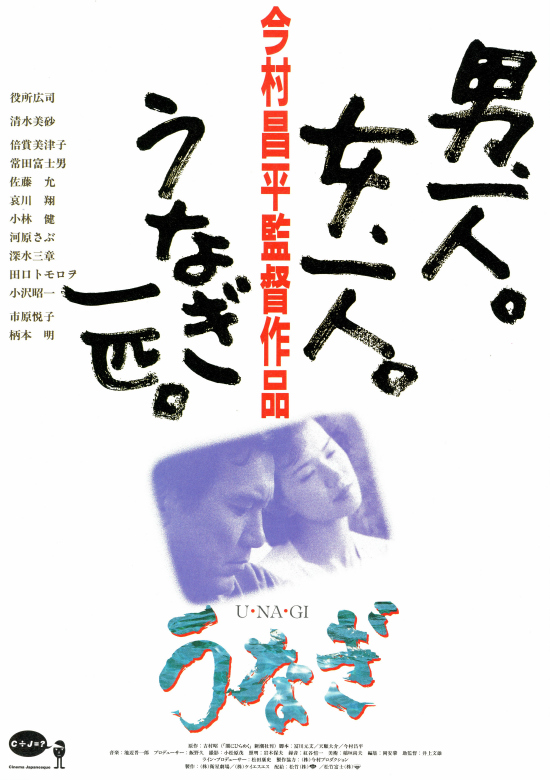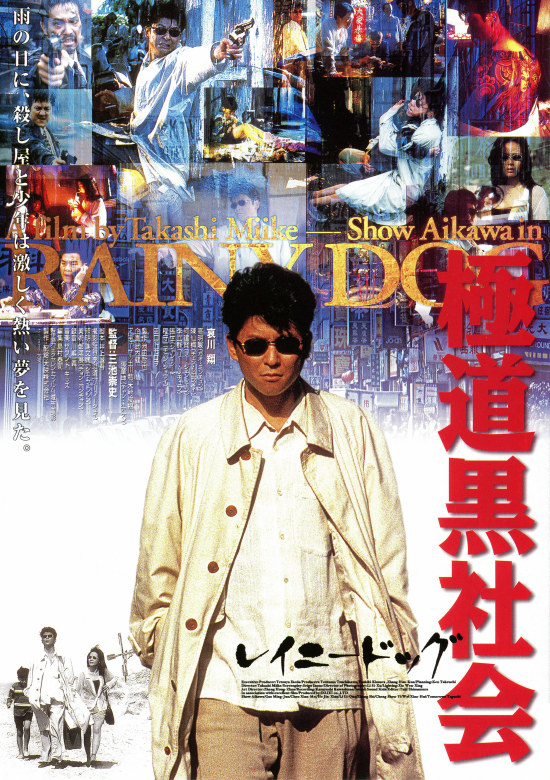
Rainy Dog (極道黒社会, Takashi Miike, 1997)

rainy-dogThey say dogs get disorientated by the rain, all those useful smells they use to navigate the world get washed away as if someone had suddenly crumpled up their internal maps and thrown them in the waste paper bin. Yuji (Show Aikawa), the hero of Rainy Dog (極道黒社会, Gokudo Kuroshakai) – the second instalment in what is loosely thought of as Takashi Miike’s Black Society Trilogy, appears to be in a similar position as he hides out in Taipei only to find himself with no home to return to. Miike is not generally known for contemplative mood pieces, but Rainy Dog finds him feeling introspective. A noir inflected, western inspired tale of existential reckoning, this is Miike at his most melancholy but perhaps also at his most forgiving as his weary hitman lays down his burdens to open his heart only to embrace the cold steel of his destiny rather than the warmth of his redemption.

Yuji’s day job seems to be hulking pig carcasses around at the meat market but he’s also still acting as a button man for the local Taiwanese mob while he lies low and avoids trouble in Taipei following some kind of incident with his clan in Japan. Receiving a call to the effect that following a change of management it will never be safe for him to go home, Yuji is as lost as a dog after the rain but if there’s one thing he hadn’t banked on it was the appearance of a rather sharp Taiwanese woman who suddenly introduces him to a mute little boy who is supposedly his son. Yuji is not the fatherly type and does not exactly take to his new responsibilities. He half remembers the woman, but can’t place her name and isn’t even sure he ever slept with her in the first place. Nevertheless, Ah Chen follows Yuji around like a lost little puppy.

Two more meetings will conspire to change Yuji’s life – firstly a strange, besuited Japanese man (Tomorowo Taguchi) who seems to snooze on rooftops in a sleeping bag and is intent on getting the drop of Yuji for undisclosed reasons, and the proverbial hooker with a heart of gold (and a fancy computer for running an internet blog) with whom he will form a temporary makeshift family. Getting mixed up in something he shouldn’t Yuji’s cards are numbered, but then it couldn’t have been any other way.

As in Shinjuku Triad Society, Miike returns to the nature of family and of the tentative bonds which emerge between people who have been rejected from mainstream society. Yuji is a displaced person, forced out of his homeland and lost in a foreign city. Though he appears to have a good grasp of the local language, the landscape confuses him as he wanders through it like the man with no name, adrift and permanently shielded by his sunglasses. The Taiwanese gangster he’s been freelancing for repeatedly describes him as “like a son” despite the fact that they seem to be around the same age but it’s clear that he could have Yuji eliminated in a heartbeat if he found he’d outlived his usefulness.

Similarly, Yuji does not immediately jump into a paternal mindset when presented with this strangely cheerful young boy. Eventually he lets him come out of the rain and presents him with a towel, greeting him with the words “you’re not a dog” but subsequently abandons him for what seems like ages during his time with the prostitute, Lily, who describes his tattoos as beautiful and shares his dislike of the intense Taipei rain. Asked if she’s ever considered going somewhere sunnier, Lily admits that she has but the fear that perhaps it would all be the same (only less wet) has put her off. Perhaps it’s better to live in hope, than test it and find out it was misplaced.

Gradually, Yuji begins to a least develop a protective instinct for Ah Chen as well as some kind of feeling for Lily which leads him to carry out another hit in order to give her the money to escape on the condition that she take Ah Chen with her. However the trio get ambushed on their way out ending up at a beach leaving them with nowhere left to run, signalling the impossibility of getting off this inescapable island. Just when it seems all hope is lost, Ah Chen finds a buried scooter which he and Lilly begin to dig up. Eventually, Yuji joins them, fully confirming his commitment to the mini family they’ve accidentally formed as they work together to build themselves a way out. Yuji’s decision separate from them and return to the world of crime, albeit temporary, will be a final one in which he, by accident or design, rejects the possibility of a more conventional family life with Ah Chen and Lilly for the destiny which has been dogging him all along.

Birth and death become one as Yuji regains his humanity only to have it taken from him by a man exactly mirroring his journey. There are no theatrics here, this is Miike in paired down, naturalistic mode willing to let this classic story play out for all that it is. Working with a Taiwanese crew and capturing the depressed backstreet world of our three outcasts trapped by a Taipei typhoon for all of its existential angst, Rainy Dog is Miike at his most melancholic, ending on a note of futility in which all hope for any kind of change or salvation has been well and truly extinguished.


Original trailer (English subtitles)

https://www.youtube.com/watch?v=bgN0BnrwruQ

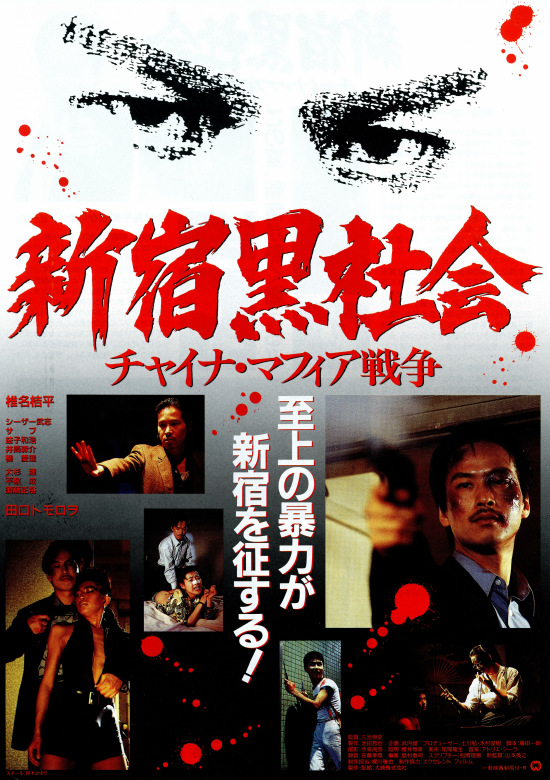
Shinjuku Triad Society (新宿黒社会 チャイナ・マフィア戦争, Takashi Miike, 1995)

shinjuku-triad-societyThese days Takashi Miike is known as something of an enfant terrible whose rate of production is almost impossible to keep up with and regularly defies classification. Pressed to offer some kind of explanation to the uninitiated, most will point to the unsettling horror of Audition or the audacity of the controversial Ichi the Killer whilst looking askance at the totally unexpected craziness of Yatterman or the child friendly Ninja Kids!!!. Before he was the gleefully unpredictable festival favourite, Miike, like many of his contemporaries, had made a name for himself in V-cinema, often with violent tales of modern day yakuza. Shinjuku Triad Society (新宿黒社会 チャイナ・マフィア戦争, Shinjuku Kuroshakai: China Mafia Senso) was Miike’s first venture into the mainstream theatrical world but retains his V-cinema focus with additional intent.

Set in the shady, sleazy, noir-tinted world of ‘90s Shinjuku, Shinjuku Triad Society opens with a voice-over from one of its central players telling us that this is a love story – sickening and sweet, as real love is. The action kicks off with this same character, a rent boy, Zhou, attempting to evade a police raid, slitting the throat of a regular street cop on his way out. Zhou is the lover of an unpredictable member of the Taiwanese mafia, Wang (Tomorowo Taguchi), who is creating several problems in the underground crime world both within Triad circles and with the local yakuza. Half Chinese policeman, Tatsuhito Kiriya (Kippei Shina), has been landed with the case but things begin to get personal when he discovers that his younger brother, Yoshihito, has been hired as a junior lawyer working directly for Wang’s gang.

Yakuza films often have a very strong homosocial atmosphere, emphasising the fraternal bonds between men but Shinjuku Triad Society is especially notable for its inclusion of explicit male homosexuality within the gangster underworld. If yakuza films are family dramas with funerals instead of weddings, Miike uses this intense male bonding as a comment on the wider nature of the family with an added focus on the place of the foreign in Japanese society. Wang and Tatsuhito are not so far removed in their desire to rebuild their own family unit, partly as a kind of protective measure against the world around them in which their Chinese heritage becomes a perpetual barrier. Wang has done this as the head of his own clan and with his lover Zhou at his side whereas Tatsuhito is intent on restoring his birth family by “rescuing” his brother from the clutches of the “Dragon’s Claw”.

Tatsuhito’s brother is, of course, a grown man who has the right to become a member of the underworld family, rejecting the blood ties to his policeman brother and doting parents if that is what he wants no matter what his brother might feel about it. Tatsuhito is disturbed to discover that Yoshihito has become Wang’s lover, even if he claims to be using him in order to progress his career. Both brothers threaten each other at gun point with Yoshihito exclaiming “if you don’t like the way I am, just kill me” which Tatsuhito refuses to do though it remains unclear if his brother’s sexuality is objectionable to him or merely a facet of his rejection of the values Tatsuhito holds dear.

Sexuality becomes a weapon as Zhou manoeuvres and manipulates through provoking and satisfying sexual desire. These are, however, consensual relationships even if a part of a wider, transactional game whereas anal rape is actively being employed as a police interrogation tactic (with a somewhat surprising spin). Even Tatsuhito, whose partner mocks him for a supposed dedication to being a “regular” cop, unwilling to take bribes or give in to corruption, himself engages in this behaviour anally raping a female prostitute from whom he wishes to extract information. Playing into the film’s darker themes of the interplay between sex, violence, and transaction, the prostitute instantly falls in love with him. Tatsuhito is clearly no saint even at the film’s beginning, but even so he continues to fall still further, seemingly outraged on discovering the true purpose of Wang’s “philanthropy” in his Taiwanese homeland, but doing relatively little about it other than adding it to the growing list of reasons why Wang must die. Eventually crossing the line from law enforcer to law breaker in the most taboo of ways, Tatsuhito finds himself rewarded even if his boss seems to be aware and in approval of what he’s done.

Tatsuhito may succeed in some of his aims, even if he has to exile himself from the family he was trying repair in the process though the closing voice over makes clear that he gains little in the long run and becomes nothing more than marginalia in the long, sad history of Shinjuku’s violent backstreets. Starting as he means to go on, Miike is entirely unafraid to step into some very uncomfortable areas, not least the way non-Japanese and those with partial Japanese heritage are regarded in the society of the time as well as the way these attitudes are filtered through recent Japanese history. Tatsuhito finds himself conflicted, choosing Japan in choosing the police but finding that it often fails to recognise him as its own son, whereas Yoshihito, in a sense, chooses China in associating himself with the Taiwanese gangsters. This central opposition of order and criminality is itself uncomfortable, but then undermined by the unorthodox nature of the local yakuza. Often strange and eerie, Shinjuku Triad Society takes place in a noirish world where there is no guiding morality – one to which Miike would often return though perhaps never with so much biting irony, where the absence of hope continues to imply its possibility.


Original trailer (English subtitles)
https://www.youtube.com/watch?v=wXzk9oOa8xU

The Eel (うなぎ, Shohei Imamura, 1997)

The EelDirector Shohei Imamura once stated that he liked “messy” films. Interested in the lower half of the body and in the lower half of society, Imamura continued to point his camera into the awkward creases of human nature well into his 70s when his 16th feature, The Eel (うなぎ, Unagi), earned him his second Palme d’Or. Based on a novel by Akira Yoshimura, The Eel is about as messy as they come.
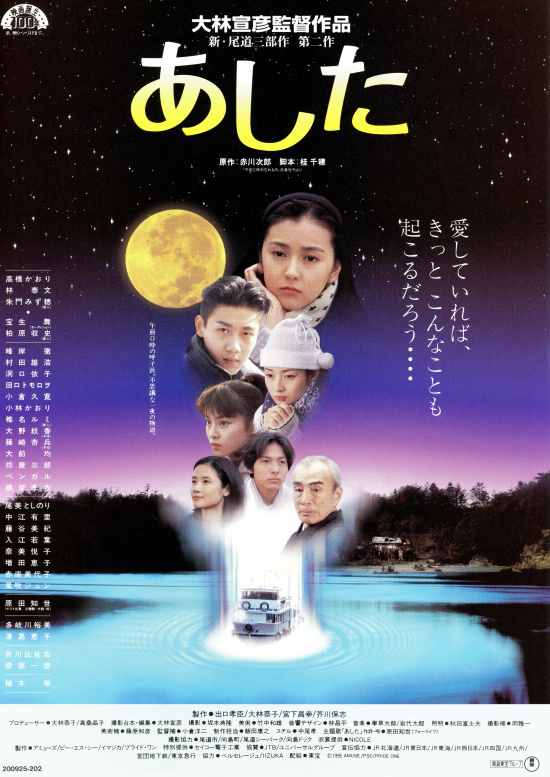
Mild-mannered salary man Yamashita (Kouji Yakusho) receives a handwritten letter filled with beautiful calligraphy delivering the ugly message that his wife has been entertaining another man whilst he enjoys his weekly all night fishing trips. Confused at first, the note begins to work its way into Yamashita’s psyche and so he decides to leave his next fishing trip a little earlier than usual. Peeping through the keyhole, he finds his beloved wife enjoying energetic, passion filled sex with another man. Drawing a knife from a nearby shelf, he enters the room and attacks the pair killing the woman but letting the lover get away.

Yamashita immediately and with perfect calmness turns himself in at the local police station, still covered in his wife’s blood and carrying the murder weapon. Released on a two year probationary period after eight years in jail, there is no one to meet Yamashita when he comes out and so he remains under the guardianship of a Buddhist priest in a nearby town. Accompanied by his only friend, a pet eel, Yamashita takes possession of a local disused barbershop and sets about trying to rebuild his life.

Things change when Yamashita comes across an unconscious woman lying in the grass while he’s out looking for things to feed his eel. The strange thing is, this woman looks exactly like his wife. Eventually, Keiko (Misa Shimizu) recovers and comes to work with Yamashita in his new enterprise but as the pair grow closer the spectres of both of their troubled pasts begin to intrude.

As the small town residents of Yamashita’s new home often remark, Yamashita is a strange man. His deepest relationship is with his eel which the prison guards, who seem quite well disposed towards him, allowed him to keep in the prison pond even though pets are not generally allowed. When asked why he likes his eel so much, Yamshita replies that the eel listens to him and doesn’t tell him the things he does not wish to hear. Like Yamashita, the eel is isolated inside his tank, content to absent himself from interacting with other creatures, both protected and constrained by transparent walls.

After his release from prison, Yamashita begins to reflect on his crime which he doesn’t so much regret but has no desire to repeat. His other double arrives in the form of fellow inmate and double murderer Tamasaki (Akira Emoto) who keeps trying to convince Yamashita that he is living dishonestly by not having visited his wife’s grave or read sutras for her. Though Yamashita pays no heed to most of his advice which is more self-pity and anger than any real concern for Yamashita’s soul, some things begin to get to him, most notably that perhaps the fateful letter never existed at all and is nothing more than the manifestation of Yamashita’s jealous rage.

Though the film presents everything that happens to Yamashita as “real”, his state of mind is continually uncertain. Not only is the provenance of the letter doubted, he doubts the existence of Keiko because she looks (to him at least) like the returned ghost of the woman he killed, and even the final confrontational arguments with Tamasaki take on an unreal quality, as if Yamashita were arguing with himself rather than another man who also represents his own worst qualities – impulsivity, violence, self doubt and insecurity. The film is so deeply embedded in Yamashita’s subjective viewpoint that almost nothing can be taken at face value.

Yamashita is, in a sense, trapped in a hall of mirrors as his own faults are reflected back at him through the people that he meets. Keiko, rather than being physically murdered by a jealous lover, attempted to take her own life after being misused by a faithless (married) man. Her past troubles are, in some ways, the inverse of Yamashita’s as she finds herself at the mercy of dark forces but internalises rather than externalises her own anger. Cheerful and outgoing, she quickly turns Yamshita’s barbershop into a warm and welcoming place which the local community takes to its heart.

Yamashita, however, remains as closed off as ever though he does strike up something of a relationship with a lonely young man who wants to use his barber’s pole to try and call aliens. When Yamashita asks him what he’s going to do if the aliens actually come, the young man replies that he wants to make friends with them. Yamashita astutely remarks that the young man’s desire to meet aliens is down to a failure to connect with people from his own planet – an idea which the young man equally fairly throws back at him. Perhaps out of fear rather than atonement, Yamashita exiles himself from the world at large though gradually through continued exposure to the genial townsfolk and Keiko’s deep seated faith in him, he does begin to swim towards the surface.

Imamura adopts his usual, slightly ironic tone to lighten this otherwise heavy tale allowing the occasional comic set piece to shine through. Yakusho delivers another characteristically nuanced performance as this entirely unformed man, unsure of reality and trapped in a spiral of self doubt and confusion. His original crime of passion is at once chilling in its calmness but also messy and violent as he gives in to animalistic rage. After showing us a street lamp glowing an ominous red, Imamura steeps us in blood as his camera becomes progressively more stained making it impossible to forget the shocking betrayal of this unexpected violence.

Yamashita remarks at one point that he died that day alongside his wife. The Eel is a story of rebirth as its protagonists begin to swim towards the shore in support of each other, though like the titular marine creature there is no guarantee that they will make there alive. Yamashita is a cold blooded murderer and creature of suppressed rage yet Imamura is not interested in moral judgements as much as he is in the messier sides of human nature. A chance offering of redemption for the unredeemable, The Eel offers hope for the hopeless in a world filled with goodhearted eccentrics where all faults are forgivable once they are understood.


Original trailer (no subtitles)

https://www.youtube.com/watch?v=yAC3KZth7E0

Goodbye for Tomorrow (あした, Nobuhiko Obayashi, 1995)

goodbye for tomorrowAfter completing his first “Onomichi Trilogy” in the 1980s, Obayashi returned a decade later for round two with another three films using his picturesque home town as a backdrop. Goodbye For Tomorrow (あした, Ashita) is the second of these, but unlike Chizuko’s Younger Sister or One Summer’s Day which both return to Obayashi’s concern with youth, Goodbye For Tomorrow casts its net a little wider as it explores the grief stricken inertia of a group of people from all ages and backgrounds left behind when a routine ferry journey turns into an unexpected tragedy.

Three months after nine people were drowned when a local ferry sank in the harbour, friends and relatives of the dead begin to receive messages signed by their loved ones instructing them to be at a small island at midnight. Cruel joke or not, each of the still grieving recipients makes their way to the boathouse, clutching the desperate hope that the dead will really return to them. Sure enough, on the stroke of midnight the ghostly boat rises from the ocean floor bringing a collection of lost souls with it, but its stay is a temporary one – just long enough to say goodbye.

Obayashi once again begins the film with an intertile-style message to the effect that sometimes meetings are arranged just to say goodbye. He then includes two brief “prequel” sequences to the contemporary set main narrative. The first of these takes place ten years previously in which a boy called Mitsugu throws a message wrapped around a rock into a school room where his friend Noriko is studying. We then flash forward to three months before the main action, around the time of the boat accident, where an assassination attempt is made on the life of a local gangster in a barber shop. At first the connection between these events is unclear as messages begin to arrive in innovative ways in the film’s “present”. After a while we begin to realise that the recipients of the messages are so shocked to receive them because they believe the senders to be dead.

At three months since the sinking, the grief is still raw and each of our protagonists has found themselves trapped in a kind of inertia, left alone so suddenly without the chance to say goodbye. The left behind range from a teenager whose young love story has been severed by tragedy, a middle aged man who lost a wife and daughter and now regrets spending so much time on something as trivial as work, a middle aged trophy wife and the colleague who both loved a successful businessman, two swimmers with unresolved romances, and the yakuza boss who lost his wife and grandson. For some the desire is to join their loved ones wherever it is that they’re going, others feel they need to live on with double the passion in the name of the dead but they are all brought together by a need to meet the past head on and come to terms with it so that they can emerge from a living limbo and decide which side of the divide they need to be on.

Aside from the temporary transparency of the border between the mortal world and that of the dead, the living make an intrusion in the form of the ongoing yakuza gang war. The Noriko (Kaori Takahashi) from the film’s prequel sequence also ends up at the meeting point through sheer chance, as does the Mitsugu (Yasufumi Hayashi), now a gangster and charged with the unpleasant task of offing the old man despite his longstanding debt of loyalty to him. These are the only two still living souls brought together by an unresolved message bringing the events full circle as they achieve a kind of closure (with the hope of a new beginning) on their frustrated childhood romance.

The other two hangers on, an ambitious yakuza with a toothache played by frequent Obayashi collaborator Ittoku Kishibe, and a lunatic wildcat sociopath played by the ubiquitous Tomorowo Taguchi, are more or less comic relief as they hide out in the forrest confused by the massing group of unexpected visitors who’ve completely ruined their plot to assassinate the old yakuza boss and assume control of the clan. However, they too are also forced to face the relationship problems which bought them to this point and receive unexpected support from the boss’ retuned spouse who points out that this situation is partly his own fault for failing to appreciate the skills of each of his men individually. The boss decides to make a sacrifice in favour of the younger generation but his final acts are those of forgiveness and a plea for those staying behind to forget their differences and work together.

Revisiting Obayashi’s frequent themes of loss and the need to keep living after tragedy strikes, Goodbye For Tomorrow is a melancholy character study of the effects of grief when loved ones are taken without the chance for goodbyes. Aside from the earliest sepia tinged sequence, Obayashi plays with colour less than in his other films but manages to make the improbable sight of the sunken boat rising from the bottom of the sea genuinely unsettling. The supernatural mixes with the natural in unexplained ways and Obayashi even makes room for The Little Girl Who Conquered Time’s Tomoyo Harada as a mysterious spirit of loneliness, as well as a cameo for ‘80s leading man Toshinori Omi. The Japanese title of the film simply means “tomorrow” which gives a hint as to the broadly positive sense of forward motion in the film though the importance “goodbye” is also paramount. The slight awkwardness of the English title is therefore explained – saying goodbye to yesterday is a painful act but necessary for tomorrow’s sake.


Dr. Akagi (カンゾー先生, Shohei Imamura, 1998)

Dr AkagiA late career entry from socially minded director Shohei Imamura, Dr. Akagi (カンゾー先生, Kanzo Sensei) takes him back to the war years but perhaps to a slightly more bourgeois milieu than his previous work had hitherto focussed on. Based on the book by Ango Sakaguchi, Dr. Akagi is the story of one ordinary “family doctor” in the dying days of World War II.
As Dr. Akagi (Akira Emoto) puts it, much of the the life of a family doctor involves running. If he breaks one leg, he’ll run on the other, if he breaks both legs, he’ll run on his hands, but he’ll do whatever it takes to get to his patients. Some of the villagers have branded him as a quack and nicknamed him “Doctor Liver” because his most frequent diagnosis is for hepatitis. Doctor Akagi is convinced that there really is an epidemic of contagious hepatitis plaguing the population and even has the evidence to back his theory up but with the war in crisis and so much else going on he’s having trouble getting anyone to listen to him. Nevertheless, Akagi fearlessly tries to find out what it is that’s causing this deadly disease to spread and hopefully put an end to it for good.

Imamura strikes an oddly comic tone here. Though the above synopsis may sound overly serious, for the vast majority of its running time Dr. Akagi is the story of a small fishing village going about its everyday life with the war just simply background. The town narrowly escapes being bombed by an American raid because it’s known that there’s prisoner of war camp nearby filled with allied soldiers and red cross personnel and there are certainly a lot of troops on the ground more or less running the show. However, despite the obvious hardships – lack of food being the biggest one, the townspeople are getting on with things in a fairly cheerful way.

Following a spot of pastoral care, Dr. Akagi ends up taking in a local girl as his assistant and housekeeper after her father has died leaving her to support her two younger siblings. Though a married woman with a husband away at the front, Sonoko (Kumiko Aso) has been making ends meet through prostitution with the rather unwelcome result that one of her regular customers wants to marry her (she does not reciprocate and after all already has a husband). Akagi doesn’t necessarily disapprove of the idea of prostitution or of openly expressed sexuality, but accepts that society does object to these ideas and takes Sonoko in so that she won’t have to sell herself (though she actually didn’t really mind very much and still finds herself called upon to provide her “services” even after she’s officially given up).

Akagi’s other supporters include a fellow doctor, Tomomi, who has become addicted to morphine after his wartime service and a drunken and lecherous buddhist monk who proves an essential ally when it comes to body snatching a recently buried corpse. Akagi gets himself into even more trouble when he takes in and treats an escaped Dutch POW who bears the scars of extreme torture by Japanese forces who are paranoid about possible spy action. Imamura is never afraid of raising the spectre of wartime brutality as his soldiers flit between righteous zealots committed to the letter of the law and bumbling idiots who can’t see that each of their actions is entirely counterproductive to their cause.

The most surprising moment comes when Akagi has a dream about his son who is an army doctor serving in Manchuria. After Akagi and his friend have conducted an autopsy to gain a fresh liver sample, Tomomi starts talking about his time in the army and a rumour about a group of doctors doing live dissections and possibly researching chemical weapons. Akagi is aghast and horrified but recounts his dream in which he stood before his son whose bloodied hands are extended towards him with a living patient writhing below. Akagi reminds him that he is a doctor and urges him to stop this barbaric practice but the nightmarish vision of this gloomy, blood-soaked room persists.

At the end of the film Sonoko and Akagi unwittingly end up viewing the giant mushroom cloud which arises after the atomic bomb blast in Hiroshima. Not knowing what it is, Akagi predictably sees it as a giant infected liver and wonders if the donor for his liver sample is angry with him but then thinks again and says the cloud is a representation of everybody’s anger towards this war. Akagi loses himself a little in the quest to solve the hepatitis question and after it leads him to neglect a patient he begins to question himself over his true motives and whether there’s really any point to what he’s trying to do. However, Dr. Akagi is a good and a kind man and eventually remembers what his true calling is – as a family doctor, running from one emergency to the next but always making sure his patients are well looked after. War or no war, life goes on – people get sick and they need to know there are men like Akagi out there that can always be relied upon to do the very best they can.


Dr. Akagi was originally released in the US by Kino Lorber but seems to be out of print. The good news is that the region free Korean disc comes with English subtitles.

Unsubbed trailer:

http://www.youtube.com/watch?v=g40YrQBAm3I

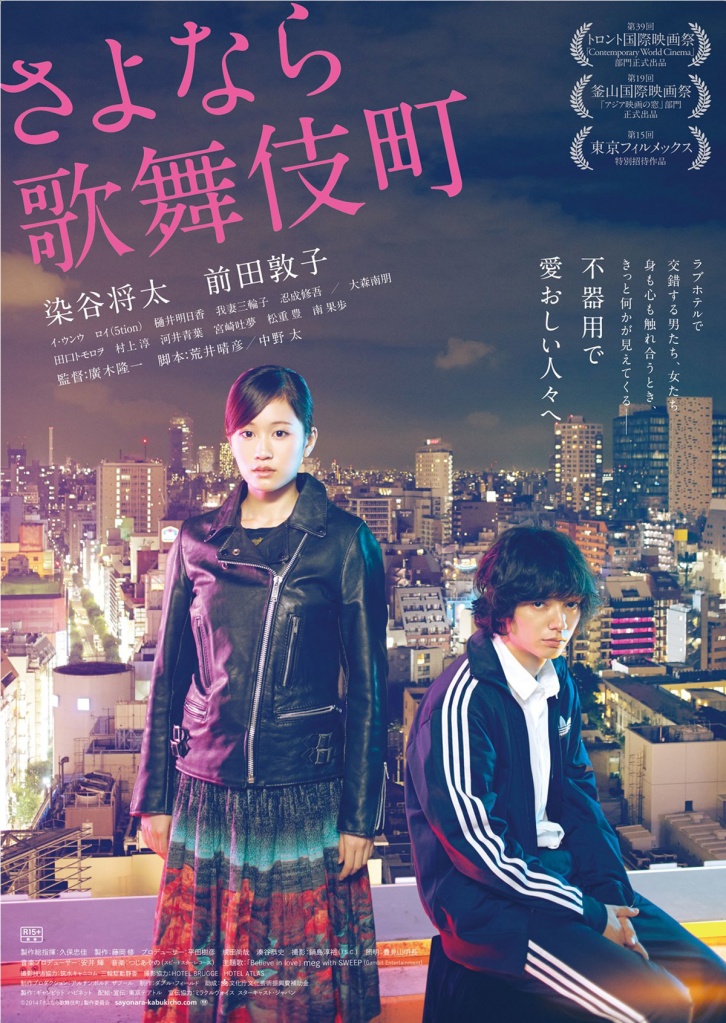
Kabukicho Love Hotel (さよなら歌舞伎町, Ryuichi Hiroki, 2014)

165709_02Kabukicho Love Hotel (さよなら歌舞伎町, Sayonara Kabukicho), to go by its more prosaic English title, is a Runyonesque portrait of Tokyo’s red light district centered around the comings and goings of the Hotel Atlas – an establishment which rents by the hour and takes care not to ask too many questions of its clientele. The real aim of the collection of intersecting stories is more easily seen in the original Japanese title, Sayonara Kabukicho, as the vast majority of our protagonists decide to use today’s chaotic events to finally get out of this dead end town once and for all.

The first couple we meet, Toru and Saya are young and apparently in love though the relationship may have all but run its course. She’s a singer-songwriter chasing her artistic dreams while he longs for a successful career in the hotel industry. He hasn’t told her that far from working at a top hotel in the city, he’s currently slumming it at the Atlas. Our next two hopefuls are a couple of (illegal) Korean migrants – she wants to open a boutique, he a restaurant. She told him she works as a hostess (which he’s not so keen on but it pays well), but she’s a high class call girl well known to the staff at the Atlas. Our third couple are a little older – Satomi works at the Atlas as a cleaner but she has a secret at home in the form of her man, Yasuo, who can’t go outside because the couple is wanted for a violent crime nearly 15 years previously. In fact, in 48hrs the statute of limitations will pass and they can finally get on with their lives but until then Satomi will continue to check the wanted posters on the way to work. That’s not to mention the tale of the teenage runaway and the hard nosed yakuza who wanted to recruit her as a call girl but had a change of heart or the porn shoot on the second floor which stars a lady with an unexpected relationship to one of the hotel’s employees…

It’s all go in Kabukicho. The punters come (ahem), go and leave barely a mark save for the odd tragedy to remind you that this is the place nobody wanted to end up. In fact, the picture Hiroki paints of Kabukicho is the oddly realistic one of someone hovering on its fringes, acknowledging the darkness of the place but refusing to meet its eyes. Everybody is, or was, dreaming of something better – Toru with his job at a five star hotel and a sparkling career in hospitality, Satomi and her romance or the Korean couple who want to make enough money to go home and start again. In short, this isn’t the place you make your life – it’s the one you fall into after you’ve hit rock bottom and promptly want to forget all about after you’ve clawed your way out.

However, while you’re there, you’re invested in the idea of it not being all that bad, really. There’s warmth and humour among the staff at the hotel who treat this pretty much the same as any other job despite its occasional messiness. In fact, the agency for the which the Korean hopeful works is run by an oddly paternalistic “pimp” (this seems far to strong a word somehow) who sits around in an apron and chats, offering comfort and fatherly advice in between dispatching various pretty young girls off to any skeevy guy who wants to rent them for an hour or two.

That’s not to say anyone is happy here though, all anyone’s focussed on is getting out and by the end the majority of them decide it’s just not worth it and the time to leave is now. Kabukicho Love Hotel may be one of Hiroki’s most mainstream efforts (despite its far less frequent than you might expect though frank sexual content) but its overlong running time and its failure to fully unify its disperate ensemble stories make it a slightly flawed one. An interestingly whimsical black comedy that takes a humorous view of Kabukicho’s darkside, Kabukicho Love Hotel is perhaps one it’s fairly easy to check out of well before the end of your stay but does offer a few of its own particular charms over the duration of your visit.


Or perhaps, you can check out any time you like, but you can never leave? We are all just prisoners here, of our own device….

Tokyo Fist (東京フィスト, Shinya Tsukamoto, 1995)

tokyo-fist_still_7Following on from their excellent remastered Tetsuo set and the more recent Kotoko, Third Window Films have again brought us another classic film from the back catalogue of one of Japan’s most underrated auteurs – Shinya Tsukamoto.

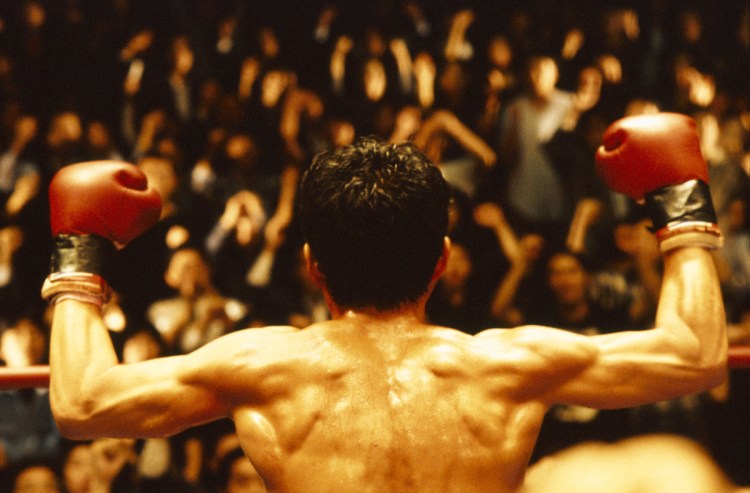
Tsuda (played by Shinya Tsukamoto himself) is a hard working insurance salesman in mid ‘90s Tokyo. He lives with a beautiful fiancée in a pretty nice flat and everything seems to be going pretty well for him except that he’s been so unbearably tired lately. Then, one fateful day a colleague asks him to deliver some money to a boxing club (which sounds kind of dodgy in itself) where he’s spotted by an old acquaintance, Kojima (played by Shinya Tsukamoto’s boxer brother Koji). Though it’s clear Tsuda doesn’t wish to resume a friendship with Kojima, somehow he still manages to worm his way into his life. This unwanted intrusion from the past begins to deeply unsettle the civilised life Tsuda and Hizaru had been living up to this point and sets them on a path of atavistic disintegration.

When you look at Tsuda at the beginning of the movie, it’s easy to think he’s ‘happy’ because the life he seems to be living is ‘normal’. He works hard, he lives with a woman he intends to marry and they seem settled and well matched. However, if you look more closely, you can see the cracks are all there even before Kojima turns up. His ‘tiredness’ is perhaps a symptom of the dissatisfaction he might not even realise he’s feeling with his boring, ordinary city life. When Hizaru, his girlfriend, asks him sensitively about his tiredness and suggests maybe he’s overworking and that she wouldn’t mind continuing to work even after they get married Tsuda’s reaction is quite telling. He doesn’t say anything particularly, he doesn’t argue, but it’s clear that he resents the suggestion and is clearly annoyed by it. This, and her subsequent comments to Kojima regarding Tsuda’s physique further undermine his masculinity and you can see that even before the catalyst of Kojima’s arrival, Tsuda’s mental state is quite fraught and his rage is already simmering quietly beneath thin layer of civility that is city life.

When Kojima finally does arrive, he does so like a pathogen infecting Tsuda first at the boxing club. Tsuda brings him home (inadvertently) to his girlfriend who is then also infected with a new strain of individualism. When Tsuda visits Kojima’s apartment to confront him about making a pass at Hizaru, what he finds is a lithe, glistening, insect-like physical force. His movements are uncanny, seemingly too fast for a human yet slightly jerky and lacking in grace. Despite the fact that everyone at the gym thinks Kojima is a terrible boxer (even when he actually wins a fight everyone seems bored) he possesses  the physical strength to knock Tsuda not only across the room but through a wall. The exaggerated, manga-like violence only further intensifies Kojima’s total dominance over Tsuda. Hizaru looks on with a curious expression which seems part way between wonder and disgust at Kojima’s increasingly bug-like appearance.

As a couple, Tsuda and Hizaru seem to have a fondness for watching old, subtitled European movies of an evening – Carol Reed’s The Third Man and Fritz Lang’s Metropolis. Both films, of course, that have something to say about ‘the city’. In The Third Man, Harry Lime’s crimes are only possible because of the unique situation of post-war Vienna. In Metropolis, famously, the city is an organism worked by an underclass of slave workers who are little more than cogs in the machine. The city assumes part of your own personality, strips you of your individuality and replaces it with a job title. It numbs you to the finer emotions and the only way left to re-assert your existence is to open yourself up to pain. In Tokyo Fist, the city is of course Tokyo, but really it could be any city any time. Living in such a codified way etches away at your humanity until barely a husk remains as you live out the day to day demands a city makes of its people. By the end of the film, the three central characters have been through an extended battle with this ‘city tax’ but whether the result is a death of the soul or a recovery is perhaps a matter for debate.

Tokyo Fist certainly a very rich film which repays repeat viewings and is open to a great number of interpretations. Like his earlier Tetsuo: The Iron Man, the film often works on a purely sensory level and needs to be experienced rather than considered but that isn’t to say it’s without plot or action. The fight scenes are intense and frenetic, captured in Tsukamoto’s trademark style, yet the boxing scenes do also have a very authentic ring to them. Tokyo Fist is a masterpiece of modern Japanese cinema that has long been underserved by sub quality releases. This remastered HD presentation from Third Window Films, supervised by Tsukamoto himself, finally restores the film to its rightful position with a truly outstanding blu-ray release. Tokyo Fist is a hugely intriguing and important film which richly deserves a place in any collection.


Available now on blu-ray in the UK from Third Window Films!

More Tsukamoto reviews:

First published on UK Anime Network in November 2013.

Monsterz (2014)

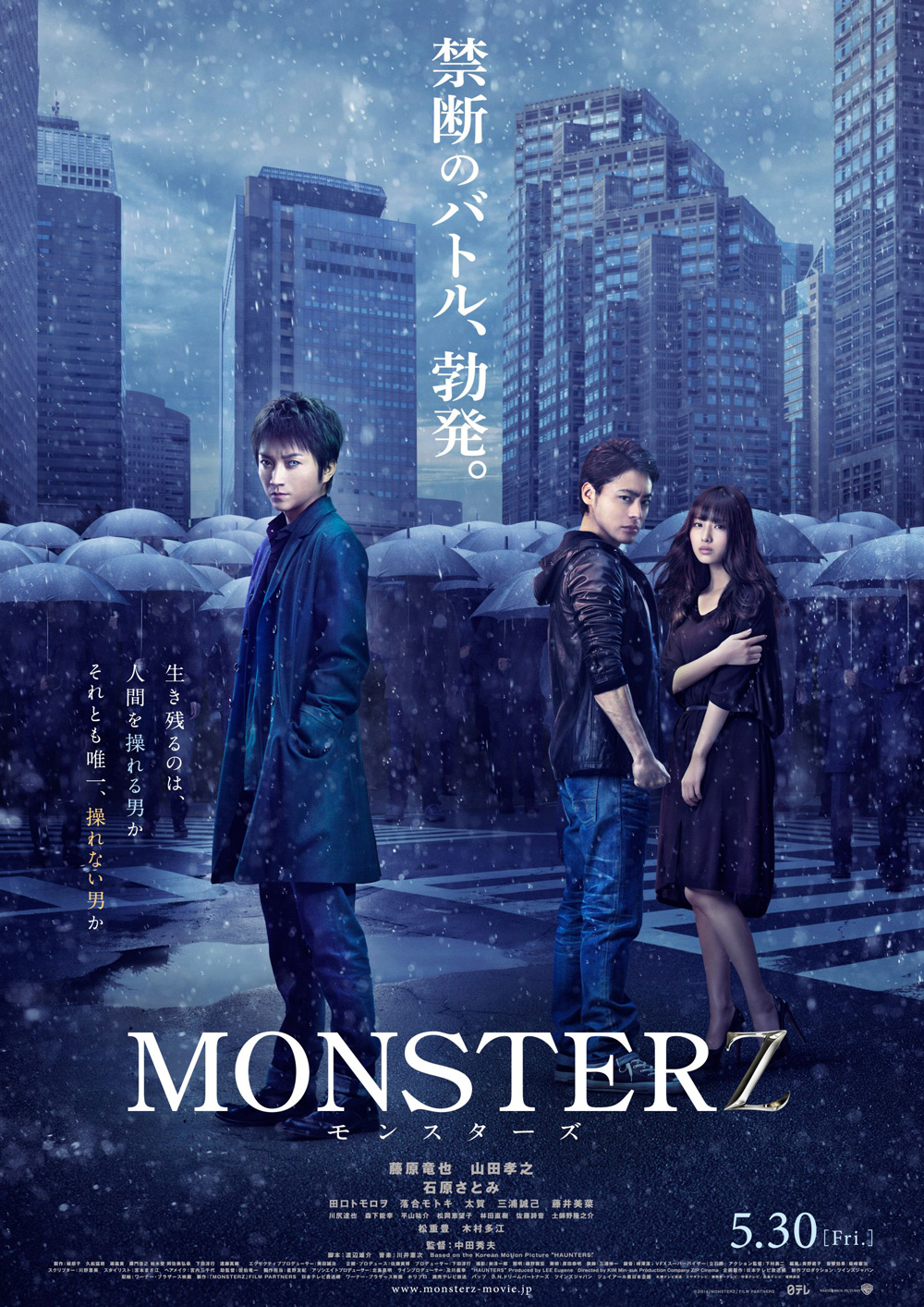
Monsterz_2014Hideo Nakata is best remembered as one of the driving forces of the J-Horror boom of the late ’90s thanks to his hugely influential Ring movies. However, despite a few notable hits including Dark Water, his career has seen something of a slump following a foray into American filmmaking with The Ring 2 – a sequel to the remake of his own Ring (though entirely different from his Japanese language Ring 2 completed in 1999). Monsterz sees him helming a remake of another foreign property – this time the Korean sci-fi thriller Haunters.

The film begins from the POV of Monster no. 1 (played by Tatsuya Fujiwara), who narrates much of the story and refers to himself solely as “monster”. Blindfolded, a small boy is dragged home by his mother only to be discovered by his abusive father who beats him and berates his mother whilst insisting “the monster” needs to die. At this point the blindfold comes off and the boy controls his fathers actions eventually persuading him to snap his own neck. Beginning to also control his mother, the boy stops short of giving her the same treatment and wanders off into the rain. Fast forward 20 years and the monster is now a criminal mastermind who uses his time freezing and mind control capabilities to make a living as a bank robber. However, one day he discovers someone who seems to be immune to his powers (Takayuki Yamada) and his whole world is shaken. The monster sets about removing this threat to his supremacy but it appears his opponent is also “a monster” – a man with super healing properties who cannot die! It takes a “monster” to fight a monster but which one will come out on top?

Yes, lots of predictably comic book style action adventures begin as the two guys with opposing super powers face off against each other. The most interesting aspect of the film is that it’s mainly told from the point of view of the otherwise unnamed “monster” though Nakata’s attempts to make him a sympathetic anti-hero never quite work out despite Fujiwara’s committed performance. The film’s ending is also unconventionally unresolved (though also very true to its American comic book roots) with a pleasing note of tolerance and inclusivity thrown in. However, that is in part facilitated by the lack of tension in the central dynamic – the two opposing forces are at a perpetual stalemate which only ends up feeling, well, stale – in a word. The monster’s freezing and mind control powers are impressive but the action sequences are much of a muchness and just get bigger rather than more interesting.

Having said that the action sequences aren’t unexciting, there are some impressive moments (bar the odd use of dodgy CGI and green screen). The main problem with the film is a slight mismatch in tones between Nakata’s portentous doom laden fatalism and the playful lightness of its comic book inspiration. The conventional hero, Shuichi, takes second lead here with his gang of sidekicks – otaku Akira and flaming queen Jun offering odd moments of comic relief. Though actually the role of Jun is another interesting inclusion as, despite offering a stereotypically “gay” character camping things up spectacularly, Jun is also presented fairly normally as a valued friend and comrade of the hero. His sexuality is merely a character trait, never a joke in itself which is a refreshing element particularly in a Japanese film. In the end, Monsterz aims to offer a message of tolerance and inclusiveness – that, oddly, there are no monsters and would be no villains if we could all just learn to accept each other’s differences and live together in harmony. However, the message is a little hamfisted and clumsily delivered and, some might feel, out of place in an action orientated film such as this.

Very typical of the comic book movie genre (though perhaps more Fantastic 4 than Dark Knight), Monsterz is middling mainstream fare which, while mildly diverting, fails to offer anything particularly memorable. A fine way to spend 90 minutes, Monsterz never outstays its welcome and offers generally high production values plus Nakata’s trademark visual flair but is unlikely to satisfy more genre savvy fans.

Roommate (ルームメイト, Takeshi Furusawa, 2013)

meinImage(Is the tag line really “A woman’s unpainted face is scary!”? I get where they’re coming from but, hmmm – problematic)

Adapted from the 1997 novel by Aya Imamura, you’d be forgiven be forgiven for thinking that Roommate is something of a rehash of seminal ’90s “my roommate is a psycho” drama Single White Female though it goes a couple of steps further in the influences stakes and throws in Fatal Attraction and The Three Faces of Eve for good measure. Honestly anything else is a spoiler (though anyone who’s ever watched a film of this nature before is going to guess 70% of the plot about ten minutes in) but sit back and get ready to enjoy a very silly (though not really silly enough) tale of violence and psychological intrigue!

The film starts with the police arriving at the scene of a violent crime where a severely injured man and woman are being taken to hospital leaving another man dead inside. Cut to three months earlier and Harumi (Keiko Kitagawa) – the woman from the crime scene, has been injured in a car accident and wakes up in a hospital dormitory. Shortly thereafter she’s visited by the man who was driving the car, Keisuke (Kengo Kora), along with his insurance broker friend who’s very keen to sort out the paperwork for the compensation etc. Whilst recuperating Harumi builds up friendship with one of the nurses, Reiko (Kyoko Fukada), and when it comes time for Harumi to be discharged the two decide to become roommates! It’s all amazing at first but cracks begin to appear as Reiko’s behaviour becomes increasingly strange and Harumi starts getting closer to Keisuke. Then Harumi starts seeing a woman who looks really like Reiko, but is not actually Reiko, hanging around and things just start to get even more bizarre from then on.

Yes, you’ve seen all of this before. Not just in Single White Female and every other identity theft stalker drama since but even the various twists and turns feel lifted from other, more successful, movies. There’s even an incident with a pet that’s kind of like the one in Single White Female but it’s been given a Fatal Attraction style twist to make it less obvious. At this point, when your roommate’s behaviour has become this dangerous, a normal person would actually do something about it, wouldn’t they? Not in the land of the movies though! Revelation after revelation and about an hour of psychobabble later it’s all explained (sort of, as long as you don’t really think about it) but the last twist and the subplot with Tomorowo Taguchi’s sleazy mayoral candidate seem a little superfluous.

Mostly the film has a disappointingly televisual feeling and though there are a fair few interesting techniques in play such as the use of split screens, this feels both too on the nose and underdeveloped to have much of an impact. Performances are also on the weaker side though this may rest partly on the lack of depth in the fairly schlocky script – Kengo Kora isn’t left much to do other than being generally ‘nice’ and though the bond between the two women is well brought out, neither of them really gets to let loose with the intense extremes of their characters. The problem, really, is that Roommate walks a fine line between camp horror movie and serious psychological thriller, which just makes it a little bit dull. It never manages to build up much of an atmosphere of fear and its unwillingness to play with ambiguity makes it that much less engaging. Had it gone further down the schlocky, campy, melodrama route, Roommate might have proved more fun but this light on gore heavy on drama approach makes it only mildly diverting.

It’s about as tame and mainstream as they come, but Roommate isn’t exactly a bad film, just not a very interesting one. Not crazy enough for the midnight crowd nor smart enough lovers of cerebral thrillers, it ultimately falls between two stools. With such a high profile cast you might have expected something a little more powerful but Roommate is the classically OK, yet totally inconsequential film that’s fine for occupying a couple of hours but little more.