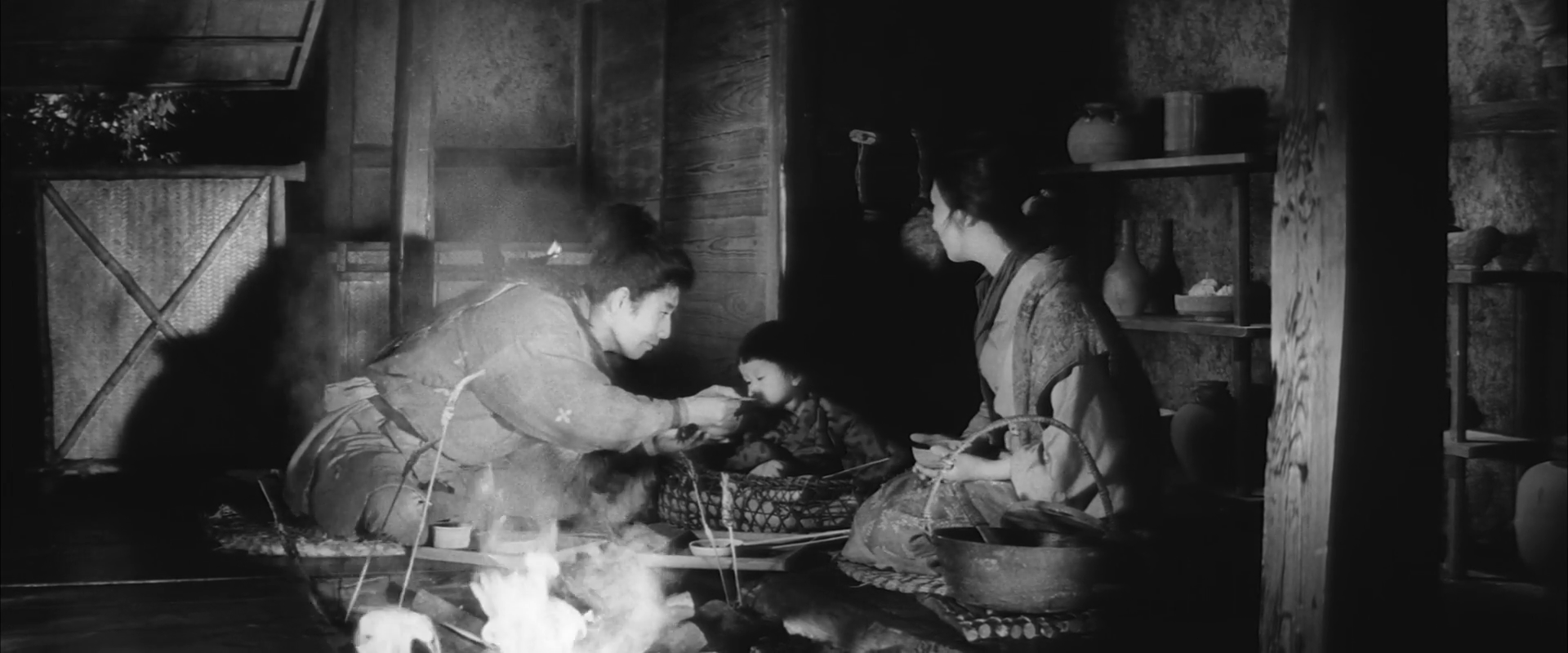
Shinobi no Mono 2: Vengeance (続・忍びの者, Satsuo Yamamoto, 1963)

Though Goemon might have thought himself free of his ninja past at the conclusion of the first film, he was unfortunately mistaken. Shinobi no Mono 2: Vengeance (続・忍びの者, Zoku Shinobi no Mono) sees him trying to live quietly with Maki and their son in a cabin in the woods, but Nobunaga is more powerful than ever. He’s wiped out the Iga ninja and is currently hunting down stragglers. Try as he might, what Goemon discovers the impossibility of living outside of the chaos of the feudal era. 

After he’s caught and suffers a family tragedy, Goemon and Maki (Shiho Fujimura) move to her home village in Saiga which is the last refuge of the Ikko rebels who oppose Nobunaga. This time around, the film, based on the novel by Tomoyoshi Murayama, even more depicts the ninja as backstage actors silently shuffling history into place. Thus Goemon takes advantage of a rift between the steady Mitsuhide (So Yamamura) and loose cannon Nobunaga (Tomisabur0 Wakayama) in an attempt to push him into rebellion. But what he may discover is that even with one tyrant gone, another will soon rise in its place. Hideyoshi (Eijiro Tono) seems to be forever lurking in the background, while Ieyasu makes a few experiences explaining that he intends to wait it out, allowing his rivals to destroy each other so he can swoop down and snatch the throne at minimal cost. 

But he too has his ninja such as the legendary Hanzo Hattori (Saburo Date) who arrives to complicate the intrigue and tempt Goemon away from his attempts to live a normal life. Interestingly enough, one of the factors leading to Nobunaga’s downfall is his disregard for Buddhism in frequently burning temples associated with ninja along with everyone inside them. Burning with a desire for vengeance, Goemon describes Nobunaga as inhuman, a demon, though he also embodies the vagaries of the feudal era in which no one is really free. Nobunaga has built a large castle estate for himself while ordinary people continue to suffer under onerous demands from local lords. Hideyoshi has also done something similar in an attempt to bolster his status and prepare for his own inevitable bid for national hegemony. 

The implication is that though the constant warfare of the Sengoku era is of course bad for farmers in particular, the political machinations which revolve around the egos of three men are far removed from the lives of ordinary people. Even so, the code of the ninja continues to be severe as we’re reminded that love and human happiness are not permitted to them. A female ninja spy working for Hanzo is despatched to Nobunaga’s castle to seduce his retainer Ranmaru but is cautioned that she must not allow her heart to be stirred. Predictably this seems to be a promise she couldn’t keep, eventually dying alongside him during an all out attack on the castle. 

Goemon discovers something much the same in encountering further losses and personal tragedies, but takes on a somewhat crazed persona in his continuing pursuit of Nobunaga, grinning wildly amid the fires of his burning castle while taunting Nobunaga that he is the ghost of the Iga ninjas he has killed. Then again, he’s laid low by his own ninja tricks on discovering that Hideyoshi has had a special “nightingale floor” installed that lets out a song whenever someone crosses it, instantly ruining his attempt to infiltrate the castle. “The days when a few ninja could control the fate of the world are over,” Ieyasu ironically reflects though perhaps signalling the transition he embodies from the chaos of the Sengoku era to the oppress peace of the Tokugawa shogunate.

Somehow even bleaker than its predecessor, Yamamoto deepens the sense of nihilistic dread with increasing scenes of surreal violence and human cruelty from a baby been thrown on a fire to a dying commander teetering on his one leg and holding out just long enough to gesture at a sign requesting vengeance against those who have wronged him. Echoing the fate of the real Goemon, dubbed the Robin Hood of Japan for his tendency to steal from the rich to give to the poor, the conclusion is in its own way shocking but then again perhaps not for there can be no other in this incredibly duplicitous world of constant cruelty and petty violence. 
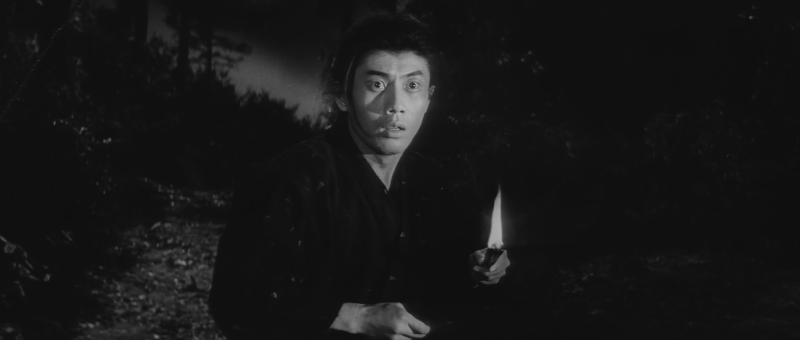

Ninja, A Band of Assassins (忍びの者, Satsuo Yamamoto, 1962)

Ninja in Japanese cinema had largely been relegated to the realms of childish fantasy prior to Satsuo Yamamoto’s Ninja, A Band of Assassins (忍びの者, Shinobi no Mono) which cast a distinctly less heroic light on the famed mercenary spies of the feudal era. Indeed, there’s something reminiscent of the cult of militarism in the repressive nature of the ninja code and the hero Goemon’s (Raizo Ichikawa) original allegiance to it despite his father’s wariness and attempt to warn him that human happiness has no place in the life of a ninja. 

As the leader of Goemon’s clan, Sandayu (Yunosuke Ito), explains the ninja are obliged to serve whichever lords require their service, but he refuses to work with Oda Nobunaga (Tomisaburo Wakayama, billed as Kenzaburo Jo) owing to his famous animosity towards them. He even goes so far as to call Nobunaga a greater threat to the ninja than demons or devils. Opening in 1573, the film takes place at a tumultuous moment as Nobunaga continues to solidify his plan to unite the whole of the land under his banner by absorbing or defeating rival clans. The pre-credits sequence finds Goemon playing dead on a battlefield surrounded by ominous crows and encountering another ninja from a rival clan, Kizaru (Ko Nishimura), who has become a more literal kind of vulture in stealing from the dead.

Stealing is against the ninja code and something of which the young and idealistic Goemon fiercely disapproves. Nevertheless, in a cruel irony he’s forced to become a burglar in an effort to raise funds for more weapons to combat Nobunaga whom he has also been ordered to assassinate in return for his life after having been caught having an affair with Sandayu’s wife, Inone (Kyoko Kishida). Goemon is inspired by the legendary figure dubbed the Japanese Robin Hood for his mission stealing money from the rich to give to the poor, but here is far from heroic. When his affair with Inone is discovered by a servant, Goemon kills him to maintain the silence. He then believes that Inone has also been killed after falling into a well and attempts to flee the scene only to be confronted by Sandayu. 

Only too late does to he begin to understand what his father tried to warn him about, that the code of the ninja is cruel and unforgiving. It cannot grant him pride or happiness despite the self-satisfied glow he feels on having been singled out by Sandayu as a protege. A ninja must be ready to sever all ties to those he loves and endure intense torture without speaking. If caught in an impossible situation he must scar his face and take his own life as one of Goemon’s acquaintances eventually does after being captured by Nobunaga. Goemon assumes he has no reason to be afraid because he is the most skilled ninja in the garrison and a single ninja can take down a fortress all on his own, but in reality he is powerless, merely a puppet manipulated by Sandayu for his own ends. After falling in love with a sex worker, Maki (Shiho Fujimura), he grows tired of his missions, gives up on burglary, and makes no move to assassinate Nobunaga but is pursued by Sandayu’s minions, the irony being that not even a ninja can escape from the confined space of ninjadom.

This world is so steeped in secrecy that nothing is as it seems and Goemon discovers the rug pulled out from under him in more ways than one before beginning to realise that Sandayu has deliberately engineered his downfall and was most likely behind his father’s murder in an attempt to get his hands on his recipe for gunpowder which is, as Nobunaga says, the future of warfare. Nevertheless, even within its commitment to realism the film contains plenty of ninja tricks from sudden appearances to superhuman leaps and expert shuriken throwing and grappling hooks.  The sense of melancholy futility implied by the presence of the crows in the opening scenes never recedes, Yamamoto frequently descending into mists as Goemon sinks into his confusion and eventual disillusionment with the tenets of ninjadom. Rival ninja clans more obsessed with their reputation and status vie for the head of Nobunga while all Goemon wants is the right to live a quiet life with Maki though that’s something that largely cannot be found amid the constant chaos of the feudal era.