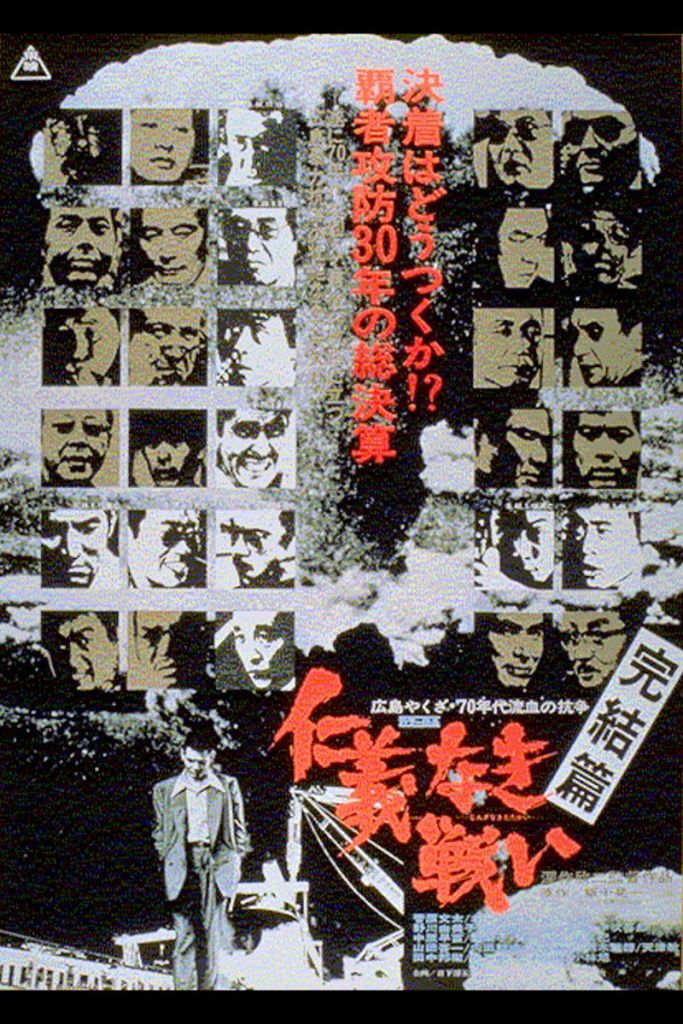
 And so, the saga finally reaches its conclusion. Final Episode (仁義なき戦い: 完結篇, Jingi Naki Tatakai: Kanketsu-hen) brings us ever closer to the contemporary era and picks up in the mid ‘60s where Hirono is still in prison and Takeda, released on a technicality, has decided to move the yakuza into the legit arena. The surviving gangs have united and rebranded themselves as a political group known as the Tensei Coalition. However, not everyone has joined the new gangsters’ union and the enterprise is fragile at best.
Hirono’s sworn brother, Ichioka, is one such antagonist and after the Coalition’s accountant is clumsily gunned down in the street, tempers start to flair. Though the Coalition is nominally headed by Takeda, an up and coming youngster, Matsumura, is winning a lot of respect for his level headed judgement and ability to form long term plans. He wants to move away from the image of the traditional yakuza with their missing fingers and bad attitudes to something a little more media friendly. However, the old guard including the veteran, Otomo (now played by Jo Shishido), aren’t willing to see the bigger picture and continue to behave in the old ways requiring swift and bloody justice for their fallen comrade. The older generation maybe on their way out, but that doesn’t mean they can’t cause a little trouble on their way. Despite the best efforts of the younger guys the cycle of violence seems set to continue, will anything ever change at all?
According to Fukasaku, almost certainly not. Though Matsumura is accounted to be a good guy by both of our “heroes” Hirono and Takeda, his yakuza revolution seems doomed to fail. This kind of coalition is completely pointless if not everybody joins and obviously not everybody is going to. Following the public outcry and subsequent police crackdown in the previous film, the yakuza feel the need to reform their image, keep the violence off the streets and appear generally less scary than the image they’ve hitherto cultivated. Now it suits them to conduct themselves in a more dignified manner, more like regular businessmen than thugs in flashy suits.
Meeting at the prison in the end of Police Tactics, Hirono and Takeda both agree that their era has passed. They still aren’t quite old men, but they aren’t young and this violent world isn’t for them anymore. Their resolutions are both that the general environment has changed making the way they’ve lived so far untenable, but also that if they attempted to live that way again they simply wouldn’t survive any longer (perhaps they are “better off” in jail). Hirono spends most of the movie off screen again, in prison, writing his memoirs. Before coming out he seems set on “retirement” but once released he decides to return to the yakuza world. It’s not until the end of the film when once again confronted by the senseless violence of gang warfare that he finally decides to retire. Matsumura may have been trying to change things, but more young guys are dying so fast there’s barely any point learning their names and what really does it get you in the end? Can you live freely, has the world really changed at all? From Hirono’s late middle age viewpoint, the answer is no.
Final Episode follows the same basic formula as the other films in the series with the narrative voice over, frenetic handheld camera work, captions and freeze frames. The violence may be a little less frequent but appears bolder in its execution. These youngsters are messier than their forebears – the gunning down of the Tensei accountant is a clumsy affair carried out by two amateurs in the middle of a crowded street. Random weapons are constructed with pretty much anything that’s lying around during a street fight. These young guys are a different kind of desperate and have no idea how to conduct themselves in a subdued way.
We’re almost up to the the contemporary era of the film. It’s getting on for 25 years since Hirono came home from the war and joined a different kind of battlefront. Japan’s development has been startlingly rapid – from post-war rubble to hosting the olympic games and a newly burgeoning prosperity. Hirono and those like him have found themselves riding the wrong wave as their fortunes continue to dwindle just as the legitimate world is coming into its own. When Hirono and Takeda were talking at the prison at the end of part four they knew something had come to an end. They had no place in this world anymore – unless you become a ruthless boss like the hated Yamamori (still harbouring dreams of domination well into his dotage), the yakuza life is a young man’s game. Once again we finish on a shot of the ruined dome and a reminder that the strong will always prey on the weak. Fukasaku’s prognosis for the future is grim but, it has to be said, accurate.
Final Episode is available on blu-ray in the UK as part of Arrow Video’s Battles Without Honour and Humanity: The Complete Collection box set.
 It’s 1963 now and the chaos in the yakuza world is only increasing. However, with the Tokyo olympics only a year away and the economic conditions considerably improved the outlaw life is much less justifiable. The public are becoming increasingly intolerant of yakuza violence and the government is keen to clean up their image before the tourists arrive and so the police finally decide to do something about the organised crime problem. This is bad news for Hirono and his guys who are already still in the middle of their own yakuza style cold war.
 If you thought the story was over when Hirono walked out on the funeral at the end of
  When it comes to the history of the yakuza movie, there are few titles as important or as influential both in Japan and the wider world than Kinji Fukasaku’s Battles Without Honour and Humanity (仁義なき戦い, Jingi Naki Tatakai). The first in what would become a series of similarly themed movies later known as The Yakuza Papers, Battles without Honour is a radical rebooting of the Japanese gangster movie. The English title is, infact, a literal translation of the Japanese which accounts for the slightly unnatural “and” rather than “or” where the “honour and humanity” are collected in a single Japanese word, “jingi”. Jingi is the ancient moral code by which old-style yakuza had abided and up to now the big studio gangster pictures had all depicted their yakuza as being honourable criminals. However, in Fukasaku’s reimagining of the gangster world this adherence to any kind of conventional morality was yet another casualty of Japan’s wartime defeat.
 Windows on Worlds