Bayside Shakedown the Final: The New Hope (踊る大捜査線: THE FINAL 新たなる希望, Katsuyuki Motohiro, 2012)

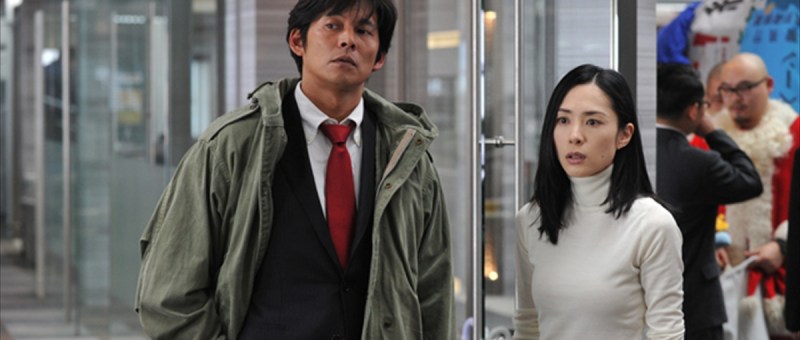
Is it really the end? Billed as the “final” instalment in the Bayside Shakedown series which began with a TV drama in 1997, Bayside Shakedown the Final: The New Hope (踊る大捜査線: THE FINAL 新たなる希望, Odoru Daisousasen the Final: Aratanaru Kibou) once again finds the gang contending with annoying red tape but also with a police force which is intrinsically corrupt and self-serving while questioning if they should remain in an occupation in which they are treated with such disdain. Continuing the familiar pattern from throughout the series, the gang find themselves coming up against a serial killer who may be a crazed vigilante only to discover that the whole thing may have been an extreme inside job designed with the intention of drawing attention to inadequacies in the justice system. 

The problem is that the body they’ve found appears to have been shot with a gun which was removed from the police evidence locker and is linked to a kidnapping case six years previously which just happens to have been handled by Mashita (Yusuke Santamaria) when he was a hostage negotiator. Mashita had ordered an end to the negotiations because of pressure from above to play by the rules with the consequence that the child later died while the prime suspect in the case was recently acquitted of the crime at trial (a staggeringly rare occurrence in Japan). When Mashita’s young son is kidnapped, all eyes are on a rogue policeman, Kuze (Shingo Katori), but it is obvious he is not acting alone. 

Toragai (Shun Oguri), the authoritarian detective from the previous film, has continued along a dark path which only intensifies when his paper on police reforms is rejected out of hand. He too thinks the police force needs structural reform but leans hard into the idea that too many people are getting away with crime rather than concentrating on removing the barriers which prevent police from doing their jobs as Muroi (Toshiro Yanagiba) and Aoshima (Yuji Oda) would probably suggest. Muroi’s lasting dream is of building a police force which trusts policemen to do the right thing and he frequently tells his subordinates that they should feel free to exercise their own judgment. 

Meanwhile, the local cops continue to suffer under the command of the elitist officers from HQ who not only look down on them but assign menial tasks, as does Mashita in finding himself short staffed while most are busy providing security for a local energy summit. While Aoshima had experienced a health crisis that turned out to be a false alarm in the previous film, so this time Sumire (Eri Fukatsu) finds herself struggling with ongoing effects from her shooting in Bayside Shakedown 2 eventually deciding that it might be better to leave the police force entirely while lamenting her unfinished business with Aoshima which remains unresolved even in this “final” instalment while he somewhat unsympathetically can only ask her not to leave rather than express his true feelings. 

Ironically enough, by the time of the final showdown neither of them are actually in possession of a police badge, Aoshima scapegoated by Toragai who still holds a grudge against him while inconvenienced by interference in his scheme to frame a local petty thief for the killings, presenting him with an invitation to resign following serious misconduct accusing him of beating up suspects and planting evidence. One again, the police chiefs sit around a large circular table issuing orders from afar but are mainly concerned how to bury the “scandal” of having a police officer steal a gun from evidence and then use it to commit a murder. In a bizarre twist of fate, it later turns out that the whole thing may be an elaborate, not to mention entirely amoral, plan to expose police shortcomings with a side dose of revenge against Mashita for contributing to the child’s death by insisting on following protocol while receiving heat from above. 

As such the apparently “final” instalment skews a little darker than the series norm while as the subtitle implies offering a new ray of hope in the reversal of Muroi’s fortunes allowing him to embark on the police reforms which have been his and Aoshima’s goal throughout the series. Meanwhile, the film pays tribute to its previous instalments with frequent words of wisdom from the late Waku read from his notebook by his nephew and the ironic return of the previous chiefs reinstated as volunteer mentors as part of a reinforcement programme while familiar faces such as the Captain Kirk cosplayer also make their customary appearances. What’s clear is that there will never really be a “final” outing for Aoshima who reaffirms himself as the last line of defence protecting the local population as he once again runs toward sunset and the next case waiting just behind. 


Trailer (no subtitles)
Bayside Shakedown (踊る大捜査線 THE MOVIE, Katsuyuki Motohiro, 1998)

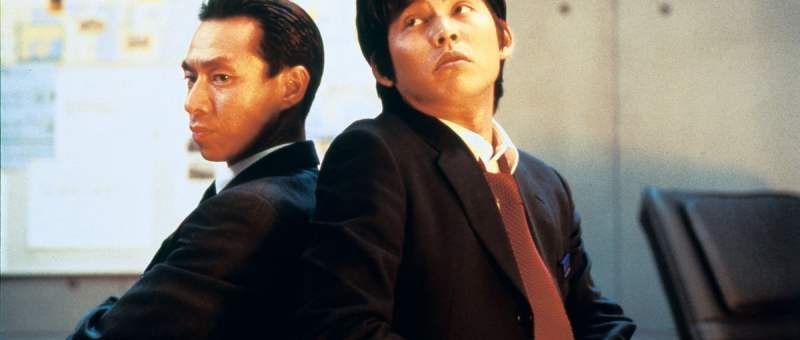
Those who believe that Japanese cinema has continued to decline throughout the 21st century often cite the release of Bayside Shakedown (踊る大捜査線, Odoru Daisosasen) as a turning point arguing that its vast and unexpected success ushered in an era of populist filmmaking dominated by existing franchises such as television drama, manga, and light novels. Leaving aside the question of whether the industry can really be said to be in a creative decline, the criticism is in itself a little unfair in that the film is exactly what it’s intended to be, perfectly enjoyable mainstream entertainment, while like the television series quietly subversive in its criticisms of police bureaucracy using humour to make subtle digs at the service in a way more “serious” films may not be able to. 

Director Katsuyuki Motohiro signals his intentions in the opening scene in which grizzled, trenchcoat-wearing detective Aoshima (Yuji Oda) stakes out a pleasant suburban house later joined by two colleagues who appear equally serious, yet as it turns out they aren’t on the look out for criminals but simply waiting for their boss, Police Commissioner Yoshida (Shigeru Koyama), to emerge so they can drive him to a police golfing tournament. Ironically enough, the scene is soon repeated, only for Yoshida to be tasered and kidnapped for ransom. Meanwhile, another difficult case arises when a body is found floating in a local river and is discovered to have been murdered, a soft toy found sewn into his stomach. 

The bizarre murder is a problem for the detectives at Wangan Police Station because whenever there’s a difficult case they have to call in the guys from HQ and are then financially responsible for them which is why the guys in accounts would really rather they write down suicide and leave it at that. Budgetary constraints are a persistent theme, the other random case hovering in the background being a phantom thief who keeps stealing the detectives’ receipts so they can’t claim their expenses. In any case, the kidnapping means HQ are involved anyway, quickly taking over an upper floor of the station and locking the local cops out of their investigation or else relegating them to demeaning leg work such as traffic stops and info gathering. 

The conflict between HQ and the local branch is further brought out by the awkward friendship between careerist policeman Muroi (Toshiro Yanagiba) and the earnest Aoshima who have each made a promise to each other that Muroi will climb the ladder while Aoshima takes care of business in the streets to ensure the police force continues to function correctly. Muroi is however in a difficult position, another officer informing him that he’s being put in charge because he’d be an easy fall guy as he went to a regional college while the others are all Todai alumni and minded to look out for each other. He finds himself compromised, unable to keep his promise to Aoshima because of the pressure from above while feeling guilty about the way the local cops are being treated by the bigwigs from the city. Meanwhile the police chiefs sit around a large circular table not unlike the war room in Stanley Kubrick’s Dr Strangelove issuing orders via video link while spending most of their time trying to make sure the local force is sidelined and squabbling over who actually gets to make an arrest. 

Pressured over their expenses, expected to work long hours, and generally made to feel unappreciated the detectives start to wonder what it’s all for, energetic female detective Sumire (Eri Fukatsu) in particular keeping a resignation letter in her desk uncertain whether or not to hand it in. Nevertheless through their quest to save the commissioner along with all the other cases including a potential serial killer operating through a murder fantasy website and a thief who seems to enjoy sneaking into people’s workplaces and stealing small personal items including those of the police officers, they each come to re-appreciate the importance of compassionate local policing along with their responsibility to each other as friends and colleagues even making sure they hold their fellow officers to account especially those involved with the budget. Lighthearted in tone yet boasting a fair few impressive action sequences Bayside Shakedown has in the past been unfairly maligned but is undeniably entertaining with a series of solid mysteries at its centre along with a few jibes at the overly bureaucratised nature of modern policing. 


Trailer (no subtitles)

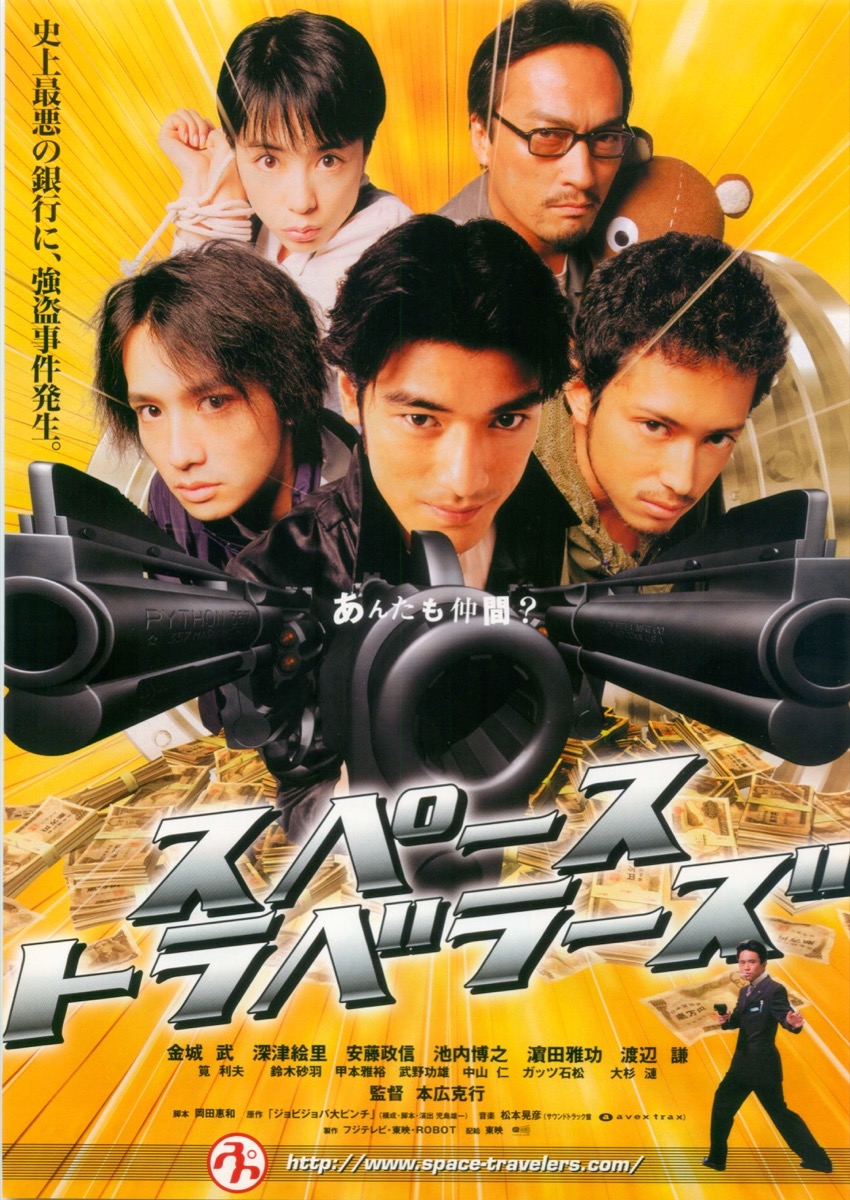
Space Travelers (スペーストラベラーズ, Katsuyuki Motohiro, 2000)

“What are you doing now?” asks a very zeitgeisty set of onscreen titles at the beginning of Katsuyuki Motohiro’s millennial heist comedy, Space Travelers (スペーストラベラーズ). Both hopeful and not, Motoyuki’s cosmic farce takes the sense of anxiety and despair which colour other similarly themed turn of the century movies and turns them into a source of possibility while simultaneously implying that for some paradise may always be out of reach or else relegated to a state of mind. After all, “reality is different from animation”.

The idea of a far off paradise is what drives a trio of orphans (Takeshi Kaneshiro, Masanobu Ando, and Hiroyuki Ikeuchi) to consider armed robbery, planning the slick kind of heist they’ve seen in the movies in which they run into off into the sunset with a bag full of cash after holding a bank to ransom. Of course, it doesn’t quite go to plan leaving the three essentially good-hearted guys with a problem because they weren’t really prepared to harm anyone (two of their three weapons are duds) and they don’t have a plan B. What happens then is somewhat unexpected as a degree of camaraderie begins to arise between the would-be-thieves and the small number of customers and employees trapped in the foyer who then become something of an artificial team trying to overcome the rapidly escalating situation as the police surround the building in the incorrect assumption that the robbery is connected to terrorist action. 

What soon becomes apparent is that for the trio the heist is part wish fulfilment fantasy and a last ditch attempt to catapult themselves out of a sense of impossible despair. As they are all orphans, they feel a deeper sense of disconnection from a society which has in itself abandoned them, partly as it turns out hoping to find their long-lost parents in a tropical island paradise known to them only from a faded postcard. For the customers and employees, the robbery is the most exciting thing to happen to them in their entire lives and the proximity to mortal danger soon forces them to wrestle with their personal dissatisfaction. Before the heist took place, bank clerk Midori (Eri Fukatsu) had been planning to attend a party to celebrate her engagement to another employee branded a sleazy creep by most of the other female members of staff with whom he had apparently tried it on on previous occasions. She had agreed to marry him despite her reservations because he had sworn to lay down his life for her if she were ever in danger only to spot him trying to escape on his own via the air conditioning ducts. Being caught up in this bizarre situation forces her to accept she had been leading a “conveyor belt life” out of fear, always picking the safe option rather than take a risk chasing personal happiness even picking a husband solely because he promised her protection. 

In the Japan of the 2000s, chasing personal happiness might have seemed like a fools errand trapped in a stagnant economy with no prospect of improvement and only increased risk if you fall from one particular rung on the ladder. Yet the conclusion Midori seems to come to is that the only way of rebelling against this sense of nihilistic frustration is to take the risk and look for the paradise that is waiting for her rather than settle for a disappointing status quo. She learns this partly through her connection with one of the bank robbers who casts each of the hostages as members of his favourite, now cancelled, anime “Space Travelers” created according to an onscreen interview to offer a sense of something tangible to an increasingly disconnected youth that would allow them to experience a full range of emotions (the animated sequences created for the film were later spun off into an OVA of their own). Through their accidental role playing, the hostages each discover the sides of themselves they’d been missing to claim their true identities, Midori learning that she can protect herself, nerdy clerk Shimizu (Masahiro Komoto) overcoming his crippling shyness, a middle-aged electrician flummoxed by modern technology proving that his skills aren’t obsolete, and a feuding couple on the brink of divorce reflecting that they actually do work well as a team. 

Even so, not everyone comes out of the situation with new hope for the future with the implication being that some gambles are simply too big or that for some paradise will always lie just out of reach even if Midori remains committed to seeking it out on her own whether she eventually finds it or not. Meanwhile, Motohiro takes potshots at the media reality of the day as a cynical boyband publicity stunt to announce their breakup tour to rake in more cash before announcing a comeback is derailed by the press tripping over themselves to get to the unfolding bank hostage crisis with the police also doing their bit to hog the media spotlight while mistakenly believing a suspicious-looking man who actually is a fugitive terrorist is responsible for the heist. With the world as messed up as it clearly is, the film seems to say, chasing paradise is the least risky thing of all. 


Trailers (no subtitles)

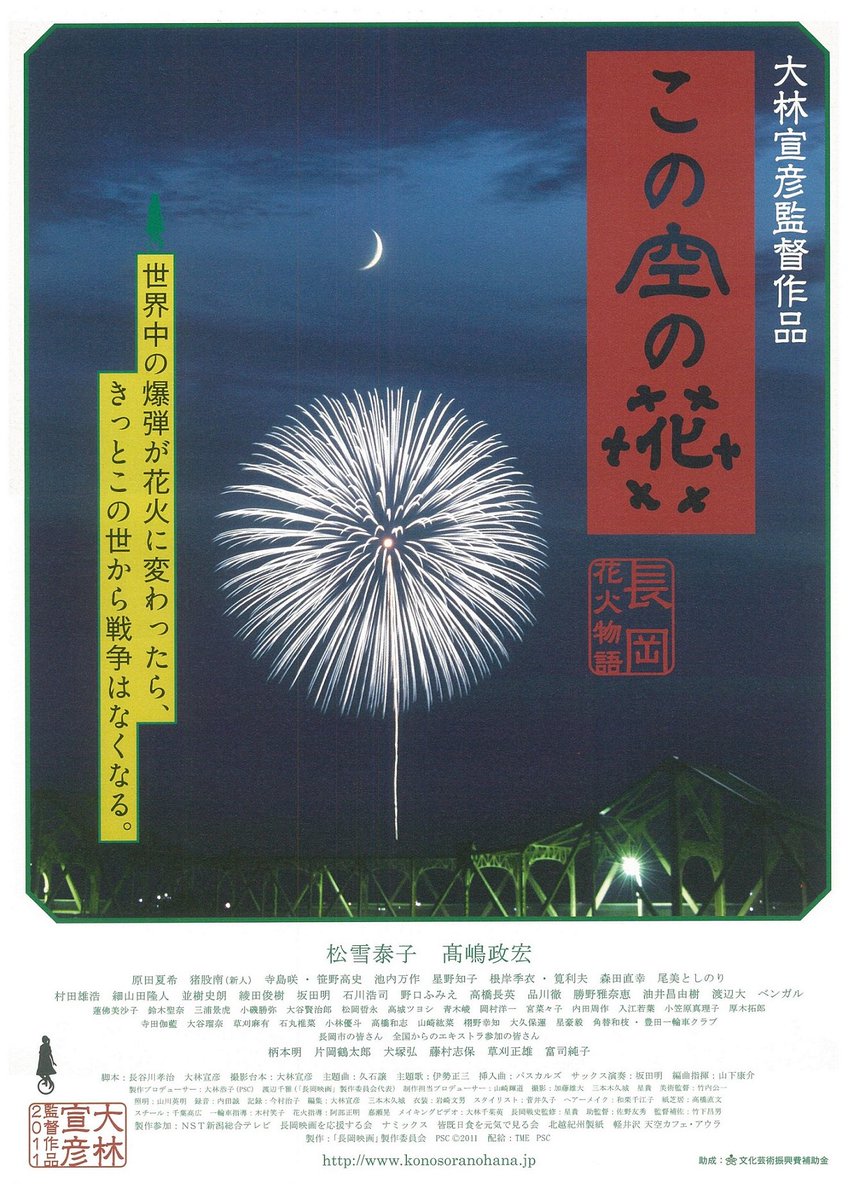
Casting Blossoms to the Sky (この空の花 長岡花火物語, Nobuhiko Obayashi, 2012)

“There’s still time until a war” runs the title of a play for voices at the centre of Nobuhiko Obayashi’s oscillating docudrama, Casting Blossoms to the Sky (この空の花 長岡花火物語, Kono Sora no Hana: Nagaoka Hanabi Monogatari). Asking why when presented with the opportunity to create something beautiful that gives joy and hope to all who witness it mankind chooses death and destruction, Obayashi considers responses to disasters manmade and natural and finds largely kindness and resilience among those determined to avoid the mistakes of the past while building a better tomorrow. 

Set in the immediate wake of the 2011 earthquake and tsunami and inspired by verbatim interviews with local people, Obayashi’s elliptical drama sends an emotionally arrested newspaper reporter to Nagoka having received a letter from an old lover that calls her back into the past. Reiko (Yasuko Matsuyuki) broke up with Katayama (Masahiro Takashima) 18 years previously uttering only the cryptic phrase “we have nothing to do with war”, but travelling through her “wonderland” begins to realise that she and everyone else is in that sense wrong. No one is really entirely unconnected or untouched by the destructive effects of conflict and pretending that it’s nothing to do with you will not in the end protect against it. 

“To the children of the future, from the adults who lived the past” runs the opening title card, making plain a fervent hope to connect the often unknowing younger generations who assume war is nothing to do with them with the traumatic past through the voices of those who directly experienced it. The play to which Reiko is invited is in itself a play for voices, an avant-garde theatre piece inspired by the verbatim speeches of residents of Nagaoka recounting their often harrowing experiences of the war apparently penned by a strange high school girl (Minami Inomata) who rides everywhere on a unicycle. The performance is set to take place in conjunction with the local summer festivals which include a series of fireworks displays commemorating lives lost in the bombing raids and symbolising a spirit of recovery following a destructive local earthquake some years earlier. 

Obayashi draws direct comparison between the natural disasters of earthquake and tsunami, and the manmade disaster of war but discovers that ordinary people often react to them in the same way with a furusato spirit of mutual solidarity and kindness. One of Katayama’s students is a displaced young man from Fukushima who remarks on the kindness he experienced having been taken in by the town of Nagaoka, a kindness he hopes to repay someday when he is finally allowed to return to his own hometown just as the people of Nagaoka have done following kindness shown to them after the earthquake. The discrimination he faces as someone from a town affected by radiation calls back to that experienced by Reiko’s parents who were survivors of the atomic bomb that fell on Nagasaki, a location chosen by pure chance on a whim when poor weather made the primary target unavailable. Among all the horror of the wartime stories Reiko uncovers, there is also selfless heroism such as that of the young man bravely throwing water over those trapped in a burning air raid shelter. 

“If only people made pretty fireworks instead of bombs, there wouldn’t have been any wars” a poet laments drawing a direct line between these two very different uses of the same material, a connection further rammed home by twin visits to a fireworks factory and atomic bomb museum. The “phoenix fireworks” become a fervent prayer, blossoms cast to the sky, in hope of a better, kinder future without the folly of war. “There are adults who think war is necessary” Katayama explains, “but not the children, of course. That’s why it’s up to the children to make peace”. Some may complain that in the rapid economic development of the post-war society something has been lost, but in times of need people are still there for each other forging the furusato spirit in contemporary Japan. Opening with a series of silent-style title cards, Obayashi’s overtly theatrical aesthetics may be comparatively retrained even while incorporating frequent use of animation and surrealist backdrops, but lend an ever poignant quality to this humanist plea for a more compassionate world in which the only explosions in the sky are made of flowers and hope not hate or destruction. 


Casting Blossoms to the Sky streams in the US July 9 – Aug. 6 as part of Japan Society New York’s Tragedies of Youth: Nobuhiko Obayashi’s War Trilogy season in collaboration with KimStim.

Original trailer (English subtitles)