Wolves of the Night (夜の狼, Yoichi Ushihara, 1958)

A cold-hearted yakuza starts to get second thoughts when confronted with the misery his actions create in Yoichi Ushihara’s slice of Nikkatsu Noir, Wolves of the Night (夜の狼, Yoru no Okami). Though the hero is ostensibly Tsukida (Ryoji Hayama), the conflicted gangster unable to reconcile himself with the fact that he has fallen in love with a women he himself destroyed, it’s equally about the women who get caught in the crossfire of a burgeoning gang war and are each victims of male greed and indifference.

In any case, gang boss Tachibana (Somesho Matsumoto) brings a lot of this on himself. The secondary narrative revolves around a woman, Takako (Mari Shiraki), who borrowed money from the Manji gang to build her bar, but now that it’s complete Tachibana swindles her by calling in the debt and foreclosing on the property, passing ownership to Tsukida with instructions to kick Takako out. She, however, doesn’t take well to this and is resentful of Tachibana for screwing her over so she vows revenge. Her original attempt to get it by seducing Tsukida doesn’t work out, so she recruits a yakuza from a rival gang to extort them claiming that they have mole and he’ll only reveal their identity when they hand over the cash. This plan has some pretty tragic consequences and not least for Tachibana himself, but none of this would have happened if he hadn’t behaved so badly in cheating Takako out of the bar she worked so hard to build. He’d also told Tsukida that the bar owner was a beauty and it was understandable if wanted to try seducing her. 

But by this point Tsukida has developed a fondness for Katsumi (Izumi Ashikawa), a young woman he first meets when she’s caught by some of his guys offering herself for sex work in their territory. The other ladies describe Katsumi as “odd” and “an outsider”. It’s clear from her behaviour and the way she’s dressed, not to mention a lack of awareness of the rules of the gang, that she’s never done this before and is terrified. Tsukida calls his men off and tells her to go home, but later realises that it’s his own fault she was put in this situation because he was responsible for collecting the debt her parents owed to Tachibana taken out because her father is bedridden. Tsukida seems shaken by the old lady’s intense resentment, but still takes their money if attempting to convince Tachibana not to pursue them any further because they have nothing left to give, correctly assuming that Katsumi resorted to sex work to get the money. 

It maybe the sense of guilt that proved the last straw as the old couple then take their own lives but rather than freeing her lead Katsumi on a lonely path of self-destruction driven only by her hated for Tachibana and Tsukida. The fact that she later becomes ill further emphasises her positioning as a symbol of a despoiled nation poisoned by the ruthless inhumanity of the post-war society, along with literal a embodiment of Tsukida’s guilty conscience. Tsukida rejects Takako as a person more like himself, an example of corrupted femininity using her body to manipulate men in a world in which a woman has little other power, and instead is drawn to Katsumi who was once innocent, demure, and cheerful but who he himself has destroyed through his own greed and heartlessness.

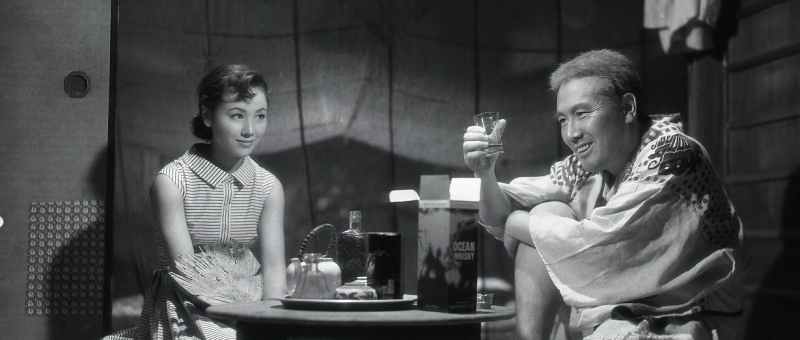
Spending some time in hospital following a failed suicide attempt seems to heal her in body body and soul, though the total about face in Katsumi’s feelings for Tsukida seems somewhat bewildering even if he did visit her every day and presumably win her over despite her resentment towards him for contributing to her parents’ deaths. Nevertheless, it’s his feelings for Katsumi that see Tsukida longing to quit the yakuza and retreat to the country to live a small, honest life with her free of the city’s corruption. But as so often in the movies, it’s not that simple and this time it’s a tragic consequence born of male failure and insecurity that eventually costs him his shot at a normal life even as his frenemy, a local policeman he often sees in the same bar and gives him unsolicited advice about how he should quit the yakuza, remains surprisingly supportive suggesting that his redemption may merely be on hold rather than cancelled. In any case, though shooting almost entirely on stage sets, Ushihara makes good use of stock footage of contemporary Ginza as a place of bright lights and equally dark shadows where gangsters lurk on every corner and mercy is in desperately short supply.
Our Town (わが町, Yuzo Kawashima, 1956)

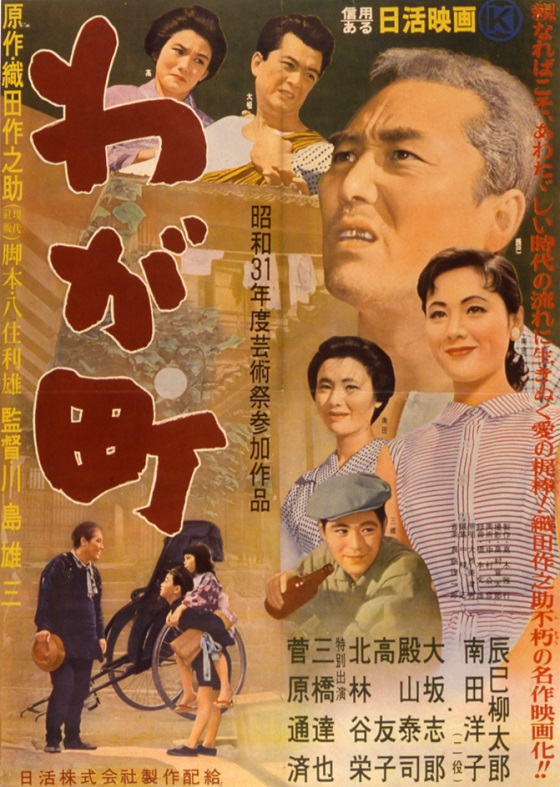
“They tricked me and you and everyone! It’s so stupid” a stammering man tries to explain to his deluded friend, but some people just don’t want to hear the truth. Spanning 30 years of tumultuous 20th century history, Yuzo Kawashima’s Our Town (わが町, Waga Machi) charts a course of authoritarian fallacy as its puffed up hero refuses to give up on the imperialism of his youth and condemns all around him to lives of misery out of misguided faith in an outdated code of patriarchal and national pride. Too late he will perhaps begin to realise that his unforgiving rigidity has done nothing more than alienate the people that he loves, but his story is both a lament for past folly and a warning for the freer post-war future. 

Back in the 1900s, the tail end of the Meiji era, Taa (Ryutaro Tatsumi) was one of 1200 Japanese construction workers who travelled to the Philippines to help build a road intended to boost the economy of the recently independent nation. Now, around this time, Japan was also embarking on the the first of its 20th century wars fought against the Russians. While Taa was breaking his back on the Benguet road, other young men were busy painting themselves in glory as imperial soldiers contributing to the expansion of the burgeoning Japanese Empire. In his own way, and quite literally, Taa was also building the Japanese Empire and intensely resents that no one recognises his contribution as the self-styled “Taa of Benguet” who apparently kept his fellow Japanese going even when it became clear that they were just exploited workers, hung out to dry once the job was done and left to die of poverty or tropical disease. 

Taa’s life philosophy is that humans are born to work and that suffering in youth builds character. He wanted to show the world what Japanese people are made of and feels he made Japan proud building the Benguet roadway, but there are no flag waving parades for his return as there were for Hanai who went away to war, nor is there any real work. Embarrassed about his illiteracy, he didn’t even write any letters home which is one reason why he didn’t know that a casual girlfriend, Tsuru (Yoko Minamida), whom he’d perhaps long forgotten, had given birth to his child, Hatsue, who is now four. Despite his initial surprise, Taa submits himself to the role of husband and father, earning money as a rickshaw driver, but never forgets that he is “Taa of Benguet” or that the meaning of life is suffering through hard work. 

Old fashioned and patriarchal even for the times in which he lives, Taa’s attitudes continue to destroy the lives of those around him. He wasn’t there to support Tsuru and so she worked herself to death in his absence. Hatsue (Tomoko Ko) grows into a beautiful young woman and falls in love with Shintaro (Shiro Osaka) the son of a bucket maker who, though athletic, is not perhaps built for hard work in the same way as Taa had been. He tries to force his philosophies on the younger generation, pressuring Shintaro to go to the Philippines to make a man of himself, not quite understanding that much has changed in the previous 15 years, nor that Shintaro may not be able to endure the kind of hardship he regards as indicative of a productive life. 

Taa learns nothing from his mistakes, eventually pressuring his granddaughter Kimie (Yoko Minamida) in the same way he’d done his daughter, objecting to her desire to marry a man of her own choosing even though he embodies many of his oft spoken ideals including dedication to hard work. Jiro (Tatsuya Mihashi) is the son of his old rival Hanai and was himself in the war. Like Taa and the men of his generation, he too was “tricked” into working overseas for a mistaken ideal of Japanese imperialism but he’s also a man of the post-war generation and has no more illusions about things like glory or suffering.

Kimie too, as she later tells Taa, is a post-war woman. She feels no obligation towards her grandfather simply because he raised her, nor will she allow her life to be ruined in the same way her mother’s and grandmother’s were by Taa’s patriarchal authoritarianism. “You’ve got to start listening to the younger generation” Jiro tries to explain, but Taa is not someone used to listening. “Every single thing you’ve ever done has been pointless” Kimie tells him, “trapped in your own happy bubble, getting in the way of everyone else”. All Taa’s philosophy has ever caused is pain and suffering, trying to make the lives of all the men who died building a road in a foreign land mean something while ironically propping up the same ideology that robs men like him of their freedom and possibility. You could say something broke in 1905, but it also broke 40 years later, people are wiser now and they know there’s no glory in suffering. Taa sees the error of his ways, but also that there’s no place for him in the kinder post-war era where there’s no sin in working hard, but no life without freedom. 


Titles and opening (no subtitles)