Crime Hunter: Bullets of Rage (クライムハンター 怒りの銃弾, Toshimichi Ohkawa, 1989)

Home video may still have been in a nascent and chaotic stage of development when Toei video executive Tatsu Yoshida began conducting customer research in video rental stores, but what he discovered shocked him. Customers were maxing out their five video allowance and watching them all the same evening. How did they have time for that, he wondered. The answer was that they were watching them all on fast forward to cut out the boring bits, like the story and exposition. It was this that gave him the idea to create “movies that will not be fast forwarded,” chiefly because they had already been excised of anything “inessential”.

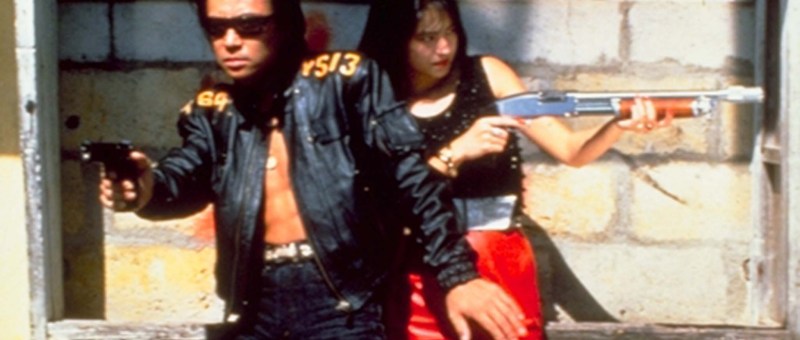
Only an hour in length, 1989’s Crime Hunter: Bullets of Rage (クライムハンター 怒りの銃弾, Crime Hunter: Ikari no Judan) was the first in Toei’s new V-Cinema range and was indeed made to conform to these aims. Consequently, it focuses mainly on action with minimal narrative and relies on genre archetypes to help the plot move along. In that, it owes something to Nikkatsu’s borderless action films in taking place in Little Tokyo (largely filmed in Okinawa) though otherwise in a world that’s recognisably Japanese despite the English-language police radio and Japanese-American names like that of fugitive criminal Bruce Sawamura (Seiji Matano) and Joe “Joker” Kawamura (Masanori Sera), the cop who’s trying to track him down but only as a means to an end in his quest to avenge the death of his partner, Ahiru (Riki Takeuchi). We can tell that Ahiru’s not going to last long in this film because we’re told quite quickly that he’s been invited to the chief’s daughter’s birthday party and is seen as a potential suitor, while after apprehending Bruce he complains that his mother bought him the shirt that’s now been stained. 

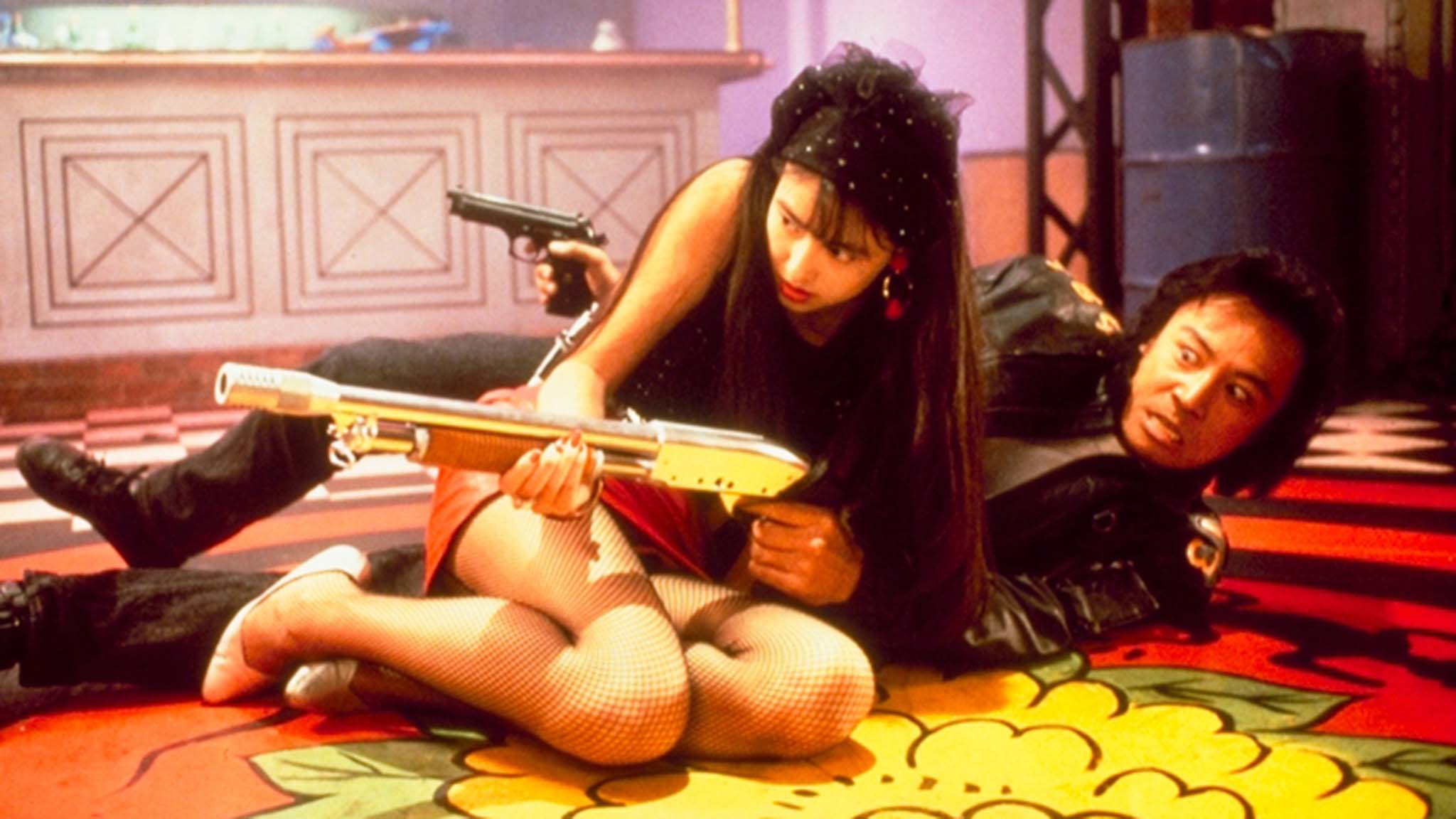
Joker’s attachment to Ahiru goes a little beyond that of a mere partner as he hands back his badge to pursue revenge while picking up the empty packet of pop-corn Ahiru had been eating and placing it over his heart. The film seems to owe a lot to contemporary Hong Kong action films and Heroic Bloodshed such as A Better Tomorrow, and it’s apparent that this almost homoerotic relationship between the men has taken the place of heteronormative romance. The female star, Lily (Minako Tanaka), is (nominally at least) at nun which makes her romantically unavailable to Joker or indeed to Bruce while in some senses she represents opposition because her cause is at odds with Joker’s. While they temporarily align in wanting to find Bruce, Joker wants information that will lead him to the identity of his partner’s killer, while for Lily he’s the endgame because she wants to get back the money he stole from the donation box at her church. 

This whole narrative strand doesn’t make a lot of sense in that Lily says she accidentally told Bruce about the donations after having too much to drink at a party with her non-nun girlfriends, which is strange behaviour for a bride of Christ. Now she feels like retrieving the money is her responsibility, though Joker isn’t really interested in that. What he discovers is further kinship with the fugitive Bruce on realising that they’ve both become victims of a corrupt police force. The opening police radio broadcast implies that Little Tokyo has become an oppressive police state in which the threat of drugs and gangs is being used to control people while cops like Joker have been given blanket permission to aim at the head of suspected criminals as they do while arresting Bruce. Joker had thought that the guys who attacked them were Bruce’s men breaking him out or otherwise trying to steal the money off him, only to later realise they were actually corrupt police. 

But really not much of that matters in comparison to the increasing outlandishness as Lily transitions from wimple-wearing bad ass sister to a nightclub dancer femme fatale in fishnets infiltrating the Cathay Tiger gang with expertly crafted dance routines. Former mercenary Bruce similarly boasts and improbably impressive arsenal of grenade launchers and machine guns before arriving at the depressing environment of a disused industrial complex for the nihilistic showdown in which Joker realises there is no way to right this world of corruption and that he and Bruce weren’t so different in each being controlled and defined by an oppressive society in which there are no happy endings even for heroes.


Devotion to Railway (大いなる驀進, Hideo Sekigawa, 1960)

In the early 1960s, Japan’s rail network might have felt a little uneasy with the Shinkansen already on the horizon. Hideo Sekigawa’s Devotion to Railway (大いなる驀進, Oinaru Bakushin) is in part a celebration of this essential service, the conductor and steward ever fond of reminding us that most passengers probably don’t realise that the Sakura sleeper service on which they are travelling from Tokyo all the way to Nagasaki is operated by only seven or eight people (though they don’t seem to be counting the staff from the dining car which hints at a minor source of division among the crew). While the Japanese title which means something more like “the great dash” might hint at a little more excitement, the film is less thriller than gentle ensemble drama in which the passengers and crew must come together to solve the improbable number of crises arising on this otherwise ordinary journey. 

Even so considering the film is directed by the left-leaning Sekigawa best known for his anti-war films such as Hiroshima and Listen to the Voices of the Sea, not to mention scripted by Kaneto Shindo, it is a little ironic that the central thrust of the drama revolves around junior steward Yajima’s (Katsuo Nakamura) rediscovery of his own devotion to the railway after at the beginning of the film declaring this will be his final journey. Mimicking the dilemma at the centre of Yoshitaro Nomura’s Stakeout, Yajima’s problem is that he has been engaged for two years and is sick of waiting to get married but his girlfriend Kimie (Yoshiko Sakuma) is the main breadwinner in her family and though his salary could support them as a couple it won’t stretch much further. Kimie, however, is dead against him taking the counter-productive decision to quit the railways even with the suggestion of going into business with a friend who owns a cafe, partly because it’s better to stick with a steady job than take a chance on something less certain, and partly because she knows he likes his work and all his experience will be wasted if he suddenly opts to switch careers. 

Despite its positive warmhearted message of people pulling together to overcome crisis, the film does skew a little conservative in essentially turning Kimie into a minor villain as if she were in a sense responsible for making Yajima doubt his devotion to the railway. After jumping aboard to make sure he doesn’t suddenly quit before the end of the line, she eventually has a heart to heart with the sympathetic conductor Matsuzaki (Rentaro Mikuni) that forces to her to admit that perhaps she’s just nervous about the nature of married life and has been making trouble where there needn’t be any, now certain that it’s better to just get married as soon as possible and let the rest figure itself out. 

Meanwhile, there’s additional tension seeing as a waitress from the diner car has an obvious crush on Yajima and is quite resentful on being presented with his fiancée, but even this is eventually solved with the two women becoming accidental friends during the climatic crisis, a landslide caused by a typhoon, that grants each of the passengers an epiphany about what it is they really want out of life. While waiting for the maintenance crew from the next station to arrive, Yajima, still in a bad mood, stands around doing not much of anything until coaxed into action by Kimie and Matsuzaki, Kimie too eventually jumping off the train to solve this literal roadblock in their relationship followed by the dining car girls and a young woman only on the train to transport blood to a hospital needed urgently by 2pm the next day. This sense of collective endeavour opening the way gives everyone on board a new sense of positivity, allowing Kimie and Yajima to repair their relationship and a man who tried to take his own life in the night to gain a new sense of hope for future. 

Several times Yajima is reminded that he has the lives of the passengers in his hands which is undoubtedly true given that there is always the chance of disaster yet also perhaps going a little far seeing as most of his job is checking tickets and providing travel information. Nevertheless, there is a lot going on on this train from eloping couples to yakuza assassins, not to mention the twin sights of a newly wed couple and a pompous politician momentarily disembarking at each stop to be feted either by workers at their factory or the local members of their political party. The snooty politician even gets a minor comeuppance from a famous pickpocket who steals his watch as a joke and then gives it back only to dismissively ignore his thank you message while eating a giant apple. 

Surprisingly handsome for a Toei programmer, Sekigawa’s deft direction lends a claustrophobic sense of dread to the interior of the train stalked by a vengeful assassin, while simultaneously making it an essentially safe space guarded by the ever solicitous crew keen to help an anxious young woman with a long journey ahead of her arrive on time to get home to her chronically ill mother. An effective piece of advertising for the Sakura sleeper service (which ran until 2005 albeit in slightly different forms), Devotion to Railway may surprise in its insistence that the hero rededicate himself to his employer but is nevertheless a charming ensemble drama which finds a new sense of positivity in the solidarity between friends and strangers coming together to overcome crisis through common endeavour. 


Original trailer (no subtitles)