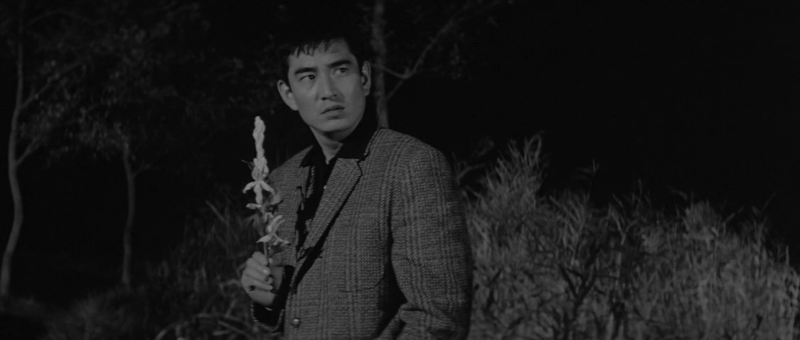
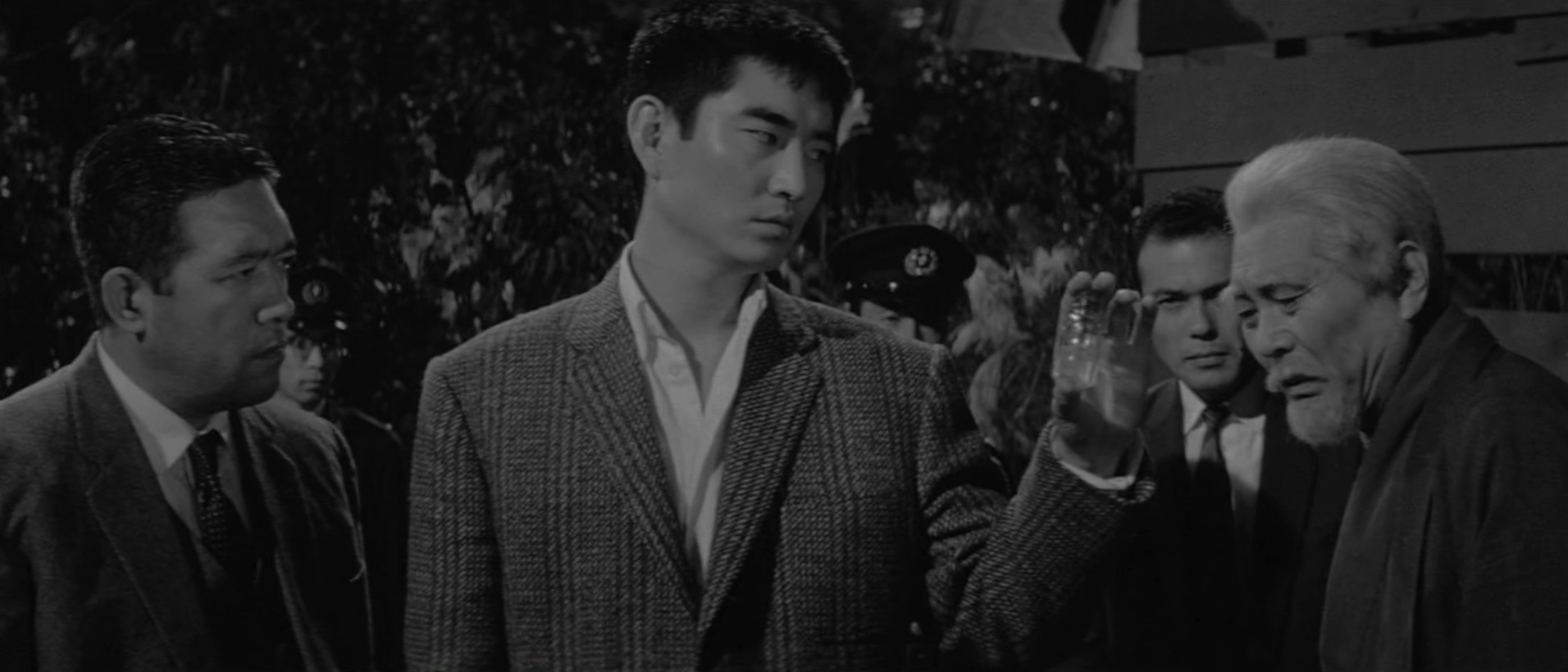
Devil’s Nursery Rhyme (悪魔の手毬唄, Kunio Watanabe, 1961)

Ken Takakura might seem like a slightly odd fit for Seishi Yokomizo’s iconic detective Kosuke Kindaichi who is known for his dishevelled appearance and general eccentricity. This 1961 adaptation of The Little Sparrow Murders, Devil’s Nursery Rhyme (悪魔の手毬唄, Akuma no Temari Uta), however, follows the path laid down by the Chiezo Kataoka-led series of Kindaichi movies in making Kindaichi a more conventional private detective who is also a consultant to the police force. As such, Takakura plays him as a dapper young man, first seen wearing a cravat and sunglasses while driving a distinctive sports car. In terms of his detecting style, however, he’s much Sherlock Holmes, relying on his observational skills to spot small details that help him to solve the mystery.

As for the mystery itself, it bears very little relation to Yokomizo’s novel. Director Watanabe was apparently unhappy with the script he was handed and had it entirely rewritten by Shinji Kessoku. Kessoku later recalled that he was only handed the original script to rewrite and wrote his version without ever reading the book, coming up with what is basically an entirely new, much simpler story that only keeps the feudalistic tensions of Yokomizo’s original in revolving around a family whose prosperity was effectively stolen through underhanded means.

Oldest daughter of the Nire family Sumako (Machiko Yashiro) has become a popular singer and is returning to her hometown for the first time in a while after receiving a threatening letter. Unfortunately, she is murdered on the way while her new single featuring her singing a local folksong plays on the radio. It soon transpires that her father, Gozo (Yasushi Nagata), has also been receiving threatening letters and is urged to go to the police by his son, Genichiro (Fumitake Omura), though Gozo insists the two things are not related. Meanwhile, he is perturbed by the return of local man Tatsuzo (Zeko Nakamura) after 18 years, fearing he means to poke into the death of his former boss Aoike whose land Gozo ended up acquiring less than ethically.

Kindaichi is in town after being contacted by Sumako and soon sets about investigating with the help of Kazuo (Tou Ono), the university boyfriend of Sumako’s younger sister Satoko (Kiwako Taichi). Kessoku and Watanabe don’t stick too closely to the classic Yokomizo formula and only include a little of the supernatural strangeness his work is known for such as the appearance of a weird old woman who seems to be a local shamaness, warning of the cursed plants near the lake and mentioning her frequent communications from the gods foretelling danger and disaster for everyone. Similarly, Gozo is apparently tormented by the Temari Uta song Sumako has just released, though unlike the novel it doesn’t have very much to do with the murders which don’t follow any particular pattern.

Though set in the present day rather than the slightly earlier setting of the novel, the “curse” does in fact relate to village dynamics and the unfair rise of the Nires who destroyed the Aoike family to become the village leaders. Not everyone who lives in a big house is a good person, Tatsuzo point out as if in one sense kicking back against the idea of feudal privilege but at the same time remaining loyal to the Aoikes and only resenting Gozo because he manipulated the system to claim a privilege he wasn’t really entitled to. The Nires have a bad reputation locally and this is likely why. People don’t like it that they usurped their position and expect the upper classes to be a little more morally upright, rather than objecting to their existence in the first place or rejecting the kind of power they still wield over them locally even in the democratic era.

Nevertheless, Satoko eventually decides to make amends by dissolving the family estate and giving the money to social causes while returning to university with Kazuo to lead a more modern life. Kindaichi, by contrast, already seems to have more cases lined up and will return to Tokyo with his secretary. He’s played a more obvious role, in some ways, than is usual in the series in which he sometimes just appears as a background character who reveals the solution to the mystery at the conclusion. Perhaps for these reasons, the film did not really fit the Kindaichi series and was not particularly successful, which might explain why Takakura never played him again, though it does perhaps say something of how Toei envisioned of the character in the early 1960s.


Devotion to Railway (大いなる驀進, Hideo Sekigawa, 1960)

In the early 1960s, Japan’s rail network might have felt a little uneasy with the Shinkansen already on the horizon. Hideo Sekigawa’s Devotion to Railway (大いなる驀進, Oinaru Bakushin) is in part a celebration of this essential service, the conductor and steward ever fond of reminding us that most passengers probably don’t realise that the Sakura sleeper service on which they are travelling from Tokyo all the way to Nagasaki is operated by only seven or eight people (though they don’t seem to be counting the staff from the dining car which hints at a minor source of division among the crew). While the Japanese title which means something more like “the great dash” might hint at a little more excitement, the film is less thriller than gentle ensemble drama in which the passengers and crew must come together to solve the improbable number of crises arising on this otherwise ordinary journey. 

Even so considering the film is directed by the left-leaning Sekigawa best known for his anti-war films such as Hiroshima and Listen to the Voices of the Sea, not to mention scripted by Kaneto Shindo, it is a little ironic that the central thrust of the drama revolves around junior steward Yajima’s (Katsuo Nakamura) rediscovery of his own devotion to the railway after at the beginning of the film declaring this will be his final journey. Mimicking the dilemma at the centre of Yoshitaro Nomura’s Stakeout, Yajima’s problem is that he has been engaged for two years and is sick of waiting to get married but his girlfriend Kimie (Yoshiko Sakuma) is the main breadwinner in her family and though his salary could support them as a couple it won’t stretch much further. Kimie, however, is dead against him taking the counter-productive decision to quit the railways even with the suggestion of going into business with a friend who owns a cafe, partly because it’s better to stick with a steady job than take a chance on something less certain, and partly because she knows he likes his work and all his experience will be wasted if he suddenly opts to switch careers. 

Despite its positive warmhearted message of people pulling together to overcome crisis, the film does skew a little conservative in essentially turning Kimie into a minor villain as if she were in a sense responsible for making Yajima doubt his devotion to the railway. After jumping aboard to make sure he doesn’t suddenly quit before the end of the line, she eventually has a heart to heart with the sympathetic conductor Matsuzaki (Rentaro Mikuni) that forces to her to admit that perhaps she’s just nervous about the nature of married life and has been making trouble where there needn’t be any, now certain that it’s better to just get married as soon as possible and let the rest figure itself out. 

Meanwhile, there’s additional tension seeing as a waitress from the diner car has an obvious crush on Yajima and is quite resentful on being presented with his fiancée, but even this is eventually solved with the two women becoming accidental friends during the climatic crisis, a landslide caused by a typhoon, that grants each of the passengers an epiphany about what it is they really want out of life. While waiting for the maintenance crew from the next station to arrive, Yajima, still in a bad mood, stands around doing not much of anything until coaxed into action by Kimie and Matsuzaki, Kimie too eventually jumping off the train to solve this literal roadblock in their relationship followed by the dining car girls and a young woman only on the train to transport blood to a hospital needed urgently by 2pm the next day. This sense of collective endeavour opening the way gives everyone on board a new sense of positivity, allowing Kimie and Yajima to repair their relationship and a man who tried to take his own life in the night to gain a new sense of hope for future. 

Several times Yajima is reminded that he has the lives of the passengers in his hands which is undoubtedly true given that there is always the chance of disaster yet also perhaps going a little far seeing as most of his job is checking tickets and providing travel information. Nevertheless, there is a lot going on on this train from eloping couples to yakuza assassins, not to mention the twin sights of a newly wed couple and a pompous politician momentarily disembarking at each stop to be feted either by workers at their factory or the local members of their political party. The snooty politician even gets a minor comeuppance from a famous pickpocket who steals his watch as a joke and then gives it back only to dismissively ignore his thank you message while eating a giant apple. 

Surprisingly handsome for a Toei programmer, Sekigawa’s deft direction lends a claustrophobic sense of dread to the interior of the train stalked by a vengeful assassin, while simultaneously making it an essentially safe space guarded by the ever solicitous crew keen to help an anxious young woman with a long journey ahead of her arrive on time to get home to her chronically ill mother. An effective piece of advertising for the Sakura sleeper service (which ran until 2005 albeit in slightly different forms), Devotion to Railway may surprise in its insistence that the hero rededicate himself to his employer but is nevertheless a charming ensemble drama which finds a new sense of positivity in the solidarity between friends and strangers coming together to overcome crisis through common endeavour. 


Original trailer (no subtitles)