Seven Years Itch (七年之癢, Johnnie To, 1987)

The shifting social codes of late ‘80s Hong Kong come under the microscope in Cinema City sex farce, Seven Years Itch (七年之癢). Loosely inspired by the 1955 Billy Wilder film, Johnnie To’s third directorial feature may in some senses suggest contemporary Hong Kong is little different from mid-50s America in its overly patriarchal gender politics but does in some senses at least attempt to redress the balance by turning the tables on the feckless husband if only to defiantly restore the status quo in the uncomfortable positioning of domestic violence as a means of social control. 

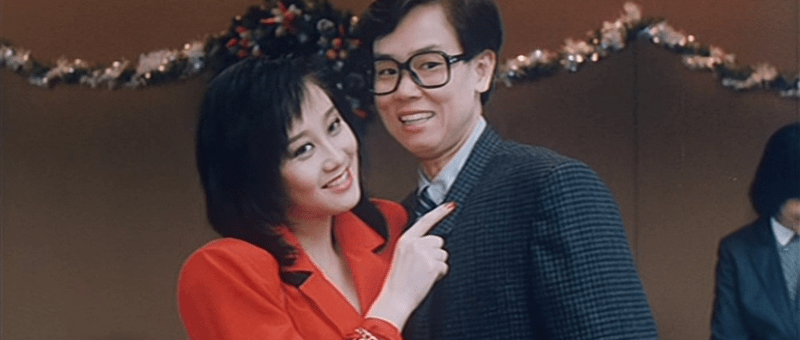
The ironically named Willie (Raymond Wong Pak-Ming) is a rising executive in a quasi marriage with Sylvia Chang (Sylvia Chang Ai-Chia) which is to say they live together as man and wife but Wille has never bothered to put in the paperwork (something which continues to annoy his harridan of a not quite mother-in-law). The couple have been together for seven years and Willie is beginning to tire of the monotony of (not actually) married life, irritated by Sylvia’s early morning Chinese Opera practice sessions and the fact he’s had nothing but sausage and egg for breakfast every day since moving in. Consequently, he fantasises about having an affair but is too mild-mannered despite the gentle ribbing of his colleagues and constant attempts of his brother-in-law John (Eric Tsang Chi-Wai) to introduce him to the red light district. 

In an early meeting with his colleagues after work, the men all discuss affairs suggesting that if a man isn’t chasing a woman it’s because he’s “sexually disabled” or gay quite clearly tying sexual prowess to masculinity. It’s also quite clear that the men view themselves as a group entirely separate from women, brother-in-law John evidently not thinking anything of it that he’s tempting his brother-in-law to cheat on his own sister implying that to him at least Willie’s masculinity is far more important than his sister’s feelings which in the end don’t seem to matter very much to him at all. John is also, however, a henpecked husband and moral coward. Challenged by his wife, sister, or mother, he immediately changes tack, dobbing Willie in when he’d tried to use him to placate Sylvia’s suspicions of an affair and quickly backtracking after having defended his decision not to file the papers by insisting “marriage is nonsense, old fashioned” only to counter with “I’m just saying for those silly men who try to overthrow the marriage tradition, I’m not one of them,”, “I absolutely agree with marriage. For women’s respect, I oppose living together”. 

Both John, whose constant badgering for loans also places a financial strain on the (non) marriage, and Wille feel themselves emasculated by the constraints of a monogamous relationship as the constant references to wild meat imply. Meanwhile the women are also depicted as vain and parasitical, the collection of trophy wives at Sylvia’s cookery class forever showing off the expensive gifts their husbands have bought them while alternately complaining they feel ignored. The implication is that the men can’t win, if they seem indifferent the wife worries they’re playing around, but too much affection is also regarded as a sign of infidelity. 

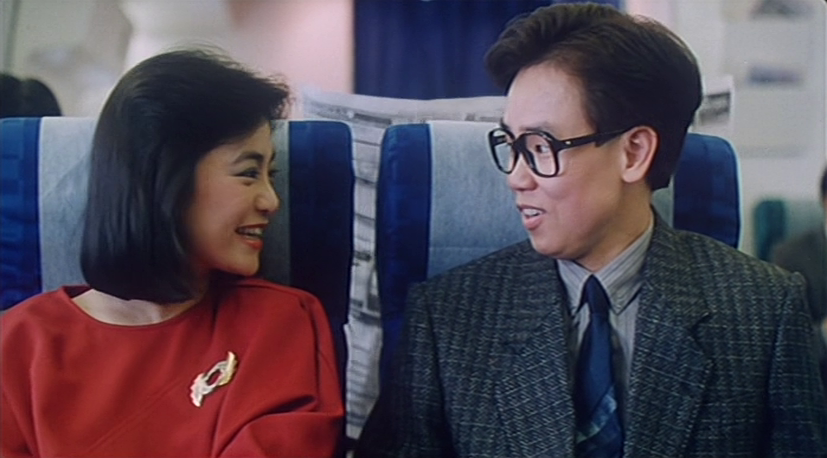
Even so it’s Sylvia who eventually gains the upper hand in refusing to play along with Willie’s games after he convinces her join him for a little Vertigo-esque role-play on a second honeymoon in Singapore, re-enacting his brief encounter with a foxy woman he met on a plane who was in fact conning him in order to facilitate a drug smuggling mission. Fed up with his ill-treatment, she falls asleep before the couple end up in an argument about her relationship with her “gay cousin” Chinese Opera partner with an inexplicably jealous Willie descending into an unpleasant homophobic rant. When he goes back to his own seat she has a meet cute of her own with a Chinese-American businessman literally named “Mr. Money” (Wu Fung) who took a liking to her in the departure hall and quite clearly needles Willie in the soft spots of his masculinity being both wealthy and cultured, able to take Sylvia off to a much more comfortable life in America with someone who is almost certainly going to treat her better than he ever intended to. 

As in many subsequent To comedies, it’s then the man who is put on the back foot blindly flailing while trying to win back a woman he took for granted. But if it seemed as if Sylvia might actually have more power in this relationship that either of them had assumed, the notion is quickly knocked back, literally, when her henpecked father raises a hand to her mother at the airport in order to support Willie’s attempt to prevent her leaving not because he thinks his daughter will be happier but in support of Willie’s compromised masculinity while reaffirming his own. An uncomfortable suggestion to a policeman that if “you slap her everything will be OK” reinforces the idea that actually the harridan mother-in-law now respects him more because of his show of manly violence, rebalancing the relationship back towards patriarchal norms while the father-in-law then turns full on sleaze cavorting with young women in public parks. 

It all adds to the impression that Willie is a sad sack, ineffectual man but largely because he turns back towards his wife while continuing to fantasise about other women seven years later claiming no longer to find her attractive and anticipating another itch this time presumably to escape his responsibilities as a father, his eyes following a pretty park jogger played by a then rising now iconic Hong Star who had appeared in the previous film Wong and To had made together. While To’s dancing camera shows glimpses of its future romanticism, it can’t quite escape the contradictions of the material even as it does its best to hand the balance of power back to Sylvia who could, it has to be said, do better. 

Shanghai Blues (上海之夜, Tsui Hark, 1984)

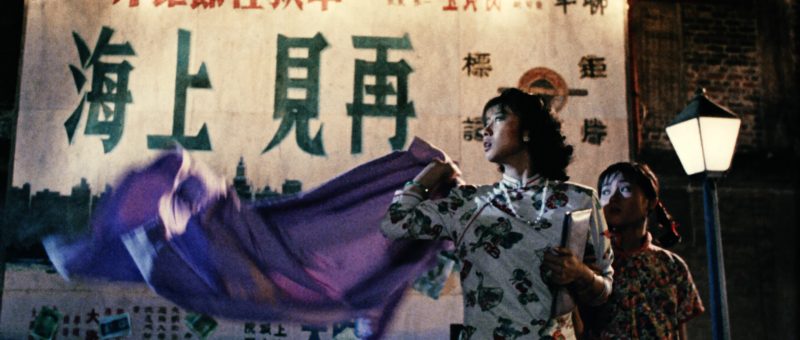
There’s a strange kind of melancholy optimism born of false courage and desperation that colours Tsui Hark’s Shanghai Blues (上海之夜). A clown soon to become a soldier tells a woman he meets in the dark under a bridge as the city burns and Shanghai falls to the Japanese to remember that they will win. 10 years later the wounded of that same war reassure each other that their time will come, they didn’t survive just to die here now seemingly cast out by the society they risked their lives to save.

The Shanghai Stool (Sally Yeh Chian-Wen) arrives in is in a moment of euphoric liberation caught between cataclysmic revolutions with the civil war and eventual coming of the communists hovering on the horizon. A wide-eyed country girl, she’s almost lost amid the hustle and bustle of the city in which the motion never stops. Like many, she is immediately displaced on her arrival, discovering that the relatives with whom she hoped to stay are no longer at their address and she is therefore homeless and alone. The clown, Do-re-mi (Kenny Bee), now a member of a marching band unable to play his instrument, thinks she’s the girl from the bridge in part because she’s wearing the same outfit but mainly because she has the same short hair cut and so he follows but loses her. Meanwhile, she has a kind of meet cute with Shushu (Sylvia Chang Ai-Chia), now a jaded nightclub showgirl still pining for the clown, in which they each believe the other is trying to take their own life but end up becoming best friends and roommates unwittingly living directly below Do-re-mi. 

In this 30s-style screwball world, identities are always uncertain and often obscured by darkness or else the continual march of the crowd. Yet there’s a kind of romanticism in this act of seeing and not seeing. Only in darkness do Shushu and Do-re-mi finally recognise each other and when their romantic moment is interrupted by the end of a power cut, they smash the neon lights opposite to reclaim it as if to reject the intrusion of this glaring modernity. To that extent, the implication may be that this innocent kind of romantic connection can’t survive the bright lights of the big city or that light blinds as much as it illuminates. In several sequences, the characters inhabit the same space but cannot see each other while a nefarious thief lurks on the edges of the frame unseen by all. On realising that Do-re-mi is the clown/soldier for whom she’s been waiting for the last 10 years, Shushu knows that she will have to break her friend’s heart or her own and that Stool’s dream of a family of three is unrealisable amid the constant rootlessness of this transient city. 

To that extent, Stool is an echo of herself as the innocent young woman she was on meeting Do-re-mi under the bridge rather than the more cynical figure she’s become due to her experiences in the wartime city. In the film’s closing moments, Stool meets another version of herself in the form of a wide-eyed young woman in a plain dress who asks her if this is Shanghai but the only reply she can give is that she wishes her luck because for her Shanghai is now a city of heartbreak just it has been one of sadness and futility for Shushu. “I have one hope, if I give it to you I won’t have any,” Shushu tells her lovelorn boss as an expression of the despair that colours her existence in which the distant possibility of romantic fulfilment is all she has to live for. 

The fact that the lovers later flee Shanghai for Hong Kong seems to take on additional import as those in Hong Kong consider a similar trajectory with their own revolution looming while adding to the sense of continual displacement, disrupted communities, and worlds on the brink of eclipse. This Shanghai is a bleak place too with its lecherous gangsters and seedy businessmen but has a sense of warmth even amid its constant motion in its serendipitous meetings and friendships born of the desire for comfort and company in the face of so much hopelessness. In the end, perhaps romanticism is the only cure for futility just as the only thing to do in a world of chaos is to become a clown.


Shanghai Blues screens Nov. 13 as part of this year’s San Diego Asian Film Festival.

Table for Six 2 (飯戲攻心2, Sunny Chan Wing-Sun, 2024)

“It’s okay to be screwed, we’ll unscrew you later,” youngest brother Lung (Peter Chan Charm Man) comforts his dejected brother in an accidental advocation of what means to be a family in Sunny Chan’s followup to the phenomenally successful comedy  Table for Six. Like the previous film and in true Lunar New Year fashion, Table For Six 2 (飯戲攻心2) explores the concept of family in a wider sense along with contemporary attitudes to marriage and traditional gender roles.

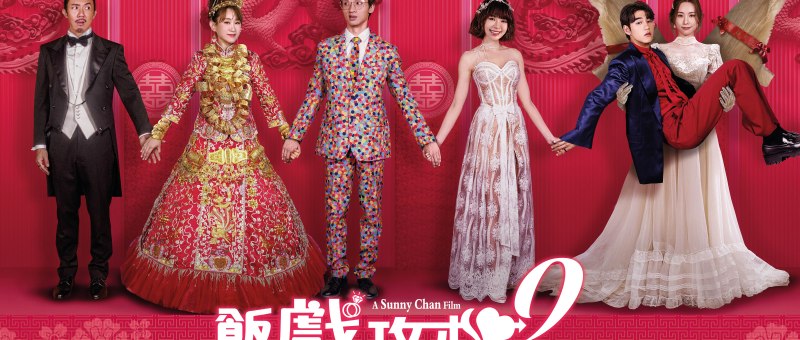
Even so, it has to be said this table is now uneven as oldest brother Steve has literally run away from his romantic dilemmas taking off for Africa leaving new girlfriend Miaow (Lin Min-Chen) behind claiming she’s too far out of his league and it’s not fair of him to waste her youth. Ironically enough, Bernard (Louis Cheung) has now started a wedding business helping people pull off extravagant public proposals such as the sort of fake one he prepares for Monica (Stephy Tang Lai-yan) as a publicity stunt featuring him dancing in a 90s-style music video. As part of the campaign, they’ve set up Lung and Miaow as a fake couple hoping to build a following for their romance online much to unexpected chagrin of Josephine (Ivana Wong) who has begun to embrace her dreams by becoming a well-known quirky chef who makes food disguised as other food. Though they had agreed to separate so the could both follow three dreams at the end of the previous film, Josephine suddenly proposes leading Bernard to put on an extravagant wedding as promotion for his business. 

In a way, Bernard’s company symbolises the performative qualities of marriage as couples put themselves through a stressful and expensive ritual more out of obligation than real desire. When Lung is prevented from reaching the ceremony on time, Bernard ends up impersonating him in a full body costume making plain that the spectacle is more for show than sentiment and it could really be anyone up there simply fulfilling a role. In fact, no one even checks the certificates were properly signed. Then again, just as in Josephine’s cooking sometimes the “fake” and can actually contain the “real” just in a different way than expected. She may say that once a relationship has cooled the spark can’t be regained, but that doesn’t necessarily mean a new, different, spark couldn’t be found. 

Perhaps that’s what happened for Bernard and Monica who’ve now overcome the awkwardness of Monica having been in a longterm relationship with oldest brother Steve. Ironically enough, they’d more or less decided not to get married only to be blindsided by their reactions to the “fake” proposal but as it turns out more because of the emotional baggage from their parents’ failed relationships that have left them too afraid to get married. Monica is still traumatised by her father’s extra marital affair which resulted in a half-brother she’s never met but has since become a Cantopop star, while Bernard still has bad memories of being treated as a “red-headed” child and like Steve is preoccupied with a desire to keep the family together while worried that he isn’t really up to it. 

The lesson Bernard learns is that family is a burden that’s carried together so he didn’t need to save it on his own and that it’s alright to mess things up because his family will be there to take care of him. Miaow meanwhile is left in the same place as Steve had been in the first film, wondering how long she should wait for love or if Steve is ever coming back, trying to decide whether to accept a promising job offer in Japan or stay in Hong Kong. Part of her reluctance to move on is that she’s become wedded to the family and fears losing her place within it but as Monica says her status wasn’t dependent on blood or relationships and that she’s already been accepted into the family just for being herself. 

Then again, families can also be annoying as Bernard remembers after inviting his gangsterish uncles to one of the weddings only for them to muscle in as a major sponsor for another own insisting on designs the dress themselves complete with a par of shark fin wings to promote their business none of which meshes well with Monica’s passion for conservation. In any case, as Monica reflects family means you can embarrass yourselves together so maybe wearing a stupid dress for a few minutes isn’t such a big deal. Heartfelt and zany, Chan’s farcical drama shifts past the performative aspects of marriage and family to what lies beneath which, like Josephine’s cooking, may not always be what it first appears.


Table for Six 2 is in UK cinemas from 9th February courtesy of CineAsia.

UK trailer (English subtitles)