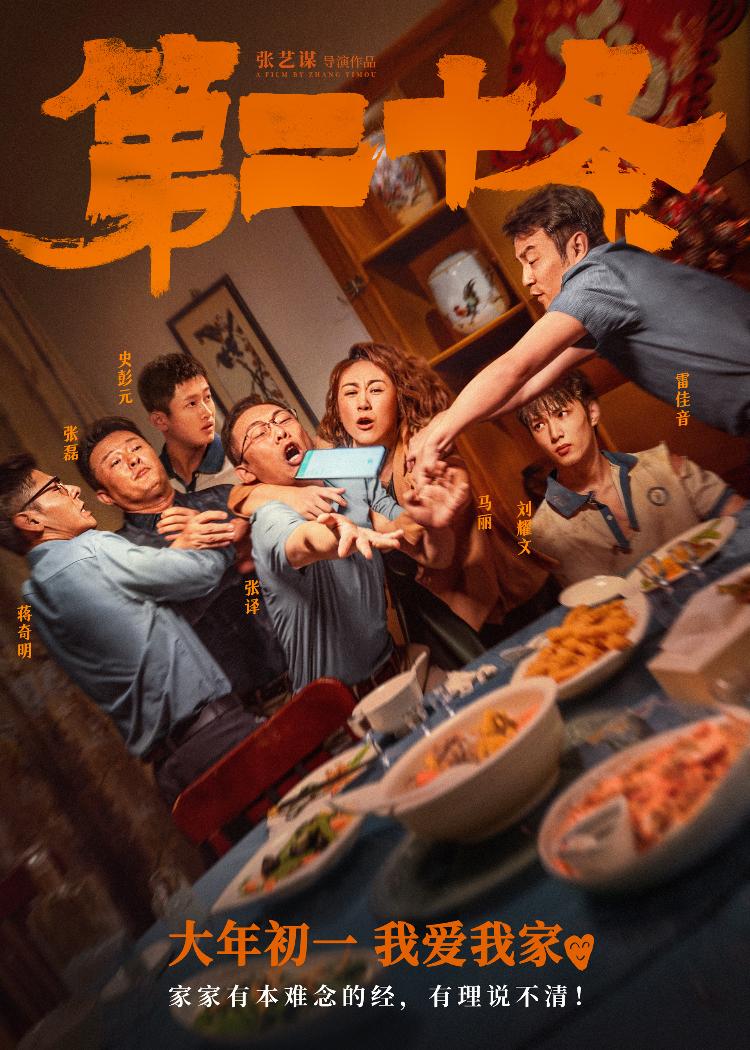
Article 20 (第二十条, Zhang Yimou, 2024)

There’s something quite strange going on in Zhang Yimou’s New Year legal dramedy Article 20 (第二十条, dì èrshí tiáo). Generally speaking, the authorities have not looked kindly on people standing up to injustice in case it gives them ideas, yet the film ends in an impassioned defence of the individual’s right to fight back in arguing that fear of prosecution should not deter “good” people from doing “the right thing” such as intervening when others are in danger. Nevertheless, the usual post-credits sequences remind us that the legal system is working exactly as it should and the guilty parties were all caught and forced to pay for their crimes.

In this particular case, the issue is one akin to a kind of coercive control. Wang (Yu Hewei) stabs Liu 26 times following a prolonged period of abuse and humiliation. After taking out a loan to pay for medical treatment for his daughter who is deaf and mute like her mother Xiuping (Zhao Liying), Wang was terrorised by Liu who chained him up like a dog and repeatedly raped his wife. Prosecutor Han Ming (Lei Jiayin) eventually argues that his attacking Liu qualifies as self defence under Article 20 of the constitution because even if his life was not directly threatened at the time it was in the long term and he did what he did to protect himself and his family from an ongoing threat.

Han Ming becomes mixed up in several different cases along the same lines only with differing levels of severity. Some years ago he’d worked on the case of a bus driver who was prosecuted after stepping in to help a young woman who was being harassed by two louts. His problem was that he got back up after they knocked him down and returned to the woman which makes him the assailant. Zhang has spent most of his life since his conviction filing hopeless petitions in Beijing. Meanwhile, Han Ming’s son, Chen (Liu Yaowen), gets into trouble at school after stepping in to stop obnoxious rich kid and Dean’s son Zhang Ke from bullying another student.

Now jaded and middle-aged, Chen first tells his son that he should he give in an apologise to get the boy’s litigious father off his back though Chen is indignant and refuses to do so when all he did was the right thing in standing up to a bully. Bullying is the real subject of the film which paints the authoritarian society itself as a bully that rules by fear and leaves the wronged too afraid to speak up. The choice Han Ming faces is between an acceptance of injustice in the pursuit of a quiet life and the necessity of countering it rather than live in fear while bullies prosper.

The thesis is in its way surprising given that the last thing you expect to see in a film like this is encouragement to resist oppression even if the idea maybe more than citizens should feel free to police and protect each other from the immorality and greed of others. It is true enough that it’s those who fight back who are punished, while the aggressor often goes free but according to Han Ming at least the law should not be as black and white as some would have nor be used as a tool by the powerful, or just intimidating, to oppress those with less power than themselves. 

Other than the theatrical drums which play over the title card, there is curiously little here of Zhang Yimou’s signature style while the film itself is not particularly well shot or edited. It also walks a fine line between the farcical comedy of Han Ming’s home life in which he perpetually bickers with his feisty wife (an always on point Ma Li) who worries he’s too interested in his colleague Lingling (Gao Ye) who turns out to be an old flame from his college days during which he too was punished for standing up to a bully by being relegated to the provinces for 20 years. A minor subplot implies that the justice-minded Lingling is largely ignored because of the sexist attitudes of her bosses who feel her to be too aggressive and often dismiss anything she has to say in what amounts to another low level instance of bullying. The film ends in a rousing speech which seems more than a little disingenuous but even so ironically advocates for the right to self-defence against a bullying culture while simultaneously making a case for the authorities having the best interests of the citizen at heart which would almost certainly not stand up particularly well in court.


Article 20 is on limited release in UK cinemas courtesy of CMC.

International trailer (English subtitles)

Journey to the West (宇宙探索编辑部, Kong Dashan, 2021)

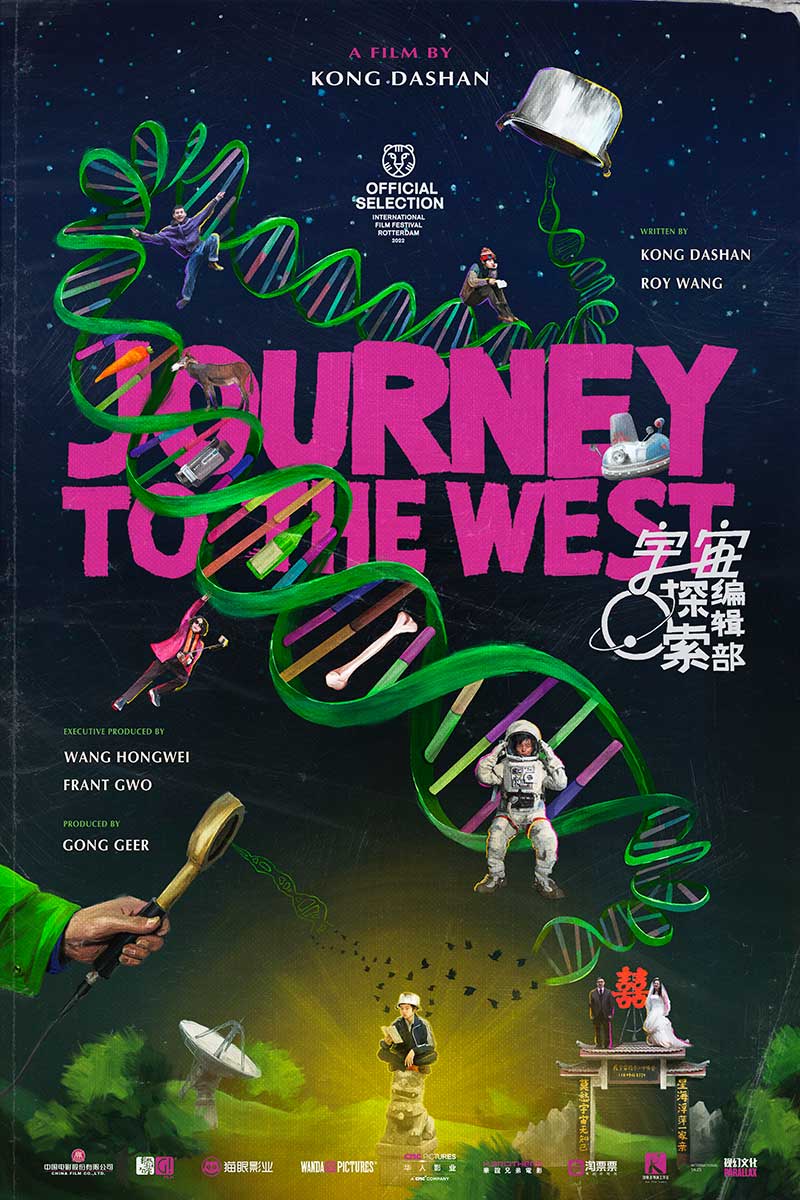
An eccentric middle-aged man’s search for alien contact sends him on a quest for enlightenment in Kong Dashan’s deadpan epic Journey to the West (宇宙探索编辑部, Yǔzhòu Tànsuǒ Biānjí Bù). Inspired by the classic Chinese tale of the monk Tang Sanzang who journeyed west in order to bring true Buddhism to China in the company of the anarchic monkey king Sun Wukong, Kong’s comical adventure finds its awkward hero longing for connection in contemporary China his search for the extraterrestrial a means of provoking the next great human evolution in the belief that on the discovery of alien life humanity would immediately abandon its petty disagreements and live in perpetual harmony. 

Kong opens however with some VHS footage from 1990 in which UFO-obsessive Tang (Yang Haoyu) is interviewed for a documentary before flashing forward 30 years to the present day in which Tang has made little progress. The magazine which he edits, Universe Exploration, is on the brink of bankruptcy with his exasperated boss Mrs Qin (Ai Liya) already holding tours for prospective sponsors none of which go particularly well. As we later discover, Tang’s obsession has dominated his life resulting in the breakdown of his marriage while his daughter later died by her own hand it seems in part because of the same despair he too feels in his inability to understand the purpose of human existence. His quest is partly one for answers, though his theories often sound unhinged as he patiently explains about messages in the white snow of a detuned analogue television or pays visits to psychiatric institutions believing that psychopaths whose brains are wired differently may be better able to receive extraterrestrial signals. 

On the other hand, his way of life is not perhaps that different to that of his namesake Tang Sanzang in his wilful aestheticism insisting that the desire for better food along with sex for reasons other than procreation is merely a consumerist trap actively blocking the path towards human evolution which he believes he will discover in contacting extraterrestrial life. In his theory, if the Earth is like a grain of sand in the desert of the universe then it’s illogical to assume there are not other beings out there whom he assumes will be far advanced not only in technological terms but also in morality. But then, as a poet he later meets on his journey west into the mountains eventually asks him what if the aliens don’t have any answers either and have in fact come to Earth in order to ask the exact same question for which Tang seeks the solution?   

Inevitably, the conclusion that he comes to is that the answer lies within, that humanity is the universe and each person a single word in a great poem centuries in the making that might in its conclusion allow us to understand why we live if only we can go on connecting with each other to form new sentences in the great unfinished journey towards enlightenment. Then again, Mrs Qin hints at the mean spiritedness of the contemporary society in her conviction that if there are aliens out there who want to come to Earth it’s probably to rob it, while out on the road Tang is taken in by a bizarre scam involving the body of an alien in a freezer you can only see if you are the chosen one which requires the willingness to pay $99.99 to man running the alien embassy on Earth though it does at least result in Tang receiving a mysterious bone which does seem to be crucial to his quest once he runs into monkey king stand in Sun Tiyong (Wang Yitong) who wears a saucepan on his head and claims to have received a mission to retrieve a stone ball stolen from a lion statue’s mouth from a mysterious alien entity. 

Ever mindful of the contemporary realities, Kong throws in several ironic nods to the censors board Tang repeatedly reminded that he must always find a “scientific” explanation for bizarre phenomena rather than succumbing to “superstition”. Travelling west with Sun and a small team including his drunken friend and a young woman the same age as his daughter would have been if she’d lived, Tang does indeed undergo a kind of vision quest culminating in the apotheosis of Sun into Wukong while a strange man in a red hat riding a tiny UFO-like cart always seems to be one step ahead of them. Shot in a faux documentary style complete with direct to camera interviews and occasional breaking of the fourth wall, Kong’s hilariously deadpan, absurdist epic sees Tang journeying west in search of the meaning of life only to be confronted by the vastness of the universe and discover himself, and the answer he seeks, already in its embrace. 


Journey to the West screened as part of Osaka Asian Film Festival 2022

Clip (English subtitles)

The Wandering Earth (流浪地球, Frant Gwo, 2019)

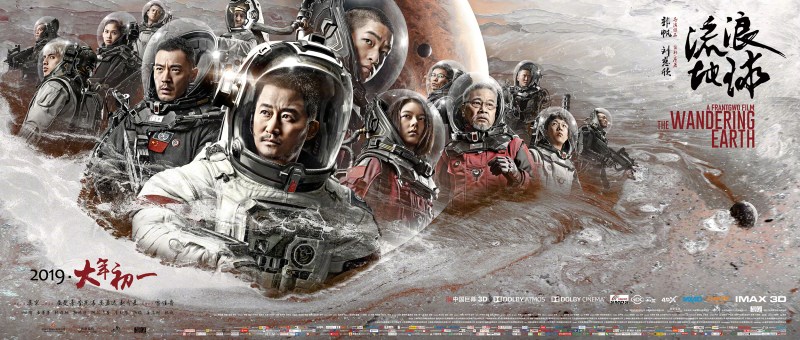
Wandering Earth poster 5Chinese cinema has not been as averse to science fiction as some would have it, but it’s true enough that The Wandering Earth (流浪地球, Liúlàng Dìqiú) marks a bold new chapter in its ambitious attempt to take Hollywood on at its own game. Adapting the novel by China’s premier sci-fi author Liu Cixin, Frant Gwo’s third feature is an interesting take on the New Year movie in which new beginnings are sought and families desperately try to reunite to see them in, only this time they do so against the backdrop of impending apocalypse as the universe threatens to swallow us whole.

Far in the future, the vast expansion of the sun will soon consume the Earth. The Wandering Earth project aims to save humanity by attaching jet thrusters to the Earth’s surface to push it out of harm’s way yet this safety measure has also had grave effects on the planet’s climate rendering the surface uninhabitable. 17 years previously, astronaut Liu Peiqiang (Wu Jing) left his 4-year-old son behind in the care of his father (Ng Man-tat) to take up a position on the space station intended to safeguard the Earth’s future. Now 21, Liu Qi (Qu Chuxiao) has grown up into a resentful, rebellious young man intent on seeing the surface for himself if only not to be home when Peiqiang finally returns to Earth. A natural disaster, however, leaves him stranded with his adopted teenage sister, Duoduo (Zhao Jinmai), just as the Earth is inconveniently drawn into a fatal collision course with Jupiter.

As much about fatherhood as it is about survival of a species, The Wandering Earth centres itself on the angry figure of Liu Qi who has been forced to live his entire adolescence underground and has come to deeply resent the memory of the father who allowed his sickly mother to die and then abandoned him. Peiqiang, meanwhile, has spent 17 years on the space station solely in order to save his son’s future, dreaming of the day they will finally be reunited. He cares little for his own life and has already spiritually handed the baton on to the next generation whose descendants, he hopes, may finally see a kinder sun rise over a new Earth.

This kind of selflessness is also reflected in the film’s refreshingly globalist outlook in which the world, no longer divided, has learned to act as one in order to combat the extreme threat from its own sun. The resistance may be China led, but depends on common endeavour and personal sacrifice. When a last ditch effort is required, the government cannot order its forces away from their families but can offer them the individual choice to keep fighting for survival, bringing teams from all corners of the Earth together as they descend on Indonesia where there just might be a one in a million chance to strike back at Jupiter and escape its gravitational pull.

Meanwhile, Peiqiang is up still up on the space station all alone and powerless while the annoyingly efficient operating system MOSS attempts to frustrate his efforts to save the Earth in service of its own mission to preserve humanity’s legacy. MOSS has made a series of calculations and given up, but giving up is not a very human trait and Peiqiang won’t do it. He makes impassioned speeches to the French-accented global authorities and ponders the best way to ensure his son’s survival even at the cost of his own but finally can only resist by literally attacking the system in overruling MOSS and acting on his own initiative.

A New Year tale through and through, The Wandering Earth is a celebration of family, togetherness, and home but is careful to dial down the patriotism for an insistence on the importance of mutual cooperation between peoples in order to combat existential threat with the spectre of climate change always on the horizon. The point, however, is that it is important to keep hope alive, if not for yourself then at least for others rather than give in to nihilistic despair. The Wandering Earth, grand and ambitious in scale, marks a new dawn of its own in terms of Chinese blockbuster sci-fi and does so with refreshing positivity as it places its hopes in human solidarity and individual sacrifice over jingoism and self-interest.


Currently available to stream on Netflix in the UK and possibly other territories.

Netflix trailer (English subtitles)

Dead Pigs (海上浮城, Cathy Yan, 2018)

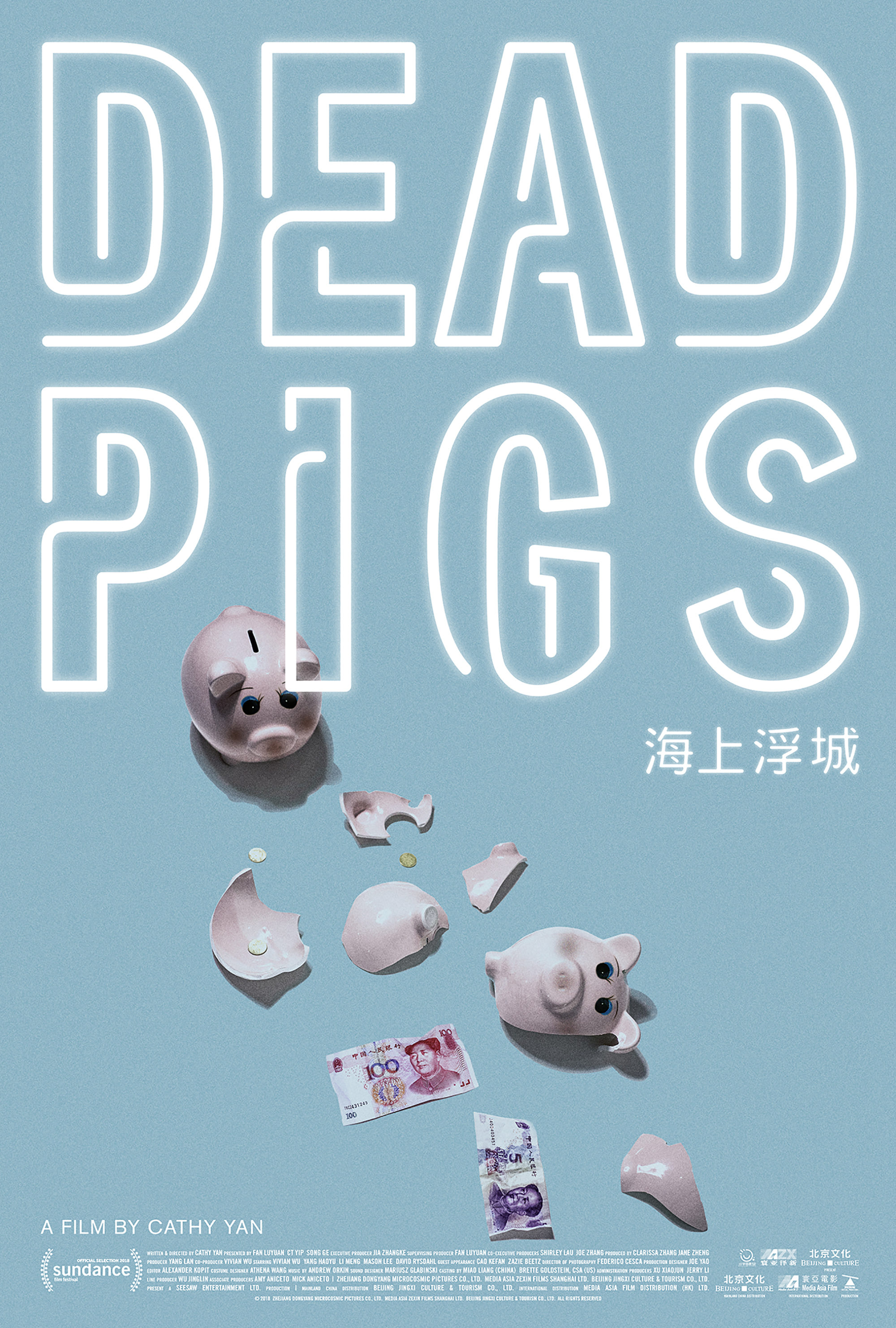
Dead Pigs posterPigs – they have the best life, according to pig farmer Old Wang (Yang Haoyu). All they do is sleep and eat while hard working folks like him go out of their way to keep them comfortable. To Old Wang, it doesn’t seem fair but, ironically enough, he seems to have forgotten the heavy price a prize pig pays for its short life of “luxury”. Nevertheless, all his hard work is about to go down the drain in the debut film from Cathy Yan, Dead Pigs (海上浮城, Hǎi Chàng Fú Chéng). Loosely inspired by the infamous Huangpu River incident, Dead Pigs is a decidedly cheerful satire of modern China’s capitalist revolution and the many changes, good and bad, it has wrought.

When all the pigs in China suddenly start dropping dead, it presents a series of problems for your average pig farmer like Old Wang. With everyone on high alert and no clear indication of what is causing the strange phenomenon, no one is buying pork and getting rid of the carcasses in the “official” way is costly, bothersome, and will alert the attention of the authorities. Therefore, pretty much everyone starts tipping their dead pigs in the river which, besides being unsightly, is also a significant risk to public health.

Old Wang, however, has other problems. When we first meet him, he’s become obsessed with the cutting edge art of VR technology because it feels just like the real thing, delighting in pretending to go swimming when he could actually just go swimming outside if only he hadn’t been polluting the river with pig carcasses. Not content with virtual delusions, he’s also got himself into debt by “investing” in a scheme which turned out to be a scam and lost him all his savings. In debt to loan sharks, Old Wang decides to ask his sister, Candy (Vivian Wu) – a beautician with an upbeat, inspirational marketing campaign, for help. Candy, however, is in the middle of a nasty dispute with a local property developer which has bought up all the other properties in the area to build a brand new housing complex bizarrely inspired by classic Spanish cathedral Sagrada Família and designed by American architect Sean (David Rysdahl) who has ended up in China in flight from failure at home. Old Wang considers asking his son, Zhen (Mason Lee), whom he thinks has a good job in the city, for the money to pay the gangsters, but Zhen is just a waiter (in an upscale bar/restaurant specialising in pork) and is too ashamed to tell his dad he can’t help. Meanwhile, Zhen has also fallen for disillusioned rich girl Xia Xia (Li Meng) who is currently rethinking her elitist lifestyle.

Snapping at the property developers, Candy laments that it’s all “money, money, money” and resents that they can’t see the various practical and sentimental reasons she might not want to move, assuming she’s just an old battle-axe out for more money. In the world of rich kids like Xia Xia, money is indeed all that matters – having the flashiest outfits, jewellery, cars and accessories while being seen at the trendiest bars and restaurants on the arm of the handsomest companions the elite has to offer. No one seems to care very much about how they treat others because every offence can be paid for. Xia Xia, though she perhaps suspected it before, learns the hard way when she winds up in hospital and none of her many “friends” bother to visit her, preferring to send expensive gifts instead.

Meanwhile, Wang Zhen and his dad are two guys left behind by rapid modernisation. Too ashamed to tell his father he couldn’t cut it in the city, Zhen eventually takes to deliberately crashing into oncoming vehicles with his bicycle in the hope of extracting compensation – willingly submitting himself to a system in which money has become a license to do wrong for those who can afford it. American architect Sean feels much the same as he makes plain in an impassioned speech to Old Wang in which he insists that no one has the right to call him stupid or to make out he isn’t good enough for the brave new world they are making. Sean, having ended up in China in an attempt to escape these same feelings of inadequacy and failure in his home country, finds a new niche for himself, uncomfortable as it is, as a professional Westerner for hire in series of bizarre publicity stunts managed by a talent agency specialising in such rarefied fare. 

Yet more than the greed, selfishness, and inhumanity the cruelty of capitalism has engendered, it’s the loss of community that seems to really sting. Candy wants to hold on to her childhood home as a physical expression of a long lost neighbourhood and now absent family. Tellingly, the song she’s always singing, which is later reprised as a community wide karaoke number, is a classic track by Teresa Teng known as “I Only Care About You” in its Mandarin version but originally released in Japanese as “Toki no Nagare ni Mi wo Makase” which literally means “surrender yourself to the flow of time”. You can’t stop progress – perhaps it’s a mistake to cling on to the tangible in a world constantly in flux when what really matters has always been close at hand. The message seems to be, salvage what you can but get out of the way of the bulldozer before it buries you too. Sparkling with whimsy and filled with impromptu song and dance, Dead Pigs is a delightfully surreal examination of a changing nation in which goodness and empathy eventually win out (to a point at least) against the overwhelming forces of rampant capitalist expansion.


Screened at the 2018 BFI London Film Festival.

Original trailer (English subtitles)

Teresa Teng’s I Only Care About You

Original Japanese version (Toki no Nagare ni Mi wo Makase)

https://www.youtube.com/watch?v=orwRnoi01AM