A Wife’s Heart (妻の心, Mikio Naruse, 1956)

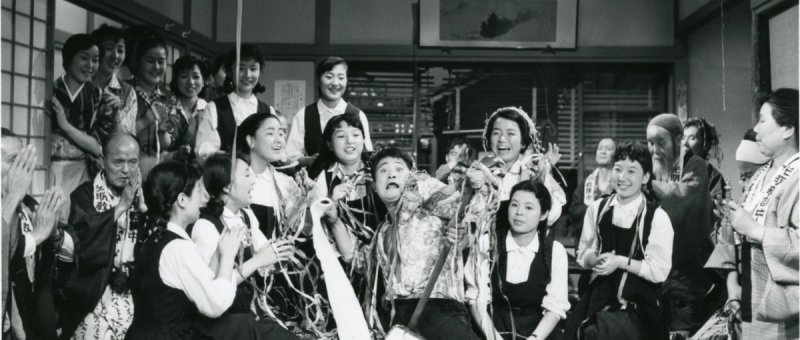
“We’re too late for everything these days,” mutters an overly cheerful geisha whose behaviour is becoming ever more erratic. A sense of fatalism, that everything has already been decided and there is no real escape from the misery of life, hangs over much of Naruse’s filmmaking even if his heroines often do their best to rail against it and on occasion succeed. Kiyoko (Hideko Takamine), the heroine of A Wife’s Heart (妻の心, Tsuma no Kokoro), finds herself faced with just this dilemma while considering which side of a generational divide she might be on and whether she has the power to escape from her disappointing life to chase emotional fulfilment. 

We can see the literal distance between herself and her husband Shinji (Keiju Kobayashi) in the opening sequence as he stands in a vacant lot at the back of their property and she firmly within the domestic space hanging washing. Yet for all that she seems excited, perhaps even a little giddy as they plot their escape together through planning to turn that vacant space into a cafe in an attempt to fend off the economic changes ravaging their town and wider society of Japan in the mid-1950s. Out and about on his bike, Shinji looks anxiously at the construction of a new pharmacy much larger than his own and with flashy modern signage. Their business is failing and they don’t know how to save it so the cafe is their way out and also a break with the depressing past represented by Shinji’s grumpy mother, Ko (Eiko Miyoshi), who is predictably dead against the cafe idea. 

The new business, in its way, is also a stand-in for the child they don’t have and a means for Kiyoko to find domestic fulfilment in a society ruled by motherhood. This one reason that the sudden arrival of her sister-in-law Kaoru (Chieko Nakakita) with her small daughter Rumiko causes so much disruption. Kaoru has fulfilled the social obligations which Kiyoko has not and quickly insinuates herself within the house, taking over the domestic space as symbolised by her otherwise trivial action of putting back a pair of nail clippers in the place she sees fit rather than their usual home. Yet she does this in part because her husband, Zenichi (Minoru Chiaki) who left the family to become a salaryman in Tokyo, is so obviously unreliable and appears to have not for the first time lost his job while employed at a company possibly involved in something untoward. On getting wind of Shinji’s plans to open a cafe, Zenichi announces he’s thinking of opening one himself and gets his mother to put pressure on the couple to give him the money they borrowed for their dream project.

It’s the loan that in part allowed Kiyoko to consider life beyond her marriage in reuniting with the still unmarried brother of her best friend Yumiko (Yoko Sugi). Kenkichi (Toshiro Mifune) is everything Shinji is not, handsome, well dressed, and with a good, middle-class job working at a bank. On a visit to her relatives, Kiyoko’s aunt remarks that everyone wanted to marry her provoking a slight twinge of pain in Kiyoko’s face. Mother-in-law Ko arranges marriages and it’s likely she arranged the one between Kiyoko and her son and that Kiyoko likely agreed out to of social obligation under the rationale that Shinji was a good catch as the proprietor of a successful business. The implication is that if, like Yumiko, she had held out a little longer she probably would have fallen in love and married Kenkichi. As the atmosphere in the family home grows ever more toxic, she grows closer to him yet at least in part as a symbol of the path not taken, what her life may have been like if only she had resisted and claimed a little more freedom for herself. 

Ko has also arranged a marriage for youngest daughter Sumiko (Akemi Negishi) who asks her if all of her matches were happy. An indignant Ko replies that only one or two have split up, but as Sumiko points out just because a couple stays together does not mean they are happy. “Women don’t have the courage, they just give up,” she remarks implying that she, as a representative of the younger generation, might be less minded to simply accept a disappointing situation in the same way as someone of Kiyoko’s age may feel she had to. For these reasons Kiyoko is torn. Yumiko remarks that she and Shinji didn’t even particularly like each other when they married and perhaps remain indifferent to each other now. The cafe may have brought them closer as a couple, but now it’s causing a rift in the wider family while also offering Kiyoko the faintest glimmer of an escape route. When she returns to the cafe where she was learning the ropes as a part-time employee, much to Ko’s chagrin at losing a domestic helper, it’s clear that she’s doing so in part to have a means of supporting herself as she leans closer to the idea of leaving Shinji. 

But for all that it seems unlikely that she has the courage, as Sumiko put it, to break with the traditional social codes of feminity by leaving a husband who was not really bad but that she did not love and made her unhappy. In rebellion, Shinji has an indiscretion with a local geisha who goes missing on the way home from a hot springs and is later found dead having taken her own life because she was trapped in a bad relationship with her husband. The implication is that this is the only way many women find to escape from their dismal circumstances and may soon present itself to Kiyoko if she cannot find a way to reconcile herself to her life with Shinji or find the confidence to leave it. The enemy is the increasingly outdated institution of arranged marriages as advocated by the austere Ko who refuses to hire maids while believing herself entitled to the free labour of her daughters-in-law, and the patriarchal social codes of a modernising nation in which Shinji can have his dalliance with a geisha and his wife is expected to put up with it, but merely being seen walking with a man not one’s husband provokes gossip and jealousy. 

When Shinji implies he suspects her of having an affair with Kenkichi, he tells her that she’s free to follow her heart and he understands if she chooses to leave him but of course by telling her this he seals her fate by making it almost impossible for her to do so. The couple repairs itself, but the resolution is far from comfortable as it becomes clear that each is essentially resigning themselves to misery because of social convention vowing that they’ll build their cafe in the next season though it seems like a dream destined to go unfulfilled while the institution of Rumiko left behind in the family superficially fills the void it was designed to fill. The fades to black between scenes seem to echo an exhalation of bleakness as the interrupted thought of Kenkichi’s dangerous “Kiyoko…” as an admission that the prospect of escape is only ever a torturous fantasy and a heart is something that must be sacrificed in the name of conventional success. 

Seven Samurai (七人の侍, Akira Kurosawa, 1954)

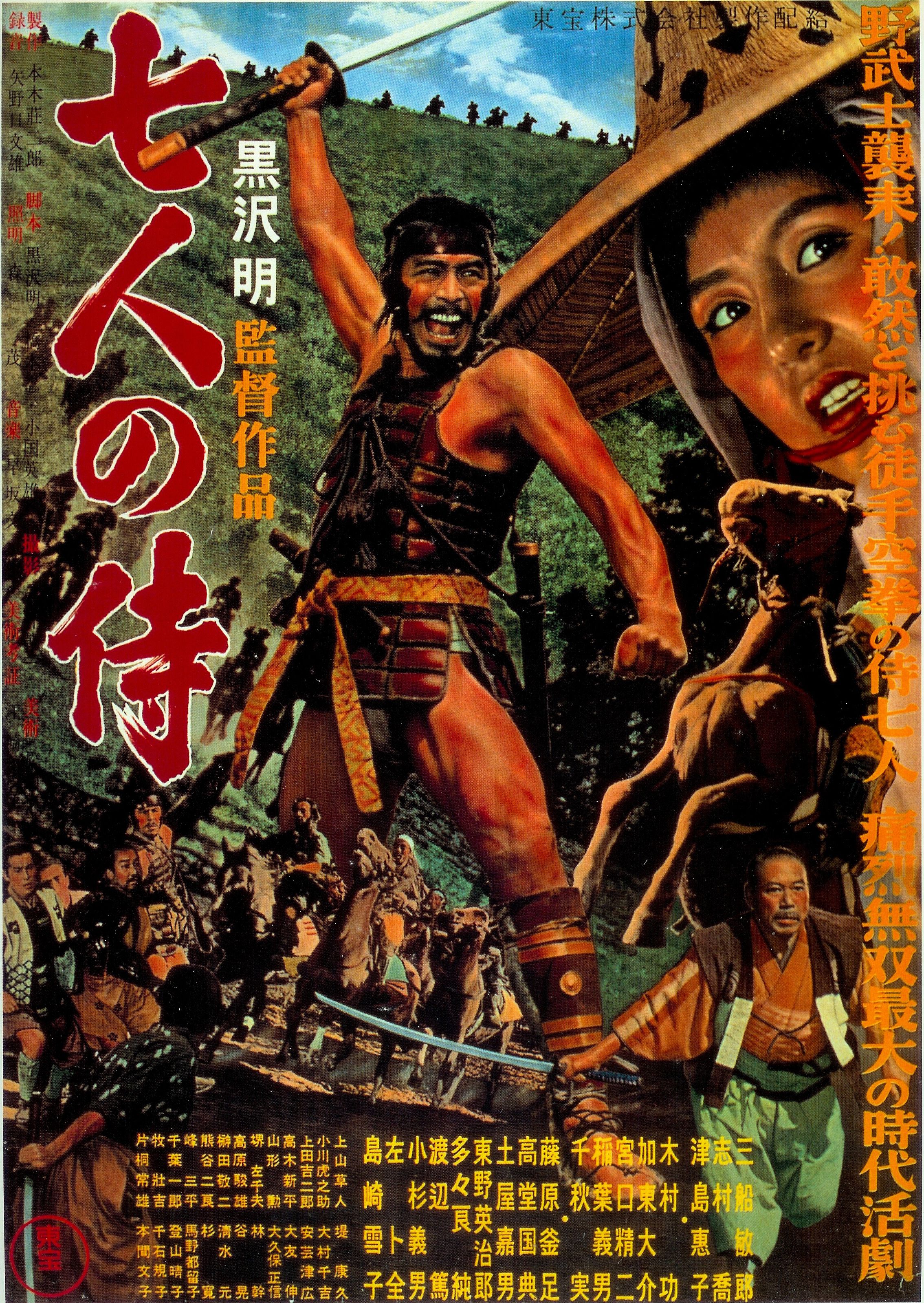
An eclipse of the accepted order allows a temporary truce in the ongoing class conflict that defines feudal society in Akira Kurosawa’s seminal post-war historical epic, Seven Samurai (七人の侍, Shichinin no Samurai). Set in the late 16th century, the action takes place in a world on the brink of collapse. The Sengoku era is drawing to a close but is also in a moment of intense crisis which has left large numbers of highly skilled warriors essentially orphaned, wandering the land torn between their basic needs for food and shelter and their dignity as members of a theoretic aristocracy. 

Plagued by bandits, many of whom may be these orphaned swordsmen, a small village contemplates the unthinkable in hiring samurai, otherwise their oppressors and uniquely responsible for the chaos which surrounds them, for protection. “Land tax, forced labour, drought…and now bandits!” one woman exclaims shortly before suggesting they simply surrender all their grain and then hang themselves. As they can offer only expenses in the form of rice, the only samurai they can hope to recruit are already desperate, so hungry that they may be willing to deign to defending their social inferiors with whom they would not usually mix unwilling to accept that they are both victims of the inherently corrupt social order. This explains why the villagers’ early entreaties are met with such scorn and cynicism, either rudely rejected out of hand or ending only in deception. 

In this there is an echo of the world of 1954 which was beginning edge away from the chaos and privation of the immediate post-war society, bandits standing in for thieves and profiteers themselves a product of intense food insecurity. Yet here it’s desperation that allows a temporary merging of the world of lord and peasant, brokered finally by unexpected compassion on the part of a noble samurai who, in an act of extreme transgression, symbolically erases his elite status by shaving his head in order to save a child taken as a hostage by another desperate man. Kambei (Takashi Shimura) may be somewhat reduced in circumstances but refuses to give in to the immorality of the world around him, finally agreeing to help the villagers essentially out of a sense of pity willing to accept only the gift of sustenance moved by the villagers’ sacrifice in discovering that they give him the last of their white rice while subsisting only on millet. 

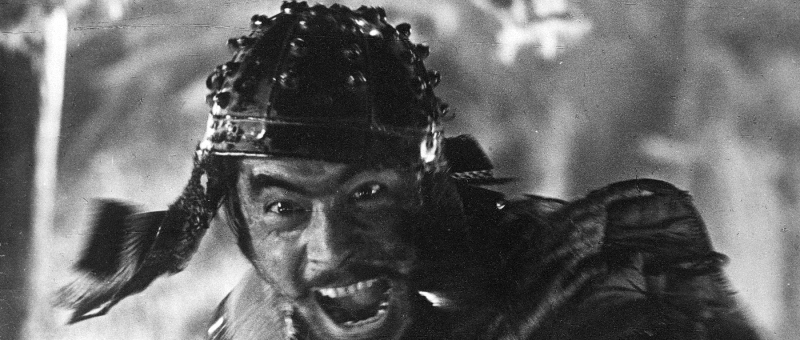
Yet having taken this step, the villagers remain uncertain they can really trust the men they’ve hired to protect them who are after all each trained in death. Later we discover that they have, like many of the time, occasionally finished off the odd lone samurai fleeing the battlefield in order to loot the bodies as a large stockpile of samurai armour later discovered by the samurai-pretender Kikuchiyo (Toshiro Mifune) testifies. On being confronted with this uncomfortable reality, the samurai fall silent knowing this armour was stripped from men much like themselves, but can ultimately offer little by way of defence when presented with an angry rant from Kikuchiyo who points out that they are themselves responsible in having created this world of chaos through their internecine quests for power. “In war you burn their villages, trample their fields, steal their food, work them like slaves, rape their women, and kill ‘em if they resist. What to you expect ‘em to do?”

When Kambei and the others first arrive in the village, there is no welcoming committee. The villagers all hide, frightened to leave their homes partly because of paranoia spread by widowed father Manzo (Kamatari Fujiwara) convinced that randy samurai are going ravish all of their daughters who will, doubtless, be overcome with awe by these sophisticated men of the elite. In an echo of Kambei’s transgression, Manzo forces something similar on his teenage daughter Shino (Keiko Tsushima), roughly cutting her hair while she cries and resists before dressing her up as a boy so that she’ll be safe from lusty samurai. The plan, however, backfires in that she later engages in a doomed romance with the young Katsuhiro (Isao Kimura). Their eventual union is the symbolic merging of the two worlds, a moment of eclipse in the usual hierarchy, but it’s born of the same impulses than brought Kambei and the others to the village. In fear and desperation, they behave as if there’s no tomorrow, only tomorrow must come and just as sun and moon must eventually move apart and resume their regular orbits so the relationship between Katsuhiro and Shino is an impossibility. 

Like Kambei, Katsuhiro had occupied a slightly liminal position because of his relative youth, neither boy nor man. He first encounters Shino while marvelling at the natural beauty of the forest, only to berate her for doing the same. “Is this any time for an able-bodied man to be picking flowers?”, he ironically asks her, yet he is repeatedly forced back towards conventional masculinity as marker of adulthood virtually ignoring her when tasked with carrying a dummy to the ridge, while she later returns the same gesture reassuming her femininity in joining the rice planting, a peasant woman once again. “What’s wrong with two people in love?” the wounded Rikichi (Yoshio Tsuchiya) asks Manzo, trying to smooth over this moment of cross-class crisis, only for Monzo to ask what he’s supposed to now his only daughter has become “damaged goods”, unfit for marriage in a fiercely patriarchal society in which it is impossible to survive without a husband. 

Katsuhiro cannot marry her, this sense of solidarity if not quite equality can be only temporary. Kambei himself admits as much as he reflects that the battle has been won but the victory belongs not to them but to the peasants, anticipating his a sense his own obsolescence the end of the Sengoku era bringing about a change in the nature of the samurai that two centuries later will lead to its abolition. Our sympathies might shift, witnessing Kambei’s obvious disapproval of the peasants’ relish in taking revenge on the bandits who have caused them so much misery in their own way perhaps perpetuating the cycle of violence and resentment that drives the feudal engine. One cannot help but pity him, displaced once again returning to a life of ceaseless wandering, his presence in the village now no longer necessary and in fact inappropriate. 

Returning to the world of 1954, there might be something a little uncomfortable in this lament for the death of the samurai who can have no place either in the modern society or in a peasant village in 1587, as there may be in the implication that the peasants are savage and vindictive while Kambei alone is good and kind even if the roots of his compassion lie in his willingness to literally sever himself from his elite status. The roles had in a sense been reversed, the samurai hired hands to peasant bosses, but the inversion can be only temporary. In insisting that only by protecting others can one hope to protect oneself, Kambei may be advocating for a more compassionate society but as much as he has attempted to remove himself from the class system he can not in the end overcome it. Nevertheless, in the gruelling battle scene that closes the film, all rain, mud, death and misery, Kurosawa himself deals the final blow to the samurai in the nihilistic futility of violence manifesting itself once again in the lingering feudalism of the mid-century society. 


Seven Samurai is re-released in UK cinemas in its recent 4K restoration as part of BFI Japan on 29th October.

BFI re-release trailer (English subtitles)

The Hotelman’s Holiday (駅前旅館, Shiro Toyoda, 1958)

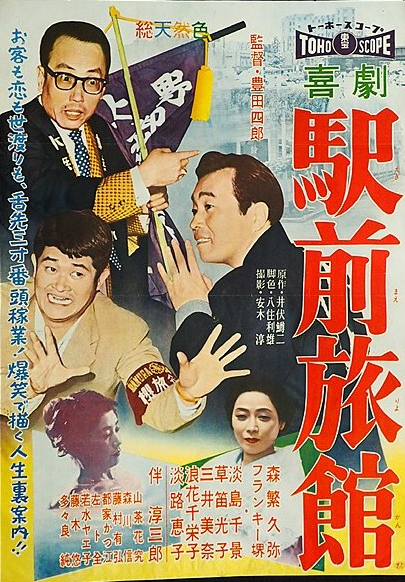
Hotelman's holiday poster 1The post-war world was one rife with trouble. By 1958, however, the horizon was perhaps beginning to brighten which means it was no longer too soon have a good laugh about how awful life could be. Nothing particularly awful happens in Shiro Toyoda’s cheerful comedy The Hotelman’s Holiday (駅前旅館, Ekimae Ryokan), the first in a series of “Ekimae” or “station front” movies produced by Toho, but it does amusingly rip a leaf out of Toei’s book in having its community of feckless hoteliers band together to stand up to greedy yakuza stand-in barkers who are actively destabilising the local economy with their underhanded ways.

Our hero, “born in a maid’s room” Jihei (Hisaya Morishige), is the manager of the Kukimoto inn near Tokyo’s Ueno station. Kukimoto seems to get most of its business from large tour groups, particularly school children on trips to the city and religious organisations, seemingly unperturbed by the area’s then scrappy working class earthiness. The problem is that there are rather a lot of inns in this small area (it is after all near a major rail station) and they’re all competing for the same walk-in guests which means they’re increasingly at the mercy of the local “barkers” who target travellers at points of transit and take them to certain inns in return for commissions. Even so, Jihei himself can often be found outside enticing passersby into the hotel to prove his managerial prowess.

The barkers know their worth and are beginning to get too big for their boots in shifting into the human trafficking business. Not to go into the finer details, the inns have a lot of ladies living on their premises on whom some of their trade relies. The barkers have been tempting the girls from the inns away from their homes and into potentially more lucrative though almost certainly less friendly occupations.

The central drama kicks off when the barkers try to abduct Kukimoto’s maid Okyo (Mina Mitsui) who is saved at the last minute by intellectual student Mannen (Frankie Sakai). Mannen is studying law and working illicitly for several tourist information companies in order to pay his way through college. As such he’s just another of the scrappy young guys trying to forge ahead in the precarious post-war environment. Jihei is, in a sense, pretty much the same. Born in a maid’s room, as he says, he’s very much part of the inn business and is proud to be a manager but also resents his subordinate position to the owner and the way they often treat him like a servant rather than the dependable employee he really is. His position leaves him feeling as if he’s already reached his peak and there is no real future for him other than the status quo. That feeling of futility might be why he, Mannen, and some of the other hotel managers eventually decide that they need to “cleanse” the Ueno Station area of the barker threat.

Their resistance has a pleasantly pithy quality in that it relies on a perfectly peaceful method of putting up banners to encourage customers not to trust the barkers and to approach inns directly. As might be assumed, the barkers aren’t very happy about their business being undermined and immediately begin threatening the Kukimoto inn, whom they assume to be the instigators, with destruction if they do not immediately cease and desist. Jihei thinks he has a solid plan and it does indeed defuse the situation but cannot ultimately rectify it. What it does do is give the inn’s owners the excuse they’ve been looking for to part with him, and Jihei the impetus he perhaps needed to rethink his life.

As Mannen puts it, “our reality is preposterous and absurd”, but we have to go on resisting because “happiness exists even in this world”. The inn managers stand up against the barker oppression in the same way communities stand up against yakuza in Toei’s modern gangster dramas, but like many of anti-gangster narratives, the corruption is so deeply ingrained that it cannot be entirely eliminated, only managed. Thus Jihei, also involved in a series of romantic subplots involving an intense former geisha (Keiko Awaji) and a diffident bar owner (Chikage Awashima), eventually realises that if he cannot change his environment he might be better to leave it, escaping to the sort of place where they still grow barley and travel by cart. Mannen too, their revolution failed, eventually takes off with Okyo to go into business in Osaka, giving up on his imagined future for a more solid present. Meanwhile, chaos rules in Ueno as crowds of travellers pour out of the station towards an uncertain future with only the barkers to guide them.


Original trailer (no subtitles)