

“This shit’s for real.” according to the front desk guy at Hotel New Mexico, an out of the way spot just perfect for those looking to lay low for a little while. Like a lot of Katsuhito Ishii’s work, Party 7 is essentially a series of self-contained vignettes which eventually collide following a series of bizarre coincidences revolving around some money stolen from the mob, a two-way mirror in a regular hotel room, and the receptionist’s tendency to almost literally shoot the shit.
Following a brief prologue, Ishii opens with striking animated sequence which introduces each of the main players with an arcade game aesthetic and explains that Miki (Masatoshi Nagase) has stolen money from the mob and is currently on the run which is why he’s turned up at the infinitely weird Hotel New Mexico. The running gag is that Miki thinks he’s holed up somewhere no one will find him, but sure enough a series of “friends” soon turn up in part thanks to a loose-lipped travel agent. The fact that people can find it so easily dampens the impression of the Hotel New Mexico as some kind of interstitial space. It’s not so much existing in a weird parallel world as a bit run down and staffed by a series of eccentrics. It does however have a “peep room” hidden behind a two-way mirror where “Captain Banana” (Yoshio Harada) is attempting to pass his knowledge on to the young Okita (Tadanobu Asano), the son of a recently deceased friend who has been repeatedly arrested for voyeurism.
Captain Banana’s insistence on his surreal superhero suit is in a way ironic, if perhaps hinting at the super empowerment of accepting one’s authentic self. “It’s your soul,” he tells Okita, “it’s screaming ‘I want to peep’.’” Meanwhile, Miki gets into an argument with his ex-girlfriend Kana (Akemi Kobayashi) who has turned up in the hope of reclaiming money that he owes her. Kana too seems to be less than rigorous with the truth if perhaps emotionally authentic. She’s now now engaged to a nerdy guy having somewhat misrepresented herself as the innocent girl next-door type. Her refusal to let her fiancé into her apartment perhaps hints at a more literal barrier to intimacy or at least that she is intent on preventing him from seeing her true self. What she doesn’t know is that her fiancé hasn’t been completely honest either, in part because he thinks she’s out of his league and is insecure in their romance.
Miki too maybe somewhat insecure, having run off with the gang’s money after hearing them bad mouth his associate Sonoda (Keisuke Horibe) who has now been charged with killing him and getting the money back. But Sonoda too has reasons to doubt the boss’ affection for him after Miki and the others point out that gifts he thought were so valuable are really just cheap knock offs that suggest the boss thinks very little of him at all. Okita’s psychiatrist tells him that there are “no rules in making friends”, and maybe in a strange way that’s what everyone is trying to do. Kana wanted the money to overcome her anxiety about having no friends or family to invite to the wedding, while all Sonoda wanted was the boss’ approval and though Miki had deliberately gone somewhere he thought no one would find him nevertheless attracts a series of followers.
Even the receptionists seem to be desperate for human contact with their strange stories of poo falling from the sky and bizarre approach to hospitality. “The point is whether you believe it or not,” one tells the other after spinning what sounds like a yarn but then again might not be. Ishii’s zany world has its own surreal logic culminating in a piece of cosmic irony and defined by coincidence as the otherwise unrelated stories begin to come together and slowly find their way to Hotel New Mexico but seems to suggest the point is in the serendipity of the meeting and its concurrent authenticity even if a literal shot in the arm is a less than ideal way of brokering a friendship.
Party 7 is released in the UK on blu-ray on 17th July as part of Third Window Films’ Katsuhito Ishii Collection.
Original trailer (English subtitles)






 Japan has never quite got the zombie movie. That’s not to say they haven’t tried, from the arty Miss Zombie to the splatter leaning exploitation fare of Helldriver, zombies have never been far from the scene even if they looked and behaved a littler differently than their American cousins. Shinsuke Sato’s adaptation of Kengo Hanazawa’s manga I Am a Hero (アイアムアヒーロー) is unapologetically married to the Romero universe even if filtered through 28 Days Later and, perhaps more importantly, Shaun of the Dead. These “ZQN” jerk and scuttle like the monsters you always feared were in the darkness, but as much as the undead threat lingers with outstretched hands of dread, Sato mines the situation for all the humour on offer creating that rarest of beasts – a horror comedy that’s both scary and funny but crucially also weighty enough to prove emotionally effective.
 Adolescent romance is complicated enough at the best of times but the barriers are ever higher if you happen to be gay in a less than tolerant society. Ryosuke Hashiguchi’s second feature Like Grains of Sand (渚のシンドバッド, Nagisa no Sinbad) takes a slight step back in time from
 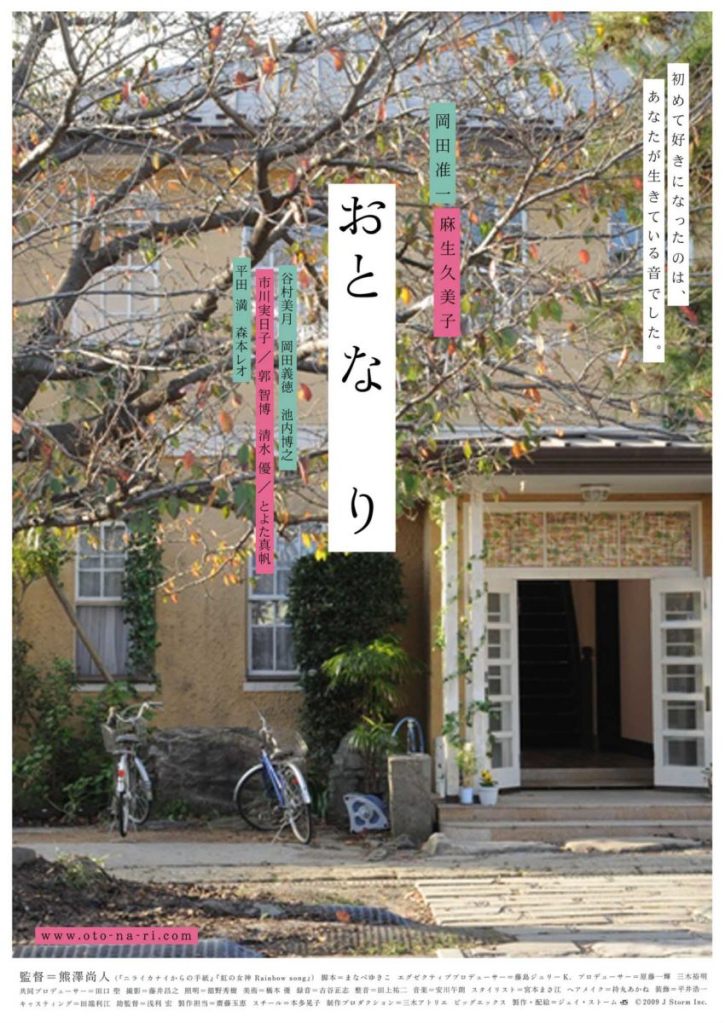 Sometimes when you live in the city it’s difficult to build meaningful connections with other people. You might find yourself a little lost, caught between the rat race and what it was that brought you to the city in the first place, but if you just close your eyes and listen, you can hear that you’re not alone. Romantic Prelude (おと・な・り, Oto-na-ri) is the story of two such people who build up a strange connection even though they’ve never really met.
 It used to be that movies about marital discord typically ended in a tearful reconciliation and the promise of greater love and understanding between two people who’ve taken a vow to spend their lives together. These endings reinforce the importance of the traditional family which is, after all, what a lot of Japanese cinema is based on. However, times have changed and now there’s more room for different narratives – stories of women who’ve had enough with their useless, deadbeat man children and decide to make a go of things on their own.
 Windows on Worlds