Alone in the Night (夜がまた来る, Takashi Ishii, 1994)

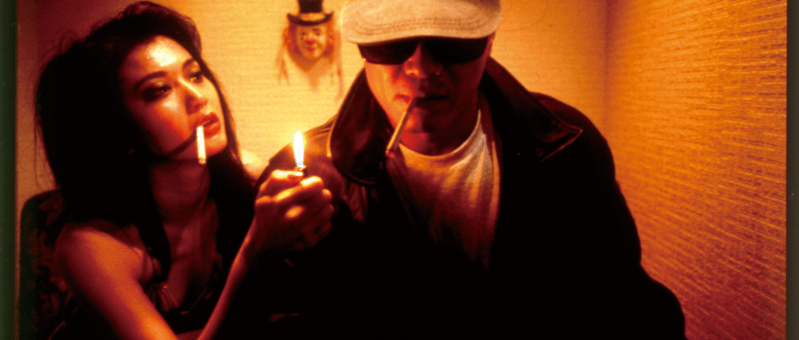
A woman enters the homosocial world of the yakuza in search of revenge for her murdered husband, but discovers only more degradation and hopelessness in Takashi Ishii’s rain-soaked noir, Alone in the Night (夜がまた来る, Yoru ga mata Kuru). Then again, perhaps it’s not really revenge Nami (Yui Natsukawa) is after so much as death itself, her relentless fall one of self-harm born of her sense of futility in world ruled by irony in which there is no such thing as truth or justice.

Indeed, one of the things that propels Nami on her mission is the injustice that her husband Mitsuru (Toshiyuki Nagashima), killed while working undercover investigating a gang dealing drugs, is then accused of taking the drugs he seized and selling them on himself. After her husband dies, she’s hounded by the press who paint him as a corrupt cop while she’s also denied his police pension because he died in disgrace. What she wants is to clear his name and thereby drag her husband back from the netherworld in an affirmation of their love for each other. 

But she too becomes corrupted by the darkness of the criminal underworld. Soon after the funeral, yakuza thugs break into her home and rape her while looking for the drugs they assume Mitsuru stashed somewhere. Amid the chaos, she attempts to take her own life by slashing her wrist with one of Mitsuru’s bones but is unexpectedly saved by a mysterious man. Reborn after her brush with death, she reinvents herself as bar hostess “Mitsuru” as a means of getting close to the gang boss, Ikejima (Minori Terada), she believes to be responsible for her husband’s death. Her attempts to kill him, however, prove unsuccessful. She’s once again raped, this time by Ikejima, and thereafter becomes his mistress until another opportunity arises which she then botches by stabbing him in a non-lethal way which only gets her beaten and tortured by his underling Shibata (Kippei Shiina) and eventually sold to a brothel in Chiba where they get her hooked on drugs to make her easy to control. 

In fact, she’s only spared death once again thanks to the intervention of the mysterious man, Muraki (Jinpachi Nezu), a middle-aged yakuza seemingly weary of life and perhaps drawn to Nami as to death. He seems uncomfortable and out of place in this world of brutal masculinity while his modernity is singled by his association with the gun to counter Shibata’s with the sword. He has other reasons for his duality, but is charged with rooting out moles in the yakuza of which there seem to be an inordinately large number. Despite warning her off, he does what he can to help Nami, in part of out of guilt and a need for atonement, but also a kind of escape from his own entrapment within the purgatorial space of the yakuza underworld. 

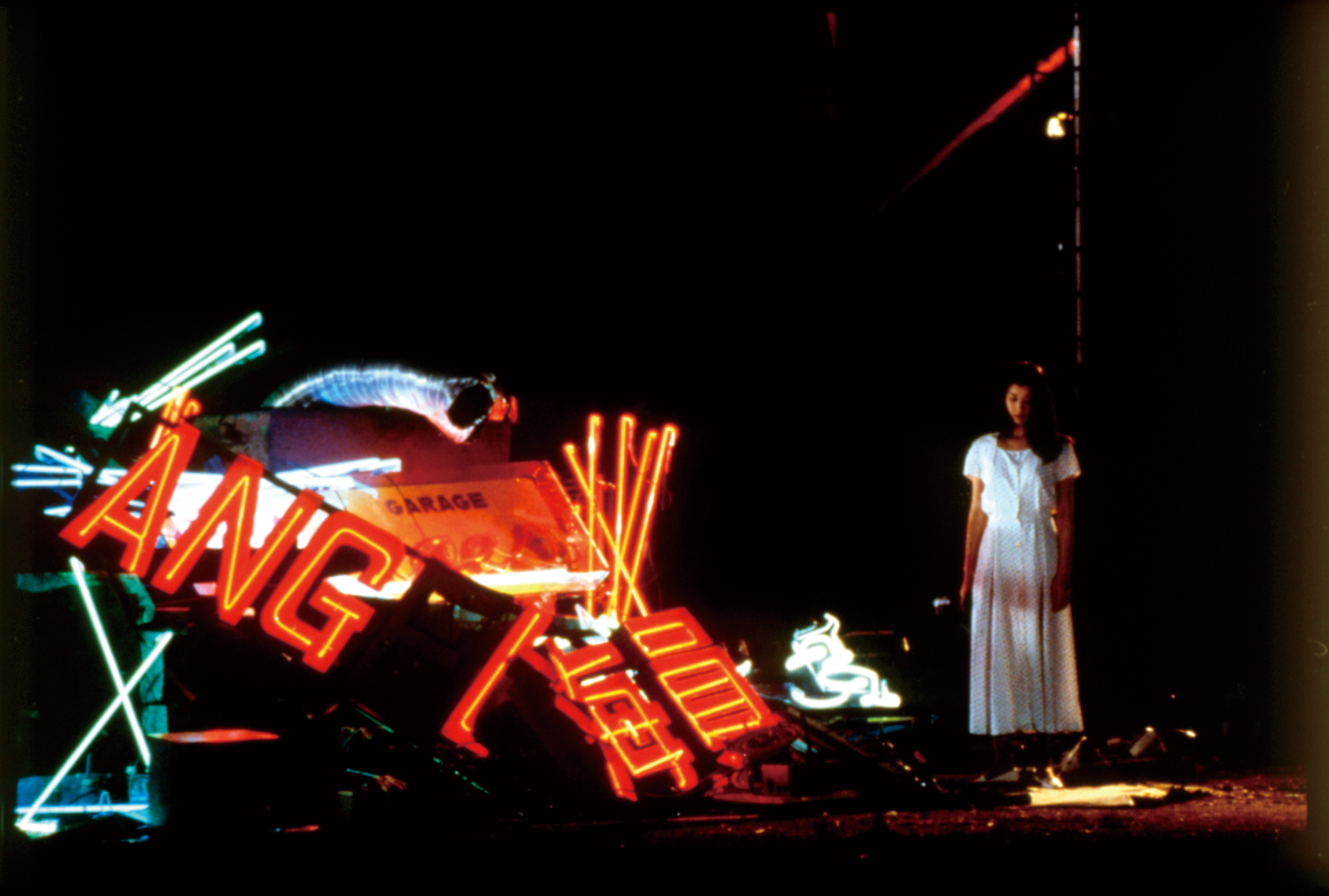
Permanently raining and shot in an eerie blue, the world around Nami and Muraki takes on an etherial, dream-like quality as if taking place somewhere between sleeping and waking. After rescuing her from an attempt to drown herself, Muraki remarks that Nami slept like the dead or perhaps as if someone was calling to her from the other side. Death seems to be beckoning each of them, even as Muraki desperately tries to keep Nami alive by tenderly nursing her back to health and helping her beat drugs so she can finally free them both by achieving their mutual revenge.

But the film’s irony is that Nami cannot achieve her vengeance on her own. She’s constantly rescued by Muraki who achieves some if for her while each of her attempts only plunge her further down the cycle of degradation and in danger of losing herself entirely. She is and remains an ordinary woman venturing into hell in search of justice, but discovering only cruel ironies and futility. Muraki too is unable to transcend himself and meets a personal apocalypse in embracing his authentic identity. Nami has been chasing a ghost all along, though in some ways it may be her own as she tries to make her way back into the world of the living by reclaiming a vision of the world she had before in which her husband was a good and honest man and there was justice in the world even she declared herself largely disinterested in world outside of their romance and their private paradise just for two.


Alone in the Night is available as part of Third Window Films’ Takashi Ishii: 4 Tales of Nami boxset.
Bad City (バッド・シティ, Kensuke Sonomura, 2022)

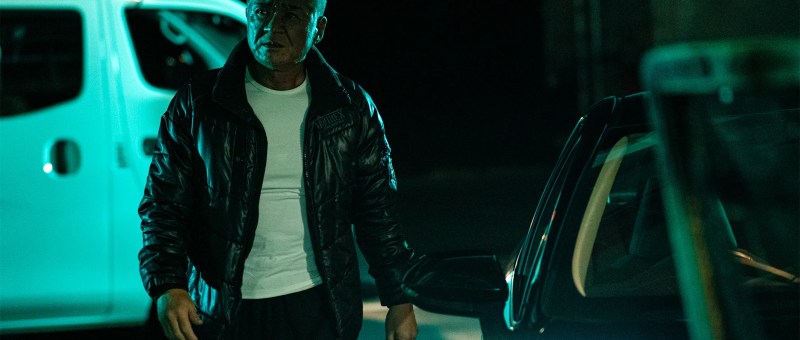
V-Cinema legend Hitoshi Ozawa returns in a tale of big city corruption helmed by Hydra’s Kensuke Sonomura. Scripted by Ozawa himself and apparently created in part as a celebration of his 60th birthday, Bad City (バッド・シティ) is a clear homage to the classic yakuza dramas of the early ’90s while boasting some of the best action choreography in recent Japanese cinema performed by the likes of Tak Sakaguchi along with Ozawa himself who performs all of his own stunts. 

According to dodgy CEO Gojo (Lily Franky) who has just inexplicably been acquitted of extortion and colluding with the yakuza, Kaiko City is riddled with crime and violence which is why he’s announcing his candidacy for mayor. Meanwhile, behind the scenes, a mysterious assassin (Tak Sakaguchi) is cutting swathes through the Sakurada gang who dominate the city’s western district which Gojo has earmarked for a redevelopment project he claims will improve the lives of citizens but is in reality just an excuse to build a massive casino complex intended to enrich himself and his company. The previous mayor had won a landslide victory thanks to his opposition to the redevelopment plan which enjoys little support from the local population but Gojo isn’t exactly interested in winning hearts and minds in the community. 

Really just another gangster himself, Gojo’s machinations are also destabilising the existing underworld equilibrium in seducing treacherous minions from other gangs including vicious Korean gangster Kim Seung-gi whose loyalty to ageing gang boss Madam Kim is clearly waning. Then again, an enemy’s enemy is a friend allowing unexpected alliances to emerge between previously warring factions especially given that the sudden offing of a high status gang boss is frowned upon in the gangster play book. 

With police and judicial collusion the only possible explanation for Gojo’s miraculous escape from justice, an earnest prosecutor sets up a secret task force under the command of Public Security agent Koizumi (Mitsu Dan) and led by veteran officer Torada (Hitoshi Ozawa) who is currently in prison awaiting trial on suspicion of offing Mrs Kim’s only son, Tae-gyun. Torada is an unreconstructed violent cop operating under the philosophy that if you beat up a good guy that’s violence but if he’s bad then it’s justice. He has perhaps learned to see the world as morally grey, not believing himself to be necessarily on the side of right so much as resisting the forces of darkness by doing whatever it takes to survive in this city which is indeed already quite corrupt. Partnered up with two veterans and a junior female officer from violent crimes who were assigned to investigate the Sakurada boss’ murder, the gang do their best to trap Gojo legally by uncovering incontrovertible evidence of his dodgy dealings they can use to nail him in court, or failing that the court of public opinion, that cannot be swept aside by his friends in high places. 

Sonomura opens as he means to go on with a series of bloody assassinations culminating the massacre of the Sakurada gang in a bathhouse, while building towards the final mass confrontation in which Ozawa and his team face off against hordes of foot soldiers trying to fight their way towards a confrontation with Kim Seung-gi. Dynamically choreographed, the action sequences are surprisingly bloody and heavy on knife action but crucially also displaying a high level of characterisation and dramatic sensibility as the earnest cops square off against amoral gangsters willing even to sacrifice their own. 

Though there might be something uncomfortable in setting up the major villain as a rogue Korean gangster, the film paints his defection in part as a reaction to Mrs Kim’s initial loathing of the Japanese while in the end allowing a kind of cross-cultural solidarity to emerge as the Sakurada gang become accidental allies and Mrs Kim receives a lost letter from her son that allows her to change her way of thinking while helping to take down the destabilising force of Gojo, restoring a kind of order at least to the streets of Bad City Kaiko. Ozawa may be an equally dangerous extra-judicial force, but at least for the moment he’s standing in the light where everyone can see him taking out the trash and leaving those like Gojo no quarter in an admittedly violent place.


Bad City screened as part of this year’s Camera Japan.

Original trailer (dialogue free)

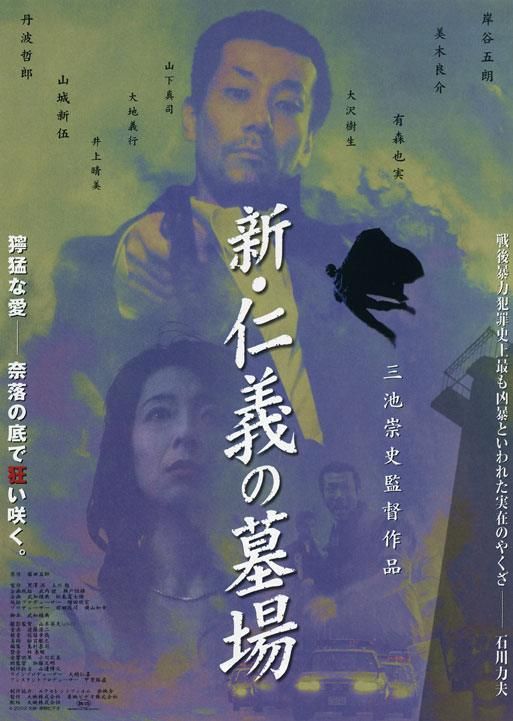
Graveyard of Honor (新・仁義の墓場, Takashi Miike, 2002)

In Kinji Fukasaku’s 1975 jitsuroku eiga Graveyard of Honor, a collection of voices open the film musing on whether the hero was corrupted by the times in which he lived or merely born crazy. Like most jitsuroku or true account gangster movies of the ‘70s, Fukasaku’s Graveyard of Honor is a post-war story about a man who failed to adapt himself to the rules of his society which was of course in constant flux though the rules of the yakuza are perhaps as fixed and timeless as any. Inspired by the same source material Takashi Miike’s comparatively subdued, contemplative Graveyard of Honor (新・仁義の墓場, Shin Jingi no Hakaba) maintains the moody, noirish feel of the ‘70s gangster drama complete with melancholy jazz score but updates the legend of Rikio Ishikawa to late 20th century Japan which again finds itself in crisis, floundering for direction and filled with despair. The bubble has burst in more ways than one as the young in particular awaken to the fact they have been deceived by the false promise that the good times of the Bubble years were cost free and would last forever leaving them abandoned in a world they no longer recognise as their own. 

Unlike Rikio Ishikawa who, we are told, always wanted to be a gangster, Rikuo Ishimatsu (Goro Kishitani) falls into the gokudo world by chance, his life thereafter one long fall until the bloody suicide with which the film opens. A bleach blonde dishwasher at a Chinese restaurant, he gets an offer he can’t refuse when he calmly defuses a would be assassin by hitting him on the head with a chair, earning the eternal gratitude of boss Sawada (Shingo Yamashiro) who takes him on and makes him his protege. This meteoric rise in the yakuza ranks, however, is not without its drawbacks especially in that it destabilises the internal politics of the Sawada gang with old retainers instantly resentful that this young upstart has leap frogged them to sit at the boss’ side while they’ve patiently put the work in only to be sidelined. 

A stretch in prison for avenging the boss’ honour brings him into contact with Imamura (Ryosuke Miki), later his sworn brother but also his opposing number, possibly the last honourable yakuza. “A yakuza without honour isn’t worth shit” Imamura’s boss later remarks, instructing him that Rikuo is a liability he’ll have to take responsibility for, but in this graveyard of honour that kind of responsibility is the one that will get you killed. Honourable yakuza can no longer survive in the world of corporatised thuggery that is the modern gokudo existence. Later we realise that the tale is being narrated by Rikuo’s former underling, Kikkawa, who reminds us that “even yakuza are human beings” existing within a social structure with clearly defined rules which must be followed, yet the rules themselves are largely superficial and Kikkawa survives because he subverts them, abandoning the reckless Rikuo for the certainty of Sawada and setting himself on the traditional gokudo path of sucking up to the boss in the constant hope of advancement. 

Kikkawa is, in a sense, the grovelling salaryman to Rikuo’s frenzied maverick, one as much they symptom of the age as another. Rikuo’s rise occurs against the economic boomtown of Japan in the ‘80s which is as much a paradise for gangsters as for anyone else but also a kind of twilight, the yakuza as an institution relegated to the Showa era and the post-war past. Gangsters forced out of their families like the desperate ronin of the feudal era further destabilise an already chaotic environment which, like that of the post-war years, is filled with despair and disillusionment only to be further disrupted by the advent of natural disaster and economic collapse. 

Like the yakuza of the jitsuroku, those of Miike’s Graveyard of Honor struggle to reorient themselves in a changing society, no more equipped to deal with economic stagnation than their forbears were for the end of occupation and the increasing irrelevance of gangsterdom in a world of economic prosperity. Increasingly paranoid and anxious, Rikuo sees betrayal in all quarters and remains essentially powerless, eventually imprisoned in what appears to have been previously used as a child’s bedroom. He seeks escape in drugs which he finds by chance, and then in romance with an equally powerless woman who bizarrely seems to have fallen in love with him after he brutally raped her though their strange, drug-fuelled quasi-wedding ceremony is the tenderest, most vulnerable we ever see them. Yet as the opening scene implied, all there is is futility. Knowing what he knows, Kikkawa meditates on his memories of happier days when he was just a minion at Rikuo’s side. In this graveyard of honour only the slippery survive and the only way to be free is to fall, and fall hard. 


Original trailer (English subtitles)

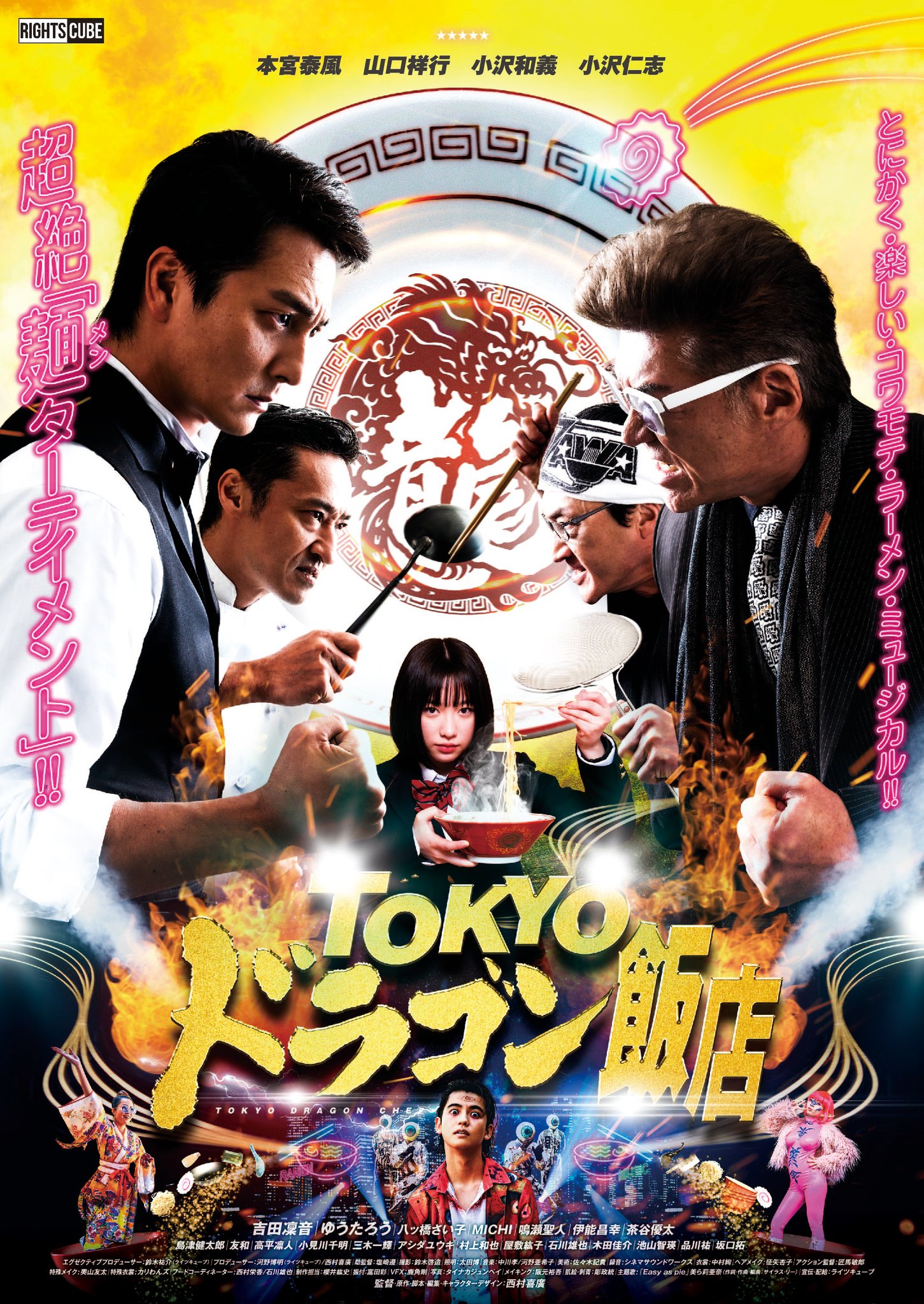
Tokyo Dragon Chef (Tokyoドラゴン飯店, Yoshihiro Nishimura, 2020)

Yoshihiro Nishimura began his career designing makeup and special effects for other directors working in the genre he would later headline, low budget splatter/exploitation primarily produced for the export market. With such legendary titles as Tokyo Gore Police, Vampire Girl vs. Frankenstein Girl, and Helldriver under his belt Nishimura’s reputation for surreal violence is already assured, but Tokyo Dragon Chef (Tokyoドラゴン飯店, Tokyo Dragon Hanten) sees him heading in a different, perhaps unexpected direction with a “family friendly” (depending on your family) musical tale of changing times, intergenerational warfare, and the wholesome soul of ramen. 

Veteran yakuza Tatsu (Yoshiyuki Yamaguchi) has just come out of prison but emerges into a world very different than he left it. His old comrade Ryu (Yasukaze Motomiya) now peddles Nata de Coco out of a tiny van, explaining that a mysterious invader with a third eye, Gizumo (Yutaro), apparently beheaded not only their gang boss but several others in the area effectively killing off the local yakuza scene. Remembering that Tatsu had a reputation as top a cook, a skill he apparently honed inside, Ryu suggests permanently retiring from the life to open a ramen bar. Meanwhile, two rival yakuza, Kazu (Kazuyoshi Ozawa) and Jin (Hitoshi Ozawa), have had exactly the same idea, setting up a van virtually outside and positioning themselves the competition by serving truly ginormous portions literally pushing quantity over quality.  

The truth is that the yakuza as an organisation has entered its twilight period, these older, Showa-style gangsters no longer have much of a place in the modern world hence why they need to find alternative ways of living. This is a fact brought home to them by the main villain who has a bizarre habit of singing Merry Christmas and is something like a youth elitist who resents the privileged status of the middle-aged and older in Japan’s ageing society, insisting that “Japan can’t survive with only old people like you” and that they should step aside to allow the young to rule. His villainy is well and truly signalled by his allegiance to fancy steak dinners which he characterises as high class cuisine suitable for righteous citizens like himself, rejecting the earthy, wholesome charms of the iconic shomin soul food that is ramen. 

The former yakuza, meanwhile, forced to work together, are an unexpected source of egalitarian solidarity. Not only do they eventually add an Okinawan soothsayer (Michi), holding a bright red crystal ball and dressed in traditional Ryukyu fashion while singing in a typical island style, to their ranks but their chief supporter closes all his YouTube videos with “kamsamnida”. Old style gangsters, they intensely resent that Gizumo has taken the battle to the streets in targeting those outside the life such as the Chinese owner of another local ramen bar and the father of their biggest fan, ramen-obsessed high school girl Kokoro (Rinne Yoshida). Yet there is something a little subversive in the irony of these multicultural nods, Kazu and Jin’s rival mascot character Mimi (Saiko Yatsuhashi), a YouTube star famous for eating giant portions who intensely resents being called an “alien”, breaking into cod Korean while the Chinese ramen guy is dressed in the full “Chinaman” outfit complete with fake pigtail. 

Nevertheless, it’s the wholesome charms of authentic ramen which eventually bring people together as the gang prepare to face off against Gizumo who apparently wants to turn the land into some kind of soulless hotel state. The final fight in which the former goons arm themselves only with ramen utensils and noren poles is also not without its share of irony as they turn Gizumo’s weird iconography back against him in despatching his henchmen who are each wearing helmets in the shape of an eyeball which would it seems be something of a handicap in hand-to hand combat even if your opponents were not fearsome gangsters, determined high school girls with vengeance on their minds, “alien” mascots, and spiritualists armed with hazardous balls. A fantastically silly affair, Tokyo Dragon Chef isn’t taking itself too seriously but has wholesome charms of its own in a tale of reformed yakuza, rebirthed communities, and the healing power of ramen as a universal unifier pushing back against snooty, youthful elitism in an ageing society.


Tokyo Dragon Chef is released on DVD & VOD on 25th January courtesy of Terracotta Distribution.

UK Release trailer (English subtitles)

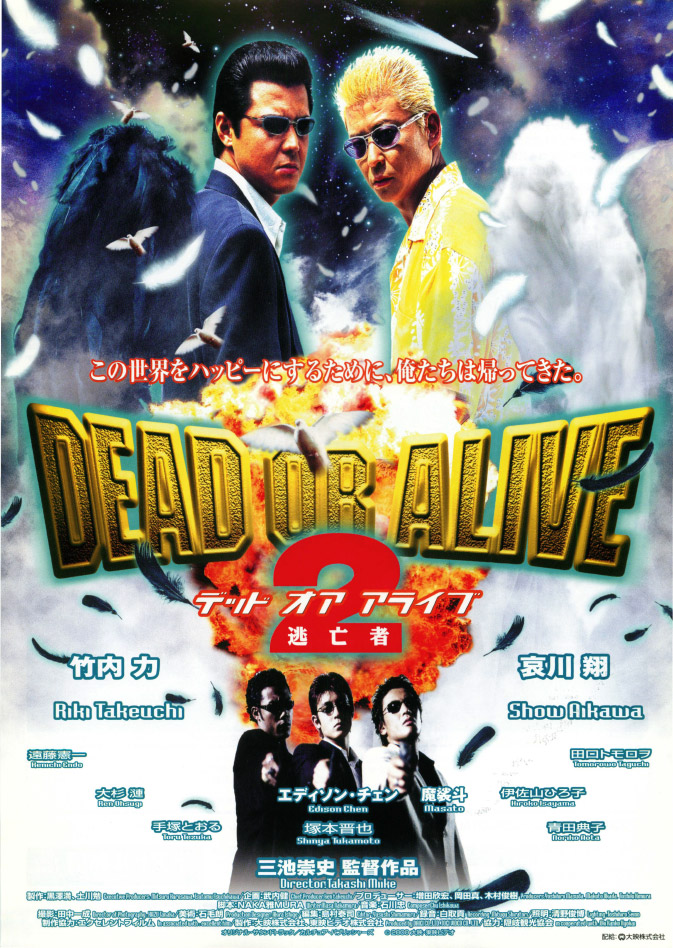
Dead or Alive 2: Birds (DEAD OR ALIVE 2 逃亡者, Takashi Miike, 2000)

dead-or-alive-2-birds

How do you make a sequel to a film which ended with the apocalypse? Takashi Miike is no stranger to strange logic, but he gets around this obvious problem by neatly sidestepping it. Dead or Alive 2: Birds (DEAD OR ALIVE 2 逃亡者, Dead or Alive 2: Tobosha) is, in many ways, entirely unconnected with its predecessor, sharing only its title and lead actors yet there’s something in its sensibility which ties it in very strongly with the overarching universe of the trilogy. If Dead or Alive was the story of humanity gradually eroded by internecine vendetta, Dead or Alive 2 is one of humanity restored through a return to childhood innocence though its prognosis for its pair of altruistic hitmen is just as bleak as it was for the policeman who’d crossed the line and the petty Triad who came to meet him.

Signalling the continuous notions of unreality, we’re introduced to this strange world by a magician (Shinya Tsukamoto) who uses packets of cigarettes to explain the true purpose of a hit ordered on a local gangster which just happens to be not so different from the plot of the first film. Because the gangster world has its own kind of proportional representation, neither the yakuza nor the Triads can rule the roost alone – they need to enter a “coalition” with a smaller outfit no doubt desperate to carve out a little more power for themselves. The free agents, however, have decided on a way to even the power share – hire a hitman to knock off a high ranking Chinese gangster and engineer a turf war in which a proportion of either side will die, leaving the third gang a much more credible player.

Mizuki (Sho Aikawa), bleach blond and fond of Hawaiian shirts, is an odd choice for a secret mission but his sniper rifle is rendered redundant when a man in a dark suit does the job for him – loudly and publicly. So much the better, thinks Mizuki, but the memory of the strangely familiar figure haunts him. Finding himself needing to get out of town, Mizuki has a sudden urge to go home where he encounters the suited man again and confirms that he is indeed who he thinks he is – childhood friend, Shuichi (Riki Takeuchi).

Revisiting an old theme, Mizuki and Shuichi are orphans but rather than being taken directly into the yakuza world they each spent a part of their childhood in a village orphanage on an idyllic island. Miike frequently cuts back between the violent, nihilistic lives of the grown men and the innocent boyhood of long hot summers spent at the beach. The island almost represents childhood in its perpetual safety, bathed in a warm and golden light at once unchanging and eternal. Reconnecting with fellow orphan Kohei (Kenichi Endo) who has married another childhood friend, Chi (Noriko Aota), the three men regress to their pre-adolescent states playing on the climbing bars and kicking a football around just like old times.

Returning to this more innocent age, Mizuki hatches on an ingenious idea – reclaim their dark trade by knocking off those the world would be better off without and use their ill gotten gains to buy vaccines for the impoverished children of the world. In their innocent naivety, neither Mizuki nor Shuichi has considered the effect of their decision on local gangland politics (not to mention Big Pharma) and their desire to kill two “birds” with one stone will ultimately boomerang right back at them.

Innocence is the film’s biggest casualty as Miike juxtaposes a children’s play in which Mizuki and Shuichi have ended up playing a prominent role, with violent rape and murder going on in the city. Whether suggesting that the posturing of a gang war is another kind of playacting, though one with far more destructive consequences, or merely contrasting the island’s pure hearted fantasy with the cold, hard, gangland reality, Miike indulges in a nostalgic longing for the simplicity of childhood with its straightforward goodness filled with friendship and brotherhood rather than the constant betrayals and changing alliances of the criminal fraternity.

The question “Where are you going?” appears several times throughout the film and perhaps occurred to Mizuki and Shuichi at several points during their journeys from abandoned children to outcast men. Neither had much choice in their eventual destination and if they asked themselves that same question the answer was probably that they did not know or chose not to think about it. All of these hopes and ruined dreams linger somewhere around the island’s shore. Kohei is about to become a father but the birth of a child now takes on a melancholy air, the shadow of despair already hanging over him. There is no way out, no path back to a time before the compromises of adulthood but for two angelic hitmen, the road ends with meeting themselves again and, in a sense, regaining lost innocence in shedding their city-based skins.


Out now in the UK from Arrow Video!

Original trailer (English subtitles)

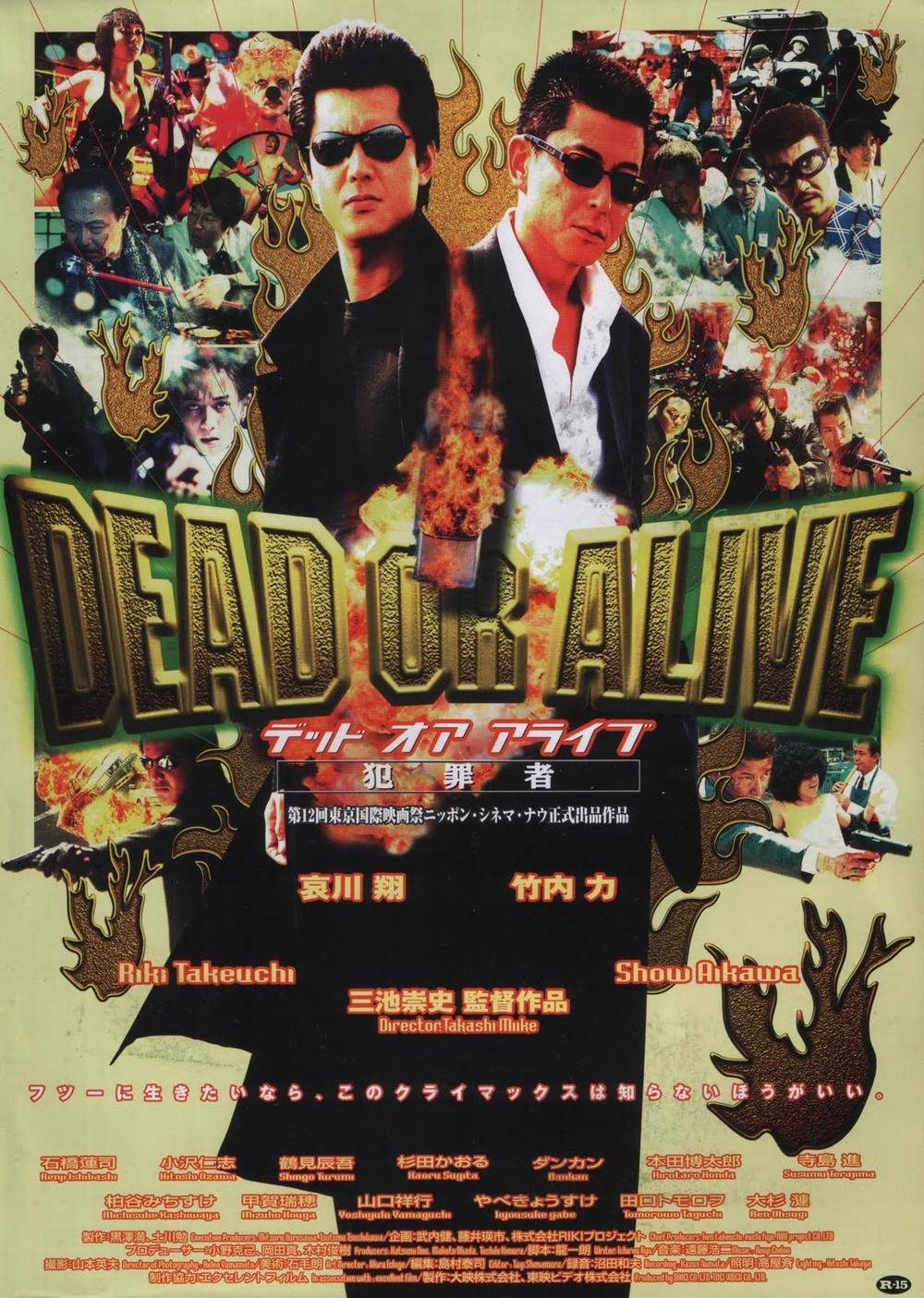
Dead or Alive (DEAD OR ALIVE 犯罪者, Takashi Miike, 1999)

dead or alive
Prolific as always, Takashi Miike released four feature length films in 1999, in addition to working in TV and video. Dead or Alive (DEAD OR ALIVE 犯罪者, Dead or Alive: Hanzaisha) came out within the same year as Miike’s seminal Audition and though it is the latter which has gone on to define his reputation, the Dead or Alive Trilogy is equally responsible for the director’s ongoing popularity. Following the Black Society Trilogy the finale of which, Ley Lines, was also released in 1999, Dead or Alive returns to the world of orphaned exiles and Chinese gangsters, men looking for family in all the wrong places and finding only loneliness, rage, and disappointment. Criminal or cop, everyone is looking for the same old thing but for one reason or another it continually evades their grasp.

Late ‘90s, Shinjuku night life. Miike captures all of its sordid glory in a wordlessly frenetic opening sequence which begins with a naked woman falling off a building and ends with the exploding belly of a noodle loving Triad. The Shinjuku gang scene is a large and complex one but this tiny corner is about to be torn apart by the opposing forces of petty Chinese gangster Ryuichi (Riki Takeuchi) and veteran policeman Jojima (Sho Aikawa).

A little later, the major antagonist – yakuza boss Aoki (Renji Ishibashi), asks a drugged up woman he’s immersed in a pool of her own excrement he himself extricated by means of a series of enemas if she’s high or if she’s come down. Drugs are always on the periphery from the bag in the hands of the falling woman to the deluded hopes and dreams of everyone who’s had the misfortune to find themselves here but Miike takes things one step further and structures his film like the inverted bell curve of a strange trip. The relentless pace of the opening sequence with its constant noodle refills, cocaine excess, and eventual bathroom sex and murder combo gradually winds down giving way to the comfortably numb central section in which Jojima and Ryuichi mirror and circle each other in the murky Shinjuku streets but, as he often does, Miike refuels for an angry, increasingly bizarre final sequence as two men whose quests have cost them everything they were fighting to protect prepare to burn the world rather than see the other live another day.

Ryuichi, like many a gangster hero, is an orphan. His major motivation is a desire to protect his delicate younger brother whom he has sent abroad to study in the hope that he will be catapulted into a successful middle class life while Ryuichi takes over the criminal underworld. Toji (Michisuke Kashiwaya) has returned, but such close proximity to his brother’s darkness may have destabilising consequences for both of them. Ryuichi’s “family” is a constructed one made of other similarly lost or discarded kids of Chinese descent, all looking for a home when neither of the two which present themselves is willing to offer them full acceptance but there is no unconditional love here, betrayal is an easily applied judgement met with a harsh and irreversible punishment.

Even if Ryuichi’s world is cold, Jojima’s may be colder. Despite his wife’s pleas he sleeps on the sofa and seems to have a difficult, strained relationship with the family his life is founded on protecting. Jojima’s reasons for continuing to avoid his marital bed are unclear whether from simple consideration of his strange policeman’s hours or the hushed phone call his wife receives which suggests she may be seeking comfort outside the home, but the one thing which is clear is that this is a family already deeply fractured. Adding to the strain, Jojima’s daughter is seriously ill and his wife has worked out that they will need an enormous amount of money for her treatment. Jojima continues to proclaim that he is “working on it” and will find the money somewhere, reacting angrily to his wife’s desperate suggestion of asking her family for a loan. Wanting to save his daughter himself, he ventures ever deeper into the criminal underworld, crossing the line from law enforcer to law breaker.

Miike operates a tightly controlled approach to pacing after the frenetic opening, slowing right down before exploding in a flurry of gun fire for the climactic shootout (flying chicken feathers and all) and then taking a break until the bonkers finale with its self amputations, mysterious bazookas and strange power orbs. Dead or alive, these are men living in a furious purgatory each denied the very thing they’ve been searching for, but in the end they mirror each other, locked in a vicious cycle of rage and violence which threatens to engulf us all.


Out now in the UK from Arrow Video!

Original trailer (English subtitles)