

The Butcher’s Blade (手遮天, Liu Wenpu, 2026)

Laws are meaningless if no one’s prepared to enforce them. According to the opening titles of The Butcher’s Blade (手遮天, shǒu zhē tiān), the Song had a complicated criminal code with lots of rules to be followed. However, in the real world, they only really apply to certain people. Xue Buyi (Liu Fengchao) has been a constable for 10 years but has become a bitter, broken man who feels himself to be a coward for remaining complicit with this corrupt regime.

A courtesan reports the local coffin maker for rape and violence having slashed her face and thereby not just physically and psychologically harmed her, but destroyed her livelihood. The courtesans complain they’ve reported him before and that no one helps them because they’re not the sort of people who matter in this world. Buyi announces he’ll get them justice and does indeed arrest the coffin maker, but the villagers then turn against him. The coffin maker is well connected and Buyi’s boss lets him go. The courtesans are unsurprised but disappointed, while Buyi’s self-loathing only deepens. His pride and masculinity are further eroded when he tries to help a woman selling noodles that he’s fond of fend off an exploitative landlord who’s been upping the rent in an attempt to coerce her into a sexual relationship. Wei simply asks him for the money instead, but Buyi has nary a penny to his name. Deliberately humiliating him, Wei makes Buyi drink flasks of soy sauce in exchange for reducing Erniang’s (Gao Weiman) debt which Buyi does until Erniang puts a stop to it.

Given all that, it’s easy to see why he might turn to the dark side and allow this world to remake him in its image. The war inside him is between his upbringing as a pupil of Eagle Hall, a brutal police training facility designed to churn out thugs who heartlessly carry out the will of the powers that be, and his natural compassion which baulks at the brutal torture and murder expected of him as a law enforcement official. Buyi is directly contrasted with former colleague Li Zhen (Yuan Fufu) who is keen to get him back on side and working for Eagle Hall, while Buyi struggles with himself over the degree of moral comprise he’s comfortable accepting to be one of Huang’s elite policemen. By remaining complicit, he hopes he can get the money to save Erniang’s noodle stall and protect her from Wei, but she quite obviously can’t stand what Buyi is becoming and didn’t envisage having brutal policemen as her main clientele.

There seems to be a subversive allusion to the present day in the world that surrounds Buyi which is filled with corrupt officials and supported by a rotten regime that policemen like him prop up with thuggish authoritarianism, serving the interests of the powerful over those of the people. Buyi finds himself at the centre of conspiracy when he takes a job guarding government funds intended for disaster relief in the hope of getting extra money to help Erniang only to be accused of robbing the place himself. Recruited by former mentor Huang (Chunyu Shanshan), he witnesses his indifference to the disaster victims who have largely fallen into exploitation at the hands of corrupt landowner Wei. Huang plans to sacrifice them for his own personal gain by framing them as a revolutionary army led by a rival official seeking to overturn the regime which he will then heroically surpress. 

Buyi, however, has to decide whether he can really continue going along with all this or rise up to resist it. Liu Wenpu frames Buyi’s intervention in heroic terms in which he’s surrounded by an eerie blue glow and the sound of firecrackers as he finally decides that he can’t let people like Huang continue with their authoritarianism and indifference towards the welfare of the people. His rebellion, however, seems to make himself something of an outlaw condemned to a life of wandering while ultimately pointless. Huang was just one many and now others are trying to use his fate as a means of advancing their own position. The elegantly choreographed fight scenes take on a symbolic quality as Buyi progresses towards his showdown with Huang while battling himself and his inner conflict, torn between the what it takes to succeed in a world as corrupt as this and his essential humanity before finally coming down on the side of justice for all rather than continuing to serve the interests of an exploitative elite.


The Butcher’s Blade is released on Digital in the US on May 4 courtesy of Well Go USA.

Trailer (English subtitles)
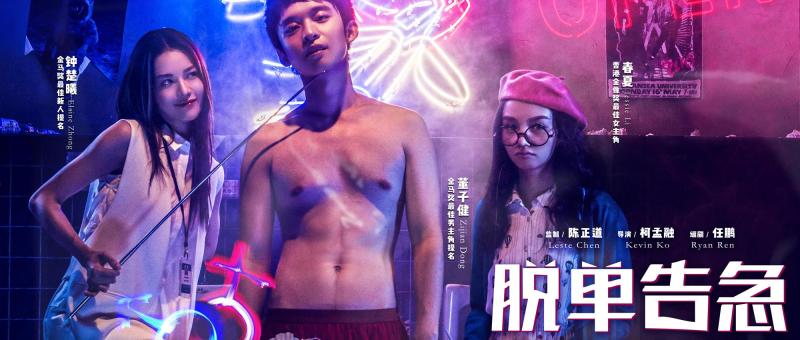
Dude’s Manual (脫單告急, Kevin Ko, 2018)

Dude's Manual posterPersonas – university can be all about figuring them out but more often than not the key comes from an unexpected direction. An unexpected direction is where Dude’s Manual (脫單告急, Tdān Gào) eventually takes us after kicking off with a scary crime thriller opening in which our hero gets himself temporally mixed up with a serial killer investigation only to earn himself the embarrassing nickname “Air Pump” when his “victim” is revealed to be a blow up doll. An unlikely meet cute brings him into the orbit of the most popular girl at school and subsequently into her plan to win back her reputation after getting it tarnished with his naffness at the expense of another shy and lonely student, but then again, isn’t everyone going to get what they wanted? Perhaps yes, perhaps, no.

He Xiaoyang (Dong Zijian) is in the last year of uni and is still single, never having had a girlfriend. An embarrassing incident with a blowup doll has earned him the nickname “Air Pump” around campus, while his roommates – “sexpert” Boshi (Yuan Fufu), and rich kid Ren Yi (Jin Jin), are doing a little better when it comes to the ladies, but neither of them is much help to the nerdy Xiaoyang whose main passion is the homemade flying machine he’s crafting in preparation for a competition. At an exclusive party Ren Yi gets the boys into, Xiaoyang’s life takes a dramatic shift when popular pretty girl Guan Xin (Elaine Zhong) throws up on his T-shirt and then becomes trapped with him in a bathroom from which they fail to escape before a budding paparazzo snaps them together in a compromising position. Guan Xin, mortified that anyone might think she hooked up with “Air Pump”, hatches a plan to get Xiaoyang a “real” girlfriend to clear her name and retrieve her top girl status.

As rom-com plots go it’s a fairly old fashioned one. Guan Xin decides to set Xiaoyang up with a shy concert pianist, Li Shushu (Jessie Li), who hardly ever comes to parties because of her intense social anxiety. She is therefore, Guan Xin rationalises, perhaps grateful for the interest and Guan Xin is really “helping” two people by manipulating them both into a possible relationship which might just have legs. Of course, while she’s doing that she and Xiaoyang can’t help but grow closer even if Guan Xin can’t quite bring herself to admit it.

The spanner in the works is that Xiaoyang, despite himself, is a pretty nice guy. He plays along with Guan Xin’s scheme but quickly goes off book, demonstrating genuine understanding and connection with the shy Shushu as he gently helps to bring her out of her shell. He is, however, also falling for Guan Xin but doubting that she will ever set aside her haughty attitude and accept her growing feelings for him.

The central irony is that Guan Xin can’t see all the ways in which she and Xiaoyang have already progressed through the standard rom-com gateways to love. Meanwhile, Xiaoyang’s friends are also enjoying a lesson in romance with both of their respective girlfriends as sex obsessed Boshi has to learn to be less superficial, and Ren Yi that money really doesn’t buy everything. It is hard to get past the unethical using of poor Shushu who becomes a sacrificial pawn in Guan Xin’s grand plan, but then again perhaps she learns a thing or two herself even if it’s just how to subvert someone else’s nefarious plan in order to engineer a happier out come for all.

Ko has a few laughs at the expense of the young men and women of modern China. Lives lived online have contributed to an already shame hungry culture and given birth to a fair few unscrupulous paparazzo gossip hounds who might be better sticking their cameras in more useful places, while also reinforcing traditional ideas about social hierarchy. Guan Xin, in many ways taking on the masculine Svengali role as she “fixes” the feminised ugly duckling of Xiaoyang, has some pretty cynical ideas about modern dating – using jealously as a weapon, trying to turn the “nice” Xiaoyang into a hot bad boy player that all the women will go crazy for, but then her plans do seem to work and Xiaoyang sees himself rising through the loser ranks to become an eligible campus catch. Like all good rom-coms, however, he doesn’t let himself be changed on the inside so much as rediscover what it is that makes him him, flying off into the sky on the wings of a romantic dream crafted with his own hands.


Dude’s Manual screens as part of New York Asian Film Festival on 14th July at 2.45pm.

Original trailer (English subtitles)