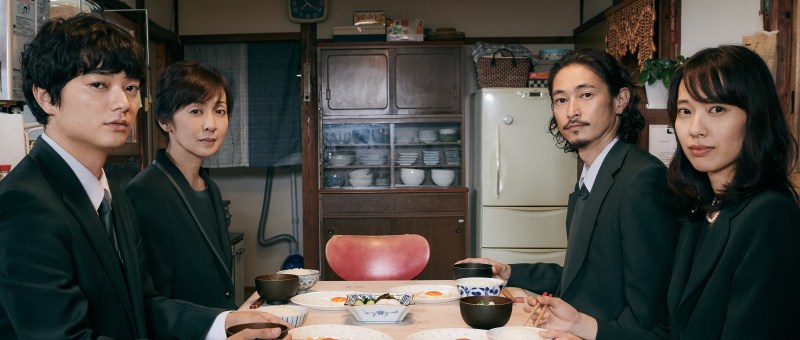
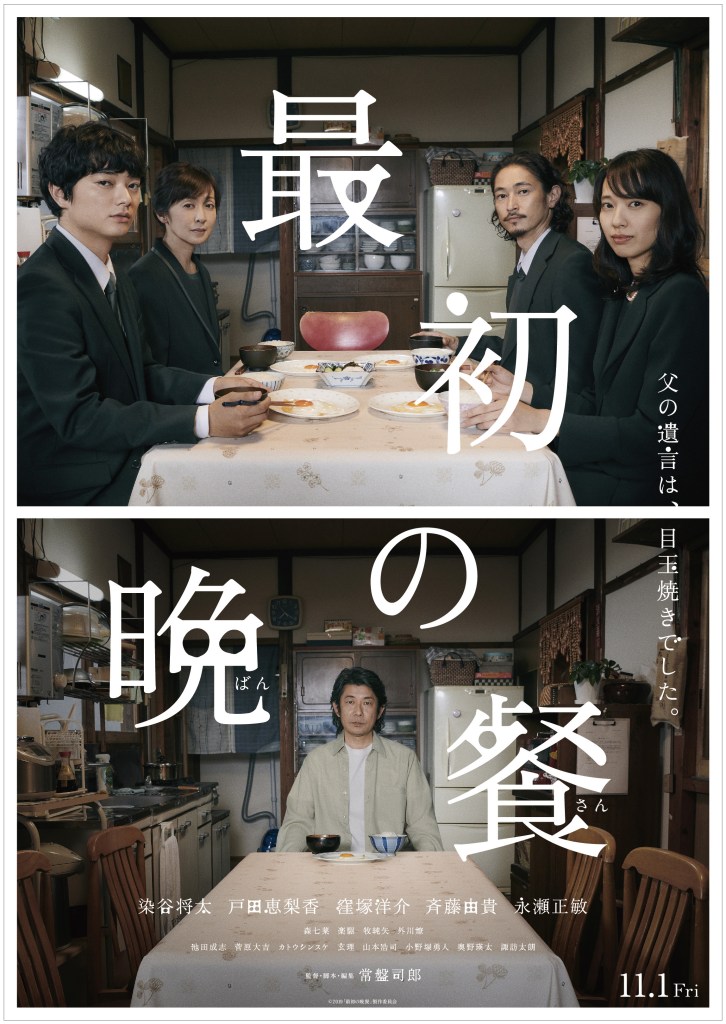
“Family” – what does it mean? The concept itself has been under examination for some time, at least as far as the “family drama” goes, but Shiro Tokiwa’s The First Supper (最初の晩餐, Saisho no Bansan) has it more positive than most as its somewhat emotionally distant hero begins to piece his back together and rediscover his place within it. He does so largely through the Proustian power of food as his lonely step-mother does her best to unite the family by reviving warm memories of the various meals they shared together.
Yet, as Rintaro (Junya Maki / Shota Sometani), a Tokyo-based freelance photographer grappling with the art/commerce divide, is insensitively told at his father’s funeral, his is not an “ordinary” family. That would be (partly) because it was a blended one. Rintaro and his sister Miyako (Nana Mori / Erika Toda) were being brought up by their single father, Hitoshi (Masatoshi Nagase), their mother having apparently left the family, before he brought Akiko (Yuki Saito) and her teenage son Shun (Raiku / Yosuke Kubozuka) to live with them. As a grown man, Rintaro still claims not to be able to understand what his father was thinking, why he wanted to start a “new” family by bringing Akiko and Shun into their home, especially as it led to him giving up his lifelong love of mountaineering to get a steady job in a factory. It never seems to occur to him that perhaps his father simply fell in love again and wanted to share his life with a woman who loved him, becoming a father figure to her teenage son in welcoming an expansion to their family.
There is, perhaps, still a resistance to the entire idea of blended families or even remarriages especially in the more conservative countryside. Dealing with an offensive uncle, Rintaro fires back that this kind of thing is perfectly normal and no kind of issue at all in Tokyo, so he’s not sure what the problem is but it’s clear that there is still a degree of disapproval of Hitoshi and Akiko’s union even 20 years later. Part of that might be to do with the circumstances of their meeting which we later discover had their share of moral ambiguity. That central secret, and the ones which spur off it, is the reason that Rintaro has never quite been able to put his family together, while Miyako, married at a young age and now the mother of two daughters, is experiencing a degree of marital strife with her mild-mannered husband (Shinsuke Kato) who accuses her of cheating with an old classmate at a reunion.
Akiko stuns them all by abruptly announcing that she’s cancelled the caterers for the wake and is planning to cook herself, serving up a selection of dishes one wouldn’t usually expect at a funeral but which she claims are taken directly from Hitoshi’s will and each reflect a particular memory of their life together as a family. There is a gaping hole, however, in that we don’t see Shun. “Why should he come?” Miyako replies to Rintaro’s questions, “He’s an outsider here”. A rather cold cut-off for a step-brother, even one you haven’t seen in a long time, and a partial negation of the idea of families not bound by blood even if it’s snapped partly out of hurt.
While Miyako struggles to reconcile herself to her place within her new family and her decision to form it, Rintaro chats on the phone to his sympathetic girlfriend, Rie (Hyunri), who has, perhaps surprisingly, not accompanied him on this emotionally difficult occasion. The problem seems to be, however, that he’s told her not to come even though she’d have liked to be there and it doesn’t seem as if anyone would have objected. An agent ringing him at a spectacularly bad time to tell him he hasn’t won a competition is forced to reveal, in the nicest possible way, that he narrowly lost out because his pictures are “cold”, he has no affection for his subjects and it shows. He remains diffident in his relationship with Rie because he hasn’t worked out this whole family thing for himself and is worried he simply doesn’t know how to fit into one.
Through re-experiencing his childhood through the meals shared with his father, Rintaro begins to regain a sense of belonging, discovering what it was that lay at the heart of his family drama and why it eventually led to a painful breakup. Before all that, however, they’d been happy. Trying to quell a spat between Miyako and Shun over different kinds of miso soup not long after they moved in, Akiko declares that from now on she’s only making one, “blended”, kind for everyone though the choice is theirs whether or not they choose to eat it. Truths are shared, new understandings are reached, and the family is in some sense restored. Their childhoods explained, Miyako and Rintaro begin see a path forwards towards a happy family life of their own while taking their bittersweet memories with them, no longer burdened by anxious insecurity but strengthened by a new sense of belonging that has nothing to do with blood.
The First Supper screens in New York on Feb. 16 as part of this year’s New York Asian Film Festival Winter Showcase.
Original trailer (no subtitles)

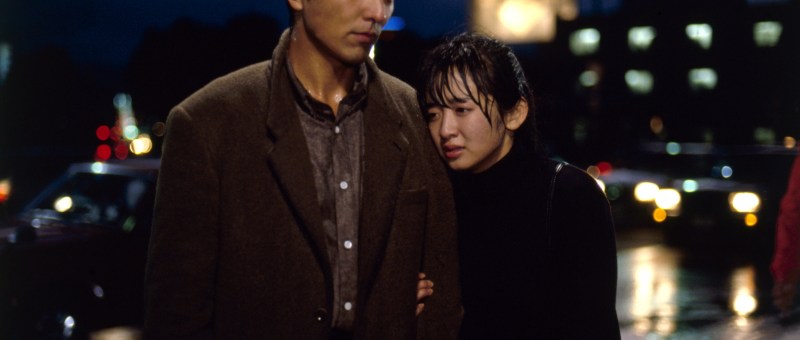
 Kenji Miyazawa is one of the giants of modern Japanese literature. Studied in schools and beloved by children everywhere, Night on the Galactic Railroad has become a cultural touchstone but Miyazawa died from pneumonia at 37 years of age long before his work was widely appreciated. Night Train to the Stars (わが心の銀河鉄道 宮沢賢治物語, Waga Kokoro no Ginga Tetsudo: Miyazawa Kenji no Monogatari), commissioned to mark the centenary of Miyazawa’s birth, attempts to tell his story, set as it is against the backdrop of rising militarism.
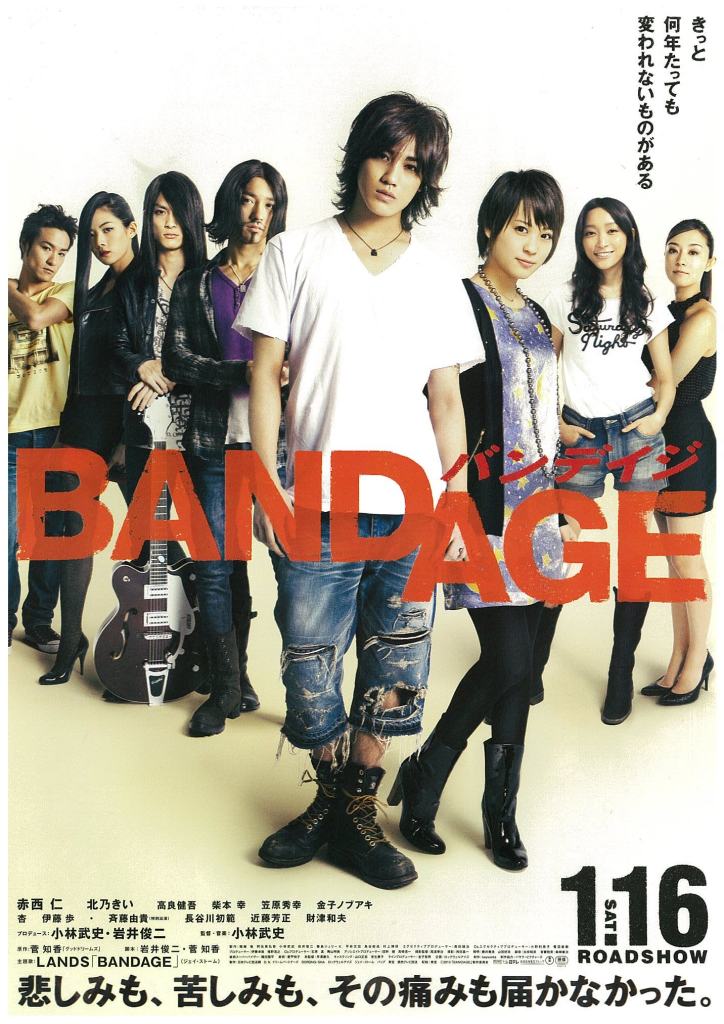 Japan was a strange place in the early ‘90s. The bubble burst and everything changed leaving nothing but confusion and uncertainty in its place. Tokyo, like many cities, however, also had a fairly active indie music scene in part driven by the stringency of the times and representing the last vestiges of an underground art world about to be eclipsed by the resurgence of studio driven idol pop. Bandage (Bandage バンデイジ) is the story of one ordinary girl and her journey of self discovery among the struggling artists and the corporate suits desperate to exploit them. One of the many projects scripted and produced by Shunji Iwai during his lengthy break from the director’s chair, Bandage is also the only film to date directed by well known musician and Iwai collaborator Takeshi Kobayashi who evidently draws inspiration from his mentor but adds his own particular touches to the material.
 The friends you make in high school are the friends you’ll have the rest of your life, says Takako – the heroine of Kazuki Omori’s Young Girls in Love (恋する女たち, Koisuru Onnatachi). Only she doesn’t quite want hers – they’re weird and cause her nothing but trouble. Also one of them is too pretty so she soaks up all of the attention – where’s the fun in that? Takako is not altogether happy in her adolescence but at least she has her friends there beside her, right?
 Windows on Worlds