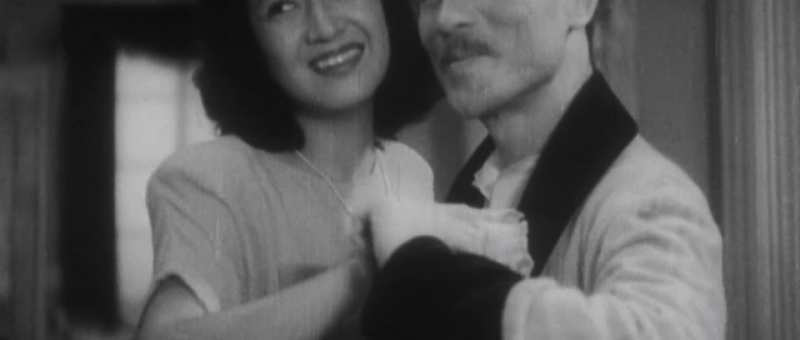
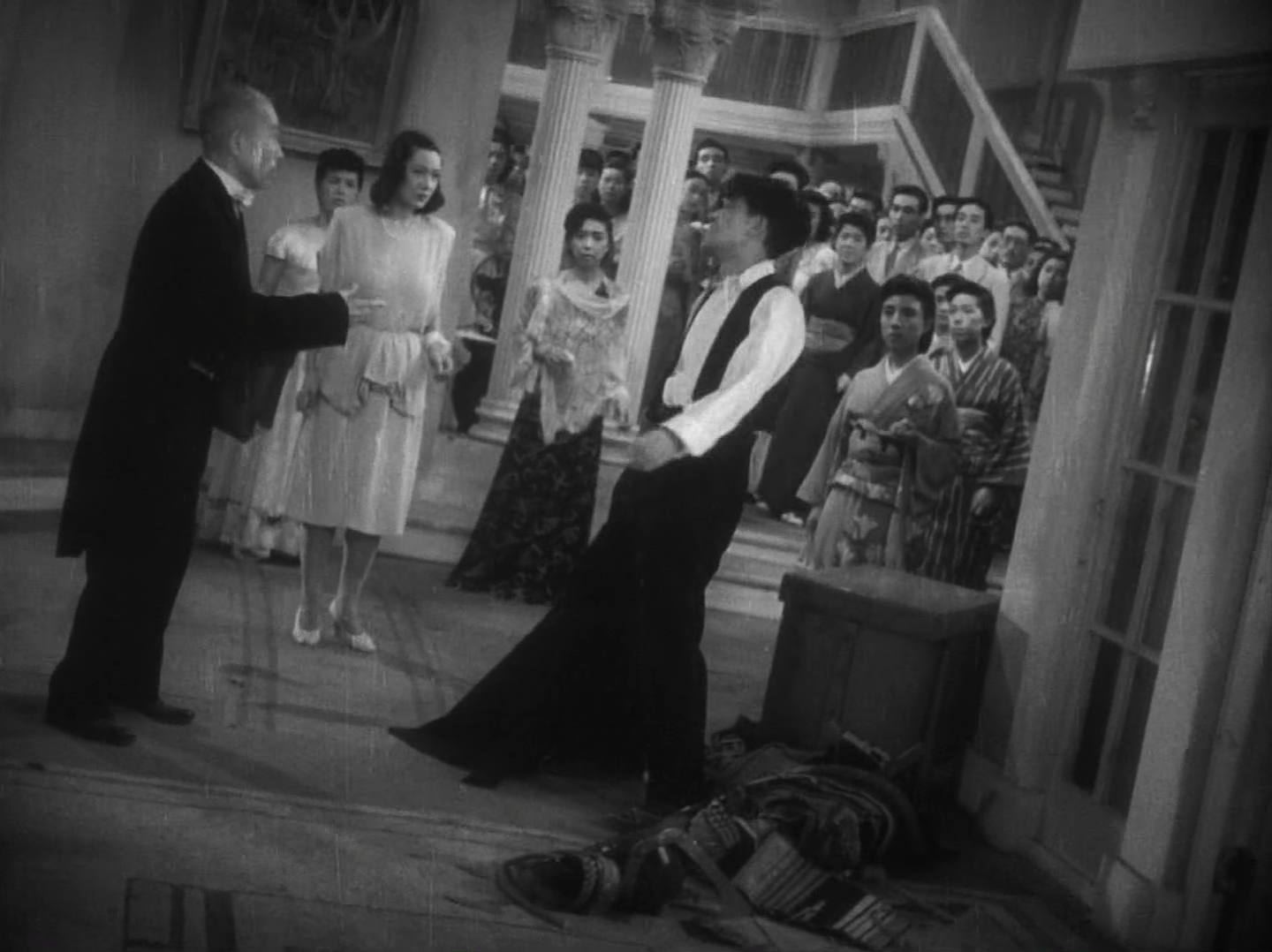
The Ball at the Anjo House (安城家の舞踏会, Kozaburo Yoshimura, 1947)

“Old things die out so new things can be born,” according to the ruined patriarch of a once noble house in Kozaburo Yoshimura’s Chekhovian drama Ball at the Anjo House (安城家の舞踏会, Anjo-ke no butokai), though he might as well be speaking to the post-war society. The Anjos are like the declining aristocracy of the earlier 20th century mourning the disappearance of their world of privilege and gaiety and reflecting that they too must now, as younger daughter Atsuko (Setsuko Hara) says, learn to serve others.

Atsuko is really the only one who accepts the age of the aristocracy has passed and that it is only right and proper that they should join this newly egalitarian, democratic society. Her sister Akiko (Yumeko Aizome) has recently returned home after 12 years having left her husband because of his adultery, but cannot now face it that she no longer has a place here. Approached by their former chauffeur Toyama (Takashi Kanda) who has long carried a torch for her, Akiko snaps that she will always be a noblewoman in heart, unable to let go of outdated customs of class and propriety. She seems to have feelings for the chauffeur too, but won’t let herself embrace them, calling him “dirty” and resenting herself for her attraction to a man who is not her social equal. 

But times are very different now and the aristocracy has been abolished which has in all other senses dissolved the class barrier between them. The tables have turned and Toyama is now a wealthy man having done well for himself in business through honest hard work. Akiko asks him for help as a kind of symbolic gesture as if she were making recompense by handing the house to its rightful owner in their former servant. He insensitively tells patriarch Tadahiko (Osamu Takizawa) that he can easily spare a few thousand to throw away on the house as a sentimental gesture, but does so largely without malice. Only after Akiko has turned him down at the ball and he begins to drink does he start to crow, if a little sadly, that now this base and ugly servant has bought the master’s house. On his way out, he knocks over the suit of armour that had stood in the hall as if literally bringing down the feudalistic military legacy of this once great family and sending it crashing to the floor. The camera suddenly tilts to emphasise that this world is now out of kilter and has been destabilised beyond repair. It’s only this action that frees Akiko from her self-imposed repression as she skips over the armour and chases Toyama out the door. Tumbling down a sand dune she literally descends to his level leaving her pearls and shoes behind. 

The class barrier has been fully dissolved, and Tadahiko too permits himself to marry his long-term mistress, the geisha Chiyo (Chieko Murata), who declares that she doesn’t care about his loss of status and invites him to live with her if he has to sell his house. But it seems as if Tadahiko can’t let go of his ancestral legacy nor his childhood home. In truth, this Western-style country house by the sea can only have been built after the Meiji Restoration which means it’s under a hundred years old and most likely built by Tadahiko’s father, the gentleman in European-style military dress in the portrait. As such, it was likely constructed to look forward to a new era as the samurai class rebranded itself into a European-style aristocracy. Tadahiko’s older sister, married to a lord who’s faring better in this new world, tells an enraptured collection of younger women of the time she danced with a prince a year after the Russo-Japanese war when she was only 19. But this will be the last ball at the Anjo House, in memory of a “beautiful way of life” that has been now been eclipsed.  

Tadahiko had faith that they would be saved essentially through the good chap system in his relationship with a nouveau riche upstart named Shinkawa (Masao Shimizu). Shinkawa holds the mortgage on the house, and there are all sorts of rumours about his shady business. He made most of his money on the black market. Shinkawa had arranged a marriage between his daughter Yoko (Keiko Tsushima) and Tadahiko’s son Masahiko, which gave him even more confidence. But as Atsuko says, Shinkawa was only friendly with him because of his aristocratic title and now it’s gone he has nothing to offer. In marrying Yoko to Masahiko (Masayuki Mori), Shinkawa would have gained the legitimacy of a connection with nobility while Tadahiko would have gained an injection of cash that would save his social status. But none of that matters any more now that the aristocracy has been abolished under the post-war reforms that have also seen Tadahiko’s lands confiscated and estate broken up. It seems that Tadahiko let Shinkawa use his name for a munitions factory during the war, which might not play so well now, just as Akiko’s decision to part with her adulterous husband may also have been influenced by the fact that he was a general who is presumably little in demand in the wake of defeat. Still, Tadahiko prefers Shinkawa to letting the house go to a former servant like Toyama who must himself be enamoured enough with that old world to want to become master of it rather than tear it down.

For Masahiko’s part, he has little interest in marrying Yoko but on learning the engagement has been unilaterally called off and Shinkawa is little more than crook decides to rape Yoko to get back at him. His cruelty is a symptom of post-war nihilism, and we soon discover he’s been sleeping with a maid, Kiku (Akemi Sora), to whom he made promises of marriage he had no intention of keeping. But Like Akiko it seems as if he does care for her after all, only he won’t let himself feel anything in the numbness of his loss of privilege preferring instead to laugh too loudly with his boorish friends. Only on seeing the class barrier dissolve when his father marries Chiyo and his sister Akiko takes off after Toyama does he allow himself to embrace Kiku and express genuine emotion.

Masahiko is played by a young Masayuki Mori who was the son of the novelist Takeo Arishima. Arishima was also a member of the aristocracy but one who became a socialist and dissolved his estate which was something of a fashion in the 1920s. The situation is however complicated by the fact that the Anjos’ servants remain loyal and don’t want to leave them. After all, this is as much their home too and they don’t have anywhere to go either because a world with no masters has no need for servants. We too are encouraged to mourn this world, but its end is also presented as a kind of liberation in which the family are finally permitted to embrace their own desires only after casting off the shackles of the aristocracy and preparing to forge new futures in a changing world leaving the feudal past behind and waltzing into a new and brighter future.
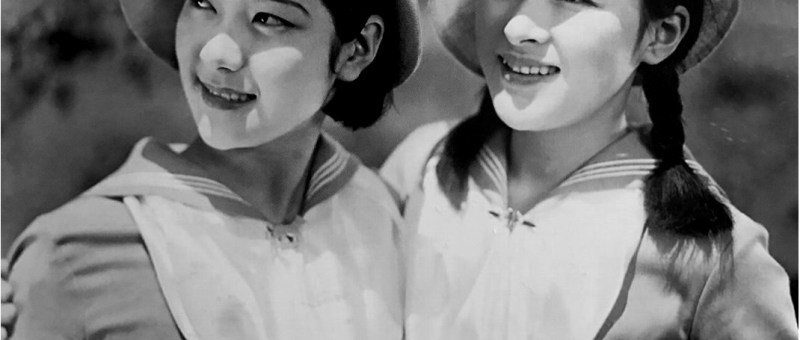
Our Neighbor, Miss Yae (隣の八重ちゃん, Yasujiro Shimazu, 1934)

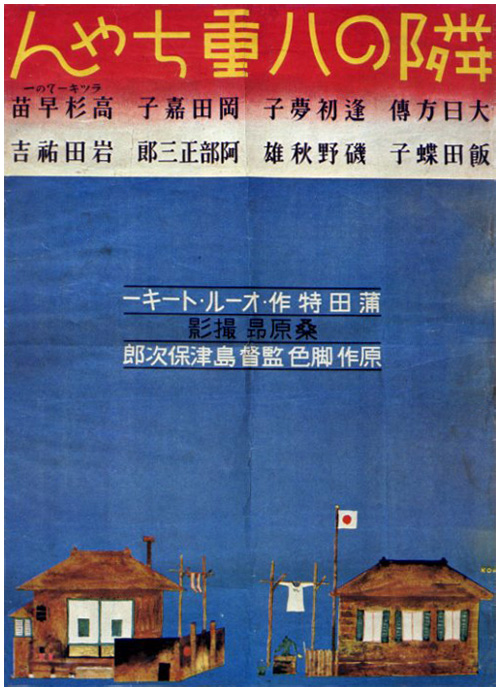
Our Neighbour Miss Yae poster

Retrospectively, Japan in the 1930s looks like a time of misery and darkness, permanently overshadowed by oppressive government and coming tragedy. However, life went on much as it had before with all its customary joys and sorrows. The films of Yasujiro Shimazu are indeed among the least politicised of the era (which might make them, in an odd way, among the most politicised) and Our Neighbour, Miss Yae (隣の八重ちゃん, Tonari no Yae-chan) is no exception in its presentation of the everyday easiness between two very close families and the burgeoning romance between the younger daughter and older son of each.

Notably, the film opens with a scene of intense suburbia as the brothers, middle-schooler Seiji (Akio Isono) and university student Keitaro (Den Obinata), play catch in the yard training for Seiji’s big game at which he has a shot at playing at the legendary Koshien stadium. As young men are want to do, they break next-door’s window but luckily Mrs. Hattori (Choko Iida) across the way is a nice woman who hardly minds, especially as this is such a regular occurrence that the families almost have an account with the local glazers.

The Hattoris and the Arais are so close that it’s no problem at all for Keitaro to jump the fence and hang out with Mrs. Hattori, who even offers to feed him, when he arrives home early to find himself locked out while his mother (Ayako Katsuragi) has gone shopping. Despite his ease in the Hattoris’ home, he is flustered when the girl next-door, Yae (Yumeko Aizome), gets back from a school with a friend in tow. Even more so when he overhears the two girls’ typically teenage conversation in which they briefly touch on Yae’s possible feelings for him while somewhat provocatively discussing breast size – something Keitaro awkwardly chastises Yae for when she returns to the living room in more comfortable clothing.

Shimazu dramatises Keitaro’s embarrassment through his ongoing clumsiness – first of all spilling tea on his floor cushion and attempting to hide it by folding the cushion in half and placing it oddly between thighs and calves, and then by tipping pickles everywhere while awkwardly trying to share them with Yae (much to the amusement of her perspicacious friend who has missed absolutely nothing in this series of awkward exchanges). Yae eventually tries to take the cushion back as it’s a good one only meant for “guests” (which she evidently does not regard Keitaro to be) only to discover his mishap with the tea which is something they can all have a good laugh over. Through all of this Keitaro and Yae seem almost like a young couple already, gently bickering but with real affection. It’s all very innocent but also flirtatious to the extent that the offer to darn a pair of socks almost seems like an elaborate metaphor but then really what could say true love better than a willingness to deal with someone’s stinky footwear?

Seiji is forced to recall his brother’s cute and innocent piece of flirtatious banter when commiserating with Yae’s melancholy older sister, Kyoko (Yoshiko Okada), who returns home unexpectedly after having apparently walked out on an unhappy marriage. An act unthinkable to her mother, Kyoko resolves to have a divorce on account of her husband’s improper relations with the maid and generally frivolous character. Keitaro jokingly said that if he had a wife he’d make her put his socks on for him everyday and she’d have to do it. Keitaro might have been joking, but there’s something in what he said and in Kyoko’s insistence that she doesn’t want to be so “submissive”, preferring to be alone rather than spend another second with a man for whom she has no respect.

Kyoko is, after a fashion, the film’s antagonist in that she begins to come between Yae and Keitaro, destabilising the easy relationship between the families by introducing unexpected tension into the otherwise happy Hattori home. Longing to return to a more innocent girlhood but mindful that she can no longer be as “pure” as Yae, Kyoko is torn between two different kinds of being. She takes on the male role, using her status and position in an attempt at seduction. Becoming a third wheel on Yae’s attempt to ask Keitaro out to the pictures, Kyoko buys the whole gang dinner at an expensive restaurant at which she gets roaringly drunk and falls asleep on Keitaro’s shoulder in the cab on the way home. Noticing Keitaro’s discomfort and irritated on a personal level, Yae asks her to move only for Kyoko to state, ironically, that as she’s paid for the evening she’s sure he can put up with it.

In any case, Kyoko becomes an unanswered question. She remains trapped, wanting her independence but unable to access it. She refuses to return to her husband, but finds scant support from her family who remain preoccupied with potential scandal and the difficult future prospects for a divorced woman. Despite Mrs. Arai’s reassurance that perhaps those things no longer matter so much to younger people, which both women seem to view as a positive development, Mrs. Hattori fails to see the effect her disapproval is having on her daughter’s mental state until it is too late. 

Shimazu doesn’t seem to have much of answer for what to do about women like Kyoko save to leave the question dangling. He does not send her back to her (possibly abusive) husband or find a way for her to move past her difficult circumstances but allows her to become another lost woman whose sense of possibility has been gradually eroded by an oppressive society. Nevertheless, counter to her melancholy we have the girlish innocence of Yae who seems to be on a path of natural, easy connection with the straightforward Keitaro. Even so, her brief idyll is then ruptured by political interventions which might take her far away from her putative love. This potential disaster is eventually partially reversed, mimicking the familiar pattern that one family must be broken in order for another to be formed though in a somewhat perverse fashion that sees Yae become a temporary member of the Arai household but as something more like a sister.

This final intervention of the political is the only hint of external darkness. Shimazu’s vision of ordinary contemporary life is a cosmopolitan one filled with Hollywood glamour which references Fredric March and takes the gang to watch a fairly disturbing Betty Boop cartoon on the big screen while the boys dream of baseball glory and the parents look on mystified but happy. Yet despite the generalised happiness of the serene suburban world they inhabit, there is a mild note of disquiet presented by a deliberate lack of resolution which sends Yae, no longer a neighbour, skipping off happily into the future full of childish innocence while others make their way in a much less certain world.


Flag in the Mist (霧の旗, Yoji Yamada, 1965)

flag in the mist poster 2In theory, we’re all equal under the law, but the business of justice is anything but egalitarian. Yoji Yamada is generally known for his tearjerking melodramas or genial comedies but Flag in the Mist (霧の旗, Kiri no Hata) is a rare step away from his most representative genres, drawing inspiration from America film noir and adding a touch of typically Japanese cynical humour. Based on a novel by Japanese mystery master Seicho Matsumoto, Flag in the Mist is a tale of hopeless, mutually destructive revenge which sees a murderer walk free while the honest but selfish pay dearly for daring to ignore the poor in need of help. A powerful message in the increasing economic prosperity of 1965, but one that leaves no clear path for the successful revenger.
Kiriko (Chieko Baisho), a twenty year old typist from Kyushu, has taken an arduous train journey into Tokyo to get a meeting with a top lawyer she hopes will defend her older brother and only living relative from a trumped up murder charge. The clerk attempts to dissuade her – Mr. Otsuka (Osamu Takizawa) charges a hefty sum for his services and, in any case, his docket is too full to be travelling back and forth to Kyushu never mind the additional travel and accommodation costs. Kiriko is disappointed but undeterred – she thinks she can manage the expenses, but asks for a discount on the fee. The clerk finds this amusing and does at least ask Otsuka who finally agrees to see Kiriko seeing as she’s come all this way. She makes an impression on him but ultimately he tells her he’s just too busy and she’s better off looking for a lawyer closer to home.

Kiriko leaves disappointed but refuses to give up, missing her original train to try again by telephone but Otsuka has already gone out “to see clients” and so she finally has to accept her mission to save her brother may have stalled. While Kiriko was using the public phone, she was overheard by a reporter, Abe (Yosuke Kondo), who wants to write something on the case but his Tokyo based bosses aren’t so keen on a local interest story from halfway across the country.

A year later, Kiriko’s brother Masao (Shigeru Tsuyuguchi) has been convicted and sentenced to death. After his second appeal fails, Masao dies of illness in prison before the sentence could be carried out. Kiriko writes a bitter letter to Otsuka blaming him for her brother’s death which forces Otsuka to reconsider his decision not to take the case. He comes to the conclusion that the case was unwinable and therefore his decision not to take it made no difference but then, he spots something that no one else seems to have noticed.

A tenacious and strong willed young woman – you’d have to be to jump on a long distance train from a tiny village all the way to the big city on your own in 1965, Kiriko is determined to save her brother but finds herself facing an uphill battle against a society deliberately structured to ignore her voice and those of everyone like her. Kiriko is an orphan and so her older bother is also a kind of father figure as well as the only living relative she has left. Masao had been a primary school teacher, which is to say a respected member of society, but found himself involved with a loanshark who was later murdered after he lost some cash collected from students to pay for a school trip and borrowed money he couldn’t pay back from a ruthless old woman. Masao has made a mistake he’s going to pay for dearly – disgraced and humiliated, it was easy work to frame him for a violent crime and force him into a confession through the usual police methods. Kiriko won’t stand for it, but she’s powerless to help him.

Otsuka is, in a sense, entitled to charge what he wants for his services. He’s clearly a talented lawyer, very much in demand, and so why “should” he trek all the way out to Kyushu for a case that doesn’t interest him when he has enough clients already. He does, at least, bother to listen to Kiriko’s pitch before letting her down gently, but just when it seems he might be about to change his mind he tells his clerk to cancel all his appointments and winds up on the golf course with his girlfriend. So much for being too busy to save an innocent man’s life.

Kiriko’s “whole life has been desecrated by one incident” as she cuttingly writes later in a letter which forms a crucial part of her plot of revenge against the man who refused to save her brother’s life (half talking about something else). Forced out of her hometown where she’s the murderer’s sister, she finds work as hostess going by the club name of Rie in a Tokyo bar which has a Kyushu theme. This brings her back into contact with the reporter, Abe, and that isn’t the last of the coincidences as Kiriko finds herself swept up by circumstances which allow her to turn an unfortunate series of events into a cunning plan to ruin Otsuka by neatly echoing the precise circumstances of her brother’s case. Now it’s Otsuka forced to plead with her night after night, begging on his knees that she agree to testify and turn over key evidence that proves his client is innocent all while Kiriko adamantly sticks to her story.

Yamada conjures a tense and gloomy film noir world, following Kiriko down foggy passageways as she tries to navigate the city from the shadows, chasing the spectre of the unjust but losing herself in the process. Masao dies because he was too poor to hire a good lawyer to save him from the police who were supposed to be protecting him, but decided it was easier to stitch up someone without influence than find the real killer. His sister destroys herself to get revenge not just on lawyers more interested in fame and success than in serving justice but on an entire society which believes her existence is insufficiently important to merit full consideration. Otsuka is not a bad man, he is not corrupt or incompetent, he is merely selfish in all the ways his society encourages him to be. Originally letting himself off the hook with the excuse that his decision made no difference, he’s genuinely horrified when he realises he’s noticed a crucial clue which could have exonerated Masao even if it’s an equally selfish guilt he feels more than a recognition that he’s failed his duty to justice by letting an innocent man die while a guilty one lives to kill again. No one wins in this case, everyone emerges ruined and broken by the increasing inequalities and selfish individualism of the post-war world. Justice is blind, so they say, but perhaps she needs to open her eyes.


Original trailer (no subtitles)

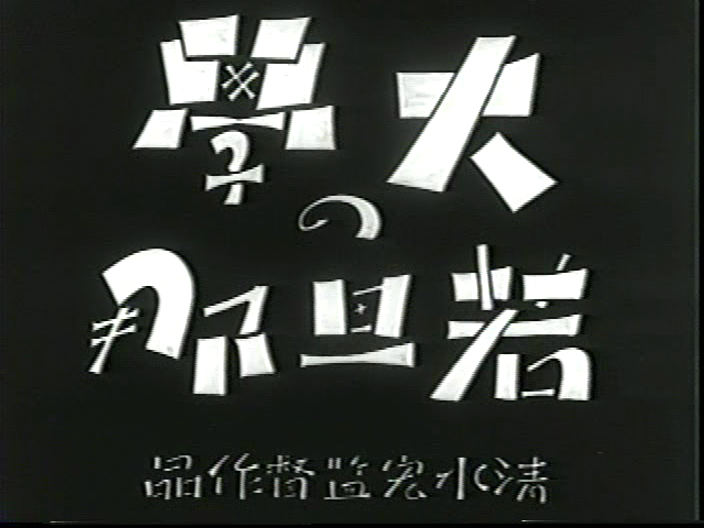
The Boss’ Son at College (大学の若旦那, Hiroshi Shimizu, 1933)

vlcsnap-2016-09-25-01h32m39s471It’s tough being young. The Boss’ Son At College (大学の若旦那, Daigaku no Wakadanna) is the first, and only surviving, film in a series which followed the adventures of the well to do son of a soy sauce manufacturer set in the contemporary era. Somewhat autobiographical, Shimizu’s film centres around the titular boss’ son as he struggles with conflicting influences – those of his father and the traditional past and those of his forward looking, hedonistic youth.

Fuji (Mitsugu Fujii) is the star of the university rugby team. In fact his prowess on the rugby field has made him something of a mini celebrity and a big man on campus which Fuji seems to enjoy very much. At home, he’s the son of a successful soy sauce brewer with distinctly conservative attitudes. Fuji’s father has just married off one of his daughters to an employee and is setting about sorting out the second one despite the reluctance of all parties involved. Everyone seems very intent on Fuji also hurrying up with finishing his studies so he can conform to the normal social rules by working hard and getting married.

Fuji, however, spends most of his off the pitch time drinking with geisha, one of whom has unwisely fallen in love with him. Like many teams, Fuji’s rugby buddies have a strict “orderly conduct” rule which Fuji has been breaking thanks to his loose ways. His top player status has kept him safe but also made him enemies and when an embarrassing incident proves too much to overlook he’s finally kicked off the team.

The times may have been changing, but Fuji’s soy sauce shop remains untouched. Gohei (Haruro Takeda), the patriarch, grumpily rules over all with a “father knows best” attitude, refusing to listen to his son’s complaints. In fact, he tries to bypass his son altogether by marrying off another employee to his younger daughter, Miyako. Though Miyako tries to come to the employee’s defence (as well as her own) by informing her father that “this way of treating employees is obsolete”, she is shrugged off by Gohei’s authoritarian attitude. He’s already tried this once by arranging a marriage for his older daughter but his son-in-law spends all his time in geisha houses, often accompanied by Fuji, and the match has produced neither a happy family nor a successful business arrangement.

Fuji is a young man and he wants to enjoy his youth, in part because he knows it will be short and that conformity is all that awaits him. His dalliance with a geisha which contributes to him being kicked off the rugby team is in no way serious on his part (caddish, if not usually so). However, when he befriends an injured teammate and meets his showgirl sister, Fuji falls in love for real. This presents a problem for the friend whose main commitment is to the rugby team who were thinking of reinstating Fuji because they have a big match coming up and need him to have any chance of not disgracing themselves. This poor woman who has apparently been forced onto the stage to pay her brother’s school fees is then physically beaten by him (if in a childishly brotherly way) until she agrees to break things off with Fuji for the good of the rugby team.

Fuji is finally allowed onto the pitch again, in part at the behest of his previously hostile father who thinks rugby training is probably better than spending all night drinking (and keeping his brother-in-law out all night with him). The loss of status Fuji experienced after leaving the team rocked him to the core though his central conflict goes back to his place as his father’s son. At one point, Fuji argues with a friend only for a woman to emerge and inform him that his friend had things he longed to tell him, but he could never say them to “the young master”. Fuji may have embraced his star label, but he doesn’t want this one of inherited burdens and artificial walls. Hard as he tries, he can never be anything other than “the boss’ son”, with all of the pressures and responsibilities that entails but with few of the benefits. Getting back on the team is, ironically, like getting his individual personality back but also requires sacrificing it for the common good.

In contrast with some of Shimizu’s post-war films which praise the importance of working together for a common good but imply that the duty of the individual is oppose the majority if it thinks it’s wrong, here Fuji is made to sacrifice everything in service of the team. At the end of his final match, Fuji remarks to his teammate that this is “the end of their beautiful youth”. After graduation, they’ll find jobs, get married, have children and lose all rights to any kind of individual expression. Fuji is still torn between his “selfish” hedonistic desires and the growing responsibilities of adulthood, but even such vacillation will soon be unavailable to him. Ending on a far less hopeful note than many a Shimizu film with Fuji silently crying whilst his teammates celebrate victory, The Boss’ Son Goes to College is a lament for the necessary death of the self as a young man contemplates his impending graduation into the adult world, but it’s one filled with a rosy kind of humour and an unwilling resignation to the natural order of things.