Flames of a Flower (火の華, Oudai Kojima, 2024)

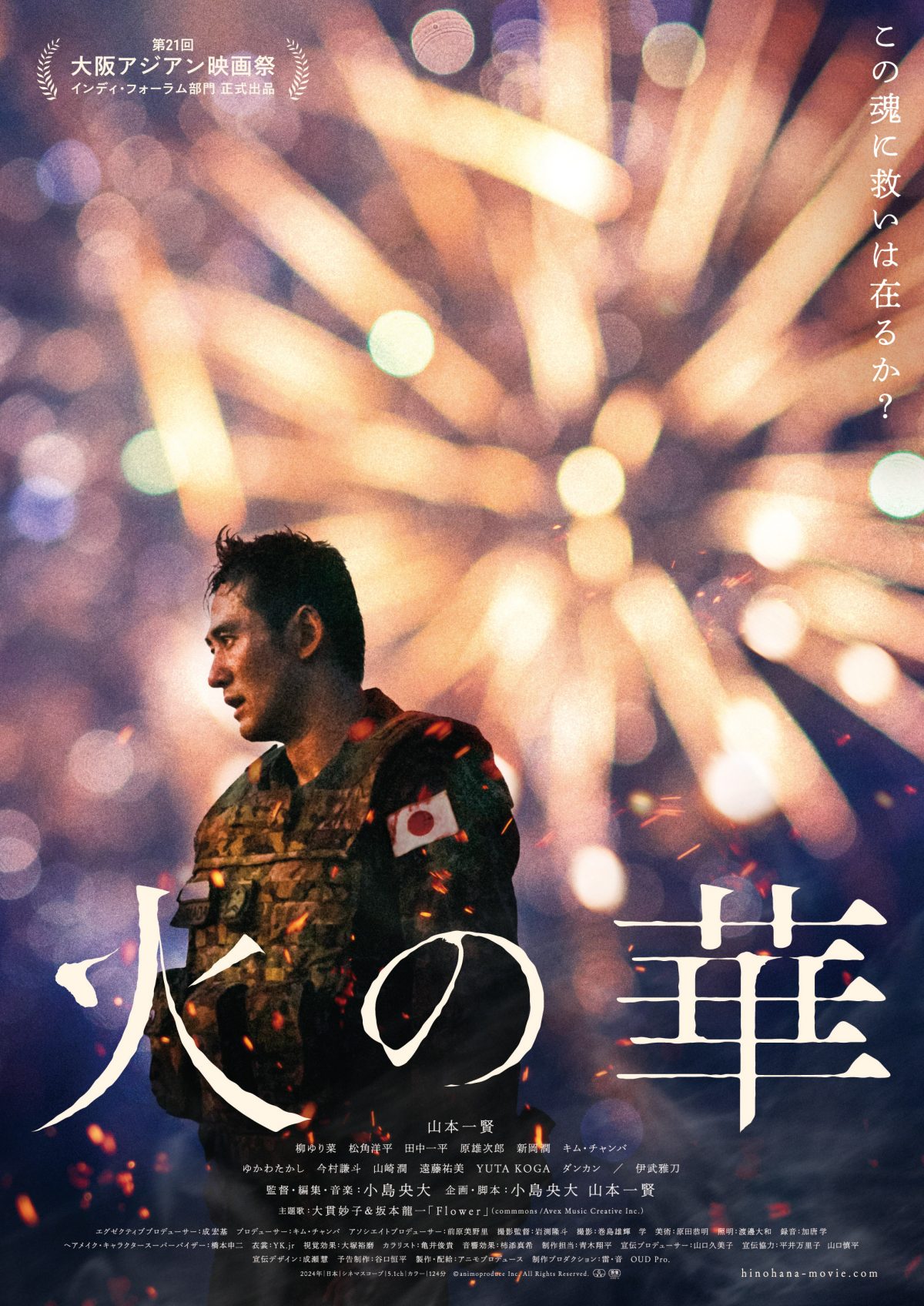
A former soldier finds it difficult to adjust to civilian life after becoming involved in a fire fight in which a close friend died while on a peace-keeping mission in South Sudan in Oudai Kojima’s politically-inflected drama, Flames of a Flower (火の華, Hi no Hana). The film takes its title from the literal meaning of the Japanese word for fireworks, but its hero is also in some senses closely aligned with a flower, both as a kind of sacrificial object burned after outliving its usefulness, and in also slowly growing in the nurturing environment of a family-run fireworks factory until finally coming into bloom.

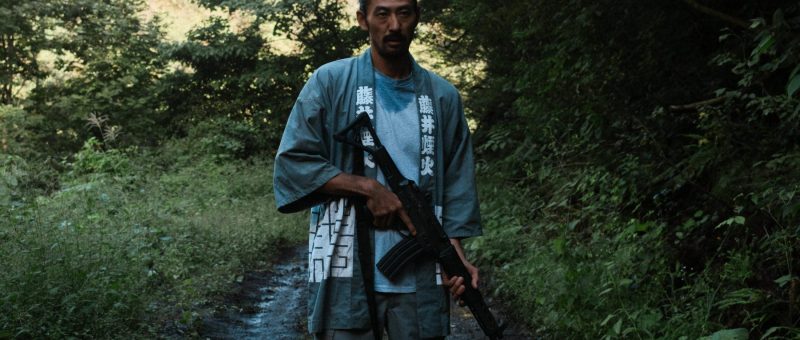
Shimada’s (Ikken Yamamoto) growth is only, however, one side of the story as the film draws inspiration from a real-life incident of a Japanese soldier dying in a combat situation in Sudan which was covered up by the authorities as, under the pacifist constitution, Self Defence Force troops are not supposed to be deployed in combat areas while on peace-keeping missions. While serving in South Sudan, Shimada’s troop is ambushed and he is forced to shoot a child soldier when his comrade and close friend is killed after having put his gun down in an attempt to defuse the situation. While he and fellow soldier Tanaka (Ippei Tanaka) attempt to get Furukawa to a hospital, Captain Ito (Yohei Matsukado) is left behind and thereafter presumed to have been killed. On his return, Shimada is forced to sign confidentiality documents that prevent him from talking about what really happened on the grounds of national security, while the authorities report that Furukawa and Ito died as a result of a traffic accident.

It’s this inability to speak the truth that informs Shimada’s trauma as much as it is the physical stressors of the battlefield or his guilt over having to kill the child soldier. Two years after the incident, he’s working as a welder in a small factory but experiences a flashback which causes him to assault a colleague. Though his boss is sympathetic, he has no other option than to let Shimada go, but introduces him to a friend, Fujii (Masato Ibu), who runs a fireworks factory and seems to have a track record with rehabilitating those with difficult backgrounds. Working in a fireworks factory might not seem the best option given Shimada’s condition, but at the same time it gives him the opportunity to do something more constructive with the same material that caused so much destruction while he was a soldier. The film plays on this dichotomy, Shimada later visiting Sudan again to teach the children about fireworks as a means of explaining to them that they have a choice between using gunpowder for fear and killing or making something beautiful, but at the same time it ignores the third option which is obviously just not to have anything to do with gunpowder in the first place. 

Showing the children the fireworks plays into the idea that children are cruelly robbed of their dreams by egotistical adults, hinting both at the children who are forced to become soldiers, and Fujii’s own regret that he would not let his daughter Akiko (Yurina Yanagi) become a fireworks technician. She has since become a florist working with a literal kind of flowers and also helping Shimada with his recovery. His former comrades, however, have largely become consumed with anger and rage against the government for its lack of transparency. Ito, having survived, has formed a militia after meeting a former member of the Japanese Red Army and is planning some kind of revolutionary action to change the society.

Exactly how they mean to change it isn’t altogether clear aside from a clear desire for transparency and also an end to Japan’s dependence on the US for defence which they argue drags them into situations they don’t belong in because of American foreign policy they might not necessarily agree with. They don’t quite state if that means having a standing army that could go to war if necessary, or if they still believe in pacfism but want the Americans out. In any case, they plan to expose the fact that the government prioritises its diplomatic arrangements over the lives of ordinary citizens while keeping from them that this puts Japanese troops in danger overseas. 

A subsequent plot by a government official working with a Chinese gangster (Kim Chang-bak) who Shimada meets after ironically becoming involved with trading illegal weapons, further muddies the waters, though the film is at its best in exploring the ways in which Shimada is able to come to accommodation with himself while being supported by those at the fireworks factory who become a kind of surrogate family. This sense of community is, the film suggests, what prevents him from jumping off the deep end like his former comrades who have become dangerously fixated on revenge. Though at times its politics may seem muddled or obscure, the film is at least at pains to stress that war and violence are choices that are often made by those who won’t have to suffer the consequences, when it is much easier to channel those same resources into something beautiful that can bring hope and enrich lives rather than destroying them.


Flames of a Flower screened as part of this year’s Camera Japan.

Trailer (no subtitles)
Zokki (ゾッキ, Naoto Takenaka, Takayuki Yamada, & Takumi Saitoh, 2020)

“Thanks to secrets carefully kept by people the world keeps turning” according to one of the many heroes of Zokki (ゾッキ), a series of intersecting vignettes adapted from the cult manga by Yoshiharu Tsuge and directed by three of Japan’s most prominent actor-directors, Naoto Takenaka (whose Nowhere Man also adapted Tsuge), Takayuki Yamada and Takumi Saitoh. According to the philosophical grandpa who opens the series of elliptical tales everyone has their secrets and without them you may die though each of the protagonists will in fact share their secrets with us if by accident or design. 

Seamlessly blended, the various segments slide into and around each other each taking place in a small rural town and primarily it seems around 2001 though as we’ll discover the timelines seem curiously out of joint as motifs from one story, a broken school window, an awkward moment in a convenience store, the retirement of a popular gravure model/AV actress etc, randomly appear in another. This is however all part of the overarching thesis that life is an endless cycle of joy and despair in which the intervals between the two gradually shrink as you age before ceasing to exist entirely. 

Or so says our first protagonist, Fujimura (Ryuhei Matsuda), a socially awkward man heading off on a random bicycling road trip in which he has no particular destination other than “south” or maybe “west” as he later tells a potential friend he accidentally alienates. Fujimura’s unspoken secret seems to link back to a moment of high school trauma in which he betrayed one burgeoning friendship in order to forge another by joining in with bullying gossip and eventually got his comeuppance. Meanwhile the reverse is almost true for Makita (Yusaku Mori) who relates another high school tale in which he overcame his loneliness by befriending Ban (Joe Kujo), another odd young man rejected by teachers and the other pupils for his often strange behaviour such as his tendency to shout “I want to die”. Ban claims to have heard a rumour that Makita has a pretty sister and Makita goes along with it, eventually having to fake his sister’s death in order to seal the lie only for Ban to find happiness in his adult life largely thanks to Makita’s act of deception. 

The broken window which brought them together turns up in another tale, that of Masaru (Yunho) whose adulterous father Kouta (Takehara Pistol) took him on a midnight mission to steal a punching bag (and some adult DVDs) from the local high school only to encounter a sentient mannequin/ghost who is later likened to the young woman from Fujimura’s past. Bar some minor embarrassment there’s no real reason the ghost sighting would need to be kept secret, the deception in this case more to do with Kouta’s affair and his subsequent departure from his son’s life only to make an unexpected return a decade later. The affair also makes him a target for fisherman Tsunehiko, the betrayed husband and one of the fisherman celebrating the birthday of a colleague along with an existentially confused Fujimura. Meanwhile, Fujimura’s fed up neighbour secretly writes a rude word on a note to himself instead of the usual “good morning” only to realise it’s been moved when he opens the local video store the next morning. 

Eventually coming full circle, Zokki insists what goes around comes around, everything really is “an endless cycle”, and that in the grand scheme of things secrets aren’t always such a bad thing. They keep the world turning and perhaps give the individual a sense of control in the necessity of keeping them if running with a concurrent sense of anxiety. The criss-crossing of various stories sometimes defying temporal logic hints at the mutability of memory while allowing the creation of a zany Zokki universe set in this infinitely ordinary small town in rural northern Japan. As the various protagonists each look for an escape from their loneliness, unwittingly spilling their secrets to an unseen audience, the endless cycle continues bringing with it both joy and sorrow in equal measure but also a kind of warmth in resignation. Beautifully brought together by its three directors working in tandem towards a single unified aesthetic, Zokki defies definition but rejoices in the strange wonder of the everyday in this “obscure corner of the world”.


Zokki streamed as part of this year’s New York Asian Film Festival. It will also screen in London on 24th October as part of this year’s London East Asia Film Festival.

Original trailer (no subtitles)

NYAFF intro

It’s Boring Here, Pick Me Up (ここは退屈迎えに来て, Ryuichi Hiroki, 2018)

SR2_teaserWhere now the dreams of youth? Japanese cinema seems to have been asking that very question since its inception but the answer remains as elusive as ever. The heroine(s) of Ryuichi Hiroki’s adaptation of a series of short stories by Mariko Yamauchi, It’s Boring Here, Pick Me Up (ここは退屈迎えに来て, Koko wa Taikutsu Mukae ni Kite), idolise Audrey Hepburn and long for urban sophistication only to find themselves hung up on unfulfilled high school promise and unable escape the wholesome romanticisation of their small-town youth to embrace the demands and possibilities of adulthood.

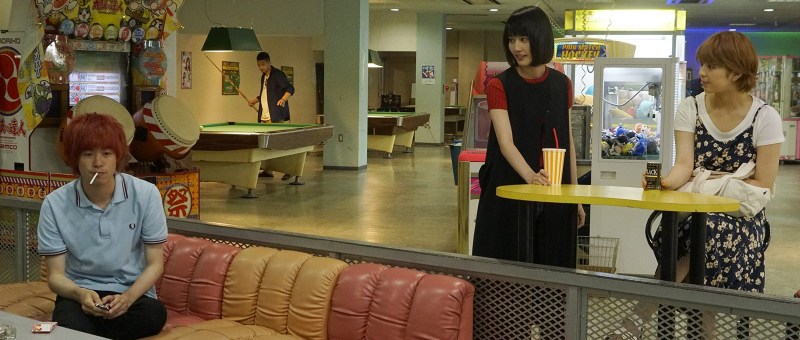
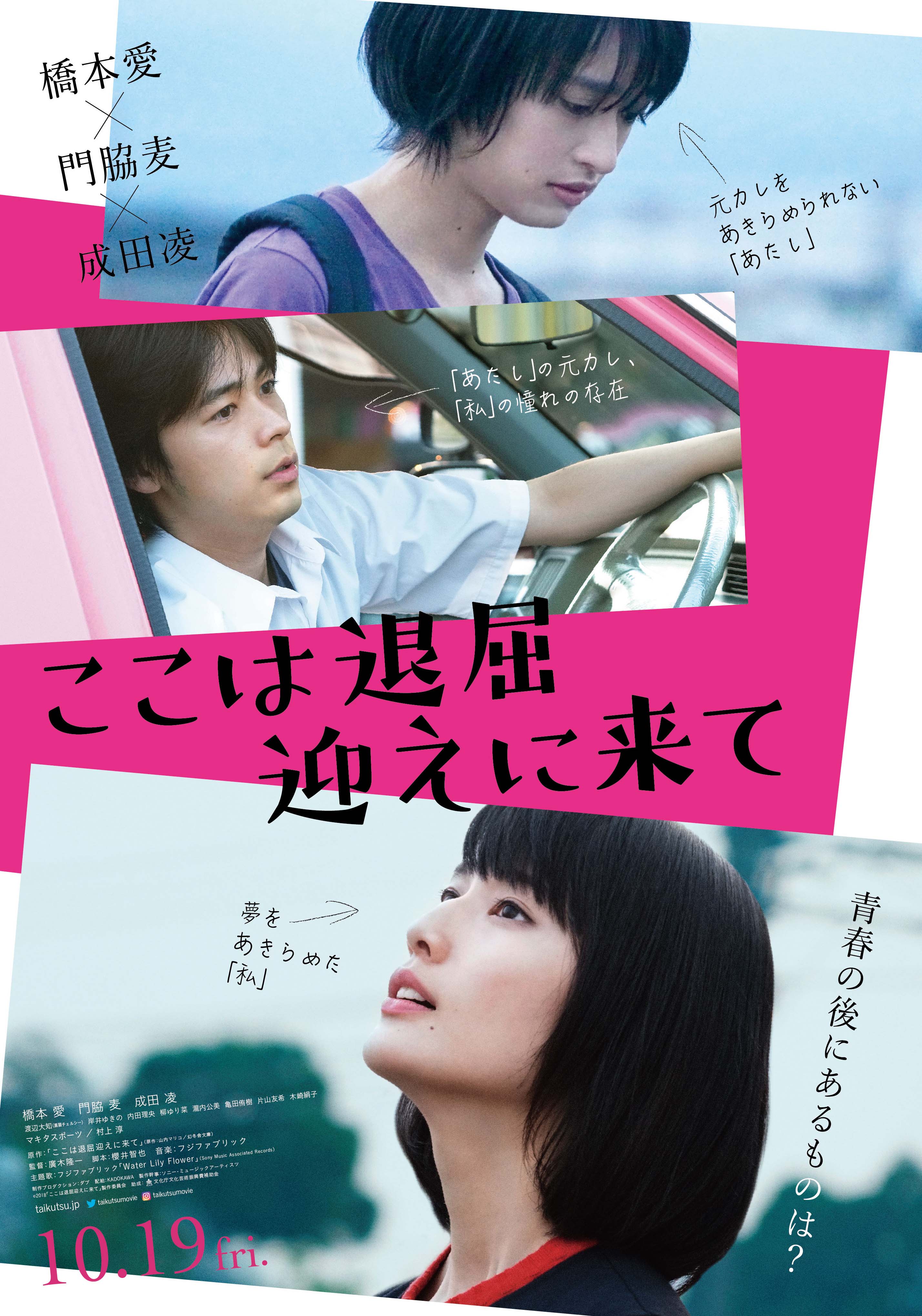
Hiroki follows his small-town high schoolers from 2004 to 2013, jumping freely between time periods as memories spark one another in emotional rather than chronological order. We begin with the unnamed protagonist, “I” (Ai Hashimoto), who has returned to her hometown after 10 (seemingly disappointing) years in Tokyo and now works as a freelance journalist for the provincial paper writing local culture articles on ramen shops and patisseries. She has contacted only one friend since her return, Satsuki (Yurina Yanagi), who has suggested, rather tongue in cheek, that they reconnect with former high school crush Shiina (Ryo Narita).

Back in high school, Shiina was like some kind of untouchable god. Everyone just wanted to be around him as if he alone made the sun shine. All the girls were in love with him, and the all boys wanted his approval. Asked about his hopes and dreams, Shiina just wants high school to go on forever, perhaps realising that he’ll never have it so good again. “I” meanwhile, claims that she wants to “become someone”. A small town girl who didn’t fit in, she hoped to find herself amid the hustle and bustle of the big the city but has returned with an even deeper sense of alienation than when she left with only the bright memory of her brief time as a chosen member of Shiina’s after school posse to cling to.

Satsuki, meanwhile, stayed behind but seems equally hung up on unfinished high school business. Having never been to Tokyo she is envious of her friend’s experiences and longs for the anonymity of the city. If you mess up in Tokyo, she claims, people will eventually forget whereas if you make a mistake in the country it’s all anyone will talk about for the rest of your life. That certainly seems to be true for another of the girls’ contemporaries (Rio Uchida) who left to become an idol only for it all to go wrong and come home branded as a loose woman. Cynical and calculating, she decides on an arranged marriage only to find herself shackled to an old man she doesn’t like very much while her shy friend (Yukino Kishii) seems to have found love by stealth and apparently won the jackpot without even knowing it.

Continuously travelling, the now almost-middle-aged high schoolers meander without direction as if circling around the locus of their departing youth and the sense of possibility disappearing with it. Running into another classmate, Shinpo (Daichi Watanabe), also connected with Shiina, I and Satsuki get a few more clues about their high school crush who apparently now lives a fairly ordinary life as a driving instructor thanks to Shinpo’s recommendation without which he was set to hit rock bottom after some kind of breakdown while failing to make it in Osaka. Nicknamed “Chinpo” (which means “willy”) in school, Shinpo’s dream for the future was to exist alongside someone that he loved but he seems to have given up even on this depressingly compromised desire and resigned himself to loneliness and lovelorn misery as someone who will never be able to find his place in a conservative and conformist society.

I meanwhile, like a similarly unnamed counterpart (Mugi Kadowaki) who really did date Shiina until he cruelly cast her aside, is finally able to burst her high school bubble by confronting it directly and seeing the reality rather than her romanticised impression of it. Those shining days of fun and friendship with everything still ahead will never come again, and so the memory of them remains bittersweet at best. Adult life is dull and disappointing, but there is perhaps melancholy happiness to be found in learning to embrace the present moment rather than harping on a largely imagined past or idealised future. 


It’s Boring Here, Pick Me Up was screened as part of the 2019 Nippon Connection Film Festival.

International trailer (English subtitles)