Invincible Swordsman (笑傲江湖, Luo Yiwei, 2025)

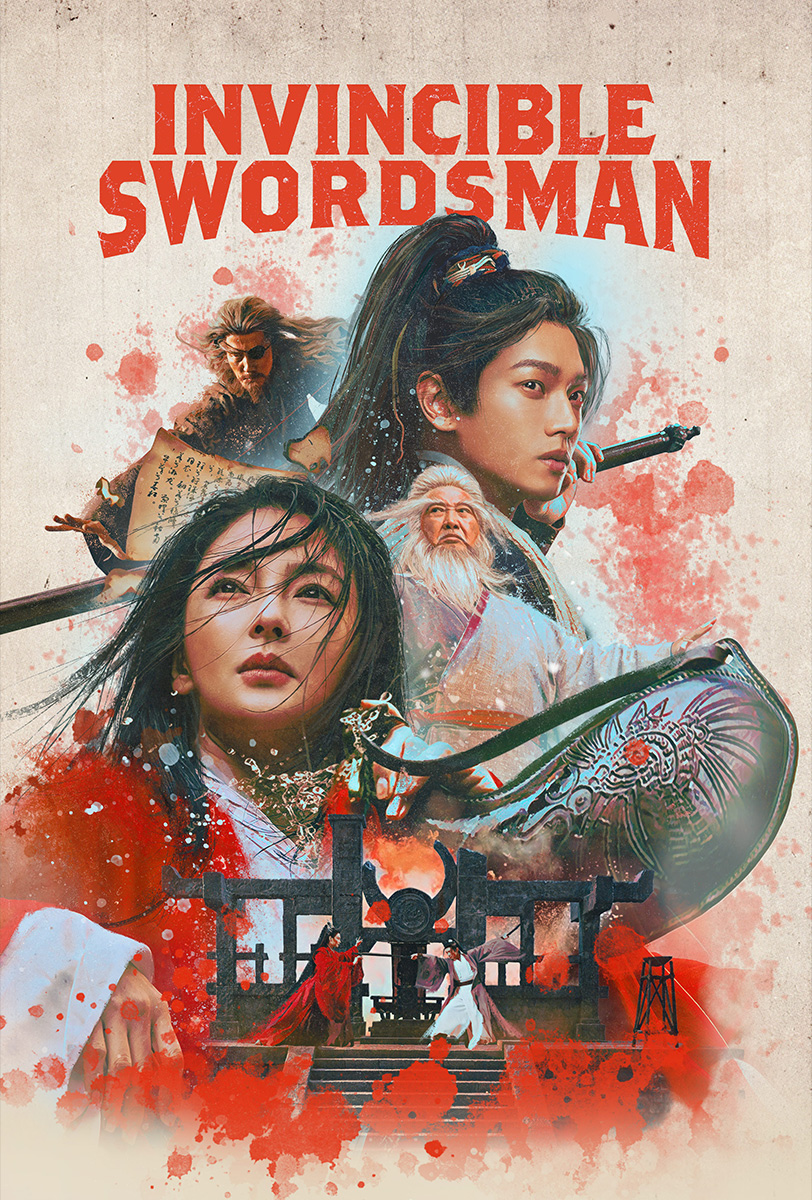
Adapted from Jin Yong’s wuxia classic The Smiling Proud Warrior, Invincible Swordsman (笑傲江湖,
xiào ào jiānghú) has a hard battle to fight in covering the same ground as 1992’s Swordsman II which featured an iconic performance from Brigitte Lin as the androgynous Invincible Asia. Produced by streaming network IQYI and Tencent, the film has a more epic feel than the studio’s similarly pitched wuxia and was also released in cinemas but is undoubtedly a much more conventional affair let down by an over-reliance on CGI.

To recap, Ren Woxing (Terence Yin Chi-Wai) led the demonic Sun and Moon Sect in despotic fashion slaughtering many of his own followers. Consequently, they flocked behind Invincible East (Zhang Yuqi ) to free them who eventually defeated Woxing and has imprisoned him in the basement of their lair. Meanwhile, drunken but earnest swordsman of the Mount Hua sect Linghu Chong (Tim Huang) has befriended Woxing’s daughter Ren Yinging (Xuan Lu) through their shared love of music and is kicked out of the clan for treason. Nevertheless, he’s taken on as a disciple by the charismatic Feng Qingyang (Sammo Hung Kam-Bo) who continues teaching him martial arts before he’s called back to the world of Jianghu by Yingying who warns him his friends are in danger after teaming up to defeat Invincible East who has now become even more despotic than Woxing in drinking the blood of their victims to stay young.

Even so, breaking Woxing out of containment so he can take out Invincible East seems like a bold plan given there’s no guarantee he’ll actually do that and even less he won’t just go back to his old ways afterwards. Linghu Chong only participates out of loyalty to his men and as a favour to Yingying and is therefore constantly insisting that none of this is anything to do with him because he’s leaving the martial arts world. It’s a fault with the source material, but it’s quite frustrating that all these women are hopelessly in love with the actually quite bland Linghu Chong who has a nasty habit of turning up every time a woman is about to fight someone and heroically standing in front of her. Ironically, that’s how he meets “Invincible East” without realising, or at least the nameless final substitute of Invincible East who has become the public face of the legendary warrior. 

Christened “Little Fish,” by a besotted Linghu Chong who believes her to be a damsel in distress, she is the only female substitute of Invincible East who has undergone self-castration in order to achieve a higher level of martial arts and in the film’s conception thereby feminised. Unlike the ’92 version, however, Little Fish is concretely female and bar a brief flirtation with some of her maids more preoccupied with her lack of individual identity in having no name of her own. Consequently, her love of Linghu Chong becomes an opposing identity though she feels herself forced to take on the persona of Invincible East. Linghu Chong too is fascinated by her mystery which causes him to act in a caddish way towards Yingying who is otherwise positioned as his rightful love interest even if their romance is frustrated by the relationships of their respective clans.

What they’re really fighting is Invinsible East’s corruption of Jianghu which it wants to rule in its entirety. The corruption has already worked its way into the Mount Hua sect as ambitious couturiers vie for power and throw their lot in with the Sun and Moon sect in the hope of advancement. Luo does his best to conjure a sense of the majestic in the elaborate action set pieces, but the over-reliance on wire work and CGI particularly for the swords leaves them feeling inconsequential while there’s barely any actual martial arts content as the fights revolve around the martial arts stances rather than combat. Frequent homages to the ’92 film including the use of its iconic song also serve to highlight the disparity in scope and vision though even if Zhang Yuqi appears to be channelling Brigitte Lin there is genuine poignancy in her tragic love for Linghu Chong which is also the longing for freedom and another identity that is forever denied her. With his belief in Jianghu well and truly destroyed, Linghu Chong finds himself a lonely wanderer and refugee from a martial arts world largely devoid of hope or honour and adrift with seemingly no destination in sight.


Invincible Swordsman is released on Digital 19th August courtesy of Well Go USA.

Trailer (English subtitles)
Nine-Ring Golden Dagger (挡马夺刀, Feng Xiaojun, 2024)

The daughters of General Yang venture into Liao territory in search of their father’s famed “nine-ring nation stabilising sword” in Feng Xiaojun’s wuxia adventure, Nine-Ring Golden Dagger (挡马夺刀, dǎng. mǎ Set in the middle of the Song Dynasty, the film draws inspiration from the western in its dusty frontier town setting if also clearly from King Hu’s Dragon Inn in the design of its central staging post where a series of action set pieces take place.

Emperor Taizong has expelled the Khitan in the north and is intent on reclaiming the sixteen prefectures of Yan and Yun for the Han people. General Yang (Wu Yue) leads his men against the invading Liao while the Middle Army do nothing and wields his nine-ring nation stabilising golden sword but is cut down by Liao general Liu and his sword is captured as loot. Yangying, (Liu Shinlei) Yang’s ninth daughter, cannot stand the injustice and is determined to march into Liao and get it back. Her sister, Yanqi (Zhang Xintong), tries to stop her but then relents and decides to go with her instead. 

The sword is in the home of the South Prime Minister of Liao, Zhang Hua (Tan Kai), who is Han and resented by some of the Liao warriors for being a token hire designed to appeal to the Han population who they fear are taking over now they’ve joined the Liao. Though Dowager Empress Xiao is minded to make peace, General Liu and Zhang would rather the war continue because it facilities their advancement amid an otherwise rigidly hierarchical social system.

One expression of this is in hilarious comic relief character Xiao Pusage (You Xianchao) who has a long and pointless intro he’s fond of reciting that explains he’s the Dowager Empress’ nephew. Jiao Guangpu (Song Tianshuo), owner of the staging post, was thinking about killing him but decides to let him go instead because they only kill evildoers and Pusage actually seems quite nice and enjoys doing good things like helping the poor. Jiao is also a former Song soldier trapped behind enemy lines without the resources to go home but dreaming of reclaiming Yang’s sword and taking it back with him. Nevertheless, he originally distrusts the Yang daughters believing them to be Liao soldiers and therefore his enemies. He too has a witty intro song in which he gives away his origins only no one seems to be paying attention. 

But in some ways, Jiao’s desire to reclaim the sword is more sentimental than that of the daughters even though part of the reason why they want it is to avenge the deaths of their father and brothers. Even so, their main mission is taking it back to stabilise the nation and symbolically end the war with Liao. Jiao, by contrast, wants it to fulfil an obligation he feels to General Yang who fought bravely in the film’s opening sequence but was executed by a cowardly arrow from Liu. After a botched attempt at assassination and an intense fight through the inn, the trio form an uneasy alliance and agree to travel back to Song together only to be continually frustrated by Liao forces who eventually have them surrounded at the staging post.

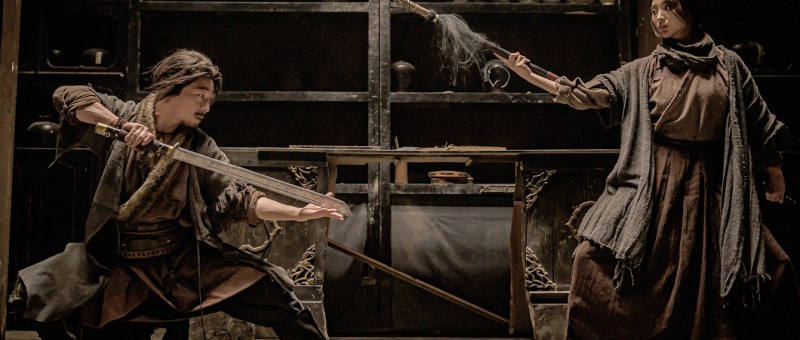
While the design may echo Dragon Inn, Feng uses the techniques of Peking Opera to stage the battle between Yangqi and Jiao while otherwise echoing the western through the newspaper-like onscreen text and dusty frontier sensibility as the Yang sisters make their way back to the border with their father’s sword in hand. Through somewhat epic in scope despite its compact runtime, the film is essentially structured around a series of action sequences from the daring raid to retrieve the sword with its various booby traps to a chase through a cornfield and the final confrontation at the inn. Each is impressively choreographed and expertly performed to make full use of the well-designed sets and meagre budget. The lean, mean feel and linear progression also add to the retro sensibility while there’s something undeniably satisfying about seeing these two rather slight women run rings around the Liao forces thanks to the training they received from their father as they become the inheritors of his legacy and saviours of Song by retrieving the sword and ushering in a new era of peace and coexistence.


Nine-Ring Golden Dagger is released Digitally in the US on July 1st courtesy of Well Go USA.

Trailer (English subtitles)

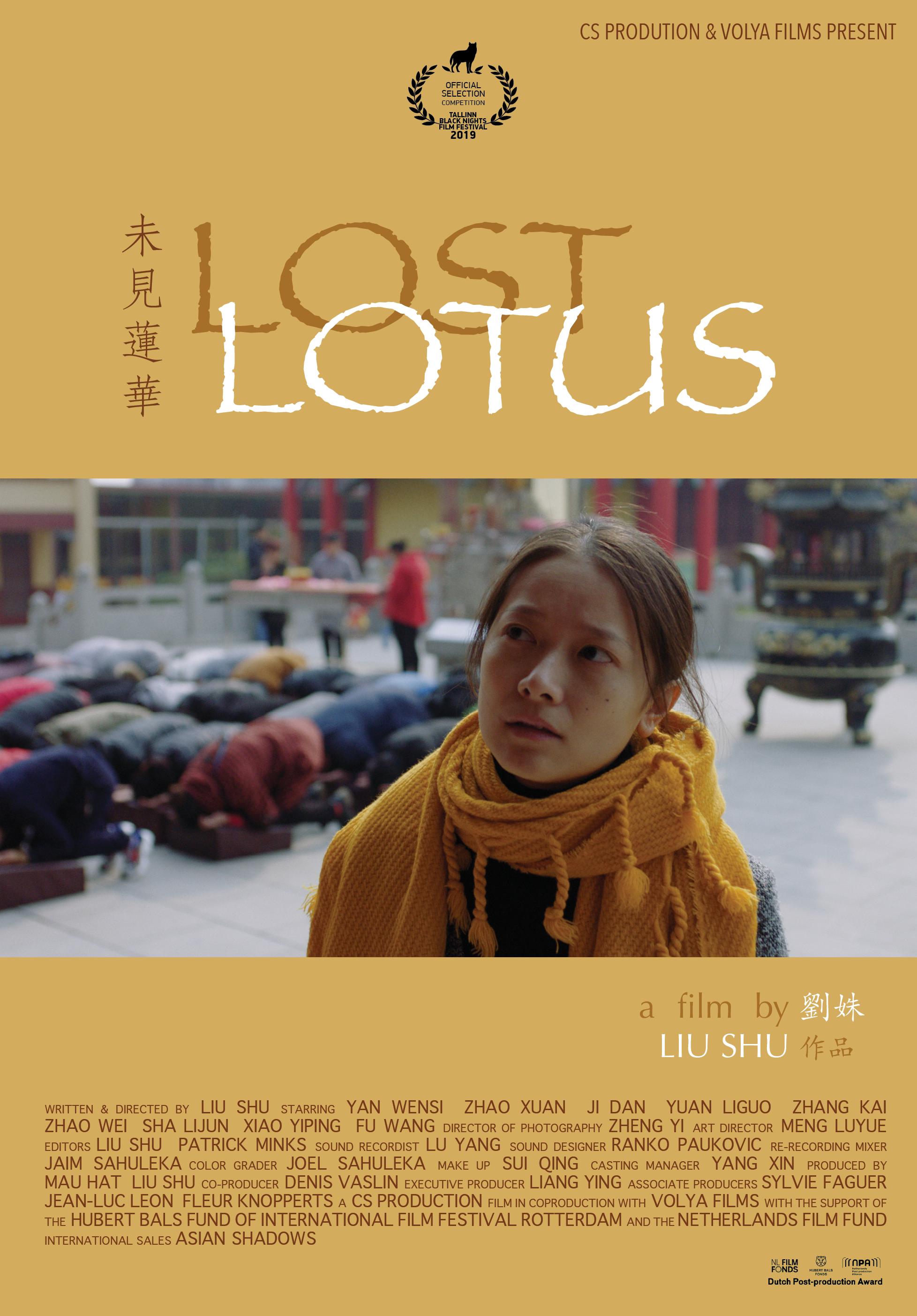
Lost Lotus (未见莲华, Liu Shu, 2019)

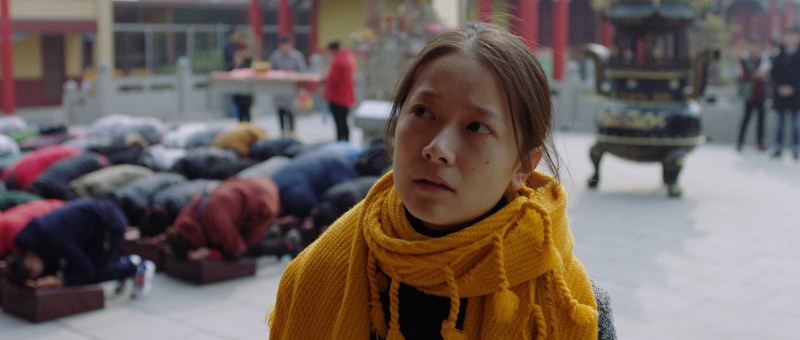
A grieving woman finds herself caught between the tenets of Buddhist thought and the contradictions of the modern China in Liu Shu’s emotionally complex drama, Lost Lotus (未见莲华, wèi jiàn lián huá). The paradoxes of Buddhism are, in a sense, a mirror for those of the contemporary society which has become mercilessly consumerist, obsessed with the material in direct rejection of the spiritual, yet even those who outwardly profess Buddhist values of compassion, goodness, and forgiveness are not perhaps free of the consumerist mindset in which everything has a price and for every transgression there is simply a fine to be paid in the next life rather than this. 

An intellectual teacher, Wu Yu (Yan Wensi) describes herself as irritated by her mother’s (Zhao Wei) devotion to Buddhism, viewing it in a sense as slightly backward and superstitious. Nevertheless when her mother is suddenly killed in a late night hit and run, she finds herself agreeing to hold a traditional Buddhist funeral guided by her mother’s friends at the temple despite having been warned by the police that going ahead with the cremation will obviously make it much more difficult to find the killer. While immersing herself in Buddhist thought helps her reconnect with her mother and deal with her grief, she continues to search for the driver determined to get some kind of Earthly justice in addition to the karmic. 

Increasingly worried and frustrated by Yu’s growing religious mania, her husband (Zhao Xuan) concentrates on finding those responsible in the hope of bringing closure so that they can try to move on with their lives as a couple. A kind and compassionate, modern man (he evidently does all the cooking), Yu’s husband does his best to support his wife in the depths of her grief but is himself conflicted particularly when he discovers that the man driving the car is a member of a rich and powerful elite who believes himself to be above the laws of men. 

Yu’s newfound Buddhism begins to change her outlook, though she struggles to orient herself in a world which is so at odds with its twin contradictory philosophies. Running parallel to her own quest for justice, she finds herself drawn into the struggles of one of her pupils who wanted to quit school because he has to look after his father who was badly beaten by thugs working for developers angry that he had refused relocation. Yu is originally quite unsympathetic, she and her husband blaming the boy’s father for valuing money over his life, cynically believing he must have been angling for a bigger compensation pay out though of course it is probably not so simple. While Yu and her husband are a two-income, professional household, the boy’s family are living in poverty having been evicted from their home, the father bedridden because of his injuries and therefore unable to work. Yu’s quest for justice strains her relationship with her husband and may later have economic consequences as his career prospects are used as a tool to convince them to back off, but her need for retribution affects only herself. The boy’s mother, however, feels terribly guilty knowing her obsessive quest to have the thugs held accountable is endangering her son’s future, but knowing also that she cannot simply give up and let them win. 

This is exactly the dilemma that preoccupies Yu as she weighs up how much of her anger is personal and how much societal. The driver, Chen (Xiao Yiping), offers them sizeable compensation which her husband is minded to accept, not for its monetary value but because taking the money means it’s over. But Yu wants “justice”, she resents the idea that there was a price on her mother’s life or that the culprit can simply pay a fine to assuage his guilt. Even justice, it seems, has been commodified. Yet Chen is also a Buddhist, subverting his beliefs to absolve himself in emphasising that all is fated and Yu’s mother’s death is a result of her karma from a previous life. His sin now pay later philosophy grates with Yu, undermining her new found faith in the Buddhist principles of compassion and goodness as the supposed devotee directly refuses to apologise for his role in the death of her mother. 

As her husband asks her, however, what sort of justice is she looking for? Does she want an apology, a jail sentence, to kill him with her own hands? Yu doesn’t know, lost in a fog of grief and spiritual confusion attempting to parse the contradictions of her mother’s faith and a society that has become selfish and consumerist, founded on elitist inequality which allows the rich and powerful to escape the constraints of conventional morality let alone the laws of men. In the end the only justice she can find is a retributive act of violence that perhaps forces Chen to feel something at least of her pain, paving the way for a kind of catharsis though not perhaps healing. An embittered portrait of the modern China, Lost Lotus suggests there can be no justice in an unjust society and only an eternal purgatory for those who cannot abandon their desire to find it. 


Lost Lotus streamed as part of this year’s San Diego Asian Film Festival.

Trivisa (樹大招風, Frank Hui & Jevons Au & Vicky Wong, 2016)

Trivisa posterIt’s worth just taking a moment to appreciate the fact that a film named for the three Buddhist poisons – delusion, desire, and fury, is intended as a criticism of Hong Kong as an SAR that revels in the glory and subsequent downfall of three famous criminals who discover that crime does not pay right on the eve of the handover. Mentored by Johnnie To, Trivisa (樹大招風) is directed by three young hopefuls discovered through his Fresh Wave program each of whom directs one of the film’s three story strands which revolve around a trio of famous Hong Kong criminals.

Back in the ‘80s, as Mrs. Thatcher delivers her pledges on the Hong Kong handover, King of Thieves Kwai Ching-hung (Gordon Lam) gets stopped by a random police patrol, kills the officers, and then has to fake his identity to escape. 15 years later he’s a petty mobile phone trafficker dreaming of pulling off a big score. Meanwhile, Yip Kwok Foon (Richie Jen), once known for his AK47 brandishing robberies is a “legitimate businessman” smuggling black market electronics into Hong Kong and bribing Mainland officials to do it, while Cheuk Tze Keung (Jordan Chan) is a flamboyant gangster revelling in underworld glory and dreaming of eternal fame.

Rather than weave the three stories into one coherent whole or run them as entirely separate episodes, the three strands run across and through each other only to briefly reunite in the ironic conclusion. The most famous of the three real life criminals, Kwai Ching-hung’s arc is perhaps the most familiar though rather than fighting an existential battle against his bad self, Kwai’s quest is to regain his title as Hong Kong’s most audacious thief. To do this, he’s reunited with an old friend and comrade in arms who’s retired from the life and married a Thai woman with whom he has an adorable little daughter. Unbeknownst to him, Kwai has not come for old times’ sake but is taking advantage of the fact that the family live directly opposite his latest score. Employing two Mainland mercenaries, Kwai has his eyes on the prize but his friend is wilier than he remembered, is quickly suspicious of Kwai’s friendship with his daughter, and has his suspicions confirmed when he finds his kid’s backpack full of guns.

Yip’s story, by contrast, is one of diminished expectations and ongoing financial woes. An early scene at a restaurant finds Yip in the company of Mainland officials to whom he must scrape and bow, placating them with various bribes and engaging in the strange trade of precious vases which seems to pass as currency among corrupt civil servants. Corporate shenanigans and business disputes, however, are no substitute for good old fashioned firefights and Yip’s frustration with his new career is sure to lead to some kind of explosion at some point in time.

Cheuk becomes the lynchpin of the three as he takes an advantage of a rumour that the three “Kings of Thieves” are getting together to plan a giant heist to track down the other two and see if he can make it work for real. The most successful and happiest in his life, Cheuk has made his fortune out of ostentatious crime – kidnapping the sons of the extremely wealthy for hearty ransoms. He is, however, bored and dreams of making a giant splash which will ensure his name remains in the history books for evermore – i.e., blowing up the Queen.

Facing the approaching handover, each is aware the world will change, unsure as to how they’re in the process of trying to secure their futures either way. Kwai wants one last heist, Yip has already begun courting Chinese business, and Cheuk just wants to be the face in all the papers across the entire Chinese world. Kwai’s sin is “desire” – he wants one last hit as a criminal mastermind and he’s willing to take advantage of his friend (and even his friend’s young daughter) to get it, Yip’s sin is “fury” as dealing with constant humiliation leaves him longing for his AK 47, and Cheuk’s failing is “delusion” in his all encompassing need to be the big dog around town, all flashy suits and toothy grins. On the eve of the handover they all meet a reckoning – betrayal, a stupid and pointless death, or merely ridiculous downfall.

The heyday of crime has, it seems, ended but that’s definitely a bad thing, laying bare a change in dynamics between nations and a decline in the kind of independence which allows the flourishing of a criminal enterprise. Bearing To’s hallmark in its tripartite structure, ironic comments on fate and connection, and eventual decent into random gun battle, Trivisa is a ramshackle exploration of a watershed moment in which even hardened criminals must learn to live in a brave new world or risk being consumed by it.


Screened at Creative Visions: Hong Kong Cinema 1997 – 2017

Original trailer (English subtitles)