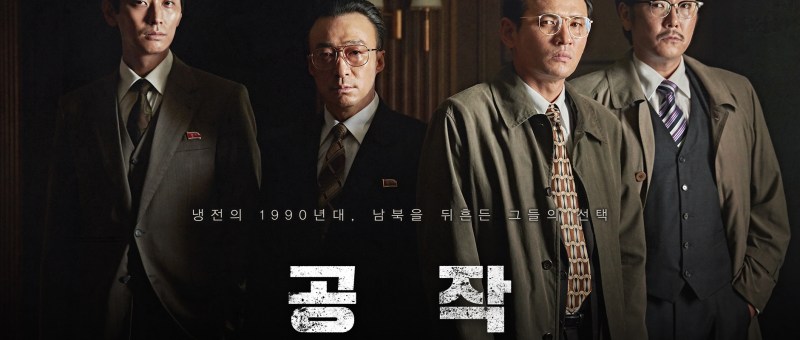
The Spy Gone North (공작, Yoon Jong-bin, 2018)

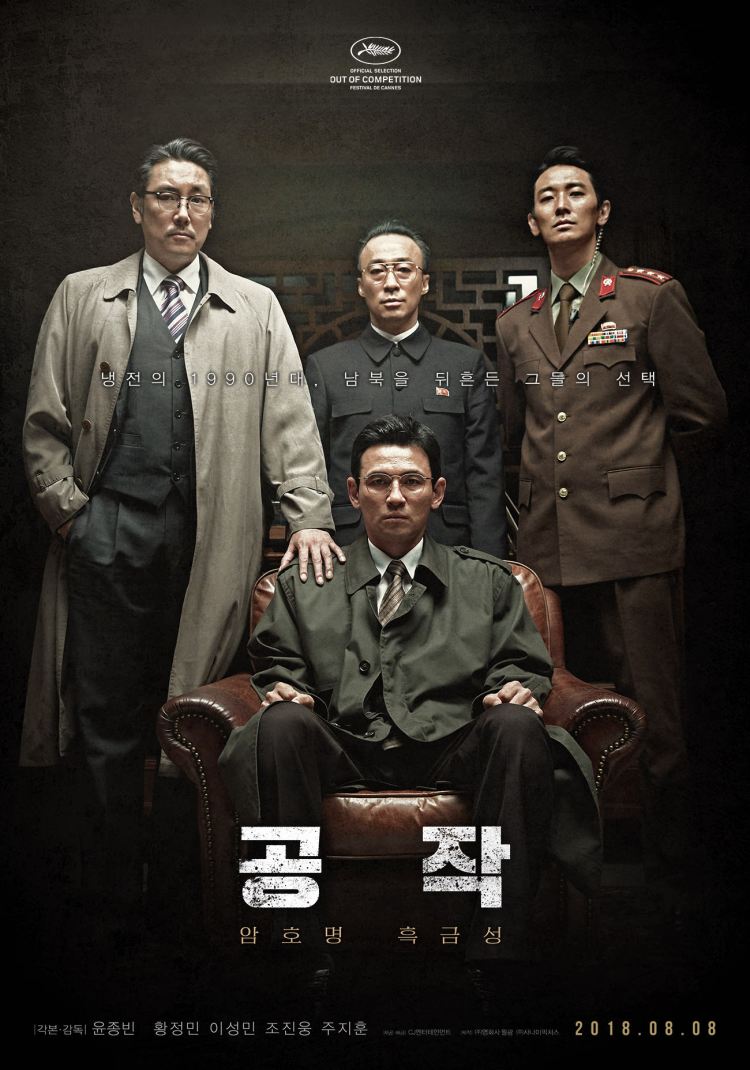
Spy gone north posterSome might say the first lesson of spying is not too ask too many questions. The hero of Yoon Jong-bin’s Spy Gone North (공작, Gongjak) may wish he’d heeded this advice as his ongoing mission to gain access to North Korea’s nuclear secrets by way of an unlikely advertising scheme sets him on a dark path towards the realisation that he might not be working for the good guys after all. In geopolitical terms, an enemy is sometimes more helpful than a friend – especially if your “enemy” is working on the same system and can be relied upon to play along when the occasion calls.

By the early ‘90s, South Korea has emerged from a lengthy period of military dictatorships into a fledgling democracy. Tensions with the North are running high as the nation has announced an intention to withdraw with from the Nuclear Proliferation Treaty on grounds of national security. Fearing that the North has already successfully developed nuclear weapons, the South decides to ramp up intelligence gathering activity which is where “Black Venus” comes in. Shedding his old identity by appearing to lose himself in drink and gambling, intelligence officer Park Suk-young (Hwang Jung-min) poses as a sleazy businessman with the intention of gaining access to the North Korean elite through their external trade commission operating out of Beijing.

Improbable though it seems, Park manages to engineer a genuine friendship with the cold and austere North Korean trade official Ri Myong-un (Lee Sung-min) with whom he eventually shares unexpected common ground. Strapped for cash after the South sets them up by getting them in hock to China over a mislabelled walnut scandal, the North needs money fast, which is why they’re prepared to talk to someone as shady as Park’s cover. Park sells them an unlikely solution which runs contrary to their core philosophies in exploiting the exoticism of the forgotten North to sell capitalistic decadence in the South through selling licenses to shoot commercials on North Korean soil (which also allows him to travel about the country with a camera), but he doesn’t quite see the added value of his mission even while almost forgetting about the need to get close to the site of the supposed nuclear research facility.

While Park finds himself an “honoured guest” of the Dear Leader (Gi Ju-bong) whose presence evokes both fear and awe, he is also faced with a pressing political crisis at home as the nation prepares for an upcoming presidential collection. Despite the democratic revolution, the same party has been in power for the last 30 years and the recent swing towards the liberal opposition party has many running scared, especially as taking a softer line towards the North is a prominent manifesto pledge – alongside a reform of the security services, which is obviously distressing news for Park’s bosses. In order to maintain the sense of fear which keeps the right-wingers in power, the security services have been secretly communicating with the North and bribing them to create disturbances at politically advantageous times to manipulate the outcome of elections. Park is not exactly a liberal, but he has to admit this is not a good look and if you’re just going to parrot the “for the people” line perhaps you’re not much better than the thing you claim to hate.

Meanwhile, Park is also witness to a side of North Korea outsiders don’t generally see filled with the starving and the destitute. Loyalists all, there are those among the North Korean elite who want to see conditions improve and worry that thanks to the intense stranglehold of the ruling regime they never will. As in everything, business interests trump all. Park and Ri are fighting for the same thing, aware their fledging enterprise is a subterfuge but also that it’s a huge and dangerous first step towards a happier future. After 40 years of mutual manipulations, however, not everyone is keen on abandoning the status quo especially as the two nations have developed an intensely symbiotic relationship founded on mutual demonisation and a friendly willingness to conspire in ensuring the survival of a useful evil. Still, the strangely fraternal relationship between Park and Ri – two fiercely patriotic men from opposing sides who each identify goodness in the other becomes the heart of the film, holding out hope for empathy and compromise when most prefer enmity and chaos.


Screened as part of the 2018 BFI London Film Festival.

International trailer (English subtitles)
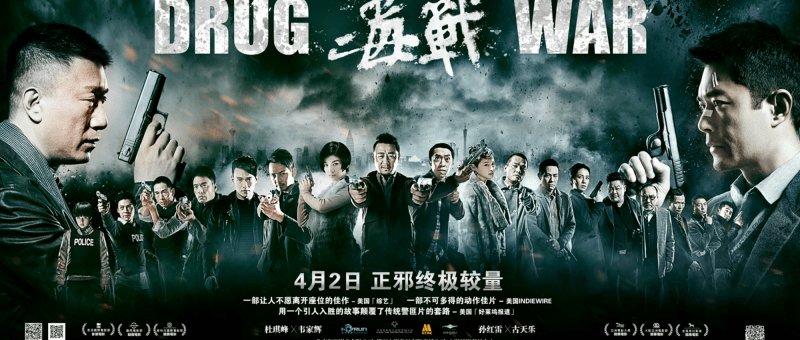
Drug War (毒戰, Johnnie To, 2012)

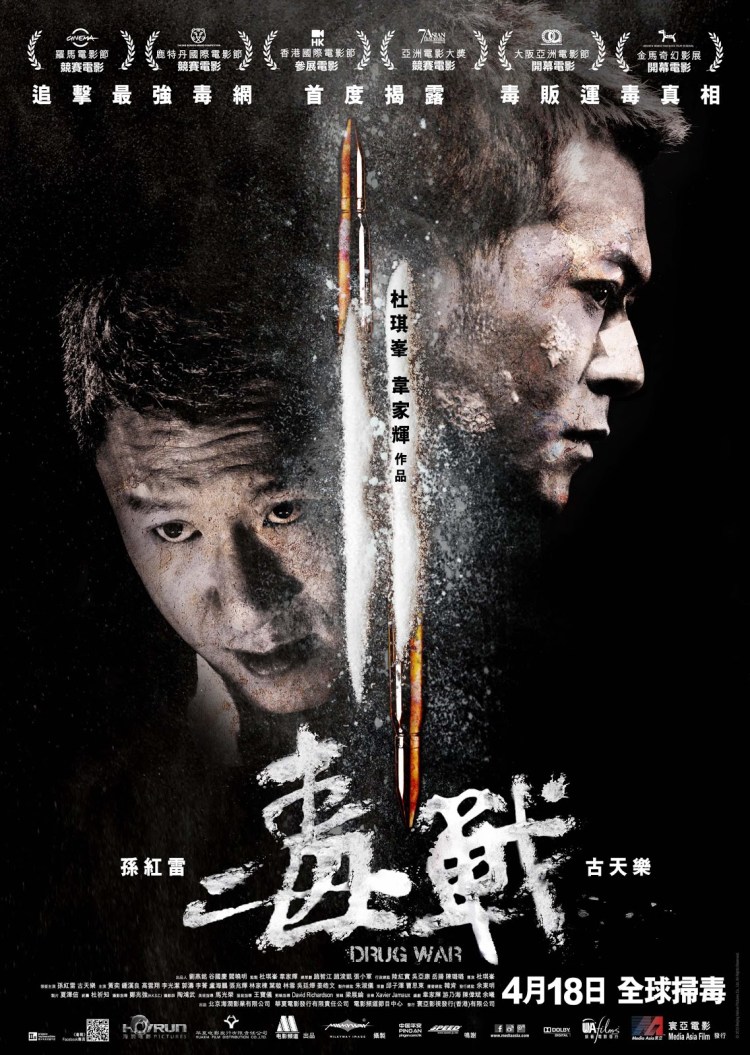
Drug War posterIn the world of the Hong Kong action flick, the bad guys are often the good guys, and the “good guys” not so good after all. Even crooks have their code and there are rules which cannot be broken ensuring the heroes, even when they’re forced into morally dubious acts, emerge with a degree of nobility in having made a free choice to preserve their honour over their life. In Mainland China, however, things are a little different. The bad guys have to be thoroughly bad and the good guys squeaky clean. You won’t find any dodgy cops or dashing villains in a thriller from the PRC where crime can never, ever, pay. And then, enter Johnnie To who manages to exactly what the censors board asks of him while at the same painting law and chaos as two sides of the same coin, each deluded and obsessed, engaged in an internecine war in which the idea of public safety has been all but forgotten.

The film begins with the conclusion of an undercover operation run by Captain Zhang (Sun Honglei) in which he successfully disrupts a large scale smuggling operation. Meanwhile, meth cook Timmy Choi (Louis Koo) attempts to escape after an explosion kills his wife and her brothers but drives directly into a restaurant and is picked up by the police. Timmy soon wakes up and tries to escape but is eventually recaptured – from inside the chiller cabinet in the morgue in a particularly grim slice of poetic irony. Seeing as drug manufacture carries the death penalty in the PRC, Timmy turns on the charm. He’ll talk, say anything he needs to say, to save his own life. Including giving up his buddies.

Timmy is, however, a cypher. His true intentions are never quite clear – is he really just an opportunist doing whatever it takes to survive, or does he still think he can escape and is engaged in a series of clever schemes designed outsmart the ice cool Zhang? Zhang takes the bait. Eyeing a bigger prize, he lets Timmy take him into the heart of a finely tuned operation even playing the part of loudmouth gangster Haha in a studied performance which reinforces the blankness of his officialdom. Zhang is certain he is in control. He is the law, he is the state, he is the good.

Could he have misread Timmy? Zhang doesn’t think so. Timmy remains calm, watchful. Eventually he leads Zhang to a bigger drug factory staffed by a pair of mute brothers who have immense respect for their boss. Suddenly Timmy’s impassive facade begins to crack as he tells his guys about his wife’s passing but it’s impossible to know if his momentary distress is genuine, a result of mounting adrenaline, or simply part of his plan – he does, after all, need to get the brothers to give themselves away. Unbeknownst to Timmy, however, the brothers are pretty smart and might even be playing their own game.

To pits Hong Konger Timmy against Captain Zhang of the PRC in a game of cat and mouse fuelled by conflicting loyalties and mutual doubts. Whatever he’s up to, Timmy is a no good weasel who is either selling out his guys or merely pretending to so that he can save them (or maybe just save himself and what’s left of his business). Zhang, meanwhile, is a singleminded “justice” machine who absolutely will not stop, ever, until all the drug dealers in China have been eradicated. Yet isn’t all of this destruction a little bit much? Zhang doesn’t really care about the drugs because drug abuse wrecks people’s lives, maybe he doesn’t really care about the law but only about order and control, and what men like Timmy represent is a dangerous anarchy which exists in direct opposition to his conception of the way the world ought to work.

There is a degree of subversive implication in the seemingly overwhelming power of the PRC coupled with its uncompromising rigidity which paradoxically makes it appear weak rather than strong, desperate to maintain an image of control if not the control itself. The final fight takes place in front of a school with a couple of completely non-fazed and very cute little children trapped inside a school bus – Timmy does at least try to keep them calm even while using them as part of his plan, but Zhang and his guys seem to care little for the direction of the stray bullets they are spraying in order to win the internecine battle with the drug dealers and stop Timmy in his tracks once and for all. A pared down, non-stop action juggernaut, Drug War (毒戰, Dú Zhàn) is another beautifully constructed, infinitely wry action farce from To which takes its rather grim sense of humour all the way to the tragically ironic conclusion.


International trailer (English subtitles)
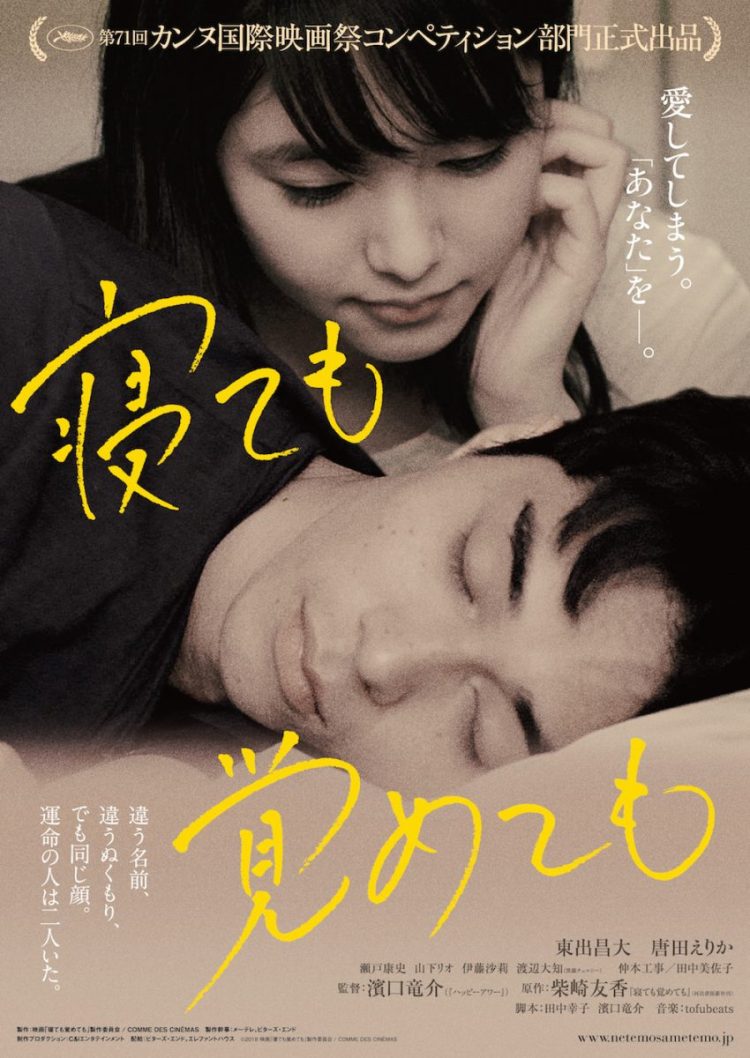
Asako I & II (寝ても覚めても, Ryusuke Hamaguchi, 2018)

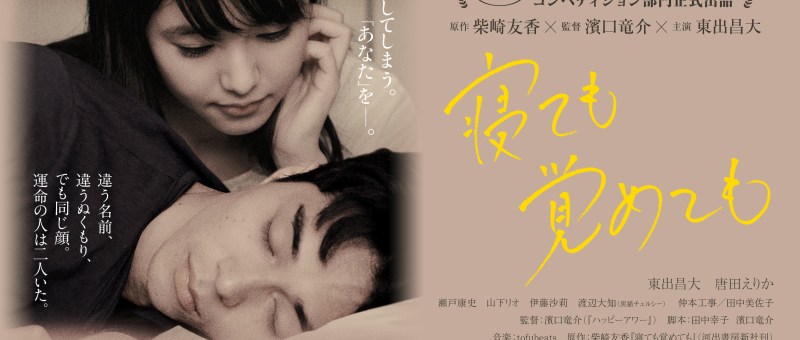
asako I & 2 posterDualities define the perpetually submerged worlds of Ryusuke Hamaguchi’s Happy Hour followup Asako I & II (寝ても覚めても, Netemo Sametemo). Waking and sleeping, fantasy and reality, past and present, presence and absence, love and sadness. Asako (Erika Karata), an ordinary young woman of the contemporary era, finds herself in a similar position to many of the heroines of contemporary Japanese literature in that she has no idea what she really wants out of life and is essentially torn between a series of idealised lives snatched from movies and magazines. Yet she is also haunted by a broken heart, arrested in a state of perpetual adolescence thanks to an early disappointment in love in which remains horribly unresolved.

As a university student in Osaka, Asako attends a photo exhibition dedicated to one of the few books put out by legendary Japanese photographer Shigeo Gocho titled “Self and Others”. Fascinated by an eerie picture of two little girls dressed identically, one slightly taller than the other, Asako’s attention is eventually caught by a striking young man. She leaves the exhibition and follows him until he eventually turns and faces her. Firecrackers some teenagers had been struggling to light suddenly explode around his feet. He strides over to her, asks for her name, and then leans in for a kiss – at least, that’s the way he later tells it to a disbelieving friend who points out that “no one meets like that”. An arty type in dungarees and shaggy hair, the young man’s name is “Baku” (Masahiro Higashide) – he uses the character for wheat (his dad was big into grains) but it’s also a homonym for explosion which a is key indication of the unpredictable excitement he comes to represent for Asako as her uni best friend Haruyo (Sairi Ito) attempts to warn her by insisting that Baku is the heartbreaking type and whatever she has with him is destined to end in tears.

Haruyo’s prediction comes to pass when Baku steps out one day to buy some shoes and never returns. A brokenhearted Asako makes her way to Tokyo and begins working a cafe but two and a bit years later, she is stunned to find “Baku” wearing a suit and working in an office. He doesn’t remember her and says his name’s Ryohei, but Asako can’t shake the association which is both attractive and repellent in equal measure. Ryohei is smitten, he felt the connection too, but Asako doesn’t quite know what to do with this unfortunate coincidence.

Events repeat themselves with only mild distortions – Asako and Ryohei attend another Gocho photo exhibition though this time with Asako’s Tokyo best friend, Maya (Rio Yamashita). Rather than a motorcycle accident, Ryohei and Asako find and comfort each other after the 2011 earthquake and eventually become a couple, move in together, and even get a cat. Asako begins to fall for Ryohei, but can’t be sure her love for him isn’t really love for Baku refracted through a different lens. Baku, a man with a wandering heart, once told her he would always return no matter how long it might take. There’s a part of Asako that’s always waiting, held back, afraid to move and unwilling to acknowledge the death of her younger self as immortalised in the image of herself with Baku.

When Haruyo runs into Asako and Ryohei unexpectedly in Tokyo, she gives us our first indication that Ryohei really does look like Baku and the association isn’t just a projection of Asako’s romantic anxieties. Haruyo’s first words to Asako are that she hasn’t changed – they’re intended as a compliment, but Asako bristles. She feels as if she’s moved forward, matured, is preparing to enter a comfortable middle age with Ryohei at her side but deep down she knows she hasn’t. She’s still the naive student pining for a lost love that never cared enough about her to resolve itself. She worries she’s been playacting and that her relationship with Ryohei isn’t “real” even if she cares about him enough to have her feeling guilty for this mild form of betrayal.

Later, offered another possibility, Asako feels as if her life with Ryohei has been like a dream, or perhaps the only waking moment of her life. When Ryohei introduces a work friend to Maya as an excuse to get close to Asako, they watch a video of her performing a scene from Chekhov’s Three Sisters – a play famously about self delusion in which the fierce belief in an impossible future becomes the only thing which makes life possible. The climactic earthquake hits just as Ryohei is preparing to watch Maya perform in Ibsen’s The Wild Duck – the play which lays bare the playwright’s key tenet, that if you take away a man’s life lie you take away his happiness. Ryohei’s friend Kushihashi (Koji Seto) might rip into Maya’s “narcissistic” acting, denigrating her for attention seeking rather than baring her soul on stage, but Asako admires her determination and absolute certainty in her chosen goal, things she herself lacks.

Talked down by the soothing tones of practiced de-escalator Ryohei, Kushihashi is prompted to confess that his outburst was mostly out of jealously, that having given up his dreams of the stage for a conventional salaryman life he resented seeing someone else embrace theirs. Asako can’t decide which “dream” she wants – a life of fireworks and unpredictability with Baku for all the heartbreak it might bring, or one of gentle happiness with the good and kind Ryohei. A series of crises prompt her into making a clear choice – seemingly her first, though it may be too late. Real love is messy, painful, and ugly, but it’s beautiful too once you learn to see through the miasma of self delusion and romantic fantasy.


Screened as part of the 2018 BFI London Film Festival.

Original trailer (no subtitles)

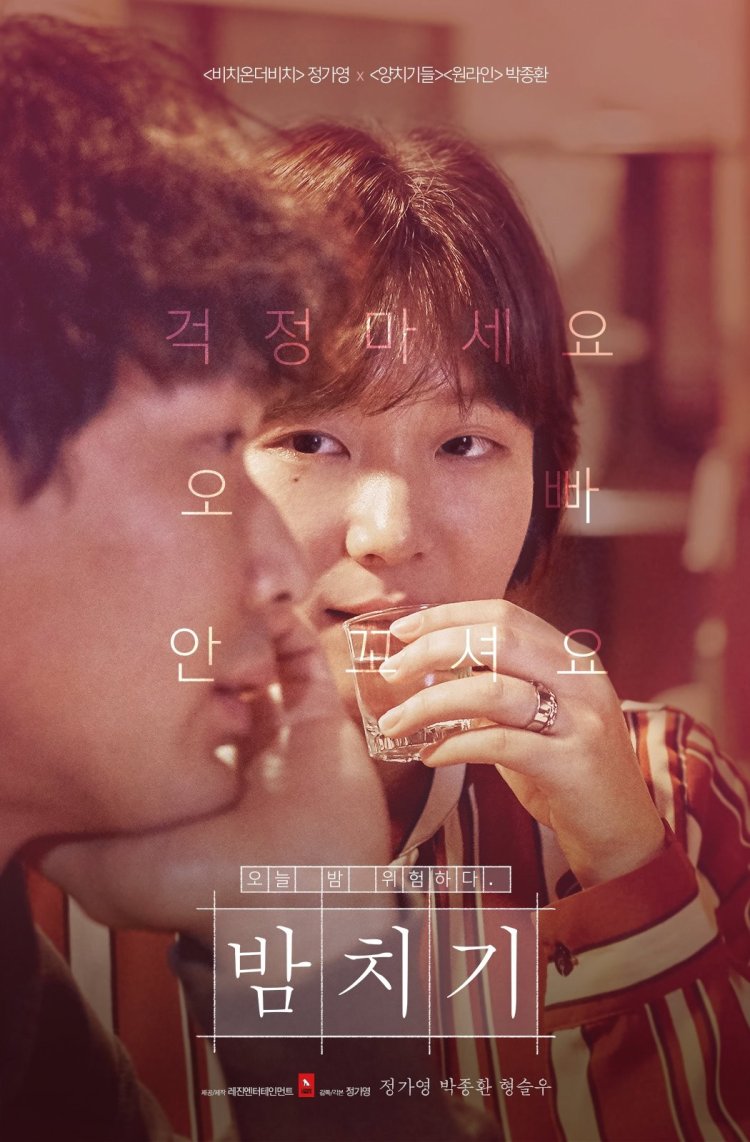
Hit the Night (밤치기, Jeong Ga-young, 2017)

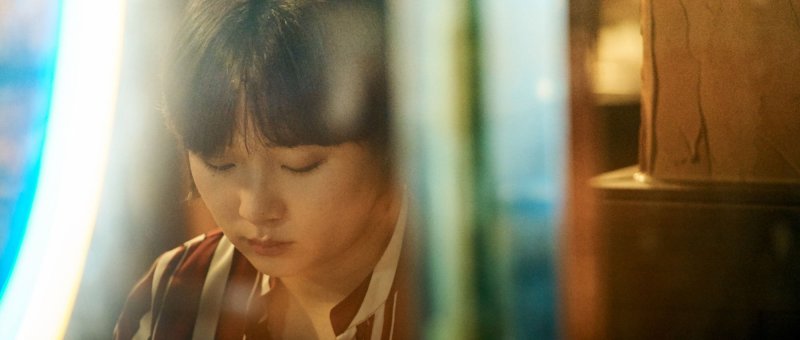
Hit the Night posterFollowing her impressive, Hong Sang-soo inspired debut Bitch on the Beach, Jeong Ga-young returns with a similarly structured exploration of modern relationships though now in a suitably fuzzy colour rather than Bitch’s artful black and white. Once again, Jeong plays a meta version of herself – this time a writer/director ostensibly researching a screenplay but perhaps obfuscating her true motives even as she makes visible her innermost anxieties for her invisible audience.

Hit the Night (밤치기, bam-chi-gi) follows Ga-young (Jeong Ga-young) as she takes a young man, Jin-hyeok (Park Jong-hwan), out on the town. The pair have dinner together, but they aren’t a couple, or even really friends – Ga-young has bought Jin-hyeok’s time on the pretext of interviewing him to get background information for a screenplay she is writing. Jin-hyeok wants to be helpful and has committed to answering Ga-young’s questions as frankly as possible. Her questions are, however, extremely personal from the outset as she begins asking him about his masturbation habits almost before they’ve even sat down. As the night wears on and the drinks keep flowing, Jin-hyeok begins to smell a rat, wondering why it is Ga-young is so interested in his sex life when it doesn’t seem to have much to do with the various screenplays she outlines to him. Ga-young is indeed trying it on, her pretext of “research” a mere ruse and means towards seduction.

It has to be said that the situation is indeed creepy and Jin-hyeok has every right to be upset and offended, especially as he has repeatedly made clear to Ga-young that he has a girlfriend and is not interested in her. If Ga-young were a man taking a young woman out for dinner, plying her with drinks, asking increasingly suggestive and inappropriate questions and all on false pretences she would not be looking very good at all (much, indeed, like a classic Hong Sang-soo hero), not to mention the fact that money has already changed hands.

Nevertheless, despite his irritation Jin-hyeok decides to stay, progressing to a karaoke box rather than simply going home only to leave abruptly after palming Ga-young off on a lonely friend. Despite Jin-hyeok’s slightly underhanded machinations, there is less calculation and a clear possibility for genuine feeling between Ga-young and the other man, but she remains too fixated on her failed conquest and the idealised, unattainable fantasy romance to take a chance on an organic connection with a cheerful guy who likes movies and has his own well developed life philosophy.

Jeong’s approach is meta in the extreme – she repeatedly tells us the ongoing arc of the movie by referencing other movies while also reinforcing her intentions by foregrounding the various ideas for screenplays which Ga-young describes to Jin-hyeok. Her movie titled “Best Ending Ever” ironically has no ending while its hero aims to make a film in which all the characters speak their own fates in a conclusion that “won’t leave you hanging”, but real life is never quite so neat and there are no clean cut, narratively satisfying conclusions to be had in a “film” which is still ongoing.

Ironically enough, unlike the heroine of Bitch on the Beach, Jeong’s screenwriter makes a performance of control she never quite possesses, ceding ground to the earnest Jin-hyeok as he picks her up on her unethical practices and makes frequent attempts to reflect the inappropriate questioning back on her. Ga-young finds herself on the back foot, trying to manipulate Jin-hyeok into abandoning his principles and betraying his girlfriend even as her mask of unflappable frankness begins to slip. Yet Jin-hyeok, even if remaining steadfast in his moral goodness, finds himself captivated by Ga-young’s surprising candour while perhaps more ambivalent about her unusually predatory behaviour. With her short hair and plain, boyish clothes Ga-young adopts an aggressive, “male” persona, pursuing rather than being pursued, and using all of the same tactics that would generally be used against her only for Jin-hyeok to punch a hole through her artifice and expose the very insecurities it was designed to mask.

Not done with her meta messaging, Jeong “ends” on a Days of Being Wild inspired epilogue in which she meticulously dons her chosen persona before setting off to meet Jin-hyeok. This is a film without an ending because in its end is its beginning. Ga-young finds herself running in circles pursuing unrealistic ideals destined to end in frustrated defeat while ignoring the various “realities” which present themselves to her as she sets her sights on the “best ending ever” rather than the emotionally satisfying conclusion.


Hit the Night was screened as part of the 2018 New York Asian Film Festival and will also be screened as part of the London Korean Film Festival on 6th November 2018, 6.30pm at the ICA where director Jeong Ga-young will be present for a Q&A.

International trailer (English subtitles)
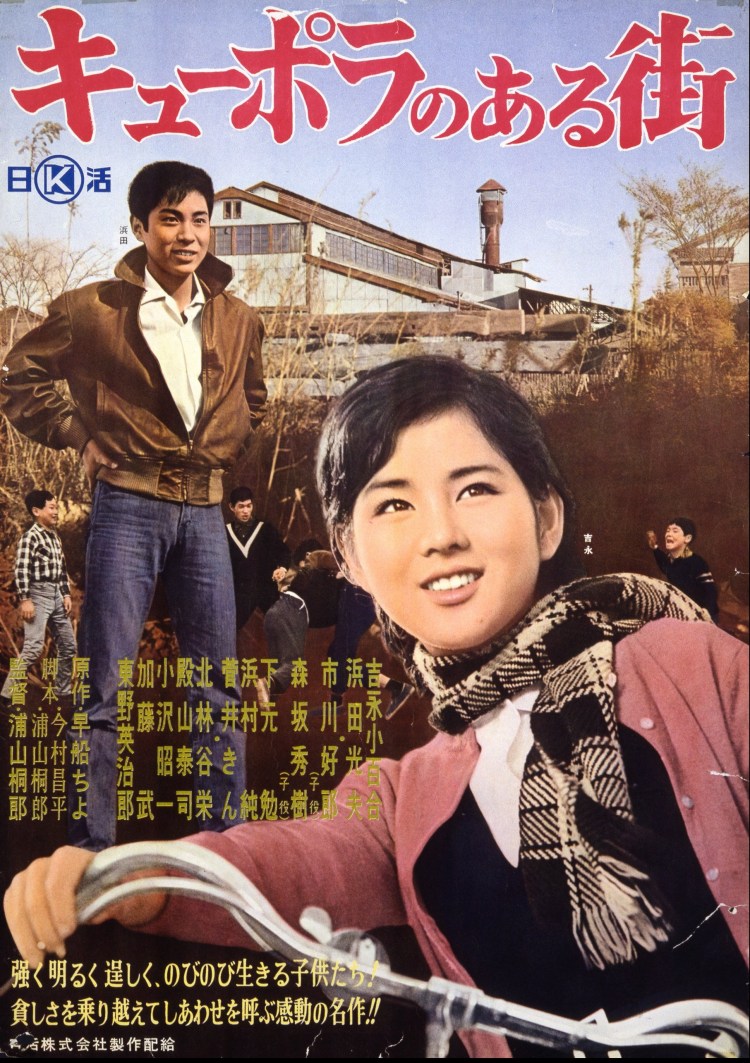
Cupola, Where the Furnaces Glow (キューポラのある街, Kirio Urayama, 1962)

(C) Nikkatsu 1962

cupola-poster-e1539038053246.jpgThe “shomin-geki” is generally associated with naturalistic depictions of the lives of “ordinary people”, but in reality most often focuses on the polite lower middle classes – white collar workers, shop keepers, small business holders etc, in short the sort of people who aren’t wealthy but aren’t starving either and generally live in moderate family homes rather than tenements or cramped apartment blocks. Blue collar lives are a less frequent sight on screen – something director Kirio Urayama seems to highlight in his mildly exoticised opening which introduces us to Kawaguchi, Saitama, a small town across long bridge not so far from Tokyo.

Unlike the bustling city still fighting its way back from post-war privation, Kawaguchi is a “town of fire and sweat” where the landscape is dominated by the “cupolas” of the title (Cupola, Where the Furnaces Glow , キューポラのある街, Cupola no aru Machi, AKA Foundry Town). Rather than the beautiful architectural domes the name might imply, these cupolas are the industrial kind – chimneys from the 500 foundries which are the area’s dominant economic force. There is, however, trouble in that the steel industry has been decline since the immediate post-war heyday and increasing automation is changing the face of working life.

Our heroine, Jun (Sayuri Yoshinaga), is a young woman with post-war ambitions trapped in the depressing blue collar world of Kawaguchi. She’s currently in her last year of middle school and is determined to carry on to high school and perhaps even beyond, but the family is poor and her father, Tatsugoro (Eijiro Tono), has just lost his job at the local steel works. The family’s neighbour, Katsumi (Mitsuo Hamada), is big into the labour movement and has been protesting the changes at the works which has been bought by a bigger concern who are intent on compulsory layoffs. Tatsugoro, however, likes to think of himself as a “craftsman” rather than a “worker” and refuses to join the union partly out of snobbery and partly out of an entrenched fear of “communism”. He refuses to fight his compulsory redundancy because he is still wedded to the old ideas about loyalty to one’s superiors whilst simultaneously viewing himself as “better” than the other workers because of his long experience and skilled craftsmanship.

Nevertheless, Tatsugoro continues to selfishly abnegate his responsibilities to his family, refusing to insist on his severance pay and drinking the little money he still has left. Tatsugoro has four children ranging from teenager Jun to an infant born just as he lost his job. Some way into the film, Jun and and her younger brother Takayuki (Yoshio Ichikawa) take their father to task for his continued selfishness but the confrontation ends only in defeat. Tatsugoro simply doesn’t care. Loudly exclaiming that he has no daughter and will send Takayuki to the boys’ home, Tatsugoro destroys their hopes by reminding them that their fate is the same his – leave school early, work in a factory, marriage, children, drink yourself into an early grave. The argument proves so disheartening that Jun gives up on a school trip she’d been given a special subsidy to attend to roam around the streets, sadly visiting the prefectural high school that she has now given up on attending and accidentally witnessing another reason to give up on life that she, naively, misunderstands.

Meanwhile, Jun and Takayuki have also made friends with a family from North Korea who will be returning (without their mother) under a preferential “repatriation” programme organised by North Korean officials in Japan with the backing of the US and the Japanese government which, uncomfortably enough, saw only advantage in reducing the ethnic minority population. Though the film adopts a mildly positive view of repatriation – after all, no one really knew what North Korea was like in 1961 and many saying goodbye to their friends fully expect to stay in touch and perhaps meet again one day, it does highlight the persistent layer of xenophobic prejudice that the children face. Sankichi (Hideki Morisaka), one of Takayuki’s best friends, is taunted from the audience whilst on stage in a children’s play by cries of “Korean Carrot” (he is wearing a funny wig at the time) while Jun’s mother makes no secret of her dislike of the children’s friendships, believing that the Koreans are “dangerous”. Others associate the North Korean (in particular) population with communism and possible insurrection, fearing that Japan might be pulled into another nuclear war in Asia by political troubles across the sea.

The repatriation program is attractive not only as a means of escaping a world of constant oppression, but because of the entrenched poverty of the Kawaguchi area and the relative impossibility of escaping it. In a poignant, resentful school essay Jun wonders why her future is dictated by a lack of money, why she alone will be prevented from going on to high school and pulling herself out of the lower orders solely because of her responsibility to her family and father’s fecklessness. Tatsugoro is eventually offered another job thanks to the kindness of the father of one of Jun’s wealthier school friends, but continues to view himself as a “craftsman” and resents being ordered around by youngsters. What’s more, the factory is much more advanced – doubtless, the father of Jun’s friend (so different from her own) thought it might be better for Tatsugoro whose health is poor because the work would be less physically strenuous, but Tatsugoro finds it impossible to adapt to automated working methods and soon quits, leaving the family cash strapped once again.

An inability to adapt is Tatsugoro’s tragedy though he later makes amends when he consents to join Katsumi’s union and takes a job in a new factory, confident that he can’t be summarily dismissed ever again. Jun, meanwhile, has discovered a third way. Longing to escape the burden of her family she resolves to step forward alone but also instep with her society. Having discovered the existence of a progressive factory which is run with friendliness and consideration and even provides education for employees, Jun realises she can have the best of both worlds. Though Jun’s decision is perhaps one of individualism and a bold assertion of her own agency, it’s also in keeping with the broadly socialist message of the film which insists that a problem shared is a problem halved and places its faith in ordinary people to look after each other. Optimistic, perhaps, but a perfect encapsulation of post-war humanism and growing hopes for the future for those who are prepared to work hard on behalf not only of themselves but also for the social good.


Original trailer (no subtitles)

Cupola, Where the Furnaces Glow was scripted by Shohei Imamura whose work often focusses on the working classes and rural poor. As such it shares some similarity with his early film My Second Brother which also touches on the lives of ethnic Koreans living in Japan though this time in a mining village where the labour movement is engaged in actively opposing the exploitative practices of the corporate mine owners.

Keiko (Claude Gagnon, 1979)

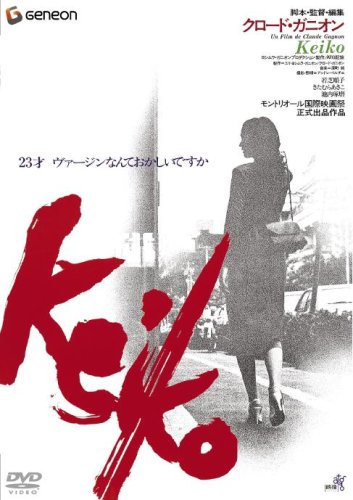
Keiko DVD coverThe Art Theatre Guild of Japan found itself in an awkward position in the late ‘70s. The kind of politically charged art cinema which had been its mainstay throughout the ‘60s was now out of fashion in the post-Asama Sanso world. The studio was then looking for new, young, dynamic voices who could potentially have something equally new and radical to offer to the the mid-’70s Japanese cinema scene which increasingly leaned towards the populist. That is perhaps how they came to work with émigré French Canadian filmmaker Claude Gagnon, distributing his independently produced debut feature Keiko. Gagnon’s film was nothing if not atypical of the time, dealing with the relatively taboo subject of female sexuality and the patriarchal society and doing it with a lens influenced more by European arthouse and New American cinema than by that of Japan or by the avant-garde movement which had forged ATG’s central ethos.

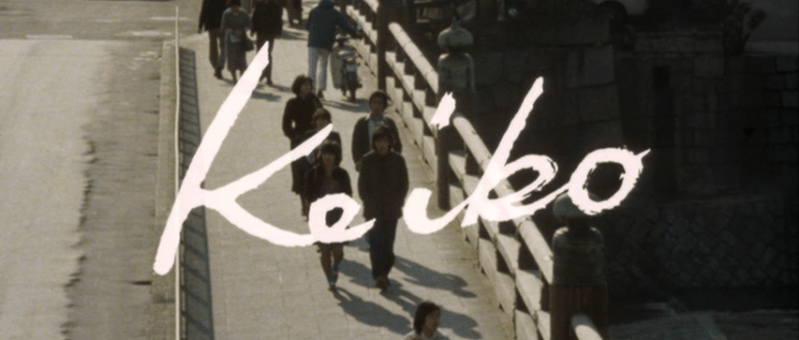
As the title implies, the tale revolves around the titular Keiko (Junko Wakashiba) – a 23-year-old office worker preoccupied with her lack of romantic success. Hoping to find a potential boyfriend, she spends her evenings in cafes, often staying until closing before going home alone. Embarrassed to still be a virgin at 23, she invites her old high school teacher (married with two children) out for a drink and they wind up in a love hotel but if Keiko thought losing her virginity would give her more confidence in dating she couldn’t be more wrong.

Soon enough she ends up in another “relationship” with a guy she meets in cafe but it’s obvious to everyone but Keiko that he is just using her for sex. Masaru (Takuma Ikeuchi), a photographer, constantly talks about himself and his work, refusing to go “out” on dates and preferring to simply arrive at Keiko’s flat and then leave again once he gets what he came for, claiming that his “mother” is waiting up for him at home. Eventually Keiko’s suspicions get the better of her and she finds out he is already married with children. The affair ends, leaving Keiko resentful and broken hearted. She drifts into a relationship with a colleague (Toshio Hashimoto) who is nice enough but Keiko isn’t really interested in him. Then something unexpected happens – a drunken experience with a female colleague leads to the most fulfilling and happiest period of her life but she is also plagued by calls from home about arranged marriages and “settling down”.

Told from Keiko’s perspective, Gagnon’s film paints a bleak picture of female existence in ‘70s Japan. Keiko’s office lady job is only really a stop gap ahead of a marriage and even at 23 she’s beginning to panic about finding a husband before her father finds one for her. She is shy and demure, modest and innocent as her society demands her to be, but she is also lonely. The camera finds her sitting alone at tables meant for four, the bars and cafes often completely empty save for her as they approach closing time. Keiko waits until the last minute, telling the girl behind the counter that she’s nothing much to do at home, but there’s nothing much to do in the bar either and she simply sits there all alone not talking to anyone, waiting for someone to take an interest only they rarely do.

Following the first few unsuccessful encounters with men, Keiko is initially confused by the unexpected interest from female colleague Kazuyo (Akiko Kitamura). Kazuyo, free spirited and independent, is perhaps portrayed more stereotypically with her short hair and tendency to dress in an overtly “masculine” fashion outside of work but few seem to have picked up on these seemingly “obvious” clues and she remains free to live her life in the way in which she chooses. Unlike Masaru who left in the middle of the night, Kazuyo is still around the next morning and not only that, she offers to cook breakfast and even takes a trip to the pharmacy to pick up some aspirin for Keiko’s sore head. Somewhat mystified by the whole affair and Kazuyo’s kindly consideration the morning after, Keiko tells her it might be better to forget about what happened the night before which Kazuyo again accepts without rancour.

Touched by all this maturity, Keiko begins to look at Kazuyo differently, and eventually decides to take a chance on something different. Before long they’ve taken an apartment together a little way out of town and begun building a life for themselves. Kazuyo is thinking about the future – she wants to start her own business and wants Keiko to help her, but the need for additional capital has her staying out evenings working in bars to earn extra money while Keiko is still getting letters from home about marriages.

Told entirely from Keiko’s perspective, Gagnon’s script veers away from its most interesting questions – why someone would willing abandon the greatest happiness they have ever felt and are certain they ever will feel to succumb to societal pressure to conform. Keiko’s oppression is almost taken as read, a constant background presence that never thinks to explain itself. Yet she is a grown woman (as she tries to point out to her father) who could simply have refused to take phone calls or answer letters. She has the power to say no to an arranged marriage, even if she perhaps does not have the power to live openly with Kazuyo as a married couple might. The film offers few explanations why she continues to placate a father she doesn’t like very much who lives a long way away save for leaving it at a need to be accounted “successful” in the eyes of society even if that conventional “success” is destined to make her very unhappy.

Gagnon’s approach is informed by European arthouse and to a lesser extent by contemporary New American cinema in attempting to create a kind of cinematic naturalism that exists in direct contrast to the expressive acting styles often found in more populist entertainment. He demonstrates the inertia of Keiko’s life by capturing her stillness, the scenes remain the same – only the outfits have changed. The camera pulls away from her as if it’s almost painful to do so, emphasising her loneliness and isolation as she remains trapped and alone in a society which abhors individualism but in reality cares little for individuals. The conformist society and its entrenched patriarchal social codes conspire to destroy happiness in order to maintain “stability”, condemning each to a particularly individual kind of misery from which it seems impossible to escape.


Original trailer (no subtitles)

Jagko (짝코, AKA Pursuit of Death, Im Kwon-taek, 1980)

Jagko poster

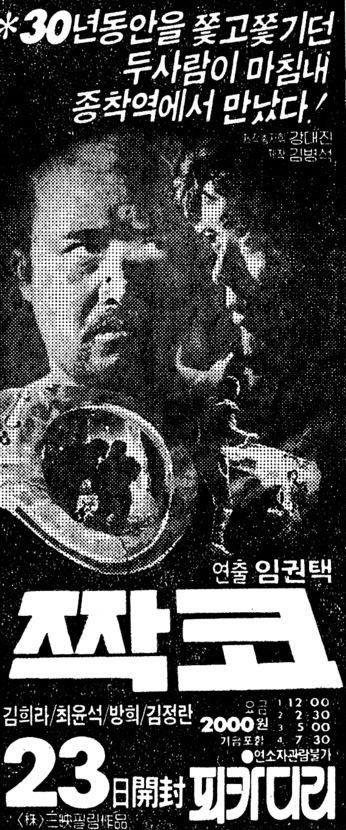
During the dark days of the dictatorships, the “anti-communist film” was a mainstay of the Korean film industry. Though it wasn’t exactly possible to make a pro-communist film and that therefore any and all films were at least implicitly anti-communist, the authorities had been especially keen on films which took a hardline on anything remotely leftwing. By the late ‘70s however times were changing and a more nuanced view of recent history began to become possible. Im Kwon-taek is thought to be among the first directors whose work precipitated a shift from the “anti-communist” to the “division” film in which the tragedy of the division itself takes precedence over the demonisation of the North (though such views were perhaps not as uncommon as might be assumed in films from the late ‘50s and early ‘60s before the passing of the Motion Picture Law). Jagko’s (짝코) two haunted protagonists are both flawed men betrayed by their country and changing times realising they have wasted their youth on a cat and mouse game over an outdated ideological disagreement when the conflict that defined their lives was merely a proxy war fought by two super powers on Korean soil.

Song (Choi Yoon-seok), a former policeman, is picked up by a vagrancy patrol and taken to a “rehabilitation centre”. Despite the name the centre is more like a debtors’ prison and Song is now a prisoner of poverty who will not be allowed to leave unless redeemed by a family member (of which he has none or he might not be here). Nevertheless, the men are treated well, fed three meals a day, and only asked for a couple of hours of non-strenuous work with the rest of the time marked “free”. Once Song has begun to calm down, he makes a shocking discovery. He is convinced that a man lying ill a few beds over is none other than Jagko (Kim Hee-ra) – a former North Korean partisan and the man he holds responsible for ruining his life.

Im lets us in on the stories of both men via a series of flashbacks. Though he pretends not to know him, the other man, calling himself Kim, is indeed “Jagko” though his life has been just as miserable as Song’s. Back on Mount Jiri at the end of the Korean war, Song was a respected policeman – he left school at 12 and made a name for himself catching partisans. When he catches the legendary Jagko, wanted for a series of atrocities and terrorist acts, all Song can do is boast and talk of his imminent promotion after which he will enjoy a life of comfort. Unsurprisingly, Jagko is not exactly happy for him but allows his captor to prattle on in order to buy time for his escape. It is Song’s own arrogance which permits him to do so. Claiming to need the bathroom, Jagko offers Song a gold ring hidden in his shoe which Song scoffs at, but he does loosen his cuffs to facilitate Jagko’s relief at which point he manages to headbutt him and run away. Song is accused of taking bribes and dismissed. He is humiliated and loses his status, job, and family all in one go. Fixated on Jagko, Song gives up everything to chase him in order to turn him in to his former commander and have him clear his name by confirming that he was not bribed and did not sell out his country for gold.

Almost thirty years later both men are older than their years, broken and defeated. As one of the rehabilitation centre residents puts it, they’re all about to die – what does it matter now if someone was a communist or a partisan, what good could it possibly do to drag the past up all these years later? For Song it’s almost as if there is no “past”, the last few decades have been spent in a relentless pursuit of the man who holds the key to his good name. He wants to undo the folly of his hubris by overwriting it, but time has passed and what he’s lost cannot be reclaimed. Meanwhile, Jagko is not an ideologically crazed leftist, but a lonely old man who is now in poor health and has nothing but regrets. The two men bond in their mutual suffering and work together to escape, but the world they emerge into is not that of their youth. Song was disempowered when he entered the facility – they took his arrest rope away from him, but when he tackles the weakened Jagko to the ground and tries to call two policemen on patrol over to arrest him as an “escaped communist guerrilla” the young officers of the law have no idea what he’s talking about. Those words no longer mean anything. The bemused policemen conclude the old men must be escaped mental patients before spotting the rehabilitation centre uniform and jogging off to phone someone to come and take them back.

The old men’s quarrel is exposed as ridiculous. Jagko, less angry more soulful, remarks that men like he and Song are the most pitiful souls on Earth as he watches America sit down with Russia on the TV and realises he is merely a victim of ongoing global geopolitical manoeuvring. It’s no longer a question of left and right, both men are victims of their times, neither “good” nor “bad” but flawed and human. We do not know if Jagko did the things Song says he did but he has paid a heavy price all the same. Song, by contrast, has shifted all the blame for his fate onto Jagko, believing that if he can catch him he can somehow make it all right, but of course he can’t and is trapped in a spiral of denial in refusing to accept his own responsibility for the tragedies of his life. What is to blame is the folly of war and particularly of an internecine fraternal conflict which remains unresolved and may well be unresolvable unless an attempt is made to address the past with empathy and understanding in place of enmity and rancour.


Jagko is available on blu-ray courtesy of the Korean Film Archive. The set includes subtitles in English, Japanese, and Korean with the audio commentary by Kim Dae-seung and editor of Cine21 Ju Sung-chul also subtitled in English. The audio commentaries from the DVD edition included with the Im Kwon-taek boxset, one by director Im Kwon-taek and film critic Huh Moon-yung, and the other by screenwriter Song Gil-han and film critic and director Kim Hong-joon, unfortunately do not carry over the English subtitles. The set also comes with a bi-lingual Korean/English booklet featuring an essay by film critic and professor Park Yuhee. Not currently available to stream via the Korean Film Archive’s YouTube channel.

Matsuchiyo – Life of a Geisha (松千代一代記, Ken Nishikawa, 2018)

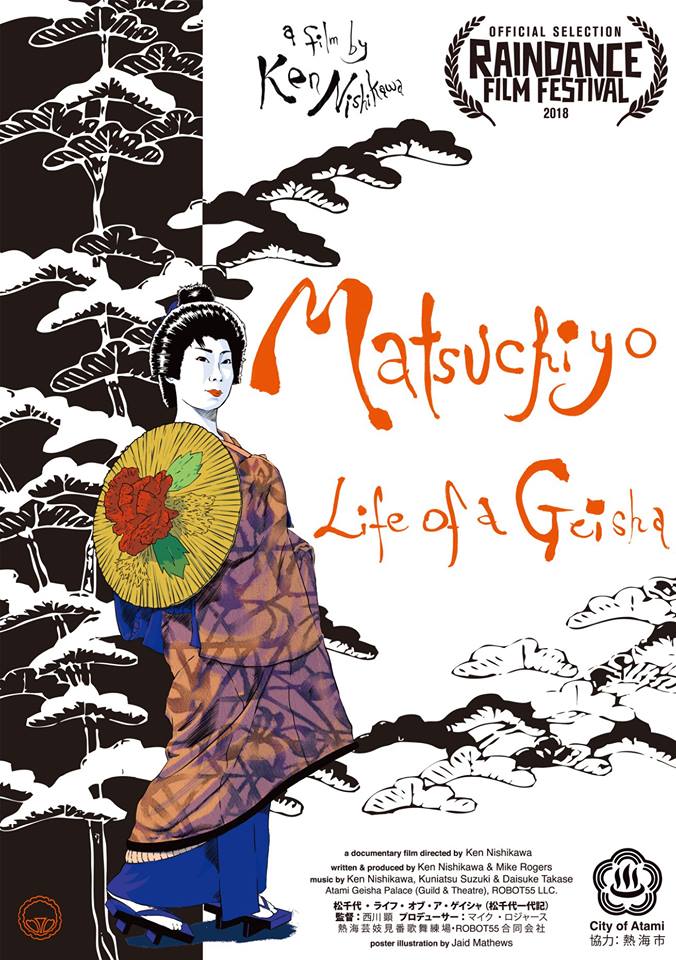
Matsuchiyo PosterThe figure of the “geisha” looms large in Japanese cinema, but all too often international perceptions of what a geisha is or should be are rooted in old fashioned orientalist ideas of exotic Eastern women somehow both refined and alluring. Most assume geisha is synonymous with high class prostitute and that the life of a geisha is not much different from any other sex worker save for the trappings of elegance which are in fact its USP. These assumptions are, however, not entirely accurate.

In order to tell the story of the modern day geisha, Ken Nishikawa steps in front of the camera to tell that of his own mother which is also in many ways, the story of 20th century Japan. Later known as Matsuchiyo, Nishikawa’s mother spent the pre-war years in Manchuria returning to a land in ruins shortly after the wartime defeat. In order to support her ailing mother, she became a geisha which is, as we will discover, an extraordinarily skilled and arcane profession entailing the mastery of a number of traditional arts from dance to shamisen.

As Matsuchiyo later puts it, it’s difficult for a foolish girl to become a geisha, but for an intelligent one it may be impossible. A flippant remark to be sure, but it hints at the true purpose of a geisha’s training which amounts to a gentle erasure of individual personality in order to play the role of the perfect woman from the point of view of each particular client. Somewhere between bartender and therapist, a geisha must listen patiently to the complaints of each of her companions as they pour out their souls over sake, laying bare the fears and worries with which they could never burden a wife (assuming they might want to). Nodding sympathetically, she must remain cheerful and supportive, never voicing her true feelings but only those the client has paid to hear. The business of a geisha isn’t selling sex but fantasy, an image of unconditional love which is entirely conditional on payment of the bill.

As far as bills go, being a geisha is an expensive business and so each must be careful to hook a patron who will support her ongoing career – paying for training, equipment, elaborate outfits and hairdressing, in return for preferential treatment and loyalty. Matsuchiyo, as young woman, fell in love with a handsome young man but he was poor and her family still had debts. Though they urged her to do what she thought best, Matsuchiyo made a sacrifice and gave up on love to continue her geisha training and provide for her family. She became the mistress of a wealthy elderly man and later the “shadow wife” of a younger one from a wealthy family who fathered her three children but had two more with a legal wife. On his death she received nothing and the children were not even allowed to go to their father’s funeral, such was the taboo nature of their existence from the point of view of their father’s family.

The children were also instructed not to tell people that their mother was a geisha, leaving them with a lingering feeling of shame regarding her profession even if Matsuchiyo herself has absolutely none. Becoming a geisha is hard, it takes skill and application not to mention an investment in time. These days there are few women who want to be one, possibly because of its associations with the sex trade, but also simply because times have changed. Before the war when poverty was at its height, it was “normal” to sell a daughter to a geisha house so she might feed her family. Thankfully, this was no longer (officially at least) possible in the post-war world, but when Matsuchiyo became a geisha there were many young women like her who did so to escape the kind of extreme poverty which is happily absent in the modern Japan. The geisha houses enjoyed a post-war boom in the Showa era but have been in rapid decline ever since, becoming perhaps a rarefied cultural icon while the regular foot traffic trots off to the decidedly more casual world of hostess bars.

Nishikawa narrates much of his mother’s story in English with occasional on screen graphics to aid in explanation before allowing her to tell some of it herself in subtitled Japanese. Though others might have lamented Matsuchiyo’s “hard life” filled with loss and heartbreak, she herself regrets nothing and continues to dedicate herself to the geisha craft as the president of Atami’s geisha guild, fostering the latest generation of younger women keen to carry on the geisha legacy in an ever modernising world. A fascinating insight into the tightly controlled dichotomies of a geisha’s life, Nishikawa’s personal documentary is also voyage through the changing society of post-war Japan through the eyes of those trained to observe and most particularly an old woman who survived it all with a smile.


Matsuchiyo – Life of a Geisha (松千代一代記, Matsuchiyo Ichidaiki) was screened as part of the 2018 Raindance Film Festival.

Teaser trailer (English)

Bad Poetry Tokyo (東京不穏詩, Anshul Chauhan, 2018)

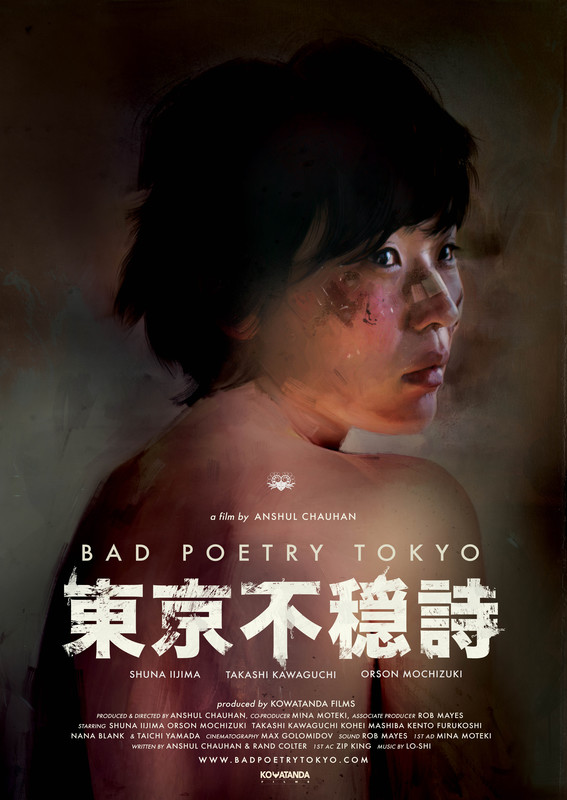
Bad Poetry Tokyo posterRunning towards a dream can help you forget whatever it was you were running away from, but there may come a time when you have to accept that your dream has betrayed you and the sun is already setting. For the heroine of Anshul Chauhan’s debut feature Bad Poetry Tokyo (東京不穏詩, Tokyo Fuon Uta) that moment has arrived all too soon and though she perhaps expected it to come and had actively resisted it, it can no longer be outrun.

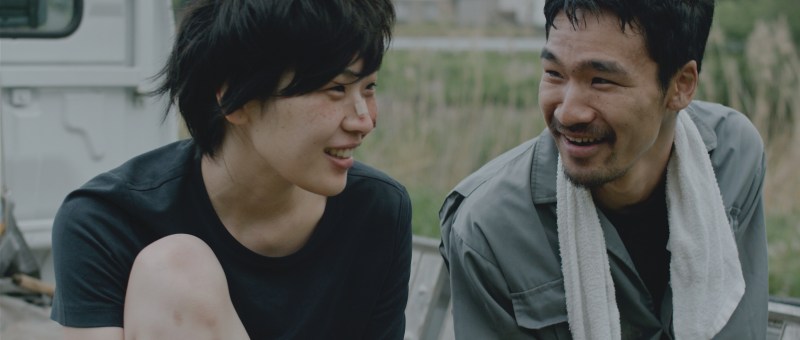
30 years old, Jun’s (Shuna Iijima) dream has been a long time coming. At a make or break audition for a Canadian film, she tells the panel that she studied English at a top university in Tokyo and plans to move to LA to work in movies. Meanwhile, she blew out of her country home five years ago and has become estranged from her family. She supports herself working as a hostess in a seedy bar which is more a front for sex work than it is a drinking establishment, but sex work is work and at least pays well allowing her to save money to move to LA.

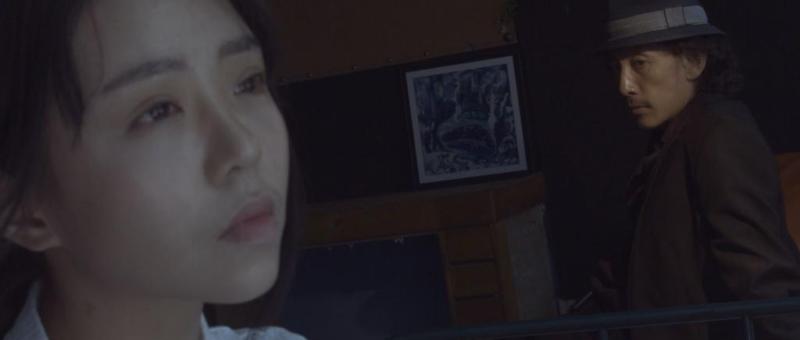
Unfortunately she plans to move there with her current boyfriend, Taka (Orson Mochizuki), who is a bouncer at the club and was responsible for getting her the job in the first place even if he now can’t quite reconcile himself with the feelings of jealousy and resentment her work causes him. Taka also has issues of his own and when twin crises present themselves in the form of a possessive and intimidating client, and a home invasion that seems like an inside job and leaves her with visible facial scarring, Jun is finally robbed of all hope and left with no other option than to retreat to her hometown and the quiet horrors which have been patiently waiting for her return.

Jun’s life, it would seem, has been one long scream. Returning to a seemingly empty home, she is less than happy to find her slumbering father (Kohei Mashiba) slumped over in the living room. Noticing the wounds on her face he begins to ask her what happened but more out of irritation than concern – he warns her not to bring any trouble to his door. Jun mutters that it might have been a mistake to come back, to which her father cooly retorts that the biggest mistake was her birth, resenting his daughter for her very existence and the taboo desires she arouses in him while insisting that this is all her fault because she is essentially “bad”. Jun’s dad didn’t even bother to tell her that her mother had died, perhaps out of embarrassment or shame for this was not a natural death and though not at his hand he is very much to blame. The first of many men to have wronged her, only now in her somewhat weakened and desperate state is Jun finally ready for a reckoning. After all, there is nothing more to lose.

Men have indeed ruined her life, as has the oppressive patriarchy which continues to define it. The first time we see her, Jun is forced to perform an intense audition scene of a woman being brutally beaten and abused for a dispassionate director. Which is to say, she is forced to humiliate herself and relive very real traumas in the quest to fulfil her dream. This early scene of playacting will be recalled several times, most obviously in the flashforward which opens the film and eventually leads to a moment of both liberation and transgression which ultimately seals her fate.

Unable to gain a foothold in acting, Jun is forced into a life of sex work which she finds degrading and unpleasant, allowing herself to be “violated” in return for money as she later describes it. Again reliving past traumas, her anger only grows and intensifies as she passively permits herself to be misused. A final act of rebellion in refusing the intimidating and entitled attentions of a controlling client leads to a dangerous situation in which he reminds her that women like her belong to men like him and if it pleases him he will destroy her. Jun gives up on her dream and therefore has no more need of the club, but employment in a hostess bar is not always as casual as it seems and one cannot just simply leave. Once again Jun has become someone’s property, not merely as an idea but as flesh.

Jun’s physical wounds are a manifestation of her emotional trauma and the legacy of violence which traps her in an oppressive cycle of abuse and despair. Back in her hometown, filled as it is with unpleasant memories and the shadow of her father’s cruelty, Jun is haunted by the spectre of an innocent childhood. Reuniting with an old friend who, it seems, has always carried a torch for the girl she once was, Jun is forced to confront the gulf between the “innocent” self which escaped with hope, and the defeated self which has returned with none. Even this seemingly positive, innocent romance is eventually tainted by violence offered as an act of love which has its own sense of disquieting poetry. Yet violence is the force which perpetuates despair, creating only fear and rage and pain each time it breeds. Jun is running once again but neither forward nor back, only full pelt towards the setting sun.


Bad Poetry Tokyo was screened as part of the 2018 Raindance Film Festival.

Festival promo (English subtitles)

The End of Wind (风的另一面, Fog Forest, 2018)

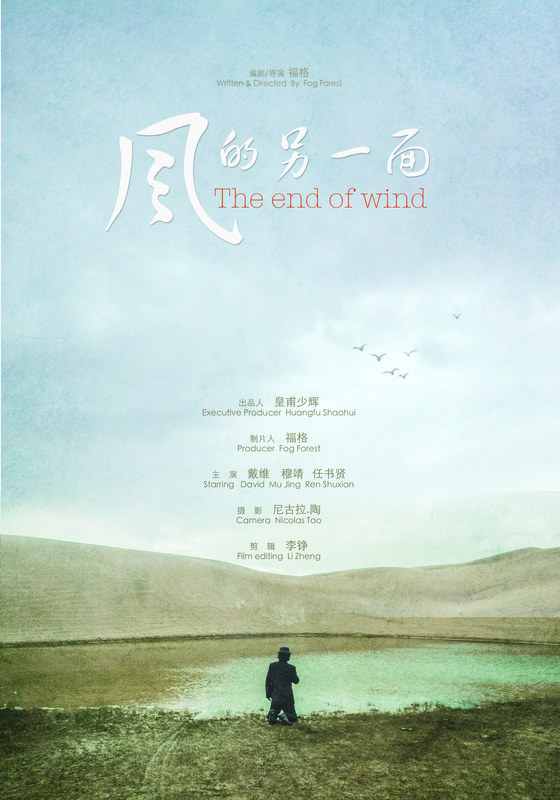
The End of Wind posterDoes beauty still exist in the world or only in the minds of lonely people? Director Fog Forest wants to know if there is anything pushing back against the forces of indifference in his debut feature, The End of Wind (风的另一面, Fēng de Lìngyī Miàn) which follows the melancholy fates of three individuals each looking for connection in an increasingly apathetic society. A salaryman with an existential crisis, a man wrongly imprisoned for a violent crime, and a young woman whose escape from North Korea led her straight into the hands of human traffickers, ponder if life is still worth living when the bonds between people have become so weak and distorted.

Wang Ran, a frustrated company man and all round snappy dresser, has long been in a depressive slump. Lamenting the attitudes of those all around him, he resents their all encompassing greed and self-interest. He can’t understand why they are so keen to destroy the “beautiful things” of the world in order to continue their quests towards materialist success. Then again, Wang is no longer sure that the “beautiful things” really exist outside of his own mind and if they do he has no idea how to find them. Meanwhile, Yang Botao has just been released from a ten year prison sentence for a crime he did not commit only to find that his mother passed away while he was inside and his father has spent all their money trying to get him released. To make matters worse, Yang is also suffering from kidney disease thanks to constant beatings from sadistic prison guards. A series of events brings the two men together when they decide to rescue a young woman, Kim Meishan, who escaped from North Korea but fell into the hands of human traffickers when her father was killed during the journey.

Each of the three protagonists is looking for some kind of connection which will restore their will to continue living even when life is so obviously meaningless and depressing. In order to find his purpose, Wang gives up his job and goes wandering, living in bare apartments and trying to make connections with kind people he finds along the way. Yang too decides to set off on a journey when his attempts to restart his life are frustrated by an inability to find a job in his hometown where the spectre of his “crime” haunts him everywhere. Unlike Wang, Yang decides to try rekindling an old connection in looking for a woman he knew before he went away who has apparently moved on, possibly to the North West. A true journeyman, Yang becomes the conduit which delivers the path to destiny that Wang has been seeking when his delivery job brings him into contact with Meishan who is able to pass him an SOS in the form of a cassette tape. Intended for her long lost mother, the message is in Korean and Wang is therefore unable to understand it save for identifying Meishan’s distress and realising that he has received a literal cry for help.

Though helping Meishan, Wang’s sense of purpose beings to return, warmed by her desire for life as evidenced by her ravenous hunger. In her he perhaps comes to believes that the “beautiful things” he dreamed of really do exist, and can be found by building genuine connections with others even if they are not supported by common language. His final answer is, however, not quite so positive and all three of our protagonists realise different destinations in their mutual quests for fulfilment. Having been abandoned by all each exists separately, unable to reconcile themselves either to the compromises of the consumerist world or discover a new one through forging bonds with other similarly lonely people. Wang’s world is one of imperfect destruction, surrounded by ruins and filled with nihilistic emptiness from which there may be no escape. Or perhaps, the only possibility of escape ends in an “end” which is not an end but a release. Poetic, if at times obtuse, Fog Forest’s debut is a noirish exploration of the sadness of being alive but one which offers no sign of hope for a society in terminal decline.


The End of Wind was screened as part of the 2018 Raindance Film Festival.

Original trailer (english subtitles)