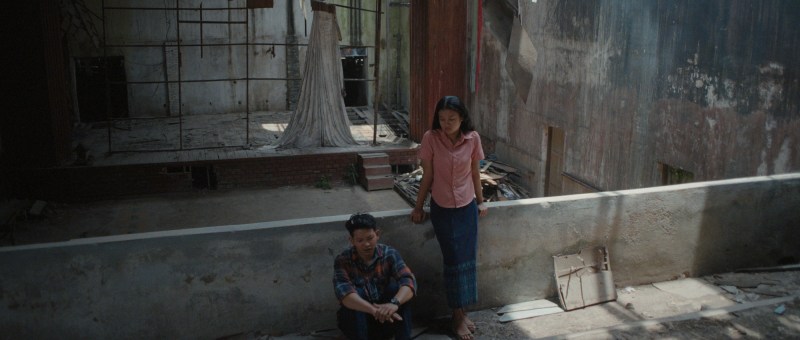
In a way, all cinemas are haunted spaces. They echo and replay time while becoming repositories for the thoughts and feelings of all who walk through their doors. Perhaps that’s why many of them feel so human, as if they really had a soul. Or perhaps they steal a little bit of ours and hide it away behind the screen. The cinema in Polen Ly’s Becoming Human (ជាតិជាមនុស្សា), however, really does have a spirit of its own now facing eviction as it, too, is to be torn down to make way for a new that no one may really want.
This feeling of unwilling displacement and rootlessness echoes through the film, not the least in the figure of the woman across the way cleaning out her late mother’s home. She looks lovingly at a tree on the rooftop knowing she will never see it again and this last memory of her childhood will not last much longer. Her son sarcastically asks her why she doesn’t take it with her and the house too for that matter if she likes them so much. She would if she could, she replies, with a tone that suggests she’s put out not have the option of doing so. Thida, the cinema ghost, is also in search of a tree, one that once stood outside her childhood home, though she’s no idea if either of them are still there now. She’s rooted to this place, or more precisely to a small shrine inside it that is later rather unceremoniously put out for the bin men with the rest of the demolition refuse.
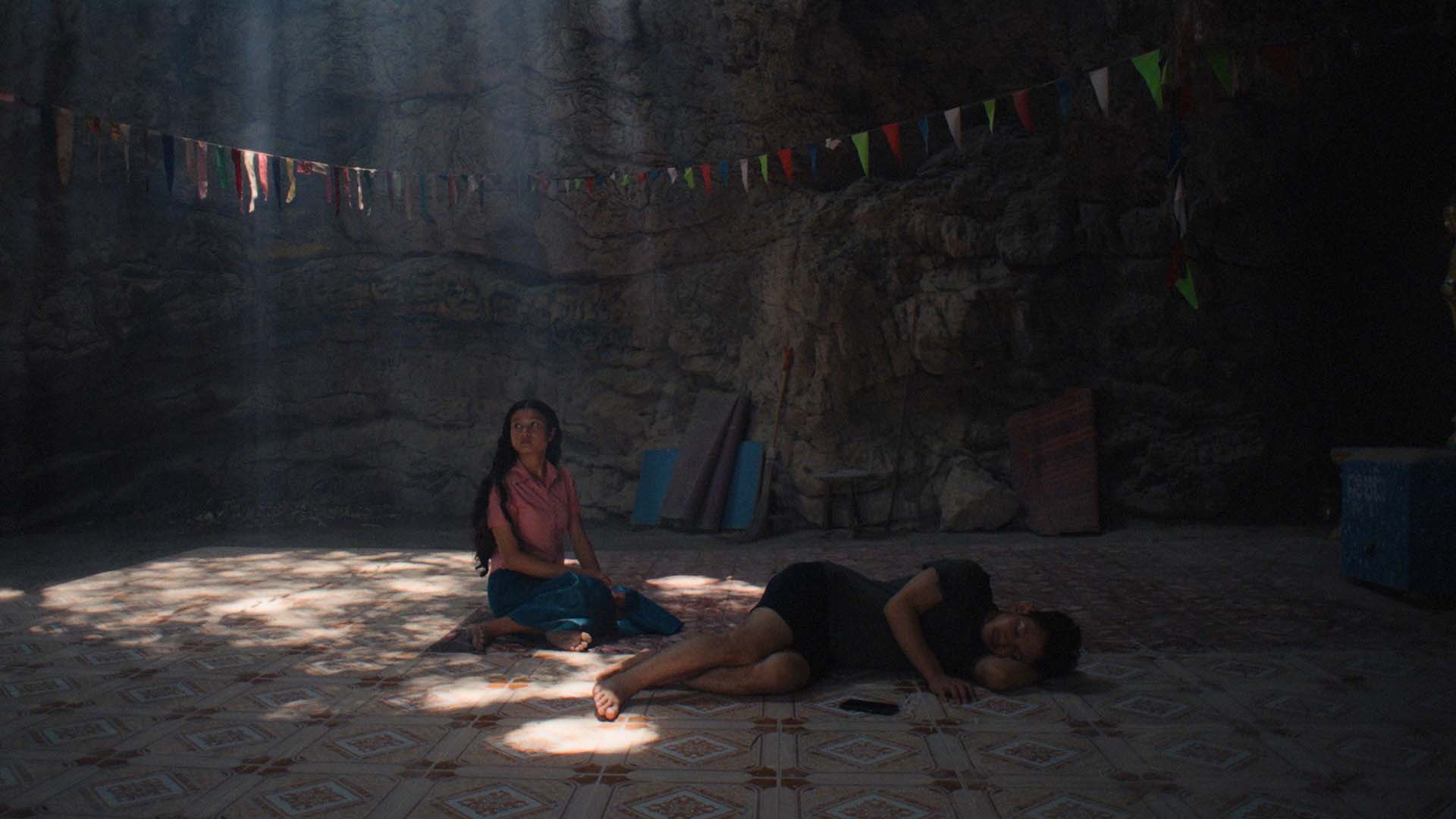
But Hai, a young photographer weary of his life as a journalist in a world in which no one wants to talk about anything serious, is also in his way haunting this space. He tells Thida that he has no home to go back to. Abandoned as a child, he took shelter in a pagoda which, when Thida breaks free and visits it, looks much like the ruined cinema with the light streaming in from above. Now the pagoda is to be torn down too, this time for a quarry which is slowly destroying the very landscape in levelling mountains to build tall buildings in other places. After being sent off for rebirth, Thida encounters a woman who used to be the guardian spirit of a lake, but has learned to live with changing times. Nevertheless, she laments that the lake was filled in to build more apartment blocks and shopping centres for the wealthy. The lake, meanwhile, was used by the poor villagers to water their crops and provided them with fish. The villagers were made into wandering ghosts too. They lost their homes, went to prison for protesting, or took their own lives because they could not find a place for themselves in this changing landscape.
Thida resisted rebirth because her suffering was too great in this life and she’s no desire to repeat it. Being a ghost’s not all that bad, she insists, but there are reasons she can’t move on and in, someways, it’s the country that’s haunting her rather than she it, much as her presence provides both comfort and melancholy for Hai who perhaps risks becoming trapped in nostalgia for a lost past he never really knew. He sings old songs in the abandoned cinema, while ironically playing a classic film for Thida on his smartphone. Perhaps in a way this demonstrates that things don’t disappear so much as merely migrate. Somewhere, the film is always playing even it’s just echoing in the ears of Thida and Hai as they look for new homes in a place where it feels as if the foundations are always been dug out from underneath them.
Still, Thida is also a temporal ghost carrying with her the lingering trauma of a war that continues to scar a landscape if only in its empty spaces. Given the ability to go anywhere, Thida realises there is nowhere to go but home. She grasps the grass where her house once was and seems to make peace with something. Nevertheless, in the end she can’t let it go, choosing to take her memories with her however painful they might be. This land is being reborn too, dying and being rebuilt, while in some respects at least forgetting itself while simultaneously unable to move on from its past.
Becoming Human screens in Amsterdam 8th, 10th, and 12th April as part of this year’s CinemAsia Film Festival.
Trailer (English subtitles)











 Windows on Worlds