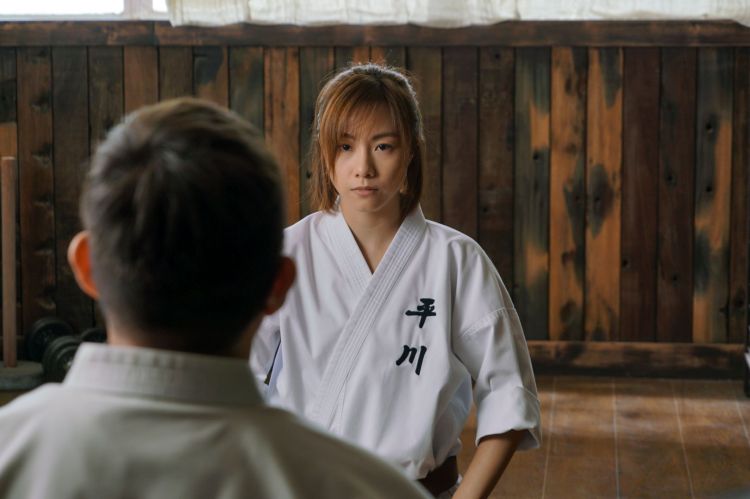
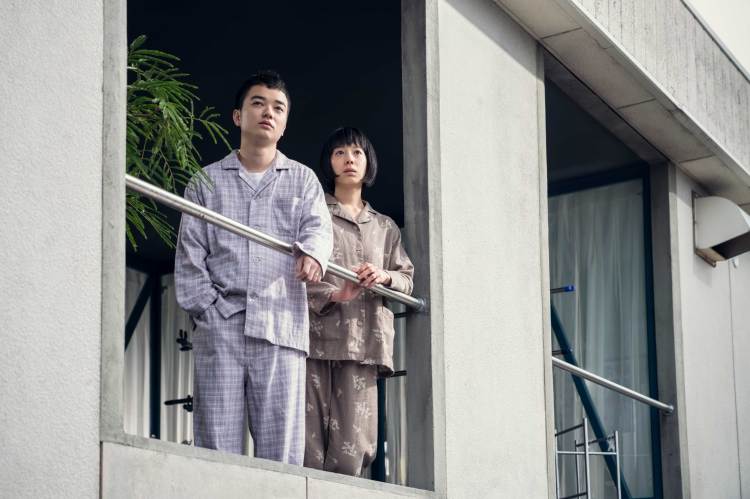
Merry Christmas Mr. Mo (메리크리스마스 미스터 모, Lim Dae-hyeong, 2016)

Merry Christmas Mr Mo posterMr. Mo does not at first seem the Christmassy type. He’s gloomy, sullen, and monosyllabic – about as far from festive as it’s possible to get, yet over the course of Lim Dae-hyung’s charming feature debut, he becomes an irresistible hero bravely fighting back against his loneliness and disappointment while there is still time. Shot in black and white with a deadpan, Jarmushian sense of humour, Mr. Mo’s journey of reconnection is one of quiet melancholy yet filled with its own strange warmth for its cast of disconnected characters each finding a point of recognition in the silent world of Mr. Mo.

The local barber, Mr. Mo (Gi Ju-bong) is known around town but does not encourage friendliness outside of his studio. His life begins to diverge from its usual routine when a visit to the doctor, who urges him to quit smoking, causes him to worry about his health. Despite his normally aloof nature, Mr. Mo engages in some slapstick humour in the pool where he swims everyday before asking a young woman, Ja-young (Jeon Yeo-bin), to go for a drink with him on the way home. Ja-young is somewhat taken aback and perhaps worried about an old man asking her to drink with him, replying that she’s quite tired and just wants to go home. Mr. Mo’s intentions are 100% honourable and he just really wanted some company on this quite depressing day. Ja-young decides to go anyway and regales him with horticulture tips and theories on physiognomy, her loquaciousness a perfect match for Mr. Mo’s laconic demeanour.

When he receives even worse news than he feared from the Doctor, Mr. Mo decides it’s time to put his house in order – clearing out a 15 year old Christmas tree but leaving the December 1999 calendar hanging on the door. It’s clear from Mr. Mo’s apartment that he once had a family and now lives alone, though he mostly spends his off time munching popcorn in front of the TV and writing in his diary. His nights are repetitions of insomnia in which he repeatedly thumps his pillow in frustration, sitting up reluctantly in the morning and tearing his eye mask off his face.

Having dreamed of being an actor in his youth, Mr. Mo’s final wish is to make a film with his distant, aspiring filmmaker son. Stephen (Oh Jung-hwan) lives in the city with his girlfriend, Ye-won (Go Won-hee), but he seems to be just as sullen and depressed as his dad though perhaps without so much of the reason. Mr. Mo is a big fan of Ye-won, though he can’t quite understand what she’s doing with his son. She puts up Stephen’s nonsense, his loss of drive and occasional fits of pique and the couple’s relationship seems solid, even if a little strained and sometimes difficult.

Making the movie, a Chaplin-esque slapstick piece, is partly an excuse to reconnect with Stephen but it also affords him an opportunity to revisit and reconsider the past, revealing hitherto hidden details of his son’s early life. Gi Ju-bong excels in the leading role of the vacant Mr. Mo who eventually becomes a hilarious silent movie comedian complete with silly walk and repeated sight gags which also take on and added degree of melancholy given Mr. Mo’s condition and his desire to push his own self-destruct button.

Despite his aloofness, Mr. Mo is a keen observer of people as revealed in the final voiceover of his diary for December (written in the form of letters to his late wife) in which he notes down his various meetings from the overly polite young man who says hello to too many people to picking up on Ja-young’s loneliness, and regretting his hostile reaction to his sister-in-law’s kindness. Getting everyone together at the end to reveal the solution to the enigma which is Mr. Mo, Lim’s debut is a whimsical journey through the loneliness and resignation of late middle age filled with a strange affection for its cast of eccentrics and enlivened by the quirky, acoustic guitar score which considerably adds to the air of mild surreality in strangely framed vistas of emptiness which perfectly capture Mr. Mo’s charming black and white world.


Screened at London Korean Film Festival 2017.

Original trailer (English subtitles)

Warriors of the Dawn (대립군, Jeong Yoon-chul, 2017)

Warriors of the Dawn posterSome might say a king is the slave of his people, but then again he is a very well kept slave even if he is no more free than a serf at the mercy of a feudal lord. Warriors of the Dawn (대립군, Daeribgoon), set in 1592 during the short-lived Japanese invasion, takes this idea to its heart in playing up the inherent similarities between the oppressed poor who are forced to impersonate the sons of wealthy men too grand for the battlefield, and the Crown Prince unwillingly forced to impersonate the King who has abandoned his people and run away to China to save his own skin. Though the Prince is young and afraid, with the help of his resentful mercenary brethren he begins to find the majesty buried inside himself all along but crucially never forgets what is like to feel oppressed so that he might rule nobly and fairly, unlike his more selfish father.

The tale begins with Tow (Lee Jung-Jae) – a “Proxy Soldier”, one of many from the Northern borderlands where the living is hard. Sons of feudal lords need not risk their lives on the battlefields while there is money to spend and so they buy the service of young men from poor families to stand in for them. The men take the name of the man they’re supposed to be but if they die, their family must send a replacement to serve out the remaining time or pay back the money that was given to them. At this point Tow’s main problem is the Jurchen rebels who’ve decided to live life their own way outside of the system of class hierarchy currently in place in feudal Korea.

The Japanese, however, are pressing on and making gains towards the capital. The King decides to flee, hoping to reach China where the Ming Emperor may be minded to help them. He cannot, however, simply abandon ship and decides to divide the court with the left behind contingent headed by his son, Crown Prince Gwang-hae (Yeo Jin-goo). Gwang-hae is young and inexperienced. Not having had a good relationship with his father, he’s mystified as to why he’s suddenly been given this “honour” but together with a selection of advisors he’s sent on a journey to found a second court at Gonggye, picking up scattered forces along the way. This brings him into contact with Tow and his contingent who become his main defenders.

Having lived a life inside the palace walls, Gwang-hae knows nothing of war or fighting and has brought a selection of books with him hoping to learn on the job. His ineptitude is likened to that of a young recruit to the band of Proxy Soldiers who has been forced to join on the death of his father but has no training and is too squeamish to kill, requiring Tow to come to his rescue as he later does for Gwang-hae. Tow is a born soldier yet reluctant, fully aware that he no longer exists and should he die another man with no name will step into his place with nary a pause. He continues to fight because he has no choice but he also feels an intense bond of brotherhood to his fellow men, something which later extends to Gwang-hae once his latent nobility begins to emerge.

Gwang-hae’s central conflict is between his advisors who council him towards austerity, and his deeper feelings which encourage him to sympathise with the ordinary people he meets along the way whose lives are being ruined thanks to the government’s failure to protect them. As it turns out, Gwang-hae is also low-born, in a sense, and therefore has inherited something of the common touch which separates him from the aloofness of his father. Though he is constantly told to make the “rational” choice he refuses – ordering troops to stop when they attempt to extort food from starving peasants, insisting on evacuating a village to safer ground, and then finally becoming a warrior himself in order to defend his people when no one else would.

Gwang-hae is, perhaps, a warrior for a new dawn and a flag that men like Tow can follow in the quest for a better world in which each man can keep his own name and fight for his own cause rather than that laid down for them by men with money or power. Despite the potential for a more urgent argument, Jeong mostly falls back on standard period aesthetics with overly familiar narrative beats heavily signposted by a subpar script. Warriors of the Dawn cannot decide whether it’s a film about catching the conscience of a king or the noble sacrifice of would be revolutionaries, failing to lend the essential weight to its duel arcs of rebirth and coming of age all of which makes for a long, hard march towards an inevitable conclusion.


Screened at the London Korean Film Festival 2017.

International trilogy (English subtitles)

Lost in the Moonlight (달빛궁궐, Kim Hyun-Joo, 2016)

Lost in the Moonlight posterGirl gets lost in a fantasy land and has to find herself to find the way out – it’s a familiar enough tale but then perhaps Lost in the Moonlight (달빛궁궐, Dalbitkungkwol) is mostly about that kind of familiarity. The debut feature from Korean director Kim Hyun-joo, Lost in the Moonlight was plagued with widespread internet controversy on release of the movie’s trailer and publicity material which heavily echoed Studio Ghibli classic, Spirited Away. Though this is, in some ways, unfair – you can’t escape the fact that fantasy mythical Korea shares some aesthetic similarities with that of Japan or China, or the fact that girls slipping into fantasy realms is the nature of the genre, it’s hard to get past the presence of the tiny helpers and their resemblance to Dust Bunnies, or the poster which puts the flying dragon front and centre. Nevertheless, Lost in the Moonlight’s intentions are less intense than Spirited Away’s and focus more keenly on a particular notion of learning to shine in the role you’ve been given rather than desperately chasing an external spotlight.

Hyunjunli (Kim Seo-young) is an ordinary thirteen year old girl who is set to participate in the performance of a musical at Changdeok Palace. Her parents, remaining off screen, sound supportive and are excited about seeing their little girl in such a big show even if Hyunjunli is a typical teenager who’s mortified at the idea of her parents showing up and embarrassing her, or she them with her minimal involvement in the action. Though shy and dreamy, Hyunjunli longs for the spotlight and feels silly stuck at the back of the chorus playing the very uninspiring part of a tree while her friends get to play animal gods and all manner of other exciting things.

Meanwhile, a Rat God of time is feeling exactly the same, tired of just standing around in the back not really doing anything. He makes a break for it and ends up in the human world where he drops his magic tag. Hyunjunli, a helpful sort of person, picks it up and is whisked off to a fantasy land where she meets a new friend, Mr. Squirrel, and is taken to the Moonlight Palace by the mysterious Lady Blossom.

Hyunjunli in the land of Moonlight is story of a little girl lost that runs back through Alice in Wonderland among many others, though the stakes originally appear a little lower as Moonlight seems safe enough save for the talking animals and general unfamiliarity of the place. The setting is inspired by traditional Korean mythology with its bickering mountain gods and focus on the natural world but is also, of course, heavily influenced by Hyunjunli’s perception of it. Slightly confusingly, the film has a mild environmentalist message as the conspiracy Hyunjunli walks straight into revolves around the awakening of the juniper tree which allows all the trees which have apparently been arrested by the tyrannical rule of time to get up and exact revenge against humanity for its widespread destruction of the planet, meaning that Hyunjunli has to find a way to restore time and stop the murderous tree rampage to save the Earth (which is also what the trees want to do).

Predictably enough, the fantasy land situation echoes Hyunjunli’s own as the drama is revealed to have been caused by the Rat God who also felt bored and unloved working as part of a team rather than doing something flashier out in front. What Hyunjunli learns is that everyone has their place and that the system fails when the little guys don’t pull their weight. The message, that there are no small parts just small actors, is fair enough as Hyunjunli realises it’s wrong to try and steal a spotlight which does not belong to you but then it also reinforces a less palatable message about social conformity and the necessity of living only inside the box in which you were born. Nevertheless, even if it does not always make complete sense Lost in the Moonlight does manage to provide a family friendly fantasy that its target audience may well be far more forgiving of than the confused adults watching along with them.


Screened at London Korean Film Festival 2017.

Original trailer (no subtitles)

The Last Witness (최후의 증인, Lee Doo-yong, 1980)

Last Witness Restoration posterThe Last Witness (최후의 증인, Choehuui jeungin), a pregnant title if there ever was one, begins with a melancholy voice over by way of a warning. It tells us that the path we are about to embark on will be a dark one but strikes a more optimistic note in affirming that 1980 was the year old evils were cleared away and, the narrator hopes, such darkness will have been left behind in the approaching new decade. Sadly this will not come to pass. The Last Witness is adapted from a novel by Kim Seong-jong which was published in 1974 but Lee Doo-yong filmed his adaptation in 1979 during the brief surge of hope for a brighter future following the assassination of dictator Park Chung-hee which ended with the military coup staged by general Chun Doo-hwan placing the country under martial law. A detective is assigned a case, but his investigation takes him on a long, soul searching journey into the recent past in which he finds countless crimes, betrayals, and proofs of human cruelty which ultimately destroy his ability to believe in the better, brighter future which has been promised yet denied.

Oh (Hah Myung-joong), a recently widowed, strung out police detective is handed a case by his sympathetic boss which seems to have been buried. A brewery owner, Young Dalsoo (Lee Dae-keun), has been murdered whilst fishing at a river and there appear to be few clues save that the woman he was living with was apparently not his legal wife. Oh’s preliminary enquiries all point back to an incident 20 years previously when Young was the youth leader in the village and supposedly helped to capture/kill a squad of rebel communist guerrilla fighters who had been hiding on Mt. Jirisan. 

Lee structures the tale to mimic Oh’s investigation; we follow him as he follows leads, jumping back to the 1950s and then forward again the world of 1980. The war becomes a corrupting and dividing line but Lee is bold in his tenet that the wounds did not heal after the truce. The villainy and greed continued, women were used and abused, men were cheated and betrayed. Justice no longer existed and the system continued to be bent to the will of the powerful rather than used for the defence of the weak.

It’s no surprise that Lee had such trouble with the censors. The version of the film restored by the Korean Film Archive runs 154 minutes (the first cut apparently ran 158) but for its original release the mandated cuts took it down to 120, leaving an already complex narrative near incomprehensible. Aside from the scenes of rape and violence, the censors took issue with the depiction of judicial corruption and particularly with its manipulation to facilitate sexual coercion of a defenceless young woman.

The woman at the centre of the storm is Son Jihye (Jeong Yun-hui) – the daughter of a wealthy man who nevertheless became a commander of a communist guerrilla unit during the war. When General Son went into the mountains he took his daughter with him, but realising he was on the losing side, and resenting orders he believed would result in nothing more than martyrdom, Son lost faith in “communism” and was murdered by his own men in an act of mutiny. Before he died he entrusted a treasure map marking the spot he buried his ancestral wealth to a fellow officer with the instruction to look after his daughter and make sure she gets her inheritance. The soldier failed to keep his promise. Jihye is raped and then gang raped, rescued by a sweet and simple man, Bau (Choi Bool-am), whom she later marries, and then forced to become the mistress of an official who also raped her. Jihye and Bau are the innocents chewed up by the system, good people pushed into a corner by the politics of others and then let down by a society so riddled with corruption that it can no longer command any degree of faith from its continually oppressed people.

The Korea of 1980 is being attacked through the legacy of 1950 but whether in concession to the censors or no, the communists do not come off well either. Son, described as an eccentric, is clearly a misguided madman who has betrayed his class on a superficial level, saving his own wealth for a rainy day, but he is allowed a semi-noble death in finally renouncing communism as a cruel, ambitious underlying has him brutally executed by bloody, violent bayonets while his daughter watches from behind a nearby bush. Once Son is dead the madness sets in as the guerrillas hide out beneath a primary school, listening to small children sing happy songs while they tie up and rape a terrified teenage girl having abandoned all concessions to morality and their supposedly noble cause.

If the communists were bad what came later was worse. Interviewing a witness, Oh is keenly aware that the man is telling him only a part of the truth, leaving out a painful detail but leaving in just enough for a skilled investigator to understand. It is this act of selective silence that Oh has come to challenge, exposing the whole sordid story of his nation across two decades of war, trauma, economic recovery and political oppression. Oh cannot resist meting out a little justice of his own in reciting the man’s hidden truth back to him, forcing him to confront the ugliness of his of youth and the guilt that he has long been repressing. Unable to prosecute him for his crimes, Oh hopes that the man will be punished “emotionally” by his words but his actions have far more severe consequences than he ever could have anticipated.

What Oh finds when he solves the crime is a long history of rape, secrecy, betrayal, selfishness, and the misappropriation of law by the powerful to oppress the powerless. It all goes back to the mountain and the war, a young woman robbed and violated, her protector imprisoned, and a legacy of pain which will come back to haunt those responsible but bring only ruin and anguish to its original victims. The question of the “last witness” remains unsolved – will these be the last witnesses to an era of fear and impotence now that the bright future is on its way, or is Oh the last witness, deciding to take his terrible knowledge with him to a better place? Then again the film itself stands as a testament to its times, butchered by censors but carrying forth its own hidden truths only to deliver them 30 years later than expected. Lee’s powerful murder mystery is an investigation into the death of a nation about to be reborn which makes its grim yet inevitable conclusion all the more painful in its brutal negation of a long buried hope.


Screening as part of the London Korean Film Festival 2017 at Regent Street Cinema on November 4th, 2pm.

The Last Witness is also available on all regions dual format DVD & blu-ray courtesy of the Korean Film Archive. In addition to English subtitles on the main feature, the blu-ray disc also includes subtitles for the commentary track by Park Chan-wook and film critic Kim Young-jin, while The DVD includes subtitles for the commentary track by Kim and Lee Doo-yong as well as an additional commentary by director of Kilimanjaro/The Shameless Oh Seung-uk and journalist Ju Sung-chul.

The accompanying booklet is fully bilingual and includes essays by Kim Young-jin, Ju Sungchul (Editor of Korean film magazine Cine 21), and Inuhiko Yomota (film critic – the booklet also includes the original, untranslated essay in Japanese), as well as a note on the restoration from the KOFA conservation centre.

(Not currently available on the Korean Film Archive’s YouTube Channel)

Original trailer (Restored, English subtitles)

Archipelago: Exploring the Landscape of Contemporary Japanese Women Filmmakers

©Little More Co.

wild berries posterFollowing the last series of free film screenings which took place over the summer, the Japan Foundation London is back this winter for a season of films dedicated to female filmmakers. Archipelago: Exploring the Landscape of Contemporary Japanese Women Filmmakers features two narrative films and a documentary as well as a panel discussion chaired by Kate Taylor with Jasper Sharp, Alejandra Armendáriz Hernández, and the season’s curator Irene Silvera.

Bare Essence of Life

©Little More Co.Released in 2009, the second feature from Satoko Yokohama stars Kenichi Matsuyama as Yojin – an Aomori farm boy who lives on a slightly different plane of existence to everyone else. When a pretty school teacher (played by Kumiko Aso) arrives from Tokyo, Yojin becomes determined to win her heart, whatever the eventual costs may be!

Screening at Courthouse Cinema on 30th November, 6.30pm.

Death of a Japanese Salesman

ending note still 1.jpgAlso known as Ending Note, Mami Sunada’s documentary follows the last days of her father, a lifelong salaryman who retired aged 67 only to be diagnosed with terminal cancer soon after. Realising that he had only a short time left to live, Sunada began preparing for his death, creating his own bucket list and thinking about the “ending note” (a kind of personal testament) that he would leave behind for his family.

Screening at Courthouse Cinema, 1st December 6.30pm

Wild Berries

wild berries still 1Miwa Nishikawa whose The Long Excuse has been doing the festival rounds this year began her career as a student staff member on Koreeda’s Afterlife before ADing on Yoshimitsu Morita’s Black House and then again for Koreeda on Distance. Released in 2003 and produced by Koreeda, Wild Berries is her debut feature and neatly mixes the influences of both her mentors in an anarchic family drama. The Akechis had been getting along just fine until prodigal son Shuji decided to return bringing a few chickens home to roost with him.

Screening at Rich Mix, 2nd December 12pm

Panel Discussion

©Little More Co.Directly after the screening of Wild Berries, there will be a panel discussion examining the rise of female filmmakers over the last 15 years. Chaired by Kate Taylor – East Asian programmer for the BFI London Film Festival, the panel will also feature film scholar Jasper Sharp (co-founder of Midnight Eye, author of Behind the Pink Curtain), film researcher Alejandra Armendáriz Hernández, and the season’s curator, Irene Silvera.

The Panel Discussion takes place at Rich Mix, 2nd December, 2.30pm.

In conjunction with the series, there will also be a screening of Naoko Ogigami’s Rent-a-Cat as part of the regular free screenings programme at the Japanese Embassy on 22nd November. Tickets are free and can be booked by the usual methods following the instructions on the Embassy’s Filmshow page.

More information can be found on Japan Foundation London’s website – each of the screenings is free to attend but tickets must be booked in advance.

You can also keep up to date with all the latest Japan Foundation events via their official Twitter account and Facebook Page.

The Merciless (불한당: 나쁜 놈들의 세상, Byun Sung-hyun, 2017)

merciless posterHeroic bloodshed is alive and well and living in Korea. The strange love child of Na Hyun’s The Prison, and Park Hoon-jung’s New World, the first gangster action drama from Byun Sung-hyun (previously known for light comedies), The Merciless (불한당: 나쁜 놈들의 세상, Boolhandang: Nabbeun Nomdeului Sesang) more than lives up to its name in its noirish depiction of genuine connection undercut by the inevitability of betrayal. Inspired as much by ‘80s Hong Kong cinema with its ambitious, posturing tough guys and dodgy cops as by the more immediate influence of the seminal Infernal Affairs, Byun’s brutal tale of chivalry is, as he freely admits, an exercise in style, but its aesthetics do, at least, help to elevate the otherwise generic narrative.

That would be – the complicated relationship between young rookie Hyun-su (Im Siwan) and grizzled veteran Jae-ho (Sol Kyung-gu). Hyun-su proves himself in prison by besting current champions bringing him to the attention of Jae-ho – the de facto prison king. Sharing similar aspirations, the pair form a tight, brotherly bond as they hatch a not so secret plan to take out Jae-ho’s boss, Ko (Lee Kyoung-young), leaving Jae-ho a clear path to the top spot of a gang engaged in a lucrative smuggling operation run in co-operation with the Russian mob and using the area’s fishing industry as an unlikely cover.

We’re first introduced to Jae-ho through reputation in the film’s darkly comic opening scene in which Ko’s resentful, cowardly nephew Byung-gab (Kim Hee-won), has a strange conversation with a soon to be eliminated colleague. Byung-gab says he finds it hard to eat fish with their tiny eyes staring back at you in judgement. He admires Jae-ho for his ice cold approach to killing, meeting his targets’ gaze and pulling the trigger without a second thought.

Jae-ho is, indeed, merciless, and willing to stop at nothing to ensure his own rise through the criminal underworld. He will, however, not find it so easy to pull that trigger when he’s staring into the eyes of sometime partner Hyun-su. Neither of the two men has been entirely honest with the other, each playing a different angle than it might at first seem but then caught by a genuine feeling of brotherhood and trapped in storm of existential confusion when it comes to their individual end goals. Offering some fatherly advice to Hyun-su, Jae-ho recites a traumatic childhood story and cautions him to trust not the man but the circumstances. Yet there is “trust” of a kind existing between the two men even if it’s only trust in the fact they will surely be betrayed.

Byun rejoices in the abundance of reversals and backstabbings, piling flashbacks on flashbacks to reveal deeper layers and hidden details offering a series of clues as to where Jae-ho and Hyun-su’s difficult path may take them. Truth be told, some of these minor twists are overly signposted and disappointingly obvious given the way they are eventually revealed, but perhaps when the central narrative is so fiendishly convoluted a degree of predictability is necessary.

The Merciless has no real political intentions, but does offer a minor comment on political necessity in its bizarre obsession with the fishing industry. The police know the Russians are involved in drug smuggling and using the local fishing harbour as a front, but as fishing rights are important and the economy of primary importance they’d rather not risk causing a diplomatic incident by rocking the boat, so to speak. The sole female presence in the film (aside from Hyun-su’s sickly mother), determined yet compromised police chief Cheon (Jeon Hye-jin), is the only one not willing to bow to political concerns but her methods are anything other than clean as she plants seemingly vast numbers of undercover cops in Jae-ho’s outfit, only to find herself at the “mercy” of vacillating loyalties.

Heavily stylised, Byun’s action debut does not quite achieve the level of pathos it strives for in an underwhelming emotional finale but still manages to draw out the painful connection between the two anti-heroes as they each experience a final epiphany. An atmosphere of mistrust pervades, as it does in all good film noir, but the central tragedy is not in trust misplaced but trust manifesting as a kind of love between two men engulfed by a web of confusion, betrayal, and corrupted identities.


Screening as part of the London Korean Film Festival 2017 at Regent Street Cinema on 3rd November, 6.30pm. The Merciless will also screen at:

and will be released by StudioCanal on 13th November.

International trailer (English subtitles)


In Between Seasons (환절기, Lee Dong-eun, 2016)

In Between Seasons posterIt’s a strange thing to say, but no two people can ever know the same person in the same way. We’re all, in a sense, in between each other, only holding some of the pieces in the puzzle of other people’s lives. Lee Dong-eun’s debut feature, In Between Seasons (환절기, Hwanjeolgi), is the story of three people who love each other deeply but find that love tested by secrets, resentments, cultural taboos and a kind of unwilling selfishness.

Beginning at the mid-point with a violent car crash, Lee then flashes back four years perviously as Soo-hyun (Ji Yun-ho) introduces his new friend, Yong-joon (Lee Won-gun), to his mother, Mi-keyong (Bae Jong-ok). Soo-hyun’s father has been living abroad in the Philippines for some time and so it’s just the two of them, while Yong-joon’s uneasy sadness is easily explained away on learning that his mother recently committed suicide. Thankful that her son has finally made a friend and feeling sorry for Yong-joon, Mi-kyeong practically adopts him, welcoming him into their home where he becomes a more or less permanent fixture until the boys leave high school.

Four years later, Soo-hyun and Yong-joon are both involved in the car crash which opened the film. Yong-joon has only minor injuries, but Soo-hyun is in a deep coma with possibly irreversible brain damage. It’s at this point that Mi-kyeong finally realises the true nature of the relationship between her son and his friend – that they had been close, inseparable lovers, and that she had never known about it.

When Mi-kyeong receives the phone call to tell her that her son has been in an accident, her friends are joking about their own terrible boys. As one puts it, there are three things a son should never tell his mother – the first being that he’s going to become a monk, the second that he’s going to buy a motorcycle, and the third is something so terrible they can’t even say it out loud. Mi-kyeong’s reaction to discovering her son is gay is predictably negative. Despite having cared for Yong-joon as a mother all these years, she can no longer bear to look at him and tells him on no uncertain terms not come visiting again. Yet for all that her reaction is only half informed by prevailing cultural norms, it’s not so much shame or disgust that she feels as resentment. Here is a man who loves her son, only differently than she does, and therefore knows things about him she never will or could hope to. She is forced to realise that the image she had of Soo-hyun is largely self created and the realisation leaves her feeling betrayed, let down, and rejected.

Both Mi-kyeong and Yong-joon ask the question “What have I done wrong?” at several points in the film – Yong-joon most notably when he’s rejected by Mi-kyeong without explanation, and Mi-kyeong when she’s considering why she’s not been included in the wedding plans for a friend’s daughter. Both Mi-kyeong and Yong-joon are made to feel excluded because they make people “uncomfortable” – Yong-joon because of his sexuality (which he continues to keep secret from his colleagues at work), and Mi-kyeong because of her grief-stricken purgatory. No one quite knows what to say to her, or wants to think about the pain and suffering she must be experiencing. They may claim they don’t want to upset her with something as joyous as a wedding but really it’s more that they don’t want her sadness to cast a shadow over the occasion.

Gradually the ice begins to thaw as Mi-kyeong allows Yong-joon back into her life again even if she can’t quite come to terms with his feelings for her son, describing him as a “friend” and embarrassed by his presence in front of her sister and other visitors. Soo-hyun’s illness and subsequent dependency ironically enough push Mi-kyeong towards the kind of independence she had always rejected – finally learning to drive, sorting out her difficult marital circumstances, and starting to live for herself as well as for her son. Yong-joon remains stubborn and in love, refusing to be shut out of Soo-hyun’s life even whilst considering the best way to live his own. Beautifully composed in all senses of the word, Lee’s frames are filled with anxious longing and inexpressible sadness tempered with occasional joy. Too astute to opt for a crowd pleasing victory, Lee ends on a more realistic note of hopeful ambiguity with anxiety seemingly exorcised and replaced with tranquil, easy sleep.


Screened at the London Korean Film Festival 2017. In Between Seasons will also be screened at the Broadway Cinema in Nottingham on 11th November.

Trailer/behind the scenes EPK (no subtitles)

Interview with director Lee Dong-eun conducted during the film’s screening at the Busan International Film Festival in 2016.

People in the Slum (꼬방동네 사람들, Bae Chang-ho, 1982)

People in the slum still 2The Korea of the early ‘80s was not an altogether happy place. One dictator fell in 1979, but hopes of returning to democracy were dashed when general Chun Doo-hwan staged a coup and instigated martial law, brutally suppressing a large scale democracy protest in Gwangju in 1980 (though the news of the incident was also suppressed at the time it took place). People in the Slums (꼬방동네 사람들, Kkobangdongne Salamdeul), adapted from the best selling novel by Lee Dong-cheol, is not an overtly political film but takes as its heroes those who have lost out in the nation’s bold forward march into the capitalist future. Opening with a voice over from the author himself, the film dedicates itself to “the memory of neighbours of bygone days”, remembering both the hardships but also the fierce sense of community and warmth to be found among those living at the bottom of the heap.

Myeong-suk (Kim Bo-yeon), a still young-ish woman with a young son, lives in a slum outside of the city with her second husband, Tae-sub (kim Hee-ra). Nicknamed “Black Glove” because of the glove she always wears on her right hand, Myeong-suk is about to open her own business – a small grocery store serving the local residents, but her happiness is tempered with anxiety. Tae-sub, despite his promises, steals money from Myeong-suk to go drinking and gambling, is occasionally violent, and does not get on with her son, Jun-il, who refers to him as Mr. Piggy. Jun-il is also a constant worry because he’s picked up a habit of stealing things and generally causing trouble around the neighbourhood. When Myeong-suk’s former husband and the father of Jun-il, Ju-seok (Ahn Sung-ki), catches sight of her by chance one day, the past threatens to eclipse the small hope of her future.

Life in the slums is not easy. There are few resources, few people are working and there are lots of children with no money to feed and clothe them. Fights are frequent but often unserious. The community pull together to support each other, turning out in force for the grand opening of Myeong-suk’s shop or the 60th birthday celebration of a fellow resident. Besides Myeong-suk, her second husband, and son, the slum is home to a collection of unusual characters from a widow who dresses in white and does strange dances to entertain the locals, to the pastor who does his best to help where he can. A poor drunken woman makes a fool of herself all over town, nursing a crush on the pastor but seemingly unable to move past her dependency on alcohol and whatever it is that caused it and landed her in the slum.

Myeong-suk’s early life would not have suggested her current trajectory, as Bae reveals in Ju-seok’s flashbacks of his courtship to the woman who would become his wife. Ju-seok, a pickpocket, spotted Myeong-suk on a bus and it was love at first sight. Eventually he married her but never revealed his illicit occupation until he was finally arrested. For the sake of his wife and child, Ju-seok attempts to go straight but his efforts are frustrated by bad luck, temptation, and unforgiving policemen. No matter how hard Ju-seok tries to be a decent, hardworking, family man, the economic instability of late ‘70s Korea will not allow him to do it.

Myeong-suk waits for him, but there comes a point she cannot wait anymore. Her second husband is no better than her first and, just like Ju-seok, is hiding something from her. Tae-sub is a bully and a bruiser who is only using Myeong-suk as a convenient place to hide. She cannot rely on him for affection, protection, or financial stability. Ju-seok, at least, did love Myeong-suk even if that love was the very thing which kept leading him back into a life of crime which then took him away from her. Once again love is a luxury the poor cannot afford .

Where the general atmosphere may seem destined for a tragedy for the resilient, suffering Myeong-suk, her damaged son, and reformed taxi-driver former husband, Bae gives them hope for a warmer, if not a better, future. As Myeong-suk prepares to leave the slum, the pastor, encircled by the residents, reads out a passage reminding the locals that a neighbour’s suffering is one’s own suffering while the drunken woman who previously hated children appears to have sobered up and happily hugs a child. Myeong-suk makes a selfless gesture of atonement and solidarity in giving the money from selling her shop to another single mother whose youngest three all have different fathers, perhaps indicating the difficulty of her life since the father of her eldest passed away. Tae-sub too reforms, decides to face the past he’s been running from and make amends for his former life, facilitating a possible reunion for the star-crossed lovers Myeong-suk and Ju-seok. The future suddenly looks brighter, but it remains uncertain and who knows if love and a taxi-driver’s salary will be enough to keep Ju-seok on the straight and narrow as a responsible husband and father in turbulent ‘80s Korea.


People in the Slum screens as part of the London Korean Film Festival 2017 which is hosting a mini Bae Chang-ho retrospective of three films at each of which the director will be present for a Q&A.

The film was also recently released on all regions blu-ray courtesy of the Korean Film Archive. In addition to English subtitles on the main feature, the blu-ray also includes English subtitles for the commentary track by Bae Chang-ho and film critic Kim Sungwook, and comes with a bilingual booklet featuring essays by Jang Byung-won (programmer for Jeonju International Film Festival), Lee Yong-cheol (film critic), and Chris Berry (King’s College London).

You can also watch the entirety of the film legally and for free courtesy of the Korean Film Archive’s YouTube Channel.

A Confession Expecting a Rejection (거절을 기대하는 고백, Park Jeong-hoon, 2017)

Confession Expecting a Rejection still 1“You’re not going to put this on the internet, right?” – a question asked by each of the interviewees in Park Jeong-hoon’s minimal yet riveting exploration modern mores A Confession Expecting a Rejection (거절을 기대하는 고백, geojeol-eul gidaehaneun gobaeg). Shot against green screen with a static camera and under a one take conceit, Confession interrogates everything from cinema as an art form and objective and subjective realities to social media, revenge porn, and romance among the young. Despite, or perhaps because of, the almost hypnotic lack of motion, Park’s meditations take on a surreal, almost mythic quality as interviewee and interviewer (seen or unseen) unwittingly dissect themselves before the passive lens of a seemingly unrecording camera.

The film opens with the camera “running” as its two operators chat amongst themselves whilst waiting for their interviewee. These interviews seem to be conducted weekly and are something to do with a university film club whose “director” is apparently somewhat pretentious and too much of a self-centred perfectionist to survive in less tolerant industries. Anyway, the first interviewee, Kyung-woo, joined the film group a few weeks ago and is, in the opinion of the men behind the camera, “a bit weird”.

Kyung-woo arrives and sits on a stool we can’t actually see because of the green screen. He seems nice enough – large round glasses, floppy hair, loose beige T-shirt. He starts chatting, introduces himself and reveals the unusual fact that he is already married. The interviewers are surprised and question him further, discovering Kyung-woo’s wife is currently living abroad, they had no wedding ceremony, and did not register their union with the government. At this point Kyung-woo’s demeanour changes, he seems spaced out but also intense as he begins to explain about meeting his wife at a “religious gathering” and how “the ancestors” that other people can’t see tell him who might be a good person to try “recruiting”.

During the short pause after Kyung-woo’s strange story, the guys behind the camera have a brief discussion about social media and a sex tape which has just gone viral – presumably an act of revenge porn. The next interviewee, Da-jeong, rushes in and ends their discussion. Unlike with Kyung-woo, one of the interviewers asks if Da-jeong would like a mirror to check her appearance before they start recording to which she seems surprised and laughingly declines – “it’s not as if I’ve come here to look pretty” she says. The same interviewer chit-chats about her part-time job as a tutor but is stunned into silence to realise she’s been tutoring a young man rather than a little girl. Unsurprisingly, interviewer 1, Han, will try and confess his love to her while interviewer 2, Jeong-gong, is out of the room.

Jeong-gong is, in fact, the boyfriend of Da-jeong whose previously cheerful demeanour dissipates just as Kyung-woo’s had only this time when faced with the increasingly intimidating presence of Jeong-gong. Da-jeong is trying to break up with Jeong-gong, but he refuses to listen. Explaining how “worried” it makes him when she doesn’t immediately answer her phone, Jeong-gong goes on to explain about a date but Da-jeong cuts him off – she won’t be coming, she doesn’t want to see him anymore. Jeong-gong ignores her, says she’s just in a mood and will change her mind after they get something to eat the next day. The implication is that Da-jeong has tried to do this before but has always backed down and intends today to be different. Unlike Kyung-woo’s rather strange tale of cults and early “marriage”, Da-jeong’s segment descends into brutal relationship drama as Jeong-gong’s increasingly manipulative behaviour keeps her from just up and leaving.

Park plays with the medium expertly. Making fantastic use of sound design to create a literally “unseen” world behind the camera, Confession allows its two interviewers to bicker irritatedly about their film course which teaches how to “see” in “layers”, picking up “emotional evidence” that the casual viewer might miss. Discussing the seen and the unseen along with the various “ranks” of student, the boys are beginning to sound just as surreal as Kyung-woo’s batty cultism. Talk of social media also smacks of cult with its “followers”, rituals, and precisely defined social codes but the conversations are essentially elliptical ending with a brief coda which returns us to origin as Da-jeong meets Jeong-gong and flicks the camera’s on switch herself, making a confession of love that ends in a promise we know will be broken.


Screened at the London Korean Film Festival 2017.


Come, Together (컴, 투게더, Shin Dong-il, 2017)

come, together posterToo fast, too loud, too bright. The pressure cooker society threatens to explode in Shin Dong-il’s sympathetic portrayal of one family’s period of crisis in Come, Together (컴, 투게더). When sorrows come they come not single spies but in battalions – redundancy (of several kinds), betrayal, anxieties academic and financial, the Parks have more than their fare share to deal with but the cumulative effect of their individual troubles quickly overwhelms their ordinary, middle-class existence, exposing the tiny fractures in its foundation hitherto papered over by chasing the dream of materialism.

From the outside the Parks are just like any typical middle-class family. They live in a nice apartment with a greenhouse balcony and plenty of space for three. Dad Beom-goo (Lim Hyung-guk) is a moderately successful salaryman, but his world collapses when he’s abruptly let go in the most insensitive of ways by his slimy boss. Mum Mi-yeong (Lee Hye-eun) is a credit card saleswoman who earns by commission and is well used to the hard sell. Teenage daughter Han-na (Chae Bin) has taken a year out to retake her university entrance exams but is now in limbo after not doing well enough to be accepted but having been ranked 18th on the waiting list, anxiously waiting to find out if enough people decide to decline the place she is so desperate to win.

Beom-goo losing his job of 18 years is not just humiliating and embarrassing, but as the family are already in huge debt it is also extremely worrying. As a middle-aged man, it’s unlikely Beom-goo is going to be able to find a comparable position in Korea’s competitive labour market where switching companies is still not the norm and most employees are hired right out of college. Having spent the last 18 years debasing himself to flatter his bosses, it’s galling in the least to realise he’s simply been replaced with a younger, cheaper employee he himself helped learn the ropes. Deprived of his breadwinner status, Beom-goo is supposed to be doing the housework but the boredom quickly gets to him and he spends most days lounging around in his pants lamenting his sorry state. That is until he meets the man from upstairs (Kim Jae-rok) who happens to be in a similar position and begins to lead Beom-goo astray before hinting at a much darker course for himself than the one he’s set Beom-goo on.

Mi-yeong is now the sole provider but her work is extremely stressful – not just the high pressure world of sales, but the bitchy, backstabbing atmosphere in the mostly female office. The job is to get people to sign up for credit cards they don’t really need and probably can’t afford, adding to the pressures of the consumerist society which have already landed the Parks in financial difficulty themselves. Mi-yeong is good at her job, she knows how to get people to sign on the dotted line but she’s also desperate enough to risk breaking the rules. When she’s undercut by a colleague whose situation she has misread, Mi-yeong takes it extremely personally, vowing revenge not just on the colleague but on the boss who refused to back her up and the client who betrayed her.

Mi-yeong’s rage and resentment are to have tragic, unforeseen consequences, threatening to deliver everything she’d dreamed of but at a terrible price. Han-na faces a similar dilemma as she finds herself staring at the list of 17 people in the queue in front of her and silently hoping some of them get hit by busses. The tense atmosphere at home only adds to Han-na’s stress levels as Beom-goo’s increasing impotence finds him playing father of the house like never before and deliberately undermining her sense of self esteem by repeatedly bringing up her failure to get into college. Unlike either of her parents, Han-na does at least have a positive influence in her life in the form of friend Yoo-gyeong (Lee Sang-hee), whom both her parents disapprove of because of her deliberate choice to live outside the mainstream.

Yoo-gyeong, though only in her early ‘20s, owns her own store selling leather bracelets and uses the proceeds to fund her free spirited lifestyle of taking off backpacking across whichever land takes her fancy. When Han-na says she wishes she could live like Yoo-gyeong, Yoo-gyeong bristles, insisting that she’d support whichever decision Han-na makes but that she ought to live her own life the way she wants rather than emulating someone else. Also, by way of an aside, she points out that people seem to assume she does exactly as she pleases but that’s not quite the case. In fact, it may be that Yoo-gyeong is, in a sense, forced to live a life outside of the mainstream simply by virtue of who she is and that her frequent flights to pastures new are a kind of escape or of running away from various social pressures at home.

Irrespective of whether or not they get what they thought it was they wanted, each is forced to reassess their way of living, realising that their relentless pursuit of material gain and the socially accepted definition of success has only made them miserable. Rather than continuing down the road to ruin, the Parks decide to choose happiness by simply dropping out, resetting their lives with the intention of doing what it is they want to do rather than what it is they think they’re supposed to. Waking up from a conformist delusion reawakens the freedom to embrace individual desires but it also restores the family to its previously happy state, released from the strain of modern life in favour of simpler, more essential pleasures.


Screened at the London Korean Film Festival 2017.

Original trailer (select English subtitles from captions menu)