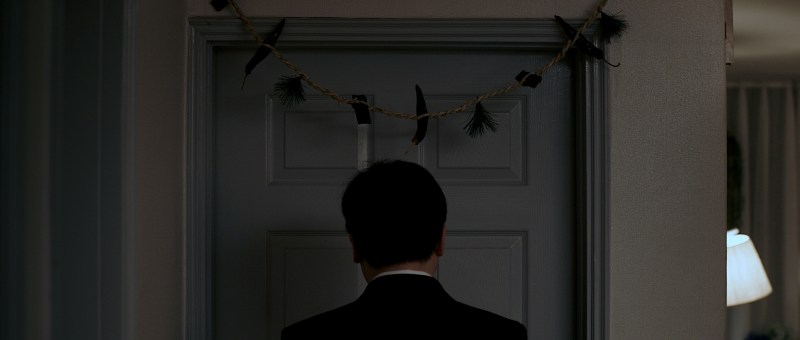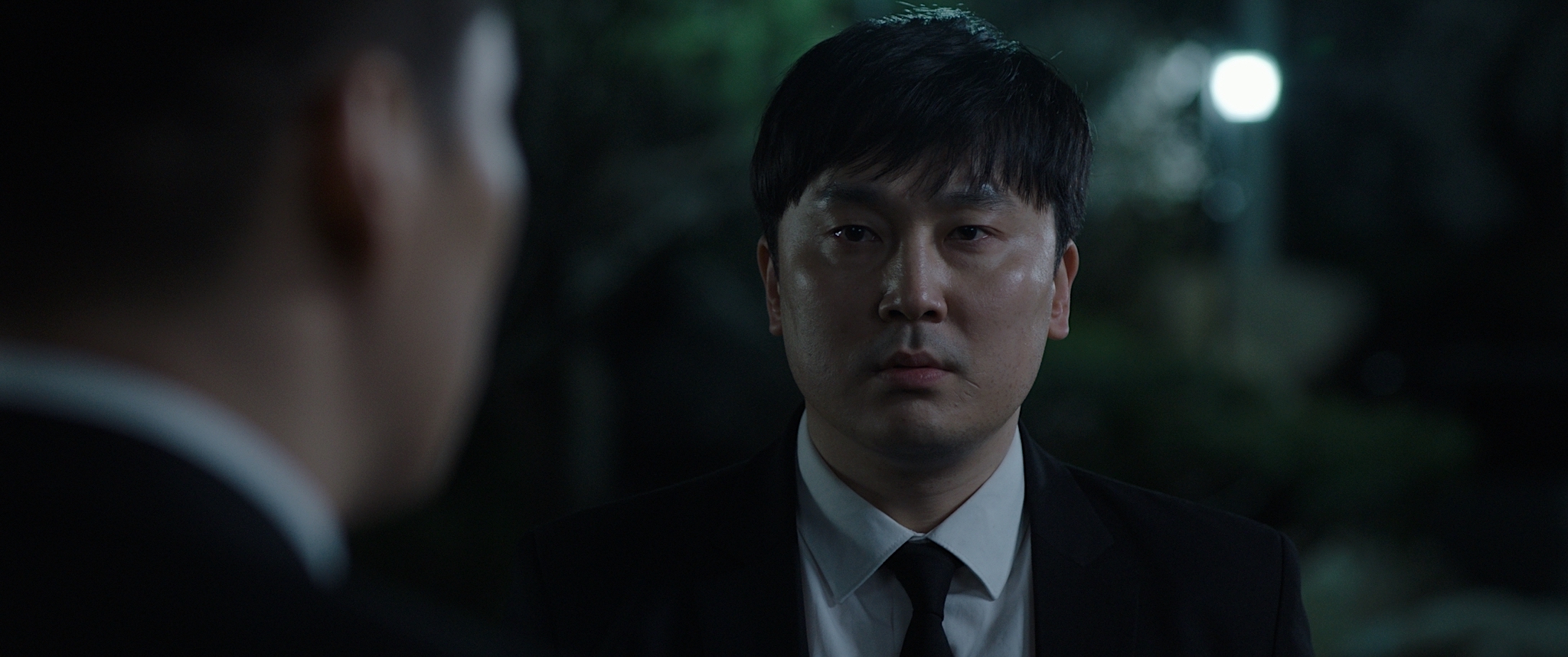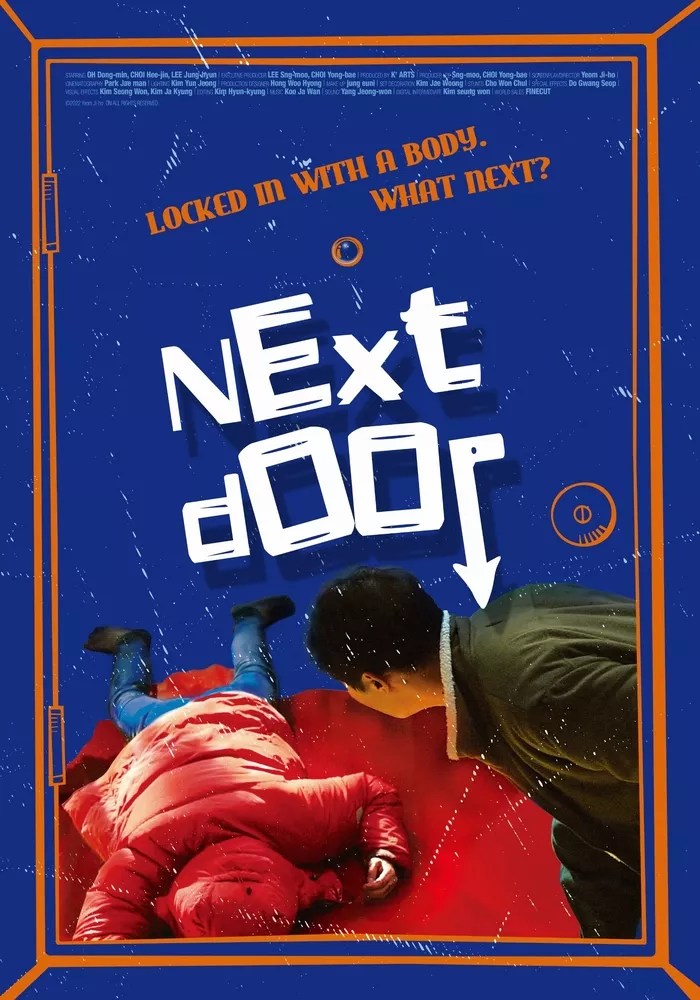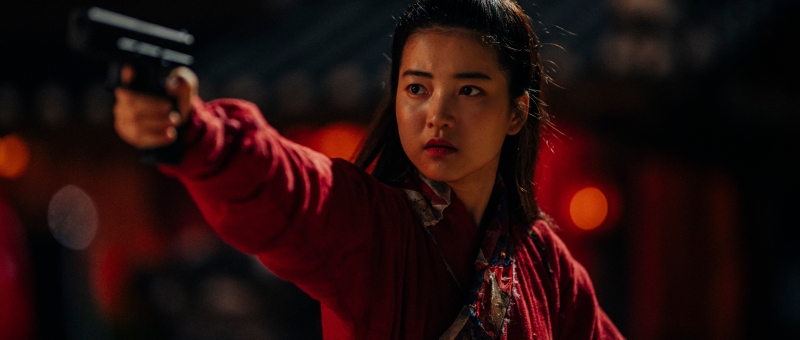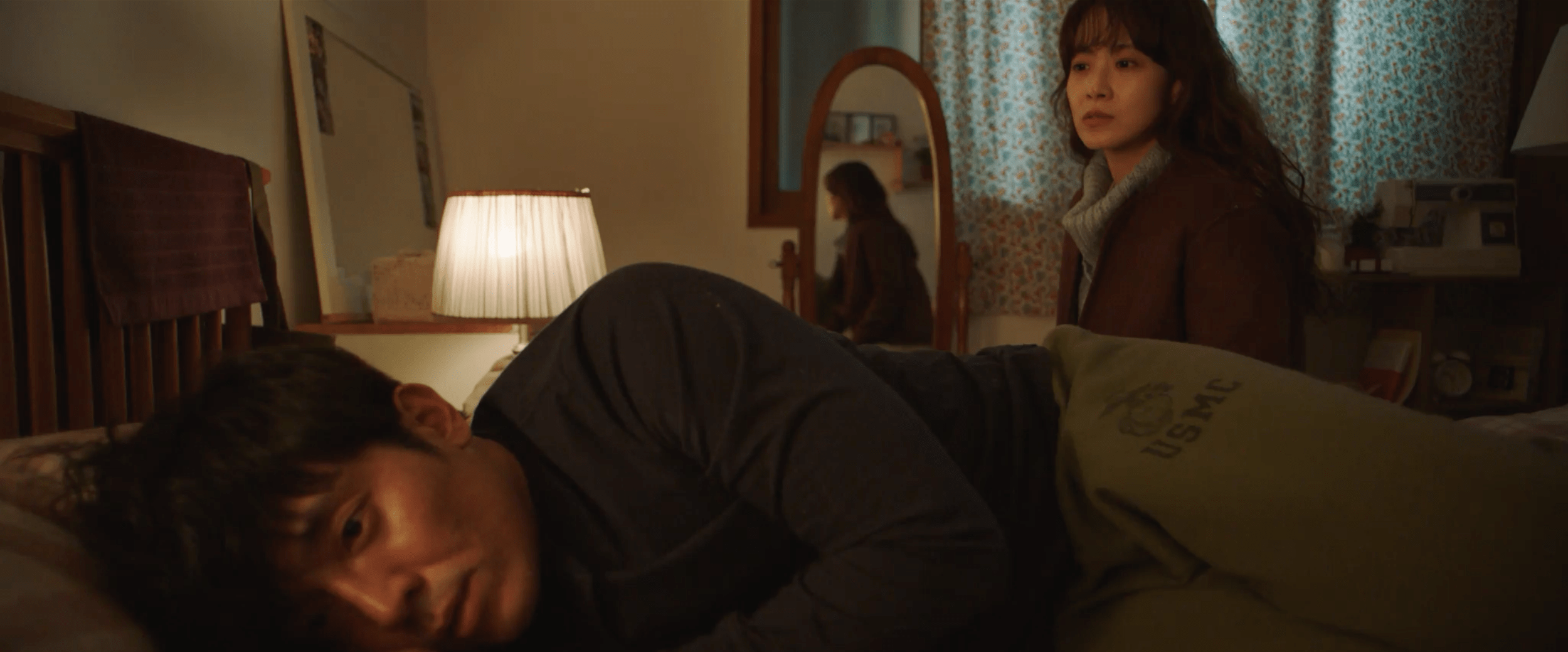
Tomb of the River (강릉, Yoon Young-bin, 2021)

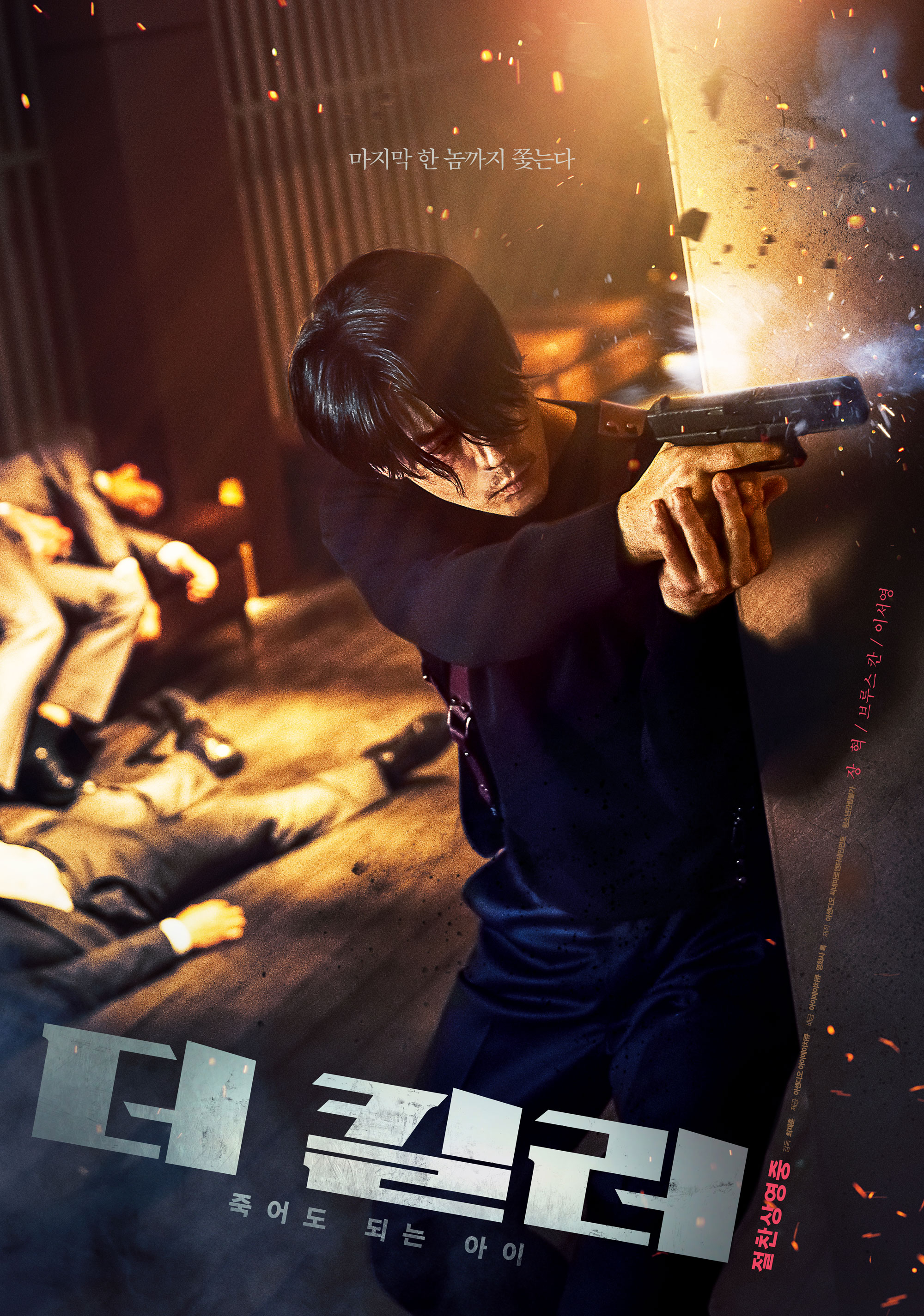
“Why did you turn this place into hell?” a reformed gangster asks his defeated enemy only to be told that nobody made the world this way, it is just is. In any case, Yoon Young-bin’s purgatorial gangster epic Tomb of the River (강릉, Gangneung) finds itself in a world of conflicting moral values in which organised crime has become increasingly legitimised conducted by men in sharp suits sitting in elegant surroundings but no less thuggish, violent, and immoral than it ever was. 

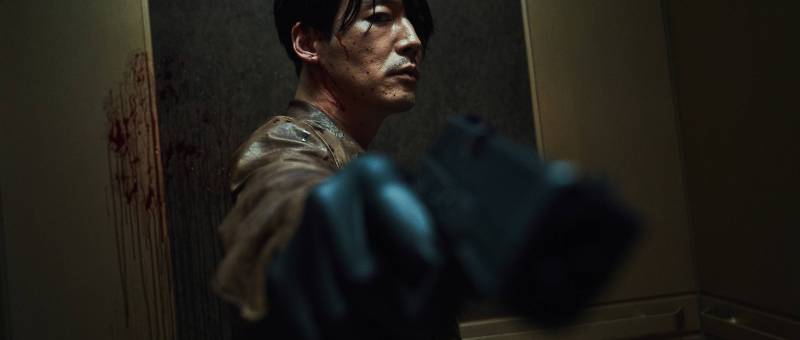
The two opposing forces are hippyish middle-aged enforcer Gil-suk (Yu Oh-seong) whose boss has adopted an anti-violence philosophy, and the psychotic Min-suk (Jang Hyuk) whom we first meet as the only survivor of a smuggling boat massacre hiding in the hold eating the dead bodies of his comrades whom he may or may not have killed himself. The battle ground is a new casino resort in the previously peaceful rural backwater of Gangneung shortly to host the upcoming 2018 Winter Olympics. Gil-suk’s ageing boss decides to hand him the reins of the business but he objects out of old-fashioned gangster etiquette because the complex is technically located in an area handled by his colleague Chung-sub (Lee Hyun-kyun) who is currently in the boss’ bad books after a group of young people were found passed out having taken drugs in one of the karaoke rooms he manages. 

Gil-suk is perhaps a representative of disingenuous contemporary corporatised gangsters who still operate like thugs but do so with a veneer of elegance, his now elderly boss having achieved a state of zen in giving him small pieces of wisdom such as “don’t fight. If you fight you suffer whether you win or lose”. Gil-suk later echoes him when he tells his friend to leave Min-suk alone and that rather than fighting they should share a meal with him sometime instead acknowledging that his gang members’ lives seem to have been hard. But his compassion is as it turns out, misplaced, Min-suk is not the sort of man who can be befriended or softened with kindness for he is the personification of humanity’s baser instincts in unbridled selfishness and destructive desire. 

“I did it to survive” his underlings often justify themselves, believing they have no other option than to behave the way they do while Min-suk exploits the venality and misfortune of others as a kind of get out of jail free card promising to wipe their debts if they take the fall for his crimes. Sooner or later everyone betrays everyone else for reasons of greed or self-preservation, even Gil-suk eventually pulled towards the dark side while his policeman friend (Park Sung-geun) attempts to save him from himself. “What other choice did I have?”, he asks, but to conform to the dubious morality of the world around him. He criticises the police for a lack of action, but watches and does nothing as Min-suk carves up his entire squad of foot soldiers while patiently making his way towards him. 

The irony is that Gil-suk had been the good gangster, never wanting more than he needed and always happy to share. He is confused by the betrayal of his closest friends because he cannot understand their motivation. He had always thought of the resort as “ours” never considering that it could be “mine” while his friend tells him he should take it all because if he doesn’t someone else will. To prove his point Gil-suk tries to broker a peaceful solution by offering to share control with Min-suk in a process of appeasement, suggesting he take the club while he keeps the casino and they split the profits between them before eventually deciding to surrender it entirely in order to curry favour with an even shadier corporate gangster whose polite interest in the resort he’d previously rebuffed. 

Taking on spiritual dimensions in its gloomy backgrounds, battles fought under the light of a full moon, and the snow falling over the living and the dead in the melancholy final sequence Yoon’s hellish tale seems to take place in a gangster purgatory in which as Gil-suk finally announces romance really is dead, in its place only internecine violence and the intense desire to survive by any means possible mortal anxiety provoking only preemptive greed and cruelty. As Min-suk suggests “only death will end things” but everyone here is in a sense already dead only trapped in the eternal limbo of the gangster mentality. 


Tomb of the River streamed/screened as part of this year’s Udine Far East Film Festival.

International trailer (English subtitles)

Nothing Serious (연애 빠진 로맨스, Jeong Ga-young, 2021)

Through her first three features in which she also played the lead, Jeong Ga-young had established herself as a provocative indie voice casting herself as an often unsympathetic if transgressively frank heroine contending with the vagaries of the modern society. Nothing Serious (연애 빠진 로맨스, Yeonae Bbajin Romance), by contrast, marks her debut as a commercial film director and perhaps softens some of her harsher edges but nevertheless maintains her characteristic saltiness and often witty dialogue in what is otherwise closer to Nora Ephron than Hong Sang-soo. 

Though played by Jeon Jong-seo rather than the director herself, 29-year-old Ja-young is a classic Jeong heroine transgressively frank in terms of her sexuality and finding herself in something of a tailspin as she approaches her 30th birthday as a single young woman drowning in debt with neither career nor relationship success to boast of. Meanwhile across town nerdy magazine staff writer Woo-ri (Son Suk-ku) finds himself having to write almost all of the magazine himself in part he suspects as punishment for having helped a friend leave to start up their own online publication. His particular problem is that his boss has asked him to take over his friend’s sex column which is really not his thing especially as he’s in an on again off again non-relationship with colleague Yeon-hee (Lim Sun-woo) who has just informed him she’s getting engaged to her old boyfriend. 

Inevitably the pair end up meeting through dating app Love Bridge to begin with just for a no strings New Year one night stand only to inconveniently realise they quite like each. Even so, their personal issues continue to overshadow the relationship, those being Ja-young’s hurt and anxiety on hearing that an old boyfriend who treated her badly and broke her heart is getting married, and the fact Woori signed up to Love Bridge mainly to find inspiration for his column which becomes an unexpected hit with readers who prefer the slow-burn tease of their romance to the X-rated content of Woo-ri’s predecessor. 

While not really “dating” the couple continue to share their relationship woes with each other, Ja-young continually fed up with her attempts to meet “normal” men who don’t invite their mother on dates, turn out to be married, or are just plain odd. Her previous boyfriend branded her an insanely jealous “alcoholic nymphomaniac” while she simply tells it like it is as a sexually liberated young woman who refuses to feel ashamed for feeling desire but is also in her own way lonely and looking for companionship as perhaps is Woo-ri while conflicted in his betrayal of her even if he is careful not to use any identifying details in his column. 

Along with their romantic woes, the pair also share a sense of hopelessness about the future, Woo-ri disappointed in himself for his lack of success as a serious writer and Ja-young staking her hopes on a career in podcasting after being forced to leave a job at a radio station because of the awkwardness between herself and a colleague she’d previously dated. Interviewing her grandmother and a series of other women she fears were denied the right to become the protagonist of their own lives, always someone’s wife or mother looking after children or in-laws, she wonders if she’s managed it herself or if things are really as different now as she had thought them to be while she continues to struggle drowning in debt and loneliness with very little hope for the future. 

Jeong’s prognosis is, however, a little more hopeful than in her previous films Ja-young and Woo-ri each flawed but basically good falling in love despite themselves only to see their connection undermined by its superficial inauthenticity. If nowhere near as caustic, she retains her sense of playfulness, even throwing in a reference to her first film Bitch on the Beach not to mention the tiny animated heads emerging from the pair’s phones, through sophisticated dialogue instantly capturing a sense of the everyday life of the average 20-something in the contemporary society longing to overcome their sense of cynicism and believe in a genuine romantic connection. Strangely charming in its breeziness, Jeong’s commercial debut loses none of her wit but gains a little in warmth as these crazy kids learn to put their anxieties aside and give love a chance even if it turns out to be nothing serious after all. 


Nothing Serious screens at UltraStar Cinemas Mission Valley, San Diego April 23 as part of this year’s SDAFF Spring Showcase.

International trailer (English subtitles)

On the Line (보이스, Kim Gok & Kim Sun, 2021)

“Voice phishing is all about empathy” according to the sociopathic villain at the centre of Kim Gok & Kim Sun’s crime thriller On the Line (보이스, Voice), ironically hinting at his heartless greed leveraging as he admits people’s fear and hope against them and actively revelling in their misery. The Korean title, Voice, hints at the nebulous quality of the scam that in the end a reassuring voice is all people fall for but at the same time there is indeed a lot on the line not least for the embattled hero fighting back against the corruptions of contemporary capitalism.

Former policeman Seo-joon (Byun Yo-han) is currently working a job in construction after being forced out of the police when one of his investigations implicated the son of a prominent person. Finally starting to get back on his feet, he’s offered a big promotion by his supportive boss and is about to buy a house with his wife Miyeon (Won Jin-A) but then everything starts to go wrong. A potential accident threatens Seo-joon’s new sense of success while unbeknownst to him, Miyeon is currently on the phone with a man claiming to be a lawyer friend of his who tells her that he’s been arrested because of a fatality on site but if she sends the lawyer money for a “settlement” Seo-joon will be released with no further consequences. Unable to get in touch with her husband and fooled by number spoofing when she tries to call the site, Miyeon takes out the money intended to pay the deposit on the house and hands it over only realising her mistake when the scammers turn off the jammers they’d hidden at the construction site and Seo-joon rings her back to find out what’s wrong. So shocked is she that gets hit by a car and is in hospital in a coma when Seo-joon learns that his boss got scammed too and has taken his own life in shame in having lost so much money meant for his employees. 

As the open intertitles relate, voice phishing telephone fraud is a rising problem which aside from landing its victims in inescapable debt can ruin lives and relationships not to mention cause intense feelings of humiliation which lead those affected to consider harming themselves. Using vast data sets often fraudulently obtained, the scammers are able to perfectly profile their victims who as the villainous Gwak (Kim Mu-yeol) points out are already living in the “hell” of the contemporary society amid employment and financial crises that leave them feeling desperate enough for help that they don’t ask too many questions of a friendly voice on the phone. The workers at the vast call centre in China operated by gangster Cheon (Park Myung-hoon) are all Korean and many of them pressed by debts some of them even scam victims themselves so damaged by the internecine assault of contemporary capitalism as to have given in and agreed to ruin others just as they have already been ruined.

Seo-joon’s primary goal is to get his money back with a little revenge on the side as he takes the police to task and then leads them by the nose to the gang’s base in China, all that time in construction standing him in good stead as he climbs through lift shafts and ventilation ducts trying to expose the scammers and bring them to justice. The police force is first seen to be hamstrung by the high-tech nature of the case while their hands are tied because the gang is operating out of a foreign sovereign nation but are then kicked into gear by super cop Seo-joon who ironically can act with less restraint for no longer being an official law enforcement officer. 

Even so, it becomes clear this kind of crime isn’t going away even if this particular gang is taken down because the most valuable commodity in the world of today is personal data and there’s more and more of that available with every passing second. There is indeed a lot on the line not least the nature of the contemporary society dragged ever further into a spiralling race to the bottom, the effects of an exploitative social system from the abuse of migrant workers to the anxiety of high unemployment rates and poor working conditions simply more tools to be manipulated by scammers promising a helping hand with a reassuring voice on the phone telling you they have the solution to all your problems but this too involves a small fee, just a tiny investment in your future you’d be foolish not to make. A timely condemnation of the amoral venality of contemporary capitalism, Kim & Kim’s steely thriller sends its hero on a quest for justice both personal and societal while pursuing the duplicitous voices all the way to the end of the line. 


On the Line screens at UltraStar Cinemas Mission Valley, San Diego April 22 & 25 as part of this year’s SDAFF Spring Showcase.

International trailer (English subtitles)

In the Name of the Son (아들의 이름으로, Lee Jung-gook, 2021)

Partway through Lee Jung-gook’s raw exploration of the radiating effects of historical trauma In the Name of the Son (아들의 이름으로, Adeurui ireumeuro), the conflicted hero quotes a line from In Search of Lost Time which his son had recommended to him, “pain is only healed by thoroughly experiencing it”. The quote in itself reflects the hero’s wounded state in having failed to reckon with the sins of the past, a failing which has cost him dearly on a personal level, while simultaneously hinting at a national trauma which has never been fully addressed by the contemporary society. 

When we first meet ageing designated driver Chae-gun (Ahn Sung-ki) he’s preparing to hang himself in a forest before noticing a stray parakeet, presumably an escaped family pet, chirping nearby in desperation. Taking pity on the bird knowing it cannot survive on its own he gives up on his plans and takes it home. We can see that Chae-gun is a compassionate man, softly spoken, perhaps a little shy and distant yet caring deeply for those around him such as the ladies from Gwangju who run a cafe where he is a regular, while he’s frequently seen making phone calls to his son in America. Yet as we later discover he is also a man of violence with an old-fashioned, authoritarian mindset, ominously sliding off his belt to beat up a gang of kids who tried to dine and dash before making them come back to apologise and pay their bill and later doing the same to bullying classmates of the cafe owner’s son, Min-woo (Kim Hee-chan). 

He does these things less out of an old man’s disapproval of the younger generation’s lack of moral fibre than a genuine desire to help and most particularly the ladies at the cafe, but simultaneously takes Min-woo to task for a lack of manliness berating him in front of his bullies for not standing up for himself. These flashes of violence hark back to the hyper-masculine patriarchal attitudes that defined the years of dictatorship while also hinting at the buried self Chae-gun struggles to accept which so contrasts with his innate kindness and sense of justice. He too is angry and confused that those who ordered acts of atrocity such as the 1980 Gwangju Massacre have never been brought to justice and are living comfortable lives often still ensconced in country’s ruling elite such as former general Chairman Park whom he often drives home from a local Japanese restaurant to his mansion in a traditional village in the middle of Seoul. 

As we discover, Chae-gun has his own reasons for being preoccupied with Gwangju in particular, yet it’s the failure to reckon with the buried past that he fears erodes future possibility. In a metaphor that in truth is a little overworked, one of the new assistants at the cafe, also from Gwangju, is mute, literally without a voice until the buried truths of the massacre are symbolically unearthed allowing her to speak. Meanwhile, many of Chae-gun’s generation are succumbing to dementia, an elderly man constantly escaping from his nursing home to wander a local park looking for his teenage son who went missing during the uprising and was never seen again. Chairman Park remains unrepentant, blaming everything then and now on “commies” while explaining to Chae-gun that they were “patriots” not “murderers” bravely defending the Korean state and in any case God forgives all so they’ve no need to blame themselves. 

Park may feel no remorse but the unresolved trauma of Gwangju continues to echo not only through Chae-gun’s wounded soul but through society, a heated debate breaking out between a group young people of critical of the authoritarian past and a collection of older conservative nationalists who object to their criticism of President Park Chung-hee arguing that he rebuilt the economy and gave them the comfortable lives they live today. Yet what Chae-gun feels he owes to his son and implicitly to the younger generation is an honest reckoning with the past and his part in it while those who live with no remorse should not be allowed to prosper, guilt-free, as victims continue to suffer. What he’d say to those who thought that they bore no responsibility is that the greatest sin of all may have been in blindly following orders. Only by fully experiencing the pain of the national trauma can society hope to heal itself from the weeping wounds of the unresolved past.


In the Name of the Son streamed as part of the 14th season of Asian Pop-Up Cinema.

Original trailer (English subtitles)

My Big Mama’s Crazy Ride (큰엄마의 미친봉고, Paek Seung-hwan, 2021)

A veteran matriarch suddenly decides she’s had enough in Paek Seung-hwan’s indie comedy, My Big Mama’s Crazy Ride (큰엄마의 미친봉고, Keuneommaui michinbonggo). Taking aim not only at the deeply ingrained and hopelessly outdated patriarchal social codes of contemporary society, Paek also asks a series of questions about the concept of family with the wives and daughters-in-law repeatedly finding themselves described as “outsiders” yet expected to sacrifice their hopes and aspirations in dedicating themselves entirely to the “family” which more often than not treats them as unremunerated housekeepers. 

It’s easy enough to see why “Big Mama” Yeong-hui (Jung Young-joo) is fed up as her husband Han-il (Yu Seong-ju) barks orders from upstairs while she tries to sort out the food for the ancestral rites knowing the men are up there lounging around drinking just expecting everything to be done for them without needing to lift a finger to help. This year she’s choosing chaos, rounding up all of the other women in the family including Eun-seo (Kim Ga-eun) her nephew’s fiancée meeting the family for the first time and packing them into her minivan leaving the men to fend for themselves.  

This is a problem for them for several reasons the biggest being that it soon becomes clear they have no idea how to do anything for themselves, drill sergeant Han-il ordering his brother and sons to finish all the food prep within the hour while they search for YouTube videos to teach them basic cooking. They can barely even figure out how to make themselves some instant noodles while they wait, becoming progressively drunker to avoid facing the reality of their situation or accept that perhaps their treatment of their wives has been unfair or that they’ve taken all of their labour for granted. Old-fashioned authoritarian Han-il even approves of Yeong-hui’s flight in the beginning in the belief that she’s taken the other women out to teach them some discipline despite her having brought up the subject of divorce because of his own treatment of her. He doesn’t see his behaviour as essentially abusive because of the patriarchal social codes in which he operates believing this is simply the way that husbands are supposed to boss their wives. His brother and sons are little different though subordinate to him as head of the family, oldest song Hwang-sang (Song Dong-hwan) eventually kicking back but only after realising his mother may really leave profoundly shaking his foundations even as a grown man with a son of his own. 

Then again, aside from a potential divorce Yeong-hui is otherwise described as an “outsider” having married into the family most particularly when it comes to light that Han-il has sold some ancestral land and intended to keep the money for himself rather than share it amongst the other family members. When he sends the proceeds to Yeong-hui in a last ditch effort to get her to come home, it causes division on both sides with his brother Han-san (Yoo Byung-hoon) in particular objecting to the money leaving the family as Yeong-hui is technically a Lee and not a Yu while the women also think she should share the money with them rather than keep it for herself little knowing she was already planning to do so. Having serious doubts about marrying into this crazy family, Eun-seo, who is in any case Christian, isn’t sure why she was attending their ancestral rites anyway but if none of these women are actually “family” why is it they’re the ones expected to prepare the rites for the Yu ancestors? Yeong-hui sees the money in part as compensation for the unpaid labour she’s performed over the last 40 years while being shouted at and ordered around by her overbearing authoritarian husband. 

Thanks to YouTuber niece Hyo-jeong (Ha Jung-min) and sleazy tabloid journalist nephew Jae-sang (Cho Dal-hwan) the women’s flight ends up going viral and even making the evening news where they find mass support from other women in similar situations along with unexpected male solidarity though a big thumbs up from a series of male policemen seems a little unlikely given the threat they present to the entrenched social order in rebelling against the same kind of patriarchal male authority the police force itself represents. In any case, it becomes clear that Yeong-hui has simply chosen to celebrate her own ancestral rights in paying tribute to another woman whose name she only belatedly found out, the other women also revealing that they don’t even quite know each other’s given names because they’re so used to addressing each other only as daughter/sister-in-law or else as X’s mum to the extent that they’ve been robbed of an individual identity. Nevertheless through their transgressive road trip the women rediscover a sense of female solidarity while the men are forced to reckon with the way they treat their wives realising that if they want to keep their family together they’ll have to move with the times. 


My Big Mama’s Crazy Ride streamed as part of the 14th season of Asian Pop-Up Cinema.

Original trailer (English subtitles)

Action Hero (액션히어로, Lee Jin-ho, 2021)

What better way to add a little authenticity to your movie than to unmask injustice live on camera? Lee Jin-ho’s indie action drama Action Hero (액션히어로) is a loving tribute to classic Shaw Brothers but also takes aim at the inequality at the heart of the contemporary society as the virtuous hero who says he just wants to be Jackie Chan starts a mini revolution in the student body after exposing the corrupt practices of their institution. 

Signalling his intentions early on, Lee opens with the “GB” “Golden Brothers” logo and a lengthy martial arts sequence spoken entirely in Cantonese with a classic Shaw Brothers-esque titles card, but as it turns out this is all an anxiety dream as the fearless hero finds himself unable to save a hostage because he cannot answer a question from the upcoming civil service exam. Dreaming of becoming an action star, Joosung (Lee Seok-hyung) decides to sit in on a film class which is where he meets Chanyeol (Lee Se-joon) who shows him a copy of an action movie shot by a former student, Sunna (Lee Joo-young), 10 years previously. Joosung decides to make his own film too and when he and Chanyeol accidentally come across a blackmail letter threatening to expose their professor’s falsification of records in order to admit the sons of wealthy men decide to stakeout the drop location hoping to apprehend the professor and the blackmailer and make it a part of their movie. 

Ironically enough, the previous Action Hero film had been about a culture of sexual harassment as Sunna herself starred as a martial arts avenger saving a young student from a lecherous teacher. 10 years on however Sunna still hasn’t finished her postgrad programme and is stuck as a teaching assistant working part-time at the campus coffee shop. Her colleague Jae-woo (Jang In-sub) is desperate for cash because he’s sick of this life and wants to open a friend chicken restaurant. Even Joosung is filled with despair for the future, working hard to pass the civil service exam even though it’s not something he actually wants to do. Meanwhile, the professor has been taking kickbacks so that chaebol sons with no talent can attend the university while their parents “support” from the sidelines. Perhaps conflicted in her actions, the offer of a promotion to department chair is enough to silence any qualms she might have hand while she’s eventually forced to confess all to the dean who is about to celebrate his 23rd re-inauguration which doesn’t exactly scream a commitment to democratic values. 

Yet through their “investigations” Joosung and Chanyeol discover that the institutional corruption in play was largely an open secret, so commonplace as to be dismissed as just the way things work. The justice-minded Joosung wonders why no one does anything, hoping that the students will eventually wake up to what’s going on and begin asking questions while wondering if they simply lack the “passion” to become their own kind of action heroes and demand integrity from their governmental body. Sunna, meanwhile, fed up with her impossible circumstances feeling as if she’s wasted too much time on Hong Kong cinema picks a different, not quite altogether altruistic path but later recommits herself to exposing the admissions fraud and corruption which go right to the heart of their institution. 

Lee continues to pay homage to the classic kung-fu movie with old school martial arts and use of freeze frame, Joosung wearing his Shaolin-style yellow top and Chanyeol at one point dressed as a classic kung fu master complete with long white beard only to discover themselves swept into a conspiracy deciding to unmask the injustice at the school. Then again, perhaps one action hero isn’t really enough to counter such ingrained corruption or the idea that this kind of impropriety has essentially become normalised and should just be accepted. Thanks to their adventures, each of the avengers is jolted out of their sense of inertia and powerlessness, Sunna realising she doesn’t need to let herself be exploited by her boss and can take control of her own future while Joosung and Chanyeol derive new hope for the future in squaring off against injustice. “The future is unclear, let’s persevere because we have each other” Joosung reflects in Cantonese on seeing the beginnings of a revolution on campus vowing to complete Action Hero 2 in the hope of a better tomorrow. 


Action Hero streamed as part of the 14th season of Asian Pop-Up Cinema.

International trailer (English subtitles)

Jang-Gae: The Foreigner (醬狗, Chang Chih-Wei, 2020)

An angry young man struggles to repair his fracturing sense of identity in Chang Chih-Wei’s provocatively titled Jang-gae: The Foreigner (醬狗, jiàng gǒu). “Jang-gae” is in itself a derogatory term for Korean-Chinese translated literally as “sauce dog”, while the film’s hero Gwang-yong (Ho Yeh-wen) feels himself to be a perpetual outsider continually othered in Korea but having little affinity for his Chinese roots and dreaming of a future in the US having been short-listed for a scholarship programme only to be confronted with the contradictions of his identity when his father is taken ill and having the wrong kind of passport may jeopardise his dreams of going abroad. 

For reasons unknown to him, Gwang-yong’s father Seo-sang (Joey Yu) pulled him out of the Chinese-medium school he’d been studying at and moved him to a regular Korean high school instead. Although a straight-A student and in fact the class monitor, Gwang-yong experiences constant xenophobic microaggressions from his classmates who sarcastically repeat the common Chinese greeting “Have you eaten yet?” and refer to him as “sauce dog” while the teacher expresses surprise that “even a foreigner like Gwang-yong” has mastered Korean history. The teacher’s remark is quite ironic in that Gwang-yong may have a Taiwanese passport but he was born and raised in Korea, as, it happens, was his father. In fact, his family has no real connection with Taiwan, his grandfather fled Mainland China during the civil war and presumably applied for a Republic of China passport as a supporter of the Nationalist Party. In any case, his passport is also a non-citizen one which grants no right of abode because his family has no household registration in Taiwan meaning in essence that Gwang-yong is stateless and has no citizenship of any sort. 

For obvious practical reasons, he wants to apply for a Korean passport which he’s entitled to by right of birth as his mother is a Korean citizen but his father won’t have it. Meanwhile, despite bullying him the other boys all complain that foreigners have it easy believing that he got a leg up in the scholarship scheme for being non-Korean while he’ll also be exempt from the National Exam and military service (which as he points out he’d have to do in Taiwan if he were a full citizen there), but being exempt from each of these requirements for Korean citizens leaves him feeling even more excluded reinforcing the sense that he’s not really a part of the culture in which he has grown up in the only country he’s ever known. He tells his mother that he just wants to live a dignified life in Korea, but is ruffed up by a trio of thuggish men later claiming to be police immigration officers accusing him of overstaying on his visa not so much as even apologising after forcibly pulling his wallet out of his pocket and seeing his birthplace listed as Korea on his ID. 

Most of his animosity is directed at his father who speaks to him only in Mandarin and is in general authoritarian and unsupportive, yet his father’s illness also causes him to lash out at his mother laying bare his own internalised shame in berating her for having married someone who was Korean-Chinese as if all his problems would have been solved if she’d only married somebody Korean, blaming her rather than standing up against the xenophobia and prejudice which pervade his society. Meanwhile the girl he has a crush on at school, Ji-eun (Kim Yea-eun) who is also an outcast having moved schools after the grandmother who was raising her passed away, just wants to get out of “Hell Joseon” and doesn’t much care where to. He points out swapping Hell Joseon for Taiwan’s “Ghost Island” might not make much difference, but discovers that his accidental statelessness leaves him doubly disadvantaged denied his full rights in either place while equally unable to escape. 

Even so his father’s illness forces him to reconsider not only his relationship to him but to his Chinese heritage along with the Korean, Ji-eun also reminding him that the people who make it in Korean society are the ones who learn to stand up for themselves which perhaps informs his final act of rebellion against the bullies no longer willing to be meek or apologetic but directly challenging their attempts to intimidate him having gained a new confidence. A gentle coming-of-age tale in which a young man comes to understand both his father and his heritage Jang-Gae: The Foreigner never shies away from the problems faced by ethnic minorities in contemporary Korea nor the inequalities of the non-citizen passport but does allow its conflicted hero to find a degree of equilibrium in himself secure in his own identity. 


Jang-Gae: The Foreigner streamed as part of the 14th season of Asian Pop-Up Cinema.

Original trailer (English subtitles)

Spiritwalker (유체이탈자, Yoon Jae-geun, 2021)

“Who do you think I am?” the amnesiac hero of Yoon Jae-geun’s existential thriller Spiritwalker (유체이탈자, Yucheitalja) eventually asks having gained the key to his identity but continuing to look for it in the eyes of others. Yet as he’s told by an unlikely spirit guide, maybe knowing who you are isn’t as important as knowing where you’ve come from and where it is you’re going advising him to retrace his steps in order to piece his fragmented sense of self back together. 

A man (Yoon Kye-sang) comes round after a car accident with no memory of who he is or how he got there. He arrives at the hospital after a homeless man (Park Ji-hwan) calls an ambulance for him, but quickly realises he might be in some kind of trouble especially as the police are keen to find out who shot him and why. With that in mind, he decides to make a break for it but finds his sense of reality distorted once again as the world around him changes eventually realising that he’s shifted into the body of another man somehow connected to his “disappearance”. In fact this happens to him every 12 hours which is in many ways inconvenient as his impermanence hampers his ability to keep hold of the evidence he’s gathered while preventing him from making allies save for the homeless man who is the only one to believe his body-hopping story. 

As the homeless man points out, no-one in his camp really knows who they are anymore and to a certain extent it doesn’t really matter (in fact, he never gives his own name) because they have already become lost to their society as displaced as the hero if in a slightly different way forever denied an identity. What the homeless man teaches him, however, is that the essence of his soul has remained figuring out that at the very least he’s a guy who prefers hotdogs to croquettes even if he can’t remember why which is as good a place to found a self on as anywhere else. Even so, through his body-hopping journey he begins to notice that all of his hosts are in someway linked, inhabiting the same world and each possessing clues to the nature of his true identity. 

The central mystery, meanwhile, revolves around a high tech street drug originating in Thailand which causes hallucinations and a separation of body and soul apparently trafficked to Korea via a flamboyant Japanese gangster with the assistance of the Russian mafia in league with corrupt law enforcement members of which have begun getting dangerously high on their own supply with terrible if predictable results. This sense of uncertainty, that everyone is operating under a cover identity and those we assumed to be “good” might actually be “bad” and vice versa leans in to Yoon’s key themes in which nothing is really as it seems. Body and soul no longer align, the hero constantly surprised on catching sight of “himself” in mirrors, not knowing his own face but realising that this isn’t it while desperate for someone to “recognise” him as distinct from the corporeal form he currently inhabits. Though they may not be able to identify him, some are able to detect that he isn’t “himself”, behaving differently than expected, speaking in a different register, or moving in a way that is uniquely his own even while affected by other physical limitations such as one host’s persistent limp. 

Inevitably, the hero’s path back to reclaiming his identity lies in unlocking the conspiracy of which he finds himself at the centre, figuring out which side he’s on and what his highest priorities are or should be in gaining a clear picture of his true self as distinct from the self that others see. High impact hand-to-hand combat sequences give way to firefights and car chases while the hero finds himself constantly on the run in an ever shifting reality, Yoon employing some nifty effects as an apartment suddenly morphs into a coffee shop as the hero shifts from one life to another existentially discombobulated by the lives of others but always on the search for himself and a path back to before finding it only in the returned gaze of true recognition. 


Spiritwalker is released on blu-ray in the US April 12 courtesy of Well Go USA.

Interntational trailer (English subtitles)

The Girl on a Bulldozer (불도저에 탄 소녀, Park Ri-woong, 2021)

“Everyone just takes it” the heroine of Park Ri-woong’s Girl on a Bulldozer (불도저에 탄 소녀, Bulldozere Tan Sonyeo) is advised by her partly well-meaning uncle, urging her to know her place, stop fighting and become complicit with the injustice that pervades their society. Already beaten down by life, he has come to the conclusion that there is no other way out other than to submit himself to the quasi-feudalistic social codes of contemporary capitalism, but Hye-yeong (Kim Hye-Yoon) is still naive enough to think that she’s entitled to fairness and that she has the capacity to resist if not exactly for the good of society then in standing up for herself and her family. 

Family is however something about which she feels conflicted, disappointed in her feckless father (Park Hyuk-Kwon) fearing his gambling and drinking problems may have got the better of him yet again. As the film opens, 19-year-old Hye-yeong is in court charged with assault after intervening in a convenience store dispute. She already has a criminal record but the judge is lenient with her in reflection of the fact that she stepped in to defend someone weaker than herself, sentencing her to community service and vocational training rather than prison but reminding her she is now old enough to receive a custodial sentence should anything like this happen again. It’s immediately obvious that Hye-yeong is a very angry young woman who has already lost any real hope for the future, staking everything on saving enough money from her part-time jobs to rent a flat so she can move out and take her younger brother Hye-jeok with her. 

What little stability she has disappears when her father leaves early one morning and does not return, Hey-yeong receiving a call from the police informing her he’s a wanted man having apparently committed an assault and stolen a car from his former employer which he later drove off a bridge harming two pedestrians in the process. Meanwhile she also discovers that her father may have lost the restaurant where they live and work, a couple turning up to make alterations as if they already owned the place, the woman claiming that her husband is the nephew of Chairman Choi (Oh Man-seok) her father’s former boss and the owner of the car which he is accused of stealing. Part of Hye-yeong’s problem is her liminal adolescent status. It’s obvious her father had been keeping a lot of things from her while she’s constantly asked when her mother is coming to sort everything out though her mother died years ago and even the aunt she later approaches for help is less than sympathetic partly as we discover because her father dragged his brother into his money problems by making him a witness to a deal with the increasingly shady Choi. 

Choi is an embodiment of corrupt chaebol culture, adopting a quasi-feudalistic authority that allows him to wield his authority over those lower than himself in the complicated class hierarchy of the contemporary society as if he were a lord and they merely serfs. Also in debt to him, Hye-young’s uncle tries to talk to her about the way the real world works, that she should stop resisting Choi whom she blames one way or another for her father’s accident and know her place, acknowledging that when you’re nice to men like Choi they’re nice to you blaming his brother not for his foolish decision to trust him but for his eventual rebellion in insisting on getting what he was promised rather than submitting himself to Choi’s whim. The fact that Choi is currently running for political office promising to “never surrender to injustice” while making this small corner of backstreet Incheon great again through almost certainly corrupt construction contracts is only another expression of the insidious links between business and politics that once again work to oppress young women like Hye-yeong. 

Meanwhile, she finds herself constantly at the mercy of shady insurance companies one working for the victims of her father’s accident who turn out to be, as she thought, scammers playing up their injuries in the hope of cash amid the compensation culture that defines the modern society. Then again on the other hand, she discovers that her father had reactivated a series of insurance policies of his own, some suggesting the accident may have been a suicide attempt in that he hoped to take his debts with him while providing his children with financial security through the payout. The dragon tattoo on Hye-yeong’s arm which she has to hide with a sleeve in mainstream society marks her out as someone not to be messed with, but also exiles her from conventional success making it difficult to get a regular job or walk around without the implication of violence following her while even the vocational training she chooses of learning how to drive heavy vehicles also rejects her the instructor flat out saying that he’s “not being sexist” but thinks the course is unsuitable for a woman and she won’t find work as one in the construction industry. Young, reckless, and naive Hye-yeong opts for short-term vengeance literally attempting to take a bulldozer to the comfortable lives of men like Choi whose wealth is founded on the exploitation of those like her in counting on their desperate complicity, but discovers that his position is already far too entrenched to be turfed out by a single mechanism alone. “We at Korea Insurance will always be a source of strength for you” she’s ironically told after finally receiving a payout rather than an invoice left with little other choice than to try and make her way free of the control of the Chois of the world in rejecting her complicity. 


The Girl on a Bulldozer screened as part of Osaka Asian Film Festival 2022

Clip (English subtitles)

Hommage (오마주, Shin Su-won, 2021)

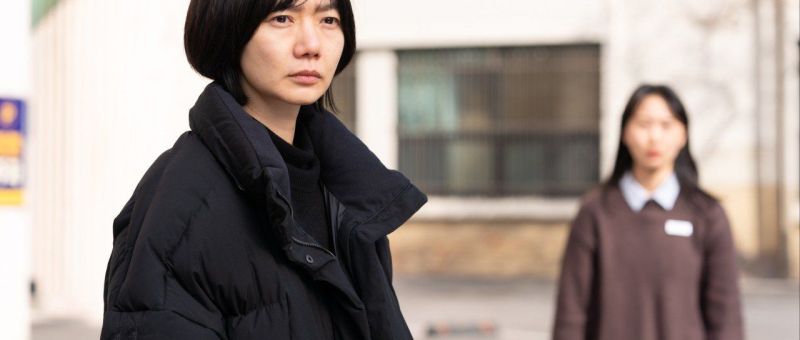
A struggling female filmmaker finds herself haunted by a ghost of the silver screen in Shin Su-won’s strangely moving ode to cinema, Hommage (오마주). As much about the difficulties faced by women in the predominantly male film industry as those faced by women in general in the still patriarchal society, Shin’s drama looks back to a cinematic golden age and the pale shadows of those history has seen fit to forget. “You will vanish one day like I did” according an ominous note discovered in a never finished screenplay, but through a gentle process of restoration the forgotten figures of the past can perhaps be resurrected as the frustrated director begins to find new hope in a departed kindred spirit. 

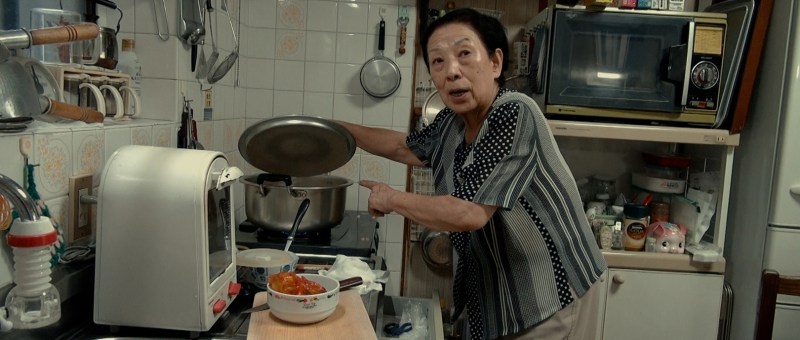
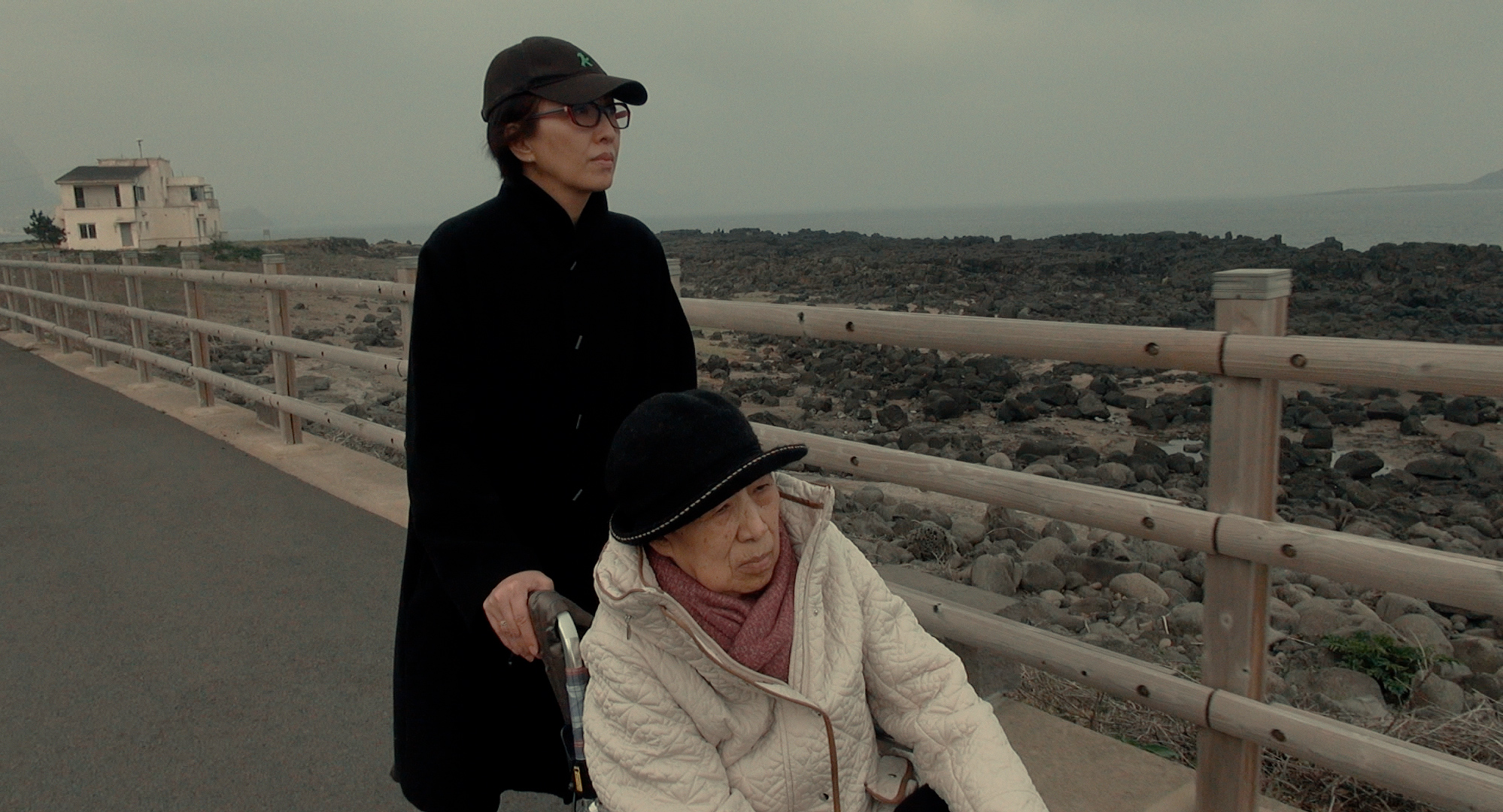
Dressed very much like Shin herself, struggling director Ji-wan (Lee Jung-eun) has hit a creative rut. Her third film, Ghost Man, has recently been released but is not exactly setting the box office on fire while the latest tentpole blockbuster continues to pack them in. With her confidence at rock bottom and financial worries hovering on the horizon, Ji-wan is offered an unusual job which although it might not pay much will be very worthwhile in helping to restore Hong Eun-won’s 1962 melodrama A Woman Judge starring the great Moon Jeong-seok to its former glory. Unfortunately like many films of its era the negative is in poor condition with sound missing from several scenes which Ji-wan is supposed to re-dub only she’s not much to go on beginning by tracking down the director’s daughter in the hope of retrieving a script before embarking on a kind of scavenger hunt in the search for Hong herself. 

As the film opens and indeed closes, Ji-wan is in the middle of a swimming lesson quite literally attempting to keep herself afloat mimicking the despair she is beginning to feel in her personal life as regards her career. She identifies strongly with Hong who, in the film’s slightly fictionalised history, was forced to give up filmmaking after her third film, as Ji-wan herself fears she may have to do, having toiled away for 10 years just waiting for the opportunity while Ji-wan is also approaching the 10th anniversary of her decision to pivot into filmmaking as a married wife and mother. Though she had taken the job only reluctantly, the desire to restore the film is partly born of her need to rebuild her confidence as a filmmaker but also to honour Hong’s legacy and restore her rightful place in Korean film history. 

Playing out like a ghost story, Ji-wan is almost literally haunted by Hong’s silhouette in her elegant trench coat and hat, at several moments hearing someone shout “let me out” as if pleading with her to release Hong’s spirit from within the sealed film cans of her almost forgotten feature. Meanwhile she’s spiritually haunted by the discovery of a woman’s body in a car parked outside her apartment building which had not been discovered for some months, a pretty photo of a young woman sitting on her dashboard perhaps of the woman herself or of a daughter, sister, friend but either way a poignant reminder of a life extinguished which Ji-won worries may have been that of her next-door neighbour whose crying she sometimes heard through the walls. On meeting some of those who once knew Hong, each at some point laments that they are the only ones left who remember that time while Ji-wan gets her epiphany in a soon to be torn down cinema with a hole in the roof raining down light into an empty auditorium,. 

Surrounded by unsupportive men from her grumpy husband (Kwon Hae-hyo) to surprisingly chauvinistic son (Tang Jun-sang) who declares himself “love-starved” while echoing the words of those around him that her desire to chase her dreams is “selfish”, Ji-wan is beginning to feel as if she’s disappearing too while finding herself forced to re-confront her notions of femininity in approaching the menopause combined with an unexpected medical crisis. Things aren’t quite as bad for her as they were for Hong, at least no one’s ever thrown salt at her as Miss Lee (Lee Joo-Sil), Hong’s friend and editor, recounts, but she’s less than surprised on hearing that Hong had kept the existence of her daughter secret from her colleagues fearful they’d never let her direct if they knew she was a mother. The film Ji-wan is trying restore is based on the true story of Korea’s first female judge who was in fact murdered by her husband, though the film envisages a more positive ending if within the limits of contemporary patriarchy in insisting that a career is not incompatible with fulfilling the expectations of traditional femininity in caring for her in-laws, husband, and children. Ironically enough, Korea’s first film director Park Nam-ok had been forced to film with her baby on her back but completed just one feature which survives only in incomplete form. 

Many films are presumed lost from Korea’s golden age not just those directed by women, but the particular lack of respect shown towards the films of Park and Hong is particularly upsetting to Ji-wan who later discovers that to add insult to injury old film stock was often mined for its silver content and then sold off to be used as hatbands other such frivolous material. No one really valued these films very much when they were made, so no one made much of an effort to preserve them just like no one is making much of an effort to save the ruined the cinema where she chases the ghost of Hong, the embittered projectionist eventually giving in to Ji-wan’s enthusiasm as she holds up the 8mm film she’s discovered to the light pouring though its ceiling. A beautifully haunting cinematic mystery, Shin’s melancholy drama eventually allows its heroine to reclaim her love for cinema along with her self-confidence as a filmmaker through the restoration of the past finding a kindred spirit in the long departed Hong unfairly denied not only the acclaim she deserved but the artistic possibility to which she should have been entitled. 


Hommage screened as part of this year’s Glasgow Film Festival.

Original trailer (English subtitles)