The Truth Beneath (비밀은 없다, Lee Kyoung-mi, 2016)

10_06_15__574b920705d42Politics in South Korea has never been exactly drama-free, though recent times have seen a multitude of storms engulf its top brass running from the national to the personal. Frequent Park Chan-wook collaborator Lee Kyoung-mi’s followup to her acclaimed 2008 debut Crush and Blush, The Truth Beneath (비밀은 없다, Bimileun Eobda) begins as if it’s going fit into the ‘70s dark political thriller mould but gradually shifts gear to present both a bleak family drama and the story of one woman’s descent into the near madness of grief as she attempts to uncover the true circumstances behind her private tragedy even as it plays out on a national stage.

Married to a prominent candidate in a tightly contested electoral race, Yeon-hong (Son Ye-jin) is perfect first lady material save that she’s from an inconvenient home town. Two weeks before the big day, Yeon-hong’s daughter Min-jin (Shin Ji-hoon) does not return from school as expected which, aside from the obvious distress, is not ideal for her father as his political campaign has largely been run on Min-jin’s face and the slogan “I will protect your children”. Jong-chan (Kim Ju-hyeok), Min-jin’s ambitious father, is reluctant to report her disappearance for fear it will hurt him politically and, after all, Min-jin has “disappeared” at times before. Yeon-hong is deeply worried and unable to understand her husband’s indifference to their daughter’s mysterious absence. As time passes, Yeon-hong steps up her investigation becoming ever more suspicious of those around her.

On the surface of things, Yeon-hong had the ideal life with a wealthy, handsome husband, and a nicely turned out, studious teenage daughter. The first glimpse we catch of them is a celebration of the campaign’s launch in which Yeon-hong is furiously cooking away, a motif which is to be repeated with an entirely different sense of celebration some time later. Yet there’s something slightly artificial about the setup even in its beginning as the conversation between the men takes on a barbed, guarded quality while Min-jin lies to her mother even whilst pledging to straighten up now that the campaign is in full swing.

The more Yeon-hong investigates, the more she realises how much of the life she’d been living was careful artifice. Min-jin had gone off the rails before, though perhaps no more than any other teenage girl and given her father’s position, she’d been under a considerable amount of strain. The “friend” Min-jin had claimed to be meeting does not seem to exist and on visiting her school, Yeon-hong finds out that Min-jin had been ostracised by the other girls, even experiencing violent treatment at their hands.

Min-jin had, in fact, eventually embraced her outsider status by forming a performance art-influenced, punk-inspired rock band with a similarly “uncool” girl, Mi-ok. Mi-ok may have been one of the last people to have contact with Min-jin before her disappearance and quickly becomes a person of interest in Yeon-hong’s investigations but whatever it is she’s hiding, it’s clear that there was a whole side of Min-jin’s life that her mother was entirely unaware of.

As Yeon-hong becomes increasingly desperate, she starts entertaining the idea of conspiracy. Her first thoughts turn to her husband’s rival, Noh, an unscrupulous man who may just be capable of kidnapping Jong-chang’s poster girl in order to punch a hole through his opponent’s ill-advised slogan by demonstrating that he can’t even protect his own child, let alone anyone else’s. Then again, how far would her husband be prepared to go in the quest for power? Would his campaign team really kidnap his own daughter to cast suspicion on Noh and win public sympathy? Jong-chang’s ongoing indifference could be easily explained if he already knows the score, but the more Yeon-hong finds out the more she begins to doubt everything she thought she knew about her family.

Son Ye-jin turns in a career making performance in capturing Yeon-hong’s increasingly volatile emotional state. A once elegant political wife, Yeon-hong’s disintegration is manifested in her untidy hair and progressively relaxed dress sense as she becomes ever surer that there is something larger at play than a runaway teen. Yeon-hong defiantly rejects the entirety of her experience through her appearance at a funeral wearing a bright and colourful floral dress almost as if demanding to be seen, remembered, and addressed. No longer will she remain Jong-chang’s silent partner, Yeon-hong’s grief-stricken, maternal fury requires answers and will not rest until the whole of the truth is known.

Lee’s composition is simply stunning making frequent use of dissolves, superimpositions, and a subtle floating of time periods to underline Yeon-hong’s precarious mental state. When Yeon-hong discovers a particularly unpleasant truth, the previously balanced camera suddenly slides into a canted angle, leaving the ordered world of a political thriller behind for a new kind of noir-ish murkiness. Yeon-hong is, literally, unbalanced, wrong footed and wild as she enters into a desperate quest to understand not only the truth beneath the events which have engulfed her, but the essential truth beneath her life. Playing out almost like an inverted The World of Kanako, the Truth Beneath is a similarly bleak tale filled with coldness and duplicity, yet its distressing finale carries with it a fragmentary warmth and the slightest glimpse of hope in the embrace of a motherless child and childless mother.


Reviewed at the 2016 London Korean Film Festival.

International trailer (English subtitles)

Luck-key (럭키, Lee Gye-Byeok, 2016)

luck-keyWhen it comes to intelligent farce, Kenji Uchida is Japan’s undisputed master so remaking his 2012 tale of love, crime, and mistaken identity Key of Life was always going to be a tall order. Thankfully it’s one Lee Gye-byeok largely manages to meet as he skilfully relocates the tale to South Korea and swaps Uchida’s complicated farce for a more lateral double sided comedy. While not as accomplished as Uchida’s hilariously intricate original, Luck-key (럭키) manages to charm with its thoroughly romantic, comically absurd, approach.
On one side of town, hitman Hyung-wook (Yu Hae-jin) finishes off his latest assignment and disappears into the night, while on another out of work actor Jae-sung (Lee Joon) contemplates suicide only to be interrupted by his landlady’s exasperated pleas for the back rent. In a fairly hopeless state, Jae-Sung heads out to the local bath house, intending to bid the world goodbye in a more dignified state. Hyung-wook also ends up at the same destination to wash the blood off his hands, only to embarrassingly slip on an errant piece of soap and knock himself out cold. Remembering admiring Hyung-wook’s expensive watch on the way in, Jae-sung makes a split second decision and switches locker keys with the unconscious rich guy.

Jae-sung decides to put his affairs in order by using Hyung-wook’s money to pay off old debts as well as experience one day as wealthy man before doing himself in. When Jae-sung discovers Hyung-wook has lost his memory and assumed Jae-sung’s identity, he decides against giving back Hyung-wook’s belongings in favour of trying on life in the fast stream. Jae-sung has also grown attached to a young woman who inexplicably appears on Hyung-wook’s TV, though he does wonder why Hyung-wook has all of these weapons and telephones, not to mention a big board of investigation material, stored away in a hidden room…

Each man begins to live a different life thanks to assuming the contents of the wrong locker. Hyung-wook has the rawer deal as he can’t remember anything about himself and ends up at Jae-sung’s apartment to find it covered in old food cartons and beer cans with his hangman’s noose still lying in the middle of the floor. With only two bucks in his wallet and no cards, he even has to ask the paramedic who brought him in, Lina (Jo Yoon-hee), to lend him the medical fees. Somewhat improbably Jae-sung’s identity card tells him that he is 32 years old (coincidentally the same as Lina) which can only make one think that he must have had a very hard life. Nevertheless, Lina decides to help him by taking him home and getting him a job in her mother’s restaurant.

Even though he can’t remember who he was before, Hyung-wook gradually reveals a different side to himself as Jae-sung, enjoying being a part of Lina’s busy family life. Jae-sung, by contrast, moves further towards the shadows as he becomes increasingly determined to protected the woman on Hyung-wook’s TV screen who turns out to be a whistleblower in a high profile fraud case. Eun-ju (Lim Ji-yeon) is a woman afraid for her life who leaves her apartment as little as possible, but eventually Jae-sung tracks her down and begins to woo her in impressively romantic ways, only to discover he’s made everything worse by misunderstanding the nature of the situation she finds herself in.

Experiencing a different sort of life highlights for each of the men what was making them so unhappy – Hyung-wook realises the value of a warm and supportive family life whilst Jae-sung finds purpose and drive in his desire to protect Eun-ju. Both men had, in a sense been “acting” as a part of their daily lives, living a kind of half life which frustrated their attempts to move forward. Through living in someone else’s world, these hidden parts of themselves – Hyung-wook’s softer, more feminine side, and Jae-sung’s masculine desire to charge of his life, become “unlocked” and allow them to become the people they always meant to be all along.

Dispensing with Uchida’s farce structure, Lee Gye-byeok more or less eliminates the third major character from the original script in order to more neatly split the action between the two guys who then mirror each other as they each begin to move more towards the centre whilst also making tentative moves towards romance. Filled with gentle, often absurd humour and taking pot shots at everything from gangster clichés to diva TV stars, Luck-key makes all the right moves in its relocation to Korea, bringing both amusing comedy and genuine romantic warmth with it.


Original trailer (no subtitles)

Spirits’ Homecoming (귀향, Cho Jung-rae, 2016)

sprits-homecomingOf all the awful things that happened in the middle part of the 20th century, the trafficking, incarceration, enslavement and forced prostitution of women and girls from across Asia (including at least 65 Dutch women in what is now known as Indonesia) who were abducted for use as “comfort women” by the Japanese military remains one of the least discussed and most controversial. The issue (arguably) runs most deeply in Korea which had been experiencing a prolonged and often brutal era of colonial rule even prior to the intensification of hostilities in the early 1940s. The torment these women faced did not end with the ceasefire as entrenched social attitudes left them not only with a lifetime of physical and psychological trauma but also internalised shame which made it difficult for them to talk about their experiences even to those closest to them. Now more than ever, it is important that this story be told and the long suffering of these women, many of whom are no longer with us, is finally acknowledged.
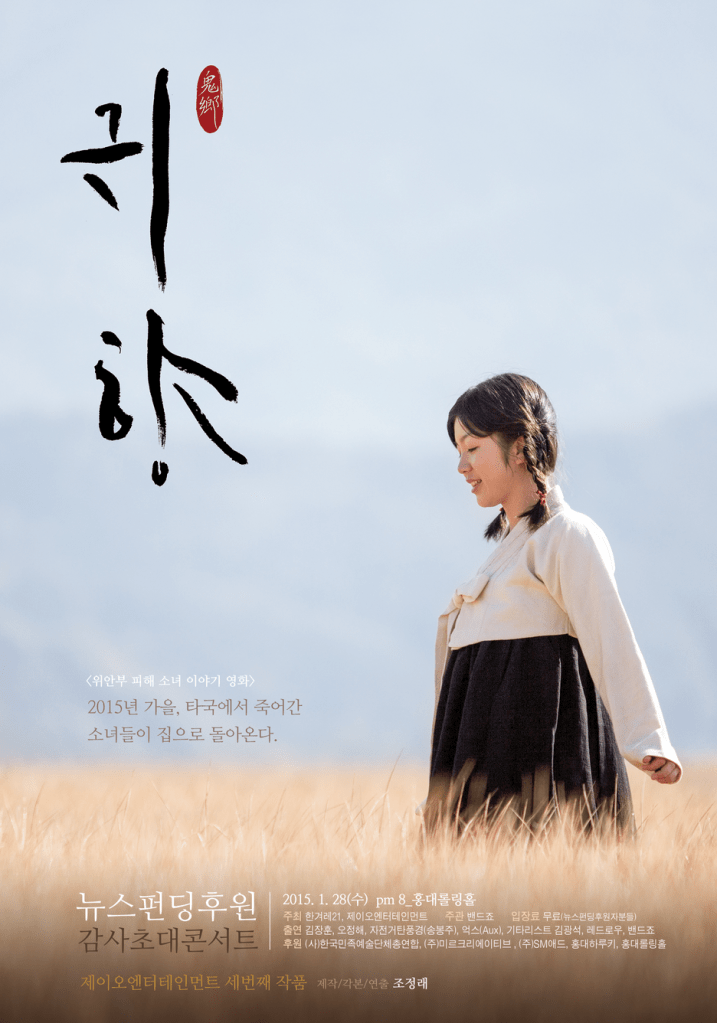
In 1943, fourteen year old Jung-min (Kang Hana) is an only child living with her cheerful father and stern mother somewhere in rural Korea. Energetic and headstrong, Jung-min thinks it sport to take a handmade amulet from one of her friends in a game despite her friend’s obvious distress. This earns her another switch beating from her disappointed mother who, regretfully, later makes her a similar amulet of her own. However, the amulet does Jung-min little good in the short term as the soldiers finally arrive and take her away with them to an uncertain destination.

Packed into a freight train with other similarly aged girls in the same situation, Jung-min is able to keep her cool and bonds with the girl next to her, Young-hee (Seo Mi-ji), who is already physically ill aside from the additional stress. Far from the shoe factory one of the girls had imagined, this collection of children is bound for a military brothel where they will be required to speak only Japanese, remaining within their tiny rooms which store only a mattress and water bucket, and endure repeated rape and violence at the hands of their captors.

Running parallel to the 1943 narrative is a jump forward to 1991 around the time in which the government finally decides to address the comfort woman issue with calls for registration so that all women affected may apply for any available compensation. Young-ok (Son Sook), now an older woman making a living from textiles and sewing amulets just like Jung-min’s, is only one of these women. Through her friendship with a shaman and her protege Eun-kyung (Choi Ri), Young-ok finds her thoughts returning to the past once again.

The younger Koreans of 1943 had known only the Japanese occupation, were educated in Japanese, and had been taught that they were “true countrymen” as one Jung-min’s friends puts it. Jung-min’s carefree, rural town is almost untouched by politics as Korean is spoken freely, folk traditions permitted, Arirang sung in the fields, and teenage girls wander around freely with no one to say to much about it. All this ends one day when the soldiers arrive, forcibly abducting Jung-min and any other young woman in the area without even a word of explanation to their parents or families. Despite the gradual erosion of their cultural identity, these women are now members of a subjugated nation so far below those of mainland birth that they barely qualify as people at all.

The treatment that these women undergo, many of them only children, is truly horrific from repeated rape to physical violence, starvation, and the ever present threat of death. Only Japanese is to be spoken in the camp which houses women and girls from both Korea and China, watched over by a Korean middle man and a Japanese madam. Allowed out of their fetid rooms for brief periods of respite (or later different kinds of work) the girls attempt to make the most of things, singing folk songs and remembering happier times. There is no real possibility of escape other than that found by one of the girls who has already gone mad after one of the visiting troops brought her own brother with it.

Indeed, there is no true escape even after the war’s end. Seeing the testimony of another former comfort woman on the television and hearing news of the programme to register women affected by wartime atrocity both for purposes of research and possible compensation, Young-ok is motivated to speak out. When she approaches a young man at the post-office to ask for the relevant forms, her nerves fail her, only to overhear the behind the counter conversation about the comfort women programme. It seems, there have been no claimants so far. The man behind the desk is unsurprised but also childishly amused. “You’d have to be some kind of loony to come out with all that kind of thing” he says, “it’s a bit…well…isn’t it?”. Not only have these women suffered immense physical and psychological trauma, they’ve also been forced into internalised shame thanks to conservative social attitudes regarding purity and surrender.

In this way, Spirits’ Homecoming (귀향, Kwihyang) stops being about Japan and Korea but becomes a wider commentary about the place of women in society and, more specifically, what happens to women in time of war. Many of the soldiers remark that the girls remind them of their sisters, yet they still go ahead with the things they do, treating these women as little more than receptacles for the fluids of their lust and rage, not much more sentient than a metal bucket. The Japanese soldiers are fairly one dimensional in their evilness, save for one who has the courage to say no, but his decision to help the girls brings only disaster for all, himself included. Berated as “bitches” for the Japanese army, the girls are denied any kind of agency and, should they outlive their usefulness, are taken off to a “better place” which smacks of the old lie told to children whose beloved dog has been taken to live a happier life “on a farm”.

Nothing can be said or done to repair what was done to these young women or return any of the things which were taken from them, but at least in telling their story there can be a kind of restitution and an end to the ongoing shame which continues to engulf their lives even though they themselves were always blameless. In reality many of these girls never got to come home, a fact which the shamanistic rites at the film’s conclusion intend to rectify, allowing Young-ok a chance to reconnect with a fallen friend whose spirit is finally guided homeward to the peaceful family life of the pre-war years. A necessarily difficult watch, Spirits’ Homecoming is a sensitive treatment of its horrific subject matter which, even if edging towards the sentimental, is resolutely unafraid to lay bare the degree of suffering inflicted on these women not only during the wartime years but throughout the rest of their lives.


Reviewed at the 2016 London East Asia Film Festival.

International trailer (English subtitles)

The Map Against the World (고산자, 대동여지도, Kang Woo-suk, 2016)

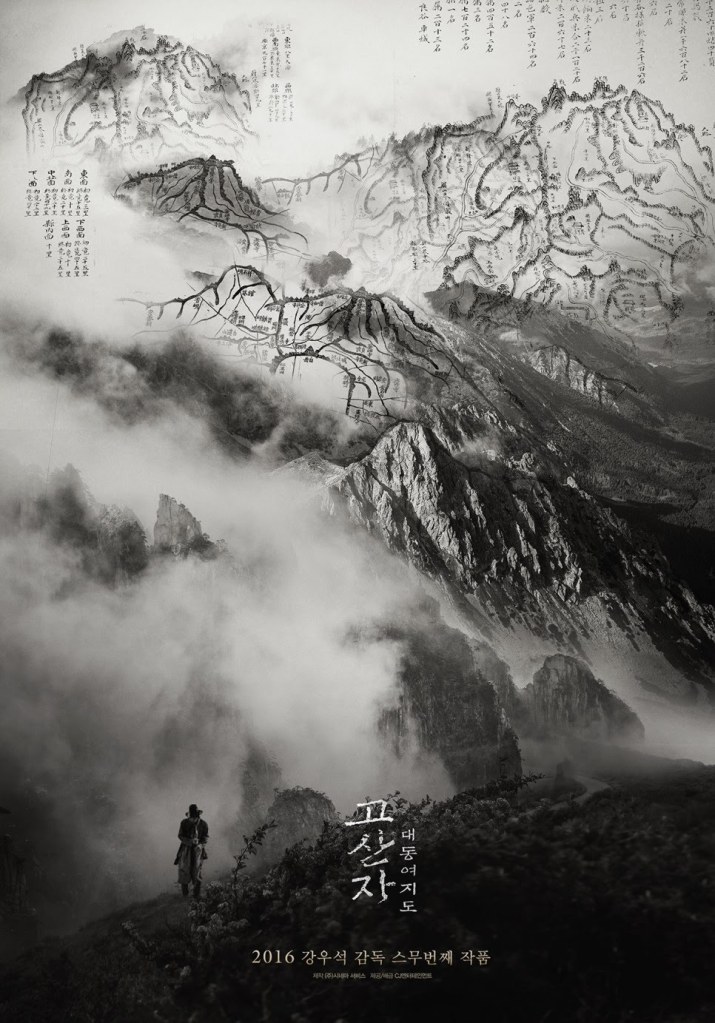
map-against-the-worldThe map is not the territory – as the old adage goes. There’s always a difference between the thing itself and the perception of it but, as the “hero” of The Map Against the World (고산자, 대동여지도, Gosanja, Daedongyeojido) points out, if you’re about to set off on a long journey it’s a good idea to not to rely on a linear map else you’ll run out of good shoes long before you reach your destination. Kim Jeong-ho (Cha Seung-Won) was, apparently, a real person (though little is known about him) who set out to make a proper map of the Korean peninsula after a cartographic error led to the death of his father and many other men from his village when they ran out of resources crossing what they thought was one mountain but turned out to be one mountain range.
The difficulty here is that The Map Around the World pivots around a man who is so crazed and obsessive in his quest that he causes serious problems not only for himself in a difficult political climate, but also for those close to him whose lives he ruins through neglect and abandonment. Is he a hero for following his dreams even though they cost others so dearly? The film seems to say yes, but it’s a difficult message to swallow.

Ever since Kim Jeong-ho’s father died, he’s been obsessed with the idea of creating an accurate map of the Korean peninsula from end to end including the “Dokdo” (or which ever name you wish to use) islands. Consequently, he spends much of his life wandering around on his own which has made him a bit strange. Returning home after a four year absence, Jeong-ho does not seem to be aware that time has been passing even in Seoul and his little daughter, Soon-sil (Nam Ji-hyun), is now all grown up. Jeong-ho also has a kind of relationship with his neighbour, Mrs. Yeonju (Shin Dong-mi), who has been looking after Soon-sil but it’s all a bit awkward.

Aside from Jeong-ho’s terrible performance as a family man, the main intrigue centres around his big philosophy – open access to information for everyone from the nobleman to the peasant. In order to make sure maps remain as accurate as possible, he’s hit on the idea of producing woodblocks so they can be reproduced en masse with fewer errors and then sold to anyone who wants one so that people are free to travel wherever they wish. This is an extraordinarily destabilising idea in the increasingly paranoid world of the late Joseon era under the Regent Heungseon Daewongun (Yu Jun-sang). The woodblocks are dangerous because the elites do not wish the common man to possess that kind of knowledge, would rather people did not travel very much, and there is always the old “national security” fear in which the rulers assert the danger of spies and invaders getting their hands on such an accurate guide to the terrain.

Of course, Heungseon Daewongun ruling as a Regent for his young son means there is also a simmering battle for power running in the background as second tier nobles snap away at each other trying to increase their status in the hope of making a bid for the big chair. Heungseon Daewongun has reason enough to be paranoid but his rule is an austere one in which all foreign elements are to be eliminated in their entirety.

Kim Jeong-ho’s world is difficult and often frightening but Jeong-ho cares for nothing but maps aside from the idea of the free exchange of information. The early part of the film is, broadly, a quirky comedy about an amiable eccentric laughing his way out of trouble whilst evading debt collectors and trying to earn the forgiveness of the women he’s abandoned with nary a word for the last four years.

Jokes about Jeong-ho’s awkward relationship with his neighbour, mild irritation with the idea that his now grown up daughter has a boyfriend, and buddy comedy with the guy helping him carve the woodblocks suddenly seem out of place when the film descends into a morass of cruelty and horror with no apparent warning. Jeong-ho himself is beaten by authorities determined to obtain his maps by underhanded means seeing as Jeong-ho wants them to be available to the people and therefore refuses to surrender them into the “care” of the state. When that doesn’t work, he places himself in line for more harassment, but that’s nothing compared to what happens when a secret sect of Christians (banned for fear of foreignness) is uncovered in the village. Brutally tortured and instructed to denounce others, the villagers are then publicly beheaded. Suddenly, maps don’t seem so important any more.

Nevertheless, Jeong-ho quickly gets over the stubbornness that has cost him the things he held most dear (aside, it seems, from maps) to get right back out there and do some hardcore cartography. The film ends on an oddly upbeat note as Jeong-ho ventures forth on another adventure, edging ever closer to completing his mission, but even if he is about to make his “dream” come true, that same dream has just got a number of people killed. Jeong-ho’s quest to make the maps available to all could be seen as resistance to the oppressiveness of the state, but it isn’t, he just really likes maps and thinks you should too. The Gangchi (otherwise known as “Japanese” sealions, apparently hunted into extinction by Japanese fishermen in the 1970s) frolic happily off the waters of Dokdo as Jeong-ho approaches, but it hardly seems like a cause for celebration.

Over long and tonally inconsistent, The Map Against the World is a frustrating and often dull experience. Hold the map against the world and see what you see, errors and imperfections everywhere. Yet fighting oppression through cartography is a difficult task, and when it comes down to it a map against the world is not enough on its own. Filled with picturesque shots of Korea’s natural beauty, The Map Against the World displays generally high production values but can’t decide if it’s the story of a valiant revolutionary waging a cultural war for freedom of information in the middle of a paranoid dictatorship, or just a film about a madman trying to map ever changing terrain. Jeong-ho’s quest may be a noble one, but his single minded determination and willingness to sacrifice other people’s lives in its service is far from heroic leaving the film’s bittersweet finale feeling very hollow indeed.


Reviewed at the 2016 London East Asia Film Festival.

Original trailer (English subtitles)

Familyhood (굿바이 싱글, Kim Tae-gon, 2016)

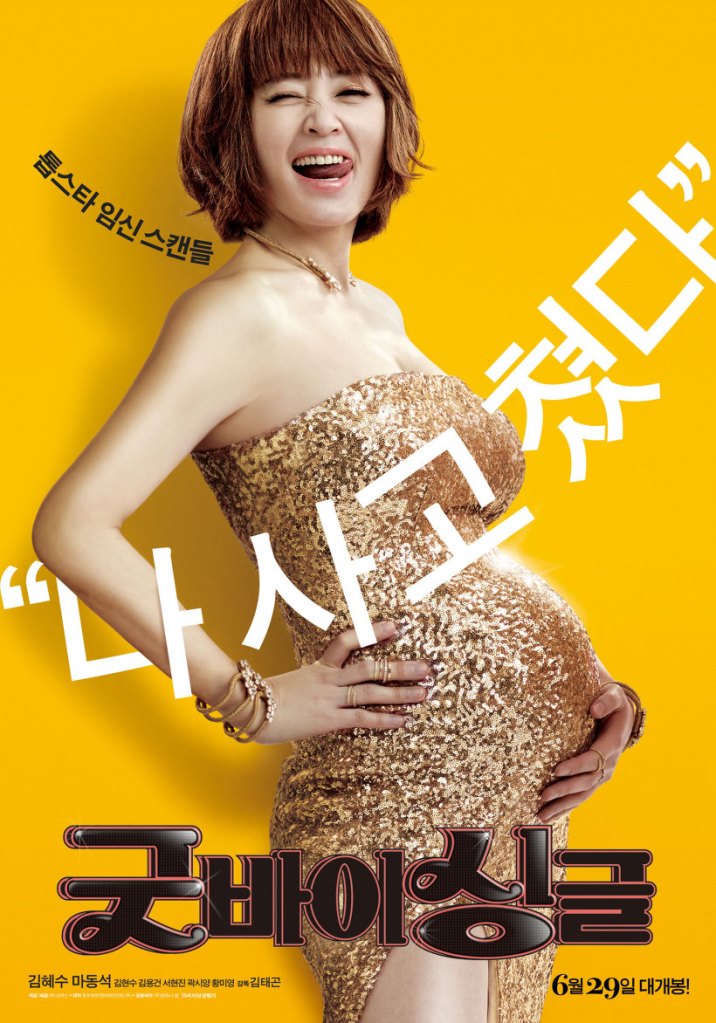
familyhoodThere are three kinds of actors – those who wait for roles, those who choose roles, and those who make roles for themselves. Ageing actress Go Ju-yeon (Kim Hye-soo) claims to be the third type, but at any rate she’s currently between gigs and facing professional scandals and personal crises from each and every direction. An unusual family drama, Familyhood (굿바이 싱글, Gotbai Singkeul, AKA Goodbye Single) is the coming of age story of a middle aged woman finally forced into adulthood through an unlikely friendship with a pregnant teenage girl.

A veteran TV star of over twenty years, Go Ju-yeon is perhaps better known for her scandalous relationships with younger men than her onscreen performance. Having worked hard to get where she is, perhaps Ju-yeon is entitled to play the diva, but her “difficult” personality alienates all but her most loyal staff. However, there’s one thing Ju-yeon has been missing – a traditional family life with a loving husband and children. She thinks her latest boyfriend, Ji-hoon (Kwak Si-yang),  a fellow TV star twelve years her junior, may the “the one”, but as it turns out he’s a no good two timing louse using her for her money and star status.

Heartbroken Ju-yeon swears off men forever and decides to buy herself a slice of unconditional love by becoming a mother. Turned down for an adoption because of her obvious unsuitability as evidenced by her appearances in the tabloids and by the fact that she just made this decision a few seconds ago, Ju-yeon figures it’s worth the nine month waiting period to do things the old fashioned way. Unfortunately she’s left it too late as a doctor’s appointment reveals she’s already heading into the menopause. Ju-yeon’s luck changes when she comes to the rescue of a teenage mother in the lift when a more conservative family decides it’s OK to lay into a vulnerable child they don’t even know.

Ju-yeon hits on an idea – buy the girl’s baby and raise it as her own. Dan-ji (Kim Hyun-soo) is an orphan living with her tough as nails older sister so it doesn’t take her long to agree to Ju-yeon’s suggestion even if she has her misgivings. Coming with her own contract prepared detailing her monetary compensation, Dan-ji has given this a lot more thought than the mother in waiting Ju-yeon but a sisterly bond eventually begins to develop between the two women despite the clear instruction to avoid getting attached. However, as Dan-ji’s presence begins to reinvigorate her fortunes, Ju-yeon begins to forget about her original career/romance replacer mission and has less and less time for the surrogate teenage daughter she irresponsibly promised to take care of.

Having lost her mother at a young age and spent all of her adult life in the pampered showbiz arena, Ju-yeon is a forty year old awkward woman child with a severe case of tunnel vision. As Dan-ji points out, Ju-yeon is a pure hearted sort but she’s also selfish and immature, jumping from one thing to the next and never stopping to consider the effect of her actions on those around her. Ju-yeon’s decision to become a mother is a similarly rash and selfish one as she only considers the upside of the boundless love she’s about to receive from this tiny bundle who is duty bound to love her, whilst failing to think about the practicalities of child rearing from the impact on her career and social life to the negative publicity she will receive as a single mother in a still relatively conservative society.

It’s these kinds of double standards which the film seems to want to lay bare as Ju-yeon attempts to come to the rescue of Dan-ji, albeit for selfish motives. Dan-ji, planning to get an abortion, has told no one other than her best friend about the pregnancy and is worried about the school finding out, not least because she is their representative at an inter school art contest. The boy who fathered her child had the temerity to ask if it was his before stealing a ring belonging to his mother to pay for an abortion. He is now off on an international golfing trip representing the country, but Dan-ji is imprisoned, kept out of sight so that Ju-yeon can claim the child is hers. Ju-yeon and Dan-ji first meet when Ju-yeon takes a smug family to task over their decision to loudly criticise Ju-yeon for her “immoral” ways in a hospital lift. After a long journey Ju-yeon will do the same again, only more loudly and even help to win over a few supporters from the collection of conservative mothers waiting for their kids after the art contest.

Kim creates a cosy world filled with calming pastel colours almost as if Ju-yeon really does live in a nursery. Ju-yeon wants to be a mother but still needs mothering herself and mostly gets it from her best friend and stylist Pyung-gu (Ma Dong-seok). Despite vowing to look after Dan-ji at least until her baby is born, it’s Dan-ji who mostly ends up looking after Ju-yeon, providing comfort and comparatively grown up advice whilst Ju-yeon mopes and eats ice-cream. Only when her schemes backfire and Ju-yeon faces losing everything does she finally begin to realise how she’s taken the people in her life for granted. What emerges is a new kind of family in which good friends enjoy food together because they want to eat rather than because someone insisted on cooking. Taking in everything from the ageist sexism of the entertainment industry to teenage pregnancy and neglected children, Kim Tae-gon’s Familyhood is a smart, socially conscious comedy making a heartfelt plea for a more understanding world.


Reviewed at the 2016 London East Asia Film Festival.

Original trailer (English subtitles)

Worst Woman (최악의 하루, Kim Jong-kwan, 2016)

movie_imageKim Jong-kwan’s award winning unexpected indie box office hit has been given the rather odd English title of Worst Woman (최악의 하루, Choeakui Haru) in contrast with the original Korean which simply means “The Worst Day”. In fact, the film is about two people – an aspiring Korean actress with problems in her personal life, and a Japanese writer visiting for the launch of the Korean translation of his novel, each of whom is indeed having an exceptionally unlucky day. Part walking and talking, part split focus romantic comedy, Worst Woman is a polished piece of indie filmmaking anchored by quality performances and an interesting approach to its material.
Eun-hee (Han Ye-ri) is supposed to be rehearsing for a play but somehow she’s not really into it, much to the consternation of her coach. Heading off to meet up with her vacuous soap star boyfriend, Hyun-Oh (Kwon Yool ), Eun-hee runs into a hopelessly lost Japanese man who asks her for directions but mangles the pronunciation of the address leaving her with little idea of the destination. Nevertheless, Eun-hee eventually helps the mysterious traveller, Ryohei (Ryo Iwase), find the place he’s looking for only to realise he’s been given the completely the wrong time and there’s no one there to meet him. The pair then decide to have coffee together in a nearby cafe before Eun-hee leaves to track down Hyun-oh.

At this point their paths diverge but each is in for a disastrous day. Eun-hee argues with Hyun-oh about a previous (married) boyfriend before teasing him about his decision to wear a face mask and sunglasses “in case someone recognises him” (hilariously, he still gets snapped when a passing woman realises only a celebrity would be wearing such an attention seeking disguise). The playful argument suddenly turns ugly when Hyun-oh calls Eun-hee by another girl’s name leading her to dump him on the spot and leave as quickly as possible. Moping around, she posts a picture of the view from the park on Twitter which “concerns” the aforementioned married ex-boyfriend, Woon-Chul (Lee Hee-joon), who also wants to take Eun-hee for coffee in an attempt to rehash the past.

Meanwhile, Ryohei has finally met up with his publisher but quickly discovers his book launch is not all that it seemed to be. Not only has the venue changed, but only two people have turned up (and even that was an accident). Making the best of things, Ryohei takes the “guests” to a nearby coffee shop and attempts to talk to them about literature with mixed results. The apologetic publisher is Ryohei’s biggest supporter, translating the book himself and determined to share it with his fellow countrymen, but has problems of his own which mean that the Korean edition of Ryohei’s novel is set to remain on the shelf a little longer.

Chatting awkwardly in English in the cafe, Eun-hee asks Ryohei what he does for a living to which he jokingly replies that he “lies”. His job is, in essence, to make things up – he’s a novelist, albeit one with only a single book to his name. Eun-hee laughs and says she’s same, only she’s an actress, and like Ryohei she is not yet famous or even particularly successful. In fact, Eun-hee has been giving the performance of her life off stage where lying has become something of a bad habit. Though she had told Hyun-oh about her relationship with Woon-chul, even explaining that he was a married man, it appears that perhaps she hadn’t been sharing the whole truth with either man. Needless to say, her taste in men has not served her well and the choice between the petty and self obsessed Hyun-oh and the possessive, persistent and obsessive Woon-chul may not be worth making.

If Eun-hee’s romantic difficulties undermine her sense of self confidence, Ryohei gets a professional dressing down from a bilingual journalist (Choi Yu-hwa) who claims to be a fan of his work but has serious questions about his approach to character. Why, she asks him, does he create such violent and sadistic scenarios and then allow his characters to suffer within them. If the writer is god, does he not owe it to his creations to show a little benevolence? Ryohei is a put out to receive such an underhanded criticism during an interview, especially as he doesn’t consider himself to be a cruel person, but now realises that perhaps his world view is a little bleaker than he’d previously thought.

Both having experienced one of those days which throw everything else into stark relief, the pair run into each other again at twilight in the picturesque Namsan Park. Eun-hee revisits the opening monologue from her play, now managing to breathe life into the lines informed by her recent experiences, before reuniting with Ryohei and making another surprising suggestion – that they set off on a long walk along the park trail which she has never managed to complete. The opening narration from Ryohei told us that he’d been dreaming a lot of his home town and had, unusually, come up with a story idea whilst travelling. Smarting from the criticisms of the journalist and realising many of the characters he’s denied a happy ending to are slightly lost, essentially nice women just like Eun-hee, Ryohei decides that it’s time to make an exception. He imagines the same place he is right now, only it’s snowing and a woman is looking nervously back along the path. This time there is no need to worry, he doesn’t know all the details yet, but this woman is definitely going to be happy, at least someday.

Featuring a light jazz score and indie-style straightforward direction, Worst Woman recalls both the distant irony of Hong Sang-soo and other recent cross-cultural romances such as A Midsummer’s Fantasia (which also starred leading man Ryo Iwase) and Hong’s own Hill of Freedom. A tale of city serendipity, the film makes use of constant reoccurring motifs from coffee shops and national parks to professional insecurity and confused relationships but even if Eun-hee has been playing the role of herself with both of the men in her life, her connection with Ryohei seems to have a more authentic quality. Light yet poignant and filled with sophisticated comic touches, Worst Woman is a delightful late summer romance which ends on a refreshingly upbeat, open ended, note careful to leave the door open for these two frustrated artists to make the best of their worst day.


Reviewed at the 2016 London East Asia Film Festival.

Original trailer (English subtitles)

The Handmaiden (아가씨, Park Chan-wook, 2016)

handmaiden.jpgPark Chan-wook has something of a track record when it comes to bending literary sources in unexpected ways – who else would have thought of adding vampires to Thérèse Raquin and actually managed to make it work? In The Handmaiden (아가씨, Agasshi), his first return to Korean filmmaking after Stoker’s foray into American Gothic, Park adapts Sarah Waters’ Fingersmith – a Dickensian tale of love and the multilayered con, and relocates it to 1930s Korea under Japanese rule.

Ambivalent attitudes to the Japanese is a key element exploited by a ruthless conman posing as “Count Fujiwara” (Ha Jung-woo) in order to seduce a lonely heiress. To complete his elaborate plan, he needs the help of pickpocket extraordinaire, Sook-hee (Kim Tae-Ri), whom he will install as a maid in the household so she can subtly sell the virtues of the dashing nobleman to the innocent flower trapped in a well of opulence.

On arriving at the curiously constructed mansion which is an elegant architectural mix of Korean, Japanese, and English country estate, Sook-hee is quite literally out of place in the upperclass environment a world away from her home in a den of petty of thieves doubling as a baby farm. Another thing she had not quite banked on was that her new mistress, Hideko (Kim Min-hee), would be quite so pretty. A serious spanner is thrown in the works as a mutual attraction builds up between the two women who, for reasons which become apparent, are being pulled in separate directions by other desires.

Park retains Waters’ tripartite structure even if he jettisons the final plot reveal for a less intricate tale of liberation and escape. Beginning with Sook-hee’s narrative he introduces us to the first layer of the con but also to Sook-hee and her down and dirty home in the criminal underworld. Chosen by the Count for her supposed lack of intellect and innocent naivety, Sook-hee is not quite at home among her family either. Both believing the promise that the babies they collect and sell in Japan will be going on to better lives and lamenting the cruelty of the whole business in wanting to mother the lot of them, Sook-hee is soft presence yet she also wants to prove herself as adept at criminality as her legendary, now deceased, mother.

It’s this essential warmth which eventually attracts Hideko’s attention. The much talked about tooth filing scene in which Sook-hee takes out a thimble to soften a lacerating sharpness in her mistress’ mouth is not just notable for the oddly erotic quality born of the obvious suggestive motion, unavoidable intimacy created by the closeness of bodies, and the growing desire of fleeting, furtive glances, but for its essential kindness. Moving into Hideko’s perspective for the second chapter, more is learned about her damaged past filled with cruelty and abuse. Orphaned and brought to Japan as a small child by her pornography obsessed uncle so that he might train her to entertain him with readings of erotic literature before he eventually marries her to inherit the family fortune, Hideko has never known anything as simple as unguarded goodness.

Caught up in a long con, the choice remains whether to blow cover and declare one’s hand or play the thing through to the end, however painful it may be. Park takes a different route than in the original novel which makes both of its heroines the victims of someone else’s avaricious plot of revenge against the cruelty of an unequal world, eventually reinforcing their bond by a shared rejection of their victimhood, but even when their passions eventually erupt the lovemaking begins as a another “con” where Sook-hee takes on the role of the Count, “educating” the assumedly “innocent” Hideko in the ways of desire.

Trapped within an oppressive gilded cage of a prison, Hideko has become the embodiment of desire for her cruel and eccentric uncle and the groups of men he invites to listen to her read erotic literature as if reciting a classical play. Complete with sideshows of sex dolls and theatrical scenery, Hideko is forced to act out the scenes from the books as an actress on the stage for an audience rapt in silence. Unable to escape alone, Hideko is offered new hope by Sook-hee’s straightforward outrage which allows the pair to destroy or repurpose the instruments of their oppression for their own pleasure. This is, in essence, their form of revenge in which they simply remove themselves from an abusive environment leaving the men behind to wonder at what’s gone wrong and later to destroy themselves without any additional help.

Filled with a gothic sense of impossible desires and uncertain judgements, The Handmaiden is unafraid of the genre’s melodramatic roots but is all the better for it. Beautifully photographed, this opulent world of swishing ball gowns and gloved hands is undercut by the ugliness of quisling collaborator Kouzuki and his basement of horrors. Erotically charged but ultimately driven by love, The Handmaiden is another unconventionally romantic effort from Park albeit one coloured by his characteristic sense of gothic darkness.


Reviewed at 2016 London East Asia Film Festival.

Original trailer (English subtitles)

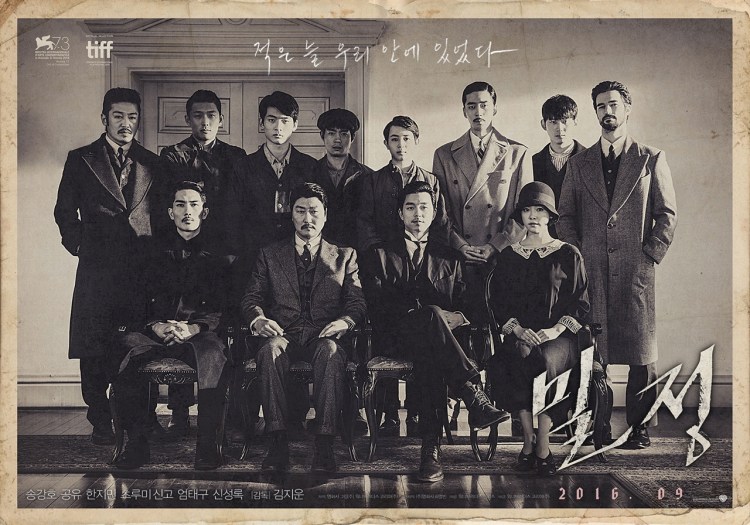
The Age of Shadows (밀정, Kim Jee-woon, 2016)

age-of-shadowsWhen the country of your birth has been occupied by another nation, what do you do? Do you fight back, insist on your independence and expel the tyrants, or quickly bow to your new overlords and resign yourself to no longer being what you once were? Kim Jee-woon becomes the latest director to take a look at Korea’s colonial past with the Resistance based thriller Age of Shadows (밀정, Miljung) which owes more than a little to Melville’s similarly titled Army of Shadows, as well as classic cold war spy dramas The Third Man and The Spy Who Came in From the Cold.
The film opens with an impressive set piece in which two Resistance members, Jang-ok (Park Hee-soon), and Joo (Seo Young-joo) are betrayed whilst trying to sell a Buddhist statue. Joo is captured but Jang-ok makes a run for it as what looks like the entire Japanese garrison of Seoul chases him, running gallantly over the picturesque Korean rooftops. Cornered, Jang-ok is confronted by Korean born Japanese policeman Jung-chool (Song Kang-ho), once a Resistance member himself and a former comrade in arms of Jang-ok. This is the point Jung-chool’s carefully crafted collaboration beings to fracture – his friend, rather than allow himelf to be captured, shouts “Long Live Korea” and blows his own brains out.

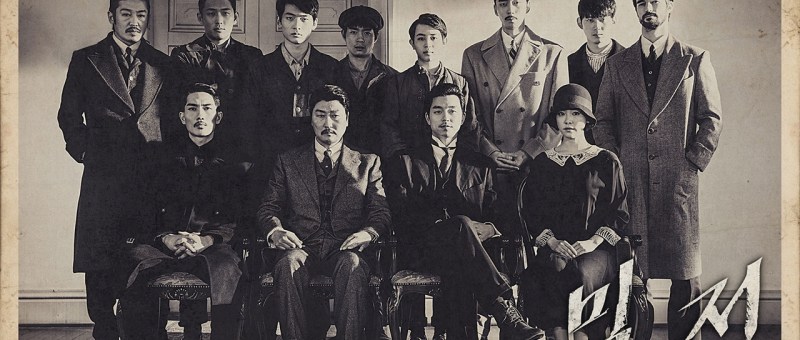
His mission a failure, Jung-chool is then moved onto the next investigation which aims to dig out the Resistance top brass in the city. Jung-chool’s Japanese boss Higashi (Shingo Tsurumi) wants him to infiltrate the cell headed by antique dealer and photographer Woo-jin (Gong Yoo) in the hope that it will lead them to head honcho, Jung (Lee Byung-hun). However, Higashi also saddles him with a very young but high ranking Japanese official, Hashimoto (Um Tae-goo), to “help” him bring in Woo-jin.

In Jung-chool’s final conversation with Jang-ok, his friend berates him for the decision to turn traitor and work for the Japanese rather than against them. Jung-chool asks him if he thinks independence is a credible aim, implying he’s long since given up believing in the idea of the Japanese ever being overthrown. Jang-ok evidently believed in it enough to sacrifice his own life, but other comrades have also abanoned the cause and actively betrayed the movement in much more serious ways than Jung-chool’s pragmatic side swapping.

Even if Jung-chool has decided that if you can’t beat the Japanese you may as well join them, he’s coming to the realisation that his superiors, even if they’ve previously treated him warmly, will never regard him as equal to the Japanese personnel. Hashimoto’s sudden arrival undercuts Jung-Chool’s career progress and reminds him that he serves a very distinct purpose which may soon run out of currency. Higashi, having seduced Jung-chool with promises of a comfortable life and praise for his skills, does not trust his Korean underling enough to send him out on his own. This personal wound may do more to send him reeling back to the other side than anything else, especially as his “replacement” Hashimoto is a crazy eyed psychopath who has half a mind to burn the entire city just to be sure of getting his man.

A man who’s been turned once can be turned again and so mastermind Jung decides to prod Jung-chool in the hope that he’ll become an asset rather than a threat. As he puts it, what’s more frightening than feeling your heart move and Jung-chool’s certainty has already been shaken. Song Kang-ho perfectly inhabits Jung-chool’s conflicted soul as his old patriotic feelings start to surface just as he begins to truly see his masters for what they are. Always keeping his intentions unclear, Jung-chool is the ideal double agent, playing both sides or maybe neither with no clear affiliation.

Like Army of Shadows, the final nail in the coffin is delivered by a sentimental photograph. In this chaotic world of betrayals and counter betrayals, there can be no room for love or compassion other than loyalty to one’s comrades and to the movement. Yet against the odds Woo-jin comes to trust Jung-chool implicitly, certain that he will finally choose the side of freedom rather than that of the oppressor. The relationship between the two men provides the only real moments of comic relief, though others members of the group are less well defined including an underwritten part for Woo-jin’s Chinese love interest (Han Ji-min) who isn’t permitted to do very much other than model some elegant twenties outfits.

Maintaining tension throughout, Kim intersperses psychological drama as betrayal piles on betrayal, with intense action sequences including a particularly claustrophobic train based game of hide and seek. Inspired by real historical events, Kim does not claim any level of authenticity but sets out to tell the story of the double dealing inside a man’s heart as he weighs up duty and self interest and asks himself how far he’s willing to go for the sake of either. The age of “shadows” indeed, these are hollow men whose identities have been eroded, living only for today but in certainty of the bright tomorrow. Kim’s examination of this turbulent period is both a big budget prestige picture with striking production values, and a tense, noir-inflected thriller in the mould of Melville, but also a nuanced human drama unafraid to ask the difficult questions which lie at the heart of every spy story.


Reviewed at the 2016 London East Asia Film Festival.

Original trailer (English subtitles)

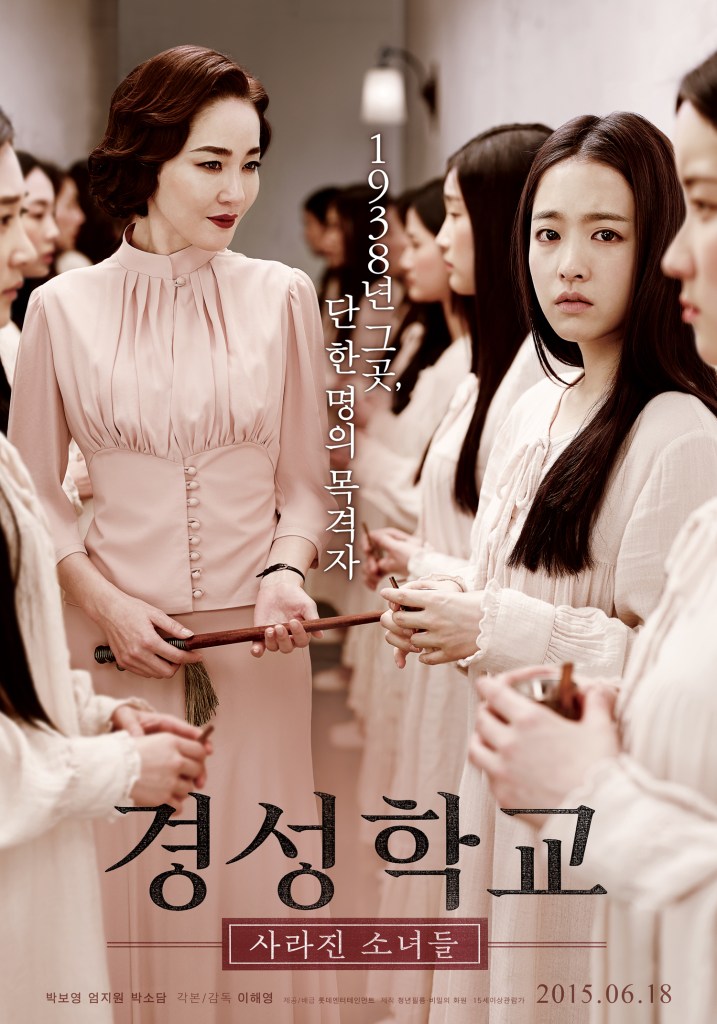
The Silenced (경성학교: 사라진 소녀들, Lee Hae-Young, 2015)

the-silencedThe Silenced (경성학교: 사라진 소녀들, Gyeongseonghakyoo: Sarajin Sonyeodeul) has all the classic genre aspects of the boarding school horror story familiar to fans of gothic literature everywhere, but this is no Victorian tale of repressed sexuality and hallucinatory psychosis. What The Silence does is take all of these essential elements and remix them as a metaphor for the horror of colonialism. Surrounded by quislings and forced into submission in order to survive, how does the essential soul of an oppressed people survive? The Silence would seem to argue that perhaps it can’t, but can evolve and learn to resist its colonisers even if it has to bend to do so.
Korea, 1938. Teenage girl Ju-ran (Park Bo-Young) is dropped off by her rather cool step-mother at a hospital school before her parents relocate to Tokyo. On arrival, Ju-ran switches to her Japanese name of Shizuko which raises a stir among her new schoolmates because another girl with the same name previously occupied her new bed before disappearing suddenly without a word of goodbye. Her physical resemblance to the previous Shizuko, coupled with her ill-health, provokes mistrust among the other girls, especially top girl Yuka and her minions. Shizuko is now expected to get used to all of the school’s arcane rules and regulations as soon as possible or risk harsh punishment. This includes “treatment” for her illness which involves frequent distribution of pills, injections, and other experimental courses. Before long Shizuko begins to notice odd behaviour among the girls, some of whom begin to disappear.

After a lengthy series of diplomatic manoeuvres beginning in the Meiji era, Japan annexed Korea in 1910 beginning a period of direct rule which would continue until the end of the Second World War. During this period, Japanese became the dominant, official language and mainland Japanese culture sought to displace that of the indigenous Korean society. The school, as an official institution, is careful to follow these regulations to the letter. Each of the pupils has a Japanese name which becomes their “official” designation, the Korean identity is “buried” with Korean birth names used only with close friends whose trust is certain.

Similarly, the school’s official language is Japanese with lessons and official business always conducted in the appropriate language. Linguistic shifts suddenly become an interesting phenomenon as the girls continue to talk to each other in their native Korean in the school room and out (even if sticking to Japanese names) but maintain order by obeying commands in the language of authority. The headmistress generally sticks to Japanese, at least when she’s at the lectern, but notably switches to Korean when addressing a girl personally or when she wishes to appear kind and non-threatening rather than authoritarian. This point is further brought home when one girl descends into a fit of rage and attacks another, ranting and raving in Japanese whilst gripping the other girl’s throat. Korean is both the language of kindness and friendship as opposed to the coldness and violence of the official Japanese, and a tool to be manipulated in order to create a false sense of camaraderie between colonised and coloniser.

The school is staffed by collaborators working with the Japanese authorities and training these young women to be model Japanese citizens. Part of their classwork involves a large embroidery project sewing beautiful pink cherry blossoms onto a map of Korea – a motif which is later chillingly repeated by sewing those same flowers onto the body the body of a collaborator. Tokyo has become a kind of magical wonderland paradise and the school even offers the girls hope of advancement there through winning a competition based on physical ability in which the school will select the two most promising candidates and dispatch them to the capital. The headmistress, once the final mystery has been exposed, begs the Japanese military forces to put their faith in her because she is determined to become a loyal Japanese citizen and leave this backward Korea behind forever.

The main thrust of the narrative centres around the interplay between these teenage girls who stand in for a subjugated people, ruled over by their collaborating teachers. Shizuko (Ju-ran) strikes up a friendship with Kazue (or Yeong-duk to restore her Korean name), previously the best friend of her predecessor. The two girls become closer though the the disappearance of the previous Shizuko always stands between them. Beginning to solve the mystery, the two girls are the only opposition to the ruling regime as they accept the various “benefits” of their treatment and education, and return to use them against their oppressors. The girls’ innocence has been corrupted by their experiences, but this same corruption is the very thing which allows them to take a stand for their independence.

Though the supernatural is posited as the ultimate enemy, the solution of the mystery leads straight back into the political realm rather than any less Earthly kind of evil. Director Lee Hae-young generates a supremely creepy atmosphere from the opening sequence onwards which empahises the gothic aesthetic and inescapable presence of something dark lurking in the shadows. Though using minimal instances of jump scares, supernatural episodes, and hallucinatory images, the film pushes its horrors into the real world even if the solution it ultimately offers is more akin to a superhero origin story than a revolutionary uprising. Beautifully photographed, The Silenced is the story of those denied a voice realising they have the right to rebel but like any gothic horror story paints its central battle as an ongoing, unwinnable fight against the darkness.


Original trailer (select English subs from settings menu)

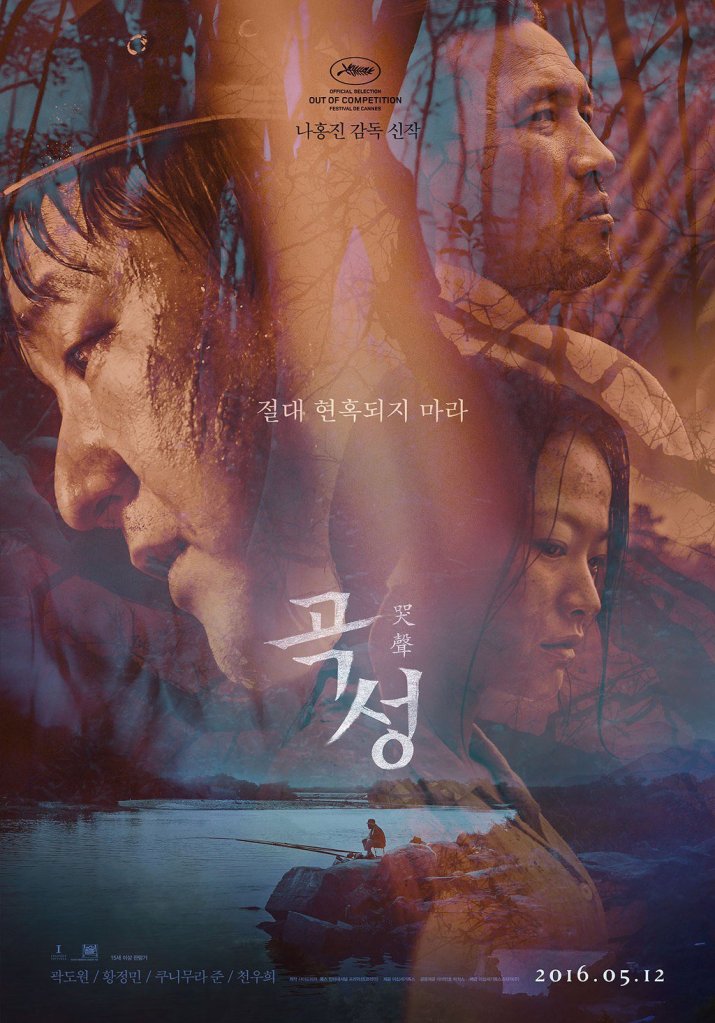
The Wailing (곡성, Na Hong-Jin, 2016)

wailingFor the world’s more full of weeping than you can understand – the residents of Goksung, the setting for Na Hong-jin’s nihilistic horror movie The Wailing (곡성, Goksung), might be inclined to agree with Yeats if only because the name of their town is also a homonym for the “sound of weeping”. There is plenty to weep over, and in places Na’s film begins to feel like one long plaintive cry reaching far back to the dawn of time but the main wounds are comparatively more recent – colonisation, not only of a landscape but of a soul. When it comes to gods, should you trust one over another simply because of its country of origin or is your faith to  be bestowed in something with more universal application?

Goksung is a sleepy little rural town way up in the mountains. This is the kind of place where nothing much ever happens but today all of that is about to change as a local man has committed a series of bloody murders and is now in a dissociative state. Bumbling policeman Jong-goo (Kwak Do-won) arrives late to the crime scene but quickly finds himself pulled in to the ongoing investigations as bodies begin piling up in the previously quiet town.

The rational explanation for the spate of violent killings is blamed on a tonic containing some funny mushrooms but others have another idea. All of this started happening after a Japanese guy (Jun Kunimura) moved to the town. Some say he’s a professor, some say he’s a Buddhist monk, but there also those who hold him responsible for the rape of a local woman, and there are even reports of him running about the forest dressed only in a loincloth and feasting on the remains of fallen animals.

Eventually, Jung-goo’s young daughter Hyo-jin (Kim Hwan-hee) falls under the curse, giving him an unavoidable impetus to find the truth. As well as the “suspicious” Japanese visitor, Jung-goo also comes into contact with a mysterious young woman dressed in white (Chun Woo-hee) who may be either friend or foe, whilst shamans and the Catholic Church are each approached for their advice on this singularly supernatural phenomenon.

This being quite a sleepy town, Jung-goo’s days most likely involved a lot of napping, eating, and card playing, broken up with chatting to old ladies. So unaccustomed to crime are they, they didn’t quite remember to put their gloves on before investigating a crime scene. Jung-goo and his partner are constantly branded “morons” by their boss and if the night they end up guarding the police station during a thunderstorm is anything to go by, they aren’t exactly the bravest of souls either. Not the best pair to be investigating a complex, supernatural mystery they decide to heed the rumours and pay a visit to the Japanese guy living way out in the woods.

Known only by the derogatory term “the Jap”, the new addition to the village quickly falls under suspicion thanks to the old fashioned crime of not being from around here. Whether out of resentment for historical crimes or simply because of being an outsider, everyone decides the Japanese visitor must, in some way, be responsible. Suspicions are compounded when Jung-goo, his partner, and his partner’s nephew who happens to be a Catholic priest in training with a solid command of Japanese, discover some very odd things whilst snooping around the man’s home. Is the mysterious visitor really, literally, a “Japanese devil” or just the victim of an ongoing campaign of intense xenophobia and the supernatural elements attributed to him a manifestation of that extremely offensive term?

Na keeps us guessing. Meanwhile, ancient remedies are sought when ancient ones are awakened, hence Jung-goo’s mother-in-law turns to shamanism to try and cure her granddaughter of her increasingly serious illness. The shaman (Hwang Jung-Min) arrives more like a TV evangelist than a witch doctor – smart suit and turtleneck, topped of with long hair tied into a bun. The exorcism scene itself is a furious battle between light and darkness (or so we presume) as the shaman dances wildly to the pulsating drum beats of his orchestra, sacrificing a chicken here and a goat there, all while Hyo-jin writhes in agony in the next room and his enemy performs a counter ritual from his recently refurbished lair.

“Believe in me and you shall be saved” is a message Jung-goo receives from just about everyone during the course of the film. The Catholic Church, however, is resolutely opposed to the idea of this demonic threat and informs Jung-goo that this is not a religious matter – he ought to take his daughter back to the hospital and instil his “faith” in modern medicine. Faith appears to be the central question, in what or whom should one believe? Can Jung-goo trust his shaman, is the Japanese guy an ally, threat, or just a neutral, ordinary man, and what of the oddly intense woman dressed in white? In the end, Jung-goo’s faith is questioned but he pays dearly for his final decision. Had he placed more faith in the old gods, his fate might have been very different but Jung-goo chose real world logic (not his strongest suit) over spiritual intuition and failed to heed the warnings.

Jung-goo, though presented as a broadly sympathetic presence, is partly responsible for his own downfall through his willingness to embrace the baser elements of his nature. In contrast to his otherwise laid-back character which sees him late to work because of family meals, Jung-goo has a violent streak first seen when he takes defending himself from an angry dog far further than he needed to. Later he rounds a group of friends to help him take out the Japanese man in a worrying stab at mob justice. Neither quality is very endearing but Jung-goo’s position as a slightly dim bruiser who mistakenly thinks he can smash his way out of a spiritual conundrum makes him an unlikely choice of saviour.

Na offers nothing in the way of hope, the forces of darkness are set to conquer the world helped only by humanity’s propensity towards doubt, its selfishness, and its fear. The dark humour fades as the pace increases until the film approaches its bleaker than bleak finale. This is a land of ghosts, both fleshy and otherwise but in order to bid them goodbye you must first accept their presence. In the end it’s all a question of faith but those most worthy of it may be among the most difficult to believe.


Reviewed at 2016 BFI London Film Festival

Original trailer (English subtitles)