
Harmony (ハーモニー, Michael Arias & Takashi Nakamura, 2015)

Harmony PosterHarmony – the word itself sounds peaceful. A coalescence of sympathetic sounds, the feeling of wholeness and happiness. However, if given the choice, would you like to live in a world of peace and plenty in which your body is almost government property and your personal freedom is limited in favour of ensuring the survival of the species, or would you rather take your chances with the world as it is complete with its violence, sadness and pain if it meant you could be free to live in which ever way you see fit? Michael Arias’ adaptation of the Project Itoh novel addresses just this question in all its complexity as utopia turns out to have a heavy entrance fee.

Fifty years after a devastating nuclear war humanity has recovered itself and the elite now live in spotlessly clean, futuristic cities. A healthcare monitoring system administered through nanotechnology ensures proper adherence to health guidelines including sending alerts about unhealthy food and heart rate fluctuations making it almost impossible to cheat the system even if you wanted to. Everyone also has “augmentations” including a heads up display in the eyes which flags all the aforementioned info as well as a break down on your fellow humans which also includes their “social aptitude quotient” based on how well they treat others and how good they are at following the rules.

For some, all of this nannying is nothing other than an infringement on their personal freedom. After all, shouldn’t you have the right to eat what you want, drink, smoke, take risks, if that is your personal choice? Camus said that the only way to deal with an unfree world is to become so absolutely free that your very existence becomes an act of rebellion. Our heroine, Tuan, has opted for a similar solution as she finds herself working for enemy as a Helix Inspector allowed to life on the margins of society where the the rules are more easily breached. She flaunts the regulations and cares little for anything or anyone. Once, long ago, she cared deeply for a girl in high school who was so opposed to the constant invasions of the modern world that she chose the only way out that was available to her – suicide. The pair intended to die together but Tuan alone survived.

Tuan is then recalled to Tokyo following an incident of mass suicides only for another high school friend to kill herself in a violent and bloody way right in front of her. Tuan is about to discover that she herself is at the centre a complicated conspiracy which intends either to save or to destroy humanity depending on your point of view.

Harmony is an extremely complex dissection of the human need for self protection from threats real or imagined. Following a large scale humanitarian disaster, fear rules the day and humans must be protected from their bad decisions by gentle reinforcement but isn’t the right to slowly destroy yourself, should you choose to do so, exactly what wars are fought for? Is it worth surrendering such basic rights to live in a world without disease or hunger (for the wealthy nations, at least) or does this level of being looked after rob humanity of the thing that defines it? The “Harmony” of the title is a medical treatment designed to spread peace and love throughout the land, yet it eventually robs the patient of a self-aware soul leaving them without the individual desires and emotions which cause human conflict. What should the future look like – cold, sterile but long and peaceful or shorter but filled with all the richness of human passions?

Arias had been working on a live action adaptation of Harmony which apparently fell though and though asked to helm Genocidal Organ managed to get them to allow him to switch back to the anime version instead. Here he’s billed as a co-director along side Takashi Nakamura and it seems there was more than a little conflict involved in the process. In any case, the finished product is vastly different in approach from Arias’ original concept though sticks fairly close to Itoh’s novel.

Made on a very tight budget and in an extremely short time, Harmony makes the best of its difficult production circumstances with a complex mix of CG and hand drawn animation styles. The production design is prescient and interesting as it presents its utopic city as a serene place of muted colours and stress free round buildings. Even the monolith presented in the framing sequence looks exactly like what a traditional Japanese tombstone would look like if it was designed by Apple. However, the natural pops right out of the screen with its vibrant colours such as in an early scene where a field of sunflowers looks almost like stop motion in its highly textured 3D CGI. Though occasionally falling back on static conversations, the composition and directing style is also interesting with unsettling circular shots, frequent dissolves and montages, and even a light jazzy soundtrack which definitely lends to the Lynchian atmosphere.

Harmony is certainly a complex film and arguably succeeds much more because of its nuanced source material than the production itself, yet like the best sci-fi it does offer an in-depth philosophical discussion along side exciting acting scenes and moving character drama. Unfortunately, the film does fall into the trap of ponderous monologuing at times and is sometimes guilty of stilted, expository dialogue but largely manages to maintain goodwill even as it does so. In many ways imperfect, Harmony is an undoubtedly ambitious project and one of the better science fiction themed anime movies to emerge in recent years.


Reviewed as part of the “biennial” Anime Weekend at BFI Southbank. Harmony has also been licensed for UK distribution by All the Anime (and Funimation in the US). Project Itoh’s original Harmony novel is also available in English translation (by Alexander O. Smith) published by Haikasoru.

Unsubbed trailer:

Sannin Yoreba (三人よれば, Toshio Sugie, 1964)

vlcsnap-2016-06-02-01h37m01s384Hibari, Chiemi and Izumi reunite in 1964 for another tale of musical comedy and romantic turmoil in Sannin Yoreba (三人よれば). Beginning as teenagers in So Young, So Bright and Romantic Daughters before progressing to the beginning of their adult lives in On Wings of Love, the girls are all grown up now so the plot of Sannin Yoreba centres around the eternal conflict in the youth of every young woman in ‘60s Japanese cinema – marriage!
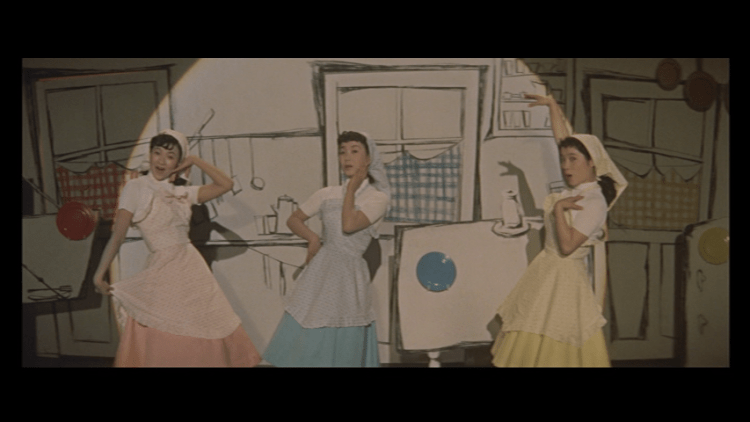
At the beginning of the film the three girls are intrigued and excited to receive a call from their old high school teacher who has recently retired. Meeting up to go visit her, the girls relive some old memories with the help of a few repurposed scenes from So Young, So Bright spliced in plus a few additional bits so that it looks like Izumi was also a classmate with them (in the movie she played an apprentice geisha Chiemi and Hibari met in Kyoto) as well as replacing the actress who played the teacher with the woman we’re about to meet. The trio even sing the title song to the first film, Janken Musume, as they drive over to their teacher’s house.

However, once they get there the nostalgic mood begins to dissipate as they realise their teacher has ulterior motives for inviting them. It seems, now that she’s retired, she’s opened a dating agency and wants to introduce our still single ladies to a few “eligible bachelors”. Horrified, the girls each quickly claim to have serious boyfriends already even though Hibari is the only one actually in a relationship. The teacher seems satisfied but invites them all back beaus in tow to give her final verdict. Thus begins the complicated road to true love for our musically inclined heroines.

It’s been seven years since the last Sannin Musume movie and truth to tell things have moved on the meantime leaving the Hollywood inspired musical glamour looking a little old fashioned. Much of Sannin Yoreba is a nostalgia fest despite the fact that it hasn’t really been all that long. Harking back to the first film by singing the title song and reusing the high school era footage seems primed to pull the similarly aged ladies of the audience back to screens across the country.

Sannin Yoreba has the fewest musical sequences and steers clear of large scale production numbers in favour of smaller solo showcases for the leading ladies. There’s more of a blur here into what are really fantasy sequences again taking place as the girls daydream or worry about various things – Chiemi at her place of work (in the production booth of a TV studio), Izumi in her salon, and Hibari at a bar after having a serious argument with her fiancee (once again played by Akira Takarada). That said, the girls end up at a theatre again as they did in the first two movies where they watch themselves perform a tripartite musical set piece which splits off into individual numbers for each one of them. A kind of Chaplin meets Marx Brothers meets Easter Parade theme, the girls dress up as tramps wandering through Times Square where they spot adverts for various shows which inspire their routines including Madame Butterfly where Chiemi plays both the captain and the geisha, and a bullfighting bolero number with Hibari giving it her full on Zorro.

Once again its an elegantly put together fluff fest intended to showcase the entertaining personalities of the three leading ladies who are now some of the biggest performing stars in post-war Japan. As usual the girls have great chemistry together and make a convincing group of lifelong friends whose relationship transcends that of any potential romance on offer. The movie ends with a wedding and another musical finale which incorporates three all three singers so, as expected, everything works out OK in the end which is mostly what people what from a cosy musical comedy starring three giants of the entertainment world. It may be a little sluggish in places and lacks the absurd comedic touch of the earlier movies, but Sannin Yoreba is a welcome return for the idol supergroup even if this kind of movie was evidently on its way out by the mid 1960s.


This is the last of the Sannin Musume movies  😦

Nothing from the film but here’s a video of the three girls some years later singing one of the songs which crops up throughout the movies:

On Wings of Love (大当り三色娘, Toshio Sugie, 1957)

vlcsnap-2016-06-01-01h48m32s675The Sannin Musume girls are growing up by the time we reach 1957’s On Wings of Love (大当り三色娘, Ooatari Sanshoku Musume). In fact, they each turned 20 this year (which is the age you legally become an adult in Japan), so it’s out with the school girl stuff and in with more grown up concerns, or more specifically marriage. Wings of Love is the third film to star the three Japanese singing stars Hibari Misora, Chiemi Eri, and Izumi Yukimura who come together to form the early idol combo supergroup Sannin Musume. Once again modelled on the classic Hollywood musical, On Wings of Love is the very first Tohoscope film giving the girls even more screen to fill with their by now familiar cute and colourful antics.
On Wings of Love does not have very much going for it in terms of plot (even compared to previous So Young, So Bright and Romantic Daughters). This time the three girls each work as maids in swanky households and have their eyes on the same guy who they think looks like James Dean (again played by Godzilla heartthrob Akira Takarada). Luckily, another two guys pop-up from somewhere so no one gets left on the shelf at the end when the completely non serious romantic difficulties work themselves out in time for the color coded waterskiing finale.

Like the other films in the series, On Wings of Love is not an integrated musical but one which is punctuated by musical numbers either given a real world context or portrayed as a fantasy sequence. In the previous two films the girls all went to the theatre and ended up watching themselves perform in one way or another, but this time the production number excuse is either a nap or a daydream whilst out on the river on a sunny day. Awkwardly, they each fantasise about Akira Takarada. Hibari goes all Madame Butterfly in an elegant sailor themed number, whereas Chiemi’s is all forlorn love with a melancholic, gothic ballad inspired by On London Bridge, but Izumi breaks all protocol here with a riotous cover of Bee-Bop-a-Lula which is sung entirely in English and becomes a high octane dance number (including the less successful involvement of Takarada).

There are fewer musical numbers included in On Wings of Love than in either of the other two movies though there are two trio sequences including the longer opening which sees the girls again color coded and drying dishes together as well as the finale which features the girls waterskiing while their boyfriends drive the boats. Each of the girls gets two numbers each, one solo and one production plus the trio stuff though interestingly there is a more “integrated” love song towards the end and Chiemi’s early song as she walks into town isn’t quite a fantasy sequence either.

Somehow, On Wings of Love isn’t quite as charming as either of the other movies in the series despite the kitch appeal of the opening number. The girls don’t actually spend much time together and the tone is a little rougher than the cutesy approach that had previously dominated with fewer humorous episodes to boot. That isn’t to say the film isn’t successful, but it doesn’t have the same kind of comforting fluffiness that dominated the previous instalments. The switch to Tohoscope gives series director Sugie a different canvas to play with though the most obvious change he makes is a split screen sequence to cover a telephone call. This time the colours appear a little muted too (though this may be down to the quality of the DVD which doesn’t seem as high as the transfers of either So Young, So Bright or Romantic Daughters which are both excellent) limiting the effect of the full on sugar rush the film seems to be aiming for. Nevertheless ,even if it doesn’t live up to the promise of either So Young, So Bright or Romantic Daughters, On Wings of Love is another suitably entertaining outing for the Sannin Musume girls only one a little less filled with laughter and song.


Hibari Misora’s Madame Butterfly inspired routine featuring her song Nagasaki no Cho Cho-san:

Also Izumi Yukimura’s quite wonderful Bee-Bop-A-Lula in its release version:

Romantic Daughters (ロマンス娘, Toshio Sugie, 1956)

vlcsnap-2016-05-30-23h55m41s358Romantic Daughters (ロマンス娘, Romance Musume) is the second big screen outing for the singing star combo known as “sannin musume”. A year on from So Young, So Bright, Hibari Misora, Chiemi Eri, and Izumi Yukimura reunite on screen once again playing three ordinary teenagers with a love of singing and being cheerful through adversity. This time the main thrust of the narrative is the girls’ friendship with a wealthy boy and his grumpy grandpa who takes a liking to them.
Michiru, Rumiko, and Eriko are three ordinary teenage girls in contemporary ‘50s Japan. Very close friends, they even have part time jobs working together at a local department store. One day Michiru decides to return some change a customer forgot to take with him directly to his home and the three girls are rewarded for their extremely high commitment to customer service by getting their pictures in the paper! This brings them to the attention of their friend Kubota’s grandfather who is very impressed with their honesty. He invites them round to his mansion where they enjoy a mini Western style feast and play a few songs on the piano. Shortly after, a man in a bow tie turns up and says he’s managed to find grandpa’s long lost daughter only she has unfortunately passed away leaving a little girl, Yukiko, with no one to look after her. Grandpa isn’t quite convinced by this story, but begins spending time with the sad little girl to try and see if she really could be his granddaughter.

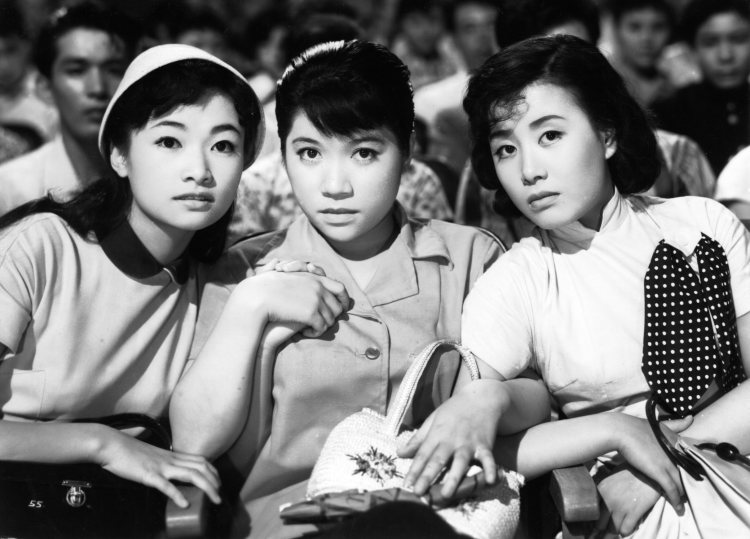
Just like So Young, So Bright, Romantic Daughters is not an integrated musical but an ironic comedy with frequent musical interludes. There are plenty of excuses found for the girls to suddenly start singing, whether it’s that they’re involved in a local festival, entertaining an old man, or trying to cheer up a sullen little girl. Also like the first film, the girls (and Kubota) attend a theatrical performance but this time they do actually see “themselves” – that is Michiru, Rumiko, and Eriko head off to see Izumi, Hibari, and Chiemi. They even sit underneath a large poster of their real life counterparts in the lobby completely confusing one of their admirers who can’t believe his luck! Once again they each get a production number with Izumi getting the “sexy” routine this time which is a little bit On the Town. Chiemi gets an elegant set piece with a ball gown and a fairytale palace behind her, but Hibari’s number is just kind of nuts as she cross dresses to play a male samurai who ends up “saving” Michiru from the attentions of Chiemi who is also playing a guy complete with bald cap and top knot.

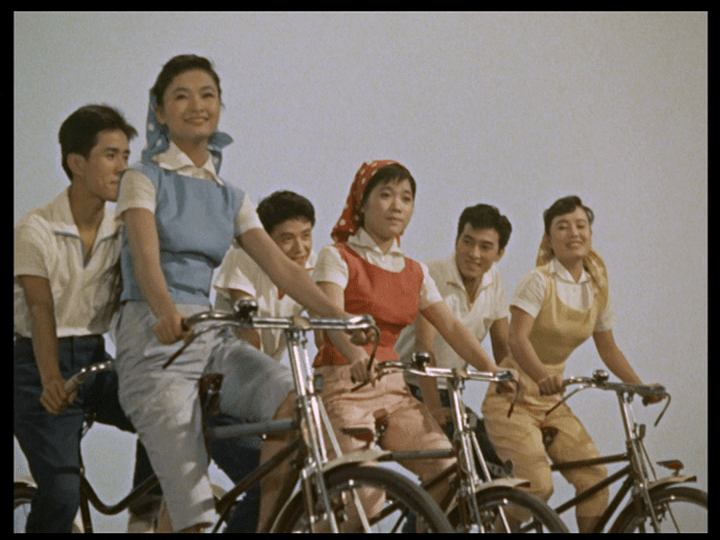
Kubota seems most interested in Rumiko and the other two girls have some kind of relationship with two other guys who work at an amusement park but are completely forgotten about for most of the film until they’re needed to fill the other two rear seats for the finale which is a trio number featuring the three girls riding bicycles with the guys on the back. At one point the girls and Kubota decide to take the little girl to the amusement park to try and cheer her up, which they eventually do by venturing into a haunted house (actually quite scary) where Chiemi decides to break protocol by using some of the judo moves she was seen practicing earlier on a couple of the ghosts and ghouls to be found in the psychedelic horror show.

Once again what’s on offer is cute and fluffy fun with some silly comedy and impressively choreographed production numbers thrown in. Like the first film there are also a number of recurring subplots of single mothers, long lost fathers, and this time also the problem of the little girl who may or may not be the granddaughter but by the time they start to reach a conclusion it may be too late to undo all the bonding that’s begin to occur in any case. Cinematic soul food, Romantic Daughters makes full use of its vibrant Eastman colours for a Hollywood inspired elegant musical feast that is undoubtedly a lot of empty calories but nevertheless extremely satisfying.


Can’t find any clips from the film but here is the English language US pop track sung by Izumi Yukimura in the movie in its release version:

So Young, So Bright (AKA Janken Musume, ジャンケン娘, Toshio Sugie, 1955)

Janken MusumePop stars invading the cinematic realm either for reasons of commerce, vanity, or just simple ambition is hardly a new phenomenon and even continues today with the biggest singers of the era getting to play their own track over the closing credits of the latest tentpole feature. This is even more popular in Japan where idol culture dominates the entertainment world and boy bands boys are often top of the list for any going blockbuster (wisely or otherwise). Cycling back to 1955 when the phenomenon was at its heyday all over the world, So Young, So Bright (ジャンケン娘, Janken Musume) is the first of four so called “three girl” (Sannin Musume) musicals which united the three biggest female singers of the post-war era: Hibari Misora, Chiemi Eri, and Izumi Yukimura for a music infused comedy caper.
As far as plot goes, it’s actually very simple and yet quite complicated at the same time as highschoolers Yumi (Chiemi Eri) and Ruri (Hibari Misora) end up on a school trip to Kyoto where they fall in a river because they’re laughing so much at their classmates’ excitement at spotting someone filming a jidaigeki on the riverbank (neat cameo from director Toshio Sugie). Breaking off from their group, they take their uniforms off to dry only to be disturbed by a young man who tries to take photographs of them at which point they pretend to be washing some clothes in the river. Later they head to an inn which is owned by a friend of Ruri’s mother (who is also an inn owner and former geisha) where they befriend an apprentice geisha, Piyo (Izumi Yukimura).

Piyo then turns up in Tokyo in a bit of a state as it turns out she will shortly be sold into prostitution! She’s fallen in love with someone from the city who she thinks could save her if only she can find him so the girls set out to help her, except the guy’s name is Saito which is the Smith of Japan. During all of this, Ruri also has a subplot about her long lost father who will shortly be moving abroad and apparently wants to actually meet her, opening lots of old wounds.

So Young, So Bright is not a musical in the classical sense, it’s not integrated, but allows ample space for its singing stars to do their thing. Yumi just loves to sing so she randomly starts singing songs she’s heard everywhere, Piyo sings as a geisha and Ruri is rehearsing for some kind of kabuki style performance she gives alone on stage at the climax of the film.

That aside, the main musical sequence comes towards the end where the three girls go to the theatre together and strangely end up seeing “themselves” performing on stage. It’s a neat kind of fantasy sequence in which each of the girls indulges in a little bit of daydreaming as they imagine themselves as stage stars with Piyo being given the cutest, most MGM style number which is then followed by a number from Yumi entitled “Africa” which is very much of its time…and then you get the elegant number from Ruri which is mostly the English version of La Vie en Rose. They also get a trio number to close the film which takes place entirely on a rollercoaster but celebrates each of their slightly different singing styles.

So Young, So Bright is not intended to be anything other than irrepressibly cheerful fluff (despite containing a subplot about possible forced prostitution), but succeeds in being exactly that. An early colour film from Japan it certainly makes fantastic use of its technicolour swirl to give Hollywood a run for its money in the sophistication of happiness stakes. Hollywood musicals are quite clearly the biggest influence though perhaps more those from the pre-war era even down to the only large scale dance sequence which has a distinct Busby Berkley vibe (even it only lasts twenty seconds or so). The rest of the film is actually quite light on dance but makes sure to showcase the singing talents of each of its leading ladies equally. Strangely innocent, even if darkness lurks around the edges with the betrayed geisha and possible prostitution subplots, So Young, So Bright lives up to its name as a completely charming musical comedy that is perfectly primed to banish even the bluest of blues far into the distance.


These movies are so much fun! No subtitles but here are some clips of the various musical numbers:

Izumi Yukimura’s Cha Cha number:

Chiemi Eri’s Africa number (not very PC by modern standards, just a warning)

Hibari Misora’s take on the English language version of La Vie en Rose

And the finale:

Hospitalité (歓待, Koji Fukada, 2010)

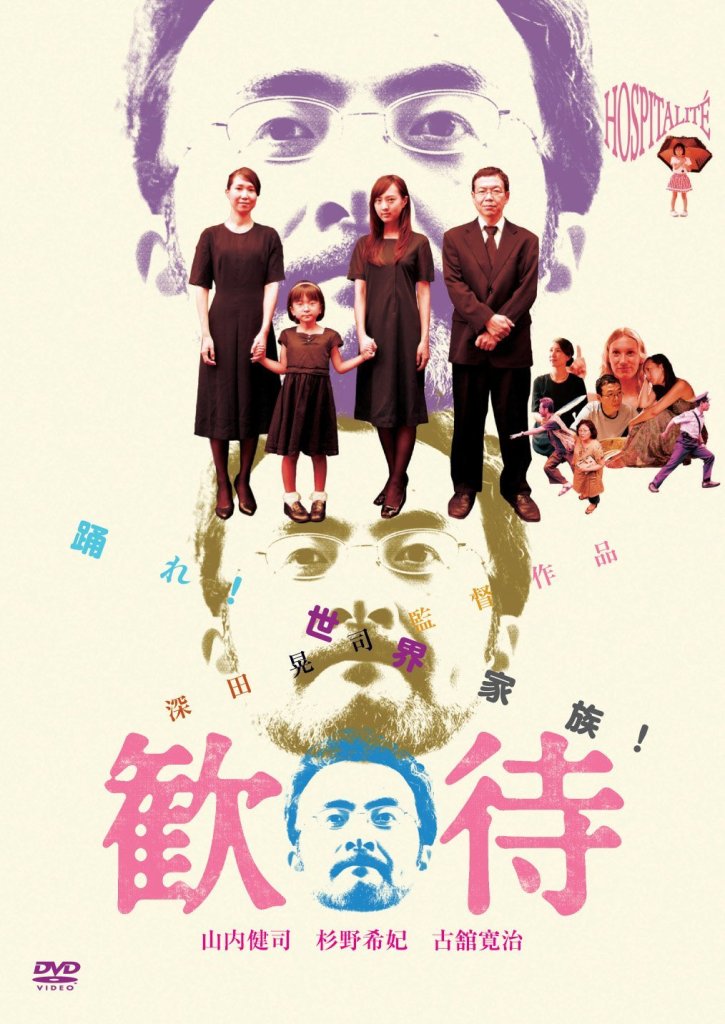
hospitaliteFrom the Ozu-esque, classic calligraphy of its elegant title sequence, you might expecting a rather different kind of family drama than the one you find in Koji Fukada’s Hospitalité (歓待, Kantai). Though his compositions lean more towards the conventional, Fukada aims somewhere between a more restrained The Family Game and a much less explosive Theorem as he uses the family as a microcosmic analogy for his country’s attitudes towards “outside intrusion”. An absurdist tale of dysfunctional families and hypocritical social standards, Hospitalité takes a long hard look at whom exactly you regard as “guest” and how much you’re really prepared to take care of them.
The Kobayashis run a small printers shop in a rundown suburban backwater. Son Mikio has inherited the business and lives above it with his second wife, Natsuki, and his daughter from a previous marriage, Eriko. Older sister Seiko has recently moved back in following a divorce though she also has a vague idea of wanting to study abroad. Things start to go haywire when little Eriko’s pet parakeet absconds from the family home. Heartbroken, she designs a special flyer to try and find it which brings them to the attention of “old friend” Kagawa who claims to have seen the bird somewhere near the station.

Kagawa hangs round a little longer than necessary chatting to the couple when their assistant suddenly keels over. This allows a convenient opening for Kagawa to volunteer his services at the print shop – luckily he knows how to handle the machines. He quickly moves into their spare upstairs room before also moving in his “foreign wife”, Annabelle, and a bunch of other non-Japanese people by which time he’s well and truly wrested control of the mini printshop empire away from the mild mannered Mikio and caused a degree of local panic in the process.

The Kobayashis are “hospitable” people. To begin with they don’t mind having this “old friend” hanging around and helping him out by letting him stay and work in the shop. When he suddenly introduces his wife without warning they may feel he’s taking advantage but anyway they go along with it. Annabelle, from “Brazil”, or was it “Bosnia”, gives the impression of someone who is always pretending their language skills aren’t as good as they really are so people let their guard down around her. She teaches “salsa”, apparently, and starts to get on Natsuki’s nerves by usurping her position as resident English speaker.

The town itself is not quite as charitable as the Kobayashis as evidenced by the older lady who keeps dropping by with petitions for the neighbourhood watch to which she’d also like to recruit the ladies of the house. She’s worried about the increasing number of “foreigners” in the area which she now feels is becoming “dangerous” as a consequence. That’s not to mention the proposed “beautification” plan for the park (which really means getting rid of all those people who sleep there in cardboard boxes). That said, though neither of the women is particularly interested in joining the neighbourhood watch or against the idea of non-Japanese people coming to live in their town, they go along with the woman and her plans not to rock the boat. They run a business here after all so they have an interest in keeping the town stable and in maintaining good social relations with their neighbours, so it makes sense to just put up with whatever bigoted nonsense they’re spouting, right?

For all their “lascivious dancing”, topless sunbathing, and “promiscuous immorality”…the foreigners are quite clearly not as much of a problem as the underlying hypocrisy which runs through the Kobayashis’ world. When Kagawa asks about Mikio’s previous wife, he says “she got sick” leading him to think Mikio is a widower which isn’t quite true but is a less embarrassing for explanation for Mikio to offer than what really happened. There’s an obvious tension between Mikio and Natsuki as well as with the recently returned older sister. As soon as Kagawa begins to work his magic, driving a pneumatic drill right into all of those tiny cracks and fractures which exist between a husband and a wife, everything begins to fall apart though in an equally quiet and subtle fashion. However, people have need of their fantasies and even after Kagawa has exposed the holes in their marriage, Mikio and Natsuki seem content to simply paper over their differences and go back to pretending everything’s fine just like before.

A surrealist’s meditation on xenophobia, social mores, and what happens when a caged bird decides to be free, Hospitalité is a suitably nuanced, not to mention frequently amusing, look at contemporary small town mentality. Everyone is so invested in maintaining a particular quality of personal truth, be it in a hospitable place which thinks the answer to people cluttering up the park with their cardboard boxes is to “beautify” the area by throwing them out, or a neighbourhood watch group that’s all egos with a local place for local people mentality, that maintaining the lies is much more important than solving the underlying problem. Koji Fukada’s farcical approach to the absurdity of everyday life is a good natured and humorous one, but the problems at its core are all too real.


Hospitalité was released on DVD in the US by Filmmovement and still appears to be in print though the distributor’s website is constant 403.

English subtitled trailer:

Together (和你在一起, Chen Kaige, 2002)

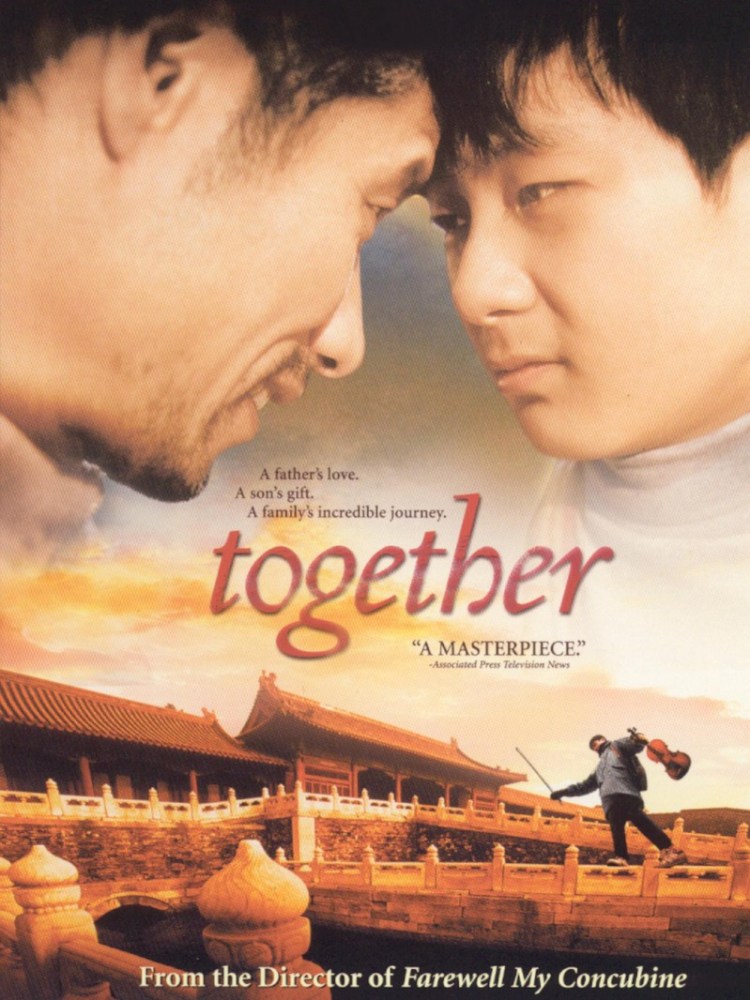
together engIt’s a sad truth, but talent isn’t enough to see you succeed in the wider world. In fact, all having talent means is that unscrupulous people will seek to harness themselves to you in the hope of achieving the kind of success which they are incapable of obtaining for themselves. 13 year old Xiaochun is about a learn a series of difficult life lessons in Chen Kaige’s Together (和你在一起, Hé nǐ zài yīqǐ), not least of them what true fatherhood means and whether the pursuit of fame and fortune is worth sacrificing the very passion that brought you success in the first place.

Xiaochun lives with his father Liu Cheng in a small rural town where he is known for his prowess with the fiddle. In fact, he even gets called in to play some calming violin music at the birth of a local bigwig’s child. After a little boy emerges safely into the world, the bigwig tries to give Liu some money which he refuses but Xiaochun later takes. The big wig congratulates Xiaochun on his understanding of how the world works, unlike his honest and sentimental father.

However, what Liu wants for his son is success so he takes the boy to the big city and enters him in a violin contest. He comes fifth but the contest is rigged in favour of donors to the school and no one wants to take on a poor country bumpkin for a pupil. Eventually Liu convinces an eccentric, lonely professor, Jiang, to give Xiaochun lessons and the pair start to build up a paternal relationship. Xiaochun also makes friends with the beautiful but equally eccentric woman from upstairs, Lili, while his father tries to find work to pay for all these lessons. Eventually Liu ends up at a swanky recital and tries to get Xiaochun to switch to the more successful professor Yu who’s all cold calculation and designer sweaters. This sudden bid for mainstream success drives a wedge between father and son who have very different ideas of what it means to be a “successful” person.

Together isn’t quite the film it seems to set out to be. You’d expect professor Jiang’s broken heart to take more of a centre stage but no sooner have we invested our time in Jiang’s back story of tragic romance than Xiaochun is swept away to the corporate music factory that is Yu’s upscale apartment. We’ve already seen how money and status are everything in this game, donate big bucks to the school and your kid gets the shiny trophy regardless of their actual talent. A depressingly realistic scene right after the contest sees Jiang trying to give a lesson to a clearly disinterested boy while his trashily dressed mother yells at someone on a blinged up cellphone from the other room. When the pair angrily declare they won’t be coming back, the boy is strangely grateful to Jian for “letting him quit” this annoying hobby that his mum obviously made him practice as a kind of status symbol despite the fact he has no ear for music.

Liu is just too bumpkinish for Beijing life, he’s simple and honest which are not good qualities to have in a big city. He insists on wearing a big red hat all the time which screams “not local”, and he even keeps his money in it so, of course, it gets stolen. That said, it’s Liu who wants his son to have the big bucks and a secure life of the kind that Yu can offer him. He sincerely wants this for Xiaochun and is prepared to get out of his way if necessary. Jiang wanted to teach him music and would have done it for free. Yu wants to use him to bolster his own success and is prepared to manipulate him in extremely cruel ways in order to get what he wants out of him. Tellingly, Yu already had a prize pupil living his apartment who is now forced to compete with Xiaochun for Yu’s attention. Now there’s a better prospect on the table, she is being abandoned despite a host of promises and all her hard work. Yu is a businessman, Jiang is an artist.

Now the boy has to choose between three fathers and three futures as he considers just giving up and going home with his father, giving in to Yu’s corporate demands and losing the love he had for playing his instrument in a simple and heartfelt way, or following Jiang’s teachings which, ironically, are all about following the heart. After an extremely late and cruelly presented revelation, Xiaochun has even more to think about with this question but ultimately what matters is heart more than money as a hand knitted sweater proves warmer than an expensive fur coat.

Together has a number of structural problems that frustrate its passage either as a Hollywood influenced feel good tale of a poor boy and his violin or a gritty indie movie about how talent doesn’t matter in a world ruled by social status and reputation (which is sort of like a futures market in an odd way, everyone buying into something which doesn’t quite exist). Liu and Xiaochun meet a lot of nice “salt of the Earth” people in the big city (except for Yu) but are perpetually locked out of the next stage of the game through not having the right connections. Liu, in his simple and honest way, doesn’t understand this so he’s able to pressure right through it but his son who is more pure hearted but also practical finds navigating its series of traps and temptations endlessly confusing. Edging into sentimentality in the final third, Chen can’t quite bring his sonata to the crescendo he seems to be aiming for but still finishes with a warmly received round of applause.


Together was released in the UK by Momentum under the title Together with You (presumably to avoid confusion with Lukas Moodyson’s film of the same title released not long before) which is a more literal, if slightly awkward, translation of the original Chinese. The disc itself and menu screen both remain “Together”. The UK disc may be technically OOP but the film is also available in the US from MGM.

Failan (파이란, Song Hae-sung, 2001)

FailanSometimes God’s comic timing is impeccable. You might hear it said that love transcends death, becomes an eternal force all of its own, but the “love story”, if you can call it that, of the two characters at the centre of Song Hae-sung’s Failan (파이란, Pairan), who, by the way, never actually meet, occurs entirely in the wrong order. It’s one thing to fall in love in a whirlwind only to have that love cruelly snatched away by death what feels like only moments later, but to fall in love with a woman already dead? Fate can be a cruel master.
The titular Failan (Cecilia Cheung) is a migrant from mainland China who’s travelled to Korea in search of her last remaining relatives following the death of her family. Unfortunately, they moved abroad some time ago and no one knows how to contact them. Stuck in Korea, Failan is running out of options but a “kindly” woman suggests a phoney visa marriage so she can legally stay in the country and earn her keep at the same time.

So, she ends up married to the feckless petty gangster-cum-video-store-proprietor Kang-jae (Choi Min-sik). We meet him around a year later and it’s his story we follow for the first half of the film as he gets out of jail after being arrested for selling adult videos to horny teenagers. Kang-jae quickly gets into an argument with his gangster boss, Young-sik (Son Byung-ho), but as they’re also old friends they patch things up over a drink only for the evening to go way south when Young-sik spots a rival gang member and ends up beating him to a bloody pulp whilst in a trance-like rage.

Young-sik is young and ambitious so when the crime is discovered he pleads with Kang-jae to take the rap for him, promising that he’ll buy him that fishing boat he’s always wanted so he can go back to his home town when he gets out. Kang-jae goes home to think it over and gets a knock on the door, two policemen are standing outside only they haven’t come to arrest him – the wife he’d forgotten all about has died. Kang-jae has hit a fork in the road both literal and metaphorical and takes a road trip with his best friend to finally meet his bride in a cold and lonely place.

Failan is almost a plot device in the film that bears her name, but her story is a sad and a hard one. Orphaned and alone she finds scant kindness in her adopted country but the woman who runs the laundry where she ends up working does at least develop an almost maternal feeling for her. Failan feels great gratitude to Kang-jae for agreeing to marry her so she could stay in Korea and is convinced he must be a very good, very kind person. She thinks this largely because she never meets him.

Kang-jae is rubbish at being a gangster. Young-Sik may have a point when he says he doesn’t have the heart for it. Early on, some of the youngsters try and rope him into an extortion scheme where they’re trying to get an old granny to pay back some of her loan. Apparently the granny had once been kind to Kang-jae when he was young and hungry so he doesn’t really put a lot of effort into being menacing towards her which makes him lose face with the young toughs who think of him as a joke anyway. Reading Failan’s letter, it’s the first time that anyone has ever said anything nice about him. The first woman who ever thought he was worth anything at all and she’s already lost to him before he even knew her.

Kang-jae is not a good man, he’s an underling just muddling through without thinking. He leaps from one thing to another always thrashing around landing where falls. He has a vague ambition to get the money together to buy a fishing boat and go home, but he’s not seriously pursing it. Even the group of gangsters he’s involved with are so laughably low rent that they can’t hold on to their completely worthless territory and have to put pressure on old ladies just to get by. After reading Failan’s letter and hearing that someone believed he was better than this, Kang-jae finally wakes up and starts thinking about his life with the ultimate realisation that he doesn’t have to live like this. Unfortunately, he might have just picked the wrong day to start living the rest of his life.

In many ways Failan is a typical melodrama filled with the pain of unrealised love and Fate’s ironic sense of timing. Based on a novel by the modern Japanese master of the tearjerker Jiro Asada (Poppoya), Failan seems engineered to rend hearts with its tale of true love frustrated by time and circumstance where every ounce of hope and goodness is well and truly trodden into the ground by the time the credits roll. Nevertheless, Song keeps things on the right side of schmaltzy, never racking up the misery and heartbreak beyond the threshold of plausibility. Like all the best melodramas, Failan’s sentimentality is sincere and, ultimately, moving. Another sad story of salvation arriving too late, Failan’s tale of tragic, unrealised love is an all too familiar one but effectively told it can’t fail to tear the heart.


You can currently stream Failan via Amazon Video in the US courtesy of Asian Crush, but the Korean R3 DVD and Region A blu-ray both contain English subtitles!

Unsubbed trailer:

Ornamental Hairpin (簪, Hiroshi Shimizu, 1941)

ornamental hair pinShimizu goes on holiday! Again! Actually, when you think about it going on holiday is always inherently sad because just like everything else holidays end and you have to return to whatever it was that made you want to go on holiday in the place only with the painful reminder that a more cheerful world exists and you’re no longer in it. That rather depressing preamble out of the way, it’s time to join the temporary residents of a small hot springs resort in the picturesque countryside where a mislaid hairpin is about to kickstart a series of mini epiphanies in the diverse collection of guests.
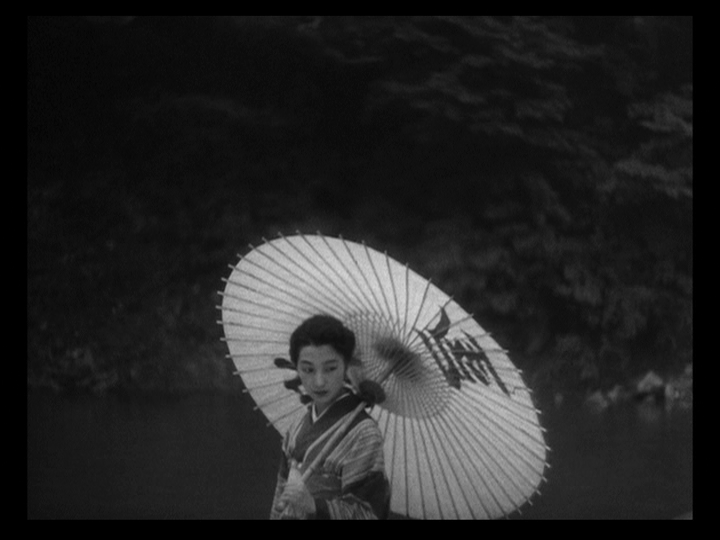
We arrive at the inn in the company of Emi (Kinuyo Tanaka) and her friend Okiku (Hiroko Kawasaki) on a brief visit from the city. The inn is very full right now with a festival in town and everybody seems to want a massage! Another guest, the extremely grumpy professor Katae (Tatsuo Saito), is put out that the tour groups are sapping all the hotel’s resources and complains vociferously to his go partner who is staying at the inn with his two grandsons Jiro and Taro. Other guests at the inn include a mild mannered husband and his wife, Mr. (Shinichi Himori) and Mrs. (Hideko Mimura) Hiroyasu, and a recuperating soldier, Mr. Nanmura  (Chishu Ryu). Eventually the tour groups go home taking Emi and Okiku with them, but Emi discovers she’s left her ornamental hairpin behind and sends a letter offering to pay for the return postage if anyone should find it.

Mr. Nanmura finds it in his foot one day as he’s enjoying the hot springs and even though he’s not that bothered about it, complaining expert Professor Katae can’t make enough of a fuss about the supposedly shoddy conditions at the hotel. When the hotel owners write to Emi and explain to her what’s happened she jumps straight on a train to apologise in person.

Nanmura had actually been quite happy about getting skewered by the pin. He says he found it “poetic”, as if the atmosphere of the place had penetrated deeply into his skin. The supposedly learned Katae doesn’t quite understand the soldier’s poetic leanings and starts debating whether the owner of the pin will be pretty or not, as if that would make a difference to the soldier’s romantic construction of events. Emi is indeed very beautiful, through perhaps a little sad and obviously contrite about the pin. Everyone in the inn is quite invested in witnessing a true love miracle between the bizarrely crippled soldier and the wounded beauty from Tokyo.

Once again the inn is a constructed world, a safe haven far away from the trouble and strife which exists outside it. The guests indulge themselves in the tranquil atmosphere taking in the beautiful scenery and killing time on otherwise trivial pursuits which occasionally include projecting a kind of narrative on their new found friends. The two boys, totally bored by this deliberately unstimulating environment, turn everything into a competition – even cheering on their grandfather as snores along side the equally noisy professor with the result that pretty much no one else is getting any sleep. Later they help the injured soldier recover with a set of endurance games which see him trying to walk unaided from one tree to another and eventually across a bridge.

Further comic relief is provided by the Hiroyasus with the husband being the sort of mild-mannered man who has no idea what he actually thinks so he just goes along with everything everyone says (and later checks with his wife who has the ultimate authority). Hiroyasu often defers to the professor whose authoritative tone gets things done for him though he is in fact an extremely self centred prig who just loves to complain out of a desperate need to be validated. He’s the loudest snorer of all and is keeping everyone awake yet he constantly complains about the noise of the other guests and is quick to shout at the inn keeper when he can’t get a massage because they’ve been booked by the visiting tour groups the very presence of which also annoys him. Eventually he gets so grumpy he just goes home which is probably a win/win for everyone.

But what of Emi herself? She too is escaping from something. The loss of the ornamental hair pin and its rediscovery leading her to the inn and perhaps to Nanmura has pushed her into a further consideration of her life in Tokyo. She doesn’t want to go back, this brief respite has been too pleasant and she wishes it could go on like this forever, though she knows, of course, that it can’t. She doesn’t know what she’s going to do now, but at least while she stops at the inn the sun will light the way. This is 1941, Nanmura will probably be going back to the war, the future is uncertain for everyone, but in here everything is beautiful, calm, safe. It’s just a shame it can’t last.


Ornamental Hairpin (簪, Kanzashi) is the fourth and final film in Criterion’s Eclipse Series 15: Travels with Hiroshi Shimizu box set.

Clip of one of Nanmura’s “trials” (no subtitles):

The Masseurs and a Woman (按摩と女, Hiroshi Shimizu, 1938)

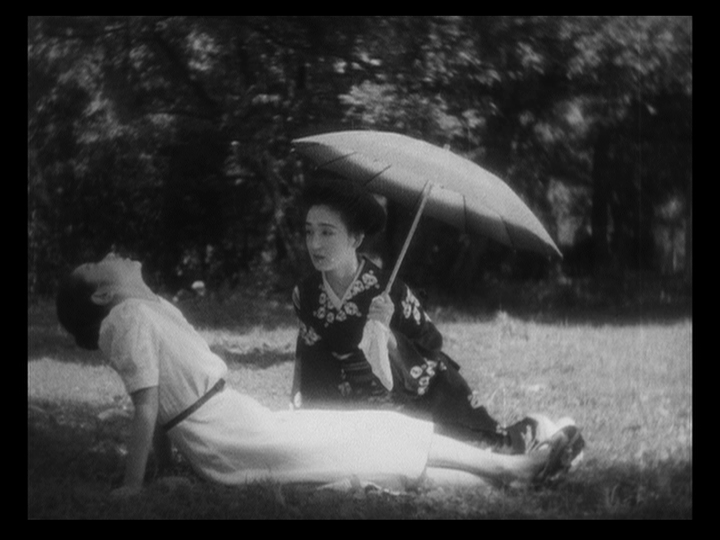
vlcsnap-2016-05-19-23h22m51s149Hiroshi Shimizu takes another relaxing sojourn in 1938’s The Masseurs and a Woman (按摩と女, Anma to Onna), this time in a small mountain resort populated by runaways and bullish student hikers. Once again Shimizu follows an atypical narrative structure which begins with the two blind masseurs of the title and the elegant lady from Tokyo but quickly broadens out to investigate the transient hotel environment with even a little crime based intrigue added to the mix.

We arrive at the resort town at the same time as the masseurs themselves who’ve walked all the way passing the time playing games with each other over who can guess how many children are in a group travelling the same way or counting how many people they manage to overtake on the road. Comically, their efforts to pass a group of students actually frighten them a little bit so they take off at speed meaning Fuku and Toku miss their daily target.

As well as the group of male students and another group of female ones, the town is also host to a mysterious and beautiful woman from Tokyo who seems both a little sad and a little scared with a tendency to overreact to small sounds and unusual situations. The other main group is a little boy and his uncle with whom he seems to have something of a troubled relationship.

Toku becomes fascinated with Michiho, the mysterious woman from Tokyo, whom he recognises because of her distinctive perfume. Though he is blind, he “watches” her – sensing where she goes and reading her emotional state. He seems to realise there’s very little possibility that she will return his interest, though he allows her to play on the obvious feelings he has for her, and the pair strike up a melancholic friendship. However, Michiho is only interested in making a play for the good looking uncle of the little boy who she has also befriended but the boy eventually goes cold on her, feeling a little rejected because she spends so long talking to his uncle. The two neglected guys, Toku and the boy, form their own kind of friendship as the blind masseur is the only person who is willing to have some fun with him in this slightly less than child friendly resort in which he’s unspeakably bored.

This being a holiday town, it’s a place that only exists for a small amount of time before sinking back into the mists like Brigadoon when the season ends. All things are transient here and everyone is just passing through. The friends you make are just for now and this brief respite from everyday life will fade from the memory like a pleasant dream. Toku ought to know this as he spends his life in such places, providing additional relief for the weary traveller, yet he still has a yearning to connect which is only exacerbated by the feeling that his blindness cuts him off from everyday society.

When a spate of bath house thefts occur and it turns out Michiho has been seen at each of the crime scenes, Toku comes to the obvious conclusion even though his feelings make him reluctant to suspect her. He tries to help Michiho evade punishment for what he believes are her crimes only to find out a very different sort of truth that sees her eventually decide to continue her journey onward to an uncertain future (though at least one that is 100% of her own devising).

Again, Shimizu opts for a lot of location shooting emphasising the beauty of the scenery and the tranquility of the atmosphere. Mostly he sticks to static camera shots, aside from one lengthly tracking sequence and the hand held finale walking after a departing cart, but when he tries to show us the vision of a blind man it’s a striking moment – a whirling chaos where we too can almost smell the elusive perfume of a woman we know is “beautiful”  though we cannot see her, and also know is deliberately toying with us. A melancholy look at the transience of human relationships and the impossibility of true connection, The Masseurs and a Woman is a genre melding tragicomedy filled with innovative directorial flourishes that are once again far in advance of their time.


The Masseurs and a Woman is the third of four films in Criterion’s Eclipse Series 15: Travels with Hiroshi Shimizu box set.

This is the only video clip I can find but it’s not subtitled and it has quite a long speech about Hiroshi Shimizu’s career at the beginning so skip to 2:17 for the film itself: