The Silent Forest (無聲, Ko Chen-Nien, 2020)


There can be no justice in silence, but when those in a position to help refuse to listen what can be done? Inspired by true events, Ko Chen-Nien’s The Silent Forest (無聲, Wúshēng) takes aim at cycles of abuse and systems of oppression in society at large through a thorough investigation of the culture of silence at a school for deaf children in which endemic bullying spreads like a virus emanating from a single trauma inflicted by a negligent authority. Yet this kind of violence cannot be fought with violence and there must be empathy too for the bully or the chain will never end as Ko’s ambivalent conclusion makes clear. 

The film opens with a boy on the run, finally chasing down an old man and tackling him to the ground pummelling him until the police turn up and separate them. The policemen are frustrated. This is apparently the first time they’ve ever come into contact with a deaf person and have no idea how to communicate with him. Chang Cheng (Troy Liu Tzu-Chuan) tries to protest their injustice, but they continue to treat him as aggressor rather than victim even as he explains in writing that the old man had stolen his wallet (the old man claims he “found” it and was planning to hand it in). Finally a teacher from his new school, Mr. Wang (Liu Kuan-ting), turns up and interprets but it quickly becomes clear that he too is in a sense complicit, reporting that Cheng is sorry for what he did and grateful to the officers. In his view at least, the boy has his wallet back and there’s no harm done so why make a fuss? Just let it go and everyone goes home.

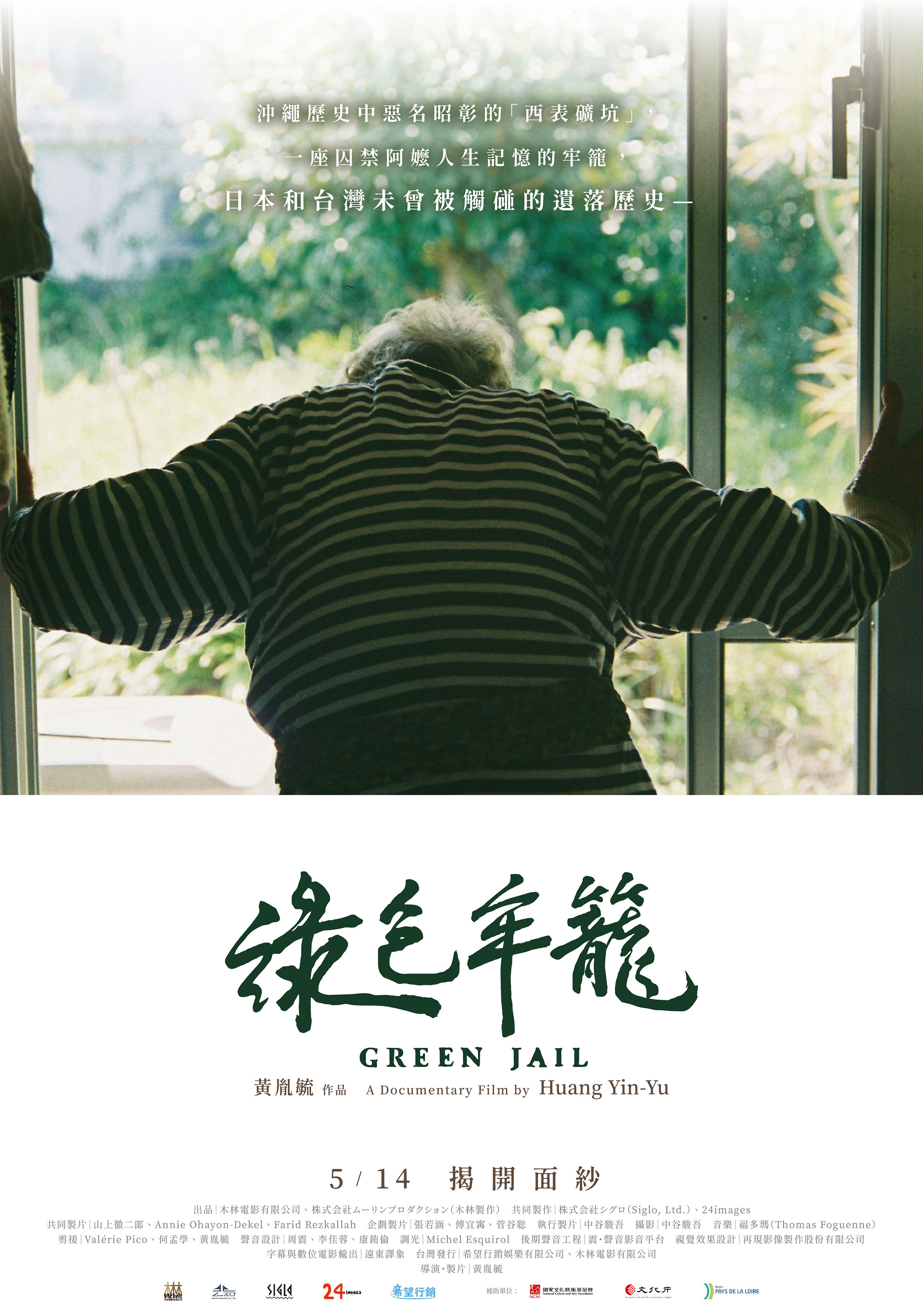
It’s this conflict between “silence” and justice that continues to prey upon Cheng’s mind after he starts at the school and becomes aware of the widespread culture of bullying witnessing a girl he likes being sexually abused by a gang of boys at the back of the school bus while the teacher sitting at the front does nothing. He tries to convince the girl, Beibei (Buffy Chen Yan-Fei), to tell one of the other teachers but she refuses, not wanting to “betray” her “friends”, insisting they were “just playing around”. Her reluctance however mainly stems from an intense fear of being sent away, that she might have to leave the school which is the only place she feels accepted. Both she and Cheng feel intensely othered in the hearing world, wary of being blamed for things that weren’t their fault as if their very existence were bothersome or “abnormal”. Even if it means putting up with extreme degradation, she would prefer it to the loneliness she felt before she found the school.

Yet the sense of social isolation is only one of the various oppressions to be found at the institution which ironically cultivates a culture of silence as regards the ongoing abuse as a means of preserving its reputation and therefore the “greater good” in providing the “safe space” from the social stigma the children face in the hearing world. Beibei points out that she was screaming, yet nobody could hear her. At first she tried to tell a teacher, but the teacher blamed it on her and implicitly on her disability insisting that the boys were “good kids” who were “just playing around” and didn’t understand she didn’t like it because she failed to communicate that she was uncomfortable. If they knew she was suffering they’d have stopped, the teacher insists before coldly walking away. Mr. Wang feels quite differently and wants to help but discovers that the culture of silence extends much deeper than he thought and the problem most likely cannot be solved through a few simple countermeasures but requires whole-scale systemic reform.

In fact, very little is done by the authorities leaving Chang Cheng with a hero complex believing that he has to be strong to beat the bad guys and save Beibei, but his righteous desire still leads him back towards complicity in order to protect her. The arch antagonist, Xiao Guang (Kim Hyun-Bin), bullies as a defence mechanism insisting that no one would dare bully him, manipulating others to do his bidding through the same mentality that one can either be a bully or a victim. Yet Xiao Guang is also a victim himself, a wounded damaged boy let down by a culture ruled by shame and unable to defend himself by any other means though apparently uniquely vulnerable to one particular aggressor. Only by addressing the root of his trauma can the cycle be brought to an end, but the concurrent cycles which he set in motion will in turn require their own resolution. A painful allegory, The Silent Forest boldly makes the case for speaking out but also admits that it doesn’t matter how loud you shout if no one is listening and without the desire for empathy and communication in all its forms the cycles will grow and repeat until the end of time.


The Silent Forest streams in Illinois until March 21 as part of the 12th season of Asian Pop-Up Cinema.

Original trailer (English subtitles)
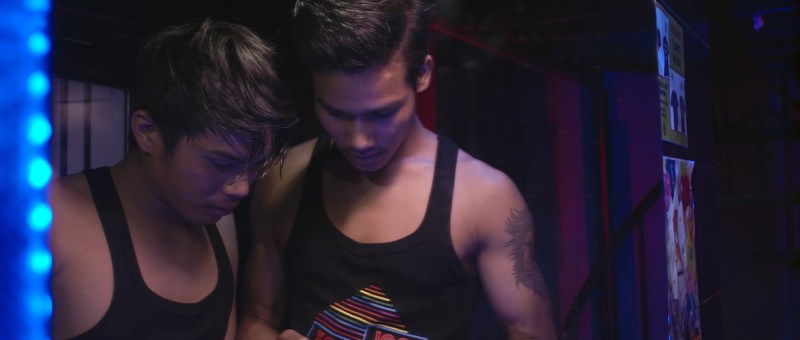
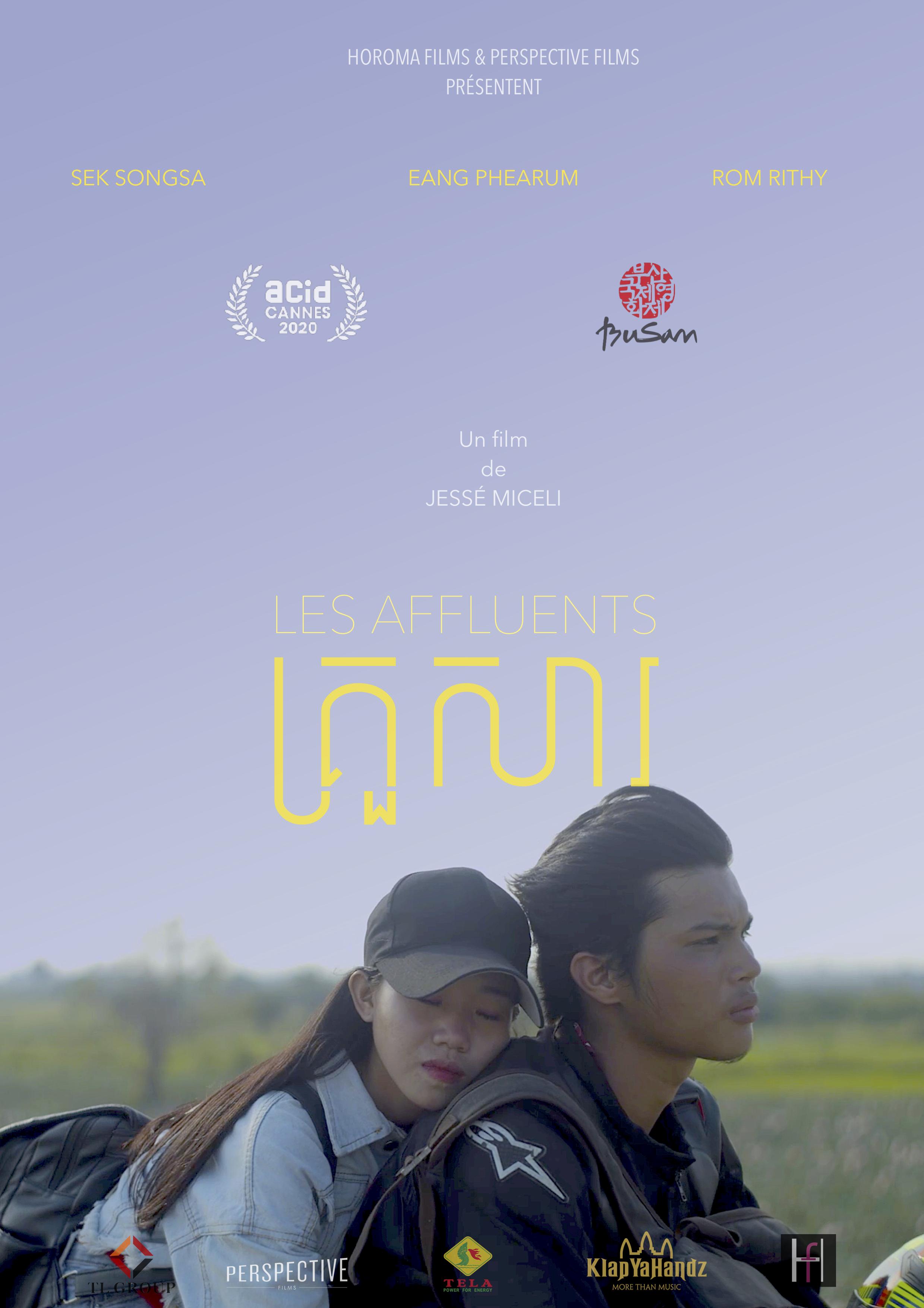
Coalesce (Les affluents, Jessé Miceli, 2020)

The frustrated dreams of three young men eventually collide in Jessé Miceli’s aptly titled debut Coalesce (Les affluents). Starring mainly non-professional actors, Miceli’s neon-lit journey through the backstreets of Phnom Penh at night exposes a different side of a changing nation caught in the midst of rising urbanisation while contending with the aspirations both of neighbouring economic powers and a thriving ex-pat community. Yet in the end the prognosis is not as bleak as it first seems, some dreams are achieved, if imperfectly, while even those which are not still may be. 

The youngest of the three men, teenager Songsa (Sek Songsa), says almost nothing and if he has a dream it is perhaps only to live his own life as he pleases. 20-year-old Thy (Rom Rithy), meanwhile, yearns for a motorcycle and, apparently disowned by his father who prefers his half-brother, has taken a job as a host/dancer in a gay bar frequented mainly by Western men. 24-year old Phearum (Eang Phearum) borrowed money to buy a taxi to earn money for his family who are in danger of losing their land but is privately preoccupied and perhaps defeated by the news that his schoolteacher wife is expecting a baby. 

Each of the men ultimately find themselves in Phnom Penh in search of different things but discovering something much the same. The contrast with the rural homes of Songsa and Phearum couldn’t be more stark even if quite literally presented in day and night. Songsa, it seems, did not perhaps want to go to the city and especially to sell knock off jeans from a disused taxi bus at the behest of his frustrated tuktuk driver uncle, but in any case the responsibility proves too much for him and he’s clearly not ready for the adult world his uncle and the owner of the bus, Leap, already inhabit. He resents their drinking and rebuffs their attempts to force him to join them, but alone on the bus at night finds himself subject to another element of city darkness as a drunken middle-aged man crawls in through the window and attempts to grope him. His only solace is discovered when he wanders off and stumbles into a death metal rave, head banging his frustrations away. 

Across town, Phearum is at another party in an upscale gallery invited by two, fairly obnoxious, Western women who climbed into his cab not long after he dropped his wife off at a doctor’s clinic for a potentially dangerous medical procedure. Already drunk, the women insult and belittle Phearum in English while one eventually tries to proposition him, offering money when he turns her down. Phearum doesn’t take it but appears to accept the situation with good humour and bemusement. Thy, meanwhile, eventually turns to casual sex work to pay for a bike an injured friend of a friend needs to sell. It’s not clear if Thy is actually attracted to men even if not exclusively, later taking a girl home after a bike ride through the country, or merely in need of well-paying work but it’s difficult to dismiss the implications of exploitation at the American-run club which seems to cater almost exclusively to Westerners exoticising the young, good looking Cambodian staff who earn a dollar’s commission on every drink sold. 

Then again, Phearum’s dream is to give up his taxi and open a garage selling cars to the influx of Chinese businessmen driving the expansion of the local economy largely through casinos and other leisure facilities supported by the tourist trade. He listens intently to an estate agent in the back of his cab who works for Chinese developers, keenly asking about the price of land perhaps weighing up selling rather than buying. The aspirations of the three men are eventually headed for an ironic collision, though the “one year later” conclusion perhaps seems unduly contrived filled as it is with exposition and the conceit that former strangers have become lifelong friends through a single, traumatic episode. Nevertheless, there is more hope than expected in Miceli’s vision even if tempered by compromise as the trio remain determined to push forward having identified their direction of travel, reclaiming the city as their own while also looking out for each other in what appears to be an often hostile environment. 


Coalesce streams in the US until March 21 as part of the 12th season of Asian Pop-Up Cinema.

Original trailer (English subtitles)
The Asian Angel (アジアの天使, Yuya Ishii, 2021)

A collection of lonely souls is brought together by angelic intervention in Yuya Ishii’s grief-stricken appeal for “mutual understanding”, The Asian Angel (アジアの天使, Asia no Tenshi). Brokering the sometimes difficult subject of Japan-Korea relations, Ishii makes a plaintive case for a pan-Asian family while his wounded protagonists each search for meaning and possibility in the wake of heartbreak and disappointment. Yet what they discover is less the urge to move forward than the gentle power of solidarity, bonding in shared sense of displacement and forging a new home from an apparently fated connection. 

Displacement is a feeling which immediately hits struggling author Tsuyoshi (Sosuke Ikematsu) as he struggles to make himself understood to a grumpy Seoul taxi driver after taking his brother up on an offer to relocate to Korea with his young son following the death of his wife some time previously. Toru (Joe Odagiri), however, has not quite been honest about his life in the Korean capital, housed above a church where they always seem to be rehearsing the hymn Angels We Have Heard on High. Wandering into the apartment, Tsuyoshi is physically thrown out by Toru’s grumpy business partner (Park Jung-bum) obviously unaware they were coming as even Toru himself seems to have forgotten inviting them. In any case, the trio eventually find themselves on the street after Toru’s Korean friend with whom he’d started an illicit business smuggling cosmetics betrays them. 

Meanwhile, across town melancholy songstress Sol (Choi Moon) has been supporting her brother and sister with her music career which seems to be on the slide with a faintly humiliating gig in a shopping mall which briefly brings her into contact with Tsuyoshi, apparently captivated by her sadness. Abruptly informed her contract has been terminated, she tries to take the matter up with her manager/lover but gradually realises she’s merely one of several ladies on his books. Feeling lost, she agrees to follow up on a suggestion from her brother Jun-woo (Kim Min-jae) to pay a visit to the grave of their parents who passed away while she was only a child. 

Running into each other on the train after Toru talks Tsuyoshi into a possible seaweed venture in Gangwon, the two trios end up travelling together if originally struggling to find the “mutual understanding” that Tsuyoshi had been looking for. The first message Tsuyoshi sees on his phone on after arriving informs him that Korean-Japanese relations are at an all time low, though perhaps one would think national tension might not descend to the interpersonal level even if he appears to feel slightly awkward as a Japanese man in Korea aside from his inability to speak the language, but after a few too many drinks at a Chinese restaurant Jun-woo starts in on how 69.4% percent of Koreans apparently disapprove of Japan while 61% of Japanese apparently disapprove of Korea which is one reason he wouldn’t be keen on his sisters dating a Japanese guy. Describing himself as a “progressive”, he claims it’s the relatives who wouldn’t accept it but ends the conversation by cheerfully looking forward to when they can finally “part from these Japanese forever”. 

Yet, they do not part despite several opportunities and in fact end up travelling together for a significant distance during which they begin to bond, discovering that they have much in common including the loss of loved ones to cancer and the improbable sighting of angels who appear not like those on the Christmas cards but a weird old Asian man with a tendency to bite. Several times they are told they shouldn’t be together, Toru lamenting that love between Japanese and Koreans is as impossible as that between angels and humans while a police officer later bemusedly remarks that they don’t look like a family but family is in a sense what they become as they each sort out their respective traumas and resentments to reach a healthy equilibrium. Perhaps you couldn’t quite call it love, but almost and it might be someday if only you let it. “Seeing the world through your eyes I might come to like it a little more” Tsuyoshi admits, while Sol too begins to awaken to a new sense of freedom and possibility brokered by an angelic intervention. Marrying the melancholy poetry of The Tokyo Night Sky is Always the Densest Shade of Blue with the gently surreal sense of humour of his earlier work, Ishii’s deeply moving drama makes a quiet plea for a little more “mutual understanding” between peoples but also for the simple power of human connection as evidence of the divine. 


The Asian Angel screened as part of the 2021 Osaka Asian Film Festival.

Images: (c) 2021 The Asian Angel Film Partners

I, the Sunshine (Би Нар, Janchivdorj Sengedorj, 2019)

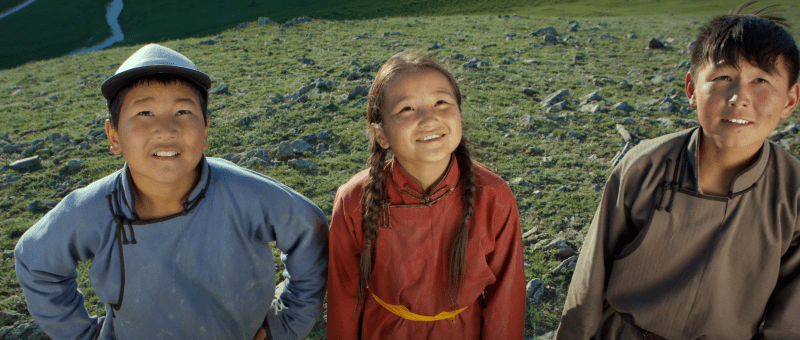
Childhood nostalgia and the changing Mongolian society come together in Janchivdorj Sengedorj’s triptych of warmhearted children’s stories, I, The Sunshine (Би Нар, Bi Nar). Set between the Steppe and the city and around 30 years apart, Janchivdorj Sengedorj’s three tales aren’t so much about idealising a traditional way of life or denigrating the increasingly digitised, modern society but emphasising that children are often resourceful and determined and above all mean well, while people are sunshine and have a duty to bring love to one another. 

Narrated by the hero of the final tale, Ideree (J. Irmuun), the first concerns his father, Bodi (U. Itgel), who grew up in a small village on the Steppe and later became an engineer because of the events he is about to convey to us though Ideree isn’t entirely sure he believes the stories his dad has told him. In any case, this one is about modernity coming to the village in the form of a television. Previously, the entire community had to cram into the back of a pickup truck and head to the Soum Centre to watch the latest instalment of the TV soap on which they are all hooked, but Bodi’s dad has returned from the city with a set of his own much to the consternation of his wife who feels he ought to have spent the money on a ger for his oldest son soon to return from the military. Unfortunately, however, no one has quite grasped how TV works and being set so low they can’t receive a signal. It being the summer holidays Bodi and his friends are determined to figure out how to get the TV working, firstly by asking their bored physics teacher who is busy with experiments of his own and sends them away with a diagram explaining how an antenna works, and then by pilfering all the metallic objects in their village including grandma’s big pan to build an amplifier. 

Though the tale takes place in, presumably, the 1980s, the kids are charmingly innocent not even knowing how to open the ring pull on a can of Pepsi and so excited to try it that they eventually bash a hole in the top with a nail. They are all desperate to leave the village for the bright lights and sophistication of the city but the older Bodi (B. Bayanmunkh) will later suggest sending his son back to the country to learn to be a real Mongolian man riding horses and herding sheep. Meanwhile, the village is in a mood of celebration as a former resident who graduated high school and went on to university is currently running for public office. It’s figuring out the TV problem that leads Bodi to want to become an engineer, certain that when you work hard at something it is possible to succeed. 

Meanwhile, Ideree’s mother Nandin (L. Shinezul) is reluctantly learning to become a contortionist with the circus in the city. Her childhood is less happy than Bodi’s mostly because her mother, formerly a contortionist herself, has encountered some kind of accident and now uses a wheelchair while her father has gone to the US in search of work and a possible cure. Having got her place because another girl was injured, Nandin struggles to get along with her new teammates while secretly reluctant to practice because the circus atmosphere reminds her of happier times. Nevertheless through interacting with the other girls and realising that her melancholy sense of abandonment has been mistaken she eventually rediscovers her calling as a contortionist instructing her son that not everyone is blessed with a natural talent but if you discover you have one it’s your duty to embrace it. 

Despite the twin lessons of his parents, however, young Ideree seems to be struggling. Bodi and Nandin (D. Asardari) are concerned that he seems to have no friends and spends all his time obsessively playing video games even though she is Facetiming someone on her iPhone as she cooks and he is working on his laptop at the breakfast table. At school everyone’s on their phones before the teacher comes in and the streets are filled with people staring at their screens. Running to school every day attempting to escape the gauntlet of older bullies on the bridge, Ideree’s life changes when his computer mouse comes to life and takes the form of a young girl (Michidmaa Tsatsralt) who can manipulate the world around him to silence his nagging parents, despatch his tormentors, and even make him a teacher’s pet but she can’t fix the fact he’s got no friends because friendship is born of the heart’s desire to connect and even the most powerful computers couldn’t forge that. Her advice? Bring love and sunshine. While perhaps criticising the alienation born of increasing digitalisation, Janchivdorj Sengedorj doesn’t exactly advocate a return to the ger even as he comes full circle with the family enjoying a traditional festival but does perhaps suggest that the world works best when people bring the love and the light. We don’t have to believe the stories, Ideree tells us, but he thinks that people start to live a completely different life when they forget childhood dreams and he just might have a point.  


I, the Sunshine streams in the US March 17 – 21 as part of the 12th season of Asian Pop-Up Cinema.

Three short trailers (no subtitles)

A Summer Trip (川流不“熄”, Feng Keyu, 2021)

Societal change and rising economic prosperity threaten the foundations of the family in Feng Keyu’s charmingly nostalgic intergenerational adventure A Summer Trip (川流不“熄”, Chuān Liú Bù “Xī”) elegantly lensed by Mark Lee Ping-Bing and boasting a typically whimsical score from Joe Hisaishi. In the run-up to the Beijing Olympics, the nation is in a celebratory mood but in a society where everybody works all the time something may be in danger of getting lost. Young Xiaosong (Hu Changlin) is going off the rails (in a fairly minor way) with both the school and grandpa, often left with childcare duties he feels might not quite be his responsibility, leaning towards blaming the parents who are simply not present enough in his life to be able to offer much in the way of guidance. 

A Korean War veteran, grandpa Zhang Dachuan (Yang Xinming) is beginning to feel as obsolete as the discontinued parts he needs to repair his ancient jeep. He can’t get his head round mobile phones, forever pressing hang up when he means to press answer and causing accidental offence in the process. Resenting the implication that he’s not got much to do all day, he finds himself enlisted by his overworked son to represent the family when his wayward grandson Xiaosong gets into trouble at school. This particular time, it’s apparently because he’s been bothering a female student by taking photos of her with a professional DSLR camera (the teacher later gives Dachuan an envelope to pass to his son and daughter-in-law which turns out to contain a love letter Xiaosong attempted to pass to the object of his affection). Slightly annoyed to be seeing Dachuan again instead of the boy’s parents, the teacher makes herself clear that the cause of Xiaosong’s poor behaviour and declining grades is most likely a lack of parental attention. Chastened, the parents discuss finding a cram school but nothing is really done about his problematic approach to romance, especially as they each need to return to work soon after dinner leaving grandpa sitting alone at the table. 

Perhaps strangely, Xiaosong seems to have forgotten that his grandpa even has a name, hanging up on a caller thinking they’ve got the wrong number only to realise they wanted grandpa and redial upon which Dachuan discovers that his greatest wartime friend has passed away in Beijing and the funeral is in a few days’ time. Though Xiaosong had technically been “grounded” for the summer, the idea was that grandpa was supposed to supervise him while he stayed home and studied. So begins their awkward road trip, passing first through the home of Dachuan’s daughter Ling (Dai Lele) in a town closer to the capital and a lengthy train ride away before pressing on to the city. 

As his opening voiceover explains, Xiaosong never really understood his grandfather thinking of him as a grumpy, stubborn old man stuck in the past. Yet as grandpa later sadly laments reflecting on his friend’s final days, people talk about the past a lot when they’re unhappy in the present. Everyone is always keen to pay respect to Dachuan and his wartime generation, though not all of them have good intentions such as the overfriendly young man they meet on the train who enthusiastically listens to his stories, or the older woman (He Zaifei) who reminds Dachuan of his late wife but leverages his desire to show off by getting him to pay for an expensive lunch. For his part, Dachuan resents his declining capacity and finds himself at odds with the modern world, unable to access technology or understand the changing nature of society. His quest to get to Beijing under his own steam is a way of rebelling against his age, proving he’s still capable and independent though his slightly narcissistic can-do attitude often backfires, his offer to fix a broken-down bus exposing his lack of acumen while his petulant decision to leave finds him stubbornly insisting on walking the remaining 30km to the capital. 

Highlighting the corporate obsession, meanwhile, another stranded bus passenger makes constant phone calls to his less than understanding boss to explain the delay. While Dachuan and his grandson experience set backs on the road, the boy’s father Jianguo (Tu Songyan) chases a reluctant client who won’t sign a contract and returns late to a dark and empty home while his wife (Yang Tongshu) works the nightshift as a surgeon at the hospital. Unbeknownst to Dachuan, Ling and her husband (Gong Zheng) are about to split up apparently because he spent too much time at work and the relationship has fallen apart as a result. Young Xiaosong says he wants to be a photographer to “document all the beautiful things and moments” lamenting that they never took a family photo with his late grandmother. In the absence of his father and son and forced to humiliate himself repeatedly at work, Jianguo comes to regret having deprioritised his family life and recommits himself to repairing their fractured bonds perhaps with a family holiday lamenting that they never got round to it while his mother was alive. The Olympics Opening Ceremony becomes, its own way, a second New Year with the TV broadcast taking the place of the Spring Gala as the family finally come back together again having gained new understandings of themselves and others through their various summer adventures. Society might have changed, those exciting KFC “family buckets” from the city apparently not going quite as far as you’d think, but the family can apparently still be saved with a little mutual understanding and a dose of self-reflection.


A Summer Trip screened as part of the 2021 Osaka Asian Film Festival.

Original trailer (Japanese subtitles only)

Over the Town (街の上で, Rikiya Imaizumi, 2019)

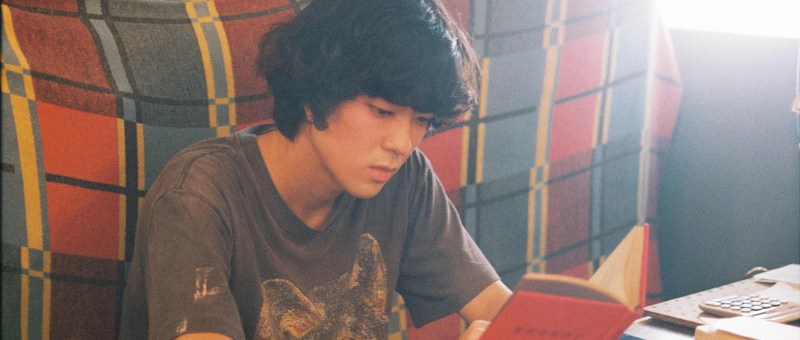
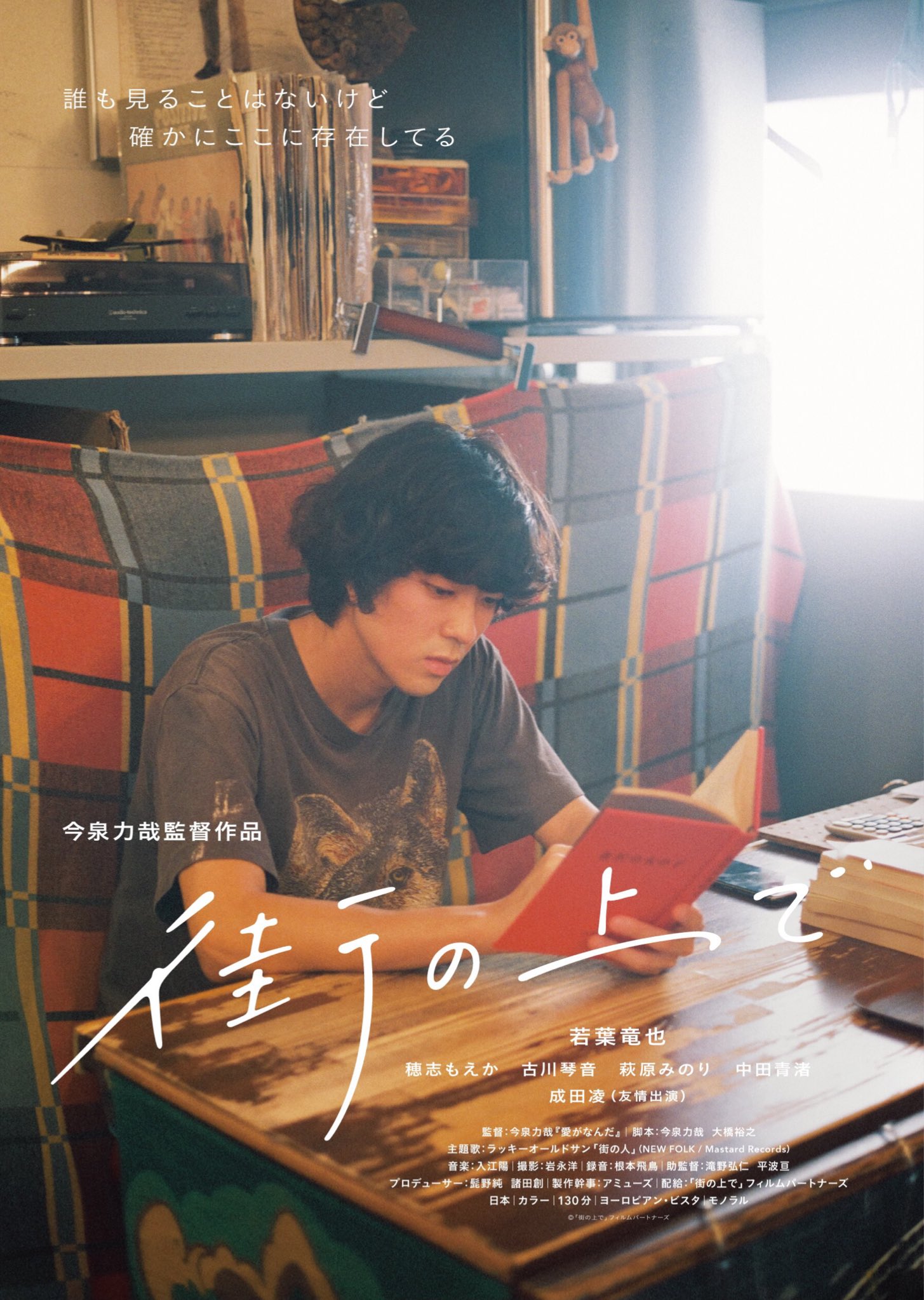
Frustrated youngsters chase an unrealisable dream of idealised romance in Rikiya Imaizumi’s ode to Shimokitazawa, Over the Town (街の上で, Machi no Uede). For the moment at least known as the bohemian, avant-garde artists quarter of the contemporary capital beloved for its slightly retro quality replete as it is with narrow lanes and period buildings, Shimokitazawa is also a place of constant change but as the hero later points out even if “parts change and disappear that doesn’t mean they never existed”. Nevertheless, he seems to be marked by a particular anxiety, as do many of his age struggling to make meaningful connections in an ever shifting world. 

Ao’s (Ryuya Wakaba) world begins to crumble when he’s unexpectedly dumped by his beloved girlfriend, Yuki (Moeka Hoshi), on her birthday. Unceremoniously telling him that she’s met someone else, Yuki rationalises that breaking up is the only option but Ao tries to resist only for her to tell him that he can go on deluding himself that he still has a girlfriend but from now on she’ll be hanging out with someone new. From then on, Ao seems to be surrounded by frustrated couples and worryingly outdated ideas of romantic politics such as those of the students who drop into the vintage clothing shop where he works. Ao assumes they’re a couple, but a row slowly brews as the girl, Asako, declares herself bored with helping the guy, Shigeru, try on clothes that turn out to be for the purpose of impressing a different girl altogether despite knowing that Asako fancies him. Eventually Shigeru makes a highly inappropriate suggestion, almost akin to a bet, that if the woman he has a crush on rejects him he’ll deign to dating her even though Asako is “a distant second” in his heart. The shocking thing is that Asako agrees, a slightly mournful look in her eyes as she finally reaffirms that she really hopes it works out with the other girl. 

Throughout the exchange during which Ao looks on as an awkward bystander, it becomes increasingly difficult to see what’s so great about Shigeru. Meanwhile, not even Ao comes off particularly well, struggling to deal with his breakup and refusing to accept Yuki has moved on. So hung up on her is he that she eventually ends up contacting the barman at his favourite haunt to ask him to have a word, explaining that it’s inappropriate to go on texting your ex even if she doesn’t reply. Meanwhile, he finds himself at the centre of romantic missed connection, captivated by a sad woman at a concert who gives him a menthol cigarette he keeps in his ashtray as a kind of talisman for the rest of the picture. Infinitely awkward, he talks himself out a potential date with the cute girl at his favourite used bookstore (Kotone Furukawa) by asking an inappropriate question, later doing something similar to a woman (Seina Nakata) with whom he makes a more platonic connection as they each reflect that for some strange reason it’s much easier to open up to someone you have no romantic interest in. 

Perhaps that’s why a melancholy policeman keeps stopping random people in the street to ask their advice on his peculiar romantic dilemma in having inconveniently fallen in love with his “niece” (by marriage and the same age as he is, so maybe it’s “OK”, he’d like to think). Shimokitazawa, which Ao rarely leaves, is indeed a small world, the various strands of his romantic entanglements strangely connected from a young woman’s unrequited longing for her sumo wrestler childhood sweetheart to a TV actor’s (Ryo Narita) troubled love life and a young film director’s (Minori Hagiwara) attempt to deflect her own sense of romantic disaffection. Just as Yuki used another man as an excuse to break up with Ao, Ao finds himself recruited as a fake boyfriend to help a young woman shake off a controlling ex whose refusal to accept the relationship is over in the absence of another man skews even darker than his own signalling perhaps like that first vintage shop exchange the dangerously outdated sexual politics which continue to underpin modern dating. Perhaps boring love is the real kind of fun, comfortable and balanced marked by true connection and mutual vulnerability rather than a giddy anxiety. A stubborn holdout where everything’s secondhand in a continual circulatory process of exchange and return, Shimokitazawa is the kind of place where love finds you even if it takes a while to wander on its way. A charming ode to this timeless yet ever-changing district, Imaizumi’s quirky dramedy keeps the neurosis of young love on the horizon but suggests that romance, like a well baked cake, keeps much better than you’d think when cooled.


Over the Town screened as part of the 2021 Osaka Asian Film Festival.

Original trailer (no subtitles)

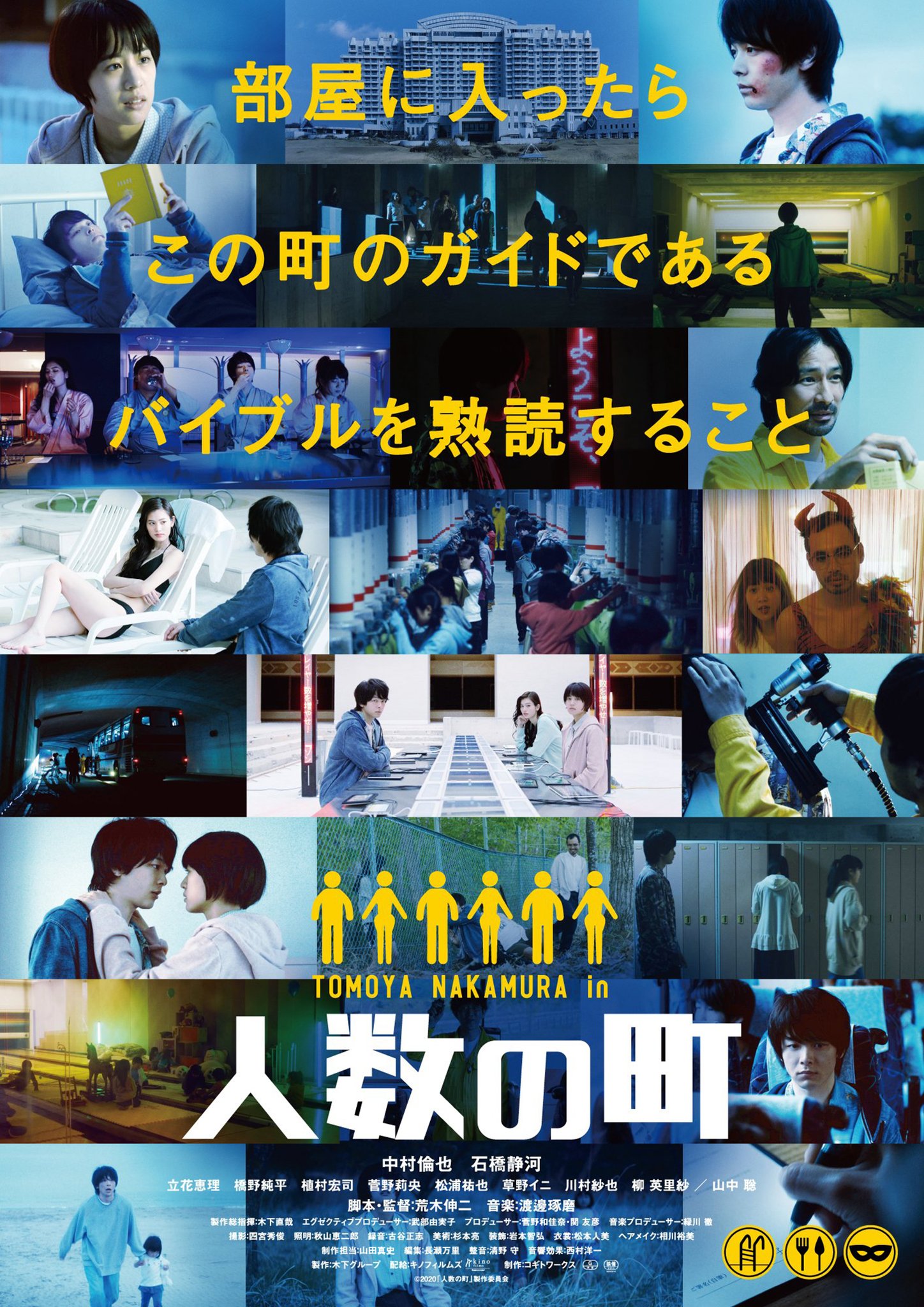
The Town of Headcounts (人数の町, Shinji Araki, 2020)

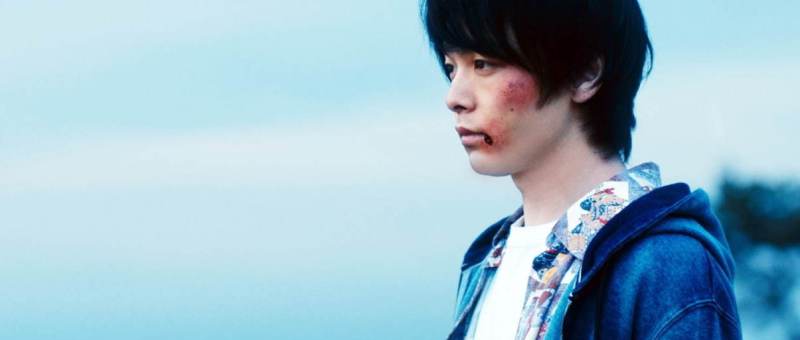
“You’re free now, so the world is more beautiful” the hero of Shinji Araki’s dystopian thriller The Town of Headcounts (人数の町, Ninzu no Machi) is unironically told by a mysterious saviour even as a watchtower lingers on the horizon behind him. Modern Japan, it seems to say, is no paradise but is it worth trading your identity and existence for the guaranteed satisfaction of your basic needs? Freedom, happiness, and love may be nebulous concepts which mean different things to different people, but in the end leading a satisfactory life might just come down to what it is you decide you can live without. 

The nameless protagonist later credited as Aoyama (Tomoya Nakamura) describes himself as an “average joe” who has “a weak will” and doesn’t “belong anywhere in society”. While being beaten up by a loanshark, he’s unexpectedly rescued by the miraculous appearance of the mysterious “Paul” (So Yamanaka), a middle-aged man dressed in an orange jump suit who tells him there’s a place he can go where’d he fit right in. After a lengthy bus ride, he finds himself a new resident of “The Town” where those like him who for one reason or another felt themselves rejected by mainstream society can live in ease and comfort, only as he later discovers he is unable to leave. Should he walk too far beyond the fence, the microchip in his head activates a sonic wave of painful and disabling distortion. 

Somewhere between a utopian cult commune and a penal colony occupying a disused conference centre, The Town is a free love society which insists that equality is possible and that freedom and peace are more than mere dreams. Family creates inequality, so The Town’s Bible says, so residents must live alone. Pregnancy is prohibited, while children brought into the compound are separated from their parents and raised in a communal nursery. All basic needs, food, warmth, shelter and even sex, are otherwise guaranteed though the residents are expected to “work” to earn them, performing often pointless tasks parasitically underpinning modern capitalism such as writing meaningless product reviews in return for treats, or performing as stooges to create hype around new store openings. Aoyama’s sense of morality is however shaken when he’s asked to commit electoral fraud by repeatedly voting for a chosen candidate with stolen ballots, later recruited as a crisis actor in a fake terrorist incident intended to further influence an election in the wake of a corruption scandal. 

In The Town, he’s told his existence is meaningful and given a place to belong. Yet he has to surrender his name, known as “Dudes” residents must greet each other ritualistically only by the word “fellow” followed by some kind of compliment. All his needs may be met, but he’s forbidden to fall in love, can never marry or have a family, and it does seem troubling that there are no elderly people around even if some suggest there are other “Towns” just for them. Some might say, The Town is way is a way for mainstream society to get rid of all the people it doesn’t want or feels have no value. Araki throws up frequent title cards featuring various statistics such as the numbers of homeless people, bankruptcies, unemployment etc along with brief flashbacks to whatever it was that brought residents to The Town from being thrown thrown out of a manga cafe after attempting to live there to being almost choked to death by debt-collecting yakuza suggesting there’s little “freedom” in the rigid contemporary society and most particularly for those unable or unwilling to live by its rules.  

In The Town rules are few, and you’re well looked after, but you can’t leave and though it seems like an individualist paradise where you’re free to satisfy each of your physical desires you have no further control over your existence. As one resident puts it, “life here is kind of weightless”, perhaps a relief for some but a crushing existential crisis for others. Aoyama realises that in The Town he rarely feels angry, but perhaps he feels nothing much of anything else, either. Just as he’s starting to adjust, his feelings of unease are strengthened by the arrival of a young woman who apparently had no previous societal issues but has come to The Town in search of her younger sister whom she failed to help despite knowing she was trapped in an abusive relationship. Unlike Aoyama, Beniko (Shizuka Ishibashi) claims not to have felt much of anything in the regular world, unsure even what love is and unimpressed by the beautiful vistas of freedom that are supposed to define The Town, but doesn’t want to stay and be rendered a mindless drone exploited by mysterious forces for whatever purpose they may choose.

What Aoyama realises he craves is the love and companionship of a conventional family life. “We want to support each other and work hard. Love each other and live together” he explains to a non-plussed Paul who seems to pity him, his simple desire at once at odds with the values of The Town and perhaps equally unobtainable in contemporary Japan. In the end, the only “freedom” he may find lies in complicity with one system or another, becoming an oppressor as one of the oppressed. The question is what sort of life is most satisfying, freedom from the anxiety of hunger and cold, or the freedom to love and live fully in manner of your choosing. The modern society may not grant you either, and both perhaps have their costs. A bleak dystopian thriller, Araki’s steely drama features innovative production design and slick direction mimicking the hero’s sense of disaffection with detachment and a total lack of resistance to the otherwise bewildering world of The Town but saves its real sense of confusion for the state of the modern society and the fate of those who survive on its margins. 


The Town of Headcounts streams in the US March 15 – 19 as part of the 12th season of Asian Pop-Up Cinema.

Original trailer (English subtitles)
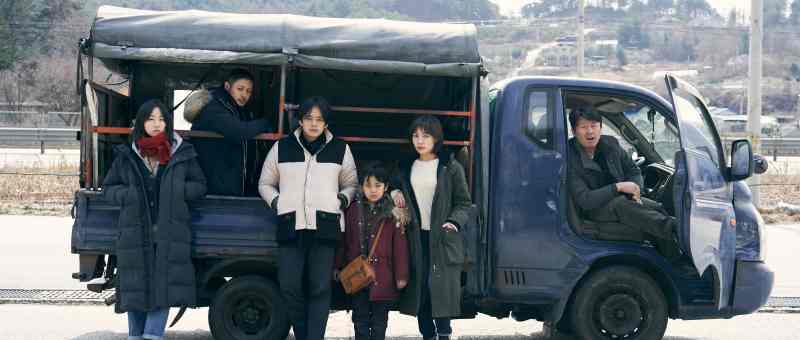
Ito (いとみち, Satoko Yokohama, 2021)

“Ye can’t hear my silence!” the timid young heroine of Satoko Yokohama’s Ito (いとみち, Itomichi), an adaptation of the Osamu Koshigaya novel, finally fires back, reminding us that silence too is means of communication. The film’s Japanese title, Itomichi, refers to the groove in shamisen player’s nail caused by the friction of the strings, but also perhaps to the path of the heroine of the same name as she makes her way towards self actualisation, figuring out the various ways there are of connecting with people as she begins to step into herself while coming to terms with the past. 

As we first meet Ito (Ren Komai) she’s trapped in a boring history lesson about local famines, reminded by the teacher to raise her voice while reading from the textbook but reluctant to do so firstly because she has an unusually strong local accent and often speaks in dialect and secondly because she is intensely shy. When she’s finished, the teacher even jokes that listening to her read is a little like classical music though it doesn’t seem much like a compliment. Even so, it’s particularly apt as Ito, like her late mother, has a talent for playing the Tsugaru shamisen and has even won numerous competitions yet she’s barely touched her instrument recently, perhaps developing a slight complex about the bumpkinishness of her intensely local way of life, especially as her father Koichi (Etsushi Toyokawa) is a university professor researching the traditional culture of the local area. 

Pointing out that talking is Ito’s weak spot, Koichi reminds her that she can communicate with others through her music even if he later admonishes her to use her words if she has something to say. Her refusal to pick up her shamisen is then a kind of withdrawal if of a particularly teenage kind. Hoping to get over her shyness, she finds herself quite accidentally applying for a part-time job at a maid cafe in the city, an incongruity in itself but one that helps her begin to open up to others. Then again, a maid cafe might not be the best environment selling as it does an outdated conception of sexual politics. Koichi later makes this argument pointing out that a maid cafe is not so different from a hostess bar while another maid, Tomomi (Mayuu Yokota), takes issue with the false chivalry of some of the middle-aged men who frequent the establishment who set up a club to “protect” Ito after she is inappropriately touched by a belligerent customer. To Tomomi the very idea that women need “protection” from men against men is inherently sexist and wrongheaded while the fact that they all rally round to protect the shy and vulnerable Ito also speaks volumes about their ideals of womanhood explaining why it is they’re in a maid cafe where the waitresses call their customers “master” and indulge their every whim in the first place. Even so, Ito’s colleagues are also quick to reassure her that she is in no way at fault, the customer’s behaviour was unacceptable and against the spirit of their establishment.

Yet as the manager points out “moe moe” is also a “means of communication” not perhaps intended to be taken literally. Ito does not exactly discover how to use her words, but through interacting with her colleagues at the cafe begins to come into an acceptance of herself no longer seeing her accent and dialect as uncool or old fashioned giving herself space to breathe as she makes new friends guided by her cafe mentor Sachiko (Mei Kurokawa) and finally getting up the courage to speak to another lonely young woman whom she’d been on awkward nodding terms with seeing as they catch the same train home from school. As Ito’s grandmother (Yoko Nishikawa) reveals, she learned how to play the shamisen with her eyes and ears proving that communication comes in many forms. Ito’s name which she had previously found old-fashioned and embarrassing appropriately enough means threads or here strings of a shamisen which become in their own ways channels to connect with other people which as the slightly dubious owner of the cafe (Daimaou Kosaka) points out is the most important thing of all. 

As Ito rehearses her maid routine with a video of her mentor, grandma outlines her thoughts about shamisen on camera for Koichi’s eager students, handing her knowledge down for the next generation. Literally finding her groove again, carving a niche in her fingernail, Ito rediscovers her love for music while gaining the confidence to stand on stage and be herself encouraged by all her friends and family. A beautifully pitched coming-of-age tale celebrating the local culture of Yokohama’s hometown Aomori, from which leading actress Ren Komai also hails, Ito is a warm and loving tribute not only to Tsugaru shamisen but to friendship and community brokered by a wealth of communication and a willingness to listen even to silence. 


Ito screened as part of the 2021 Osaka Asian Film Festival.

Images: (C)2021『いとみち』製作委員会

B/B (Kosuke Nakahama, 2020)

“It’s been a while since I asked, who are you?” comes the incongruous question at the beginning of Kosuke Nakahama’s stylish, hugely accomplished graduation movie B/B. What begins as an unconventional, reverse investigation of a bizarre crime committed in a bizarre world, eventually descends into a philosophical interrogation of the modern society and most particularly its continued indifference. “All the oppressors and all the oppressed, those who didn’t notice the pain. We’re all complicit. You think you’re the exception?” asks the witness of her questioners, partly perhaps in justification but also pointing the finger back at a society which prefers to avoid asking uncomfortable questions. 

Set in an alternate 2020 in which the Olympics has been suspended not because of a global pandemic but because of a bribery and corruption scandal, and a terrorist gas attack by a shady cult has recently been foiled, the central mystery revolves around the murder of a convenience store manager dubbed by some the “Icarus” killing. Sana (Karen), a high school girl, has been called in as a person of interest because of her connection with the victim’s son Shiro (Koshin Nakazawa) who has become withdrawn and is unable to offer testimony of his own. The problem is that it’s not exactly “Sana” that they want to talk to as the young woman apparently suffers from Dissociative Identity Disorder, once known as multiple personality. A cynical policeman and sympathetic psychiatrist have been tasked with trying to sort out her unreliable narrative to discover her connection with the crime. 

In a handy piece of symbolism, Sana apparently hosts 12 distinct personalities, a perfect inner jury, while the body of the murdered man was apparently dismembered into 12 parts. As the psychiatrist later advances, the personalities are a symptom of Sana’s mental fracturing in response to trauma and were not born altogether but arrived individually following the increasingly traumatic events of her life presumably beginning with her mother’s death. It’s this sense of parental abandonment that allows her to bond with Shiro who, like her, avoids school by hanging out in local parks in his case because of a further sense of rejection in realising that his teachers are aware of the abuse he suffers at home, Sana immediately noticing the scars protruding from the collar and sleeves of his T-shirt, but have chosen to do nothing to protect him. 

The goal is not to unlock the mystery of Sana, to cure her or to address the various traumas which lie at the root of her psychological fracturing but to investigate the Icarus murder. She is not, however, a credible witness. An infinitely unreliable narrator, her personalities switch at random each giving their own contradictory testimonies in their characteristic fashion. Nakahama mimics Sana’s mania through frantic cutting and abrupt edits, close ups on hands, feet or random objects rather than faces or landscapes. The earliest scenes with Sana and her posse of imaginary friends, only six of whom she is apparently able to manifest at one time, hanging out in the park are shot with a beautiful summer glow coloured with its own kind of nostalgia as she slowly befriends Shiro bonding in shared trauma and a mutual sense of safety. 

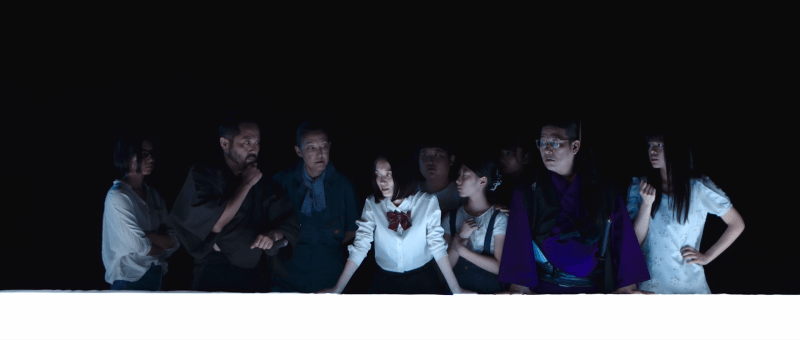
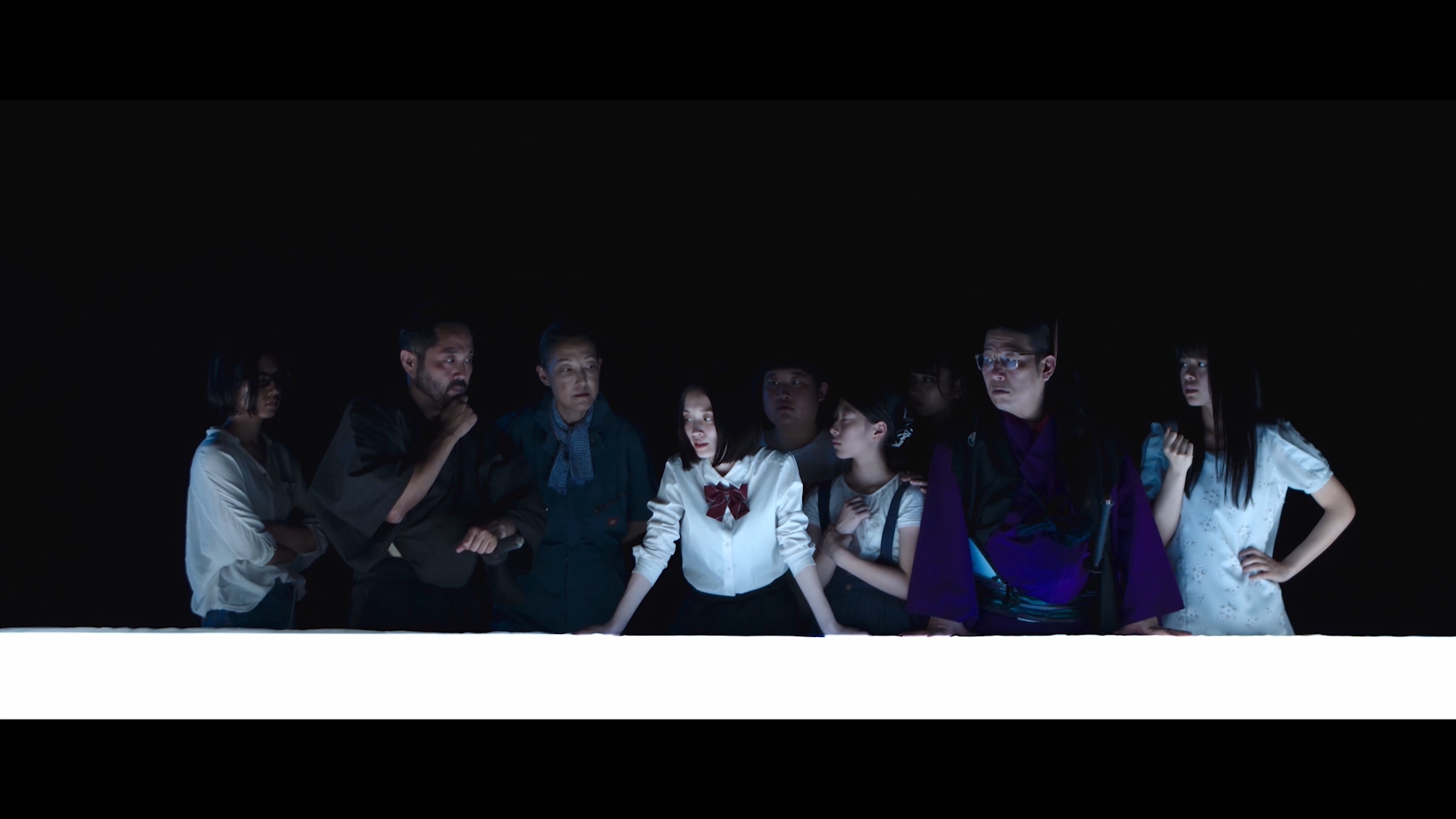
While the interrogation scenes trapped in the relative claustrophobia of the doctor’s office may have a sense of the clinical, the judicial manifests most clear in Sana’s mind. The “Council of Sages” in which all her personalities are present takes place in a minimalist space of black and white, shot like a Renaissance painting with echoes of the The Last Supper, as they crowd around and wonder what’s to be done about the Shiro problem, the manic pace slowing somewhat as Sana’s thoughts apparently clear. Yet as she later says to the disbelieving policeman pointing out the absurdity of prosecuting crimes committed as opposed to preventing those yet to occur, “This is hell, we are all trapped in hell”, advancing that she does not believe someone from hell belongs in heaven and would rather reign below than live in pitiable servitude above. Anchored by a phenomenally strong performance by Karen, sophisticated fast paced dialogue including more than a few surprisingly retro pop culture references, and featuring stylish on screen text Nakahama’s striking debut ultimately takes aim at societal indifference and perhaps points the finger at the viewer to pay more attention in a world of constant suffering. 


B/B screened as part of the 2021 Osaka Asian Film Festival.

Original trailer (no subtitles)

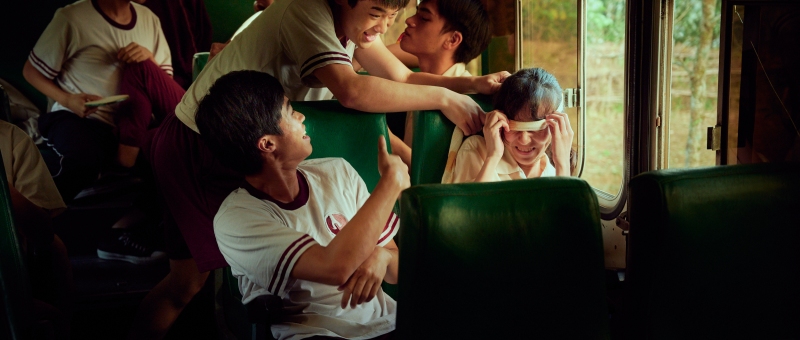
Green Jail (綠色牢籠, Huang Yin-Yu, 2021)

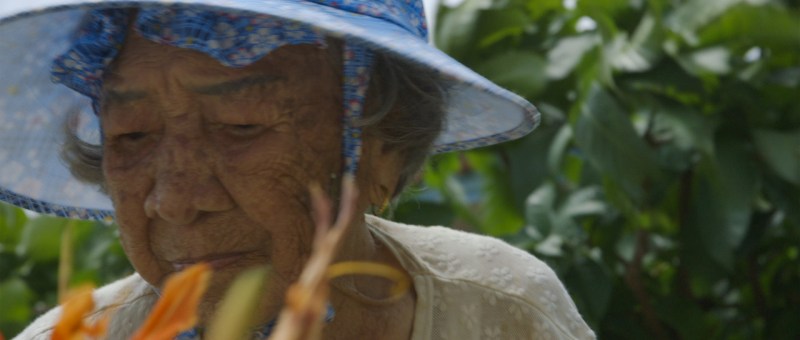
The legacy of Japanese imperialism continues to haunt a small Okinawan island once home to a sprawling network of coal mines but now mostly to ghosts of its troubled past at least according to Huang Yin-Yu’s beautifully lensed, elegiac documentary Green Jail (綠色牢籠, Lǜsè Láolóng). So named for its thick forests of mangrove trees, the island’s Iriomote Coal Mine ceased production in 1960 but from the late 19th century to the fall of the Japanese Empire at the end of the war, lured workers from not only from the Japanese mainland but from Korea, China, and Taiwan with false promises of tropical climes and plentiful fruits failing to disclose the harsh and exploitative working conditions they would later prove unable to escape. 

Possibly the last witness to these times, grandma Yoshiko Hashima (her name naturalised from the original Yang) travelled to the island with her adopted father, Yang Tien-fu who worked for the mines and was responsible for recruiting other workers, at the age of 10 leaving briefly after the war but soon returning. The last of the Taiwanese settlers, she recalls little regarding the running of the mines save witnessing frequent beatings by Japanese soldiers but does recall the discrimination she faced as a foreign worker from the local community who by far made up the smallest percentage of those employed at the mines finding herself with few friends as locals often even declined to eat their food or accept their hospitality. 

Yet in a strange way history perhaps repeats itself. Now elderly and alone, her children all having left the island returning only infrequently, she rents out her spare room for extra money to an American traveller, who, like her, came to Japan as a teenager. Though Luis tells us that he hadn’t intended to stay long on the island but likes being able to help Yoshiko who is elderly and alone, she tells us that she regrets her decision to rent to him which she claims she made in the belief he had a wife. She describes him as “‘messy”, claims he has lice, and that his slovenliness has attracted an influx of ants while the pet dog that he keeps on a leash outside disturbs her with its constant whining. Later we see him again having returned to Kansai revealing that he felt that people disliked him and found it difficult to fit in, but that his time in Okinawa has perhaps brought him clarity in the further direction of his life. 

Luis was at least able to leave the island at a time of his own choosing, but as the ghostly voice of Yoshiko’s late father reminds us those who worked in the mines were not so lucky. He tells us that he once slept on a pile of bones and the remains of workers who attempted to flee but ended up starving to death in the jungle were a frequent sight in local caves. Exploited and manipulated, workers were often hopped up on morphine, for which they had to pay, in order to up their productivity but also to make them dependent on their employment to avoid withdrawal aware that they would be unable to obtain a such substances in their home country. They also found themselves borrowing on their wages, especially if they contracted malaria and were unable to work, leaving them essentially indentured and therefore unable to leave without satisfying their debts. Yoshiko tells us that few wanted to come to “Dead Man’s Island” yet Tien-fu declares himself uncertain why some miners remained unhappy with the arrangement eventually needing to organise a specialised police force to enforce discipline complaining that workers who were in debt and therefore earning almost nothing often shirked and only worked when the police were around. 

Travelling around the otherwise idyllic landscape with its verdant green forests and peaceful rivers, Huang finds occasional ghosts of the departed miners hovering on the horizon dressed only in their white fundoshi underwear, slipping into brief scenes of reconstruction set amid the now ruined structures of the industrial mining complex. The last survivor, Yoshiko hangs on alone yet perhaps not quite reflecting on the implications of her father’s role in the development of the mines or particularly of their legacy. Her own life has evidently been hard, adopted as an infant and then married to her “brother” only to see her children desert her left behind alone in the Green Jail a guardian of a dark history few wish to remember. Juxtaposing the island’s traumatic past with the beauty of its verdant scenery Huang’s elegantly composed documentary poses some serious questions about the imperial legacy but always mindful of its wandering ghosts. 


Green Jail screened as part of the 2021 Osaka Asian Film Festival.

Original trailer (Japanese subtitles only)

The festival will also be screening Huang Yin-Yu’s accompanying short film Green Grass, Pale Fire: an elliptical, ethereal dramatisation of three men’s attempt to escape the mines only to find themselves trapped by the beautiful yet maddening landscape.

Images: (c) Moolin Films, Ltd./ Moolin Production, Co., Ltd.