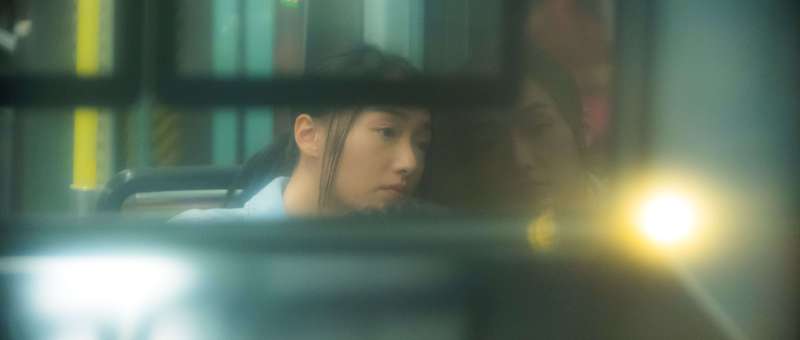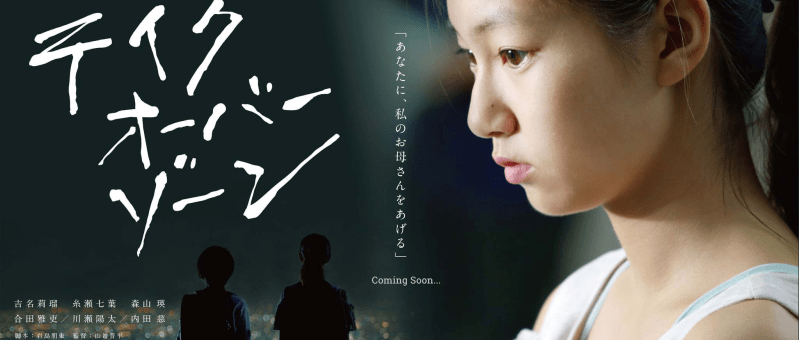
Not Quite Dead Yet (一度死んでみた, Shinji Hamasaki, 2020)

©2020 Shochiku Co., Ltd. Fuji Television Network, Inc.

“What’s important is purpose, to live for something. Without it you’re as good as dead” according to the hero of madcap existentialist farce Not Quite Dead Yet (一度死んでみた, Ichido Shinde Mita). The feature debut from ad director Shinji Hamasaki pits a rebellious student against her overly literal, authoritarian dad as the pair begin to come to a kind mutual understanding only once he “dies” after being tricked into taking an experimental drug in order to unmask conspiracy within his own organisation. 

College student Nanase (Suzu Hirose) intensely resents her father (Shinichi Tsutsumi), the CEO of Nobata Pharmaceuticals which he has long been pressuring her to join. She’s currently the lead singer in death metal band Soulzz only according to a record scout at one of their shows their problem is that they’re all “zz” and no soul. Meanwhile, Nobata has assigned an underling, Matsuoka (Ryo Yoshizawa), to shadow her partly because Matsuoka too has very little presence and is in fact nicknamed “ghost” for his essential invisibility. The trouble starts with the escalation of a corporate feud as Nobata’s old buddy Tanabe (Kyusaku Shimada) starts manoeuvring to get his hands on the company’s research into an anti-ageing serum codenamed “Romeo”, planting a mole inside the organisation. As a consequence of his research another of the scientists nicknamed “Gramps” has stumbled on another drug which renders someone temporarily “dead” for a period of two days, naming it “Juliet”. Watabe (Yukiyoshi Ozawa), a consultant Nobata has brought in to streamline the business, convinces him to take the experimental drug in order to flush out the mole while secretly working with Tanabe to take over the company by forcing through a merger while Nobata is out of action. 

A typical socially awkward scientist, Nobata believes that life is about experiment and observation, a belief system which has thoroughly irritated his daughter who still lives at home but has divided the territory in half with clearly marked red tape. Nanase’s animosity towards her father apparently stems back to the death of her late mother Yuriko (Tae Kimura), angry with him that he never left his desk and didn’t make it to the hospital in time to see her before she passed away. “Life’s not a lab experiment” she sings, recalling her childhood during which her overly literal father took away life’s magic by patiently over explaining fairytales, scoffing that Prince Charming probably didn’t revive Sleeping Beauty with a kiss but a transfer of static electricity, while continuing to order her around in fatherly fashion now she’s all grown up. Perhaps still stuck in a petulant adolescence she started the band to vent her frustrations with the world in the form of a death metal “mass”, but she’s growing up. Her bandmates are getting jobs or getting married, she’s still stuck with no real clue about what it is she actually wants to do with her life except that she doesn’t want anything to do with Nobuta Pharmaceuticals.  

Once her father “dies”, however, she begins to gain a new appreciation for his life philosophy able to see but not hear his “ghost” while his body lies on a table in the office cafeteria. Nobata went into pharmaceuticals to help people, but has been led on a dark and vacuous path pursuing anti-ageing technology which is in itself a rejection of change and transience. Ending all her sentences with the word “death”, that’s not something Nanase can get behind. She believes in growing old gracefully, that they make drugs not to cheat death but to be able to spend longer with those they love. As her father had advised Matsuoka to do, she begins to find her purpose, rediscovers her soul, and figures out what it is she’s supposed to do with her life.

Matsuoka, however, seems to be permanently “invisible” despite the tentative romance that develops as he and Nanase attempt to subvert the conspiracy to stop them doing her dad in for good, brushing up against the venal Tanabe who seems set to muster all his corporate advantages against them partly because of an old grudge against Nobata. Of course, you have to wonder why the conspirators didn’t just poison him rather than having him go Juliet and then entering a race against time to cremate him before he wakes up, but as Nobata reminds us there are many things which science cannot explain. A cheerfully silly Christmas tale of rediscovering what it means to be “alive” in the presence of death, Not Quite Dead Yet is zany seasonal fun but with plenty of soul as its heroes learn to shake off cynical corporatism for a healthy respect of the values of transience.


Not Quite Dead Yet screened as part of Camera Japan 2020.

Original trailer (English subtitles)

Images: ©2020 Shochiku Co., Ltd. Fuji Television Network, Inc.
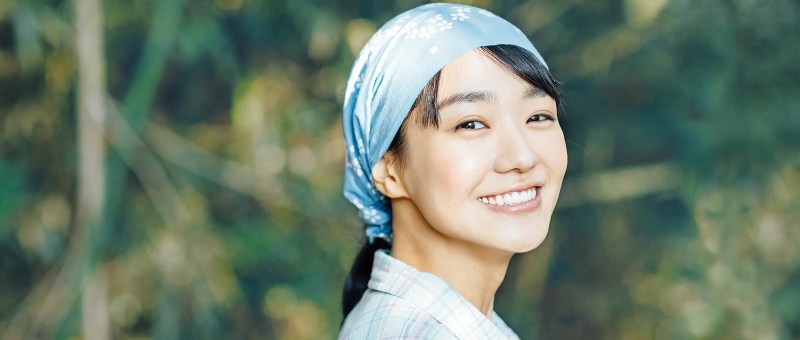
Haruka’s Pottery (ハルカの陶, Naruhito Suetsugu, 2019)

(c)2019 "Haruka's Pottery" Film Partners

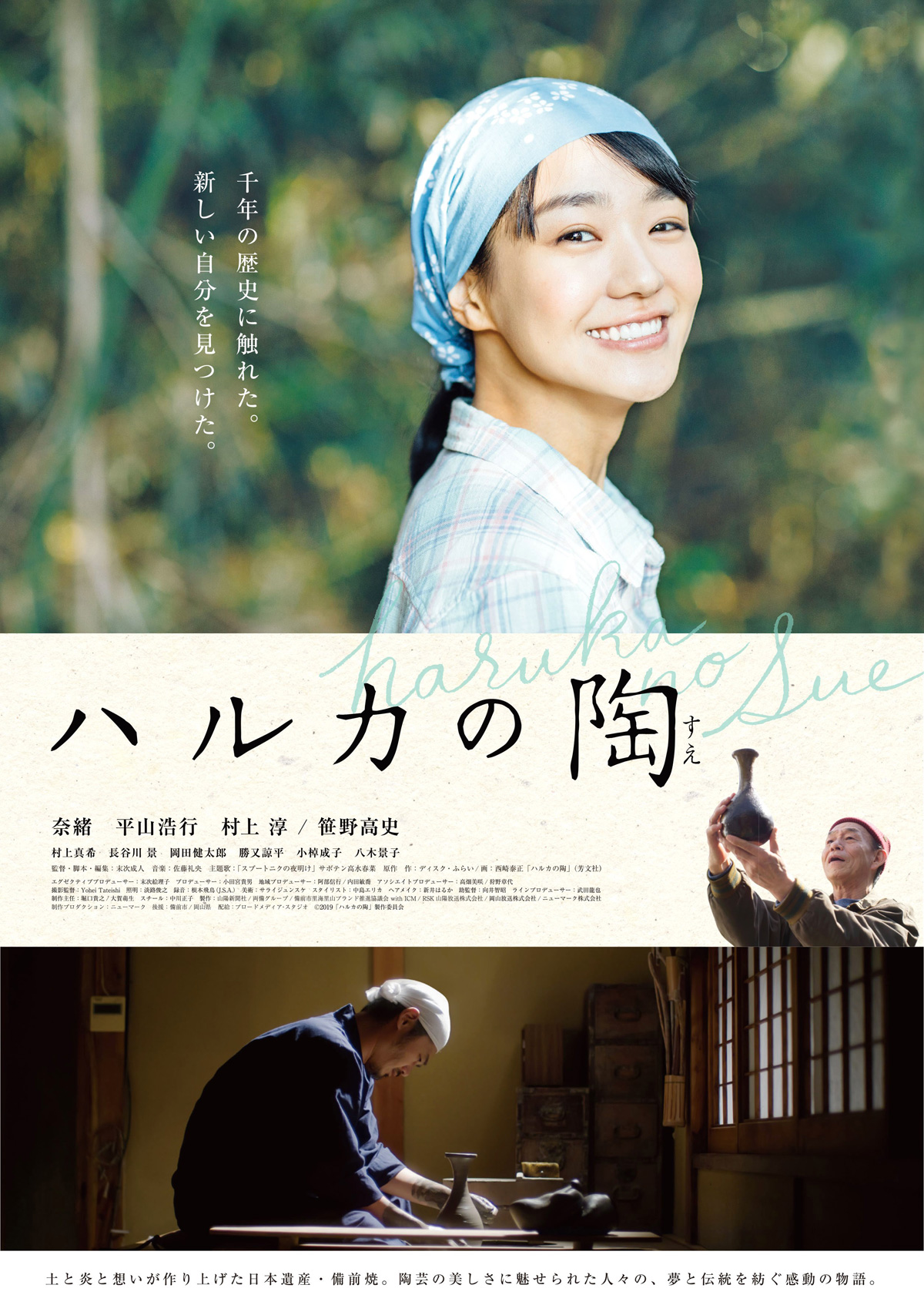
“Growth comes only through connecting with others” according to a master craftsman in Naruhito Suetsugu’s manga adaptation Haruka’s Pottery (ハルカの陶, Haruka no Sue). Japanese cinema has a long history of showcasing traditional crafts but this may be the first dedicated to Bizen ware, artisanal pottery which allows one lost young woman to find purpose in her life after being deeply moved by an oversize platter displayed in a department store exhibition. What she discovers, however, is that pottery is not an isolationist art and lives only in practical application which is in its own way impossible without interpersonal connection. 

A 20-something office worker, Haruka (Nao) laments that nothing exciting is ever going to happen to her. She has no dream or particular passion and sees nothing in her future other than an ordinary job and conventional marriage. Dragged into a department store exhibition by her boss who reminds her that she never has plans so she can’t refuse, Haruka is captivated by a large Bizen ware platter and finds herself heading to the library to find out all about this ancient craft. It’s not long before she’s made the decision to quit her job and try to become a potter herself, determined to train with the artist who made the platter, but when she arrives in the Bizen ware capital of Imbe, Okayama, she finds him cold and unresponsive. Only after bonding with an old man, Toujin (Takashi Sasano), who turns out to be a “national treasure” of traditional pottery does she manage to persuade Osamu (Hiroyuki Hirayama), the aloof and grumpy potter, to allow her to stay. 

Talking to Toujin later Haruka reveals that one of the reasons she was so struck by the platter was because her family is small and she’d always dreamed of a big gathering where everyone could eat off the same large plate. Toujin fires the same logic back at Osamu, that subconsciously he made the plate because he’s lonely. It’s not something he would ever use, in fact it’s too big to have much of a practical use at all, it was basically just a kind of beacon to summon someone to him, to express the depths of his solitude. Osamu lost both his parents as a child, his mother to illness and his father (Jun Murakami) to overwork brought on by grief, and has kept himself to himself ever since. He may have become a master potter, but according to Toujin at least he is somewhat lacking as a human which means, in essence, that his art will never progress not to mention that he’ll go on being lonely and resentful all his life if he fails to seize this opportunity to pass on his Bizen ware skills to a willing pupil.

For her part, Haruka is determined to learn and only from Osamu, the man who made the plate. While others in the town which is largely populated by other Bizen ware potters are supportive if somewhat surprised that Osamu has taken on an apprentice, Haruka finds herself at odds with Toujin’s daughter Yoko (Maki Murakami) who, according to her husband, has not exactly had it easy as a female potter. Yoko resents Haruka as an arriviste, unconvinced she’s really serious and assuming she’s another refugee from the city fed up with urban life and looking for something simpler which is to say she’s probably underestimated the commitment required to become a Bizen ware craftsman. Haruka is fond of cheerfully stating that she’ll persevere, but that’s rarely enough for Osamu or for Yoko who’d prefer to see some concrete results. Yet as Toujin had said, it’s as well to connect with as many people as you can and learning something from each of them she begins to grow in confidence, becoming a full part of the Bizen ware community and earning the respect of the other potters. 

As an old lady puts it, Bizen ware is designed to be used. Its harsh corners become soft and round through contact, and the same is true for people too. Having pushed himself too far trying to connect with his late father through their shared art, Osamu too softens assuring Haruka that pottery is not an exact science and it’s OK to fail every now and then as long as you learn something when you do. “The potter must have a strong will and be as unbreakable as the pottery itself” in order to “melt people’s hearts on the spot” Toujin had somewhat paradoxically told her, but Haruka perhaps learns that there’s truth in what he says, falling in love not only with traditional craft but with the small community of craftsmen accepted as one of their own in her unbreakable love for Bizen ware. 


Haruka’s Pottery screened as part of Camera Japan 2020.

Original trailer (no subtitles)

Fancy (ファンシー, Masaoki Hirota, 2020)

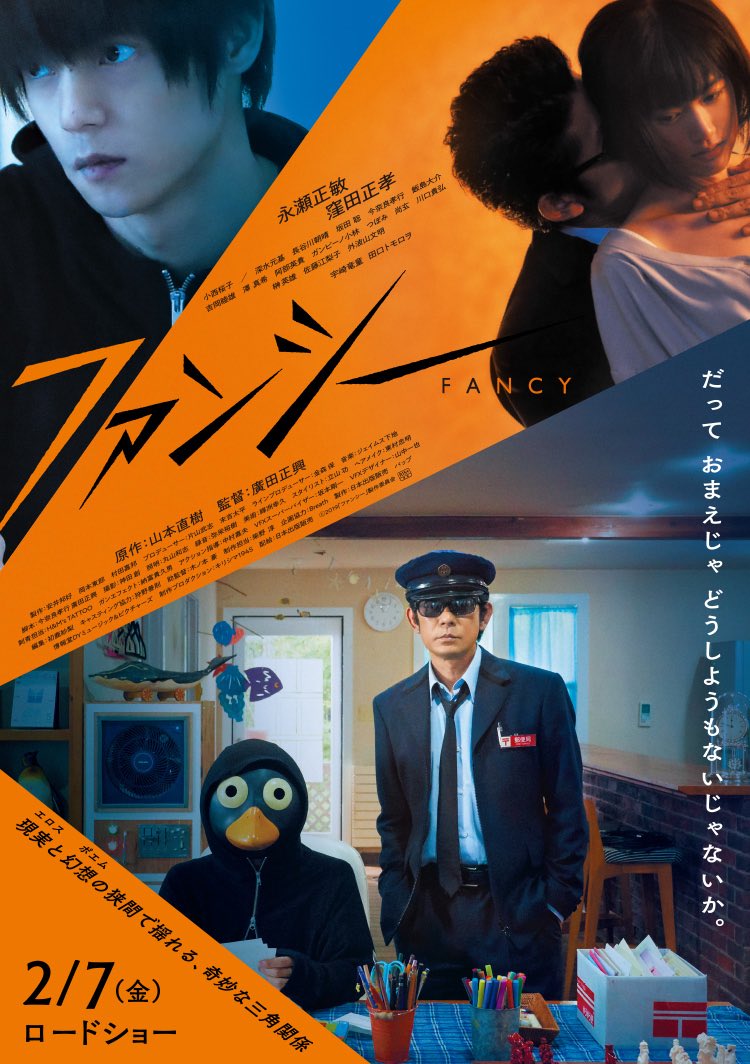
“Every minute of life is yours to make use of” according to the ultra cool hero of Masaoki Hirota’s Fancy (ファンシー), a laconic postman with a penchant for sunshades and a resigned attitude to transience. Adapted from the manga short story by Naoki Yamamoto, Fancy is indeed a transitory tale, a minor episode in the life of a poet who thinks he’s a penguin, his best friend the postman, and his penpal seeking her own kind of escape in an impromptu and probably unwise proposal of marriage. 

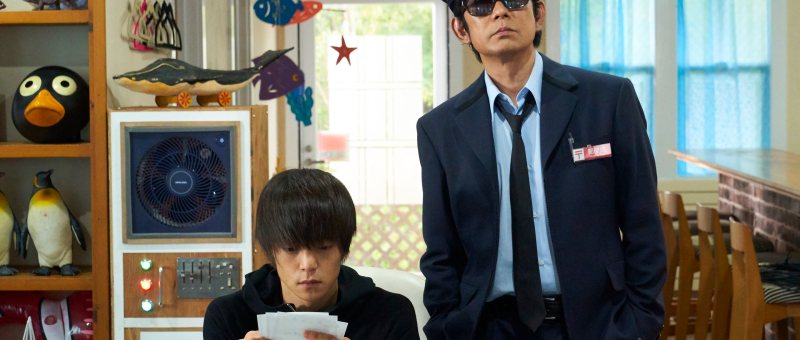
The postman, Takasu (Masatoshi Nagase), is also a tattooist, a former yakuza now reformed and living quietly in an old-fashioned hot springs town which seems to be stuck in the Showa era. As Takasu’s colleague Tanaka (Tomorowo Taguchi) puts it, it’s pretty “standard” now for everyone to have two jobs, his side hustle being a shooting gallery which is a front for the sex trade. Even the local Buddhist priest is intent on trying to sell everyone he meets a funerary monument, while Southern Cross Penguin (Masataka Kubota) is a best-selling poet particularly popular with high school girls in addition to being a flightless aquatic bird in human form. Penguin doesn’t expect us to believe him, but tells us that a penguin is just what he is and there’s no particular reason for it. So completely does he take his penguinhood that he opens the door in a full penguin mask, dresses only in black and white, mainly eats raw fish, and keeps his home ice cold with the aid of several industrial-size air conditioners. Penguin prides himself on answering the many fan letters he gets, explaining that they’re not so much “fans” as “comrades” who are also looking for the “shining country”. In any case, his fan mail is how he met the postman, his only friend, who is content to shiver in his home putting whisky in his tea to stave off the cold. 

Penguin’s life begins to change, however, when he gets a letter from “Moon Night Star” (Sakurako Konishi), a fan with whom he’d been corresponding. Moon Night Star pretty much insists on becoming his “wife”, failing to take Penguin’s hints that she might not be very happy “married” to an aquatic animal who can’t go outside. As we will later discover, Moon Night Star is in her own way rebelling against her fate, taking refuge in Penguin’s igloo and engaging in a delusion that she loves him in order to make it work. For his part, Penguin perhaps comes to like her too, but he can also see that she’s quite “depressed” stuck in the cold with him, pushing her towards the outside and into the arms of the postman. 

Takasu, meanwhile, finds himself on a series of borders as he begins to confront his past in the form of his absent father and the family he seems to have lost, sympathetically telling his pained former wife that her life is hers to do with as she wishes, perhaps in a sense cuttingly refusing her apology but also accepting her right to seize the present. Another man with two jobs, Takasu’s childhood friend is both yakuza gang boss and hotelier, confiding that the gangster stuff is too stressful and he wishes he could just focus on the hotel in the same way the Takasu has now become a postman. It’s his strange relationship with a yakuza drifter, however, that threatens to drag him back into gangsterdom as he learns that there’s been a schism in his former clan. With a turf war brewing, the loyalists have taken over his friend’s hotel, unreconstructed Showa-era yakuza on the streets of a pleasant hot springs resort. 

“We’re doomed anyway, do what you like” one of the goons intones, in one sense subverting Takasu’s mantra but in another perhaps embracing it. A memory of his father reminds him to “make very second count” while also catching him in an endless moment of gaze, unable to forget the back of the woman his father was tattooing at the time. Takasu looks and does eventually touch, but admits his jealousy obsessed with skin as canvas only latterly taking off his shades in a willingness to see and be seen. Penguin, meanwhile, who wanted to swim in a sea of words, finds himself floating free, braving but eventually succumbing to the heat before exclaiming that he’s going to close his eyes to allow a new story to start. The love of a poet is fleeting, Takasu reflects as each of the various protagonists shifts towards their “main” identity, edging back towards conventionality in abandoning the “fancifulness” of their sometimes strange existences. There will, however, be more strange adventures because even if it falls apart beneath your feet, life’s what you make it, be you a postman or a penguin. 


Fancy screened as part of Camera Japan 2020.

Original trailer (no subtitles)

The Teacher (我的靈魂是愛做的, Chen Ming-Lang, 2019)

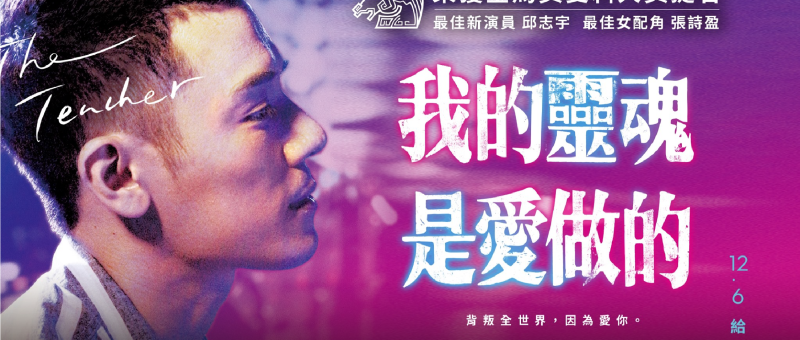
Taiwan became the first Asian nation to legalise same-sex marriage on 24th May, 2019. That does not however mean that the LGBTQ+ community is universally accepted or that entrenched conservative social attitudes simply evaporated over night. As Chen Ming-Lang’s The Teacher (我的靈魂是愛做的, Wǒ de Línghún Shì Ài Zuo de, AKA My Soul is Made of Love) makes plain, not even those within the community are entirely free of prejudice especially when comes to issues such as HIV and the complicated give and take of what it means to be “out” when personal concerns may conflict with those of an employer or industry. 

Those are perhaps questions that politically engaged civics teacher Kevin (Oscar Chiu) has largely resisted asking. On his off days, he campaigns for marriage equality and for gender equality in education as well as attending pride rallies, but is warned about including LGBTQ+ issues in his teaching programme for fear of offending parents. Director Lin (Lin Chin-Yu), the headmaster, makes offhand comments about Kevin’s perfectly respectable haircut while reminding him that while he works at the school he’s also its representative and he’d prefer it that he keep a low profile to avoid bringing its name into disrepute. Lin is careful to couch his complaints in neutral language, stressing that he personally is fine with Kevin’s sexuality, but is required to be mindful about the reactions of others, deflecting responsibility for at least failing to counter homophobic attitudes in and around the school. Nevertheless, Kevin tries to sidestep him by continuing to include the topics he’d like to talk about by framing them in less problematic terms, for example discussing the upcoming referendum on marriage equality by debating the vote itself, asking if it’s even ethical to give people the option to vote to deny a specific sector of their society the same rights that everyone else has that should be accorded to all without question. 

Kevin’s worldview is challenged, however, when he starts dating a slightly older man, Gao (Chang Chin-hao), whom he met in a gay bathhouse. Kevin tells him that he’s looking for a longterm relationship, wanting to settle down and eventually get married but is currently living with his hairdresser single mother. Moving in with him quite quickly after Gao went temporarily incommunicado following a minor illness, Kevin is later shocked to discover not only that Gao’s relationship with his ex-wife is not quite as over as he implied, but that he is also HIV+. Learning that Gao has HIV exposes Kevin’s rather shallow grasp of his sexual health. Not only does he not know where to go to get tested, but he conflates HIV and AIDS, convinced that he’s been given a death sentence after noticing that his gums are bleeding. 

While beginning to resent Gao for exposing him to the virus, Kevin is also confused by his admittedly complicated family situation. At some point in the past, Gao evidently opted for a heterosexual marriage to please his conservative family who still don’t seem to be aware that the relationship is over or that Gao is gay. At an awkward family gathering, Kevin is invited but introduced as Gao’s friend while his former wife, Wei, sits on the other side of him being quietly needled by her judgemental mother-in-law for failing to provide a grandchild. Gao apparently promised to father a child with Wei through IVF as a condition for dissolving the marriage which is why she’s still overly present in his life and in Kevin’s eyes laying claim to him. Yet Kevin’s major preoccupation isn’t so much with the results of everyone’s choices or how best to support his new partner and his extended family in this unusual situation but with his own reluctance to think of himself as a “home wrecker” the fact that the marriage ended two year’s previously seeming not to occur to him. 

It’s at school, however, where he faces the greatest challenges not only in the homophobic bullying from his immature students with whom he never seems to have much of a rapport, but from his colleagues when he becomes the subject of an internet rumour about a teacher with AIDS. Faced with a dilemma Kevin’s reluctance to confirm his sexuality while insisting that the rumour is false (despite suspecting it might not be) is more personal than political even as his female colleagues attempt to stand up for him by countering a belligerent, older male teacher who wants him sacked that no one should be expected to submit themselves to invasive medical procedures or be denied their right to privacy simply because of a malicious rumour. Lost and afraid, Kevin shuts down, giving in to passivity while succumbing to misplaced rage about his marginalised place in society as he’s denied access to a hospital where he believes Gao has been taken for treatment after an accident assuming they won’t tell him if he’s there because he’s not a legal relative. 

Chen closes with a brief coda explaining that same-sex marriage will be legalised later in the year, Kevin declaring that it will be on his syllabus as if confirming something has changed, yet it’s clear that attitudes may not have shifted as much as hoped while there is still a widespread lack of awareness about HIV issues combined with a social stigma compounded by homophobia. Nevertheless The Teacher presents a complex picture of LGBTQ+ lives at a moment of social transition in which the promise of a coming equality brings with it both anxiety and hope for those who’ve had to accommodate themselves to life on the margins of a now less hostile society. 


The Teacher is available to stream in the UK as part of the Iris Prize Film Festival in collaboration with Queer East.

Original trailer (no subtitles)

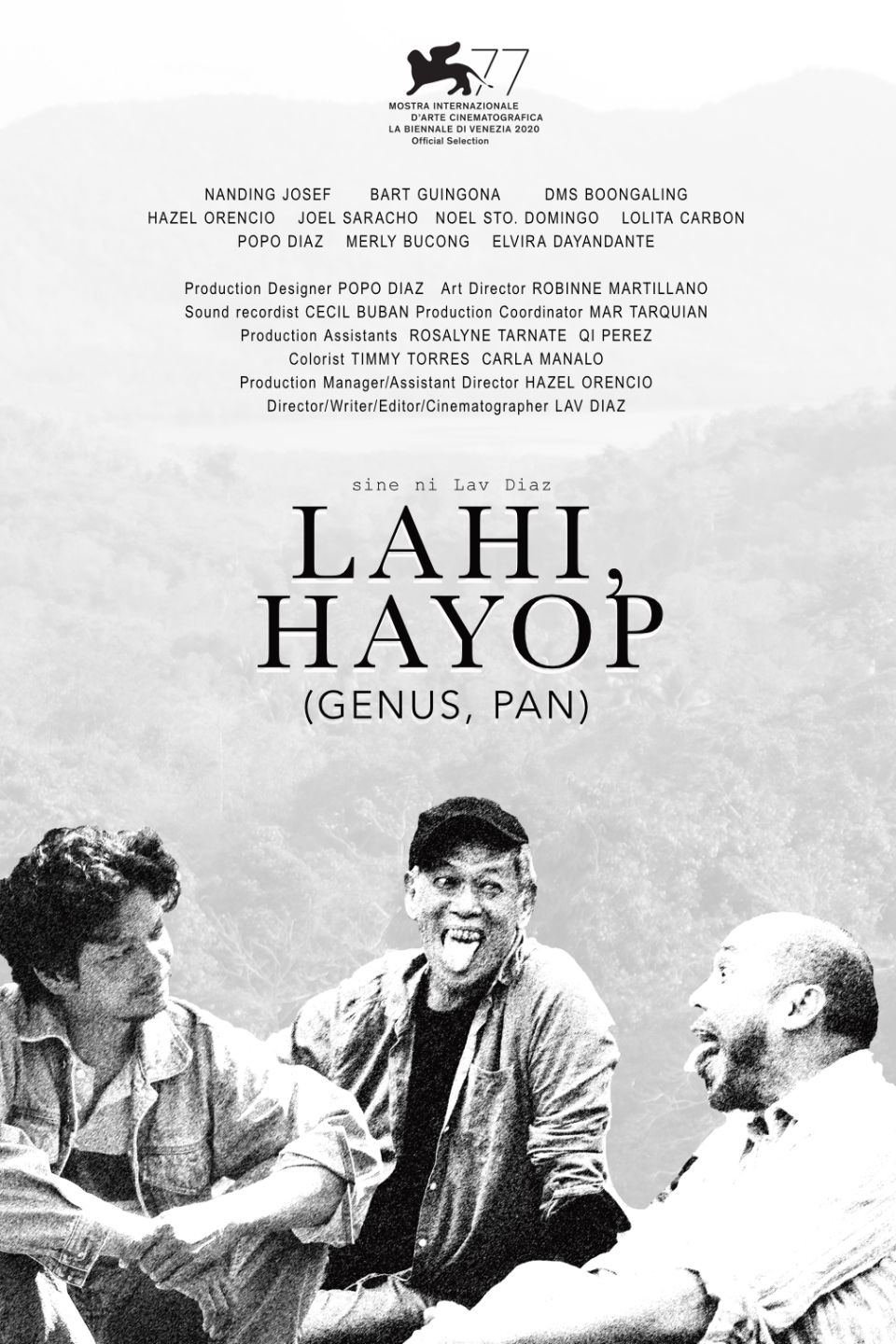
Genus Pan (Lahi, Hayop, Lav Diaz, 2020)

“Use your mind not your emotions” the hotheaded youngster of Lav Diaz’ Genus Pan (Lahi, Hayop) is repeatedly told, perhaps ironically by an earnest man of faith. Diaz’ shortest work in quite some time at a comparatively trim 156 minutes, Genus Pan is also among his most accessible in its seeming directness but carries with it hidden depths in its questioning of the “unevolved” human psyche, no better than an ape unable to overcome its baser instincts or cure the curse of human selfishness in which the only way to escape oppression is by becoming an oppressor. 

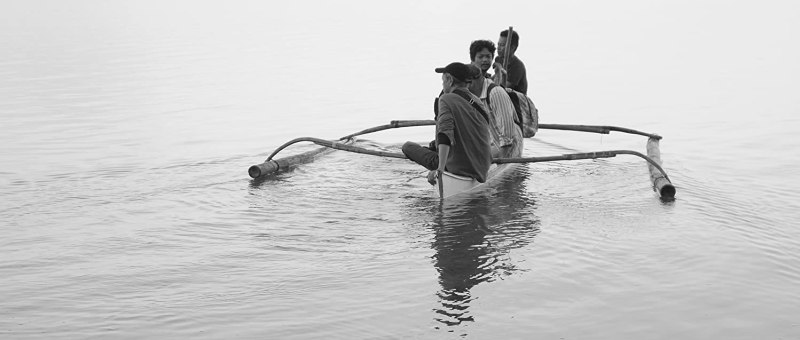
This is what Andres (Don Melvin Boongaling) fears has happened to his sometime friend, Baldo (Nanding Josef). As the film opens, the men are collecting their pay but as is customary the money is depleted before it even enters their hands with so many charges and deductions symptomatic of a world of normalised exploitation. Baldo found jobs at the goldmine for the young Andres and his old friend Paulo (Bart Guingona) but expects a cut of their pay as a brokerage fee, money Andres is loathe to give him both on principle and because he needs it to pay for medical treatment for his ailing sister. Baldo, however, is unsympathetic accusing the young man of ingratitude and disrespect. The three men are to travel back to their home village together on a boat Baldo has paid for, instructing the boatman to drop them at the far end of the island in order to avoid having to pay any more “fees” to the various authorities they may otherwise encounter in town, after which they will journey on foot through the forest. 

The forest itself is a primal place in which man is most aware he is also an animal. This fact is perhaps brought home to the men thanks to a broadcast received on Paulo’s radio in which a psychologist expounds on the idea that the human brain is largely underdeveloped, the marking of a developed mind a predisposition towards altruism. There is not so much difference, he argues, in the mind of an average human with that of an ape, “Genus Pan”, ruled by its basest instincts of selfishness and violence. Left alone in the forest and forced into mutual dependency, the differences between the three men each in their own way archetypes begin to strain their relationship. Paulo, a deeply religious man who spends most of his time reading the bible, is the peace maker but is also hiding a dark secret which perhaps informs his unexpectedly cynical advice to the earnest Andres who declares himself sick of his world of constant corruption, unwilling to be “a witness to this kind of dirt all my life”. Andres resents Baldo not only for the practical impact of his attempts to extort him, but that he has given in to the world’s venality and become another oppressor just like everyone else. Paulo advises him to use his head not his heart which would doubtless tell him that resistance is futile, but even in his nobility Andres cannot escape his rage at this infinitely feudal world in which a powerful few carry untold authority. He alone raises concerns about conditions at the goldmine where being buried alive is not an uncommon occurrence, not to mention the other mysterious deaths and disappearances, and longs for answers as to the murder of his brother he suspects for refusing to pay bribes to the local authorities, along with the spurious imprisonment of a local woman, the rape of a pair of sisters, and abuses against an indigenous mountain community.  

At the forest’s edge, Paulo reveals to him what it might have cost to escape his oppression as a member of a circus ruled by a cruel and sadistic tyrant, lamenting that in truth they were never able to escape Hugaw Island the ironic name of which apparently means “dirt”, given to it under the Japanese occupation in which it housed a comfort women station where women kidnapped from surrounding islands were forced into sexual slavery. The action shifting to another three men, the oppressors the Captain (Popo Diaz), Sergeant (Noel Sto. Domingo), and the least “developed” mind of all the calculating thug Inggo (Joel Saracho), further history of the island is revealed in its past as a smuggling hub unfairly defamed by foreign powers who spread rumours of its dangers to keep the curious away. Inggo longs to get his hands on the “jar of truth”, a burden later entrusted to Baldo’s daughter Mariposa (Hazel Orencio) who can move only very slowly yet is often carrying tremendous weight. 

Shooting in his familiar style, monochromatic static camera and long takes, Diaz’ shocking shift to handheld to dramatise false testimony as Inggo conspires against Andres to quell his rebellion hints at the irrational instability of “truth” and its potential for misuse at the hands of men like Inggo. A lone holdout against post-colonial feudal oppression, Andres’ refusal to capitulate cannot stand. As Paulo had warned him, he is a threat to the social order. The “smart” ones play along, and then like Baldo they join in while the Inggos of the world continue to prosper in their smug and heartless cruelty. “The island people are mute” a bereaved mother laments, “fear has taken over”. Ending on a note of intense anxiety, Genus Pan suggests that the civility we believe separates man from beast is at best paper thin while resistance is met only with futility when those in power are free to act with absolute impunity. 


Genus Pan streams in the UK 11th October, 5.30pm to 14th October, 5.30pm as part of this year’s BFI London Film Festival.

Original trailer (English subtitles)

Between the Seasons (계절과 계절 사이, Kim Jun-sik, 2018)

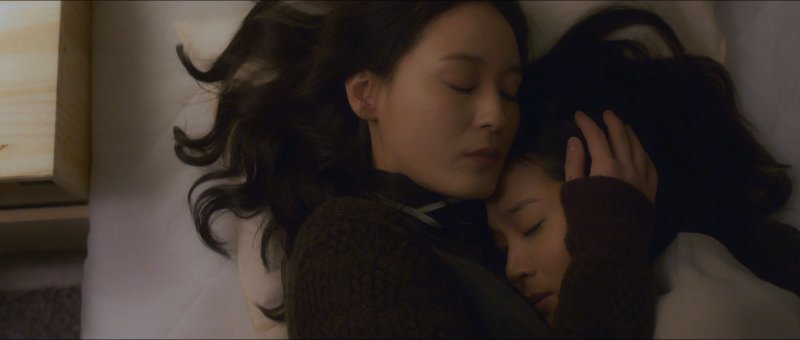
“To live the way I am” replies the reserved heroine of Kim Jun-sik’s Between the Seasons (계절과 계절 사이, Kyejeolkwa Kyejeol Sai Kaebongyejeong) when questioned about her dream, not quite able to answer when asked if she isn’t living that way now. An anti-romance and gentle meditation on the costs of authenticity, Between the Seasons finds two women at different stages of life unknowingly fighting a similar battle, perhaps identifying something in each other but unable to voice themselves fully though in fear and insecurity rather than shame even if they each internalise something of that too as they struggle to push past the barriers that prevent them from fully becoming themselves. 

In her mid-30s, Hae-soo (Rie Young-zin) has just moved from Seoul to a small town to open a bare bones coffee shop. She spends her spare time alone, and we quickly get the impression that she’s making an attempt to move on from something, eventually visiting a mobile phone shop to buy a new handset and instructing the salesman to delete all of her previous contacts and photos. Despite her attempts to discourage her, however, Hae-soo ends up forming an awkward friendship with bubbly high schooler Ye-jin (Yoon Hye-ri) who came into the coffee shop with an unusual order and then became a regular customer. Further bonding on a rainy night after the movies where Ye-jin was stood up by her boyfriend, the young woman starts randomly helping out just because she can see Hae-soo is overstretched eventually becoming an official part-timer spending most of her spare time with Hae-soo much to the consternation of her overbearing, grades-obsessed mother. 

Ye-jin quite literally begins to bring spring into Hae-soo’s life decorating the cafe with pretty cherry blossoms and floral motifs, lending it a cosier, more domestic atmosphere than the rather frosty, utilitarian vibe of Hae-soo’s original non-design. Questioned by Hae-soo about her dream she says she’d like to make things by hand, a dream that is perhaps in direct contrast with her mother’s obvious ambition for her. There’s not much money in paper cherry blossoms after all. That’s two reasons she might prefer being in the cafe rather than at home or studying somewhere else, Hae-soo both mysterious older sister and quasi-maternal figure, only the relationship is further complicated by Ye-jin’s growing romantic attraction to the older woman, becoming jealous as Hae-soo begins a tentative relationship with the sweet and goofy guy from the phone shop (Kim Young-min). 

For her part, Hae-soo remains either wilfully oblivious or simply unwilling to acknowledge Ye-jin’s obvious crush, awkwardly failing her as a friend and as a quasi-parental figure in refusing to engage with her complicated feelings in fear of having to reveal her true self. Instead she pushes the younger woman away without explanation, rejects her, and leaves her with only more shame and awkwardness despite having insisted that that there is nothing wrong in being different and that only by embracing your difference can you improve your life. Ye-jin continues to struggle with her feelings, observing her homophobic friends making fun of the supposed lesbian only to find herself semi-stalking the young woman confessing that if the rumours are true she too is the same. Despite eventually approving of her, the other girl tells her to keep her distance at school, lest they each fall victim to guilt by association. Eventually she gets all dolled up and heads to a gay bar where she furiously makes out with the bartender, mostly one assumes because she reminds her of Hae-soo doubly confirming her feelings. 

Hae-soo, however, is still conflicted, afraid to reveal her true self to anyone. The realisation she eventually comes to, symbolically removing the scarf from around her neck, is that she wanted to shine by herself, finding the confidence in authenticity rather than reflecting the light cast by the approval of others. Ironically that’s something she tried to encourage Ye-jin to do too but accidentally crushed in her brutal rejection of her feelings, costing her perhaps more than she realised in the process. Ye-jin had coyly asked her if she wasn’t making a rash decision, that so far she’d only shown her spring in her cheerful coffeeshop interior design, perhaps she’d like to take in the summer, even see her in winter too, truly thinking long term but the two women remain caught between the seasons, trapped by a sense of internalised anxiety that prevents forward motion. A gentle meditation on connection, authenticity, and self-acceptance Between the Seasons offers no easy answers for its conflicted heroines but motions towards a season of openness in which all are free to be who they are.


Between the Seasons streams in the UK until Oct. 11 as part of the Iris Prize Film Festival in collaboration with Queer East.

Original trailer (Korean subtitles only)

Days (日子, Tsai Ming-liang, 2020)

It’s not so much time that makes you feel old as the weight of all the days. Returning with his first narrative feature since 2013’s Stray Dogs, Tsai Ming-liang’s Days (日子, Rìzi) spins a tale of twinned loneliness in which two men, one young one older, one rich the other poor, embody two kinds of sadness as they live out their days of detachment as living ghosts in world which seems to have no place for them. 

Tsai opens with the face of his muse, Lee Kang-sheng billed only in the credits as Kang a wealthy man living in a spacious home surrounded by the beauty of nature. The lengthy, unbroken scene finds him staring impassively out of a window while a storm rages outside, the sound of rain falling while the reflection of trees blown by the wind is eerily reflected behind him. We can see that Kang is a man in great pain, his eyes filled with a melancholy desperation. He stretches and rubs his neck, his physical discomfort perhaps a manifestation of the emotional suffering which he tries to heal by fire, enduring painful moxibustion in search of relief.

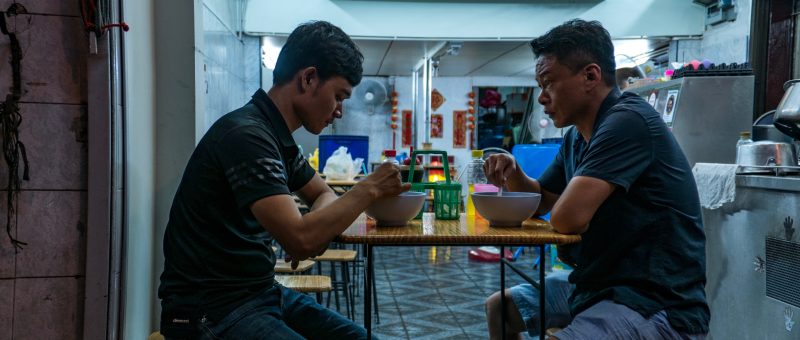
Meanwhile, in Bangokok, Laotian migrant Non (Anong Houngheuangsy) is quietly tending fires of his own, firstly those of ritual offering and secondly of sustenance as he stokes the embers to cook the old fashioned way in his tiny, spartan apartment. While Kang is a resolutely passive presence, Non fills his lonely days with industry, constantly at work as we witness him laboriously prepare his dinner with documentary realism. Non is at home with solitude in the private space, but forever alone outside of it. He stands to one side at the market where he works as customers mingle around him, always out of place and unseen like a ghost hovering in the corner of the frame. 

Parallel lines who meet, the two men eventually share a poignant, nominally transactional encounter in a nebulous third space of a neutral hotel room to which Kang has called Non for a sensual massage, presumably how he makes ends meet in Bangkok. Once again the young man does all the work while Kang lies impassive, Non oiling his fingers as he runs his hands over the older man’s body easing his pain through physical contact before he retreats off screen and we hear fabric falling, his Calvin Kleins hitting the floor as the two men briefly connect through an intense act of lovemaking, later proceeding to the shower where Non, still in the role of caregiver, tenderly washes the dejected Kang. Before he leaves, Kang idly hands the younger man the gift of a music box, a spontaneous decision that sparks a moment of melancholy emotional release. They struggle to say goodbye. Non leaves and Kang chases after him, Tsai lingering in the empty space of the hotel room while the two men head for dinner before returning to their respective days in someways changed and others not. 

His pain perhaps temporarily eased, Kang is not quite so passive as before, doing something or other with a fish and going for late night walks, but still finds himself lying awake while the sounds of outside wash over him, his eyes wide with fear and sadness. Non, meanwhile, returns to his routine but even more of a ghost than before, sadly cradling the music box as if in memory of his momentary connection its sound drowned out by the noise of anonymous modernity while the world goes on all around him, an invisible figure ignored by passersby walking alone into the night. 

A opening title card warns us that this is a film intentionally unsubtitled, much like life left to our own shallow grasp of meaning in thought or action, but what little dialogue there is hardly requires interpretation we feel it all the same. Tsai conjures an almost Antonionian sense of emptiness in place, a lengthy still shot of a “haunted” building peeling at the facade suddenly brought to life by the brief shadow of a cat in a window, while abruptly shifting to handheld to follow Kang, somehow alone and clutching his neck in pain in the chaotic streets. Both men exist at angles to the world, as if in some kind of secondary plane, meeting only for an instant and then returning to their solitary existences with only the brief memory of connection perhaps more painful than its absence. Tsai charts competing reactions to existential loneliness, the listless ennui of the wealthy Kang and the ceaseless industry of migrant worker Non, but finds them both equally displaced, searching for connection in an increasingly disconnected world. 


Days streams in the UK until 11th October, 6.30pm as part of this year’s BFI London Film Festival.

Original trailer (dialogue free)

Beyond the Dream (幻愛, Kiwi Chow Kwun-Wai, 2019)

Two troubled souls battle illusionary love in Kiwi Chow Kwun-Wai’s existential romance, Beyond the Dream (幻愛). What is love when divorced from fantasy, and once you know do you have the courage face it? That’s a question asked by each of the mirrored protagonists who’ve convinced themselves they are unworthy of love while struggling to extricate themselves from past trauma and present insecurity as they find the sands of reality constantly shifting beneath their feet. 

Chow opens with a street scene, the evening crowds gently parting to find a woman in distress, Ling (Wong Lam), who eventually begins to take off all her clothes. While passersby stare and film her public breakdown, a man, Lok (Terrance Lau Chun-Him), who recognises her from a support group for sufferers of schizophrenia, comes to her rescue as does a mysterious woman who wraps her cardigan around her giving her both modesty and warmth. Helping Ling into an ambulance, Lok ends up with the mystery woman’s cardigan somehow captivated by her, touched by the way she came to Ling’s rescue when everyone else was intent on ridicule. Sometime later he is surprised to realise that the woman lives on the floor above him on his estate. Returning her cardigan he discovers her name is Yanyan (Cecilia Choi Si-Wan) and she lives with her violent drunk of a father (Ng Kam-Chuen). The pair become a couple and Lok starts to wonder if he should tell her about his struggles with mental health only for his symptoms to begin resurfacing. Much to his horror he realises that his relationship with Yanyan is nothing but a vivid fantasy, a figment of his illness which exists only his mind. 

Yet even fantasy is built on a grain of truth as Lok later discovers when “Yanyan” turns up at one of his support group sessions only she’s a post-grad psychology student by the name of Yip Nam who is looking for volunteers to participate in her research into erotomania in those diagnosed with schizophrenia. Nam hopes to find out if lack of love is a causal factor in the condition through the stories of those who become consumed by romantic delusion. Unfortunately, her project is rejected by her supervisor, Dr. Fung (Nina Paw Hee-Ching), on the grounds that she has no viable subjects. Lok would seem to be the ideal patient, were it not for the awkward fact of which Nam is still unaware that she herself is the subject of his fixation, the “real” woman who came to Ling’s rescue all those months ago. 

“Relationships are always your problem” Nam is warned, herself carrying the burden of a traumatic past which, according to her mentor Fung, has also convinced her that she doesn’t deserve love, mirroring Lok’s fantasy of Yanyan and her imprisonment at the hands of the abusive father who eventually keeps them apart. In her role as his therapist, she counsels him to “find your true love in reality”, interpreting his recurring dream as a metaphor for his desire to lose himself in the comforting fantasy of his illusionary love for Yanyan rather than take the risks concurrent with seeking happiness in the “real” world. But she herself is also seeking wilful oblivion in other kinds of illusionary romantic distraction pursued perhaps as a form of self harm or at least a means of blaming herself for something for which she has no need to apologise. 

For Lok, meanwhile, romance is still more uncertain, his sense of reality permanently impaired as he finds himself pulled between his idealised love for Yanyan and the problematic relationship with Nam while convinced that no one could ever love him because of his mental illness. “No matter who you really are, you’ll all leave me in the end” he sadly affirms, later advising Nam that “it’s time we wake up from our dreams” ironically advocating for a return to “reality” while simultaneously running from it. Continually divided in Chow’s elegant composition, forever gazing through mirrors and seeing only the reflection of unfulfilled desire, the lovers struggle to overcome their psychological barriers to move beyond the dream of love into something more concrete if perhaps no less illusionary, chasing self-acceptance in the eyes of another as they surrender to romantic destiny as its own kind of “reality”. 


Beyond the Dream screens at Chicago’s Davis Drive-in on Oct. 10 as the closing night of the 11th season of Asian Pop-Up Cinema.

Original trailer (English subtitles)

A Day-Off of Kasumi Arimura Ep. 1 (有村架純の撮休 第1話, Hirokazu Koreeda, 2020)

As has sadly become all too clear recently, the Japanese entertainment industry can be a brutal place rife with exploitation in which performers are often expected to push themselves well beyond the limit or risk offending their agencies and thereby disrupting their careers. That is perhaps why a “day off” for a headline actress seems like a concept incongruous enough to spawn an eight-part, late night TV drama aired on premium channel WOWWOW. Often around half an hour in length (though this one is a little longer), drama series running after midnight have the freedom to embrace darker themes and can sometimes be risqué, but more often than not cater to those looking for easy comfort watching often revolving around food and/or local culture such as in the phenomenally popular Midnight Diner which was later picked up by Netflix, or the much loved Solitary Gourmet.  

The chief draw for international viewers, however, is that the first and third episodes of A Day Off of Kasumi Arimura (有村架純の撮休 第1話, Arimura Kasumi no Satsukyu) are directed by Hirokazu Koreeda, with Rikiya Imaizumi (Their Distance; Little Nights, Little Love) and Santa Yamagishi also doing double duty, while Satoko Yokohama (Bare Essence of Life, The Actor) and Megumi Tsuno (Ten Years Japan “Data”) fill the remaining slots. Each of the eight self-contained stories features lead actress Kasumi Arimura (Sekigahara, Narratage, Flying Colors) playing a fictionalised version of herself enjoying a surprise “day off” when, for one reason or another, shooting is cancelled at short notice. In the first episode under review here penned by Sakura Higa, Kasumi is currently filming a TV drama playing a top prosecutor but is given the day off after a member of the creative team calls in sick with flu. As a producer points out, flu isn’t the sort of thing that would have held up filming in the old days but what can you do?

Accordingly, Kasumi decides to take a bullet train to her hometown in southern Japan to visit her mother, Yumiko (Jun Fubuki). Having not returned for New Year, Kasumi is perhaps slightly put out to realise that her mother seems to lead a very active life and though she is obviously happy to see her it’s clear that she doesn’t just sit around wishing her daughter would call. On their way home from the station, Yumiko takes Kasumi by the supermarket to pick up supplies for a home cooked dinner where she shows her off to the cashier with whom she seems to be on extremely friendly terms. Kasumi smells romance in air, and even if a little surprised is not unsupportive but unwittingly puts her foot in it by bringing up the fact that Mr. Onishi (Akio Kaneda) is divorced and has a son from his previous marriage. 

It’s not Mr. Onishi that Kasumi ends up worrying about, however, so much as a mysterious young man, Makoto (Shinnosuke Mitsushima), who calls in to see her mother. While Yumiko has her signing autographs for all her friends and posters of her hit movies Flying Colors and Cafe Funiculi Funicula standing in the living room, Kasumi can’t help but feel put out having come all this way only to see her mum much more interested in this random man even if she seems to have come more out of duty than of love, disappointing Yumiko by declaring she won’t be staying overnight but heading back to Tokyo to go over her lines. Out of jealousy and a slight awkwardness, she worries as to what Makoto’s true motives are, especially after hearing her mother hint that she’s been giving him money, though it’s perhaps also true enough that she is simply grateful to have someone close by to help out with small but irritating tasks like changing the chain on a bicycle or getting rid of unneeded appliances. What Kasumi realises, however, is that her mother is harbouring a sense of guilt that relates to their perhaps atypical family history, something which she herself is forced to process through her surprise journey home which finds another echo in her relationship with her sickly, or not as it turns out, colleague. 

More or less a three hander, the episode is like much of Koreeda’s work replete with the detail of everyday life and the slight awkwardness of familial reunion. On stepping into her childhood home, Kasumi is chided by her mother for behaving like a guest, signalling that she no longer views herself as someone who belongs there or has the right to simply walk in. Kasumi never gets round to talking to her mother about whatever it was she might have wanted to talk about, but through their encounter with Makoto the two women begin to repair their relationship, meditating on the things which have changed while they were apart and those which haven’t. A beautifully gentle tale of familial reconnection, Kasumi Arimura’s first day off is another slice heartwarming drama from the empathetic director in which an actress takes the day to play herself and learns to make peace with the past by accepting the present.


A Day-Off of Kasumi Arimura Ep. 1 streams in the UK 10th October 1pm to 1pm 13th October as part of this year’s BFI London Film Festival.

Series trailer (no subtitles)

Take Over Zone (テイクオーバーゾーン, Shinpei Yamasaki, 2019)

The Take Over Zone (テイクオーバーゾーン) is where the heroine of Shinpei Yamasaki’s coming-of-age drama finds herself trapped, resentfully mired in adolescent confusion torn between the childish delusion of familial reunion and an adult acceptance of change. Sari (Riru Yoshina) is indeed on the run, a lonely loner convincing herself that freedom lies only in total independence while simultaneously justifying her new found appreciation for a team sport in insisting that they need her, basking in their gratitude when they win only thanks to her. 

Running may be the only bright spot in Sari’s life, though she can hardly be bothered even with that anymore. Two years previously her parents divorced. Sari’s mother Fumi (Chika Uchida) left with her younger brother Toma while she stayed behind with her feckless father Kenichi (Yota Kawase), a construction worker with a gambling problem. Forced to grow up all too soon, Sari is more or less looking after herself. Finding only beer in the fridge and a betting slip in the bin which explains why the cash jar is empty, she’s forced to raid her piggy bank for food while the house is a permanent mess. Understandably resentful, Sari is rude and petulant, talking back not only to her dad but to her teachers too. At school she’s a bullying delinquent, hanging out with the cool kids and picking on the captain of her track team, Yukina (Nanaha Itose). Seeking escape from her disappointing life, she tells her teacher she’s no interest in high school and plans to get a job, arrogantly refusing to train with her teammates preferring to hang out with the boys playing cards in the shed. 

A chance encounter with Toma in a local supermarket, however, begins to change her perspective. Her polar opposite, Toma is quiet and polite, though his awkward formality perhaps upsets her in his wilful distance after two years apart. Before long she runs into her mother too, discovering not only that her father hid from her the fact that she had remarried and returned to the area, but that she is actually married to Yukina’s dad which is somewhat pouring salt on the wound. Not only is her mother apparently happy, leading the kind of life she wanted to lead as a middle-class housewife, but she has a replacement daughter in Yukina who is everything she currently is not, the archetypal good girl. Bonding with Toma who is overburdened by his mother’s well-meaning ambition for him and dejected that the other kids don’t let him play because he’s no good at sports, Sari decides to run away childishly believing that the two of them can simply move in with grandma to be a family in rejection of their “selfish” parents. 

Sari resented her mother because she was always hounding her to study, perhaps a reflection of her dissatisfaction with their working class existence wanting to ensure her children enjoyed a more comfortable standard of life. Economic pressures do indeed seem to have been the motivating factor in the breakdown of the marriage, Fumi irritated by the exact same qualities in Kenichi which are beginning to drive Sari away, convincing her she’s better off alone than with her irresponsible father who has only casual employment with no prospect of advancement. She yearns for independence, not only for practical freedoms but for the emotional to simply not need to be burdened by disappointment or hurt. “Teams just hold you back” she snaps at her teacher threatening to quit the relay in favour of the solo race. 

Yukina meanwhile has problems of her own, missing her mother who passed away from illness while struggling to accept Fumi’s intrusion into her family home. A climactic event sees her moving towards the centre, claiming Toma as her own little brother while positioning herself as Fumi’s rightful daughter leaving Sari feeling further exiled, unable to process her resentment towards her mother for her abandonment while struggling to accept that her childish belief her parents would get back together and the family would be repaired will not come to pass. Yet it’s their shared love of running which eventually brings the two young women together, no longer rivals but teammates, later perhaps friends and then sisters as Sari comes to acceptance of her complicated family circumstances while realising just how unpleasant she has often been to those around her out of a mistaken attempt to push them all away. “I always ran like I was all alone” Sari admits, no longer running away but passing through her own take over zone, ready to face herself and her grief as she steps into the next stage of the relay race that is life.


Take Over Zone screened as part of Camera Japan 2020.

Original trailer (no subtitles)