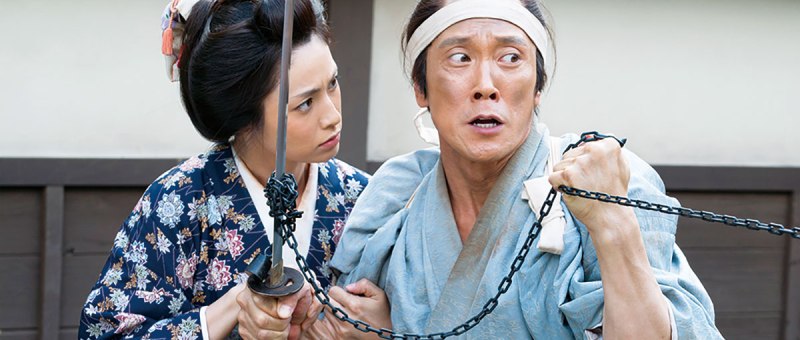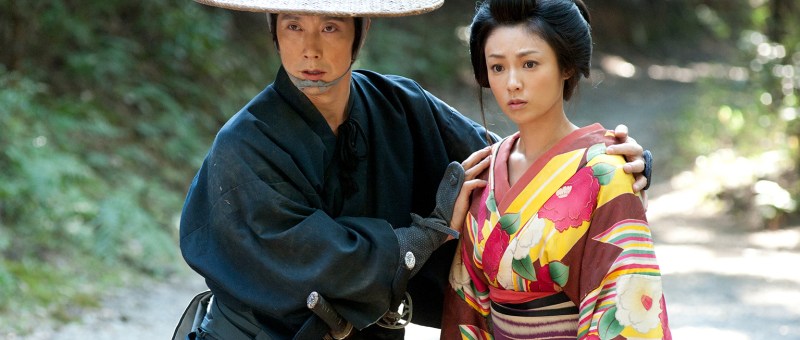
A Bullet Hole Underground (地下街の弾痕, Kazuo Mori, 1949)

Produced by Daiei Kyoto under the guidance of the Osaka Police, Bullet Hole Underground (地下街の弾痕, Chikagai no Dankon) is keen on selling a vision of order in a new Japan in which the police force employs all the latest technology to solve crimes calmly and methodically. We see them approach the crime scene forensically and conduct a series of scientific tests with microscopes and gadgets such as lie detector machines and code breaking equipment as they proceed towards the truth while earnest policeman Minagawa (Hiroshi Nihonyanagi) battles the ghosts of his past on realising that the dead man’s wife is his own lost love.

In any case, the film opens with a noirish scene at Umeda Station, Osaka, which then turns strangely comic. A man stumbles toward the exit and we assume that he is probably drunk but another man soon comes up behind him and pushes a pistol into his back. The second man pulls the trigger, then again to make sure, before calmly walking up the steps and leaving the station. A little while later, another drunk man arrives and has a little banter with the body before covering it with a signboard which is one reason it isn’t spotted until the shoeshine boys turn up in the morning. 

This sudden influx of children at rush hour is another symbol of the destabilisation of the post-war society in which the war orphans try to support themselves amid the still difficult economic environment. The lack of economic opportunities is also posited as a reason that the deceased, later identified as Kaneko, may have turned to crime by getting involved with a criminal gang smuggling drugs and money to destabilise the society even further. Yet the rot may have set in a little earlier than that. Before the war, Minagawa had wanted to marry Michiko (Machiko Kyo), the sister of his friend Sekiguchi (Toshiaki Konoe), but she later threw him over to marry the wealthy son of a family running a pharmacy. She admits she married him for the money, but after the war he lost everything. Unable to find work, Kaneko became a wastrel while Michiko gained employment at a cabaret bar as a dancer. He told her that he’d found a job at a company, but this turned out to be a lie and chief investigator Fujimoto (Takashi Shimura) assumes he must have been working for the gang. 

Still, to begin with it seems like it may have been a case of mistaken identity. Kaneko’s clothes turned out to belong to other people, a fact easily explained by Michiko that they were second hand, but also suggesting that someone may have set him up to take their fall. The gang needed the skills he learned in the navy but maybe they didn’t need him anymore. The root of the evil is located, ironically enough, in a jewellery store presenting a front of affluence and elegance but in reality founded on crime and misery when so many are still struggling to rebuild their lives. Michiko too seems to have turned cynical. She snarls and pushes Minagawa away, but privately cries and appears to regret her youthful decision to reject love for material comfort.

Perhaps because of its genesis as a film designed to promote the local police force, it has a much more upbeat conclusion and particularly for Michiko who is, unusually, allowed to redeem herself and gain a second chance to make a better decision by reuniting with Minagawa who does not and never has held her past against her. The pair of them look out over the fracturing city and remark at how it just carries on as if nothing had happened which feels like advice intended for the post-war society that it should do the same and try to leave the past behind to start a new life in this new era. Meanwhile, huge numbers of policemen swarm the harbour to crack down on the smuggling gang sending the not altogether comforting message that this city is well protected against all kinds of crime and the police force is a well-trained, modern institution that has the latest technology at its disposal along with astute and compassionate officers. There may be sleazy clubs, duplicitous men and heartless gangsters, black markets and smuggled dangers, but there are, the closing scenes with their wide-open vistas in which scorched trees stand behind the burgeoning city imply, better days to come.


Whirlpool of Flesh (おんなの渦と淵と流れ, Ko Nakahira, 1964)

A intellectual professor and his wounded wife find themselves trapped in a toxic marriage after returning from Manchuria in Ko Nakahira’s fatalistic drama, Whirlpool of Flesh (おんなの渦と淵と流れ, Onna no Uzu to Fuchi to Nagare). Set in the late ‘40s, the film does indeed position Manchuria as a point of corruption while otherwise suggesting that Japan itself has been emasculated by the Occupation, but otherwise demonstrates how the couple drag each other into a cycling whirlpool of jealousy and obsession that it seems neither of them are really equipped to understand let alone escape.

Claiming to have been struck by her bright and smiling face in her omiai photo, Keikichi (Noboru Nakaya) married Sugako (Kazuko Ineno) in Manchuria without actually meeting her before the wedding. Apparently uninterested in sex, Keikichi was a virgin on their wedding night but harbours doubts Sugako may not have been. In any case, he seems put out that Sugako is not in his opinion his intellectual equal. He chances on her diary in which she details how bored she is by his constant lectures about English literature and that she feels him to be more schoolteacher than husband, but he merely scoffs that it’s not particularly well written. He begins to suspect that she’s sleeping with customers who come into the speakeasy she opens in their home during the days between the Russian invasion and repatriation and succumbs to a generalised sense of impotence hiding out in his room upstairs reading while she takes care of business below. 

In the present day, convinced that she’s having an ongoing affair with a merchant, Otani (Kazuo Kitamura), Keikichi pretends to go to a hot springs resort and then sneaks back to spy on her from an adjacent room. Though he feels no desire for her as his wife, through the eyes of these other men he rediscovers a sense of Sugako as the woman from the photograph for whom he does feel some attraction and satisfies his latent sexual desires through watching her sleep with Otani. As an escape from the war, he’d been working on a translation of Shakespeare’s Troilus and Cressida the heroine of which he seems to superimpose on Sugako in wondering if she is a faithless woman or true, angel or devil. 

Yet from Sugako’s point of view, she begs him for physical intimacy which he refuses to grant despite his jealousy over her relations with other men. Traumatised by her sexual abuse at the hands of her uncle, Sugako believes that she has a body designed to satisfy men’s desires and is drawn into meaningless, and often transactional, sexual relationships. When Keikichi later questions her, it seems she doesn’t remember any of them in detail for to her they were simply “men” and nothing more. The situation is somewhat complicated by the fact that her uncle was a scholar of Chinese literature, which in part aligns him with Keikichi, but also points back to Manchuria as a source of corruption though coming uncomfortably from the opposite direction. 

Sugako equates this corrupted sexuality with the great emptiness inside her that frequently leads to thoughts of suicide. Nakahira constantly shows us shots of Keikichi’s knife as if implying some kind of violence is inevitably going to take place, though in the end it signals nothing so much as Keikichi’s impotence. Then again, the emptiness is also linked to a sense of despair in Japan’s defeat that is manifested most obviously in the house next-door where the widowed mother may have been having an affair with Sugako’s uncle and unsubtly tries to blackmail her by threatening to expose the secret of her sexual abuse about which she had tried to tell Keikichi but he had refused to listen. The daughter has become a sex worker catering to American servicemen to support the family while her brother, Kenichi (Tamio Kawachi), allows her to sacrifice herself for him justifying himself that it’s for the greater good as he’ll eventually become a doctor and save countless other lives. He’s also masquerading as a Christian to get a scholarship to an American university through the church which is all very contradictory not to mention selfish and cynical. The sister, meanwhile, appears to have lost her mind and frequently rants and raves, blaming her mother by claiming that walking in on her with Sugako’s uncle permanently corrupted her sense of self and sexuality. Like Sugako, she exorcises her trauma through abusing her body, in her case through sex work with “nasty GIs who don’t always pay.”

Keikichi refers to this as “post-war nihilism” like the frequent strikes and workers parades that take place around him, but partially repairs his sense of masculinity after moving to Tokyo and getting a job. At work he meets another young woman who is a mirror of the young lady from next-door in that she was also repatriated from Manchuria where her father was a member of the government. With her mother dead and father unable to work, Shimura (Kaori Taniguchi) also supports her family with her secretarial job and often goes without lunch herself to make ends meet. Keikichi notices this and offers her his bento claiming to be feeling unwell, but fails to notice how his pity wounds her dignity even if he meant in kindness while acknowledging that he’s never known hunger. Unlike the mismatched Sugako, Keikichi and Shimura are an ideal match. She also wanted to study English literature and can meet him on his level discussing politics and culture though he does not seem to be aware that he is attracted to her and acts almost paternally in offering to pay her university fees to help her escape her life of poverty, echoing Sugako’s claims that he had become her “little boy” rather than her husband. 

The irony is that Sugako insists Keikichi, who does little but look down on her and alternately complain that she’s either impure or unattractive, is the only man she’s ever loved and blames his lack of sexual interest in her on the unresolved trauma of her childhood abuse. Having asked Kenichi to help her get her hands on some cyanide, she is shocked and disgusted when despite his need he rejects her money and asks for her body instead. He insists that it’s “only the friction of mucus membranes” and that she might as well sleep with him first if she’s going to die, though her refusal is in part a desire to die “pure” and finally overcome the emptiness and despair inside her. This inability to reconcile herself is also aligned with Keikichi’s vision of “post-war nihilism” and suggests that in the end this trauma can’t be healed and must necessarily lead to destruction. Meanwhile, Keikichi seems to have discovered a path towards his rebirth in his friendship with Shimura only to potentially have the rug pulled from under him. His new future too, may end up poisoned by Sugako’s unilateral decision to facilitate it. Dark and twisted in true Nakahira fashion, the film paints the post-war society itself as a deepening whirlpool from which there is no escape or at least not for those like Keikichi and Sugako forever locked in a deathly embrace and drawn ever deeper into the waves.


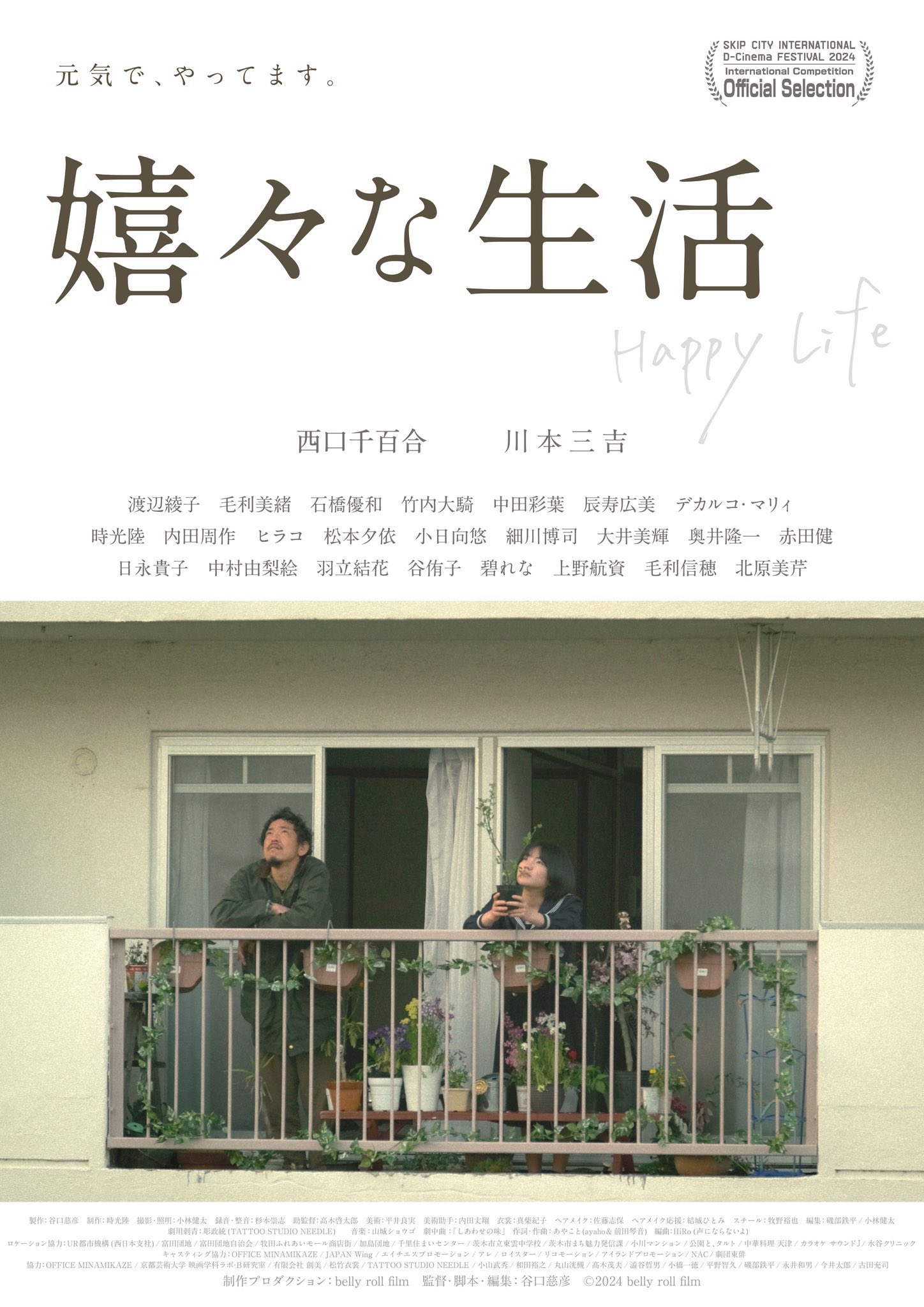
Paradise of Solitude (孤独な楽園, Ikki Katashima, 2024)

A blocked writer and a introverted young woman discover unexpected connection through accidental epistolary communication in Ikki Katashima’s poetic drama, Paradise of Solitude (孤独な楽園, Kodokuna Rakuen). Each wondering what exactly “paradise” means, the pair of them eventually find new ways to face the past and move on with their lives all while undergoing a vicarious romance with yearning at its centre that may or may not develop into something more “real” or else achieve its power solely through its lack of resolution. 

Yu Tsushima (Sho Aoyagi) is a writer struggling to meet his deadlines on a new serialised novel. Suffering with an illness, he’s retreated to his hometown and is now unable to leave because he experiences seizures on boats which understandably leaves him preferring not to get on them. One day, he receives an incredibly poetic love letter from an anonymous address only to notice a link to a porn site at the end of the email like a cruel punch line. Meanwhile, Ayame (Akiho Otsubo) is a nervous and introverted young woman working at a factory on the next island over. To begin with, it seems like she has suffered under the authoritarian rule of her aunt Tsukiko (Narimi Arimori), though as we later discover she may have meant well. 

Showing a talent for writing which sees her exploited by the factory boss, Ayame is tasked with writing a love letter on behalf of her friend Elena to a man she’s apparently only seen once yet has fallen hopelessly in love with. There’s something a little strange about this proposition, and not least because it seems like Elena may actually want this letter for herself and has unspoken (in Japanese, at least) feelings for Ayame. Elena is not the only non-Japanese person working at the factory at which it seems there may be some racist attitudes and behaviour among the employees, though there may be other reasons she feels isolated and otherwise drawn to Ayame.

But somehow, the letters find their way to Yu who is then “inspired” to write a new serial basically ripping off the anonymous correspondence but rewriting it in his own way while Ayame, having read his stories in a literary magazine, is not exactly angry yet confused and continues writing in order to complete this literary back and fore in crafting a new story together. Though the letters spin a tale of a lovelorn soul, it’s really the past that Ayame longs to revisit in the resultant trauma of her mother’s unexplained abandonment.

On top of the weird island drama, Katashima builds on the sense of uncanniness with a subplot about a cult-like local church and its own desire to reclaim Ayame thereby preventing her from fully confronting her past. Just as Yu is suffering from a medical condition, Ayame too experiences panic attacks when in contact with the church. Though it’s not always clear what is objectively true and what part of the story Yu is constructing from Ayame’s prose, parallel stories develop in which Ayame’s father hoped to liberate her mother’s soul though she eventually decided to chase paradise somewhere else. 

Because of her experiences, Ayame comes to believe that love within her has died, but perhaps begins to regain something of it thanks to her correspondence with Yu who becomes remorseful in learning that his actions may have been additionally unethical in encouraging Ayame to engage with her past trauma and risk dragging it all up again. He, meanwhile, begins to discover his creativity and overcomes the psychological dimensions of his condition by leaving his island and breaking out of his self-imposed isolation. The correspondence is like the message in a bottle discovered by Ayame’s mother which claimed to be from “paradise”, a hand across the ocean promising a better world over the horizon. Whether or not they find each other eventually in a more direct sense may not really matter, for simply having this invisible presence has enabled each of them to move past their internalised inertia and restart their lives. They may be trapped in a paradise of solitude, but on the other hand not quite alone and now a little more open to life’s possibilities rather than bound by its hurts and disappointments too frightened to leave the safety of their isolation in search of a more perfect paradise.


Paradise of Solitude screened as part of this year’s Cinema at Sea.

Trailer (no subtitles)
Okinawa Blue Note (오키나와 블루노트, Cho Sung-kyu, 2024)

If you run into someone who has the same name, same birthday, and was on the same flight as you to a random destination wouldn’t you call that fate? The protagonists of Cho Sung-kyu’s Okinawa Blue Note (오키나와 블루노트) prefer to think of it as mere coincidence, at least to begin with. They each have different reasons for coming to Okinawa, but then again perhaps fate sent them here to get a new lease on their lives if not to fall in love.

Love does however seem a little unlikely for the mismatched pair each named Kim Jungmin who are about as different from each other as it’s possible to be. Yet the male Jungmin’s (Kim Dong-wan) animosity is somewhat understandable given that his arrival in Okinawa has become chaotic thanks to the female Jungmin’s (Hwang Seung-eon) presence given that she mistakenly ended up with both his pre-booked car and room reservation because the staff members only checked the name and not the booking number. Jungmin isn’t the sort of person who copes well with complications, nor does he cope well with noisy, more extroverted people like the female Jungmin who is also annoyed by the whole thing but on the other hand doesn’t think it’s really her problem having merely assumed she’d been lucky enough to receive a free upgrade rather than actively nabbing someone’s more expensive package. Nevertheless, he’s forced to get along with her because he needs to borrow her rental car to get around which also means accompanying her on her touristic adventures and getting swept up in her enthusiastic exploration of the island.

The female Jungmin has a tendency to drink too much, say things she shouldn’t, and forget about them by the next morning. The male Jungmin, by contrast doesn’t drink because he is living with rheumatoid arthritis though he says he intends to drink again if his condition improves. He writes romance novels and doesn’t use the internet all that much. She writes webtoons and posts stories to instagram. They really have very little in common aside with a sense of dissatisfaction about their lives, their names, birthdays, and travel itinerary but you can’t deny that their meeting is like one of the male Jungmin’s novels as even he finds himself musing on a new story about someone who comes to Okinawa to patch things up with an old lover only to fall in love with a whale shark they met along the way.

Gradually it becomes apparent that the female Jung-min is here to confess her feelings to a boy from Korea who, it turns out, may have come to Okinawa in search of greater freedom rather than needing to be liberated from his tank which ironically may be more the case for the male Jungmin. Though it’s obvious from their second meeting with Taemin’s colleague Hiro that the two men are a couple, the female Jungmin can’t seem to see or accept it nor does he actually tell her outright that he’s gay only that all he wants from her is friendship as he’s explained several times before only she was too drunk at the time to remember she’s already declared her feelings and been rejected. What the female Jungmin saw as “fate” really was just coincidence and personal myth making as Taemin too had his own fate to follow that led him to Okinawa where he was freer to pursue his romantic desires, if only slightly, than in the still conservative Korea. When the male Jungmin floats an idea for a book inspired by his time in Okinawa the two men give their consent to be included but also ask their relationship remain a same sex one rather than the heterosexual casting Jungmin had given it possibly out of an attempt to disguise their identity but also an underlying squeamishness towards the inclusion of LGBTQ+ issues.

Nevertheless, the male Jungmin is able to re-envision the situation by turning his life into fiction and exploring a relationship between himself and the female Jungmin with the roles somewhat reversed in which he is a stereotypically hard drinking, chain-smoking writer and the female Jungmin a put upon woman with rheumatoid arthritis helping someone else achieve their romantic desires. Is this life imitating art, or art imitating life? Whatever it is, it seems the trip to Okinawa with its tranquil streets, picturesque environment, friendly and laid-back people has offered each of them opportunities both romantic and creative in a moment of unexpected serendipity, or perhaps this time it really was fate after all.


Okinawa Blue Note had its World Premiere as part of this year’s Cinema at Sea.

Rules of Living (ルール・オブ・リビング, Greg Dale, 2023)

A lost tourist finds a begrudging sanctuary in the home of a reluctant middle-aged woman in Greg Dale’s cross-cultural comedy, Rules of Living (ルール・オブ・リビング). Well intentioned as it may be, the film has some outdated humour and suffers from an unbalanced perspective that prioritises that of the American hero and at times uncomfortably pushes a message of Western individualism as he somehow “liberates” there heroine, Mikako (Kaho Minami), from her sense of obligation to her family and wider community. 

In a case in point, Mikako doesn’t want a roommate because her well-appointed home is a private sanctuary from the outside world and its constant judgement but is more or less forced to let Vincent (Greg Dale) in out of guilt and politeness. For his part fleeing a messy divorce and his own dissatisfaction with life under capitalism, Vincent arrives in Japan only to be somehow surprised that everything’s in Japanese and he can’t communicate with anyone because they are all too embarrassed about their English ability to respond to his questions. This results in a little well-worn humour in which his asking a portly middle-aged lady about a cheap place to stay is misunderstood and leads to an awkward situation as the apparently sexually insatiable older woman drags the naive and wholesome Vincent to a love hotel. Yet Vincent, an aficionado of Lafcadio Hearn, continues to wander round with wide-eyed wonder before rocking up Mikako’s office for more language-barrier banter and subsequently at her house despite not having made any attempt to contact her to make arrangements having befriended her daughter Chieko in Bali.

The film seems to directly contrast Mikako with her daughter who has given up a prestigious job and corporate career to go travelling leaving Mikako overstretched trying to care for her own mother alone as her health declines. Chieko’s decision is to a degree selfish in that she doesn’t answer her mother’s calls and does not even return home for her grandmother’s funeral while ironically looking down on Mikako for being a doormat who always puts the needs of others above her own as, the films argues, is expected by Japanese society. That’s not entirely wrong, though there must be a middle ground between total abandonment and selfless sacrifice in which not everything would simply be left for Mikako alone to deal with and she would have more freedom to fulfil herself outside of the expectations of others including those of Vincent. It’s notable that Mikako also seems to be dissatisfied in her career because of persistent sexism and office mores in which, at 49, she’s been more or less demoted to the ranks of office ladies after spending the rest of her working life in accounts and likely won’t be offered any further promotions, therefore justifying Chieko’s decision to quit. At the office, Mikako is treated as a maternal figure unfairly over relied upon by the boss because of her advanced skills while the younger women make too many mistakes and are slapdash in their work because they aren’t planning to stay in these jobs long term.

Meanwhile, Mikako is also under pressure to remarry especially as many seem to remark on the fact her family home is too large for her as a single woman. She’s been in a semi-serious relationship with a divorced childhood friend for some time but neither of them seem keen to give marriage another go until he too is pressured by his father to find another wife in order to take over the family business. Koichi (Kippei Shiina) is apparently the perfect man, nice, polite, well turned out and professionally successful yet there’s no real spark and Mikako feels guilty that she can’t learn to love Koichi in the way everyone else seems to love him for her. If she marries him, it will be for convenience and companionship along with the expectations of others much more than for herself. 

Her romance with Vincent is not all that convincing but born of frustration with these same social expectations and desire to put herself and her feelings first as manifested in her sudden desire to learn English. Vincent teaches English around the neighbourhood and spreads these individualist ideas around while enlivening the community through the simple act of communication as if no one had ever thought to speak to anyone else before. Yet he meets a more cynical force in the head of the language school he eventually gets a job at who is from India and offers yoga classes on the side despite never having practiced it before coming to Japan in another example of the pernicious qualities of these “expectations”. Vincent partially falls victim to them too in assuming a young woman in the staffroom is a lost student rather than a teacher simply because she looks Japanese. Nana complains no one takes her seriously because of her appearance despite her native level English and American accent. Before arriving at Mikako’s Vincent had tried to rent an apartment only to be told they don’t rent to foreigners and those that do either offer inappropriate accommodation or ask for a series of spurious additional fees. A man in the street also yells at him to go out with his own kind when seeing him with Mikako.

Essentially, Mikako’s choice is between two men, Vincent who apparently represents “freedom”, and Koichi who represents conventionality. This rather undermines the central thesis of Mikako rediscovering herself and taking agency over her life rather than as her daughter had said devoting herself entirely to the service of others. The film’s title is taken from a series of rules Mikako pastes up as condition for Vincent staying with her which included not using the bathroom or disturbing her while she’s in the living room, symbolising her desire for privacy and reluctance to let the relentlessly friendly Vincent into her life (even though being reluctant to let a total stranger and especially a man you’ve never met before stay in your house with you is completely understandable), but also hints at the “rules” that govern her own life in a conformist and patriarchal society. Some of these at least she may escape in deciding to follow her heart even if the place it leads her to has rules of its own that may not in the end be all that better.


Rules of Living screened as part of this year’s Cinema at Sea.

Trailer (English subtitles)

Sunset Over the Horizon (夕陽西下, Lin Fu-Ti, 1968)

Shot at the same time as The Love in Okinawa, Sunset Over the Horizon (夕陽西下) is another Okinawan and Taiwanese co-production directed by Lin Fu-ti assumed lost until its discovery in San Francisco’s Chinatown in a Mandarin-dubbed print. Unsurprisingly, it features many of the same cast members and locations and even has a similar theme of impossible love but is more ambitious in scope incorporating both dream sequences and flashbacks to explore the changing relationship between Japan and Taiwan.

Lin opens the film with its conclusion as Shizuko watches a boat silently depart carrying away her love, the much older pastor/penniless painter Ching-wen who has made the decision to return to Taiwan having finally faced, if not quite come to terms with, his traumatic past at the end of the war and Taiwan’s “liberation” from Japanese colonisation. Japan had conquered Taiwan by force in 1895, but otherwise ruled with much less of an iron fist than it did in other areas of its empire. Lin seems to be making a minor point in dramatising the moment of “liberation” as one of conflicting emotions as the Japanese flag is slowly lowered and that of the KMT, another colonising force, rises in its place meaning that the island is not really “liberated” at all, merely changing hands and to a regime that became more oppressive than that which preceded it had been. 

The irony is that it’s this “liberation” that disrupted his romantic future as a young Taiwanese student in love with the daughter of a Japanese general. With the end of the war, the Japanese must leave Taiwan and so his love must go with them and return to the mainland. She asks Ching-wen to come with her, but he refuses. He is unwilling to leave his nation and his family, though we can see he did so years later and traveled to her hometown of Okinawa though she ultimately chose to take her own life out of a sense of despair and futility. She could not return to Japan with Ching-wen nor stay with him in Taiwan either and so to her the only answer, the only real “liberation,” lay in death.

Shizuko later posits something similar even if her dilemma is different. Her businessman father wants her to marry the son of a local factory owner so that he will support his business but Shizuko refuses because she wants to fall in love and does not seem to like her father’s chosen suitor. The situation is somewhat complicated by the fact that Shizuko is a child of her father’s first marriage and is therefore resented by her stepmother who wants her to leave the family as quickly as possible. In some ways this dynastic union represents a decision to embrace the more consumerist future that Japan in the later 1960s represents. Ching-wen on the other hand despite his ruination represents something purer and more spiritual that is less materialistic and rooted in sincere emotion. Shizuko insists that the businessman may buy her body but never her heart, but that seems perfectly fine to him because it seems he’s not all that bothered about her heart and just wants to possess her like a trophy. Frustrated by her objections, he continues to offer greater sums of money and later tells his underling, who looks horrified, that he plans to keep her locked up at home.

But there are other forces which stand in the couple’s way such as the inappropriate 18-year age gap considering that Shizuko is only 19 years old meaning she was born around the time Ching-wen’s first love died (probably at around the same age). It appears that Ching-wen is protestant preacher and so there’s no religious reason why he should not be married, but it’s clear that he has a serious alcohol problem and is a broken, ruined shell of a man unable to bear the romantic heartbreak he endured as a student and has presumably been atoning for ever since. Given all of this, there is no real explanation for the love that exists between them in the first place save for physical attraction (which is less likely given Ching-wen’s unkempt appearance) or a meeting of souls. In the end the theme seems to be moving on from the past and we realise that the lovers cannot be together because Japan and Taiwan must in effect go their separate ways. Though Shizuko too says she longs to return to Taiwan (when she lived there is not explained), she must fulfil her duty to her father by marrying the Japanese businessman. Over the horizon, there is only ever a sunset with no real indication of a happier future in the distance only futility and endurance if also a new beginning in moving on from the traumatic past.


Sunset Over the Horizon screened as part of this year’s Cinema at Sea.

Trailer (English subtitles)

Eye for an Eye 2: Blind Vengeance (目中无人2, Yang Bingjia, 2024)

The wandering swordsman returns but this time to a world much more in disarray than when we last left it in the sequel to the surprise hit streaming movie An Eye for an Eye: The Blind Swordsman, An Eye for an Eye 2: Blind Vengeance (目中无人2, mùzhōngwúrén 2). Less origin story than endgame, the film finds bounty hunter Cheng Yi living in another dusty town and working for Youzhou Prefecture to bring in wanted criminals dead or alive but finally forced into the role of protector for a little girl dead set on vengeance against this world.

Richer in scope and ambition, this time around we’re given a little more backstory about the former lieutenant who is now using his martial skills to enact justice in an otherwise lawless society if only when he’s paid to do so. One of his targets turns out to be a man who served under him in the war and is disillusioned about its aftermath. “What did we gain in the end?” he asks, justifying himself that he may have killed a few people and taken some money but he was only claiming what he was owed. The argument doesn’t wash with Cheng Yi, but the war also took his sight from him and he too is a disillusioned exile from his home in Chang’an living a nihilistic life of drink of killing on the behalf of a distant and compromised authority. 

His wilful isolation may be why he is not originally motivated to help the orphan little girl Xiaoyu (Yang Enyou) who says her mother starved to death during their escape. Xiaoyu had tried to protect her little brother who seemed to be mute only to see him trampled beneath the hooves of a debauched nobleman who had just murdered an entire family because they had dared to tell on him to his father. The family had been planning to flee at dawn but Li Jiulang (Huang Tao) got there first. Xiaoyu witnessed his crime after sneaking in to steal the bread they were baking and was then freely given to her by a young woman Li later killed, further stirring her desire for revenge. Cheng Yi ends up saving her from Li on two separate occasions, though the second time it isn’t overly clear whether it was intentional or a drunken coincidence. Nevertheless, he continues to counsel her against pursuing her revenge, especially towards a man like Li who is wealthy and connected and has no compunctions about killing children. 

Li is also seen to abuse drugs and have a sadistic streak though no real explanation is given for his cruelty save that he is evil and has enough money and power to do as he pleases. No one except the little girl is going to put a bounty out on him, as she naively tries to do by selling her brother’s silver whistle to get a poster mocked up though Li simply offers a double bounty on her and it seems plenty are desperate enough to consider killing a defenceless girl to get their hands on it. Perhaps it’s this that eventually moves Cheng Yi’s heart as she continues to insist on an impossible justice even at the cost of her own life. Like him, she no longer has any family nor any place to call home and is displaced within the chaos of late Tang. Through bonding with her, he begins to rediscover his humanity and considers leaving the world of the bounty hunter behind to become an “ordinary person” in Chang’an to raise her away from this nihilistic way of life.

Building on the success of the first film, Yang Bingjia makes the most of an increased production budget to fully recreate the atmosphere of a bustling frontier town while continuing the Western influence as Cheng Yi hunts down wrongdoers in an otherwise lawless place. The connection between the cynical swordsman and his tiny charge has genuine poignancy as he continues to caution her against the path of revenge, reminding her that it is a continuous cycle and one act of vengeance merely sets another in motion, yet finally deciding that he must teach her what he knows anyway because like him she has no other way to live. Still, what he envisions for her is a peaceful life in Chang’an, far away from the chaos of the frontiers in a world that may not quite exist anymore but may yet come again if not, perhaps, for all.


Eye for an Eye 2: Blind Vengeance is released in the US on Digital, Blu-ray & DVD March 4 courtesy of Well Go USA.

Trailer (English subtitles)

Project Silence (탈출: 프로젝트 사일런스, Kim Tae-gon, 2023)

“It’s a nation’s duty to protect its citizens wherever they are,” according to a more earnest politician, though Blue House security advisor Jung-won (Lee Sun-kyun) counters him that actually their duty only extends to those who voted for them, and they expect wise political judgment. Jung-won is a classic political lackey in that he’s intensely cynical and his every living thought is about how best to spin any given circumstances so that his boss, Hyun-baek (Kim Tae-woo), will become Korea’s next president.

There’s something quite remarkable about the extent to which Jung-won has erased himself from this equation and dedicated his life to making Hyun-baek’s a success while otherwise leaving conventional human morality at the door and pursuing a doctrine of doing only that which is most politically expedient. Some of his detachment might be explained by the fact he lost his wife some time ago to a lengthy illness and is about to send his daughter, who views him with contempt, to study abroad in Australia thanks to a few strings pulled by Hyun-baek. 

But as he later says, if Hyun-baek were actually there and seeing this for himself, he would make a different decision. Despite his cynicism, Jung-won eventually becomes a voice of authority during a moment of crisis and determines to set about rescuing the survivors rather than communicating with Hyun-baek about how best to turn this situation to their advantage. Paradoxically, he redeems the government in the eyes of those stranded on a bridge after a multi-car pileup in the middle of a particularly thick fog who come to realise that the authorities are not all that invested in rescuing them and may even be partly responsible for putting them in danger.

The Project Silence of the film’s title turns out to be one of creating genetically enhanced attack dogs who can chase a target with a specific voice. Apparently developed originally by the US and EU, the project is being researched in Korea but rendered a failure with the current batch of dogs set for “disposal”. That is, if they hadn’t been set loose by the accident and the possibly malicious actions of their handler who claims he was researching rescue dogs but was forced to reprogramme them to kill on the orders of the military. As he points out, the leader of the dogs, who has a head injury suggesting their programming has been disrupted, is only taking their revenge for their constant mistreatment at the hands of humans.

Then again, one of the ironies of Project Silence is that there is quite a lot going on from the unusually thick fog, the multi-car pileup caused by a live streamer driving recklessly for views, the toxic gas flowing from a crashed lorry, to the fact the bridge itself may collapse after the military helicopter sent to retrieve the dogs crashes and damages the support cables. All things considered, it is too much all at once considering the outlandishness of the evil dog plot. Though there are an assortment of survivors to become invested in as is usual in these kinds of films, we don’t always get to know them well enough with a series of subplots left unresolved such as the creepy behaviour of a Buffalo Bill-esque trucker who nevertheless becomes a kind of comic relief figure and eventual saviour of the group while becoming a reluctant buddy to Jung-won. Similarly, the dementia of an elderly woman (Ye Soo-jung) is intermittently brought up but never for any real reason nor is it ever fully explored, not even in her relationship with her husband who is responsible for her care. The younger of two bickering sister’s golf career does however turn out to have a practical application.

The conflict between Jung-won and his daughter, meanwhile, is largely mediated through her contempt for his callousness and resentment towards him for failing to address her mother’s death. Of course, saving the passengers is also a way to redeem himself in Kyoung-min’s (Kim Su-an) eyes much like the father in the similarly themed Train to Busan, though the awakening that Jung-won undergoes is more like the fog gradually lifting as he realises he is also being played by political manipulators while it is as he said different if you’re actually there and much harder to make the “sensible” decision to let the bridge collapse and take the potentially embarrassing evidence of their rogue science experiment with it. Perhaps that’s the real meaning of “project silence,” making sure there’s no one left to speak. But Jung-won is used to playing this game from the other side so he’s a few steps ahead and knows his best weapon is noise, tell everyone and do it right away so they don’t have time to shut you down nor can they deny it later. He may have been party to lingering authoritarianism, but has now realised that a nation’s primary duty is to protect its citizens after all, even if they voted for the other guy. 


Project Silence is available in the UK on 4K UHD courtesy of Altitude.

Trailer (English subtitles)

Asian Pop-Up Cinema Returns for 19th Edition

Chicago’s Asian Pop-Up Cinema returns for its 19th edition March 20 to April 13 in a new format featuring a juried competition with 16 films vying for the coveted inaugural prize. Taiwanese horror comedy Dead Talents Society will open the festival with director John Hsu and star Chen Bo-lin, also the recipient of the Bright Star Award, attending to present the film. Producer Daisuke Sato will also be attending the closing film Brush of God to collect the posthumous lifetime achievement award for late director Keizo Murase, while actress Michelle Wai and director Anselm Chan will be in attendance for the Centrepiece Film, the director’s cut of The Last Dance.

Here are the East Asian films included in this year’s programme:

China

  • Like a Rolling Stone (出走的决心) – powerful drama inspired by the real life story of a middle-aged woman who decided to go travelling in order to escape her oppressive marriage.
  • A Long Shot (老枪) – a former sharpshooter finds himself unbalanced amid the corruptions of China’s 90s economic reforms in Gao Peng’s intense social drama. Review.

Hong Kong

Indonesia

  • Crocodile Tears (Air Mata Buaya) – the intensely claustrophobic relationship between a mother and son is disrupted when the boy meets a girl in Tumpal Tampubolon’s eerie maternal drama. Review.

Japan

Malaysia

  • Indera – horror film in which a father takes his daughter to the countryside to cure her illness after a stand off between villagers and government forces in 1985.

Mongolia

Singapore

  • Stranger Eyes (默視錄) – a fracturing family is confronted with the cracks in its foundations when they begin receiving strange DVDs after the disappearance of their daughter in Yeo Siew Hua’s elliptical drama. Review.

South Korea

Taiwan

  • Dead Talents Society (鬼才之道) – faced with disintegration a teenage ghost must learn how to seize the stage in John Hsu’s zany horror comedy. Review.
  • Doubles Match (乒乓男孩) – two little boys dream of making the national table tennis team but their friendship is disrupted when one is sent to school in the city.
  • Hunter Brothers (獵人兄弟) – Yuci’s peaceful life is disrupted when his brother is released from prison after serving time for the hunting accident that killed their father.
  • Old Fox (老狐狸) – a young boy begins to absorb all the wrong lessons while drawn to his enigmatic landlord in Hsiao Ya-chuan’s 80-set coming-of-age drama. Review.
  • Yen & Ai-Lee – gritty drama in which a young woman is released from prison after killing her abusive father only to learn her mother (played by the iconic Yang Kuei-mei) is dating another abusive man.
  • The Uniform (夜校女生) – drama set in 1997 in which a girl is forced to attend an elite high school as a night student but becomes friends with one of the day pupils.

Thailand

Asian Pop-Up Cinema Season 19 runs in Chicago March 20 to April 13. Further details are available via the official website and you can also keep up with all the latest news by following Asian Pop-up Cinema on FacebookX (formerly known as Twitter),  Instagram, and Vimeo.

Tale of the Land (Loeloe Hendra, 2024)

After witnessing her parents’ murder, a young woman is forced into an isolated way of life in Loeloe Hendra’s indie drama, Tale of the Land. Land is, at least according to grandfather Tuha, a place where nothing good happens which might be why he insists on keeping May on the boat. Or then again, perhaps as May is beginning to suspect, he is willingly constraining her and ensuring that she will remain at sea though she now wants a little more out of life.

On one of his ventures out, Tuha is passed by a huge and impressive coal liner while plagued by visions of the house sinking. May asks him if the house will last, but he replies that it surely will for the ancestors will protect them. Yet this is why land has become such a contentious issue to Tuha. The family was forced off their ancestral land by the arrival of the mine. Tuha isn’t lying when he tells May that the land is dangerous because the mine appears of have acquired the consent of the villagers through threat and violence. He no longer speaks to his surviving son because he views him as a traitor for having given in and thrown his lot in with the miners.

But May isn’t sure she believes her grandfather anymore. Perhaps he’s only saying that because he fears being alone and means to trap her with him. Tuha told her that she’s the victim of an incurable curse and is in effect allergic to the land. Every time she touches ground, she collapses. Her fate is echoed in the wounded buffalo she sees on the shore, longing for freedom yet tethered and caught between two worlds. The buffalo turns out to belong to Lawa, a local soldier who seems to have taken a liking to May but a sworn enemy of Tuha in representing the modern nation  mired in authoritarianism and destructive capitalism. 

Thus May is caught between the two men, the grandfather with his certain faith in the power of the ancestors, and the modern man who swears he’ll cure her and also take her to the site of her parents’ graves. Tuha tells her that this is the only place left to them and they must accept it, that she should give up any thought of returning to the land and learn to be happy with the self-sufficient life they’ve built at sea. The film is then a kind of parable for the fate of the Dayak people who have been displaced from their ancestral lands by the incursion of modernity in the form of violent corporatism as manifested in the destructive mining industry which ruins the environment. Whether May’s condition really is a “curse”, or a trauma response to witnessing the deaths of her parents, the land is a dangerous place and most particularly for people like her. Yet the sea isn’t really safe either and offers her little prospect of safety or happiness.

She tries to fight her curse with modernity by simply wearing shoes so that the soles of her feet don’t touch the earth, but discovers that it isn’t really that simple. Dreams and reality become indistinct, May performing a traditional folk dance on the house on the water and also taking part in a folk ritual with Lawa on land. She experiences echoes of the life that’s been taken from her, but finds little in its place already fed up with the monotony of life on the sea but torn between her grandfather’s warnings and Lawa’s promises. Tuha constantly berates her for doing the wrong thing, claiming it’s her fault they’ve no fish because she upset the ancestors by forcing him to kill a chicken in order to appease her curse but she can’t be sure he’s wrong, or that his stubbornness isn’t justified. He was right when they said they had nowhere else to go because their people have been exiled from their own lands and can no longer wander freely but are trapped within a liminal space literally floating in the ocean between the land and the horizon while unable to travel in either direction. May may be on the move and trying to reclaim what is hers by right, stepping ashore onto an uncertain land little knowing whether it will accept her or she it.


Tale of the Land screens as part of this year’s Cinema at Sea.

Trailer (English subtitles)