The Tale of the Princess Kaguya (かぐや姫の物語, Isao Takahata, 2013)

no3_kaguya_nikonikoboard_outSo, Studio Ghibli is no more. For the moment anyway – both of the old masters have hung up their paint brushes for good, intent on indulging other pursuits, or so they say. Neither has yet found a suitable apprentice to succeed them and so all Ghibli’s revels are now ended, the staff is broken, the book is burned and it’s time we all went home. We’ve not quite set them free yet though, 2014 saw both the founders release their “final masterpiece” in a pattern that was intended to mimic their early success – the double header of the gently melancholic yet uplifting My Neighbour Totoro and the utterly devastating Grave of the Fireflies. Miyazaki’s The Wind Rises read like a deeply moving final poem – a artist’s apology for his failings as man. Takahata’s, in a pattern reminiscent of his career overall, feels in some ways harsher. He pushes deeper both artistically but also emotionally, less cynical but also perhaps less forgiving. Based on the classic Japanese folktale by the same title, often translated into English as The Tale of the Bamboo Cutter, The Tale of the Princess Kaguya is another late career masterwork from Takahata that cuts right to the quick of what it means to be human.

Bamboo cutter Okina makes his everyday journey up the mountain to cut bamboo, but this time finds a single stalk shining strangely. When he cuts into it, a tiny yet elegant lady is sleeping inside. Quickly realising she must be a princess sent from heaven, he carries her home to his wife in whose hands she suddenly morphs into a screaming human child. The couple embrace their miraculous gift heartily and raise the girl as if she were their own. “L’il Bamboo” as the other village kids call her, grows at an alarming rate, but enjoys an idyllic country childhood full of long hot summers, juicy, ripe melons pinched from a neighbour’s garden and fantastic adventures. However, another shining bamboo stalk has yet more presents for Okina in the form of gold and expensive kimonos. Believing his little princess is intended for the life of a noble woman, not that of the lowly daughter of a bamboo cutter, he buys a big house in the city filled with teachers and servants. However, one person’s idea of “best” can be quite different from another’s, and no matter how much you love someone, there are lines that cannot be crossed.

Li’l Bamboo is an elemental creature, meant for frolicking with frogs and dancing under cherry blossoms but Princess Kaguya, the name given to her by a nobleman as she comes of age, is forced into the constrained life of a court lady. Imprisoned inside her castle, separated from her childhood friends and confined to a life of sedately studying “the feminine arts” Kaguya’s once wild love of life seems to dissipate under the weight of adulthood. Even on a rare (and secret) journey outside to once again view the transient cherry blossoms, she decides to return almost immediately after encountering a mother and her children who rapidly kneel, apologise for their presence and leave. Feeling the ever present barrier between herself and “ordinary” people because of her fine clothes and appearance, Kaguya retreats despondently. However, as relative “new money” to the noble set, she doesn’t fit in there either.

The life that Okina envisages for his “princess” maybe one that society regards as better, but that isn’t to say it’s the best for everyone. Okina’s tragedy is that he never stops to consider his adopted daughter’s own feelings. The responsibility he takes is too great and he never sees that he’s stifling the gift nature has given him. Kaguya goes along with most of this because he’s her father and she doesn’t want to displease him, but she’s constantly setting free caged animals because she herself feels so imprisoned. Okina’s desire to ensure his daughter’s future happiness has only made her miserable and in the end will cost them both dearly. As common now as it’s ever been, this classic miscommunication between parent and child is made all the more tragic because it has love at its core.

Unfolding like an illustrated scroll, Princess Kaguya is full of beautiful and imaginative artistry. With its beguiling watercolour-like aesthetic, the film often breaks into breathtaking, impressionistic spectacle that can allow a girl to dissolve into the landscape or summon dragons from the clouds and waves. It’s a style that’s perfectly suited to the classic nature of the story which is only aided by the traditional, folk-tale narration and whimsical score from Joe Hisaishi (working with Takahata here for the first time despite his long association with Studio Ghibli as a whole).

A fitting end to a long and sometimes difficult career, Princess Kaguya is, in the end, a tale of sad yet inevitable partings. Still, though Kaguya was often unhappy on Earth, ultimately she doesn’t want to leave nor to forget her experiences be they of joy or sorrow. Perhaps better appreciated from a perspective of age, Princess Kaguya is a sorrowful tale in many ways, full of misunderstandings and missed opportunities yet there is great beauty in it too. All things must pass, and we must bid goodbye to Studio Ghibli (for now, at least) though painful as it may be, we ought to be grateful for having had something to grieve.

The Fake (UK Anime Network Review)

2013 - The Fake (still 7

Another Korean Film Festival review just gone live on UK Anime Network, this time a new animated effort from the director of King of Pigs – The Fake.


Yeon Sang-ho’s previous film, The King of Pigs, was the first Korean animation to be screened at Cannes and was nothing if not a bleak look at the prevalence and long term effects of bullying in the Korean high school system. His next film, The Fake, is another dark exposé but this time of another great pillar of Korean society – evangelical religion. False prophets abound as Yeon takes us on a difficult journey through the nature of faith, desperation and the exploitation of human weakness.

A small Korean town is slowly being dismantled before being sacrificed for new damming project. The people of the town are being appropriately compensated by the government, but still they’ll have to pick up and start again somewhere else even though many of them are already past retirement age. Two new forces are descending on this once ordinary town – one offers hope in the form of an evangelical preacher who claims to cure the sick and offers a place in a new paradise (to those with the money to buy a ticket – places strictly limited, terms and conditions may apply) and the other a violent drunkard, Min-chul, who wastes no time in wreaking havoc on the lives of his wife and daughter. Unfortunately, Min-chul picks a fight with the wrong person and is the only one to realise that the preacher’s “backer” is notorious fraudster currently wanted by police for a string of similar crimes. Sometimes the truth comes in unpleasant packages, and being the sort man he is, who would believe Min-chul when he’s the only one who’s seen through this “fake” miracle?

It goes without saying that like The King of Pigs, the world depicted in the The Fake is utterly bleak and without even the faintest glimmerings of hope. Every character is flawed, very few have any redeeming features at all and almost nothing good happens in the entire course of film. However, it is marginally more subtle than King of Pigs which is a much welcome upgrade over the previous film’s excesses. Faced with such a bleak situation, it isn’t surprising that the entire town has fallen hook, line and sinker for the false hope offered by the eerily cult-like preacher and his camp of evangelicals. The preacher himself may once have been a genuine man of god, but his business minded backer acts totally without compunction and is only interested in cold, hard cash. Peddling “holy water” as a supposed curative, neither the preacher nor the business man seem to care that one of their biggest supporters is currently suffering from tuberculosis and foregoing modern medicine in favour of this spiritual treatment – after all, the con is nearly played out and they’ll be on their way before their spurious claims are exposed.

Their only adversary is Min-chul, a man so rude and violent that people stopped paying attention to him years ago. It doesn’t help that Min-chul is much less interested in the injustice of the fraudulent operation than he is in taking personal revenge against the group, firstly because of what happened the first time he met the businessman and secondly because they threaten to take away his wife and daughter which seems to be the thing that most frightens him. Nevertheless, he is a dogged pursuer and his constant attention is enough to put the fraudsters on edge. The real horrifying truth is that some of these people half know the reality already, they just don’t want to hear it. It’s much easier to just believe in the false hope offered to you than to face a hopeless reality in which you have no control and no possibilities. If someone tells you they can carry your burdens for you and make it all OK, you likely won’t want to listen to someone who says differently and the fact of the matter is you’re very unlikely to trust someone you didn’t like very much in the first place no matter how sensible their arguments maybe.

In terms of animation style, The Fake offers a slight upgrade over The King of Pigs whilst retaining a similar aesthetic. Yeo overuses the shaky-cam effects which have an oddly rhythmical, computerised feeling which becomes distracting and works against their intended purpose but overall the The Fake feels much more accomplished in terms of production values. It’s a cynical message and hardly an original one, but The Fake offers its own take on the nature of faith and organised religion and bar a few missteps does so with a much more nuanced eye than The King of Pigs. Intensely bleak, violent and unremitting, The Fake is definitely not for the faint of heart but is a definite step up from The King of Pigs and ironically offers a ray of hope for serious animation in Korea.


A Tale of Samurai Cooking – A True Love Story (武士の献立, Yuzo Asahara, 2013)

A-Tale-of-Samurai-Cooking-teaser

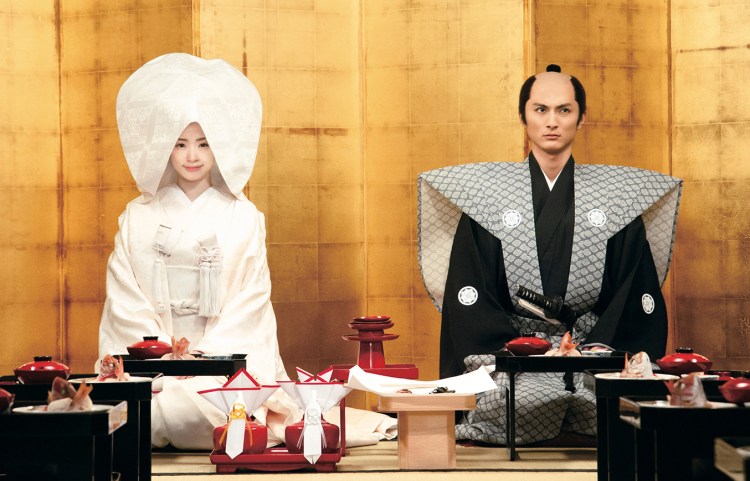
I kind of love this photo because he already looks so annoyed 🙂

Review of period romantic comedy/drama with a side serving of culinary delight A Tale of Samurai Cooking – A True Love Story up at UK Anime Network.


It’s a little known fact but though all samurai carry swords, some of them hang them up when they get to work and serve their lords with meat cleavers and skewers in the relative safety of the kitchen rather than the noisy chaos of a battlefield. Of course, a retainer’s job is to serve the lord in whatever capacity is expected of him, though some maybe happier with their dictated fates than others. In A Tale of Samurai Cooking – A True Love Story (武士の献立, Bushi no Kondate), it’s not only a conventional romantic tale between two initially mismatched people that the title alludes to, but also how one may fall in love with a path in life that was once deeply resented.

Back in feudal Japan, Haru (Aya Ueto) is an orphaned maid servant to a prominent samurai house. She was briefly married, but embarrassingly enough was “sent back” because her new husband and his family found her far too headstrong for their household. The daughter of a pair of restaurateurs, Haru has a keen sense of cooking of her own which sees her catch the attention of a visiting famous cook, Dennai Funaki (Toshiyuki Nishida), when she is the only person able to guess the real ingredients in his “mock crane” dish. Instantly smitten, Dennai makes her a proposal – albeit one for his son who is set to take over the family business but has no real aptitude for cooking. Yasunobu (Kengo Kora) is his second child whose fate was sealed on the death of his elder brother and though he would rather be a more conventional kind of samurai, he is the only heir to this kitchen empire. Can Haru’s cooking skills raise a fire in Yasunobu’s heart for his unwanted destiny or will they both be subjected to a lifetime of cold dinners?

A Tale of Samurai Cooking is definitely much more “period drama” than “samurai movie” though it does share a little of the historical intrigue of your typical “jidaigeki”. Set in the Edo period of feudal Japan, there are plenty of sudden reversals of fate where one house jumps ahead of another which then falls out of favour, sometimes with tragic consequences. However, though those these events inform the drama they are really just the backdrop to the true story of the very grown up (though extremely chaste and innocent – this is a U rated movie!) slow burning love story between Haru and Yasunobu. Though it’s a very charming and old fashioned sort of romance, it’s also true that Kengo Kora and Aya Ueto don’t have a tremendous amount of chemistry and their love story is pretty subtle and one sided until very late into the film. Of course, the audience knows how this sort of film has to end, but the film does rather rely on this fact.

Yasunobu is at heart a kind man undergoing very difficult circumstances. Having had to let go of the life he wanted that was so nearly his following the death of his older brother, it isn’t a surprise that he’s generally sullen and extremely resentful that his father has arranged this marriage for him with a slightly older woman who’s already been married once before, not to mention the fact that it’s all because she’s better than he is at this thing he’s now supposed to do for the rest of his life. Yasunobu doesn’t even like cooking, he thinks it’s “woman’s work” and had devoted his life to the art of the sword. Luckily, Haru’s perspicacity extends beyond her palate and she’s quickly figured out what’s going on with Yasunobu so she can turn him into the ace cook his father needs him to be. Haru’s influence opens up his wilfully closed eyes to the rewards of both good women and good cookery which is part way to saying that food cooked with love can heal a broken heart, but it’s equal parts changing times and a young man growing up.

As films about food go, A Tale of Samurai Cooking certainly has a fair few mouth watering dishes on display but perhaps lacks the hearty fare of something like the comparatively more sensual, though equally comic, Tampopo. In truth, its overwhelming quality is a kind of inoffensive niceness and perhaps for some tastes could have done with a little more spice though like the best Japanese cuisine offers its own rewards precisely because of its subtlety. It’s a perfectly nice light meal, but you’ll probably wishing you’d gone for something more substantial come bed time.


I went a bit overboard with the food metaphors, which is maybe what you get when you spend your food budget on movie tickets. I regret nothing.

Anyway this is showing at the Curzon in Mayfair until tomorrow, though they did say it may extend if there’s enough interest. It’s also going to be screened at the Genesis Cinema in Mile End and the Everyman and apparently will open in Ireland from 9th January. Yume Pictures will then release it on DVD in 2015 if you aren’t near a cinema that’s showing it, or you can even watch it on Curzon Home Cinema right now.


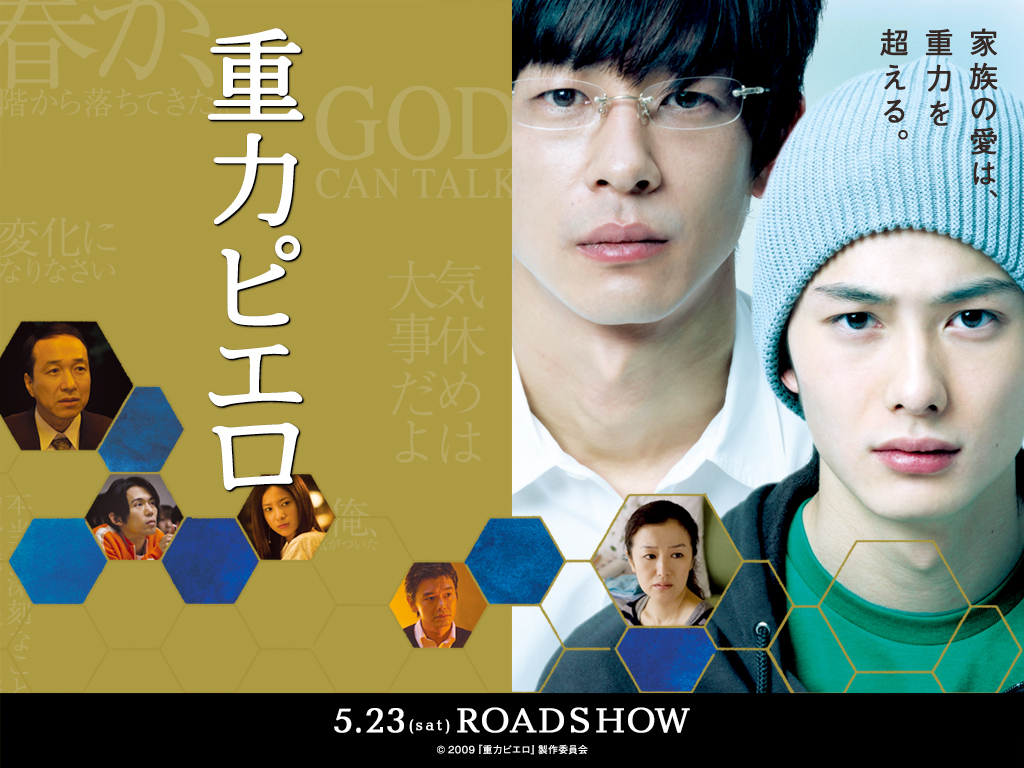
Gravity’s Clowns (重力ピエロ, AKA A Pierrot, Junichi Mori, 2009)

wp03_1024-768

Based on a novel by Kotaro Isaka (Fish Story; The Foreign Duck, the Native Duck and God in a Coin Locker), Gravity’s Clowns is the story of two very different brothers who discover a dark family secret following the death of their mother. Part mystery story part character drama, Gravity’s Clowns takes a look at the themes of nature vs nurture as well as the importance of familial love and acceptance.

Returning home for the first anniversary of his mother’s death, Izumi (Ryo Kase) and his younger brother Haru (Masaki Okada) spend some time with their father Tadashi (Fumiyo Kohinata) reminiscing about the past. Watching a local news broadcast, Haru realises the site of a recent arson attack is not far from where he’s been working. Noticing a pattern in the location of the attacks, Haru decides to investigate and ropes his brother in for the ride. However, the mystery Izumi finds himself embroiled in ends up being far different than the one he imagined.

It’s revealed fairly early on in the movie, but the fact of the matter is that Izumi and Haru may only be half brothers as their mother became pregnant with Haru shortly after being brutally assaulted in her own home by a serial rapist operating in the area. Having decided to have the baby and raise the child together whatever his true parentage, Haru’s parents did their best to give him a normal, loving upbringing alongside his older brother. Though there was some gossip in the town thanks to the incident’s notoriety, neither Haru nor Izumi were aware of their mother’s ordeal until after her death. After discovering the truth, both brothers react in different, though ultimately similar ways.

As a mystery, Gravity’s Clowns tries to pack in a fair few twists and turns though ultimately they are all quite obvious and frequent viewers of crime thrillers or psychological dramas will have guessed the entire plot in the first ten minutes. However, the mystery is definitely of secondary importance to the character drama that is being played out in front of it. The real key to the film is in the relationship between the two brothers, and to a larger extent the family as a whole. What’s important is that the brothers support and and love each other no matter what and as their father told them, their family is the strongest family there is. No matter what past traumas or biological facts may interfere, these guys will always come through for each other.

Having said that, the narrative does meander somewhat and in particular the “comedy stalker” subplot feels a little out of place and under developed. Despite playing a crucial plot role, and providing quite an amusing joke early on in the film and at its end, Yuriko Yoshitaka’s “Natsuko” (this is just a nickname and a fairly amusing pun as Haru’s name means “spring” and she always follows him around so they called her “Natsuko” which means “summer’s child” , she doesn’t even get a proper name) doesn’t have a tremendous amount to do. Likewise, the small but important role played by the boys’ father feels as if it bounces around a little in terms of weight as does that of their mother who is only seen in flashback. Ultimately Gravity’s Clowns over reaches itself as it tries to tackle some more weighty themes like nature vs nurture and the ethics of certain kinds of crimes which are only addressed in a very superficial way, and in fact concluded fairly ambiguously.

A flawed, if pleasant enough character drama, Gravity’s Clowns is generally entertaining but ends up feeling a little insubstantial. High quality and committed performances from the cast and especially from Ryo Kase and Masaki Okada as the two central brothers help to elevate the material but somehow it never quite takes off. Heart warming and actually quite funny at times, Gravity’s Clowns is a noble effort but one that ultimately fails to strike home.

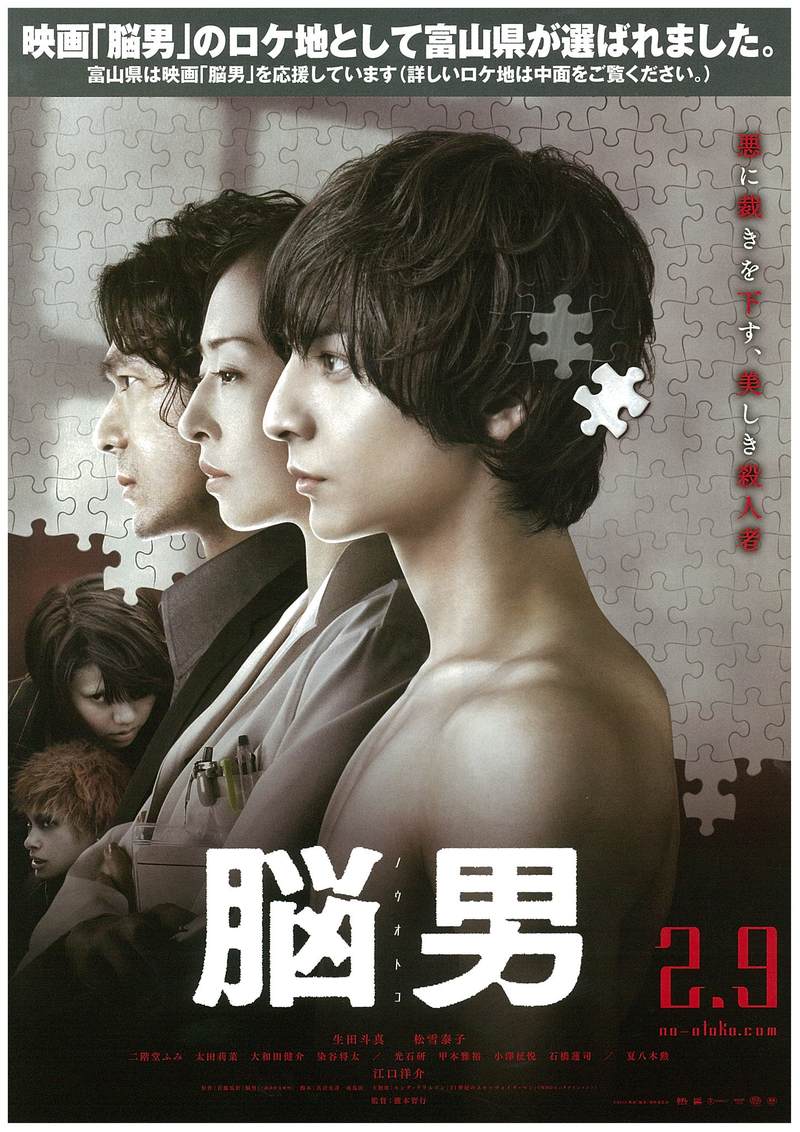
Brain Man 脳男

imgnewly1-187l

Based on the Edogawa Rampo award winning novel by Urio Shudo, Brain Man is a stylish psychological thriller which addresses such themes as guilt, redemption and the effects of childhood trauma. Are some people just born bad, can even those who’ve committed terrible crimes be rehabilitated? People on opposite sides of the legal system seem to have some conflicting ideas but perhaps the answer is never going to be as simple as ‘yes’ or ‘no’.

While a series of explosions rock a small provincial town, forensic psychologist Mariko Washiya (Yasuko Matsuyuki)  is the head of a research programme which aims to help convicted felons come to terms with their crimes through interacting with the victim’s families and there by coming to feel a kind of empathy for all the hurt and destruction they have caused. After leaving the office one day she races to catch the bus only to miss it by seconds while a bunch of bratty kids make faces through the window. Moments after the bus pulls away, it explodes killing all on board. Becoming an unwitting witness to events, Mariko finds herself at odds with the hardline policeman investigating the crime. When the police arrest the perfect suspect, a strange, near silent man discovered at the site of an explosion, Mariko is called upon to examine him. Ichiro Suzuki (Toma Ikuta) presents himself robotically, answering each of Mariko’s questions at face value no matter how strange and otherwise remaining motionless. That is, until something disturbs his sense of justice and he breaks out some killer martial arts moves. As might be expected, nothing is quite as cut and dried as it might seem on the surface and something convinces Mariko that there might be something more ‘human’ locked away deep down in Ichiro’s psyche.

First and foremost Brain Man is pretty mainstream thriller which means it isn’t totally free of a few melodramatic turns and far fetched plot developments but by and large it gets away with them. The first plot line centred around the bombings quickly gives way to the mystery surrounding Brain Man himself before getting back to the bombers towards the end. The two narrative strands sometimes seem at odds with each other and don’t feel as cohesive as they perhaps should. Though having said that though the “bombers” plotline is definitely the film’s second strand it gives ample room for Fumi Nikaido’s gloriously crazed depiction of a drug addled lesbian terrorist which she manages to play in a refreshingly restrained way (well, as far as the part allows – it is a particularly well pitched performance). There is also even a third subplot regarding Mariko’s prestige project of a young man who’s shortly to be released from a young offenders institute (played by Shota Sometani) seemingly rehabilitated and eager rejoin society all thanks to Mariko’s new therapy program which plays in conjunction with a fourth subplot concerning Mariko’s family and its own past traumas. Undoubtedly, there’s a lot to juggle but Brain Man makes a surprisingly valiant attempt at getting it all to work together.

Director Tomoyuki Takimoto is probably best known for his previous film Ikigami: The Ultimate Limit – a low budget though similarly impressive adaptation of a manga. Brain Man has a slightly higher budget and its fair share of flashy direction both of which impress from the get go. Even more so Takimoto has amassed a cast of up and coming stars who each turn in well rounded performances ranging from the completely out there extremes of the aforementioned Fumi Nikaido to Shota Sometani’s small but complicated patient and, of course, Toma Ikuta’s powerful portrayal of the near silent and emotionless killing machine the Brain Man not to mention Yasuo Matsuyuki’s warm hearted doctor.

Although a little slow to get going initially and excusing the odd lacuna brought about by throwing the points on the great train track of narrative, Brain Man manages to pack in a decent amount of excitement into its relatively tightly plotted structure. In many ways it isn’t particularly original, but it does what it does pretty well and mixes in enough twists and turns to keep even the most jaded mystery enthusiast interested. Perhaps a little bit too crazy for its own good, Brain Man is another classy Japanese thriller that isn’t afraid that isn’t afraid to go to some pretty strange places in the name of entertainment.

A Hard Day (끝까지 간다, Kim Sung-hoon, 2014)

2014 - A Hard Day (still 2)In an unprecedented level of activity, here is another review up on UK-anime.net – this time Korean black comedy crime thriller, A Hard Day (끝까지 간다, Kkeutkkaji Ganda) which was shown at the London Film Festival and the London Korean Film Festival and is now out on DVD from Studio Canal.


For most people, a “hard day” probably means things like not being able to find a parking space, missing your train, the office coffee machine being broken and your boss having a mental breakdown right on the office floor but for not-totally-honest-but-sort-of-OK Seoul policeman Gun-su “hard” doesn’t quite begin to cover it.

Gun-su is driving furiously and arguing with his wife on the phone because he’s skipped out on his own mother’s funeral to rush to “an important work matter” which just happens to be that he has the only key to a drawer which contains some dodgy stuff it would have been better for internal affairs not to find – and internal affairs are on their way to have a look right now. So pre-occupied with the funeral, probable career ending misery and the possibility of dropping his fellow squad members right in it, Gun-su is driving way too fast. Consequently he hits something which turns out to be man. Totally stressed out by this point, Gun-su does the most sensible thing possible and puts the body in the boot of his car and continues on to the police station. Just when he thinks he’s finally gotten away with these very difficult circumstances, things only get worse as the guy the he knocked over turns out to be the wanted felon his now disgraced team have been assigned to track down. Oh, and then it turns out somebody saw him take the body too and is keen on a spot of blackmail. Really, you couldn’t make it up!

Some might say the Korean crime thriller format is all played out by this point, but what A Hard Day brings to the genre is a slice of totally black humour that you rarely see these days. Gun-su is obviously not an honest guy, but he’s not a criminal mastermind either and his fairly haphazard way of finding interesting solutions to serious problems is a joy to watch. This isn’t the first film where someone happens on the idea of hiding a body in a coffin, but it might be the first where said person uses a set of yellow balloons to block a security camera, his daughter’s remote control soldier to pull a body through an air conditioning duct and his shoelaces to prize the wooden nails out of his own mother’s coffin to safely deposit an inconvenient corpse inside. Gun-su (mostly) manages to stay one step ahead of whatever’s coming for him, albeit almost by accident and with Clouseau like ability to emerge unscathed from every deadly scrape. He’s definitely only slightly on the right side of the law but still you can’t help willing him on in his ever more dastardly deeds as he tries to outwit his mysterious opponent.

Though it does run a little long, refreshingly the plot remains fairly tight though it is literally one thing after another for poor old Gun-su. A blackly comic police thriller, A Hard Day isn’t claiming to be anything other than a genre piece but it does what it does with a healthy degree of style and confidence. The action scenes are well done and often fairly spectacular but they never dominate the film, taking a back seat to some cleverly crafted character dynamics. Frequent Hong Sang-soo collaborator Lee Sung-kyun excels as the slippery Gun-su whose chief weapon is his utter desperation while his nemesis, played by Cho Jing-woong, turns in an appropriately menacing turn as a seemingly omniscient master criminal.

Yes, A Hard Day contains a number of standard genre tropes that some may call clichés, but it uses them with such finesse that impossible not to be entertained by them. Bumbling, corrupt policemen come up against unstoppable criminals only to find their detective bones reactivating at exactly the wrong moment and threatening to make everything ten times worse while the situation snowballs all around them. However, A Hard Day also has its cheeky and subversive side and ends on a brilliantly a-moralistic note that one doesn’t normally associate with Korean cinema in particular. It may not be the most original of films, but A Hard Day is heaps of morbidly comic fun!


Quirky Guy – An Interview with Yosuke Fujita (via UK Anime Network)

44ea2aa088e78643f1ee584fde4e3d2eI interviewed the director of Fuku-chan of Fukufuku Flats for UK Anime Network while he was over here for the Raindance Film Festival. You can read my review of the film too if you’re so inclined (that might be a link to a link to a link, um – sorry!).

Seeing as I asked him about enka in the interview here’s a video of one of the songs featured in the film (as tracked down by ace music detective and film blogger genkina hito!)

Tabidachi no Uta

Those opening chords sound a little like I am a Rock by Simon & Garfunkel which I did listen to a lot as a child, maybe that’s why the song sounds so nostalgic even though I couldn’t have heard it before?

New Directors From Japan Box Set (UK Anime Network Review)

A1rM9z8kBbL._SL1500_Great new box set from Third Window Films reviewed on Uk-anime.net.


We’re used to Third Window Films bringing us some of the best in contemporary Japanese cinema (as well as a few classics too), but this time they’ve gone even further and let us in on the ground floor as we meet these three new directors on the rise. This project was also a first as it took the unusual route of going to Kickstarter to fund its production, albeit following a pleasingly straightforward pre-order system. The three directors featured in this set all come from different backgrounds and are working in very different genres. As such they represent the level of diversity in modern Japanese indie filmmaking and each prove they have something very different and particularly idiosyncratic to offer in their later careers.

The first of these up and coming directors is Nagasa Isogai who has two films featured in the set – her student film My Baby and her longer short film, The Lust of Angels. My Baby tells the slightly crazy story of two sisters whose sibling rivalry intensifies as they both plan to have children of their own. Made to very strict guidelines, it’s shot in a now old fashioned looking 4:3 screen ratio with non-sync sound and has a strangely ‘70s-esque feeling with its odd, melodramatic concept and mostly straight forward shooting style.

Similarly, Lust of Angels takes on a lot of baggage from ‘70s exploitation cinema and though shot in a more modern feeling 2.35:1 widescreen it still has a distinctly old school feeling. Taking its queue from the delinquent girl movies of the past, The Lust of Angels is a dramatic story about train groping and female revenge. Transfer student Yuriko accidentally catches the train to school, something which most girls don’t do owing to its reputation as a “groper train”, where she discovers fellow student Saori about to fall victim to just this unpleasant crime. However, unbeknownst to the others Saori catches the train because she enjoys the attentions of the various perverts who ride it and even goes so far as to carry a special book which marks her out as desiring their attentions. Exploring such complicated themes as the differing reactions to burgeoning teenage sexuality, sexual abuse and sexual violence as well as female violence and revenge, The Lust of Angels is one of the more complex efforts in the set. However, first and foremost it works best as an exercise in genre and proves enjoyable both in that regard and in offering a good deal of promise for the future.

Next up is Kosuke Takaya whose 27 minute short is the most straightforwardly comic selection on the bill. Made under the NDJC program which aims to give a helping hand to promising new Japanese directors, Buy Bling Get One Free is a humorous satire on the fashion industry. Its hapless protagonist Kamono is literally a fashion victim – much less interested in expressing himself than in fitting into a scene, Kamono is easy prey for a bunch of weird fashion cultists. While it is undoubtedly very funny (and totally packed with awesome puns!), Buy Bling Get One Free is slightly hemmed in by the constraints of the NDJC programme. As such it may feel like a slighter effort than the other offerings in the set but it does still allow director Kosuke Takaya to show off a fair amount of skill which bodes well for the future.

The final and longest film included comes from Hirofumi Watanabe whose 88 minute feature tells the surreal story of layabout Takashi who unexpectedly discovers he has a teenage half sister he was previously completely unaware of. Takashi is a divorced father with no job and no hopes or plans for the future but his sudden discovery of a little sister and the new found responsibility being a big brother prompts him into thinking about his life. Finally, he makes a decision but unfortunately it ends up involving drug smuggling, shady business and finally….aliens! And The Mud Ship Sails Away is definitely the most surreal film in the set. It starts off with a sort of Jarmuschian aloofness which is brought out by the relatively static camera and black and white photography but towards the end this has been completely turned on its head. The last and strangest act takes on a Gilliam-esque level of absurdity with completely crazy, jagged camera action and bizarrely framed super close-ups. Some may feel the third act is simply too much or at least too far removed from the relative naturalism of the rest of the film but for those who like their movies surreal with a capital “S” And the Mud Ship Sails Away is another excellent addition to weird cinema.

Alongside the films themselves the package also offers interviews with each of the directors discussing how they got into filmmaking and more specifically how they came to make these particular films, as well as their general hopes for the future. Additionally, there’s also an interview with producer Shogo Tomiyama who’s the supervisor of the NJDC programme at the moment but is also famous for his involvement in the Godzilla franchise. This entire package was something of a labour of love for its producers and a fairly risky business venture – hence the initial need for Kickstarter. However, what The New Directors From Japan box set proves is that there is a wide and varied crop of new talent hovering just below the surface of contemporary Japanese cinema. Hopefully not the last boxset of this kind, each of the films presented has its own degree of promise and it will certainly be interesting to see how these burgeoning careers develop in years to come.


Rurouni Kenshin 2: Kyoto Inferno (UK Anime Network Review)

ruruoni_kenshin_the_kyoto_inferno_still(saito’s just so cool!)

Review of the first Rurouni Kenshin sequel, Rurouni Kenshin 2: Kyoto Inferno up at UK Anime Network.


At the end of the first Rurouni Kenshin live action film, you might have been forgiven for thinking that this once wandering warrior had finally found a place to hang up his (reverse blade) sword for good. As fans of Nobuhiro Watsuki’s much loved manga and its anime adaptation will know, there’s no such luck for Himura Kenshin or the long suffering Kaoru as once again Kenshin will be called upon to put his unique skills to use and this time the very survival of Japan’s new era of modernism and equality is at stake!

Having successfully seen off would be drug baron Kanryuu and the false Battosai Jin-e, once remorseless killer Kenshin (Takeru Satoh) has moved into the dojo run by Kaoru (Emi Takei) and made a seemingly joyful life alongside Kaoru’s only pupil, the boy Yahiko (Kaito Oyagi), the doctor Megumi (Yu Aoi) and loud mouth Sanosuke (Munekata Aoki). However, the happy family’s peace is about to be rudely interrupted as an envoy from the Home Minister arrives and requests a private meeting with Kenshin. It seems an old enemy once believed dead has been discovered to be alive and currently plotting terrible vengeance against the new government in Kyoto. Shishio’s skills are matched only by Kenshin and so the government wishes to make use of his services once again to stop this new threat to the development of the modernising Japan. However, Kenshin has laid down his sword and dedicated his life to atoning for the lives he took as a warrior – will he really return to the life of a wandering swordsman? Originally reluctant and very much against the wishes of Kaoru, a tragic event finally convinces Kenshin he has no choice but to stop Shishio whatever the cost!

Even more so that the first film, Rurouni Kenshin 2: Kyoto Inferno is set against the backdrop of a Japan in the middle of earth shattering cultural shifts. The age of the Shogun is over, there are no more samurai or feudal loyalties to fulfil. This fresh new world of possibilities has no place left in it for the men who fought so bravely to bring it into being. Some, like Kenshin, hung up their swords and set themselves into atoning for the violence of the past by vowing to build a better, kinder, future. Others, however, like Shishio, were left with nothing other than the desire to return to a world where their skills mattered – the familiar world of lords and castles and glorious battles. Kenshin and Shishio are two sides of the same coin – light and shadow. Having been assassinated and thrown on a funeral pyre before miraculously surviving thanks to a fortuitous fall of snow, Shishio has made fire his very own symbol and primary weapon of attack. This new world is a hell for him and along with his bandage clad gang of followers, he’s about to plunge all of Japan into a fiery abyss too.

The first instalment was also notable for its fairly high production values and if anything, Kyoto Inferno even improves upon the original film’s impressive aesthetics. Fire in particular has often proved something of a bug bear for the modern action film and as you might expect from the title Kyoto Inferno is jam packed with flaming action. From its extremely striking opening scene, Kyoto Inferno lays on some of the most complex and beautifully filmed action sequences to be seen in a Japanese film in quite some time. Where it falls down slightly is bound up with its nature as the first part of a two part film as it is does begin to pile on the sub plots and risks becoming overloaded while the original gang (and particularly Yu Aoi’s doctor Megumi) end up with relatively little to do. Likewise, as with the first film the more manga-like elements such as some of the overly broad comedy or a couple of characters who are just the wrong sort of outrageous don’t quite fit with the otherwise classical feeling of the film though fans of the manga franchise may appreciate this attempt at remaining faithful to the source material.

In many ways the Rurouni Kenshin movies are just fluffy mainstream action films (not that there’s anything wrong with that) but Rurouni Kenshin 2: Kyoto Inferno is that rarest of beasts in that it manages to build on the foundations of the first film to become something greater with the result that it even helps to elevate the original. Of course, this largely hinges on how well the last part of the trilogy, appropriately entitled The Legend Ends will fare but suffice to say the first two thirds have stood it in very good stead. Action packed but with a tightly plotted storyline, convincing characters, good performances and high production values Rurouni Kenshin 2: Kyoto Inferno offers everything that’s good about blockbusters without any of the drawbacks. In fact the only real problem that the film presents is the likely long wait until The Lengend Ends finally arrives!


This is out in UK cinemas from Friday 28th November 2014 when it’ll play all these cool places:

  • Cineworld Enfield
  • Cineworld Crawley
  • Cineworld Sheffield
  • Cineworld West India Quay
  • Cineworld Glasgow RS
  • Cineworld Cardiff
  • Cineworld Stevenage
  • Cineworld Bolton
  • Vue Piccadilly (London)

Well worth seeing on the big screen, might even be better than the first one!

One on One (일대일, Kim Ki-duk, 2014)

9ae7eea7-3b8a-4212-96ca-023eb8b5cdd5wallpaper1Review of Kim Ki-duk’s latest from the London Korean Film Festival up at UK Anime Network.


Kim Ki-duk is back with another frankly baffling state of the nation style assault on contemporary Korean values. In contrast with much of his other work, One On One is much more dependent on plot and dialogue and has a much more straight forward yet distant shooting style than the poetic and painterly scenes we often see from him. Like his other films however, it employs shocking episodes of violence to expose some of society’s festering wounds though perhaps this time it’s with the eyes of a curious anthropologist rather than an embittered social investigator.

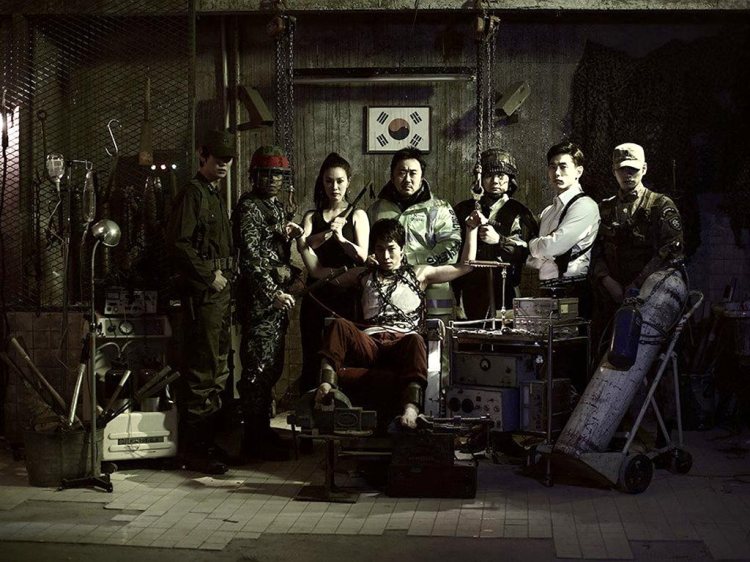
This oddly symmetrical tale begins with the shockingly matter of fact murder of a young schoolgirl by a gang of seven masked aggressors. Following this seemingly senseless crime another group of seven, this time a group of vigilantes brought together by a desire for some kind of personal vengeance against society, have taken it upon themselves to avenge this killing by kidnapping each of the seven perpetrators and torturing them until they confess and give some kind of information regarding the true nature of the crime. In another duality, the “villains” are all well to do, successful underlings whereas the “vigilantes” are generally working-class people who’ve lost out in the current economic climate and in some cases are living in dire poverty through no fault of their own. The villains offer several different reactions or explanations for their involvement in such a heinous crime varying from “I was just following orders” or “it was for the common good” to “what does it matter, I have status and can do as I please” but at the end of the day those on both sides will have to realise that the lines between good and bad are much more fluid than most people would like to think and that eventually you will have to decide for yourself not just where you stand but who it is you really are.

One on One often feels like a slightly underbaked pudding, the flavour is good (mostly) but it’s gone a bit soggy in the middle. The symmetrical nature of the two sets of seven is interesting as is the direct mirroring of their social statuses but somehow the ideas don’t quite feel developed enough and even end up feeling a little too neat or obvious. The elite group who murdered the school girl in the beginning are all successful people with seemingly no particular worries in their lives other than being caught up in a hierarchical system and unable to climb the ladder fast enough. When one of the men whose explanation is simply that this isn’t his fault, he was only following orders and whoever gave the order is to blame is reminded that one day he may be the one giving the orders he seems to regard it simply as the natural order of things. He and some of the others seem to have an unshakeable faith that they would not have been asked to do this (and presumably other “crimes” too) had it not been of vital importance for the survival of the Republic of South Korea. Where this “faith” comes from remains unclear, though it offers the slim justification of the fanatic for the senseless murder of a teenage girl. Some of these men wanted to get ahead and simply didn’t care what they had to do to get there, but others at least thought their actions had  a noble purpose no matter how terrifyingly awful the task they’ve been assigned.

The group of vigilantes by contrast are mostly those who’ve been disadvantaged by the current climate of Korean society. One is living on instant ramen, which as is pointed out by the group’s leader is a staple food for the poor but simply “a snack” for the rich, whilst trying to save money for his wife’s medical treatment and fend off various loan sharks. Another is living outside his old tenement building in a tent with his mother who seems to be suffering with dementia because they have nowhere else to go. The young men are angry that even if they’ve done everything right – got a degree, been abroad, learned English, they still can’t get those steady white collar jobs and a leg up into the middle classes like they were always promised. The one aberration in the group is its only female whose anger stems from being involved in an abusive relationship which she nevertheless does not seem keen to end. It isn’t difficult to see where their anger stems from and for most of them the vigilante activities are a way of taking a personal revenge against society as a whole by taking these entitled, well connected “thugs” down a peg or two and trying to make them realise the true nature of their societal roles.

However, things start to fall apart towards the end where Kim allows his message to become a little too muddy. There are good bad guys and bad good guys, nobody’s perfect and perhaps nobody even wants to be – can you really build a society when everyone has completely lost sight of any kind of human compassion? At one point some of the vigilantes attempt to make the best of their situation by exclaiming “ah, at least we aren’t in North Korea” which just makes you half wonder if North Korea isn’t just a giant government conspiracy designed to maintain the status quo by allowing the lowest members of society to feel good enough about their situation to avoid any revolutionary grumblings from the proletariat. The title card at the end flashes up the following three words “Who Am I?” with no other explanation to whom they might pertain. Like all the best riddles there might be several answers to that multifaceted problem though they may end up saying more about those who answer than those who posed the question.