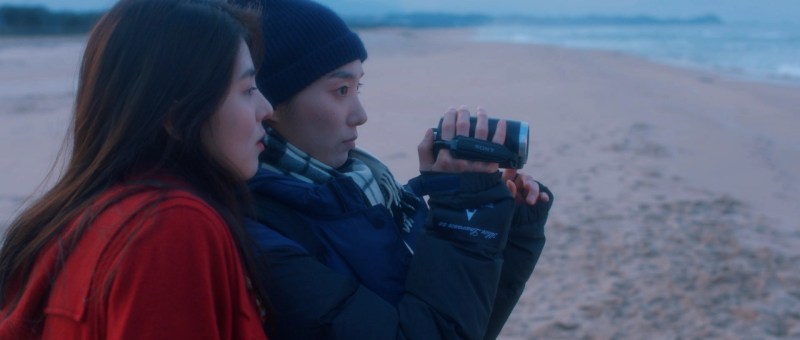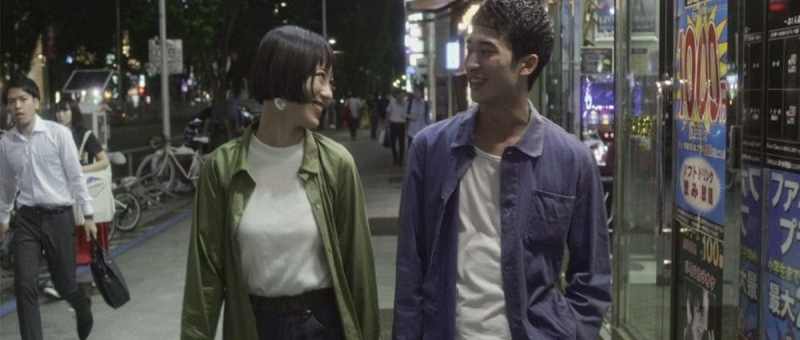
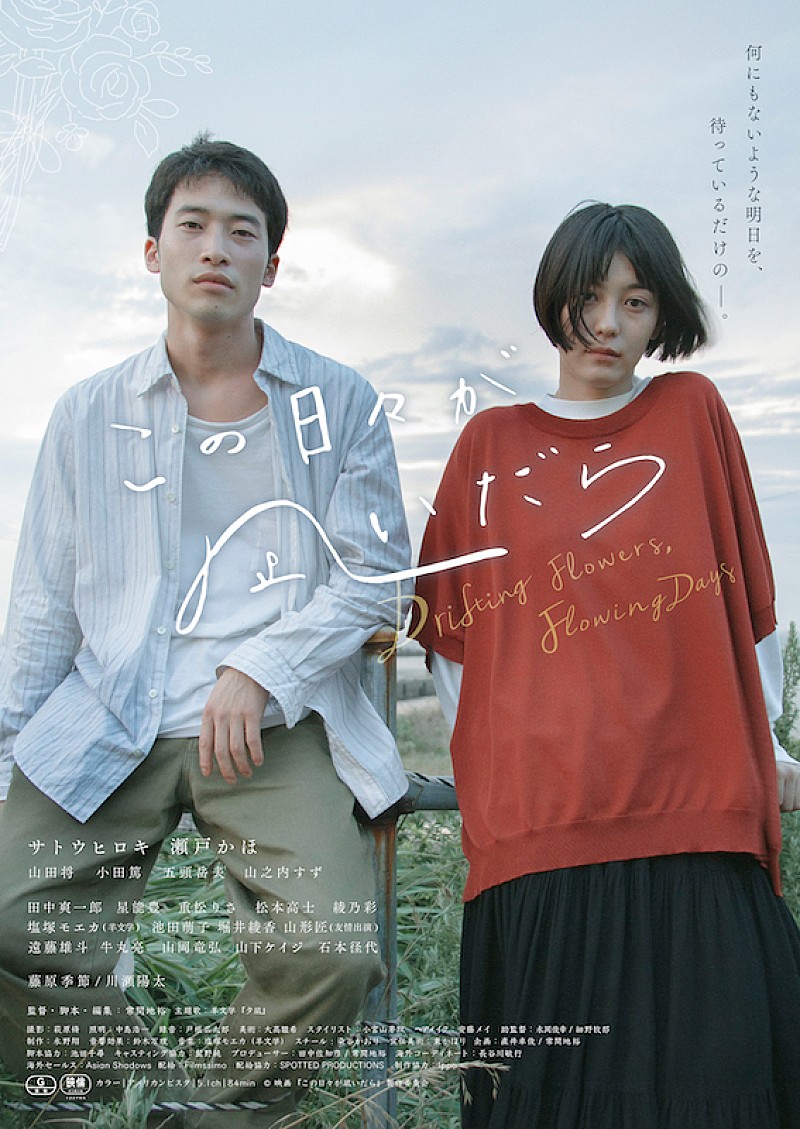
Drifting Flowers, Flowing Days (この日々が凪いだら, Yutaka Tsunemachi, 2023)

Life goes on as usual, until it doesn’t. The couple at the centre of Yutaka Tsunemachi’s debut feature Drifting Flowers, Flowing Days (この日々が凪いだら, Kono Hibi Ga Naidara), are about to hit the crisis of youth in which they begin to think seriously about their futures and fear that their lives can no longer continue simply as they were but also struggle to find direction while torn between what society views as a successful life and their own desires.

The crunch point comes when Hiroto (Hiroki Sato), a construction worker, and Futaba (Kaho Seto), who works in a florist’s, learn that their rundown apartment block is going to be demolished and they have six months to find somewhere else to live. While Futaba idly looks at wedding rings, she isn’t really sure how Hiroto views their relationship or if he’s even assuming they’ll finding somewhere new together. The financial strain of an unexpected move also has her wondering if she should give up her job in the florist’s, which she enjoys due to her love of flowers, and start looking for a regular company job but an attempt to talk about it with Hiroto only results in petulance born of male pride as he takes it as her complaining he doesn’t earn enough with his job as a casual labourer. 

Another source of friction is that Hiroto seems reluctant to meet Futaba’s family while refusing to introduce her to his hinting at longstanding childhood trauma stemming from a legacy of domestic abuse and a father who lost himself in drink. Even so, he’s drawn to an older man at work, Haruo, who soldiers on despite his decreasing physical capability. When he is unceremoniously fired, the Haruo takes his own life having lost his both his means of supporting himself and his sense of purpose. Haruo might remind him of father though Hiroto feels somewhat guilty that he didn’t do very much to help while he was alive and resentful towards his heartless boss and colleagues who did nothing more than make fun of him. 

This idea of people being disposable tools of corporate entities is further born out by the experiences of his hometown friend, Daigo (Masashi Yamada), who is feeling burned out by his dream job in the city largely thanks to a bullying boss and overbearing work culture. A friend who experienced something similar tells him she just quit her job and feels much better so if he doesn’t feel appreciated he should leave, but it’s not really that simple. Not only does he need a steady income to survive but there’s a degree of shame and trepidation in not following the conventional path, the same shame and trepidation that has Futaba worrying she’s being irresponsible in following her dream of opening a florist’s of her own rather than using her degree to get a better paid job and start saving for the next phase of adulthood while still uncertain if Hiroto is going to want to get married and settle down. 

Experiencing another crisis that forces him to confront his childhood trauma, Hiroto sighs that his future is shrouded in darkness and he wishes that it was all set out for him an ironic inversion of the crisis experienced by others his age that they resent being railroaded into a life of conventional success that in fact does not make them happy. In any case, he emerges with a little more clarity about the kind of future he might want no longer so frightened of commitment or suspicious of familial bonds. What the youngsters experience is a perhaps premature end to their youth symbolised by the literal tearing down of their world in the soon to be demolished apartment block that forces them out of their inertia and onto a path towards a more settled adulthood. But equally that doesn’t necessarily mean that they have to abandon their dreams or live up to an ideal of conventional success if it’s not what they want but can begin to find other futures for themselves outside of the mainstream that are valid and satisfying. Tsunemachi follows them with a hazy detachment but captures something of the anxieties of contemporary youth still struggling to find accommodation with demands of living in a judgmental and uncertain society. 


Drifting Flowers, Flowing Days screened as part of the 18th Season of Asian Pop-Up Cinema.

Original trailer (English subtitles)

Good Autumn, Mommy (尋她, Chen Shizhong, 2023)

A family tragedy forces a grieving mother to confront the sexism and hypocrisy of mid-90s China in Chen Shizhong’s biting rural drama, Good Autumn, Mommy (尋她, xún tā). Quietly simmering with an internal rage her society convinces her she must repress, Fong-tai (Shu Qi) finds herself constrained by the intensely traditional atmosphere of her small-town home and more than that by her husband’s eternally passive attitude in which he resolutely refuses to rock the boat or make any attempt to stand up for himself. 

Fong-tai is warned by her brother, in a nice way, that her personality may make it difficult to live somewhere like this where a woman is clearly intended to know her place and keep her peace. Not that she particularly blames him for it, but Fong-tai is resentful towards her birth family who fostered her out and saved their money to send her brother to university. For this reason she remains an outsider in the village (a sentiment rammed home by the casting of Taiwanese actress Shu Qi whose accent quite clearly stands out in Cantonese-speaking Guangdong) and not least because of her feisty temperament and tendency to speak her mind. 

Often, however, it does her little good. Pregnant with her second child she begs her mother-in-law to take her to a modern hospital but she insists on doing everything the old fashioned way taking both her and her similarly pregnant friend Lam San to a disused clinic only to be trapped there by an encroaching storm. Both babies are born healthy, but battered by the high winds the dilapidated clinic collapses plunging them into the lake. Fong-tai manages to save one but the other disappears without trace. As she had put a bangle on her newborn child and the rescued baby doesn’t have one, she assumes it’s Lam San’s but later comes to doubt herself. 

Part of the problem is that Fong-tai assumes no one is really looking for her baby because it is a girl and if it had been a son they’d have left no stone unturned. As her desperation mounts, many of those around her imply that the loss of her daughter is a kind a kind of blessing for, as the couple have one daughter already, it frees them up to try again for a son given the restrictions of the One Child Policy which allowed a second child if the first had been a girl. One even tells them that a second daughter kills off the family name given that Fong-tai’s husband Yiu-cho was also an only son, and that they should simply have another child as soon as possible to produce a male heir. 

Ironically this might also be why Kong-yan, Lam San’s husband, is prepared to accept the rescued baby as his own and reluctant to submit to a DNA test given that in that sense it doesn’t matter as much whether or not he is the biological father because this child is not expected to continue his line in the same way a son would be. Yet Kong-yan also embodies another side of a changing China in that he has become rich under the new economic reforms but largely by exploiting local sugar cane farmers. Kong-yan leverages his wealth in insisting Fong-tai pay for the DNA test knowing full well she can’t and then refusing to buy any of her sugarcane out of pettiness thereby destroying her livelihood. 

While looking for her daughter and frightened enough to take note of an urban legend about wild men living in an old banana plantation, Fong-tai is confronted with the borders of her world after venturing to the edge of it and discovering a construction site she had no idea existed because she doesn’t venture out of the village. She begins to wonder what the outside world is like and if she’s been trapped here by outdated notions of filiality and patriarchal social codes that conspire to keep women in their place while becoming sick of Yiu-cho’s complicity and refusal stand up for their family even when it’s their child that is missing. 

When she decides to drain the supposedly sacred lake herself by destroying the dam it’s as if she’s pulling down the borders of that world and removing the source of her oppression in breaking free of “tradition”. The villagers that were hostile to her just minutes before, begin to reflect that it’s just a lake and sympathise with Fong-tai as a bereaved mother rather than a troublemaker who didn’t know her place. Highly critical of ingrained sexism and the hubristic behaviour of the nouveau riche elite in changing 90s China the film’s haunting yet hopeful ending suggests at least that Fong-tai was able to ensure that her older daughter was freer than she had ever been even if she can never escape the wounds of the past or regain what was taken from her.


Good Autumn, Mommy screens in Chicago April 13 as part of the 18th Season of Asian Pop-Up Cinema.

Original trailer (Simplified Chineses & English subtitles)

365 Nights (三百六十五夜, Kon Ichikawa, 1948)

For his second film at Shintoho, Kon Ichikawa had wanted to adapt a story by Ryunosuke Akutagawa that later inspired Rashomon, but was handed a standard melodrama to direct first. Ichikawa apparently did not think much of the novel the film was to be based on nor the script by Kennosuke Tateoka which he subsequently brushed up with the help of his new wife Natto Wada, and it’s not difficult to see why he might have felt he had an uphill battle. Melodrama is after all a genre that is founded on coincidence, though 365 Nights (三百六十五夜, Sambyaku-rokujugo ya) quickly strains credulity with the sheer number of unlikely events and surprise reappearances along with its rather strange take on the contemporary post-war society which is undoubtedly influenced by the demands of the Occupation censorship regime. 

Indeed, the setting itself seems reminiscent of 1930s cinema following the dashing hero Koroku, played by the equally dashing Ken Uehara, an architect who has walked away from his privileged upbringing as the son of a successful construction magnate. His problem is that he’s being aggressively courted by the haughty Ranko (Hideko Takamine), also the daughter of a successful but shady businessman, who to modern eyes is basically stalking him. Grinning with an evil glint in her eye, she tells her minion Tsugawa (Yuji Hori) that she’ll have seduced Koroku within 365 days which by melodrama standards seems to give her quite a lot of leeway.

Clueing us up to her villainy, Ranko is always seen wearing incredibly stylish Western outfits but otherwise behaves in a transgressively masculine fashion ordering her male employees about while set on the sexual conquest of Koroku who despises her for everything she is. It’s difficult not to see an inherent criticism of the new post-war woman and an anxiety regarding the power that comes with wealth being wielded by someone who is not a man. The contrast between Ranko and traditional femininity is rammed home by the fact that Teruko (Hisako Yamane), the daughter of the landlady in the house where Koroku finds new lodging after moving home to escape Ranko, is always dressed in kimono and otherwise naive and innocent. 

This positions Ranko, and her minion Tsugawa who is also in love with her, as the villains who are rebelling against the kind of earnestness expressed by Koroku and Teruko. From more humble origins, Tsugawa is deeply resentful of Kokoku’s class privilege and feels that he looks down on him which is one reason he seeks revenge by destroying his life along with his sexual jealously that Ranko pays him no attention yet is fixated on Kokoku perhaps precisely because he is entirely uninterested in her though it remains mystery why you’d want to be married to someone who strongly dislikes you. 

Yet for all his own earnestness, Koroku is almost betrayed by the capitalist father of whom he also seems to disapprove when he asks him to consent to an arranged marriage with Ranko to save his business. Meanwhile, it also transpires that Teruko’s father has been absent from her life because he two has a criminal past further tainting the legacy each of them bear. Ichikawa stages each evolution of their relationship at the same, noirish street corner that seems to exist as a kind of border between the illicit underworld that seeps out from Tsugawa’s bar into the post-war society, and the geniality represented by Teruko’s otherwise nice, middle-class home. 

It’s the this transgressive quality, of being caught between these two worlds, that starts to eat away at Koroku leaving him a broken and shabby man little better than a tramp. In a break with melodrama norms, though he is aware that he has led Teruko into Tsugawa’s trap he comes to believe that she has betrayed him while she clings fiercely to her love and in the end attempts to sacrifice it basically giving Koroku to Ranko whom she believes can better care for him in his now corrupted state. Though events become grim with a wedding that is staged like a funeral and takes place at a death bed, there is also the sense that something must come right that seems a little incongruous and perhaps a concession to the censors board as may be the coda implying that Ranko, despite having undergone a kind of redemption, will also have to pay for all her dodgy dealings. Though clearly hampered by the material, Ichikawa crafts some stunning images such as the final scene at Tsugawa’s bar along with a surprisingly energetic action sequence during which Koroku fights off burglars at Teruko’s home and wins her heart with his manliness. In any case despite the hints at redemption the implication remains that this is a world dark at its core in which not even the earnest can escape its creeping corruption. 


Faraway Family (彼方の家族, Taro Kawasaki & Eisuke Sakauchi, 2023)

It may be a truism to say that you never really know what’s going on in other people’s lives, but even if a family looks superficially happy and gives the impression everything is going just perfectly for them that might not actually be the case. The title of Taro Kawasaki & Eisuke Sakauchi’s Faraway Family (彼方の家族, Kanata no Kazoku) has a double meaning in that in the Japanese title can be also read as “Kanata’s Family” which is the name of the hero and also a word meaning “somewhere in the distance” which is in fact how both of the boys feel their fathers to exist. 

Kanata may feel it more closely in that he lost his father in the 2011 tsunami and has never really dealt with the grief having moved to Yamagata with his mother. Kanata’s father also had quite a difficult relationship with his fisherman grandfather who was intent on railroading him to take over the boat and seemingly never had a good word for anyone yet his father lost his life after heading to the harbour to look for him explaining only that he was family. Now the only breadwinner in the family, his mother has to work to support them and is therefore often absent, leaving him money to buy dinner from a convenience store which he usually eats alone. 

Having become withdrawn and fearful of making new relationships that may end suddenly, Kanata also has the added stigma of being someone from Fukushima in the wake of the nuclear disaster. His new teacher, Yoshikazu, makes a well-meaning faux pas in telling Kanata to consider him a father figure yet as it turns out Yoshikazu is a fairly compromised one. On being introduced to his classmate Riku who is also Yoshikazu’s son he thinks he’s had his face rubbed in it with this picture of the perfect family.

But what he discovers is that Riku has many of the same problems as himself seeing as he also fears he does not really fit in his family and wonders if they’d be happier and better off if he weren’t in it. Unlike Riku, Kanata doesn’t seem to be overly burdened by parental expectation and despite the problems between his father and grandfather his early childhood seems to have been happy and filled with love and cheerfulness. His problem is more to do with what he’s lost and the resulting sense of absence it’s left behind as he finds himself eternally missing his father. 

For Riku meanwhile, it’s the connection itself which is painfully absent. The more he tries to connect with Yoshikazu the more it seems to backfire while Yoshikazu seems obsessed with the idea of his getting into Japan’s most prestigious university mostly for his own gratification as double proof of what a great teacher and father he is. Or else, to mask his own sense of inadequacy in that he would feel embarrassed professionally if his own son turned out not to be academically inclined. Riku’s family don’t celebrate birthdays and he can’t ever remember getting a present but when he decides to try and buy one for Yoshikazu it’s a reminder of a happier memory when he simply played with him as a loving father rather than a hard taskmaster driving him on to a vicarious goal as evidence of his controlling nature. 

Kanata seems to have had more than his share of tragedy in life and is painfully aware of the things just our of reach but also increasingly that not all of them are and if you’re not careful you can in fact be the one to push them away. Shooting in the icy snow of a Yamagata winter, Kawasaki and Sakauchi capture the frostiness of the boys’ emotional isolation but also the quickening warmth of their friendship as they bond over their shared loneliness in pining for an absent father. What Kanata learns is to embrace the things that seem somewhere far away for they do at least exist there, even if no longer present in a physical sense, and that the memory of them can be warm and comforting rather than painful or lonely. 


Faraway Family screened as part of this year’s Osaka Asian Film Festival.

Original trailer (no subtitles)

Lee Jang-ho’s Baseball Team (이장호의 외인구단, Lee Jang-ho, 1986)

After finding huge success with his debut film, Lee Jang-ho soon became disillusioned with the film industry and was in fact temporarily banned after being found in possession of marijuana. After the assassination of Park Chung-hee in 1979, Lee returned with a new focus on socially conscious filmmaking only to be blindsided by the advent of an entirely new age of oppression following the coup of general Chun Doo-hwan in 1980. In contrast to Park’s regime, Chun’s embarked on a deliberate bread and circuses policy pushing sports, sex, and screen in which social commentary was out and softcore very much in. 

Lee had opened his nonsense film Declaration of an Idiot with a scene of himself committing suicide because no one cares about movies anymore, they only like sports which lends a note of irony to his incredibly strange and very of its time baseball film, Lee Jang-ho’s Baseball Team (이장호의 외인구단, Lee Chang-houi wingudan). Adapted from a popular sports manhwa, the film is ostensibly a much more commercial affair yet in its way is attempting to subtly attack the growing inequalities of the Chun era as its poor mountain boy hero, Hye-seong (Choi Jae-sung), squares off against posh boy rival Dong-tak (Maeng Sang-hoon) not only for sporting glory but the hand of his innocent first love Um-ji (Lee Bo-hee). 

As Dong-tak joins a top-rated team and is interviewed on television, Hye-seong returns to the mountains to train and is trying to dodge the train fare while travelling with his father to discuss joining a team. He eventually strikes a blow against Dong-tak by striking him out during a perfect game, but ruins his shoulder in the process with his baseball dreams then behind him, which is a problem because he’s devoted his entire life to fulfilling the promise he made to Um-ji when they were children to become a great baseball player. Hye-song repeatedly promises to do anything he can to make Um-ji happy even if it means accepting her relationship with Dong-tak, but Dong-tak openly laughs at him for being a nobody though there is something worryingly intense in his suddenly throwing all his letters from Um-ji, which he had in his bag, on the table describing them as written by a “goddess” and his “sacred place.”

As for Um-ji herself, she seemingly has little control over her life as the daughter of an upperclass family. She began dating Dong-tak before reconnecting with Hye-seong in Seoul and originally sticks to her class-appropriate match before being tempted by her innocent childhood connection and realising Dong-tak is an arrogant arsehole who didn’t show up to her birthday dinner because he forgot and went on a date with another girl. Even so, her family continue to pressure her into marrying Dong-tak despite his manly decision to ignore her until he’s accomplished his mission of achieving 100 consecutive hits at which point he’ll propose. Hye-song ironically makes a similar decision, taking off for a training session on a remote island which ends up lasting a whole year during which his completely insane mentor Coach Byeon-ho (Ahn Sung-ki) denies him permission to write to her. When he returns, Um-ji has ended up married to Dong-tak and is in a depressive state wandering through life in a daze of guilt and disappointment that she betrayed both herself and Hye-seong because of social pressure to conform and is now stuck in this emotionally unsatisfying relationship. Hye-seong rejects her on the grounds that the spark has gone from her eyes and she’s no longer the Um-ji of his youth though also accepting some responsibility for that. At the end of the film, Hye-song loses his sight which allows him to reunite with a changed Um-ji who has separated from the now loser Dong-tak, no longer able to see the change in her remembering only the Um-ji he fell in love with. 

The men who were with him on the island where they underwent bizarre martial-arts style training regimes, were whipped and shackled, and almost killed their one-armed teammate have similar problems returning to situations that are less satisfying than they hoped. A wimpy pitcher despised by his son returns to find him unimpressed, while another discovers his wife had temporarily left him, and an incredibly short man, Kyeong-do, who’d been bothering a bank employee so much she switched branches to avoid him discovers she’s engaged to another man. Kyeong-do refuses to give up, arrogantly telling her that he’ll be replacing her groom on the big day while continuing to behave like a massive creep but actually successful in the end because of his sporting and financial success though it looks more like a case of her giving in than actually falling for him and sends some very mixed messages about a woman’s agency in this still conservative age. 

The players brand themselves losers and outsiders, each of them in some way compromised and locked out of pro-baseball from Kyeong-do’s short stature to Hye-seong’s poverty though the decision to include a mixed race man which may have been intended as a progressive gesture seriously backfires by having a Korean actor perform in blackface while insensitively mimicking racial stereotypes. The coach, Byeong-ho is also an outsider by virtue of walking with a cane and purposefully creates a team of others like himself he can train with his cruel and bizarre methods to take on the Dong-taks of the world. Even so, others brand them “inhuman”, “beasts trained with whips”, and continue to resent their attempt to subvert the contemporary class order. 

On the surface, however, Lee has simply made a baseball film about a group of outsiders who triumph over adversity. He fills it with the spirit of the times, throwing in several sequences accompanied by contemporary pop songs along with an atmosphere of ridiculous excess not to mention inconsequentiality as if he were actively mocking the current direction of Korean cinema despite the occasional moment of artistry such as the gothic scene in which Um-ji realises Hye-seong has returned but the pair are separated by a billowing white curtain. An oddity, but perhaps one that speaks of the oddity of its times. 


Polar Rescue (搜救, Lo Chi-leung, 2022)

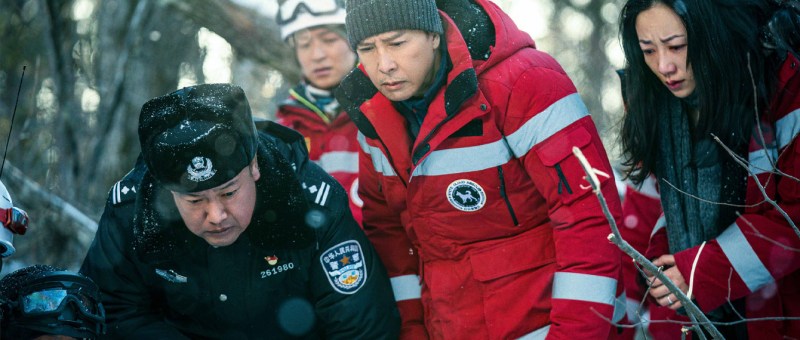
One of the more surprising things about Polar Rescue (搜救, sōujiù, AKA Come Back Home), a rare vehicle for Donnie Yen outside of the martial arts and action genres, is just how unheroic its panicked hero is. Though he may start off as a frantic parent who has our sympathies, we later begin to realise that he is at least severely flawed while there are also a few perhaps subversive hints towards the pressures of the modern China which have frustrated his attempts to be what he would assume a good father to be.

Despite later hints that the family is in a spot of financial bother, they’ve all gone on what looks like a fairly expensive skiing holiday in a European-style resort. The problem begins towards the end of their stay when eight-year-old Lele starts acting up in part because his father, De (Donnie Yen), promised to take him to Lake Tian to see the monster but has broken his word because of road closures due to the adverse weather. Wanting to make it up to his son, De decides to try going anyway via the backroads which are still open but soon enough gets stuck in a ditch. Events from this point on are deliberately obscured, but somehow Lele gets separated from his parents and sister and goes missing in the freezing wilderness. 

Rather than a father’s one man race against time to find his missing son, the film soon shifts into familiar China has your back territory as the full force of artic rescue complete with helicopters and specialist equipment is deployed to find this one missing boy. De is still not satisfied and at several points frustrates the rescue effort by getting into trouble himself without really reflecting that it’s his own irresponsibility and paternal failure that have caused the rescuers to risk their own lives trying to find his son. 

Though we might originally have sympathised with him, particularly as it seems clear Lele is behaving very badly and will not listen to either of his parents, we later come to doubt De on learning that Lele’s disappearance is at least in part related to an incredibly ill-advised though perhaps understandable parenting decision. As the film would have it, De is both too old fashioned in his authoritarian approach in which he’s often been violent towards his son, and too slack as evidenced by the boy’s bad behaviour. He’s failing in most metrics as a father given that he’s run into career difficulty as an engineer after challenging some of the nation’s famously lax safety regulations on a site he was working on he believed to be unsafe and then getting swindled on another construction project by a client who ran off with all the money. He also seems reluctant to allow his wife (Han Xue) to work to ease the family’s financial burden out of a mistaken sense of male pride. 

This ties in somewhat to the propagandist themes as we see him totting up how much it would cost to send his kids to school overseas only for his wife to tut that Chinese education is good too, while the fact the family have two children also hints at a new ideal in the wake of the loosening of the One Child Policy to encourage correction to the rapidly ageing population. The rescuers, meanwhile, are portrayed in a perhaps slightly ambiguous light given than many of them quickly become sick of De and think they should stop looking given the unlikeliness of a child surviving alone for several days in such freezing conditions. Some even suspect De may be responsible for his son’s disappearance and is using them to cover up the crime. Even so, they get to sing a rousing song to the tune of Bella Ciao and re-echo their commitment not to give up until they’ve found Lele even if it turns out to be too late to save him.

A subplot about the two-sided nature of social media in cases like these is dealt with only superficially, while many other things do not quite make sense including the inclusion of a bear and his cub whose appearance, though obviously serving a symbolic purpose, seems like overkill. Nevertheless, there’s a good degree of ambiguity in the central disappearance that helps to head off the otherwise predictable nature of its trajectory. 


Polar Rescue is out now in the US on Digital and Blu-ray courtesy of Well Go Usa.

US trailer (English subtitles)

The Kamikaze Guy (カミカゼ野郎 真昼の決斗, Kinji Fukasaku, 1966)

The hero of Kinji Fukasaku’s Kamikaze Guy (カミカゼ野郎 真昼の決斗, Kamikaze Yaro: Mahiru no Ketto) is described as cheerful and with a spirited personality though unfortunately not very bright. A vehicle for rising star Chiba, the film was intended as the first in a series starring its bumbling hero, Ken Mitarai, though no other instalments were ever produced. In any case, it seems to echo the lighter side of Nikkatsu’s borderless action line along with Toho’s spy spoofs in its wrong man tale of wartime legacy and corporate duplicity. 

Often called “Mr. Toilet” because of the way his name is pronounced, Ken (Sonny Chiba) is a slightly sleazy private plane pilot who has pinups on the roof of the cockpit. According to the voiceover, there is no bottom to the depths of his crassness which is a sentiment later borne out by his attempt to pick up a woman on a ski slope by uttering the immortal lines “please don’t think I’m a creep, just hear me out.” However, events take a turn for the strange when the pair of them are witness to a murder. Ken valiantly tries to help, but is later brought in as a suspect himself, partly as the police are annoyed by his smugness. The woman, Koran (Bai Lan), turns out to be from Taiwan which is where Ken ends up flying only to discover that his cargo is the body of an old man he also encountered at the slopes. 

In keeping wth the growing internationalism of mid-1960s Japanese cinema, the film travels to Taiwan but does so in a rather complicated way as Ken is drawn into a plot concerning three men responsible for the death of a Japanese official shortly after the war killed because he wanted to return 200 billion yen’s worth of diamonds stolen from the local population. While on his travels, Ken runs into a woman who was trafficked to the island at the age of 15 and later cheated out of the money she’s saved to return. The film almost flirts with the awkward relationship between the two nations and Japan’s imperialist past but in the end does not quite engage with it save for the brief appearance of the indigenous community which seems to stand in for layers of historical and contemporary colonialism.

In any case, the murdered man was Japanese as were the two of the three currently being targeted in the assassination plot Ken is being framed for. Ken’s defining characteristic is his bumbling earnestness in which his determination to get to the bottom of the mystery only lands him in further trouble. At one point he even tries to stop the villain escaping by standing in front of the plane with his arms wide open as if it hadn’t really occurred to him that a man who has already killed a number of people is unlikely to be deterred by the thought of killing one more. Nevertheless, it provides the film with one of its more memorable and quite incredible sequences as Ken grabs on to the wing support as the plane is taking off and eventually climbs his way inside.

Chiba reportedly designed the action sequences himself and his martial arts skills are very definitely on display in the unusually well accomplished fight scenes while the film also contains a lengthy and expertly choreographed car chase albeit one occasionally interrupted by random bison and an indigenous parade. Perhaps because of this manly tone, there is an unfortunate strain of semi-ironic misogyny that runs through the film with frequent exclamations that women are too quick to jump to conclusions while Ken later seems slightly put out that Koran is “using her feminine wiles” to combat the bad guys. 

By the same token, there is something a little ironic and subversive in the film’s use of the term kamikaze, self-adopted by Ken to emblematise his devil may care nature while otherwise setting the action in a nation once colonised by Japan that holds a celebratory gala in Ken’s honour for his assistance in retrieving the gold and returning it to the Taiwanese people. Perhaps in another sense, it echoes a new willingness to make restitution with the past even if Ken bumbles his way into it and does so by accident taking on both the new and destructive capitalism of the post-war society and the toxic wartime legacy and freeing himself from them, literally a body flying in midair with no direction but his own.

Original trailer (no subtitles)

WE 12 (12怪盜, Berry Ho Kwok-man, 2023)

Phenomenally popular Cantopop boyband Mirror have been dominating the Hong Kong box office lately with several of the guys playing regular roles in movies not particularly designed as vehicles for their star persona such as Anson Lo’s turn in arty horror It Remains, or Lokman Yeung in Mad Fate. We 12 (12怪盜) is however the first time the band have made a movie altogether as an ensemble star vehicle and is clearly intended for their many devoted fans filled as it is with what seem to be in jokes and references to the guys’ “real” personas or at least those of the “character” they play in terms of their membership of Mirror.

The guys’ solo projects and movie work are perhaps hinted at in the film’s central thesis, if you can call it that, in that the boys have been doing too many solo missions and have lost their team spirit. In the universe of the film, they’re a kind of crime fighting zodiac who do things like save princesses and conduct jewel heists. Each of the band members, who use similar character names, is introduced with a special power which ranges from the ability to converse telepathically with animals to the nebulous “strategic planning” and the downright plain “abseiling” which seems particularly unfair given that any of the other guys could obviously learn to abseil too and then he wouldn’t have a power anymore.

In any case, their group mission is to stop a mad scientist from activating a device which can send mosquitos to other universes because it would destroy our ecosystem. Meanwhile other scientists are working on creating a “right-wing chicken” which turns out to be less political than it sounds and in fact much more absurd, along with a series of other cancer causing foods just in case you weren’t sure if they were really “evil” or not. Even so, the plot isn’t really important more a means of tying the silliness together given that focus is split between the 12 guys who each have their particular moment to shine and personalised gags. When the big job goes wrong because they decided to all do their own thing rather than work as a team, they have to come back together again and rediscover the equilibrium of Kaito (i.e. Mirror). 

Which is all to say, it’s a little impenetrable to the uninitiated but fans of the band will doubtless be in heaven. It’s all in the grand tradition of boyband popstar movies in which the silliness is sort of the point in generating a sense of conspiracy with fans that they’re the ones who get the jokes because of their intimate relationships with the stars. The film also features extended cameos from fellow Cantopop group Error who play their back up team and have a few gags of their own, while Malaysian actress and star of Table for Six Lin Min Chen also has a small cameo as the kidnapped princess. 

The best performance comes however from The Sparring Partner’s Yeung Wai-lun as the slimy security manager Johnny who is obsessed with order and dresses in fascist uniform so obviously out of keeping with the silliness and absurdity the boys represent in a mild kind of rebellion towards anything serious or grown up society in general. There is something quite childish about the way the gags suddenly pop up out of nowhere along with the otherwise nonsensical nature of the film which isn’t so much a nonsense comedy like those of the 80s and 90s as much something totally random perhaps intended to express the essence of Mirror or at least that which its fans believe it to be. For all of these reasons, the film makes very little literal sense and does not hang together very well for anyone not already well versed in the world of the band but presumably plays out just fine for anyone with a 21st-century equivalent of a decoder ring and a silly sense of humour willing to join the boys for whatever crazy adventure they may be embarking on next.


WE 12 is on UK cinemas now courtesy of CineAsia.

Evil Does Not Exist (悪は存在しない, Ryusuke Hamaguchi, 2023)

Whatever happens upstream affects those further down according to the headman of a small village faced with incursion from city dwellers hoping to turn their peaceful idyll into a tourist hotspot in Ryusuke Hamaguchi’s eco drama Evil Does Not Exist (悪は存在しない, Aku wa Sonzai Shinai). He reminds them that those at the top have a responsibility to those below, and it’s only because of this sense of mutual consideration that life is possible here. It’s an obvious metaphor for the contemporary society in which those with money and power have largely forgotten about those without, but then the film’s title also asks us a question. What is “evil”, does it exist or not, or is it merely in inextricable part of nature human and otherwise that balances out the good?

After a long tracking shot along the trees shot from below, Hamaguchi focuses on the figure of Takumi, a man at home in nature patiently sawing and cutting logs. He teams up with another man, Kazuo, to harvest water from a local stream we later realise is being used by an udon restaurant for a superior taste. Takumi shows him wild wasabi and explains how the locals use it, suggesting that Kazuo consider adding some to his dishes. Like him, Takumi’s daughter also seems to be at home in the forest, wandering off to walk home alone when Takumi inevitably forgets to pick her up from school.

Takumi describes himself as a “jack of all trades” or more to the point a local odd job man, but seems in many ways he’s one who keeps the balance. The problem they have now, is that a company from Tokyo has bought some land and is intent on stetting up a “glamping” resort in the village. A pair of agents turn up from the city to give a kind of question and answer session, but as one of the attendees later suggests it’s mainly to make themselves look good. Unable to answer most of the villagers’ quite reasonable questions all they can do is state they’ll take their opinions into account while offering flawed promises of financial gain and insistence that people from Tokyo will visit as if that were some kind of honour. It doesn’t seem to occur to them that the villagers maybe happy as they are and aren’t interested in further material gain while understandably wary of the effects of the resort on the local area from increased traffic and pollution. The agents encounter unexpected resistance centring on the septic tank which has been penciled in for an area which would lead to the contamination of wells and groundwater while it’s also clear that the company are determined to cost cut with the agents blithely telling them that a little bit of sewage in your drinking water never harmed anyone and in any case it’s within the permitted amount. 

Others ask questions about fire risk and understaffing with the agents later asking Takumi to become the resort’s caretaker, insulting him with the implication that he’s some kind of layabout easily bought with a fat paycheque. He corrects them that he has a job and doesn’t need the money, though they persist with asking him to be a kind of advisor. Takahashi, a jaded manager, is soon captivated by the area and in particular Takumi’s manliness in his log splitting and mysterious demeanour but there’s something inevitably harsh and unforgiving about nature even if it’s man that has corrupted it. Gunshots are heard over the horizon, men hunting deer. Takumi and Hana walk past the carcass of one who bled out from a bullet wound and was presumably just left there dying for no real reason. Takumi tells the agents that their site is on a deer path, so they’d need high fences which might put the customers off but reflecting that wild deer aren’t usually “dangerous” unless they’re sick or have been shot. Takumi asks where the deer are supposed to go but gets only a shrug of the shoulders and “somewhere else” from Takahashi, but there are only so many other places, what if this is the last one? If you continue to displace things, there won’t be anywhere left for anyone.

Still, as Takumi says it’s not that villagers have already decided to resist the glamping project, only that they want their fair complaints to be addressed and are willing to engage with the process if only the agents would treat them with a little more respect. But that’s something thin on the ground from the execs in Tokyo who think they’re all a load of bumpkins easily bought off with promises of a better economic future. To Takumi it is really a matter of balance, something that should be maintained for one’s protection as much as anything else. The ominous score which frequently cuts out abruptly adds to an edge of unease and supernatural dread in the ancientness of the natural world even if as Takumi points out this isn’t their ancestral land. It’s a new village that originated in the immediate post-war era when returning soldiers were given land to farm. They are all to some degree outsiders, as perhaps are humans in this inhuman place, but also ones who’ve found a way to live in it that’s as much about respect for the land and others as it is about survival.


Evil Does Not Exist opens in UK cinemas of 5th April courtesy of Modern Films.

UK trailer (English subtitles)
Heavy Snow (폭설, Yun Su-ik, 2023)

“It’s obvious it was a romance, why did you pretend it wasn’t?” one wounded woman asks another while their connection seems to be frustrated by internalised shame and conflicting desires. Yun Su-ik’s frosty drama Heavy Snow (폭설, pokseol) does indeed seem to suggest that their love for each other can only exist in a kind of otherworld, eventually segueing into a metaphysical realm which simultaneously implies that this isn’t actually a romance but self-reflection and interrogation as a tomboyish actress searches for herself inside her various roles.

Indeed, Su-an (Han Hae-in) views Seol (Han So-hee) with a kind of awe which might be understandable given that Seol is a TV drama superstar improbably transferring to her rural arts school for a break from the world of showbiz. Or as Seol would later imply, because she’s become too difficult to manage and is rebelling against the emptiness of her ostensibly glamorous life through increasing acts of reckless self-harm. Su-an might wonder if that’s all her flirtation is, an attempt to flaunt a taboo while otherwise puzzled and jealous as to why someone like Seol would actually be interested in her. 

Yet Su-an’s interest is also in part idolisation, attracted to Seol because she fears she is everything she wants to be but isn’t, beautiful and talented. But Seol seems to doubt she’s either of those things while otherwise superficially confident in her sexuality and drawn to Su-an because of her ordinariness. Experiencing a moment of identity crisis, she’s looking for herself outside the frame yet also perhaps like Su-an caught in moment of self-idolisation. Noticing one of the giant billboards of her face that the litter the city she briefly touches it before walking away as if attracted to an image of herself she recognises and doesn’t. 

Yet it seems it’s less the awkwardness of too much intimacy that causes Su-an to pull away when Seol kisses her than shame. She tells Seol that she thinks it isn’t right, and perhaps goes on to regret that decision while continually pining for an idealised teenage love. The two women in a sense trade places. Years later Su-an is a famous TV actress, having in a way taken over the image of Seol, while Seol is evidently no longer acting but a depressed and defeated figure still resentful of Su-an’s rejection. The effects of their shifting fame deepen the gap between them with the teenage Su-an further nervous in her relationship with Seol knowing the danger that her celebrity presents. There is a suggestion that their creative desires conflict with the romantic, that they feel they cannot embrace their sexuality freely and remain in the entertainment industry because of the intense pressures a conservative society places on prominent people to be shining examples of moral purity. Each of them appear to become worn out by the demands of their fame, Su-an turning to drugs in attempt to mask her depression while the teenage Seol ponders quitting acting to become more her authentic self.

In the dreamlike third act which commences at the sea, a touchstone for each of the women connected to the innocence of their teenage romance, may suggest that in looking for Seol Su-an is really looking for herself or perhaps simply to recapture the person she was at the beginning of everything. At odds with each other, the two women become marooned in a snowbound land with no one else around. Finally repairing their relationship, it seems that they can only embrace their love in this barren place where no one else exists to judge them. The implication maybe that as Seol says the things Su-an wants to say to Seol she really wants to say to herself in a desire for self-acceptance, but equally that we can’t be sure that any of this “real” rather than dream or wishfulment.  In any case all that remains is a painful longing either for an unrealised love or the elusive self. 

Hinting at the pressures of the contemporary society, the unrealistic expectations placed on those in entertainment industry and outward social conservatism the film never less presents its central romance with an evenhanded poignancy even in its continuing impossibility as the two women continue to look for the self in each other but seemingly struggling to see past the hollow images of their own self-projections.


Original trailer (no subtitles)

Heavy Snow screened as part of this year’s BFI Flare.