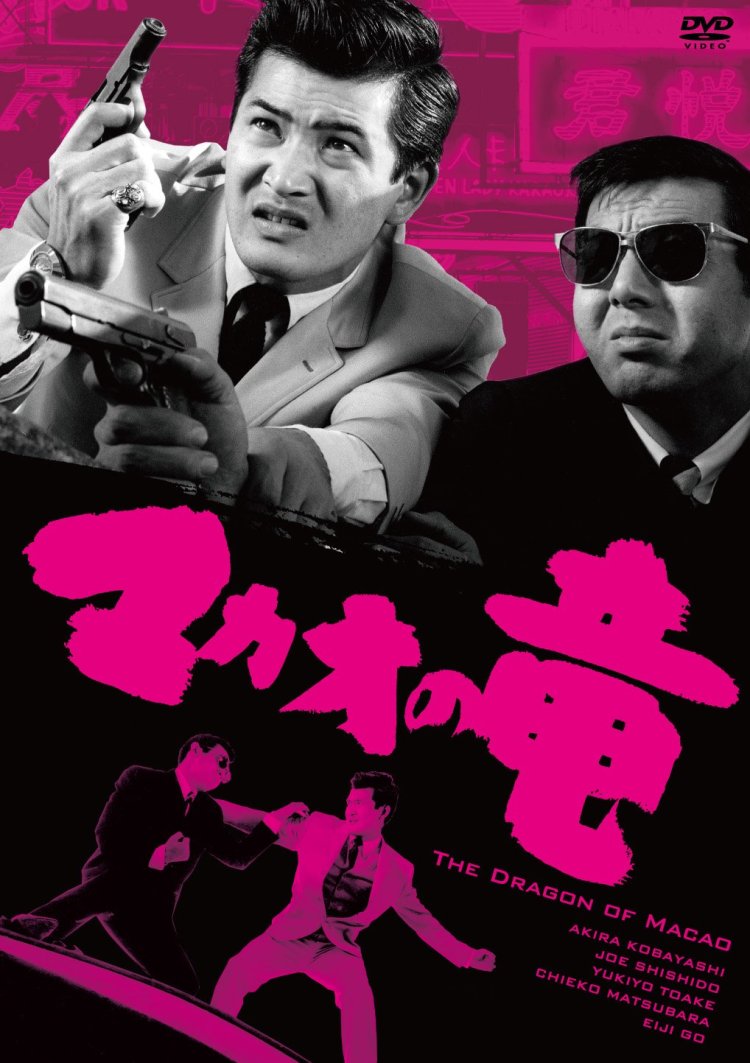
The Dragon of Macao (マカオの竜, Mio Ezaki, 1965)

Dragon of Macao DVD coverNikkatsu’s “borderless” action was famously internationalist, but as Japan’s place on the world stage began to change in the mid-60s, it also betrayed a slight anxiety in the nation’s new status as a burgeoning economic power in the Asian sphere. The Dragon of Macau (マカオの竜, Macao no Ryu), while indulging in the genre’s characteristically xenophobic vision of China as an exporter of criminality, is another attempt to cash in on James Bond cool as its suave, British passport-carrying hero tries to wrestle a precious gem away from fiercely amoral “pirates” while protecting a betrayed young woman trying to avenge the death of her parents at the hands of duplicitous gangsters.

Set in the bustling port town of Yokohama, the film opens with the harbour patrol forcibly boarding a ship to look for smuggled gold. However, it turns out that the two men they’re searching are members of the patrol themselves on an undercover mission trying to expose organised crime while the guys dressed as policemen are actually members of a gang trying to steal a precious diamond. Fearing the operation blown, the gangsters’ plant offs the lot of them and makes off with the loot.

Meanwhile, “Dragon of Macau” Ryu (Akira Kobayashi) lurks about on the harbour while rival gangster Tsukada (Asano Sano) tries to get the police onside and convince them that someone else is targeting his operation though the police are apt to wonder if he staged the whole thing himself to get rid of the undercover agents. The truth, however, is that ambitious harbour punk Aizu (Jo Shishido) is after a precious diamond known as the “Himalyan Star” which is rumoured to be cursed seeing as everybody who’s come into contact with it has ended up dead.

Unsurprisingly, Aizu gets his hands on the gem from a Chinese broker, Chen, who warns him that two gangsters, Gordon and Boomerang, will do “anything” to get their hands on it. Ryu later turns up a bar run by Tsukada and gets into a bar fight with a series “damn foreigners”, sailors who’d had too much to drink and started hassling the staff. The “damn foreigners” quip is especially ironic seeing as we later discover Ryu is a British citizen who seems to have grown up in Hong Kong after being rescued by a British vessel when the boat he and his parents were travelling on was torpedoed during in the war. Introducing himself to Tsukada, Ryu says that he works for the aforementioned “Gordon”, presumably an imperialist Brit engaged in shady colonial shenanigans out of Hong Kong. The truth about “Ryu” at least turns out to be slightly different, but for the moment he’s a Bond-inspired unflappable agent of cool complete with a fancy white three-piece suit and a collection of gadgets (a cigarette lighter blowtorch, pistol that dispenses matchstick flares, and a tiny nail gun) that would be the envy of any cold war spy.

Not to be outdone, however, Aizu has his own share of surprises including the tiny dagger hidden in the cigarette which permanently hangs from his lip. Temporarily entering this land of intense amorality, Ryu plays along but retains his nobility and remains permanently one step ahead as he attempts to get his hands on the Himalayan Star and return it to its “rightful” owners. Aizu’s main gambit is weaponising women – Aizu’s sister is a plant working at Tsukada’s bar and apparently also his mistress, while he also makes use of another young woman, Nami (Yukiyo Toake), whose late father was a patron of his. She believes Tsukada is responsible for the deaths of her parents and is participating in the plan as revenge, but eventually falls for Ryu’s suave nobility and refuses to betray him when faced with Aizu’s continuing duplicity.

A few narrative machinations later, we’re told that Ryu is “a person without a motherland” but also that he has always been a force for “good” or at least order in that he wants the gemstone not for himself but to get it away from the gangsters and back to its “official” owners (which sort of ignores the fact that the stone was “stolen” from the eye of a Buddhist statue which is presumably why people think it’s “cursed”, and that his primary motivation is avoiding a giant insurance payout). Having fallen for Nami, he leaves her a message that he’d have liked to take her back to Macau but is unsure she’d be happy with someone like him, asking her to look after another young woman who came all the way from Hong Kong to warn him that Gordon and Boomerang have finally taken each other out.

Perhaps in contrast to Nikkatsu’s other international crime dramas, the “threat” turns out to be wholly homegrown in Aizu’s rapidly individualist stance that “life is cruel”, “mercy is for fools”, and those who stand in one’s way must be eliminated. The solution comes, paradoxically, from destabilising internationalism at the hands of a man who is both Japanese and not, speaks several languages, and works as an agent for colonising imperial powers to whom he eventually exiles himself, job done. A rip-roaring spy drama complete with modern day pirates and an extremely ineffectual police presence, The Dragon of Macau is a surprisingly complex effort from Nikkatsu’s “borderless” action strand which makes the case for Japan as a part of wider world rather than a isolated island fearful of losing out in an increasingly globalised environment.
The Catch (飼育, Nagisa Oshima, 1961)

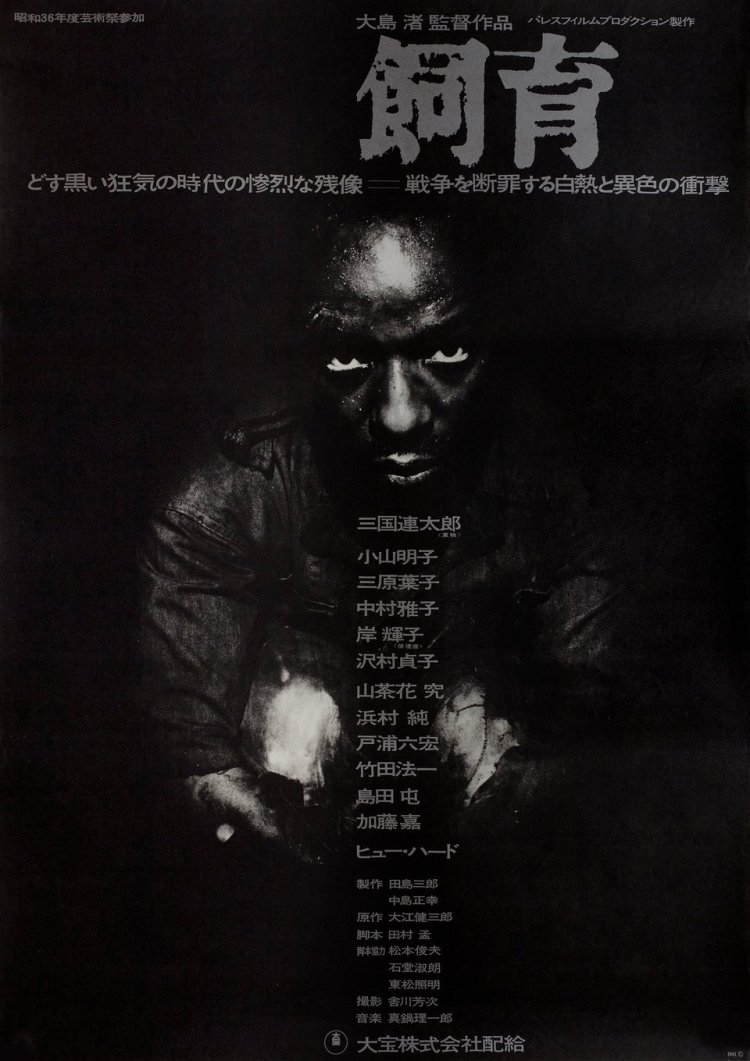
The Catch poster1960 was a turbulent year for many, not least among them Nagisa Oshima who dramatically broke his contract with Shochiku after the studio withdrew Night and Fog in Japan on grounds of sensitivity after the leader of Japan’s Socialist Party was murdered by a right-wing assassin live on TV. 1961’s The Catch (飼育, Shiiku), an adaptation of a novel by Kenzaburo Oe, was Oshima’s first post-studio picture and as uncompromising as anything else he’d worked on up to that point. Unlike many other filmmakers of the post-war generation who had been keen to use the corruption of the war as an excuse for a failure of humanity they now thought could be repaired, Oshima suggests that the rot was there long before and all the war did was give it justification.

In the summer of 1945, a small village captures a black American airman (Hugh Hurd) shot down over a nearby forest. They are originally quite jubilant about their act of heroism, believing that they will eventually be rewarded by the authorities, but are then irritated by their new responsibility. They are already low on food, and now they’ll have to feed this full grown man or risk being branded as amoral war criminals. Predictably, nobody wants to be saddled with looking after him until the authorities arrive with further instructions or knows what to do now, so in time-honoured fashion they tie him up in a shed and hope for the best. Only latterly when one of the children points it out do they realise that they should probably remove the bear trap attached to the airman’s foot which may already be infected seeing as he seems to be in a considerable amount of pain and is running a high fever.

It goes without saying that villagers are extremely racist, using quite pointed racial slurs and dehumanising language to describe their captive, even when others stop to remind them that he is after all human too even if he’s an enemy. Just as their sons and husbands are overseas fighting, and dying, bravely for the emperor so was this man valiantly risking his life for his country. Shouldn’t he be accorded some respect just for that? Wouldn’t they want that for their sons too?

Sadly thoughts are thin on the ground, as is food. Jiro (Toshiro Ishido), a young man shortly to enlist, wants a bag of rice off his dad to take into town to buy a woman, but his dad doesn’t have any because he’s already in debt to the immensely corrupt village chief (Rentaro Mikuni). Jiro eventually satisfies himself with a sexually liberated high school girl evacuated from the city and thereafter disappears – the first of many negative events to be randomly blamed on the captive airman. Meanwhile the village chief is responsible for a series of problems because of his out of control need for sexual dominance which sees him apparently abusing his daughter-in-law (Masako Nakamura) and attempting to assault a young widow (Akiko Koyama) with two children evacuated from the city and otherwise undefended in the village.

The rot here is feudalism, the idea that gives free rein to the village chief to misuse his position for his own satisfaction – extracting sexual favours from the women and controlling the men economically. Because he’s the village chief no one really questions his authority or his orders, so when he says all the problems are new and caused by the “black monster” they’ve brought into the village then everyone believes it to be true. The airman, who cannot be responsible for any of these crimes because he is still recovering and locked up in the shed, becomes a scapegoat for every bad thing that has ever happened in the village. More than an embodiment of the war, he is a symbol of all the external pressures that the village would like to pretend are the reasons it has turned in on itself.

Yet the airman is only one kind, the deepest kind, of other. The village hasn’t quite even integrated its evacuees who also constitute a secondary community. The young woman’s two starving children are repeatedly caught with their fingers in other people’s rice jars and receive little sympathy from the villagers, but their crimes only expose the fact that the man who has sheltered them, and also owns the shed where the airman is kept, has been keeping quiet about people thieving his potatoes. He knows it’s not the widow because there are simply too many taken to feed a small family of three, which means that there are probably several “thieves” among the villagers, content to betray their neighbours in thinking that the wealthy farmer won’t miss a measly few root vegetables.

Predictably, rather than deal with the problem, everyone obsesses over the idea that the corruption is born only of the airman and if they could just eliminate him everything would go back to “normal” – i.e. the feudal past in which everyone does what the village chief says and lives in superficial harmony without complaining about their reduced status as lowly peasants forced to live in penury by an unfair and essentially corrupt system. To cure the discord between them, they decide that the airman must be killed, no longer caring about the censure they may face from the authorities. Only two young boys stick up for him, remaining sane amid the madness all around them in insisting that the airman is a person too, is unrelated to the village drama, and deserves his dignity and respect. Sadly, however, the madness has already taken hold.

On learning that the war is over, the villagers refuse to reflect on their behaviour and seek only to bury the past, superficially smoothing over their barbarity with convenient justification. They receive the news that the American authorities do not trust the Japanese with surprise and hurt, despite the fact they are living proof of the reasons why they would be foolish to do so. We gave him white rice while we ate potatoes, he had goats milk, they say, what more could he have wanted? The answer is self evident, but it’s already been forgotten. The villagers start blaming each other, and eventually settle on another scapegoat – a deserter, as if another death could tie all of this into a neat bundle to be burned away on a funeral pyre as if it never existed at all. The evacuees are invited to leave, and the villagers start thinking about the harvest festival, as if the evil has been excised and everything is returning to the way it’s supposed to be, but this “peace” is brokered on the back of secrecy and an abnegation of responsibility. A grim exposé of man’s essential cruelty and selfishness, The Catch rejects the tenets of post-war humanism to suggest that the corruption of feudalism has not and may never be eliminated at least as long as a nation remains content to bury its past along with its shame.


Short clip (English subtitles)

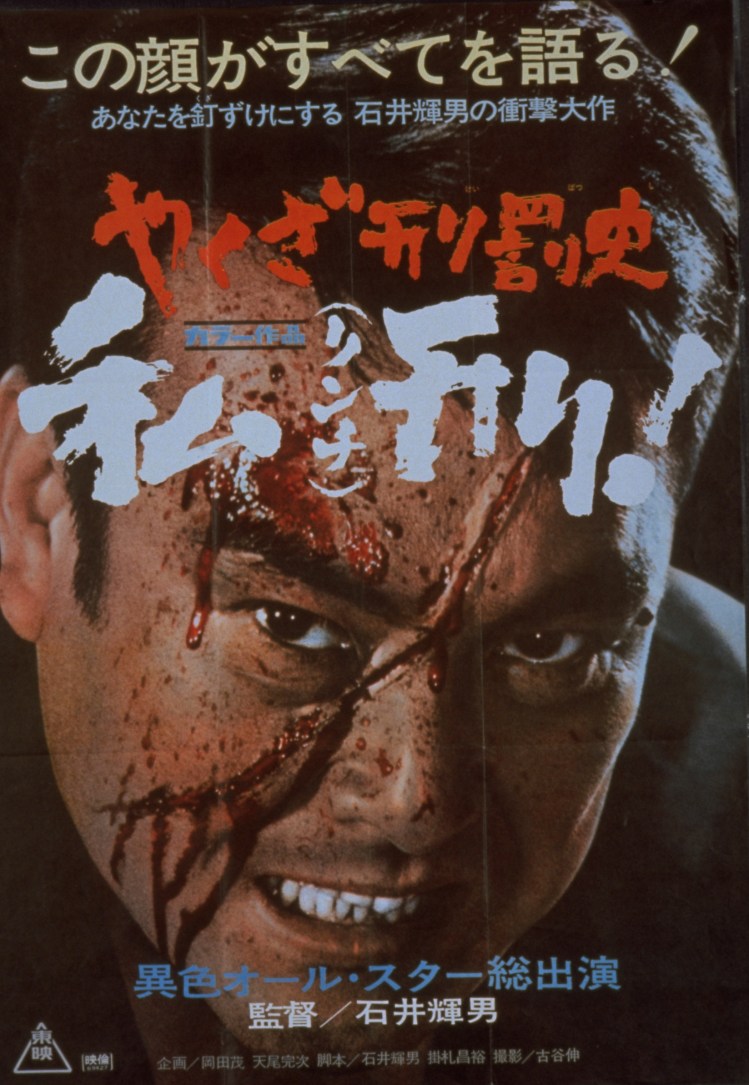
Yakuza Law (やくざ刑罰史 私刑!, Teruo Ishii, 1969)

yakuza law posterOne of the things that (supposedly) separates the “yakuza” from regular thugs is that they have a “code”. That code means many and various things, but in their grand mission to justify their existence it often means that they stand up for the little guy, all too often oppressed by the powers that be. Of course, a lot of people might feel themselves to be oppressed by yakuza thugs who like to throw their weight around and generally cause trouble for small business holders, but that’s beside the point. Teruo Ishii’s Yakuza Law (やくざ刑罰史 私刑!, Yakuza Keibatsushi: Lynch!) goes one step further and asks if the yakuza are themselves “oppressed” by their own code, or at least the various ways it is used and subverted by all who subscribe to it.

Set in three distinct time periods, Yakuza Law is also fairly unique in that the vast majority of those on the receiving end of its violence are male. The yakuza is an extremely homosocial world after all. Each of the three tales presented is preceded by a title card featuring the particular “laws” the unhappy gangsters are about to break and what kind of punishment they might expect for doing so.

The first and earliest, set in the Edo era, is a typical giri/ninjo tale that places the ideal of the yakuza code against the need to preserve a personal vision of justice. The “rules” here are that a yakuza does not steal and he does not fool around with married women. Our hero, Tsune (Bunta Sugawara), takes the heat for a nervous underling, Shinkichi (Hiroshi Miyauchi), who crumbled in the heat of battle, but incurs the wrath of his boss while a devious footsoldier, Viper (Renji Ishibashi), hides in the bushes and then stabs a corpse numerous times to make it look as if he’s done good service. Viper, not content with his ill-gotten gains, sets up Tsune and his superior Tomozo (Ryutaro Otomo) by implicating them in a gambling scam while Tsune falls for the boss’ girl Oren (Yoshiko Fujita) who is also desperately trying to protect the feckless Shinkichi.

The problem with all of this, it would seem, is not so much that the yakuza “law” has been broken but that’s it’s being misused in all quarters and is clearly in conflict with basic humanity. The boss uses the code to manipulate his underlings and keep a firm grip on his power, while Viper bends it to his own nefarious ways and a third underling, Shohei (Shhinichiro Hayashi), rests on the sidelines playing a little each way but remaining loyal to his brothers even as the axe falls on his head. The punishments meted out are suitably gruesome, escalating from finger cutting to eye gauging and ear removal in a senseless and counterproductive lust for violence which does eventually blow back on the boss who pushes his authority too far over too small a cause.

In tale two, however, which takes place in 20th century pre-war Japan, the “crime” is causing trouble and the punishment exile, but again the problem is not the code but the men who subvert it. Thus, hotheaded foot soldier Ogata (Minoru Oki) sets the cat amongst the pigeons by starting a gang war on his own and is sent to prison for three years during which time his gang prospers because of the movement he started. Even so, they aren’t keen to have him back when he gets out and immediately exile him from their territory. He sticks around waiting for his girl, Sayo (Masumi Tachibana), but she gets picked up by the evil boss who wants her for himself and delays her departure so that Ogata can be captured. Believing he’s dead, she hooks up with another goodhearted yakuza, Amamiya (Toyozo Yamamoto), who saves her from the bad guys only to have a romantic crisis when Ogata suddenly resurfaces. Amamiya and Ogata are, however, both “good” yakuza which means they both really love Sayo and want the best for her, each respecting the other for the old love and the new as they team up to kick the corrupt yakuza out of town and make sure she’s permanently safe whoever it is she eventually ends up with.

By the third tale we’ve reached the contemporary era, but we’re no longer in a traditional “yakuza” world so much as one seemingly ripped from a spy spoof in which the cardinal rule is that if you undermine the organisation you will be eliminated. More thugs than yakuza, this kind have no code and will stoop to the lowest kind of cruelty solely for money. Debonair, 007-esque international hitman Hirose (Teruo Yoshida) accepts a job from shady gangster Shimazu (Takashi Fujiki) to assassinate his boss, only Shimazu offs him first and then frames Hirose (which he finds very irritating). Hirose spends the rest of the picture teaching him a lesson while Shimazu tries to eliminate his competition in increasingly inhuman ways (including having someone crushed into a cube while trapped inside a luxury car).

Bar the third episode which isn’t really even about “yakuza”, what Ishii seems to be saying is that the yakuza are also oppressed because they are forced to live with fragmented integrity, torn between giri and ninjo in their adherence to an arcane set of values which are often overly enforced at the cost of true “justice”. To be fair, that is the idea behind every other yakuza film, but Ishii does is add a more cynical edge in suggesting the issue isn’t the code and conflicting value systems but individualised corruption (which is itself perhaps a kind of “ninjo”) in those who deliberately misuse the “noble” idea of the code for their own ends – something which has intensified since the Edo era though is apparently not a result of post-Meiji internationalism. All of that aside, despite the brutality of the title, Yakuza Law is fairly tame outing for Ishii which tempers its lust for blood with cartoonish irony as its deluded heroes battle themselves in service of a code which has never and will never truly serve them.


Available on blu-ray from Arrow Video in a set which also includes a new audio commentary by Jasper Sharp and a vintage interview with Teruo Ishii, as well as a booklet featuring new writing by Tom Mes.

Original trailer (no subtitles)

Red Beard (赤ひげ, Akira Kurosawa, 1965)

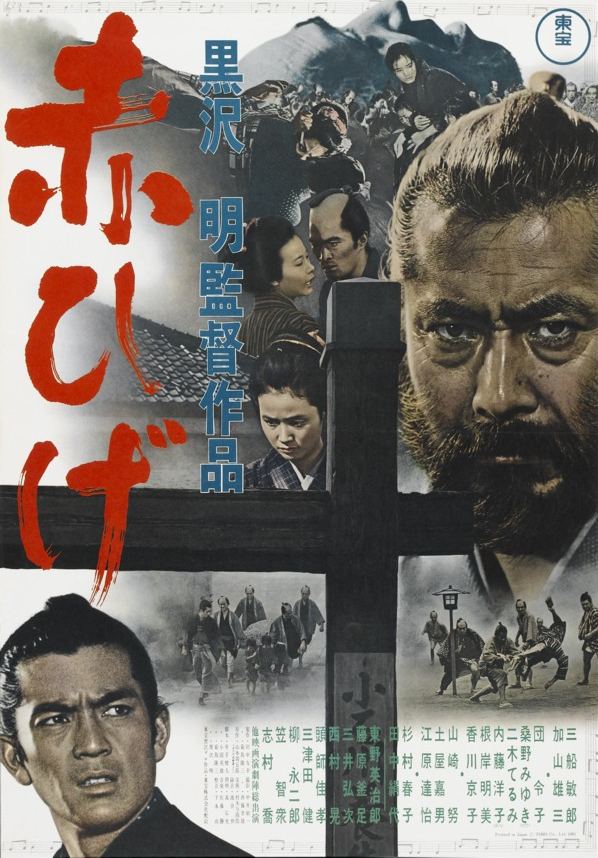
Red Beard posterAkira Kurosawa may be the most familiar golden age director of Japanese cinema to international audiences, but he was in many senses somewhat atypical. Where many of his contemporaries were eager to tell the stories of women, Kurosawa’s films are resolutely male and where many were keen to find the good among the bad, Kurosawa was often keen on the reverse. Nevertheless, that does not mean that he did not see goodness, merely that it was something which needed to be rooted out and fought for rather than simply permitted to exist. His final collaboration with Toshiro Mifune, Red Beard (赤ひげ, Akahige) finds the director at his most optimistic, fully embracing his natural tendency towards humanism even while making plain that goodness can often be hard to find, especially within yourself, and there may be no real cure for injustice but you have to treat the symptoms anyway.

The tale begins at the close of the Tokugawa era as a young doctor, Yasumoto (Yuzo Kayama), pays a courtesy call to the Koishikawa public clinic presided over by an old friend of his father’s, Doctor Niide (Toshiro Mifune) – otherwise known as “Red Beard”. Yasumoto, having just graduated from studying under the Dutch in Nagasaki, had only intended to make a brief visit on his way home and is therefore shocked to realise that he has been tricked into accepting a position at a hospital for the poor.

Our introduction to the Koishikawa clinic is through the eyes of Yasumoto as he receives a tour from another doctor who loudly remarks that he is glad that Yasumoto has now arrived because that means he can finally be free of this wretched place. Yasumoto’s nose wrinkles on smelling the “rotting fruit” of the poor waiting for afternoon appointments, while one of the patients complains about the “sterility” of the environment and his plain hospital clothes before a genial inpatient, Sahachi (Tsutomu Yamazaki), explains the reasoning behind such austerity and praises the attention to detail of head doctor Red Beard who has thought carefully about the best way to ensure his patients experience the best of care.

Yasumoto is extremely displeased by his predicament. He had believed himself on track to become a royal doctor working for the Emperor and being sent to poor clinic seems like a poor joke. He is indeed extremely full of himself, refusing to surrender his medical notes from Nagasaki as if he had made some great discovery and hoped to profit from it. Hoping Red Beard will fire him, Yasumoto behaves like a petulant child – refusing to wear his uniform, deliberately stepping into areas he knows are out of bounds, refusing to see patients, and just generally being unpleasant to have around. Red Beard is stoic and patient, though it gradually becomes apparent that perhaps Yasumoto has been sent here deliberately for a humbling everyone believes he had coming to him. Asked to perform the most routine of tasks, Yasumoto is forced to realise that the medical knowledge of which he was so proud is mostly book learning. He doesn’t know how to diagnose a living patient, has never been present at an operation, and has never sat with someone while they died knowing there was nothing more he could do for them. Reluctantly, he has to accept that the advice he received from the other doctors on his first day, that there was much to be learned here for those who wanted to learn it, was as true as it could be.

The first half of the film is indeed Yasumoto’s humbling as he begins to come around to the mysterious workings of Red Beard who gradually leads him to understand his first duty as a doctor is help those in need. Then again, Red Beard is an unwilling mentor. He is fully aware of the corruptions of the world in which he lives but has made a decision with which he remains conflicted to bend them to his advantage. Enraged to discover his government funding is being cut, Red Beard deliberately over charges the local lord whom he, amusingly enough, puts on a diet as he snorts like a piggy short of breath thanks to his unhealthy life of luxury. He also blackmails another local lord to save a young mother who turned a knife on an abusive husband, and later uses his medical knowledge to unfair advantage to take out a whole gang of yakuza. Red Beard isn’t sure he’s in a position to become anyone’s role model, but that only seems to make Yasumoto respect him more.

Nevertheless, there is darkness too in Red Beard’s philosophy. The real enemy here and perhaps everywhere is poverty and the selfishness which enables it. Most of the diseases Red Beard treats in his clinic are a direct result of impoverished living, mostly those of malnutrition and overwork as well as the necessity of living in cramped, unsanitary conditions. Yasumoto, a young man of means, has a puffed up sense of self and a natural ambition that tells him he is destined for the court and so he looks down on these unfortunate people as something other, something that does not concern him and is not worthy of his attention. He won’t put on his uniform out of spite, but eventually relents when Sahachi explains to him that the uniform marks him out as member of the clinic meaning that ordinary people who cannot afford to pay a doctor know that he is someone they can ask for help when no one else will help them.

As Red Beard says, there may be no real cures for disease. All they can do is fight poverty and mask their ignorance. Yasumoto learns by experience. He discovers the rampant injustice of his society in the sad stories that he hears. A “mad” woman who became a serial killer after years of childhood abuse, a woman who rejected a good father out of fear and allowed a bad mother to marry her to a bad man who was also her mother’s lover, a little girl adopted by a cruel madam who turned in on herself when she tried to press her into sex work at only 12 years old, a sex worker suffering with syphilis but too valuable to be released and sent home. This world is built is built on female suffering which is not, perhaps, something which Red Beard is in much of a position to treat.

The mad woman tries to hang herself and Red Beard wonders if it would have been kinder let her die, while the mother of a family who decided on group suicide asks him what the point was in saving her. The world is not an easy place to live in, but Red Beard’s prescription is refreshingly simple. One heals oneself by helping others, as he proves to Yasumoto through making him both doctor and patient to a wounded little girl who then passes her new found humanity on to another needy soul eventually reformed by kindness alone. Day by day, Red Beard goes to war against selfishness and indifference, treating the symptoms in order to undermine the disease which has infected his society in the hope that it might eventually decide to cure itself.


Original trailer (No subtitles)

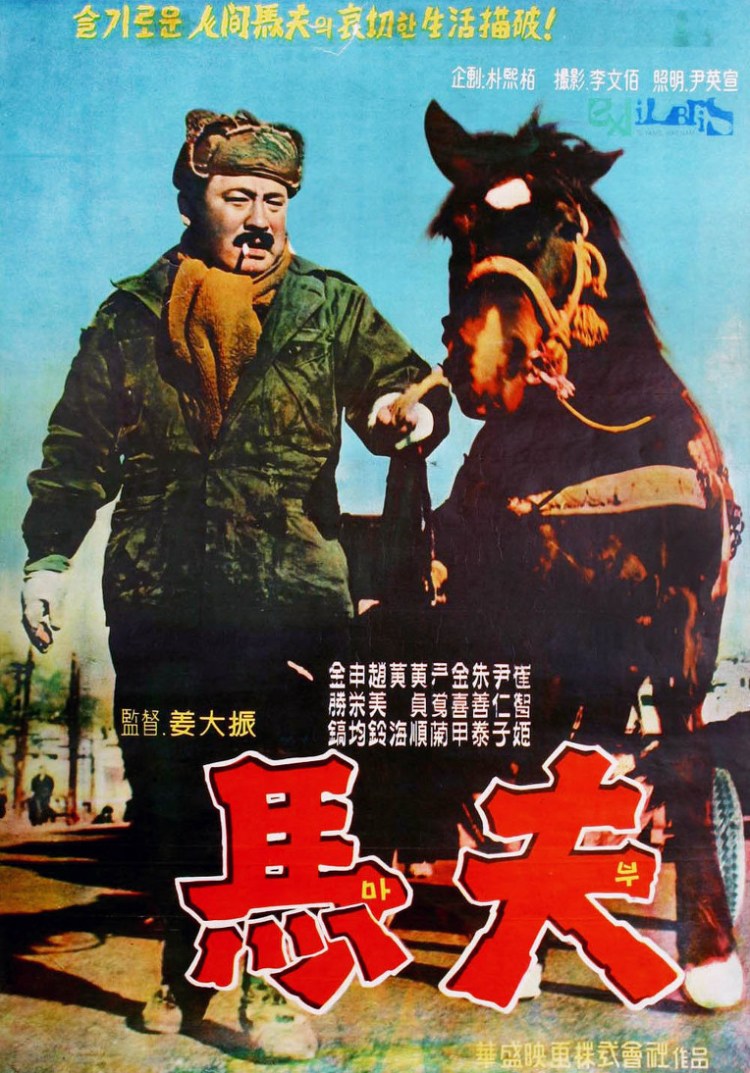
A Coachman (馬夫 / 마부, Kang Dae-jin, 1961)

A coachman poster 1The Korea of 1961 was one of societal flux, mired in post-war poverty but striving towards a brighter economic future. The rising tides of affluence had given birth to a new middle-class with the old feudal attitudes while others were largely left behind on the shores of prosperity. Kang Dae-jin’s A Coachman (馬夫 /마부, Mabu), the first Korean film to win a major international award with the Silver Bear Extraordinary Jury Prize at the 1961 Berlin Film Festival, finds itself at just this juncture as an old man pulling a horse and cart is forced to face up the automobile age while worrying what is to become of his family in the perilous modern society.

Ageing patriarch Chun-sam (Kim Seung-ho) has been guiding a horse and cart since his father died in Manchuria when he was 14. Technically speaking, he is not the owner of his horse, Dragon, but operates it on behalf of the owner, the mistress of an upper middle-class salaryman. As business is slow, she is always threatening to sell the horses which would leave Chun-sam and the other coachmen without a means to support themselves. Meanwhile, Chun-sam’s four children whom he raised alone after his wife passed away at a young age are each looking for different ways out of their impoverished existence. Chun-sam married off his eldest daughter Ok-nyeo (Jo Mi-ryeong) who is deaf and mute to a man he saved during the Korean War but he is abusive and treats her like a servant while openly inviting his mistress into their home. Oldest son Su-eop (Shin Young-kyun) is currently studying to retake the bar exam for the third time, middle daughter Ok-hee (Um Aing-ran) has begun dating a shady salaryman, and youngest boy Soo-up has become a high school delinquent.

Kang opens with an exciting sequence following Soo-up who has attempted to steal a bicycle as he tries to escape from its owner chasing him. Returning home covered in mud, slowing to a walk and putting his student’s cap back on to avoid suspicion, he makes his way from the modern houses of the new city back through traditional Korean homes towards his rather makeshift family abode which they share with the horse stabled in a side room. Chun-sam is obviously not a wealthy man, but the family bear their struggles with fortitude, perhaps to some extent avoiding each other but rarely arguing directly. Even the news that Ok-hee has once again quit her latest job, working in a cafe, in record time is greeted with exasperated acceptance rather than anger or resentment.

Ok-hee quit the cafe to fall in with her ultramodern friend Mi-ja (Choi Ji Hee) who has arranged a double date with a pair of sleazy executives, telling them that Ok-hee is a university graduate and daughter of a wealthy CEO. Intensely ashamed of her working class background as a mere coachman’s daughter, Ok-hee tries to catapult herself into the middle classes by weaponising her sex appeal, too proud to take the long way round through honest work. She rejects the attentions of family friend Chung-soo (Hwang Hae) who is good and kind because he is only a driver, taking little notice of his earnest warning that nothing good ever comes of hanging around with shady types like her boyfriend. He keeps trying to persuade her to take a job in a nearby factory, but she still thinks she’s above that kind of life and is convinced she can get the executive to marry her.

Chang-soo’s interest is of course romantic, but the advice he gives her is honest and altruistic. Unlike his unsavoury money lender father, Chang-soo is a salt of the earth type, but good men are hard to find and trying to escape poverty through marriage is a road fraught with danger as Ok-nyeo discovers. Chun-sam thought he’d done the right thing in marrying her off, believing a match would be hard to come by because of her disability and worrying she’d be left alone with no-one to look after her, but she is forced to endure mistreatment and humiliation at the hands of her husband. Ok-nyeo repeatedly returns to her family home, only able to show them the bruises to explain what’s happening, but Chun-sam always sends her back unable to break with the old patriarchal rules which insist that once married she must forever remain this man’s wife.

Chun-sam faces a similar dilemma of his own when he strikes up a tentative relationship with the kindly maid at his boss’ mansion who often heats up rice wine for him and goes out of her way to give him little treats. The odious moneylender is also after Suwon (Hwang Jung-seun) who is considered “old” to be unmarried at 37, but she favours Chun-sam because, as she says, she has always known him to be a “good man”. The “courtship”, if you could call it that, is innocent in the extreme with Suwon largely taking the lead while Chun-sam lags bashfully behind, childishly excited but also embarrassed because he cannot afford a wife and would be ashamed to ask her to share his life of poverty.

Looked down on by everyone, Chun-sam is forced to go cap in hand to his employer where he is made to “know his place” and reminded he is “just a coachman” with no right to talk back. When Hwang, the boss’ lover, injures Chun-sam through reckless driving, Su-eop becomes fed up with persistent feudalism and intends to have a polite word but is quickly shut down, reminded that he is nothing more than coachman’s son and told that his dreams of becoming a lawyer are not only unrealistic but an offence to the social order.

Su-eop alone takes the conventional route out of poverty in pursuing education and a steady government job, but is repeatedly told that he’s getting above himself and should be content with becoming a coachman like his dad, despite the fact that being a coachman is already close to an obsolete profession given the increasing affordability of the motorcar. He alternates between guilt and despair, wondering if he’s being irresponsible in pinning all his hopes on the bar exam and worrying that he’s not doing enough to support the family.

Yet Chun-sam, forced to consider his own obsolescence, is keen for him to succeed, not only because the family needs him to make a success of himself but because he wants his son to have a better kind of life than he had taking full advantage of the possibilities of the new society. Though their lives are hard, Chun-sam and his family remain kind and honest (even Ok-hee and Suo-up eventually conclude that hard work is the way after all), bonding with others of the same mindset like the maid Suwon who eventually quits her job in protest, and Chang-soo who rejects his father’s underhanded venality for simple human decency. United by friendly solidarity, the family is repaired and resolves to live on as a tiny unit of cheerful resistance against the feudalistic greed and selfishness of the modern society.


A Coachman was screened as part of the 2019 London Korean Film Festival.

Goryeojang (고려장, Kim Ki-young, 1963)

Goryeojang hanging bannerWhat happens to the marginalised in times of trouble? Nothing good, might be the answer. To exist outside of the group, to be in some way other, is to be rendered vulnerable but there can also be a kind of strength in involuntary independence. Like the Japanese Ballad of Narayama, Kim Ki-young’s Goryeojang (고려장) envisages a world in which the old are expected to sacrifice themselves for the young, but unlike either Keisuke Kinoshita or the later Shohei Imamura, Kim struggles to find nobility in adherence to such a cruel and inhuman tradition.

Kim opens with a contemporary TV panel discussion on overpopulation (a key concern of the day) which strays uncomfortably into comparison with vermin, leading one expert to contribute that when short of food rats eat each other in order to survive so perhaps people should too. Moving swiftly on, the host turns to a historian who explains that in the distant past during times of war or famine, there was a tradition of abandoning the over-70s on mountains to reduce the burden on the rest of society.

Kim then shifts to the main narrative which takes place in the feudal “Goryeo” era. During a time of scarcity, a lord married four times already scorns the local shamaness to marry a young and beautiful widow with a young son. The shamaness claims that the lord’s 10 sons from his previous marriages are to blame for the failure of the relationship and vows revenge on the entire family. Meanwhile, new wife Keum (Ju Jeung-ryu) struggles to adjust herself to the household and is warned that none of the previous wives managed to endure it very long. Though the lord accepts her son Guryong as his own and tries to integrate him with his 10 new brothers, the boys fiercely reject him, especially when they hear about the shamaness’ curse which states that he is destined to kill them at some unspecified point in the future. The abuse culminates in an attempt to assassinate Guryong with a snake bite. He survives but is left with a lame leg. Keum realises she cannot stay in the lord’s house, and so he gives her a small plot of land and some money to support herself and her son.

20 years pass, during which time Guryong (Kim Jin-kyu) has managed to make a life for himself but the brothers are still obsessed with getting back the land that was given to him. When they find out that Guryong has amassed enough resources to consider marrying despite the fact that he is disabled and therefore considered undesirable, their rage intensifies. Guryong meanwhile has been trying to keep to himself, but is brokenhearted in unrequited love for a woman, Gannan (Kim Bo-ae), who rejects him because of his disability. He is eventually married off to a woman who is mute, considered a socially acceptable match for both, but the brothers kidnap and rape her in an attempt to extort Guryong for the deeds to the land. Unable to tell anyone what’s happened, she murders her attacker. Faced again with cruel tradition, Guryong does not resist. 

After that, he goes back to minding his own business, but there are customs he will not follow including that of abandoning his mother on the mountain. 15 years later, drought and famine strike again. Keum worries that she is the cause and Guryong’s refusal to take her to the mountain has angered the gods. As supplies dwindle, the brothers make the most of their feudal powers, restricting access to the local well which is technically on their land, exchanging water for potatoes which are the only available source of food. Guryong, meanwhile, has spent the last few years quietly working away and has quite a sizeable crop of his own which makes him a rather wealthy and powerful figure, once again irritating the brothers. It’s at this point that a starving Gannan, now the mother of nine children, reappears and is forced to throw herself on Guryong’s mercy.

Marginalised because of his disability and fatherless status, Guryong has had to learn to survive alone and has prospered because of it, yet others regard him as a potential drain on their resources, an ill omen or harbinger of doom forever associated with the shamaness’ curse. With little to eat, people are forced to put their prejudices to one side but do so superficially. Gannan’s husband, dying of hunger, urges her to seduce Guryong and if possible marry him before he dies so that she won’t have to obey the custom of waiting three years in mourning before marrying again. Gannan is minded to sell her body, if that’s what it takes, but still reluctant to sell it to Guryong. In another case of socially acceptable partnering, she eventually sells one of her children to Keum to raise as a ward – Yeon, who is “imperfect” because of her pockmarked face.

Like Guryong, Yeon is brave and defiant, in some senses emboldened by her difference. She volunteers to go to Guryong because her siblings bully her over her face, but thinks nothing of cheerfully mocking Guryong’s limp or of talking back while playing the part of a servile daughter-in-law. She does, however, remain loyal to Gannan, stealing potatoes to sneak back to her family. The arrangement fails only when Keum decides it’s time to absent herself, that her presence is preventing Guryong uniting with Gannan and her children, but Guryong refuses to swap a mother for a wife and angrily rejects Gannan, beating her and the child believing them to have orchestrated a plot to get rid of Keum.

With the brothers hoarding food and Guryong keeping well out of it, the only solution proposed by the villagers involves the human sacrifice of a child. Guryong struggles to believe that they would really go that far, but finds himself again in the firing line when the brothers frame him for a murder and leave him at the mercy of the shamaness and her sacred tree. Spared only on the condition that he give in and take Keum to the mountain where she will pray for rain, he is forced into complicity with the cruelty of his times but his rage on his return knows no bounds. Realising he has been betrayed once again, he fulfils the shamaness’ prophecy, but is shaken by the words of one of the 10 as he attempts to stay his violence, insisting that they are not bad people and must embrace each other as brothers. He blames everything on the shamaness and her curse, which is of course a matter of a woman scorned. Guryong doesn’t quite buy that, the brothers were cruel to him because they could be even if the root cause was their father’s moral transgressions in his many marriages. He does, however, awaken to the inherent corruption of the world in which he lives embodied by the tyrannical authority of the shamaness and “Divine Spirit” manifested as the tree from which transgressors are hanged.

Kim never closes his framing sequence, the dark humour of the contemporary opening merely an introduction, but obliquely references the April Revolution of 1960 as Guryong takes an axe to the tree and frees himself from the shamaness’ control. According to Guryong, the tree kept the small evil out, but let the big one in. Taking the children by the hand, he leaves. “If there is someone to teach us, we can grow anything”, he tells them, it’s time to plant some seeds. Claiming his own freedom and rejecting his marginalisation, he steps forward into a better world out of the mountain’s shadow and free from the terrible tyranny of “tradition”. 


Goryeojang was screened as part of the 2019 London Korean Film Festival. The new 4K restoration will also be released on blu-ray by the Korean Film Archive on 14th November.

Night and Fog in Japan (日本の夜と霧, Nagisa Oshima, 1960)

night and fog in japan posterUnlike many of his contemporaries, Nagisa Oshima entered the world of filmmaking almost by chance. While studying law at Kyoto University, he’d become deeply involved in the leftist student movement and reportedly joined Shochiku’s assistant director program in 1954 solely because no other company would hire him. His path there too was hardly typical and saw him become a leading light of the studio’s extremely temporary bid to play Nikkatsu at their own game with a series of gritty youth dramas which included the melancholy Cruel Story of Youth and infinitely bleak The Sun’s Burial. It was his fourth film, however, which proved the most controversial perhaps unexpectedly given its otherwise dry subject matter. Named for Alain Resnais’ incendiary documentary, Night and Fog in Japan (日本の夜と霧, Nihon no Yoru to Kiri) was pulled from cinema screens following the assassination of the leader of Japan’s Socialist Party by a right-wing nationalist just three days after the film’s release.

Oshima’s film is in itself an attack on the left, though one from an entirely different angle. The failure of the student movement would become a preoccupation for the left-leaning avant-garde movement of the early ‘70s, but one could argue that though the movement had been dealt a huge blow by the failure to stop the renewal of the ANPO treaty despite the mass protests of 1960 it had not yet “failed”. Indeed, protests continued and intensified throughout the 1960s until weakened by a government crackdown in the run up to the treaty’s renewal in 1970 and were only really ended by the horror exposed by the Asama-Sanso Incident in 1972.

In a strange way, Oshima’s impassioned attack on the misguided rigidity of radical student politics almost presages the dark place into which the movement would eventually fall through the already emergent generation gap between the earnest contemporary students keeping up the fight, and the jaded post-war generation who have long since given up the struggle for bourgeois comforts. He opens, of all places, at a wedding notable for its solemnity as a young student radical, Reiko (Miyuki Kuwano), weds a newspaper reporter, Nozawa (Fumio Watanabe), she met at the climatic June 15 protest. The wedding is later interrupted by two melancholy outsiders – one the leader of the students currently on the run from the police, and the other an older man coming in from the cold, though both with the intention of confrontation.

As we might have assumed, the younger man, Ota (Masahiko Tsugawa), is not the jilted lover of the bride. It’s the revolution he’s come to accuse her of betraying through her rejection of their comrade, Kitami – missing since the failed raid on the Diet building, whom Ota assumes to have been her lover now thrown over for the “cage” of family. Reiko’s “betrayal” is mirrored in the drama between the older generation as we gradually discover the complicated history between the groom and Misako (Akiko Koyama), the dejected wife of the current head of the Socialist Party, Nakayama (Takao Yoshizawa).

The demands of ideological purity are mirrored in the strangely moralistic attempts to police female desire in suggesting that both women have made “practical” choices at the expense of their personal integrity. The major drama, however, revolves around the older students’ overreaction to having caught a “spy” in their dorm, keeping him imprisoned while they try to bully him into betraying his true masters. One student however, Takao (Masahiro Sakon) – nursing an unrequited crush on Misako, refuses to believe the man is guilty and is thereafter accused of betraying the movement by allowing him to escape. Takumi (Ichiro Hayami), the second ghost at the feast, has come to ask if it was the movement which betrayed Takao by ignoring his emotional fragility, causing him to abandon faith not only in it but in himself.

Throughout it all, Nakayama remains the stoical voice of authority, blaming anything negative on the nebulous figure of the “imperialists” while insisting on superficial “unity” which really means do as I say and don’t rock the boat. The students want more and they look to the older generation for guidance, but the old guard have lost the faith. Even among the youngsters, few think the cause can be won. The struggle is between those who give up, and those who keep fighting anyway for the right to “march towards a brighter tomorrow”. As a student, Nakayama had dismissed the “spy” as unworthy of their revolution because he was an uneducated worker, but now dismisses the students because they exist outside of the economic structure and therefore cannot occupy a space within a workers’ movement. This wedding, which might have been the unification bringing together the old and the new, has become a funeral that marks the death of post-war idealism, betrayed by the bourgeois need for respectability. The students know their movement will fail, but they move anyway. Nakayama, meanwhile, makes speeches about unity to his dejected contemporaries, berating the students for their lack of “realism” as if insisting that the route to social change lies in concession to populist conservatism.

“I feel empty and sad” the post-war students lament, watching their movement withering on the vine. Betrayed by the older generation, the contemporary students have no role models to follow and no real hope for the future, but still they fight on earnestly. A fierce condemnation of political hypocrisy, dogmatic rigidity, and bourgeois paternalism, Night and Fog in Japan sees no way out of its existential malaise as its would-be-revolutionaries remain lost in a fog confusion with no exit in sight.


Original trailer (no subtitles)

Burning Mountain (山불 / 산불, Kim Soo-yong, 1967)

Burning Mountain still 1In his 1965 film The Seashore Village, Kim Soo-yong had presented a broadly positive vision of a community of women who had learned to survive without men by supporting each other. 1967’s Burning Mountain (山불 / 산불, Sanbul, AKA Flame in the Valley) revisits a similar theme but with much less positivity. This time around, the women have been deprived of their men not because of nature’s cruelty, but because of man-made corruption. Set during the Korean War, Burning Mountain finds a collection of wounded, lonely women condemned by patriarchal social codes and hemmed in by political strife not of their making struggling against their baser instincts as they determine to survive in an often hostile environment.

A small village near Jirisan has lost all of its men. Pressed by communist guerrillas for food, the lone women are hungry and afraid. Consequently, they are often at each other’s throats and united only in a shared futility of waiting for men they are almost certain will never return, either because the war has taken them or they have taken the opportunity to seek a better kind of life. The drama begins when Jum-rye (Ju Jeung-ryu) discovers a communist deserter, Kyu-bok (Shin Young-kyun), hiding in the bamboo grove and is seduced by him, satisfying her long repressed desire and escaping her loneliness through a transient bond with a captive man.

Unlike the fishwives of The Seashore Village, the women of Burning Mountain are a more conservative bunch though they too are largely unafraid to talk plainly of their unanswered desire in the absence of men. Rather than embracing each other as the fishwives had, the mountain women allow their sexual frustrations to make them bitter and irritable, forever at each other’s throats and unable to let go of past grievances. They dwell on the possibility of escape, but do not believe it to be real. One of the younger, unmarried women, talks of going to the city to find work as a maid but is confronted by a world of checkpoints and soldiers which restricts both her movement and her freedom in ways she is ill-equipped to understand.

The village stands as a tiny enclave, caught between North and South, part of both and neither as if lost in some eternal netherland. The bamboo grove represents the innocent natural freedoms which have been taken from the villagers by civilisation and by later by the folly of men and war. It’s in the bamboo grove that Jum-rye first encounters Kyu-bok in a meeting which begins as rape but ends in seduction as Jum-rye surrenders herself to a rough stranger in desperation and loneliness. The affair continues and relations between herself and the other women improve until Sawol (Do Kum-bong), a woman with whom she’d been on bad terms because their absent husbands had been on different sides, discovers Kyu-bok’s existence and blackmails the pair into allowing her to make sexual use of him in order to ease her own frustration.

Roles interestingly reversed, Kyu-bok takes exception to his new status as a kept man, resenting the feeling that he is nothing more than a pet, breeding stock kept to scratch an itch. Nevertheless, he stays while the women, increasingly conflicted, urge him to turn himself in to the authorities sure that if he explains himself they will not treat him harshly. Already emasculated in having been forced into the mountains against his will, Kyu-bok remains impotent in all ways other than the sexual, pleading with Jum-rye that she let him stay in the bamboo grove “until the world gets better”.

Sadly, the world shows little sign of doing that, though thanks to their shared transgression a strange kind of camaraderie arises between former enemies Jum-rye and Sawol, now disposed towards female solidarity having eased their own frustrations. They want to trap Kyu-bok and keep him for themselves, but at the same time they dwell on the idea of the unseen woman waiting somewhere for him just as they are waiting for their menfolk and know they cannot have him for long. Where the constant refrains of “we are all the same” had rung somewhat hollow, they ring true now in the two women’s commitment to a woman they don’t know who is, in some senses, their rival.

Yet, the liminal space of the bamboo grove cannot be allowed to stand in the increasingly straitened future. Already subversive in his frank depiction of female desire, Kim subtly undercuts the austerity of the times in making accidental villains of the South Korean army who arrive to burn the bamboo grove down to smoke out the guerrilla fighters, taking from these women the symbol of their freedom in the natural pleasure of the forest. The cowardly communist, while fulfilling the demands of the censors’ board, is both passive victim of his times and a representative of the frustrated masculinity which has caused them in the first place. The corruption of the war has come to the bamboo grove and set light to the last vestiges of hope in taking from these already impoverished women their very source of life. A sorry tale of despair and futility, Burning Mountain spins a tale of weak men and resilient women whose solidarity is bought through a mutual satisfaction cruelly ended by an austere and unforgiving regime.


Burning Mountain is available to stream online via the Korean Film Archive’s YouTube Channel.

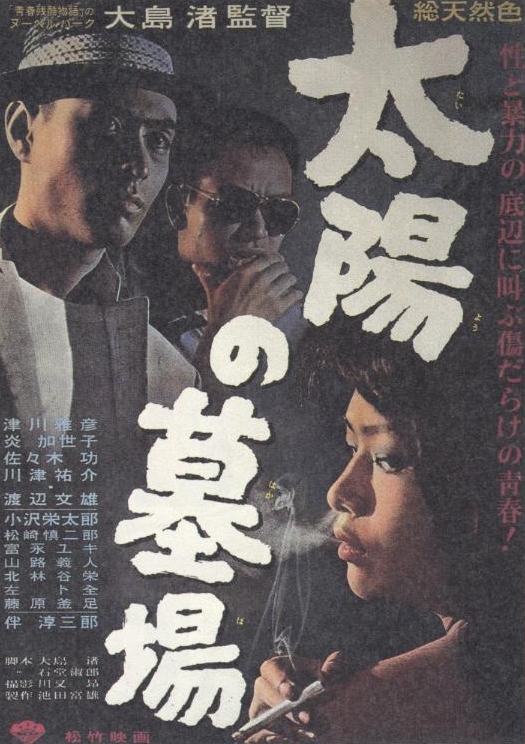
The Sun’s Burial (太陽の墓場, Nagisa Oshima, 1960)

sun's burial poster

“Love and hope for the youth!” reads a prominent sign in the middle of a hopeless slum in Oshima’s bitterly nihilistic youth drama The Sun’s Burial (太陽の墓場, Taiyo no Hakaba). Then at Shochiku, home of polite melodrama, Oshima was one of a handful of youngsters (that also included Kiju Yoshida and Masahiro Shinoda) bumped up to director ahead of schedule in an attempt to find voices who could speak to youth in much the same way Nikkatsu was doing with its incendiary tales of the new bright young things. The Sun’s Burial would be Oshima’s penultimate film for the studio before he stormed out after they pulled his next film Night and Fog in Japan from cinemas fearing its fierce critique of a divided left torn apart by dogmatic rigidity and generational conflict was too on the nose in wake of the assassination of the Socialist Party leader by a right-wing nationalist.

Set in the slums of Kamagasaki, Osaka, The Sun’s Burial follows a collection of desperate adolescents trying to survive in an intensely hostile environment. Our “hero” the conflicted Takeshi (Isao Sasaki), is inducted into a street gang after getting beaten up by young tough Yasu (Yusuke Kawazu). Along with his friend Tatsu, he is originally quite taken with the idea of becoming a gang member, but blanches when he passes a room full of captive women, one of whom is being beaten for having conceived a child.

Meanwhile, across town, his polar opposite, the cynical survivor Hanako (Kayoko Honoo) is running a blood racket, literally bleeding the proletariat to sell their bodily fluids on to the cosmetics trade. Technically operating under the aegis of her petty thug father Yosematsu (Junzaburo Ban), Hanako is in business with a doctor and a couple of minions but later has her authority undercut by a mad old imperialist known as “The Agitator” (Eitaro Ozawa) who keeps insisting that the Russians are coming and they have to be ready.

Not permitted to maintain power in her own right, Hanako is forced to shuttle between male protectors, occasionally pitting one against the other in a bid to come out on top. In addition to her blood business, she also engages in casual sex work and seemingly has no qualms about wielding her sex appeal as a weapon in order to manipulate male power. Pushed out by The Agitator, she turns to gang leader Shin (Masahiko Tsugawa) for a temporary alliance. When he too cuts her out, she thinks about tipping off the area’s big Yakuza boss, Ohama (Gen Shimizu), to Shin’s whereabouts, always looking a few moves ahead while the callous Shin remains wary and ever vigilant.

In a move which surprises and disturbs the naive Takeshi who is nevertheless captivated by her cynical self assurance, Hanako is entirely indifferent to the suffering of other women, willingly co-operating with Shin while knowing that he runs an abusive prostitution ring. Takeshi’s loss of innocence comes early when he is sent to go out and find some victims with his friend Tatsu who convinces him to club a high school boy canoodling with his girlfriend over the head so they can rob him. Takeshi looks on in mild confusion and horror as Tetsu proceeds to rape the young woman, turning to Hanako for guidance but all she does is shrug. The high school boy later commits suicide, presumably unable to bear the shame of having failed to protect his girlfriend, leaving Takeshi feeling as if he has blood on his hands. To Hanako, however, the boy’s death is no one’s fault but his own, a product of his own weakness. A strong person, she posits, would have sought revenge. What sort of person ups and dies without a fight?

Meanwhile, back in the slum, a man hangs himself after falling victim to The Agitator’s latest scam – getting involved with a dodgy gangster’s exploitative scheme to buy up legitimate IDs from desperate people and sell them to even more desperate undocumented migrant workers. Full of tales of Empire, The Agitator declares that he’s going to march them all up to Tokyo and teach those noisy students a lesson, proving somehow that populist militarism is not yet dead in quiet corners of Japan. The Agitator has several followers among the middle-aged and older denizens of Kamagasaki, taken in by his bluster and lacking any other sources of hope. They follow him because he demands to be followed and because he made them a series of promises. Only when they realise his plans rest on exploiting people even more unfortunate than they are, and suddenly realising he never got round to paying them either, do they finally rebel, burning down the slum in protest of their hopeless circumstances.

Berated for her cynicism by the now compromised Takeshi, Hanako offers only the defence that she has survived and will continue to survive where others may not if they allow their consciences to take precedence over self-preservation. Bleak as it gets, Oshima ends on with a note of anxious industry as his determined heroine dusts herself off and gets “back to work”, escaping from the ruins of the burned out slum in the bright morning sun. “No hope for Japan now” an embittered member of the older generation laments, and Oshima, it seems, is apt to agree.


Original trailer (no subtitles)

Bloodline (血脈 / 혈맥, Kim Soo-yong, 1963)

Bloodline posterDirector Kim Soo-yong began his career while still in the military shortly after the end of the Korean War, originally making “military films” for the Ministry of Defence’s Film Department. Since his debut in 1958, Kim had directed 19 features before the release of his “breakout” transition into mainstream cinema with Bloodline (血脈 / 혈맥, Hyeolmaek, AKA Kinship) – an early example of the “literary film” with which Kim would become heavily associated. Like much of Kim’s later work, Bloodline is a socially progressive, empathetic look at the lives of everyday people living in very difficult circumstances but trying their best to be their best all the same.

The film opens in 1946, immediately after the end of the Second World War which is also, of course, the end of the Japanese Colonial Period and the beginning of a short-lived Korean post-war democracy. A small shantytown courtyard in Seoul is home to three families – the wealthier Kim Deok-sam (Kim Seung-ho) who was once a successful mining agent in Japan and lives with his grown-up son Geobugi (Shin Seong-il), the tinker “Ggangtong” (Choi Nam-hyun) who lives with his second wife Ongmae (Hwang Jung-seun) and daughter Boksun (Um Aing-ran), and Wonpal (Shin Young-kyun) whose wife (Lee Kyoung-hee) is seriously ill while his daughter (Lee Gyeong-rim) is disabled. Wonpal, a refugee from North Korea, is also responsible for his elderly Christian mother (Song Mi-nam) and younger brother Wonchil (Choi Moo-ryong) who went to university in Japan but has come back with literary aspirations and has so far refused to get a job and help support the family.

The world of 1946 is an immensely chaotic one in which the old order has been destroyed but nothing has yet arrived to take its place. For good or ill, the American occupation has become an essential economic force – Deok-sam is forever urging Geobugi to get a job on the American military base which he believes will pay well both in terms of salary and a series of perks official or otherwise. Meanwhile, Wonchil’s old girlfriend, Oki (Kim Ji-mee), is one of many women who’ve found themselves without support in the desperate post-war economy and has become the mistress of an American serviceman. Like Won-chil she came from the North with nothing and was left with no other option than entering the sex trade as a bar girl – the same fate which awaits Boksun at the behest of her step-mother who plans to sell her to a bar to provide for the family and has been forcing her to learn bawdy folksongs in order to become a fully fledged “gisaeng”. 

Both generations are, to a particular way of thinking, intensely selfish. The old, still bound up with a series of ancient social codes, try to oppress their children in the same way they were oppressed only now they’re in charge and reluctant to cede the little power they have now they finally have it. The parents want their children to do what is best for the “family” regardless of their personal happiness. Deok-sam is determined that his son should get a job with the Americans, Ongmae is determined that Boksun become a bar girl so that she and her husband can live in comfort, while Wonpal just wants to support his wife and daughter but can’t and resents his brother for not helping more. Yet the young people want their freedom and to be a part of the world which is opening up before them. They are filial and want to look after their parents, but reject their oppressive demands especially when it comes to their romantic futures. Ggangtong disagrees with his wife’s decision to sell Boksun and has hatched a plan to marry her off to a nice barber who has asked for her hand and seems to have good prospects, but Boksun is in love with Geobugi and wants to marry him, only he is dragging his feet because he has no money and worries about his father. Geobugi wants to get a job in a nearby factory, but hasn’t had the courage to go against his father’s wishes.

Kim Soo-yong, as unjudgemental as always, places his sympathies firmly with the young as they demand their right to choose while also reserving a right to a fresh start for all – including bar girl Oki who is allowed to simply walk away from her life in the sex trade and into a happier future once the moody Wonchil has learned to accept her past and also reconciled with his brother, literally “repairing” the family home in fixing the hole in the leaky roof through which Wonpal’s wife once used to watch the stars. Meanwhile, Boksun and Geobugi also look forward to their brighter future with jobs in a progressive factory which is friendly, bright, and open. Ggangtong, who resented his wife’s feudal desire to sell their daughter but also tried to arrange her marriage, is the first to see that his era has ended, affirming that the youngsters were right to leave and that the world now belongs to them. Eventually sense is seen, the old give way and accept the desires of the young, realising that they will lose their children if they cannot learn to set them free. The world has changed, mostly for the better, and familial bonds will have to change with it but they will not necessarily have to break if each side is willing to give ground in expectation of a better tomorrow.


Bloodline is available on English subtitled DVD courtesy of the Korean Film Archive in a set which also includes a bilingual booklet featuring an essay by director Kim Soo-yong, and an article about the restoration by the Korean Film Archive’s Kim Ki-ho, as well as full cast and crew credits.